


Erhalten Sie Zugang zu diesem und mehr als 300000 Büchern ab EUR 5,99 monatlich.
- Herausgeber: Books on Demand
- Kategorie: Geisteswissenschaft
- Sprache: Englisch
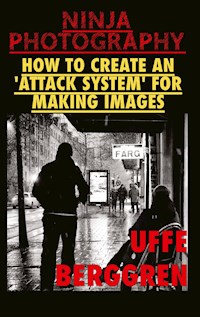
Ninja Photography is describing an attack system for making images. Try to create images that are part of you will take a while, but dont cave in, you will get there, even if you may despair at times along the road towards your own photographic language of images. Try to acquire the skills of making photography automatic, a part of who you are, walking around in life. Practice a lot, like a martial artist, making loads of images, and please leave the areas with canned photography out of your life.
Sie lesen das E-Book in den Legimi-Apps auf:
Seitenzahl: 247
Veröffentlichungsjahr: 2021
Das E-Book (TTS) können Sie hören im Abo „Legimi Premium” in Legimi-Apps auf:
Ähnliche


















Nothing is original. Steal from anywhere that resonates with inspiration or fuels your imagination. Devour old films, new films, music, books, paintings, photographs, poems, dreams, random conversations, architecture, bridges, street signs, trees, clouds, bodies of water, light and shadows. Select only things to steal from that speak directly to your soul. If you do this, your work (and theft) will be authentic. Authenticity is invaluable; originality is non-existent. And don’t bother concealing your thievery – celebrate it if you feel like it. In any case, always remember what Jean-Luc Godard said: 'It’s not where you take things from – it’s where you take them to.'
Jim Jarmusch, MovieMaker Magazine #53 - Winter, January 22, 2004
Contents
Intro – Show, instruct and practice
Snapping pictures, or making images
Steps in your development
Finding out what you want to say
Where and how to shoot
Limitations
Less is more
Chaos photography
Commitment
Making a photo-book
Humour
Do you make new images?
Technology is never the message
Where to sell images
The rigging of life
Approaching ideas
On editing
Literature
Intro – Show, instruct and practice
Originally, these texts were aimed at trying to use traditional training methods derived from language studies, track & field, military training and martial arts, applying them to photography in order to describe a possible way of sharpening and honing your skills in photography. Why did I choose to point out these fields as examples of educational background? The answer is simply that they are fields I have some experience from.
The mantra used in this book is a very traditional educational method that could be summarized with the key words: Show, instruct and practice. It is nothing more to it, no fancy, secret tips. It is just down to earth honest hard work that will make you better at anything you do.There are no secret paths towards greater proficiency. I would argue that it is all about having some guidelines and keep on practicing.
You will be shown a way, or several, to make images.
You may need some hints on what NOT to do.
You practice, trying to apply what you have just been taught.
Still photography is about capturing the essence of something going on. It might be a slow process, or it might be trying to capture an image of a very complicated series of events occurring in some athletic game like soccer, track & field, or martial arts. If we want to capture ONE image from these events with some degree of interest for others it is possibly about understanding the game.
Still photography is, to some extent, also about finding the“exotic”in everyday life, that thing that is chafing your perception, like the ’punctum’ Roland Barthes talks about. It is there, and it is up to you to find it within your everyday life, without going to places that unconditionally will give you some images of ’exotic’ views in one way or the other. You should not make the mistake of believing that because you haven’t seen your image earlier that it in general is an ’exotic’ image.The big challenge is to find the ’exotic’ in your everyday environment.
What stands out might be about something that has a ’hidden’ shape in the form of ’perspective lines’ that traverse the image in some spectacular manner when you discover them. Until then they are living in obscurity and appear to be ’ordinary’, but when you expose them, they stand out in a self-explanatory way.You have made an interesting image and your surroundings seem to be more spectacular than before.
Skip the ‘canned photography’
One last reminder about what is not the ‘real’ interesting photography. In the world of big game (and fowl) hunting there has appeared a concept called ‘canned hunting’.In order to get hold of trophy’s the hunters set out to kill the game within a confined area. I reckon it is a way of speeding up the hunt.At least it will up the odds for the hunter to get lucky. Of course it is not only other hunters who frown upon this manner of hunting, the animal welfare advocacy groups are not so keen on it either.
I advocate making images in the area where you live, digging deeper than ever, when you try to wring some new perspectives off from the streets you walk every day. So, you might guess where I am going with this.
Travelling to new locations to make images are not really making ‘fresh’ or, ‘interesting’ images. If you travel to Habana, Mexico City, Paris, Berlin,Amsterdam or Tokyo in order to make more ‘interesting’ images, the result will rarely be more ‘interesting’ images.What you make are images that might seem to be novel, or fresh, to you, but in all honesty, you have just added some ‘exotism’ that dupe you into thinking that your images are ‘more interesting’, or ‘better’ than the ones you do on your way to the grocery shop back home.
This way to fool yourself into thinking that you suddenly make a whole lot better images is almost as weak as the genre of ‘Street portraits’ in street photography. If you strike up a conversation with an individual in order to get him/her to pose, the whole idea is about setting up individuals in order to take the picture. If you then crop that image too hard, it could be one of your friends in your hallway, since you cannot detect any street background. Leave that to the people who lie to go on staging their photography. If you are interested in making images of the ‘theatricality’ in the city, it is a no-brainer that you should never ever stage your images. Okay, you might stage them in that capacity that you try to use a certain background, a special wall, building or doorway.You might be said to have staged your images by just choosing the moment you open the shutter. But, never ever stage your images more than that.
Snapping Pictures, or Making Images
What do you aim at with your photographic images? Are you trying to express some ideas, are you just trying to catch “life” or are you even more devoid of real aims?You will get more out of your photography if you set your own goals. One way to systemize your routine is to create “projects”. One project might be to see to it that there are shadows as a showcase of the principal content in your photograph.You might make images of almost anything in the world and turn image series of it into a ’concept’. Examples are:“couples regarding each other”,“back-lit scenes in general”or“tourists consulting a map”.Whatever you might come up with as a good “concept” will do as a basic theme for your project. The manner in which you set up your ’concepts’ will influence your photographic output. The physical world is out there to be turned into images.
The wise photographer creates a lot of basic themes. Sometimes the themes will come to you, they will in that sense create themselves, but you have to be open to accept them and not refuse them.You might discover that you want a couple of images of people eating in the street. Try to make a ’project’ out of that. Don’t be so hard on yourself at the very beginning of your project.You will get new insights that you have created a new concept, since this is a scenery that you can foresee a lot of coming in variations.
Basically it is all about making the images you want to make and sorting them along the ideas that you have about them. Looking at images “before” they really are images, i.e. finished “products” if you like, is hard, since you might not really have thought them through thoroughly enough to even know yourself what the images are expressing.You are, in a way, discovering what kind of images you are making.
At times the concepts will have been out there long before you realize that they might be treated as concepts. You might suddenly realize that you have a lot of images of traffic signs that have been altered by somebody with a felt marker or spray can. “The Public Change” is a concept as good as any. You might even divide it into sub-categories. In that manner you might, over time, create a lot of subgroups, and that might be a good thing.You will acquire a sense of trying to fill gaps in the “collections” of the subgroups. Perhaps that will lead you into discovering new themes.
Bear in mind that when you have first identified a “group”or a“concept”you will see them more clearly. You might even be surprised over the fact that you haven’t noticed them before, since you realize that what you now call “concepts” really are images that have been out there for the making for a very long time. It is when you started thinking of them with a “label” that they became visible to you.That insight is a good one, since it means that it is a lot of images out there only waiting to be categorized. They are at arm’s length away. You just have to get out there with your camera. It does not mean that you have to travel to a distant location, your concepts might help you to make your images anywhere.
You will be aided in your quest for “meaning” by your own sorting of your images into the subgroups of your “concepts”.You will feel no urge to baptize your images with any name. They will stand alone without any title or caption, since you have already loaded them with content and stories. Don’t write captions that describe what the viewer might see in an image. That is for the future curators of your photographic heritage to do in order to be able to archive your photographic images. If you need a caption to stay on the decent side of “good taste”, or to explain it, your picture isn’t good enough.
The aim, using aids like “concepts” or any labels for your pictorial material, is to broaden your vision on your objects. Does this belong within your categories, or has it no chance in belonging in any of the old ones? Then you have to make yet other categories.
This means that you will be systemizing your creation of images. Please, pay attention to that categories may be made to transcend geography, i.e., images made at the same location do not necessarily have to be categorized together. It is your “concept” that is the guideline with regard to your classification system. Let us imagine that one of your concepts is “darkness”. That label means that you can sort any image with dominating dark areas into the category, but even images with some part “darkness”like a car tire against a white sandy beach may also belong in this category.
You will as time passes invent your own ’content’ for your pictures looking at them and comparing them to other images you have made. You might discover that some of them are filled with similar ideas and forms.
When trying to match your images in categories you will have a lot of fun and steadily grow new insights.
Systematically sorting your images along themes or concepts will teach you to look at your images in a whole new way. Instead of looking at them one picture at a time, you will have the opportunity to try to group them in a bundle with some kind of traits making them related to one another.That will indeed help you with taking a close look at your own work. In a manner of speaking you will compete with your own images and make your conclusions from that comparison. Over time, some images might be sorted along new criteria. Since you discover that they belong more together with images that you hadn’t sorted them with to begin with.
Basic tip
The manner in which you handle your equipment will have an impact on your images. Or, rather, it will be instrumental in your ability to capture the motifs that appear in front of your as you walk through your neighborhood. Be sure to have your camera ready to shoot at all times! Bringing a camera is not enough, you have to wear it in its strap around your neck or, in your hand, otherwise you will not be prepared to shoot when your moment manifests itself.You have to prepare your gear before you leave your house. That means that you should see to it that your batteries are alive and kicking, you ought to check your memory card for space. You won’t appreciate to find yourself in the situation of being forced to delete images from it during your shoot. So, check your batteries and memory card before you leave home.
In this part some things like categorizing images and labelling them have been discussed. Some of the main features discussed above are:
sort your images in folders according to ’themes’
don’t label your images with captions, or titles
Steps in your development
You might experience an initial giant leap forwards when you imagine, or at least get the feeling, that you are looking at the same image over and over again, even if the pictures appear to be the result of several individual exposures. Don’t let yourself become confused by the similarities you encounter at first, since within that range of similarity lies an intense range of differences.
Let us suppose that your collection of images seem to show a diverse view of some aspect of life. You might have made a lot of images on a series of separate occasions when you have watched people standing in line in front of a kiosk in the street. Study each and every one of these pictures, looking for the story hiding in them: are there connections between people,are there textures that seem exiting, may the viewer assume that something is going to happen or, has just taken place, and so on!
So, what about the ideas that will come to you while you are compiling your sets of pictures along with your concepts? Keep an open mind while making your pictures. Do not try to make them in the same manner someone else would. Being inspired by others is all right, but don’t copy.Try to draw on what others have done, but add something. That is imperative. No one loves a copycat; you will not even respect yourself if your work is too close to the photographers who inspired you. Copying the work of others will make you feel like a cheater, so try to get inspired by others and take their ideas to a totally new level. Adding, or developing, some of your own ideas, and your own processing of your material will enhance your photography. In doing so you will become a much better photographer, one who stands on the shoulders of giants in order to become a giant yourself. We should learn from others, preferably people we don’t hang out with! That kind of closeness might end up devastating. That is, the advice you will get under such circumstances are not to be trusted.
Trying to create images that are part of you will take a while, but don’t cave in, you will get there, even if you really may despair at times along the road towards your own photographic language. Make certain to choose with care whom is allowed to criticize your work in such a manner that you really will listen. It is not certain that it is good to choose your partner, relative, colleague or friend to look hard at your photographic work. First of all, these persons may not at all be interested in your work. Secondly, they might perhaps not have the necessary knowledge and overview to say something constructive that will help you.They might be nice to you, and you might not need or deserve that.You’ll need someone looking at your images with an eye for visual storytelling. That person must be willing to look at least some hundreds of your images. A smaller amount will not be enough as material for an assessment of your level of skill.
So, you have to look a lot (A LOT) at pictures. Not just photographs, but also paintings, movies, graffiti, calligraphy or whatever form of images you can think of. You have to shower your eyes and brain with pictures. You have to get a lot of experience to become able to create your own pictures. Yes, some are talented and seem to make pictures effortlessly, but if you are not one of those fortunate individuals you have to do it the hard way and look at pictures trying to learn how to create your own images.That’s the way you do your homework.You are not really incorporating them into the way you make your images.
If you imagine that you will get your act together in a couple of weeks, your ambitions are too low. real planning for the future skills and improvements ought to cover at least a year.In all other cases you’re only trying out things you are interested in.
Doing is learning and watching is part of learning to find elements in your soon to be created pictures.
Exercise: This is an exercise you can do at home. The main objective is to incorporate some foreground and background into your shot. It is built on three levels, center, foreground and background. So, try to spot what is to be in the center of your image. Then look at the background, what do you see there? The step that often will kick life into your image is to find some foreground. Don’t take the easy choice of incorporating a spectacular back drop. Aim at including everyday backdrops. You don’t want the backdrops becoming the prime part of your image. Whatever your friends argue about juxtaposing, that part is not your image.Then you just focus on everyday occurrence in front of a spectacular background.
You have to elaborate on where you position your focus in your image. You might place it in the foreground, at the center or in the background.Try all three options and you will discover that your image will look very different depending on your choice of focus.
In this part some things like how you should think about a few things in order to make your images better have been discussed.
Some of the main features discussed above are:
don’t make use of juxtaposing with marvelous back drops too much,you will become dependent on this
looking at a LOT of images from all fields of image making will make you a better photographer
Finding out what you want to say
As you make progress during your immersion into the world of visual arts you may start to wonder where your stories are in this disparate flow of stories and images.Yours might be about light contra darkness, shift of focus, blurriness, catching the “theater in the street”or“the happenings of nature”.You might lean towards making images at events that someone else has staged – like festivals, concerts or the like in a more journalistic genre. Whatever you design or what method you use, someone has probably tried that variant earlier.
But don’t you fret! The fact that someone already has tried a method, or style, really is good for you. If you can get hold of examples in books, or on the Internet, or elsewhere you may learn something and in the process you don’t necessarily have to do the same mistakes as your predecessors. Mind you, you’re supposed to gather ideas, not becoming a copy cat!
What is the story of a concept?
For starters, each individual image has to contain a story to be interesting for other people, probably even for the creator of the picture too. If you, as a viewer, are not intrigued by your own images, if you can’t see the “riddle” in them (Roland Barthes called it “punctum”) probably no-one else can either. If you get many “likes” in a group on social media it doesn’t really mean that the image is a “good” image. All that those likes indicate is that you have reached the “main-stream” level within that particular group. Getting no likes means either that your picture is unique, or that it is lacking in so many ways that no one even bothers to comment. Okay, I’m exaggerating, but you get the main idea, creating images with, at least, some impact is a rather lonely activity. Sometimes I upload an image in some Facebook group that is actually what I regard as an “average” image, and to my amazement I get busloads of ’likes’.Don’t I understand the ’greatness’ of some of my images? Maybe, or maybe not. What is a great image to me does not necessarily have to be ’great’ to anybody else. I lean towards regarding the ’story’, ’punctum’, or ’riddle’ as the ’agency’ of images. Agency has a lot to do with loading the images with traits that are recognizable within (or without) your own cultural surroundings.
That doesn’t mean that you cannot have friend that are trying to do the same things as you yourself. You have that ambition in common and that ambition may prove to be fruitful! So, you might be a member of what David Riesman called “the lonely crowd” when he described the emerging American middle class during the 1950s.
Images may be argued to be about ideas that are described by turning them into lines, shadows, highlights and a spectrum of colors.That means that they are possible to turn into almost anything you might imagine.An idea is something that is created, we don’t necessarily “have” ideas, we spawn them in order to create new solutions and we spawn new combinations of ideas when we least of all expect it. That is why the ’making’ of images is important enough to really create a part of a really continuous flow of images.
It is very important to take good care of your ideas. Without them you will not create many photographs, not good ones, at least. You have to cultivate your ideas in order to be able to execute them in a manner that will render them a presentational form that is so good that others may comprehend their content. It would seem to be an easy task, but trust you me, it really isn’t! Ignoring the complexity of images is, at the least, a major mistake,
You might say that images are driven by ideas. In the long run that indicates that without ideas backing your images you will end up producing a bunch of contentless, flat, hollow or empty images — at best replicas of someone else’s ideas and work.You have better hurry up trying to come up with some ideas or you will fall behind. If idea is king, execution of the images is its shadow. Good ideas, good execution and good presentation is the rule of three that will make it possible for you to accomplish some great pictorial work. With a systematic approach you will make more “good” images over any given time span. The strategy to think constantly think about your images will help you getting around the worst trap of all — getting trapped by color alone. An image consists of content trapped inside what is seemingly “seen” in the picture. You have to combine the “content” with what is “shown” in the images. The two aspects will together become an awesome image. You have to bear in mind that the ideas are the basic content in the images.With-out underlying ideas it doesn’t matter what colors, focus or shades you have caught. There is a lot of technical aspects to making images. I don’t mean only your camera’s limitations, but rather the way you apply the capabilities of your camera and your ideas about images.
The pictures you have created so far in your life deserve that you take your time looking through them. Maybe you have already touched upon concepts that you can develop further? You might even see ideas surface on alternative pictures,images that you didn’t expose at the moment you are out there taking them. Try figuring out why you didn’t make the pictures you now understand that you could have made. Understanding why they were never exposed is a step further in understanding yourself as a photographer. This might perhaps be the first step in really getting to know what kind of pictures that make you tick and what kind of pictures you should avoid, since they don’t do anything for you and/or your art.
You may stumble on surprising answers during the time your spent out there,in reality,making your images. If you have believed that your pictures of architecture are what you should see as your path it may come as a surprise to understand that you have created a number of impressing photographs of flowers and trees — they really get to you when you look at them a couple of years later. Even if they are your own images you tend to see them as rather good, since they seem to “tell” something.
It is at cross-roads like that you have to decide what is the most important. Is it to nourish the mental image of yourself as an architectural photographer or to do the best photographs that are possible for you, and are within the reach of your skills?
Maybe you have to abandon your architectural photography? Well, you don’t have to abandon it all together, but you may have to allow for more time photographing flowers for example. Don’t worry if it feels awkward at the beginning — it will perhaps change your outlook on photography as a whole. The more you learn about your new motifs, the more fun it will get!
It is like that with everything we commence doing — if we are lucky, we think it is becoming more and more fun as time goes.You may keep on doing your architectural shoots, but concentrate on the flowers and plants for a while. Or, you’ll do both, because it is bound to push you into doing things towards an end just because you will keep your attention on its toes that way. If your heart is in the architectural photographs, don’t deny what your heart is trying to tell you. Leave the flowers and plants to someone else and be happy and forever content doing your architectural photographs!
In this part some things like working according to a systematic approach towards your image making and, the kind of motifs you choose to work with doesn’t really matter have been discussed. Some of the main features discussed above are:
try to focus on a number of select motifs
you might find any combo of motifs might work for you
Where and how to shoot
The locations where you shoot your images, is there any importance in being picky about choosing them? The optimal case is if you are able to shoot your photographs anywhere. Even if the back-drop, or setting, might more or less DO a picture, it’s not wise trying to create a style that is totally dependent on rare or exclusive geographical back drops.
If you choose to go down that lane you must ask yourself if you’re incapable of doing photographs in an ordinary plain environment. I agree that some of nature’s or certain cityscape’s configuration do tend to make it possible to allow for doing more spectacular pictures than other locations. The awesome pictures you do there are dependent on that milieu and really does not tell if you yourself are a talented photographer or not. If you never attempt and learn how to execute, spectacular, pictures in a more everyday environment you have to ask yourself some questions:
Do I see images before they are exposed?
Do I need a lot of“preparation”to start shooting?
Am I able to manipulate “ordinary” images into “spectacular” ones with image editing software?
Does the image have to be straight?
Do images have to be in focus?
Do you make use of concepts like“the rule of thirds”, or “the golden ratio”?
Before we start discussing what these questions imply and what we may do to get along with part of them, let us imagine an example:What if all photographers had the same equipment and there were no alternative settings to be done on the camera and the image editing software was just a manner of cropping or tidying the picture up. Would that mean that no awesome images were made in the future? Probably not. If there is a will to create images filled with stories, there is a way to see to it that those images are made.
Seeing images before they are exposed




