


18,99 €
Mehr erfahren.
- Herausgeber: John Wiley & Sons
- Kategorie: Fachliteratur
- Sprache: Englisch
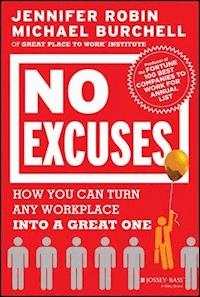
The business leader's guide to creating a great workplace from the Great Place to Work Institute
In this follow-up guide to The Great Workplace, experts from Great Place to Work® Institute, Inc. reveal the most common excuses managers use for why they can't create a great workplace. Authors Jennifer Robin and Michael Burchell poke holes in every single excuse. Whether the reasons involve the organization's leadership, employees, environment, or any other factor, the authors explain that if managers lead people properly, they can create a great workplace. The authors explore how managers can interrupt their own negative thought patterns and instead create lasting change, and they describe how great workplaces have surmounted very real difficulties with aplomb.
- Includes case studies, stories, tips, and tools for managers who want to transform their organizations
- From the experts at the Great Place to Work, a global research, consulting, and training firm that operates in nearly 50 countries
- Proves that any and every organization can change for the better when managers have the right tools and mindset
Creating a place where people want to work and want to succeed is the primary key to success for every manager. No Excuses shows that managers in any organization can transform their workplace—if they'll only get out of their own way first.
Sie lesen das E-Book in den Legimi-Apps auf:
Seitenzahl: 311
Veröffentlichungsjahr: 2013
Ähnliche


















Table of Contents
Title page
Copyright page
Dedication
Foreword by Amy Lyman
Introduction: Creating a Great Workplace
The Knowledge Base
Trust, Pride, and Camaraderie
Chapter 1: The Anatomy of an Excuse
Why It Matters
No Excuses
How to Use This Book
Chapter 2: I Think [Like a Great Workplace Leader], Therefore I Am [a Great Workplace Leader]
“Great Workplaces Are Born That Way”
“Great Workplaces Always Have [Insert Practice Here]”
“We're Not as Good as Some, But We're Better Than Others”
“Resolved: We Will Be a Great Workplace by Tomorrow”
Reflection
Chapter 3: We Are What We Repeatedly Do
Basic Elements of an Organizational Identity
Understanding and Alignment
Focus, Commitment, and Resources
Chapter 4: I Didn't Have Enough Time to Do It Right
Time
Persistence
Personal Characteristics
Habit
What to Do Next
Chapter 5: That's Just Not My Job
My Goals and Priorities Compete Too Much
But I Can't Wear That Many Hats
This Is Someone Else's Problem
I Don't Have the Power to Create a Great Workplace
Organizational Politics
What to Do Next
Chapter 6: My Industry Is Different
The Industry Norms Excuse
The “Hunker Down” Excuse
The “Too Big” Excuse
What to Do Next
Chapter 7: It's Just Not the Right Time
Disruptive Events Come in All Shapes and Sizes
What Makes Disruptive Events Disruptive?
Events Happen in Best Companies Too
What to Do Next
Chapter 8: I'd Be a Great People Manager if It Weren't for All the People
But My Team's Mindset Is So Entrenched
But the People Who Work Under Me Are So Entitled
But My Employees Are All a Part of a Union—My Hands Are Tied
But the Characteristics of My Workforce Just Doesn't Make It Possible
But My Workforce Is Young—They Don't Care About a Cohesive Workplace Culture
What to Do Next
Chapter 9: My Boss Ate My Homework
The Ignorant Leader Excuse
The Neglectful Leader Excuse
The Weight of the World Excuse
You as an Employee, not a Manager
What to Do Next
Chapter 10: The “One Rule” for Excuses
The Opportunity in the Challenge
The Judo Move
What to Do Next
Acknowledgments
About the Authors
More from Wiley
Index
Cover design by Adrian Morgan
Cover image : © Daniel Boom/Shutterstock
Copyright © 2013 by Great Place to Work® Institute, Inc. All rights reserved.
Published by Jossey-Bass
A Wiley Brand
One Montgomery Street, Suite 1200, San Francisco, CA 94104-4594—www.josseybass.com
GREAT PLACE TO WORK is the registered trademark of Great Place to Work Institute, Inc.
The Trust Index Survey, the Culture Audit, and the Great Place to Work® Model are the copyrighted works of Great Place to Work Institute, Inc.
No part of this publication may be reproduced, stored in a retrieval system, or transmitted in any form or by any means, electronic, mechanical, photocopying, recording, scanning, or otherwise, except as permitted under Section 107 or 108 of the 1976 United States Copyright Act, without either the prior written permission of the publisher, or authorization through payment of the appropriate per-copy fee to the Copyright Clearance Center, Inc., 222 Rosewood Drive, Danvers, MA 01923, 978-750-8400, fax 978-646-8600, or on the Web at www.copyright.com. Requests to the publisher for permission should be addressed to the Permissions Department, John Wiley & Sons, Inc., 111 River Street, Hoboken, NJ 07030, 201-748-6011, fax 201-748-6008, or online at www.wiley.com/go/permissions.
Limit of Liability/Disclaimer of Warranty: While the publisher and author have used their best efforts in preparing this book, they make no representations or warranties with respect to the accuracy or completeness of the contents of this book and specifically disclaim any implied warranties of merchantability or fitness for a particular purpose. No warranty may be created or extended by sales representatives or written sales materials. The advice and strategies contained herein may not be suitable for your situation. You should consult with a professional where appropriate. Neither the publisher nor author shall be liable for any loss of profit or any other commercial damages, including but not limited to special, incidental, consequential, or other damages. Readers should be aware that Internet Web sites offered as citations and/or sources for further information may have changed or disappeared between the time this was written and when it is read.
Jossey-Bass books and products are available through most bookstores. To contact Jossey-Bass directly, call our Customer Care Department within the U.S. at 800-956-7739, outside the U.S. at 317-572-3986, or fax 317-572-4002.
Wiley publishes in a variety of print and electronic formats and by print-on-demand. Some material included with standard print versions of this book may not be included in e-books or in print-on-demand. If this book refers to media such as a CD or DVD that is not included in the version you purchased, you may download this material at http://booksupport.wiley.com. For more information about Wiley products, visit www.wiley.com.
Library of Congress Cataloging-in-Publication Data
Robin, Jennifer, 1974-
No excuses : how you can turn any workplace into a great one / Jennifer Robin, Michael Burchell. — First edition.
pages cm
Includes index.
ISBN 978-1-118-35242-7 (hardback), 978-1-118-74694-3 (epdf), 978-1-118-74700-1 (epub)
1. Corporate culture. 2. Organizational behavior. 3. Employee morale. 4. Work environment. 5. Management. 6. Job satisfaction. I. Burchell, Michael, 1967- II. Title.
HD58.7.R625 2013
658.3—dc23
2013022239
Dedicated to the managers and leaders championing great workplaces. We hope you will see this book as an invitation to connect with others so that all of us widen our understanding of what great workplaces are and can be.
Foreword
Somewhat like Nike's infamous “Just Do It” tag line, I'm hopeful that No Excuses becomes the calling card of the next generation of managers and leaders seeking to create great workplaces. Jen Robin and Michael Burchell's exploration of their two rules for creating a great workplace—treat every interaction as an opportunity to build trust, and don't resist—provides both guidance and admonishment to spur people forward.
A short, simple phrase, “no excuses” captures the bane of work life for some managers. There's always a reason for not making the effort, for not taking a risk, for doing just enough to get by. The trouble is that all of these excuses for not exerting a little more effort lead to a mediocre workplace rather than one in which people are committed to seeking excellence.
An excuse is somewhat like an apology. Excuses and apologies are comments or stories we share with others that relate to a specific event or action, though an excuse usually comes before any action has been taken and an apology comes after actions have been taken when perhaps things haven't gone so well. A major difference between excuses and apologies is that excuses keep us from doing things while apologies can help us to do things better. If we learn from our apologies, then we can make improvements. But our excuses stop us in our tracks.
No Excuses is about helping you to do things better and keep moving. After reading this book and implementing the practices presented here, you should actually have fewer apologies to make. That's because Robin and Burchell provide you with a way of moving forward as a manager to create a great workplace environment in your organization that will benefit everyone.
The focus on interactions and opportunities takes everyday encounters and moves them into the future with the question, “What is the opportunity that can come from this moment?” As a manager you can choose to orient your thinking to always consider what could possibly come next. When you do this, you create an opportunity for continuity between your actions and words, your current interactions and the promises that you make—to yourself and others—about the future.
Building trust is all about following through on your promises. So if every interaction is an opportunity to build trust, then every interaction also represents a promise. Which so quickly takes us to Burchell and Robin's second rule: Don't resist. Don't resist the challenge before you. Don't resist the opportunity to make and fulfill your promise, and build a bond of trust.
Don't resist is quite a simple strategy, yet like most concepts that are simple, it is one of the most powerful approaches to effective management that there is. Rather than trying to corral employees, projects, or a whole department to behave according to a complex set of assumptions and expectations about what ought to be, keep it simple. Don't resist the reality of the situation; work with it and build trust.
Why does this work so well as an approach to creating great workplaces? First of all, with a commitment to no excuses, you can focus on making progress and trying things out. Clearly the target for your progress needs to be the creation of a high-trust workgroup or organization. You won't achieve high levels of trust without specifically aiming in that direction. So with high trust as a target, and your commitment to no excuses, you begin the journey.
Most everyone I've ever met in a workplace wants to be part of a great team and a great organization. People will put up with a lot to hold on to their hope that things will get better. When you, as a manager, actually do work hard to make things better, creating trust through every opportunity, the cooperation and commitment you receive in return will more than make up for the extra effort you may be expending to build trust. And when that ball starts rolling forward—no excuses, building trust in every opportunity, and no resistance—you will be able to channel the group's energy toward market opportunities that others let pass them by.
Great workplaces are more successful than others because of the power of trust. Burchell and Robin know this because they have been coaching and consulting with great workplaces for many years, helping managers and leaders to achieve ever greater success. The examples they provide in this book affirm their knowledge by detailing the experiences of managers and leaders in businesses that you know. There are no false stories here, made-up analogies, or fantasy discussions about what might be possible. This is real.
I hope that every reader is as inspired by this book and the examples provided as I have been. And I also hope that everyone commits to taking action based on the excellent guidance provided by Michael and Jen, and all the people they have profiled here. You will become a more effective manager and leader once you start practicing “no excuses” management.
Amy Lyman
Author, The Trustworthy Leader
Co-founder, Great Place to Work® Institute
Introduction: Creating a Great Workplace
Culture matters. A company's culture determines the limits of its success. Recent surveys conducted by both PricewaterhouseCoopers and IBM assessing the key issues that CEOs face in growing their firms highlight the role of people and culture as crucial to long-term competitive advantage.1 Organizations today seek the most useful strategies and methods to create a culture of excellence where employees go above and beyond. And decades of research underscore the importance of workplace culture in firm performance.
In 2011, we published The Great Workplace: How to Build It, How to Keep It, and Why It Matters. We advanced the idea that creating a great workplace is central to organizing for business success. Based on years of research into the world's best companies, we have found that organizations characterized by a high degree of trust, pride, and camaraderie result in more satisfied and engaged employees. Additionally, these firms also experience an unusually high degree of productivity and financial success. Trust, it turns out, matters.
As a result of that book's publication and reception, we were invited to speak publicly at professional association conferences and more intimately with the managers and leadership teams at a broad range of organizations. As we discussed the model of a great workplace, we found that people were interested and excited. However, when we pressed on to discuss how they could apply the model to their own organization, we were met with some resistance. We found this common pattern of “love the idea, not sure it would work here” curious. We thought, if this sample of managers raised these objections, it stands to reason that many more held similar points of view, and held themselves back from doing the work required to create an environment of trust, pride, and camaraderie in their own work group.
Lesen Sie weiter in der vollständigen Ausgabe!
Lesen Sie weiter in der vollständigen Ausgabe!
Lesen Sie weiter in der vollständigen Ausgabe!
Lesen Sie weiter in der vollständigen Ausgabe!
Lesen Sie weiter in der vollständigen Ausgabe!
Lesen Sie weiter in der vollständigen Ausgabe!
Lesen Sie weiter in der vollständigen Ausgabe!
Lesen Sie weiter in der vollständigen Ausgabe!
Lesen Sie weiter in der vollständigen Ausgabe!
Lesen Sie weiter in der vollständigen Ausgabe!
Lesen Sie weiter in der vollständigen Ausgabe!
Lesen Sie weiter in der vollständigen Ausgabe!
Lesen Sie weiter in der vollständigen Ausgabe!
Lesen Sie weiter in der vollständigen Ausgabe!




