


16,99 €
Mehr erfahren.
- Herausgeber: Airlife
- Kategorie: Lebensstil
- Sprache: Englisch
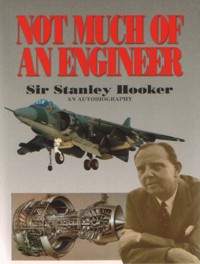
Stanley Hooker joined the Bristol Aeroplane Company in 1949 and tugged a rather reluctant company into the jet age, determined to give real competition to Rolls-Royce. So successful was he that in 1966 Rolls-Royce decided the best thing to do was to spend £63.6 million and buy its rival. By this time there was scarcely a single modern British aero-engine for which Hooker had not been responsible.
Das E-Book können Sie in Legimi-Apps oder einer beliebigen App lesen, die das folgende Format unterstützen:
Seitenzahl: 502
Veröffentlichungsjahr: 2011
Ähnliche

















Not much of
an Engineer
an autobiography
Sir Stanley Hooker
assisted by
Bill Gunston
Airlife
England
Contents
Foreword
Chapter 1 The Professional Student
Chapter 2 The Merlin
Chapter 3 Jets
Chapter 4 The Nene
Chapter 5 Axials
Chapter 6 The Break and a New Start
Chapter 7 The Proteus
Chapter 8 The Olympus
Chapter 9 The Orpheus
Chapter 10 The Pegasus
Chapter 11 The Mergers and my first Retirement
Chapter 12 The RB211 and the Prodigal’s Return
Chapter 13 Romania and China
Chapter 14 Farewell to Nightingale Road
Glossary
Appendix I: The engines
Appendix II: Merlin Power and Jet Thrust
Appendix III: The Propulsive Efficiency for a jet Engine
Appendix IV: Supercharging the Merlin Engine
This is a love story between aircraft engines and two people.
Kate Hooker
Foreword
by The Lord Keith of Castleacre
Most laymen regard higher mathematics as a dull subject and consequently suspect that those who practise it must be somewhat sombre and live in a rarefied atmosphere.
Stanley Hooker’s life story and the way he has written it clearly disprove this view.
Stanley first came into my life when in October, 1972, I went to Rolls-Royce as Chairman of a company recently rescued from bankruptcy, but still proudly possessing one of the greatest of names. He rapidly became my guide, philosopher and friend. He held my hand, technically, throughout the seven years I was with the company and I shall always be deeply grateful to him.
This brilliant mathematician, who won almost every available scholarship and academic prize, is possessed of a warm and loveable character. He has a capacity for making enduring friendships with all types, kinds and nationalities. A truly modest man, he is generous to a degree. He was the first to give credit to others when things went right; equally the first to assume the blame when things went wrong. As the reader will discover, he also has a ready wit and an excellent sense of humour.
Almost by accident, he became one of the world’s most brilliant engineers. His clear and precise mind was combined with the engineering equivalent of green fingers when it came to solving abstruse problems, as he so clearly demonstrated when he led the technical rescue work on the RB211, thereby saving it for the nation following the Rolls-Royce bankruptcy.
If asked to pinpoint his greatest contribution to the nation, I suppose one would start with his work as a supersonic airflow expert, analysing superchargers, thereby giving them improved and more predictable performance. This resulted in the Merlin engine keeping ahead of the Germans, with inestimable benefit to the R.A.F., throughout the war.
Stanley changed the face of the aero-engine business when he introduced Lord Hives to Sir Frank Whittle and persuaded the former that he should take the gas turbine seriously. He then went on to father the design of the Nene engine which was to become the forerunner of the modern gas turbine and which was licensed to the Americans and, foolishly, sold by the Government of the day, to the Russians. Incidentally, Meteors — powered by the Rolls-Royce Welland engine built at Barnoldswick under Stanley’s guidance — were first used in action to chase and destroy flying bombs in August 1944.
He was also a supporter and promoter of vectored thrust and played a major part in the development of the Pegasus engine. This enabled Sydney Camm to design the Harrier which demonstrated its outstanding capabilities in the Falklands war.
Stanley has that rare and invaluable facility of making complicated technical matters understandable to the layman. He is the master of the blackboard and chalk and is able to give even people like myself a reasonably clear idea of how the engine works.
This book records how he left Derby to go to Bristol in 1948; how he returned temporarily in 1967; and how he finally became director of engineering at Rolls-Royce in 1971.
I have often wondered how different the course of Rolls-Royce and indeed British high technology engineering might have been if those two outstanding but determined men — Lord Hives and Stanley Hooker — had been a little more flexible and a little less precipitate in September 1948 and had Stanley not left Derby to go to Bristol.
I hope that everyone who reads this book will enjoy it as much as I have done.
Keith of Castleacre
March 1984
Chapter 1
The Professional Student
It was a damp, cold day in January 1938 when I garaged my car at the junction with the Osmaston Road and began to walk up Nightingale Road towards the great Rolls-Royce works in Derby.
The dreariness of the street, with its terrace of redbrick workers’ houses on the left, interspersed with the odd conversion to a general grocer’s or tobacconist, and on the right a small open lot used as a works car park, matched the foreboding in my mind. Not a soul was in sight, nor was there any noise, because the workshops were set back from the road behind the front facade of offices.
With each step I took, my heart sank further. Why had I left my comfortable and interesting job in the Scientific Research Department of the Admiralty? And what was I going to do in the formidable Rolls-Royce company, which represented the very pinnacle of engineering excellence?
I was no engineer. I had been trained in Applied Mathematics, so how could I hope to compete with, or even to help, the semi-Godlike engineers with which, I was convinced, Rolls-Royce must be stocked — doubtless trained by the legendary Sir Henry Royce himself?
The apprehension grew as I approached the main entrance on my right. It stood back a few yards from the pavement, with an oval drive in and out in front. At the door stood a very smart uniformed commissionaire. I approached him with caution.
‘Yes, sir, you will find Mr Elliott’s office in the next block. Take the next gate on the right, and then the entrance to the Engineering Offices is on your left’.
I found my way easily enough, and stumbled along the corridor until I reached the office marked A. G. ELLIOTT, Chief Engineer. I knocked and was told to enter. It was not a large office, and very sparsely furnished. Mr Elliott sat at his desk, back to the windows and facing the door. In the further corner sat his personal assistant, A. Livesey.
Elliott clearly had not the foggiest idea who I was, and had forgotten that he was to interview me. He spoke very quietly and enquired about my business. I explained that I was the new man joining the firm, by name Hooker. He smiled as the memory came back and said, ‘Of course, welcome to Rolls-Royce. We have prepared an office for you, and Mr Livesey will show you to it’.
The interview was over that quickly, and it was not at all what I had expected. Livesey led me around the corridor, and at a junction he opened a door, and said ‘This is your office, cheerio’. The walls were painted metal for the first four feet from the floor, and frosted glass above. It was about eight feet square and contained a desk, a chair, an empty bookcase and a telephone, and nothing more. I sank bewildered into the hard chair and gazed at the nothingness of the wall.
All around me there was a hive of industry. I could hear telephones ringing, the clacking of typewriters, and the hum of conversation. Mostly the offices were much larger open spaces with similar dividing walls, but housing groups of men working with intense concentration. A very large area was clearly devoted to design, and full of towering drawing-boards.
Later I learned that rumour and curiosity was rife about the new so-called ‘mathematical whizz kid’ who had been granted the rare privilege of a private office. At the time I was just ignored, completely.
And so the day wore slowly on. I had anticipated that I would have been put into the charge of some awe-inspiring engineer, who would have allocated me some simple tasks while instructing me in the mysteries of the super aero engines that Rolls-Royce was designing and producing. But it was not so. I, who had never seen an aero engine at close range, and who only had a schoolboy’s knowledge of its inside, did not even know the names of the engines Rolls-Royce was producing.
At 5.00 pm there was a general exodus, and I departed with the rest, thoroughly dispirited at the emptiness of my first day. However, after my evening meal, I cheered up a bit when it occurred to me that the only possible explanation must be that the powers that be were still debating my ultimate fate, and had not yet reached any conclusion about the job I was to do.
On the next day I arrived promptly at 8.30 am with the rest of the staff, but I had with me The Times, and my pipe and tobacco. In those days I only smoked occasionally in the evenings, but I felt the need of a comforter. Never was The Times read more completely and carefully, as the second day proved to be a replica of the first. Nobody came near me.
Things being thus, I had plenty of time to cogitate on the curious chain of events which had led me, at the age of 31 years, to be seated in an office in the Engineering Department of the great Rolls-Royce company doing nothing — especially as I had had no previous aspirations to be an engineer.
I was born on 30 September 1907, at Sheerness, Kent. After various vicissitudes through World War I, I was sent to Borden Grammar School, near Sittingbourne, in 1919.
For the first four years, I had an uninspiring career, because I soon found that I could maintain an ‘invisible’ position, about mid-form, with the minimum of effort on my part. I was, however, quite interested in physics and mathematics, and in the examinations at the end of each year usually managed to acquire the prize awarded jointly for these subjects.
At the end of the fourth year, in June 1923, I knew that I, with the rest of the fifth form, was required to take the Matriculation Examination for London University. Since there was no escape, I decided to try a little harder, and unnoticed I put in a couple of terms’ good work. To the immense surprise of masters, boys and myself, I did very well indeed in the examination; so well, in fact, that the school was granted a half-day’s holiday in celebration.
This was a turning point, because it was then decided that I must try for London University by way of three more years at school, and by taking a Royal Scholarship in Physics. There were six such scholarships given annually, and they had to be won in open competition. They were tenable for three years at Imperial College, London, and were worth £150 per annum, of which the college took £62.10s (£62.50) for fees.
In 1926 I won such a scholarship, and also, in the Entrance Examination for Imperial College, I was awarded a free place, so that the whole of the £150 was mine. This was a princely sum for a young student in those days.
When I went up to Imperial in 1926 I elected to take the course in Honours Mathematics. The Professor of Mathematics was Sydney Chapman, whose main interest was geophysics. I found him a very cold and distant man, and I had no interest in his subject. Much more to my liking was his Assistant Professor, who was a volatile jew, Hyman Levy. His interest was hydrodynamics, and so I elected to specialise in that subject.
It was Levy who introduced me to the Kármán Vortex Street, which is the series of eddies which are shed alternately from each side of a body moving through a fluid such as air or water. These eddies produce the drag of the body, and are spaced in a particular manner which was first evaluated by Professor von Kármán at Göttingen.
Under Levy’s guidance, I produced two papers — one published by the Philosophical Magazine and the other by the Royal Society — slightly extending von Kármán’s theory. In this manner I came to know, and become friends with, the great man himself. Years later this was to prove an enormous advantage to me and of great benefit to the British aero industry.
At the end of my third year at Imperial College, I was awarded the Governors’ Prize for Mathematics (£5 worth of books!), and I began vaguely to think of an academic career as a lecturer and, hopefully, later as a professor. But in September 1928 I was awarded The Busk Studentship in Aeronautics. This had been instituted by the Busk family in memory of Edward Busk who was killed as a pioneer aviator. I still remember with gratitude and affection the personal letters which came from either his mother or his widow at the beginning of each term, with a cheque for £50.
The Aeronautics Department was situated in the basement of the Huxley Building in Exhibition Road, South Kensington. This also housed the Mathematics Department, so I did not move far, but fell under the tuition of Professor Leonard Bairstow, W. S. Farren, and H. Roxbee Cox (now Lord Kings Norton), who respectively initiated me into the mysteries of the lift and drag of wings, the design of aircraft structures, and the design of airships. I suppose this was my first tentative step in the direction of engineering, but, because of Levy’s influence in directing me towards hydrodynamics (the flow of fluids), I found that the most interesting part of the Aeronautics course was the aerodynamic flow of air around the wings of aircraft, thus producing the lift and the drag.
The department had a small wind tunnel, and I was able to make experiments on the flow of air and found, somewhat to my surprise, how much I enjoyed such work. In fact, the appreciation, liking and knowledge of aerodynamics which I gained at that time have been a great strength to me throughout my career, especially when I was moved into the field of gas turbines.
In 1929 an income of £150 per year was an enviable one, particularly as I was living quite cheaply with my sister and her husband in a flat in Battersea. The economy of the country was very depressed, and jobs were hard to come by, and so it seemed quite reasonable to carry on as a student while I could get such funds to support me. In fact the student life, with its long vacations during which I did no work but had a pleasant time with my friends in Kent, suited me very well.
But fate intervened, and in December 1929, I suffered a broken leg in a football match against University College Hospital. I was taken to Ealing Hospital and spent two wearisome months in Plaster of Paris. I went home to Kent in March 1930 but on Good Friday I had a motor-cycling accident, breaking my leg again, and this time my right arm for good measure. This time I was taken to a little country Cottage Hospital in the small and delightful market town of Faversham. I knew the town well; all my friends were within 10 or 20 miles, and visited me frequently.
Most of the time I was the only male patient in the hospital, and had the undivided attention of all the young nurses and sisters. While my right arm was no problem, merely requiring to be pulled straight and bandaged, my right leg was in a sorry mess. The country doctor who dealt with it was a tough middle-aged exrugger player, but was superb to me. It took him three goes at setting the leg, extending over a week, and when he was finally finished, he showed me the X-ray, and there it was with all the jagged bones fitted together like a jig-saw puzzle. He said to me ‘I am satisfied that those bones will join together and be stronger than before, but you will have to watch the circulation and take care of that leg’. And so it proved. I had two further operations on the leg during the 1950s, and on the last occasion my friend Gordon Paul, the great Bristol surgeon, said to me ‘I have done all that science can do for that leg. From now on you must watch it’.
At the time when I was taken to the Faversham Cottage Hospital it was the custom for people injured in road accidents to be treated and boarded free of charge. So here I was in hospital with £3 a week coming in and no outgoings at all. In fact, from my earlier incarceration I had capital in hand.
The total staff at the hospital consisted of three young probationer nurses — pros as they called themselves — a day and a night sister, and what seemed to be a very severe matron. Apart from one farmer, who came in to have a hernia fixed, I was the only male patient for the several months I was there. The farmer was in the next room, and when he came in I could hear my doctor quizzing him:
‘Do you smoke?’
‘Yes, I like my pipe.’
‘Well, you will have to lay off it for some time after this operation, because after the anaesthetic smoking will make you cough, and coughing will be very painful.’
The farmer agreed that there would be no problem.
After the operation, I could hear him coming to from the anaesthetic, muttering and moaning in the usual way. A few minutes later I heard him cough, and then give a sharp cry of pain. Again this was repeated, and then the smell of the tobacco smoke wafted into my room. He had lit up immediately, and, although the nurses rushed in, all he would say was ‘Don’t tell the doctor, please.’
These young nurses, nubile young ladies of about eighteen, looking lovely in their fresh blue uniforms and white cuffs and caps, fastened on to me as their prize exhibit, and never was anyone ‘nursed’ like it. They were full of high spirits and fun, and, once the initial pain of the break had subsided, they took particular pleasure in giving me ‘blanket baths’ in bed. Never was any patient kept so well washed! They were like several cats with one kitten.
On their afternoons off, I persuaded them to go into town and buy such delicacies as lobster, oysters (Whitstable was the neighbouring town), foie gras, Stilton cheese and the like, with a bottle of wine. In the evening, when their duty was finished, with the connivance of the night sister (and the matron, I found out later), they would come to my room and we would all have supper together, with me having to be fed until I learned to use my left hand effectively. I taught them to play whist and we sang together. They made the dreariness of being bed-ridden into an experience which I can now look back to with enormous pleasure and gratitude. I can never forget them, and wonder where they are today.
The first broken leg was on 29 December 1929, and the second on Good Friday, 1930. Thus it was that for ten months to October 1930 I did no studying or academic work of any kind. I had written to Mrs Busk telling her of the happenings and offering to forgo the money, but, generously, she would not hear of it, and so I continued to get the £50 per term.
I gave no thought to what should happen next, until one day at Faversham a letter arrived from Professor Bairstow saying that he had recommended me as a candidate for the Armourers and Braziers Research Fellowship in Aeronautics. I was bidden to appear at the Guild of Armourers and Braziers in London. Having delayed as long as I could, I appeared on crutches and that won the day! I now had £250 per annum to continue my studies and research in the Aeronautics Department of Imperial College. Fate had intervened again, and I was committed to at least two further years of academic life.
I do not wish to give the impression that this Fellowship was handed to me on a plate. Professor Bairstow had an all-consuming obsession, and that was to solve the equations of motion of a viscous fluid. All fluids have the property of viscosity, though in the case of air it is less obvious than with oil or treacle. It is this property which gives an aircraft its drag, and wings their lift. Without the property of viscosity, neither birds nor aeroplanes could fly, and winds would blow around the world undiminished for ever. In the real world in which we live air’s viscosity gradually dissipates, like friction, all air motion into heat. Unfortunately the equations, which are well established, are very intractable. Bairstow decided to try to solve them by numerical methods, and employed two ladies to operate with numbers, just as present-day computers do, although the ladies were a few million times slower.
For my part, I had taken a modified and much simpler form of the equations, called Oseen’s Equations, after their creator, and had managed to solve these for the case of low-speed flow past a circular cylinder. Bairstow was interested, and it was for this reason he recommended me for the Armourers and Braziers Fellowship.
But when I returned to Imperial in October 1930 I became much more interested in the flow of air at very high speeds, where another of its properties, compressibility, becomes very important. At speeds up to about 300 mph air can be regarded as incompressible, like water. In other words, the pressure differences caused by the air velocities are small compared with the pressure of the atmosphere, and so the air behaves as if its density remained constant.
For example, at 200 mph the maximum pressure that air can exert is only 5 per cent of the atmospheric pressure, which has a negligible effect on the air density and the flow. But at 400 mph the pressure increases to 21 per cent and at 600 mph to 51 per cent. These pressure increases have a significant effect upon the density of the air, and, hence, upon its flow pattern and the forces that the air exerts.
Since the speed of even the fastest fighters was only about 200 mph at that time, mathematical and experimental studies of airflow around wings and other aircraft parts had ignored the compressibility effects on the flow. But in 1930 Professor G. I. Taylor (later Sir Geoffrey Taylor of Trinity College, Cambridge) began to send his theoretical work on the flow of air as a compressible gas to the Aeronautical Research Committee, who duly published it in their Reports & Memoranda.
Of the many great applied mathematicians in the field of aerodynamics or fluid motion whom I have had the good fortune to know, G. I. Taylor ranks at the very top — before Prandtl of Göttingen, von Kármán of Aachen or Southwell of Oxford. The breadth of G. I.’s theoretical work was vast, and it always had a practical slant. He was adept at devising experiments to verify his theories, many of them of fascinating simplicity.
At this time, in the early 1930s, there were few people in the world studying the effects of compressibility on the flow of air. There was Büsemann in Germany, who went to the USA after World War II, Ackeret in Zurich, who evolved the first simple theory of the effect on the lift and drag of a wing, and there was G. I. Taylor in England. Years earlier Lord Rayleigh, Rankine and Stokes — all British — had shown how significant this property of the compressibility of air could become, especially when the velocity exceeded the speed of sound.
Taylor’s papers interested me greatly, and I began to dabble myself. I evolved what I thought to be a brilliant mathematical solution to the flow around a circular cylinder at speeds approaching the velocity of sound, and sent it to the Aeronautical Research Committee, of which G. I. was a member. Alas, the theory contained a subtle flaw, and Taylor slaughtered it in devastating fashion. I was stunned, almost to the point of physical sickness. How could a man of his eminence be so savage to a young man of my insignificance?
But I did not then know G. I. Shortly afterwards I received a note asking me to meet him in the rooms of the Royal Aeronautical Society, which were then in Arlington Street, off Piccadilly.
With great trepidation, I turned up at the appointed time, to meet for the first time this great man. I was charmed immediately. He said that my theory was a brave effort, and that he was sorry that he had had to be so critical. He then went on to give me a personal tutorial on the subject, and encouraged me to pursue this type of study. He said, ‘Send your work to me first, and I will do all I can to help.’ And thus began a friendship which was to affect profoundly the whole course of my future.
I did not appreciate at the time — and very few other people did either — that the understanding of the aerodynamic flow of compressible air was to lead on to supersonic flight once an engine of sufficient power was available. Nor did I know that a young Royal Air Force officer called Frank Whittle was at the University of Cambridge designing the first jet engine which would ultimately give this power. Whittle had a superb grasp of the relationship between supersonic airflow and the thermodynamics of the gas turbine. He was one of the first men to weld together and formulate the science of Gas Dynamics, which is now a normal course for engineers at the beginning of their studies.
Fate decreed that I was to follow a course of study, first at Imperial College and afterwards at Oxford University, which by chance specifically trained me for the tasks which, years later, were to be allocated to me by Rolls-Royce. Now, on reflection, I would not wish to change a day of it. I sometimes think that perhaps I could have worked harder, but ‘unconscious of their fate, the little children play.’
Back at Imperial College, I continued to study G. I. Taylor’s work, and, to his evident satisfaction, even extended the scope of some of his publications.
It was well known, of course, that there was an exact similarity between the flow of a ‘perfect’ gas (one without viscosity) and the flow of an electric current through an electrolyte, such as a solution of copper sulphate. Taylor evolved a method of making the flow of the electric current simulate the flow of a compressible fluid. He took a shallow square tank which he filled to a depth of about one inch (25mm) with copper sulphate solution. Two opposite walls of the tank were made of copper strips, and a current was passed between them. Such an arrangement produced a uniform flow of electricity from one wall to the other, and if a non-conducting obstacle was placed in the centre of the tank, then the flow lines of the electric current would pass around it, exactly as air would if the obstacle was in a uniform stream of air. This was straightforward stuff, but Taylor made the base of the tank in paraffin wax, and used a circular cylinder embedded in the wax as the obstacle. By carving the wax away or adding more at the appropriate places, the depth of the electrolyte around the obstacle could be varied, and Taylor showed that this depth was exactly analogous to the density of compressible air as it flowed around the cylinder. Where the air velocity was high, the depth of the electrolyte had to be reduced; when the air velocity was low, the depth had to be increased. By this relatively simple experimental technique, Taylor was able to evaluate the effects of compressibility on the flow, and obtained the answer to a problem which was quite intractable by mathematical methods.
Although I was better with pen and paper than as an experimenter, I wrote to G. I. to ask him if I could use the tank at Imperial College. He replied that he had given it to Professor R. V. Southwell, who was head of the Engineering Science School at Oxford, but that he would write to Southwell and tell him of my interest. I had never met Southwell, but knew him from his reputation as an applied mathematician in the fields of Fluid Dynamics and the Elasticity of Materials.
A little later, I was delighted to get a letter from Southwell, inviting me to meet him for tea at London’s Athenaeum Club, a venue which I regarded with great ‘awe’. The upshot was that Southwell invited me to go to Oxford to work with the tank; moreover since he was a Fellow of Brasenose College (BNC), he undertook to persuade the Principal of that College to accept me as a member of it for post-graduate study.
Secretly, I had always wanted to go to Oxford, but had thought that I would have difficulty in getting a college to accept me, and that I could not afford it. But now, with £250 per year from the Armourers and Braziers Fellowship, I had ample funds, and so jumped at this God-sent opportunity. In those days, one could buy a made-to-measure suit for £5, and a reasonable secondhand motor car for £20, so that £250 was equivalent to several thousand pounds today.
I realised that I was in danger of becoming a ‘professional student’, but jobs were very difficult to get, and pay was low. I was doing at least as well on my emolument as I would have done in a job, even if I could have got one! So, with all the other young men fresh from the great public schools, I went up to Oxford in October 1932, and became a commoner of Brasenose “in statu pupillari”.
I must confess that I had always been jealous and envious of public school boys. Coming from my humble origins, I expected to get the cold shoulder, and was prepared to be cold and distant myself. After all, was I not already 24 years old with a Bachelor’s Degree in mathematics, so why should I bother about these snobbish young puppies, who had been born with a silver spoon in their mouths?
But I had got it all wrong; and they soon showed me what a fool I had been. I was immediately accepted by all, and spent four of the happiest years of my life enjoying the great camaraderie that existed in BNC. There is no doubt that the public schools give to their product an indefinable something which is of inestimable value to Britain. Those jealous and bigoted people who seek to destroy them — in the name of anti-class privilege or for votecatching — are misguided, small-minded fools. We should have more public schools, and not fewer; thus could we increase the output of leaders for all walks of life, with their unparalleled record of excellence.
Alas, the young men I lived with in BNC for those unforgettable four years were ripe for slaughter in World War II. It is so terribly sad to read their many names on the Roll of Honour at the entrance to the College Chapel. Yet I always remember them as generous, happy, high-spirited young men, who promised to have the world at their feet.
The School of Engineering Science was situated at the junction of Parks Road and the Banbury Road. It was a small two-storeyed building, with a tiny library up an iron staircase in the attic. The staff was small. Under Professor Southwell were E. B. Moullin, a fellow of Magdalen, as the Reader in Electricity, and A. M. Binnie, a don of New College, specialising in Hydraulics. There was a small workshop in the basement, where a very skilful man made the apparatus necessary for the experimental work.
At this period, engineering was hardly the ‘in-thing’ at Oxford. The annual intake of students was about a dozen, several of whom were Rhodes Scholars from the Empire. For these reasons, Southwell concentrated on the mathematical and theoretical background to Engineering Design, and how wise he was. My later experience in Rolls-Royce showed me that no university course could possibly compare with the knowledge gained by rubbing shoulders with experienced, practising engineers actually doing the job in a factory. On the other hand, once one’s student days are over, and one is gaining practical experience by doing a job, it is extremely difficult again to pick up the mathematical and theoretical background so vital to anyone who aspires to lead in engineering.
Although I had no examinations to sit, I was in the end aiming to write a thesis for a doctorate in Philosophy, so I attended many of Southwell’s lectures, particularly those on the Strength of Materials. I supplemented these by attending A. E. H. Love’s course on Elasticity held in the Clarendon Laboratory.
Love was an old man with a white walrus moustache, who lectured straight from the enormous tome he had written — the classic work on the subject. It was a purely mathematical treatise of great erudition, and the old boy could reproduce page after page of it on the blackboard without a note or reference. I watched him with awe and admiration. Although I never specialised in this subject, the grounding I got from him and from Southwell has served me in great stead. Many times it prevented me from being “blinded by science”, when the real test of the strength of materials came in the gas turbine engine.
When I first arrived at the Engineering Laboratory, Southwell was away on sabbatical leave as a visiting professor at the Massachusetts Institute of Technology. So I was left to my own devices for a couple of terms. I had been allocated a small office overlooking The Parks, and in this seclusion I again turned to G. I. Taylor for inspiration.
It was well known that if air was compressed to, say 100 lb per square inch, and then released to the atmosphere through a nozzle which first contracted to a throat and thereafter expanded in a divergence, the velocity of the escaping air would exceed the velocity of sound. In the case just quoted the jet would reach approximately twice the speed of sound.
At the National Physical Laboratory, Stanton had made such a jet of air, and in it had measured the lift and drag of wing sections. Because of the large power required to compress the air initially, the experiments had to be conducted on a small scale; Stanton’s jet was just 2 in (50mm) in diameter. Nonetheless, the measured results were the first that had ever been made. They provided the first tentative information necessary for the dream of supersonic flight, which 20 years later was to become a reality for fighter aircraft, and 40 years later a routine occurrence for old ladies in the Concorde.
When an aircraft accelerates through the speed of sound, it generates waves or pressure pulses in the air. At the speed of sound the pressure waves are small, like sound waves. As the speed increases, a bow wave is set up at the nose and at the leading edge of the wings like the wave at the prow of a ship. This has a large amplitude, and can no longer be regarded as a simple sound wave. This shock-wave is responsible for the supersonic ‘bang’ of the Concorde and other supersonic aircraft.
Professor Ackeret at Zurich had already evolved a theory of the lift and drag of a wing at supersonic speeds, on the basis that the waves generated were small, like sound waves. His theory, therefore, applied to speeds near the velocity of sound. Despite this, Taylor applied Ackeret’s theory to Stanton’s experiments, and compared the measured results with the theoretical calculations. The agreement was reasonably good, even though the experiments had been made at Mach 1.8 (1.8 times the velocity of sound). I decided to extend Taylor’s calculations, using real shock-waves, such as would be generated at Mach 1.8. The results, as expected, were even closer to Stanton’s experimental measurements. Both theory and experiment showed that, as the speed increased from below to above that of sound, the centre of lift of the wing moved rearwards from about one-quarter of the chord (distance across the wing) at subsonic speeds to one-half of the chord at supersonic speeds. Thus, an aircraft flying through the speed of sound would rather suddenly become nose-heavy, since the centre of lift would move rearwards from the centre of gravity. This effect was to confuse pilots when, in the early 1950s, they first ventured through the speed of sound in conventional fighters.
In 1932-33 this work was only an interesting hobby. I had no conception whatever that it would prove basic to my first job in Rolls-Royce, and that the knowledge I was acquiring would ultimately give me such a head-start in that great firm.
In another part of the Laboratory, young Frederick Llewellyn Smith was experimenting with the only internal-combustion engine the Lab possessed. It was a single-cylinder petrol engine, and Llewellyn Smith was interested in the combustion process that went on during the power stroke. He had designed a highspeed valve which opened very briefly during the power stroke; out would puff a little of the combustion gases into a collector. The gases were then analysed chemically, and he could vary at will the point in the power stroke when he took his sample.
I asked him, ‘What are you going to do when you leave Oxford?’.
‘I am going to get a job with Rolls-Royce at Derby’, he replied.
‘Have you fixed it?’.
‘No’, he said, ‘but I am sure they will take me on’.
I admired his confidence, and was envious of his engineering degree and the practical work he was doing on piston engines. He, on the other hand, was very intrigued by my theoretical work, and regarded it with the same awe that I lavished on his engine.
We became good friends, but our ways parted in 1934 when he went off, sure enough, to join Rolls-Royce. Three years later he wrote to me to ask if I would like a job at Derby with Rolls-Royce, and it was through Llewellyn Smith, who eventually became a Director of Rolls-Royce and ran the Motor Car Division at Crewe, that I was first introduced to the company that was to change my whole life.
When I arrived at Oxford a post-graduate student from the Laboratory was just finishing, and offered me his rooms in the Woodstock Road. In those days every member of the University was required to live either in College or in registered and approved lodgings where the landlady could keep an eye on one — which most did, very unwilling to risk the danger of losing their licences. Having taken these rooms, which were exceedingly comfortable — and, thereby, having acquired a landlady who was a splendid cook — I found to my consternation that for the first two years a freshman had the option of rooms in College. Thus, of the entrants in my year, I was the only one not to live in College.
It was also a College rule that everyone had to attend a minimum of 24 chapels per term. This meant that, on three evenings of every week, I had to attend the evening Chapel Service in College from 7.00 to 7.30 pm. These very simple and short services gave me great pleasure and comfort, for in the early days I felt as lonely as a stranger in a foreign land. This chapel rule was revoked during my time at BNC. Like many others, I seldom went again, mainly because time did not seem to permit. The half-hour before dinner was thrown away in idle chatter or other inconsequential things, and the custom of going to chapel before dinner — which had been going on for centuries, and gave so much ease to my mind at least — was thrown away, as I now know many other customs at BNC have been, all for nothing more than the so-called ‘march of progress’.
Dinner was at 7.30 pm, and since the Hall was not large enough to seat everybody, the ‘freshers’ had to dine in one of the lecture theatres. Thus, all the new boys were thrown together, and this proved to be a great boon to me, for it was at dinner that I began to make new friends. Soon I was being invited to their rooms for coffee after dinner, to play cards, or even just to talk. Bridge was one of the passions of my life, and I shall never forget the many winter evenings spent playing with such pleasant companions. The mellowed rooms, panelled with ancient oak and warmed by a blazing coal fire, gave a feeling of immunity from the world at large, and conjured up a sense of belonging to a family which was directly descended from those who had lived and studied in these peaceful and graceful surroundings for centuries before.
After the impersonal life of Imperial College, where one attended lectures or studied from 9.30 am until 5.00 pm, after which everyone went their separate ways, I found the communal life at BNC very much more to my taste. I never cease to be thrilled when I walk through the massive doors at the lodge into the old quad, and into another world.
My contemporaries lived in College for the first two years, during which I enjoyed their hospitality. In the third year I opted to live in College, while they were in digs, and so returned their hospitality. My rooms became a focal point for many people and ‘open house’ for them all — so much so, that I never attempted to do any work in my rooms, but always went back to my little office in the laboratory.
Life at Oxford was governed by many rules and regulations, none of which I found irksome, and none that prevented us all from enjoying ourselves. It was permitted to lunch or dine in the town, but not to visit any of the pubs or go to any of the local dances. We were required to wear a cap and gown after dark in the town, although this rule was not strictly enforced, and one never bothered with a mortar-board and used to use one’s gown as a muffler. One was not permitted to have ladies in BNC before 1.00 pm, and they were required to leave by 7.00 pm — not a great hardship.
The lodge gate was closed at 9.00 pm but one could demand admittance free until 10.00 pm, after which the fine was one shilling (5p) until midnight. Admittance after midnight was reported to the Proctors, who dealt with the matter by a fine of £1, provided one had an adequate excuse.
Despite the restrictions outside College, inside parties and celebrations could go on ad-lib. If they were too noisy the Dons would telephone the Porter and ask him to call on the offending party to request less noise. Thus, the restrictions on the town’s facilities were more than made up for by the freedom inside College — except, of course for female company.
Excursions to London were allowed at week-ends, although one always had to be back in College or digs before midnight. This entailed catching the ‘Flying Fornicator’ from Paddington, which arrived at Oxford about 11.40 pm, and left barely enough time to get to College before midnight.
Today, all is changed, and it is sad for me to go back and see men dressed in any old clothes, lounging around in mixed company at all hours. This so-called freedom is at the expense of that happy though mildly disciplined life which had been going on for centuries, and was, to me, a part of Oxford’s great contribution to the moulding of character.
Brasenose was primarily a Law College. The Vice-Principal was W. T. S. Stallybrass, an authority on law of world renown. He was ‘Sonners’ to us all, and combined with law, a love of cricket and athletics. As a consequence, BNC was replete with ‘blues’ in cricket, athletics, rowing, rugger and so-forth — some of international fame, such as Mitchell Innes who played cricket for England; Sean Wade, the Irish international rugger player; Bob Cherry, the Olympic oarsman, and Alex Obolensky, whose rugger will never be forgotten, and who was killed early in the War while training to be an RAF pilot.
BNC was not short of stars. Two of my best friends were John and Paul Bradbury, whose sister I married in 1937. Unhappily, this marriage was to end in divorce after the war. On the scholastic side, there was Leslie Scarman, now Lord Justice Scarman; John Freeman, who became Ambassador to the USA; John Profumo, so likeable and charming; Val Duncan, destined to be Chairman of Rio Tinto-Zinc; John Gorton, who turned up as Prime Minister of Australia; and, interwoven with the story that follows, Reginald Verdon Smith, who had the great distinction of winning the Vinerian Prize for Law.
Part of the ritual of life was that every afternoon should be spent playing games or taking exercise to keep fit or to sublimate other desires by sheer physical tiredness. With the memories of broken limbs still fresh, this was not to my liking, so that in the afternoon, I would go to my little office in the Lab to work. Thus, my evenings would be free for the ‘flicks’, bridge, or any other form of entertainment that happened to be going.
The cinema was very popular. I remember the occasion when Sanders of the River was showing, and the scene came of the natives paddling Sanders ferociously down-river. Suddenly a voice in the audience rang out, ‘Well rowed, Balliol’, and pandemonium followed. Balliol had the reputation, probably unfairly, of having more coloured students, as well as budding prime ministers, than any other college.
The servants, known as ‘scouts’, were all male, and each had a staircase to look after with about six or so rooms and occupants. They arrived early in the morning, lit the fires and generally tidied up before producing hot water for shaving and washing. They stayed on duty until after lunch and then returned again in the evening to serve dinner in Hall. A very friendly relationship existed between us, and I never knew a surly one.
The cost of rooms varied from £10 to £20 per term, according to size and position. Dinner in Hall cost 3/6d (17½p) and one was required to dine in Hall at least three times per week or be charged accordingly. Drink in Hall was confined to beer served in splendid silver mugs, but there were two varieties: one of normal strength, and the other, called Audit Ale, which was very potent indeed. It was dark with a peculiar flavour, and was brewed specially for the College. He was a tough man, indeed, who could drink more than two pints (just over one litre).
There were certain subjects that were taboo at table. If anyone transgressed, an application could be made to the High Table, at which the Dons dined in style, always in black ties, for permission to “sconce” the offender. If granted, a magnificent two-handled, heavily embossed silver mug would be brought in by the scouts, and filled with at least two pints of Audit Ale. The accused then had to rise and empty the mug in one drink. If he failed he had to buy ale for all, but I never saw anyone fail; struggle hard perhaps, but fail — never.
If one lived in College, then three breakfasts per week had to be eaten in Hall. This was to get the slackers out of bed, and not only was one charged for the breakfasts, but fined to boot if one failed to appear the necessary number of times. My friend Dick Wilkins could never face breakfast, and only made it on one occasion five minutes before service ended. His astonished scout took his order of bacon and eggs and came back a few minutes later saying there was no more bacon, only sausages. Dick said he would have those and away went Albert, the scout, only to return to say that they also were gone now. Dick said he didn’t care, he would have anything, so away went Albert, and never came back at all, because a practice fire alarm was staged, and he was in the Brigade. Dick never tried again, but just paid his fines.
Lunch was taken in one’s rooms, and one ordered in advance either rolls and butter, still called ‘commons’, or a bowl of soup for a few pence, or chop and chips at one shilling (5p). Guests could be entertained for lunch, and a special menu ordered from the chef. Each room was equipped with a reasonably sized table, and chairs would be conjured up by the scouts. Sherry decanters, cigarette boxes, flowers, and so forth, would appear like magic, borrowed by the scouts from other rooms on the staircase, such was the communal life. For a small fee the College silver could be hired to decorate the table, and there was no end to the sophistication that could be lavished on the entertainment of guests of standing from outside the College.
A speciality of the chef was Hare Pie. This was hare in aspic, and it sat on its dish looking like a yellow translucent half rugger ball filled with gravel. I do not remember anybody ever eating it, but as it was the pièce de résistance of the chef, it had to be ordered as one of the courses. The other speciality of the College was hot mulled claret which was exceptionally good, both in winter and summer. For special occasions it would be served in silver carafes, but normally it came in the jugs that were in the bedrooms for hot water, since mulled-claret parties were apt to get a trifle rumbustious.
On one occasion Cecil Borland, who aspired to be an athletics blue, borrowed my room to give lunch to the President and Secretary of the University Athletic Club. He ordered a splendid lunch and returned to College just before 1.00 p.m. to find that other of my friends had arrived earlier and had, uninvited, set to on the lunch. The smiles left their faces when they heard the gravity of the situation, but the scouts rose magnificently to the task, and the debris was swept away with a new lunch arriving at high speed. The great men were intercepted at the Lodge and taken to other rooms for sherry, and never knew how close to a débâcle the occasion had been.
One summer, my friend Douglas Swan invited me to his father’s box for a day at Ascot. This meant hiring full morning dress from Moss Bros. Rather self-conscious, I left my rooms in the corner of the Old Quad, resplendent in a grey topper, to run the gauntlet to the Lodge. Alas, I did not pass inspection. Pat Swire ran to his rooms to return with a red carnation for my buttonhole, and another produced a pair of racing binoculars, complete with a bunch of tags from Tattersalls. With cheers of encouragement and a number of betting commissions, we set forth. Pat Swire gave me £1 and a list of horses on which to bet the proceeds of each race. To my amazement, he picked the winners of the first four races, and the pound had then become more than £100. I was instructed to bet the whole lot on the fifth race, but caution prevailed and I only put one-half on it. The horse lost, but I was still able to bring back over £50 to the grateful Pat.
I was not much of a betting man, since it was against all my mathematical training to gamble on such unreliable data. Dick Wilkins and John Body were always keen on a flutter, and used to place their bets with the local bookmaker, an honest man called West. Because I was a post-graduate student, I was allowed to have a car at Oxford and was, therefore, in demand to take them to sundry race meetings. On one occasion they both wanted to go to Warwick races but, unfortunately, I was going to Southampton for some reason. They tried to persuade me to go to Warwick, but I refused and, finally John said ‘All right, Stanley, you go South and we will go North’. ‘And your money will go West’, I replied.
Body and Wilkins were particular friends of mine. They both came from wealthy backgrounds, and both were reading Law, John seriously and Dick reluctantly; Dick left after two years to become a very successful jobber on the Stock Exchange. John Body’s ambition was to own a Derby winner, but, alas, he was killed in the RAF in the early days of the War. He was an atrocious car driver, and I have no doubt an equally atrocious pilot. I tried hard to persuade him to transfer to the Army or the Navy where he would not have to depend so much on individual, co-ordinated mechanical skill, and where his undoubted gifts of leadership could be used to equal advantage. When I heard of his death I cabled his father, ‘It could just as likely have been the V.C. . . .’.
The activities of the Oxford Union Debating Society were never very popular in BNC. No one seemed to aspire to be a politician. I attended a few of the debates, and was present when the famous motion — ‘That this House would not fight for its King and Country’ was carried. This anachronistic result was due entirely to the facile philosophical verbiage with which Professor C. E. M. Joad, the proposer of the motion, hypnotised the young audience. I remember him telling the story of Lytton Strachey, who was a Conscientious Objector in World War I, being cross-examined by the committee for such affairs. Colonel Blimp said, ‘Well now, tell me what would you do, Strachey, if you came home to find a German Officer raping your sister?’. (A German Officer, mark you, there was nothing peculiar about our Colonel!) Strachey replied, in his squeaky voice, quoth Joad, ‘Well, I suppose I would try to get between them’. But this House did fight for its King and Country most heroically and generously in the hour of need of the whole world.
So far as my work was concerned, nobody in BNC had the slightest idea what I did. I had a moral tutor, who was supposed to look after my behaviour, but I never saw him, and I went my own way unrestricted. This suited me well, because I had reached a stage in my studies and research where I was quite independent. I concentrated more and more on the effects of compressibility on airflow, and published several reports on this subject. One, in particular, on oscillations in the airflow in a conical nozzle, attracted G. I. Taylor’s attention, who wrote that I had discovered a new solution, which he regarded as a considerable feat.
I mention this because in the same letter he asked me if I had considered applying for an 1851 Exhibition, of which he was an elector. These Exhibitions, as they were called, had been funded following the Great Exhibition of 1851, and were the most valuable in the country. They were worth £450 per annum with an extra £50 to cover books, fees and other expenses. I had never dreamed of getting one, but, nonetheless, I applied and was duly awarded this great distinction, with its financial advantages.
I thus became quite a wealthy student. Most people, in those days, could exist very comfortably, either in college or out, on about £250 for the three academic terms. My ‘battels’, as the College charges were called, amounted to £70 to £90 per term, despite the entertaining I did and the rather expensive rooms I had. This included all fees, food, drink and accommodation. I drank little in those days, only the occasional pint of Audit Ale, and I did not smoke. I kept sherry and some spirits in my rooms for visitors, but otherwise led an economical life, apart from the small hospitality extended to the many visitors who used my rooms. Most of them were friends who were in digs in the town and needed a focal point inside College.
I used to work in my office at the Lab on most mornings and afternoons. I have always been disposed to work in fits and starts, and I suppose this is only natural when one is doing theoretical work, because one can only move forward when the inspiration comes along. One cannot solve a mathematical problem by just sheer hard application. There has to be a spark of insight, which can, however, be cultivated by simply mulling continuously over the problem. On most occasions the means of moving forward comes almost unconsciously, like a flash of light as one’s brain continuously sifts the facts that have been fed into it. Once the light has dawned, a quite valuable paper can be written in a week; that is, one worthy of publication in the Proceedings of the Royal Society, the Philosophical Magazine or the Reports & Memoranda of the Aeronautical Research Committee. It was upon one’s output to these journals that one was judged.
In my subject, the experimental information was very sparse. Wind tunnels, where models could be tested in a stream of air simulating motion through the atmosphere, were well-known and available, but their speeds were limited to about 100 mph (160 km/h). For speeds up to 1,000 mph, in which I was interested, the power required to drive such tunnels was enormous and very expensive, and no laboratory in the world had such facilities. If the density of the air was reduced, then the power required to drive it at high speeds would be reduced in proportion, and I wrote a report on the design of such a tunnel.
I did not know it at the time, but this report was picked up by a man called Wood, at the Royal Aircraft Establishment. Such a tunnel was made, and used for examining the shockwaves at the nose and tail of shells when fired from guns. This had an important effect upon my career.
In 1935 my period at Oxford was coming to an end. I had obtained a DPhil degree (Doctor of Philosophy) by putting my reports together in a thesis entitled Some Problems in Supersonic Air Flow and Elasticity, and now the problem was getting a job.
I went up to Oxford a callow, gauche young man, rather shy and somewhat lacking in self-confidence, although with a solid background of mathematical training. I left with a much more mature and rounded personality. For the priceless gift of savoir faire I owe a great debt to Oxford, Brasenose College and the many accomplished and splendid young men who, in the friendliest possible way, enlarged my world.
The carefree, yet ordered, batchelor life at BNC provided exactly the right atmosphere for me to work well at the Lab during the day and to enjoy myself in the evenings. The years I spent at Oxford were very happy ones, but in June 1935 I left to face the hard world alone for the first time.
My original idea of an academic career had long since faded, because, in those days, jobs as university lecturers were few and far between. Nor, after the gracious living at Oxford, was I attracted by a job in a non-residential university, just commuting to and fro at 9.00 am and 5.00 pm.
There was, however, one advertisement in The Times that attracted me. It was a new Professorship in Aeronautics at the Pei Yang Technical College at TienTsien in China. It offered £1,000 a year, plus a house and servants, and the thought of a glamorous life in the Far East attracted me greatly. I applied and was interviewed at the Chinese Legation, which was up some back stairs in Soho. All went well at the interview, and I was then summoned to the Foreign Office in Whitehall to be vetted for my suitability to represent the British Raj in the Orient. Again all went well, and I was told that I had been selected. However, the operations of the Japanese in Manchukuo delayed the appointment, which in the end the war brought to nothing.
When in 1972 I at last visited China, I stood on the platform of the railway station at TienTsien, and my mind went back to that near miss of nearly 40 years earlier. I must say, I was more than relieved that things had happened in the way they did. Even stranger, the wheel of fate turned a full circle and, in 1974, I was invited by Li Chang, the Minister for Foreign Trade, to become an Honorary Professor of the Peking Aeronautical Institute, a distinction which I prize highly.
In 1935 it was clear to me that Hitler was heading for war, so I decided that I must go into the Navy, in which Service I had more than the necessary qualifications to join as a Lieutenant-Commander. However, I was diverted into the Scientific and Research Department of the Admiralty. I started work in September 1935 at the Admiralty Laboratories at Teddington as a Scientific Officer at £450 a year. I had hardly settled in the place when I was suddenly summoned to Whitehall to see the Director of Scientific Research, Charles (later Sir Charles) Wright. He was a tall, rugged Canadian who had been the physicist on Scott’s fatal expedition to the South Pole. Later, when I knew him better, I tried to get him to tell me about it, but he said that it was too awful to discuss.




