


Erhalten Sie Zugang zu diesem und mehr als 300000 Büchern ab EUR 5,99 monatlich.
- Herausgeber: Notting Hill Editions
- Kategorie: Lebensstil
- Sprache: Englisch
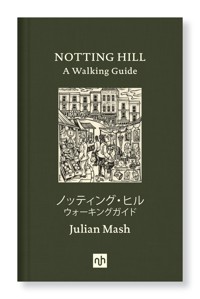
This bilingual guide to Notting Hill and Portobello Road is designed to take the curious wanderer through one of London's most bohemian districts. Through four themed walks, Julian Mash uncovers the history, culture, and little-known facts about this unique area. Featured photographs and hand-drawn maps, and a curated Directory of special places to visit, this is an essential handbook for visitors and residents alike.
Sie lesen das E-Book in den Legimi-Apps auf:
Seitenzahl: 81
Veröffentlichungsjahr: 2017
Das E-Book (TTS) können Sie hören im Abo „Legimi Premium” in Legimi-Apps auf:
Ähnliche


















NOTTING HILL A Walking Guide
–
Julian Mash
For my parents: John and Annie
Contents
Kim Kremer
– Preface –
Notting Hill Editions was founded by my father Tom Kremer in 2011. Tom began his commercial life in Notting Hill when he founded a toy invention company named Seven Towns, in Kensington Park Road in 1963. The company licensed both his own inventions and those of other creatives – Rubik’s Cube was one of his greatest successes (a puzzle he championed despite being told it ‘would never work’). Seven Towns continues to flourish today in its studios off Westbourne Grove.
Tom was born in Transylvania, and emigrated to Britain in the 1950s. He met my Scottish mother Lady Alison Balfour at Edinburgh University. There was an unlikely but immediate attraction between them: Alison used to say that she knew instantly that this strange, scruffy Hungarian would be a significant person in her life. Their relationship was frowned upon but they moved in together, unmarried and broke, and eventually settled in Notting Hill – a remarkably open-minded place even in the Fifties. They bought a run-down house in St James’s Gardens which had no running water, and rented a room to a professional gambler who paid the rent irregularly from his winnings. There, in that rambling, tall house, they brought up my brother, my sister and me. Our neighbours were an Irish laundress and an Italian restaurateur. The rag-and-bone man regularly drove by in his horse-drawn cart, calling for scrap.
Alison worked as a journalist and food writer, and Tom took odd jobs until he hatched Seven Towns in a moment of epiphany. Notting Hill was, and still is, a culturally rich and interesting area, a fertile place for new initiatives. Even as an eccentric Translyvanian Jew, Tom always felt at home and formed a strong and life-long attachment to the area.
After a successful business career in toy invention Tom decided, at the age of eighty, to fulfill his passion for literature. In a fast-moving digital world, Tom’s aim was to nurture the slower art of deep conversation and ideas-mongering. He set out to revive the art of the essay, and to create exceptionally beautiful books that would be cherished. He named the venture Notting Hill Editions because he felt that this iconic name would resonate wherever it was heard. The company began its life at Newcombe House on Notting Hill Gate.
Tom asked me to join Notting Hill Editions in 2014, and we worked together until his death in 2017. Had he lived to see this book he would have said, ‘But of course! There is nowhere in the world like Notting Hill.’
Julian Mash’s book is a walk through the cultural, social and architectural history of this remarkable part of London. You can take your imagination for a stroll from the comfort of an armchair or put on your boots and tread the pavements, as you follow in the footsteps of Notting Hill’s iconic and revolutionary residents. Welcome to Notting Hill, and happy walking!
Julian Mash
– Introduction –
Walking is the best way to explore and make sense of a city. There is no barrier to entry. No ticket is required. Select some comfortable shoes; choose a route or area; and away you go. Whenever I visit an unfamiliar city I try to walk as much as I can, sometimes with no clear destination in mind. This can lead to some startling discoveries that would never have happened had I simply gone from A to B.
I have lived in London for the past fifteen years, over a decade of which has been spent in Notting Hill, and I have found walking to be the best way to unlock the secrets of the neighbourhood. It is not just about what you will see when you walk, but who you will meet. I have made lifelong friends and connections by walking around the Portobello Road market, chatting to stallholders and seeing familiar faces in the local coffee shops.
When you live in a city it is all too easy to become stuck in old routines, wedded to certain routes that you walk over and over again. And with the rise of the smartphone many of us are cocooned in a digital world as we walk, listening to music or podcasts as we stroll, unaware of, or uninterested in, what lies around us. Think of this walking guide to Notting Hill as an antidote to the iPhone – designed to put you back in touch with your surroundings. In her book Wanderlust: A History of Walking, Rebecca Solnit describes how the activity should be ‘… a state in which the mind, the body, and the world are aligned, as though they were three characters finally in conversation together, three notes suddenly making a chord. Walking allows us to be in our bodies and in the world without being made busy by them. It leaves us free to think without being wholly lost in our thoughts.’
Notting Hill is perfectly suited to being enjoyed on foot and these four walks are designed to give you a feel for its rich and diverse history. The neighbourhood has changed dramatically over the last sixty years, transformed from a shabby, run-down district into one of the most desirable and expensive postcodes in the city. The four walks contained here are arranged thematically – think of them as snapshots of the recent past. You will learn about the origins of the Notting Hill Carnival that takes place every August Bank Holiday weekend; you will walk the length of the famous Portobello Road Market, discovering how it has evolved over the years and meeting some of its longest-standing traders; you will visit some of the neighbourhood’s iconic buildings and learn about the lives of the people who lived in them; and you will be introduced to the wealth of culture the area has spawned in film, music and literature – from Hawkwind to Hugh Grant.
Waves of gentrification have altered the neighbourhood greatly over recent years, but despite these changes, it retains a unique character and charm that the influx of money cannot eradicate. I agree with the words of the protagonist in G. K. Chesterton’s locally set novel The Napoleon of Notting Hill: ‘There has never been anything in the world absolutely like Notting Hill. There will never be anything quite like it to the crack of doom. I cannot believe anything but that God loved it as He must surely love anything that is itself and unreplaceable.’
WALK 1
– The Market –
1. Barham Antiques, 111 Portobello Road. 2. Virgin Records HQ, Vernon Yard Mews. 3. The Portobello Estate. 4. The Red Lion Arcade, 165–169 Portobello Road. 5. Junction of Talbot Road and Blenheim Crescent – the main venue for street entertainment and political demonstrations in the early 20th century. 6. Canopy under the Westway, vintage market Friday/Saturday. 7. Acklam Village Market. 8. I Was Lord Kitchener’s Valet, 293 Portobello Road. 9. George’s Portobello Fish Bar, 329 Portobello Road.
Walking the length of Portobello Road from Notting Hill Gate in the south, to Golborne Road in the north is one of the best ways to explore the neighbourhood. There is nothing more enjoyable than to spend a day navigating the market stalls that appear, as if by magic, overnight and populate this stretch of West London. Fridays and Saturdays are traditionally the busiest days for the market, though Sunday is increasingly popular. Each section of the street has its own distinct character and speciality – from vintage clothes underneath the Westway canopy, to street food on Golborne Road; and the arcades between Westbourne Grove and Elgin Crescent, which sell every kind of collectable and antique imaginable. Portobello is known the world over as one of the biggest antique markets in the UK, with over a thousand dealers attracting 100,000 visitors a week. Consequently, it can take a while to walk anywhere on market days, so be prepared for the crowds and expect a slow stroll rather than a brisk walk. Whilst Portobello Road has seen some major changes over the last ten years, losing some of its best-loved independent shops, and witnessing the arrival of High Street chains, it retains a raffish, bohemian charm that marks it out as a unique corner of London.
So, let’s get started. Make your way to Alice’s Antiques at 86 Portobello Road. Alice’s is one of the oldest antique shops in the neighbourhood, dating from a time when most of this stretch was dominated by the trade. Those that remain, including Barham Antiques at 111 and Judy Fox at 81, offer an insight into how things used to be – the owners are all friends, helping one another out with deliveries and sending customers to whichever one best suits their needs. The antique trade sprang up here in the post-war era when rents were cheap and many traders started out with market stalls before graduating to shops. That was the case with Barham Antiques at 111 Portobello




