


18,99 €
Mehr erfahren.
- Herausgeber: John Wiley & Sons
- Kategorie: Geisteswissenschaft
- Sprache: Englisch
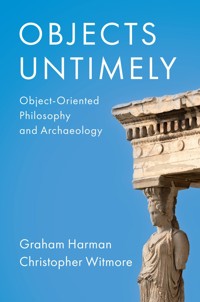
Objects generate time; time does not generate or change objects. That is the central thesis of this book by the philosopher Graham Harman and the archaeologist Christopher Witmore, who defend radical positions in their respective fields.
Against a current and pervasive conviction that reality consists of an unceasing flux – a view associated in philosophy with New Materialism – object-oriented ontology asserts that objects of all varieties are the bedrock of reality from which time emerges. And against the narrative convictions of time as the course of historical events, the objects and encounters associated with archaeology push back against the very temporal delimitations which defined the field and its objects ever since its professionalization in the nineteenth century.
In a study ranging from the ruins of ancient Corinth, Mycenae, and Troy to debates over time from Aristotle and al-Ash‘ari through Henri Bergson and Alfred North Whitehead, the authors draw on alternative conceptions of time as retroactive, percolating, topological, cyclical, and generational, as consisting of countercurrents or of a surface tension between objects and their own qualities. Objects Untimely invites us to reconsider the modern notion of objects as inert matter serving as a receptacle for human categories.
Das E-Book können Sie in Legimi-Apps oder einer beliebigen App lesen, die das folgende Format unterstützen:
Seitenzahl: 473
Veröffentlichungsjahr: 2023
Ähnliche
















CONTENTS
Cover
Title Page
Copyright
Acknowledgments
Preface
Notes
1 Time and Objects
Notes
2 The Antiquity of Time: Objects Greek
A. Line: History, Archaeology, Time
B. Segment(s): From Nafplion to Kazarma 2012
C. Pleats and Rents: Mycenae 2014
D. Things: Contiguities, Symbioses, Emergence
E. Percolation/Time
F. An Archaeological Paradox
Coda
Notes
3 Discussion of Chapter 2
Notes
4 Objects as the Root of Time
A. The Quadruplicity of Time
B. Critiques by Wolfendale, Gratton, and Kleinherenbrink
C. McTaggart on the Unreality of Time
D. Process, Retroaction, and the Status of the Past
Notes
5 Discussion of Chapter 4
Notes
A Note on Models of Time
Notes
References
Index
End User License Agreement
List of Illustrations
Chapter 1
The Archaic temple at Corinth
The Lechaion Road, Corinth
Chapter 2
Kastrakia
The cyclopean bridge at Galousi
Kazarma Hill with the bare heights of Arachneo in the background
The Kazarma Fortress
The Kophino Valley
Shaft graves, Mycenae
The multitemporal walls of Mycenae
Chapter 5
An abandoned fishing boat from Svaerholt, Norway
Guide
Cover
Table of Contents
Title Page
Copyright
Acknowledgments
Preface
Begin Reading
A Note on Models of Time
References
Index
End User License Agreement
Pages
iii
iv
vi
viii
ix
x
xi
1
2
3
4
5
6
7
8
9
10
11
12
13
14
15
16
17
18
19
20
21
22
23
24
25
26
27
28
29
30
31
32
33
34
35
36
37
38
39
40
41
42
43
44
45
46
47
48
49
50
51
52
53
54
55
56
57
58
59
60
61
62
63
64
65
66
67
68
69
70
71
72
73
74
75
76
77
78
79
80
81
82
83
84
85
86
87
88
89
90
91
92
93
94
95
96
97
98
99
100
101
102
103
104
105
106
107
108
109
110
111
112
113
114
115
116
117
118
119
120
121
122
123
124
125
126
127
128
129
130
131
132
133
134
135
136
137
138
139
140
141
142
143
144
145
146
147
148
149
150
151
152
153
154
155
156
157
158
159
160
161
162
163
164
165
166
167
188
189
190
191
192
193
194
195
196
197
198
199
200
201
202
203
204
205
206
207
208
209
210
211
212
213
214
215
216
217
218
219
220
221
222
223
224
225
226
Objects Untimely
Object-Oriented Philosophy and Archaeolgy
Graham Harman and Christopher Witmore
polity
Copyright © Graham Harman and Christopher Witmore 2023
The right of Graham Harman and Christopher Witmore to be identified as Authors of this Work has been asserted in accordance with the UK Copyright, Designs and Patents Act 1988.
First published in 2023 by Polity Press
Polity Press65 Bridge StreetCambridge CB2 1UR, UK
Polity Press111 River StreetHoboken, NJ 07030, USA
All rights reserved. Except for the quotation of short passages for the purpose of criticism and review, no part of this publication may be reproduced, stored in a retrieval system or transmitted, in any form or by any means, electronic, mechanical, photocopying, recording or otherwise, without the prior permission of the publisher.
ISBN-13: 978-1-5095-5656-4
A catalogue record for this book is available from the British Library.
Library of Congress Control Number: 2022943168
The publisher has used its best endeavors to ensure that the URLs for external websites referred to in this book are correct and active at the time of going to press. However, the publisher has no responsibility for the websites and can make no guarantee that a site will remain live or that the content is or will remain appropriate.
Every effort has been made to trace all copyright holders, but if any have been overlooked the publisher will be pleased to include any necessary credits in any subsequent reprint or edition.
For further information on Polity, visit our website:politybooks.com
Acknowledgments
This book has benefited from conversations with Levi Bryant, Ewa Domanska, Gavin Lucas, Laurent Olivier, Bjørnar Olsen, and Michael Shanks. We are grateful to Gavin and Bjørnar for their comments on Chapters 1 and 2. We also thank two outside readers for their invaluable feedback on the book as a whole: one of them Jon Cogburn at Louisiana State University, the other still anonymous.
Preface
The spark for this book originated during a visit by Harman to Lubbock, Texas in February 2014 to give the prestigious Haragan Lecture at Texas Tech University. Over the two-day course of this visit, we conversed on a number of occasions about philosophy, archaeology, and the concept of time, the challenge posed by object-oriented ontology (OOO) to anthropocentrism, and the various ways in which archaeology was engaging with OOO while taking leave of a modernist historicism. Witmore invited Harman to discuss time in relation to OOO, while contemplating a few archaeological examples, in an open interview that was audio recorded. As the conversation went on, it became patent that we shared an understanding of time as generated by objects rather than encompassing them.1 By the interview’s end, we agreed that this axiom – objects generate time – warranted a deeper exploration in light of both archaeology and OOO. The first fruits of this endeavor appear here as Objects Untimely.
That we consider the objects to which the present book is devoted as untimely can be justified on multiple grounds. Against the current and pervasive conviction that reality consists of an unceasing flux, associated in philosophy with New Materialism, OOO asserts that objects of all varieties are the bedrock of reality from which time emerges.2 Against the narrative convictions of time as the course of historical events, the objects and encounters associated with archaeology resist the very temporal delimitations which have defined the field and its objects ever since its professionalization in the nineteenth century. Against the current tendency to treat time as deep, this book articulates a time that is counterintuitively superficial; as Chapter 1 will explain, this has nothing to do with Plato’s contrast between time and eternity. Finally, it is also anything but timely to consider a field routinely defined as “the study of the human past through its material remains” on the grounds that all that exists are objects here in the present, and that they cannot be reduced to their pasts.
It is true that within the history of ideas, there is a sense that the exchange between philosophy and archaeology has been far from balanced. For the archaeologist who holds that philosophy seems to have rarely concerned itself with the archaeological endeavor, it would be easy to cast blame upon their fellow practitioners. Not only could they argue that archaeologists – laboring in the shadows of history – have given philosophers little cause to see their soil-encrusted objects as anything other than yoked to the past, burdened by allegory and historical expectation. They could also resign themselves to the all-too-common opinion that theoretical concerns within archaeology are little more than derivative, insofar as the archaeological application of philosophical ideas rarely comes back to impact philosophical developments.3 The philosopher who comes to ponder this imbalance could just as easily denounce their own field for an overemphasis on the human subject, one that has contributed to a neglect of things. This is a neglect that, in the case of archaeology, was further intensified by the tarnish of entropy, the banality of random detritus, the grimy dregs of oblivion, or the treatment of downcast ruins as a canvas where deeply held fantasies might be satisfied. To be sure, a closer look would reveal the inadequacies of these exaggerated impressions. One could contend that the allure of archaeology is critical to modern philosophical thought.4 But more than this, there are also numerous philosophers who have given serious consideration to the field – R.G. Collingwood, Merrilee Salmon, and Alison Wylie, among others – in terms of the philosophy of history, science, or language.5 This book does not seek to balance scales. But if forging connections and mutual understandings comes about by actively engaging in generous and open-minded conversation, it will already help to pique curiosity by showing that both fields are not what one expects them to be.
Objects Untimely takes shape over the course of five chapters. In Chapter 1 we explore the grounds for the book in more detail, with a brief discussion of time and objects in archaeology and philosophy. We move from a consideration of archaeological clockmaking through the example of Ancient Corinth to the place objects hold with respect to the past. Turning to philosophy, we find a recapitulation of Harman’s longstanding thesis that Martin Heidegger possesses no conception of time at all; the Heideggerian temporality of thrown projection is contrasted, in particular, with the philosophy of time found in Henri Bergson. Against the New Materialist conception of reality as being in constant flux, there is a discussion of the occasionalist tradition in which reality consists of a series of static though ephemeral poses that quickly pass away into something else. As another way of accounting for the irreversibility of time, the discussion moves on to the views of Lynn Margulis on serial endosymbiosis: when two previously autonomous organisms form a symbiotic union, we know we have stepped forward into a new world. Against this philosophical background, we contemplate a number of archaeological examples in which time arises from objects rather than the reverse.
In Chapter 2, “The Antiquity of Time,” Witmore explores the fraught relation between archaeology and history, both of which ostensibly deal with the past, to offer a different understanding of archaeology and the time that is generated by things. Over the course of six discrete sections, Witmore moves through the line of disciplinary history, following a path whose route complicates the sequential model of time: through a temporal topology of the storied citadel of Mycenae, with the times of things found in the course of the citadel’s excavations, onward into Michel Serres’ notion of time as percolation, and finally towards a different definition of archaeology as exploring the antiquity of time alongside objects themselves.
In Chapter 3, Harman and Witmore shift to a dialogue format to discuss the implications of Chapter 2, beginning with the idea of an archaeology that is not primarily the study of the human past. For Witmore, archaeology is very much a discipline of the present that works with what is still available to us in order to imagine what might have been. The discussion ranges from the traditional Three Age System of Stone, Bronze, and Iron, to James G. Frazer’s apparently linear conception of magic and then religion giving way in turn to science, to a possible tension between the notions of time as percolation and as topology found in the writings of Serres. Among other topics, Harman and Witmore discuss how periodization is established in archaeology, the discursive topography of the discipline, and how a situation where politics has become first philosophy drove some kindred spirits twenty or so years ago to return to things, under the influence of Serres and Bruno Latour. In closing, the authors discuss Harman’s assessment that archaeology is best viewed as a “cold” medium in Marshall McLuhan’s sense, since certain aspects of the discipline are lacking in completeness of detail.
In Harman’s Chapter 4, “Objects as the Root of Time,” he presents his view that time belongs to the surface rather than the depth of reality. This implies no denigration of time, since for OOO the surface of the world is the only place where anything can happen. After a summary of the fourfold model at the heart of OOO, of which time is one part, Harman responds to three specific critiques of the OOO model of time, as formulated respectively by Peter Wolfendale, Peter Gratton, and Arjen Kleinherenbrink. From there the chapter shifts to the much-discussed theory of the unreality of time proposed by J.M.E. McTaggart, supplemented by the OOO critique that his perspective shares too many of the assumptions of classical Empiricism. After giving an analogy of intermittently moved chess pieces to depict how objects are not actually in a state of constant flux, the chapter closes with a discussion of so-called “process philosophies,” a term that mixes two very different types of theories: (a) the true philosophies of constant temporal flux, as with Bergson and his later devotees Gilbert Simondon and Gilles Deleuze, and (b) those of Alfred North Whitehead, Latour, and even Heidegger, who are fully aware that reality changes frequently, but whose models of time focus instead on the internal complexity of individual instants.
Chapter 5 returns to dialogue format, recapitulating some of the alternatives to linear or sequential time already discussed: percolating, topological, and cyclical. What, Witmore asks, might OOO add to these alternatives? Harman offers three answers: (1) an epochal conception of time grounded in the constant change of human generations; (2) the possibility of a calmer relation to time (given that much of what happens proves to be unimportant) as opposed to the almost crazed models of constant flux that are currently in fashion; and (3) a conception of time as frequently reversible, given the constant possibility of reviving or retrieving seemingly dead past realities. Pressing forward into the central problem of how changes along the surface of reality can have retroactive effects on its depth, it is argued that all causation can be interpreted as the retroactive effect of a whole on its parts.6 Against the recent tendency to favor change and flux as the basic constituents of reality, it is argued that we need to turn our focus to the surprising stability of the cosmos. The book closes with a summarizing note on the various conceptions of nonlinear time that have been introduced.
Notes
1.
Harman 2010b; 2011; Witmore 2006; 2007; 2015; 2020a: 37–57.
2.
See for instance Bennett 2010; Nail 2018; Raud 2021.
3.
It would not be unfair to state that an engagement with continental philosophy during the latter half of the twentieth century turned eclectic (cf. Holtorf and Karlsson 2000; see Edgeworth 2012).
4.
See González-Ruibal 2013; also Webmoor 2015.
5.
Of course, in many cases these philosophers were also trained as archaeologists (see Hodder 1995; Wylie 2002; Wylie et al. 2013; Kobayashi and Marion 2019).
6.
This theme is already found in such works as Husserl’s
Formal and Transcendental Logic
and Alain Badiou’s
Logics of Worlds
, but is perhaps just as explicit in Manuel DeLanda’s notion that real assemblages can have retroactive effects on their own parts (DeLanda 2006). This may be the clearest hint of a solution to the workings of retroactivity, and is developed further in Harman 2010b.
1Time and Objects
Graham Harman and Christopher Witmore
Objects generate time. This axiom grounds the exploration that follows, and while it constitutes the basis of a shared understanding between archaeology and OOO, it inverts what is currently conceivable, due to the primacy both fields tend to bestow upon time. Such an axiom cannot avoid stoking the flames of present-day controversy in either archaeology or philosophy. Still, when considered in relation to the history of these disciplines, the importance of this principle becomes clear. Archaeological thought has always endeavored to situate human societies in time, which ultimately was also a matter of situating ourselves. We who live in the present were secure in our position at the end of the long sequence of events whose distance from us was measured in years, centuries, and millennia. For two hundred years, modern archaeology built its trade on foundations laid through its own clockmaking, in the form of a periodization established on the basis of old things, treated as proxies for the past to which they were assumed to belong.1 In seeking out the age of extant remains, nineteenth-century archaeologists – following in the footsteps of antiquarians – fixed the contours of historical epochs to temporal coordinates derived from texts, themselves regarded as sources. While the chain of successive historical events served as the model for earlier periods and non-textual traditions – worked out stratigraphically on the basis of differences in found objects – the historical text as an intermediary (equally valid when copied, multiplied, or digitized) served as an exemplar for how archaeological things were treated as sources for a particular past.2
In recalling the circumstances of early archaeological clockmaking, one recognizes how it was (and continues to be) bound foremost to specific localities. By searching for what had become of a particular past, nineteenth-century archaeologists (in Greece, for example) ventured to those places where they already knew what might be found. Prefigured in a long tradition of antiquarian readers of ancient texts, archaeologists pushed beyond what remained on the surface at sites like Ancient Corinth.3 Beginning with excavations in the shadows of Doric columns, they worked to reveal what had (according to Benjamin Powell, a fellow of the American School of Classical Studies at Athens) “survived the changes and chances of time unto our own day.”4 On either side of what is believed to have been a synoecism in the eighth century BCE, archaeologists eventually found evidence of Prehistory – Neolithic, Helladic, and Early Iron Age – as well as History. The latter followed the familiar cadence of the Archaic, Classical, and Hellenistic down through the Roman destruction of 146 BCE, which was trailed by the founding of a Roman Corinth in 44 BCE, and so on. Each period formed a separate link in a chain of terminations and replacements that gauged time’s passage up to the present.
The Archaic temple at Corinth
Through archaeology’s own labors, time displayed the familiar features we now associate with modern historicism.5 It was linear: for the past, which was held to be separate, demarcated, and distinct, remained at a measured distance. It was successive: for periods were arranged sequentially, and tethered to their locations, while the objects they contained continued to sink deeper into the abyss of the past. The arrangement of archaeological objects into their temporal compartments expanded beyond matters of chronological metrology, for it invited us to contemplate their erstwhile existence over yonder; it tied what was found at places like Ancient Corinth to the circumstances of a given historical period; it suggested limits to their being within a specified timeframe, impacting the circumstances within that capsulized past, and perhaps affecting subsequent periods up to a definitive terminus-transition, such as the coming of Christianity.
Of course, there is a great deal of truth to this image of succession in a fossilized city like Ancient Corinth, where the oldest levels of abandonment tend to be buried below more recent accretions. In effect, the superposition of heterogeneous structural forms lent itself to the notion that the true identity of archaeological objects belonged to an arbitrary sliver cut from the continuum of time.6 The questions posed by archaeologists reinforced this image. To what era does the Doric temple standing at the center of Ancient Corinth belong? Do transformations around the bases of its columns relate to the Roman resettlement of the site? The first question seeks temporal coordinates, and the answer keeps them there. To label a ruin “Archaic temple” suggests to us that the seven columns and other remains on Temple hill belong to a particular block of time. To link a nearby surface to the “Roman resettlement” suggests that it is only knowable in historical terms.
To be sure, archaeologists posed questions of time in other ways. Were those surfaces revealed around the bases of its columns residues of a particular event, or aggregates of multiple events? How long did it take to produce the vestiges that were encountered here by archaeologists? These questions suggest that whatever old things happen to persist in the present are to be understood as consequences or products of activities in the past, thereby according a separate past primacy over what is found here in the present. Are archaeological surfaces and vestiges derivative of a particular moment or sequence of events long passed? Do they owe their existence solely to the efforts of those who lived at another time? By situating objects in time, archaeologists reinforced the old Platonic notion that time was independent from those things that were placed within it.
Archaeological clockmaking would widen to encompass larger areas, whether in Greece or elsewhere, first by comparing the results from the excavation of different sites, and later by surveying the areas in between. Yet the tenacity with which modern historicism was maintained by archaeologists was tied to the structural organization of the field. Primal and external, the continuum of time took on definitive shape through archaeological labors, while those different compartments structured their own divisions of labor, as practitioners continue to be defined by their specific period of study. This, of course, is not without good reason: for without the toil of period specialists, changes over the long term of millennia would be far less comprehensible, whether in Greece or elsewhere. Nevertheless, while practitioners were beneficiaries of how they structured history, the way history was measured reinforced the notion of time as a basic structural dimension of reality. Given how archaeologists were consigned to their various periods from deepest prehistory down to the present, who among them did not regard their craft as the study of the past through its material remains?
We will return to these points in Chapter 2. For our purposes here, it is worth noting briefly that archaeologists came to recognize their objects less as offering glimpses of the past as it was, and more as affording suggestions as to what might have been, on the basis of what had become of it.7 Lewis Binford gave the name the “Pompeii premise” to the assumption that material vestiges speak to the moment of their deposition.8 By classifying objects solely in terms of the making, use, and activity associated with human beings, archaeologists neglected the processes of formation, entropy, and accretion that have transformed sites like Ancient Corinth into what they are today.9 While this processual emphasis opened a way to conceive of their objects beyond the confines of any one moment or period, an entropic time served as a counter to the steady and consistent image of a homogeneous clock time.10 The pavement of the Lechaion Road – the cardo maximus of Roman Corinth – was buried under episodes of sporadic deposition where rates of formation varied between slow accumulations with a few centimeters of soil accruing over the course of centuries, and rapid accretions with catastrophic avalanches of debris amassing in the span of but a few hours. Complete gaps are not infrequent. Just as “great quantities of earth and mud” were left after an extraordinary rainstorm in August of 1906 reburied the excavated hollow of the Lechaion Road below the Archaic temple, subsequent clearing work by the Greek government removed any archaeological indication of it apart from what is now referenced in publication.11 In addressing the different temporal rhythms associated with the sporadic formation of the archaeological record, archaeologists emphasized time perspectivism (the latter refers to Geoff Bailey’s notion that different timescales relate to different features of behavior) and nonlinear dynamics (James McGlade and Sander van der Leeuw have, for example, sought to emphasize the variability of persistence and change).12
The Lechaion Road, Corinth
Formational theories were, by and large, the rearguard of an archaeology that continued to grant primacy to a past consisting of static stratigraphic units regarded as derivative of those dynamic processes that gave rise to them.13 In many ways, these theories anticipated a pervasive emphasis among archaeologists today on process-first philosophies where the stability of objects, human or otherwise, takes a backseat to that incessant kinesis on the carousel of becoming. We have more to say about these theories below in relation to their philosophical background. But the second-rate status granted yet again to things more than legitimates the need for a conversation between archaeology and philosophy.
Returning to Ancient Corinth, we may note a few more points with respect to archaeology and time. First, change can only stand out against a stable background. The seven standing columns that continue to uphold a portion of the architrave above the archaeological site of Ancient Corinth have constituted parts of the peripteral temple now associated with Apollo; they have persisted where others were quarried as stone; they lingered to delimit an estate in Ottoman Corinth; they offered themselves as objects of antiquarian scrutiny and modern Greek heritage. Even as Roman surfaces were buried, the road persisted in form, impacting the orientation of medieval buildings and enduring as the route to the coast, which is said to have remained in use until the earthquake of 1858. Stone columns and buried road surfaces can neither be reduced to a particular moment nor to a protracted portion of a continuum, for they persist as objects amidst change. Second, when one ponders archaeological considerations of time, at root the most basic question pertains to the age or duration of a particular object. How old are the Doric columns and remaining portion of the architrave? For how long did the form of the Roman road persist? Neither question can be posed without the objects that elicit them, but it is also the case that these objects do not retain unequivocal chronicles of their age: this requires the work of archaeology. We will return below to the issue of how archaeology seeks to answer such questions by explaining such objects in terms of those that do offer a measure of their duration, which is translatable into calendar time. Here we have simply provided some ground for understanding the place of objects in relation to time in archaeology. In order to begin the task of understanding how time is generated on the surface of objects, we will now turn to philosophy.
Here it is appropriate to first say a word about Heidegger and his theory of time. Heidegger is often seen as a champion of dynamic temporality in opposition to stasis, as someone who converts sluggish nouns into active verbs, and as a general advocate of ceaseless historical flux and becoming. After all, his major book is called Being and Time, and this title seems to hint at a replacement of the Ancient Greek tradition of motionless being with a more processual conception of reality.14 In fact, the real situation is quite different.15 We can see this by contrasting Heidegger’s position with that of a true champion of the ever-flowing river of change in philosophy: Bergson, whose ideas reached a new vogue in the late twentieth century through the influence of Deleuze.16
Heidegger is often associated with the phrase: “Time is not a sequence of now-points,” which is one way he puts it in Being and Time. This also sounds like something that Bergson might conceivably have said, given his constant critique of the model of time as a cinematic sequence of frozen, statuesque poses. Nonetheless, if they had ever met and conferred on this point, issuing a joint press release saying that “time is not a sequence of now-points,” they would have meant very different things by this phrase. For it turns out that the two have nearly opposite models of time. From the Bergsonian standpoint, of course, one can never really break time down into “nows.” Imagine choosing two successive instants of time, as close as you want to make them. For Bergson, something would always happen between these two instants; in fact, there are no instants of time at all. Motion is ongoing and cannot be reconstructed through any series of poses, no matter how tightly we might try to pack them together. One could say the same for Deleuze, or for any other philosopher who makes “becoming” primary. Another good example would be Deleuze’s fellow Frenchman Gilbert Simondon, who is gaining in popularity now that his major book is finally available in English.17
There are surprisingly ancient roots to this model of time. For although Bergson often has critical things to say about Aristotle, the Aristotelian conception of time is the same as his own on this particular point. The Physics is where Aristotle discusses time in greatest depth.18 He argues there that time is fundamentally a continuum, meaning that one cannot break it up into individual points except “potentially.” How many distinct moments are there in the reading or writing of this book? Are there three? Are there a thousand? Or are there a million? For Aristotle it is entirely arbitrary how we decide to cut up this stretch of time, because time does not consist of any definite number of units. Among other things, this is the method he uses to dispose of Zeno’s famous paradoxes, in which Achilles can never catch up with the turtle and an arrow can never move towards its target. But there are other continua for Aristotle as well. Space is also a continuum: for example, you cannot say that there are exactly five parts or seven parts of the room in which you are currently sitting, since the room is a single continuous space that can only be carved into parts in a more or less arbitrary way. Becoming, too, is a continuum. No one can slice up the development of an organism into any definite number of parts, although, interestingly, Aristotle adds that this does not mean that all becoming is gradual: the dam bursts suddenly after a long build-up of pressure. And finally, number is a continuum for Aristotle. How many numbers are there between 0 and 100? The answer is once again arbitrary, since it depends on how large our intervals of counting are. We can count by integers, halves, tenths, or any increment as large or small as we please.
Yet, crucially enough, Aristotle does not say the same thing about substances, which are the key topic of his Metaphysics, and which survive – in heavily modified form – as the real objects of OOO.19 How many people are in your room right now, yourself included? The real answer is one, two, seven, or some other definite number. We cannot proclaim that some arbitrary number of people are present, in the manner we do when speaking of space, time, or number. This is one crucial way that Aristotle differs from many philosophers of becoming, who also want to absorb what used to be called substance into a continuum as well. They might speak of a “pre-individual” realm as Simondon does, or they might suggest, in the manner of the anthropologist Tim Ingold, that objects such as landscapes are “continually in formation, shaped by concurrent processes – of work and rest, of seasonality, of growth and decomposition, building and ruination, erosion and deposition – that are going on now as they have ever done, and that their rhythmic resonances describe the passage of time.”20 One might venture even further in the manner of Bergson or Karen Barad, saying that the world is carved up into objects only by means of practical activity: by making an “agential cut,” in Barad’s terminology.21 Others agree that there is initially a swirling, turbulent whole and that our minds are what cuts things up into parts, as in the early Emmanuel Levinas or the mature work of Jane Bennett.22 But how is it that our minds are separate enough from this whole to be able to carve it up in the first place? This is a question that such positions cannot really answer. To summarize, Aristotle notes a central duality that later philosophers try to erase: on the one hand reality consists of continua, while on the other there are also chunks, quanta, substances, distinct entities. Aristotle addresses the problem taxonomically, in the sense that he holds certain kinds of things (time, space, number, becoming) to be naturally continua and others (substances) to be naturally chunky.
At any rate, for Bergson it is impossible to break time into instants; time simply cannot be constructed from a series of instantaneous moments, since no such moments exist.23 Although it is widely assumed that Heidegger is making the same point, he is not. What Heidegger aims to show instead is that any given instant already has an ambiguous threefold structure made up of what he does call past, present, and future, but which no longer have the usual temporal sense of these terms. Far from dismissing the model of time as made of moments, he provides a new and fascinating basis for theories of time as made up of frozen poses. “Past” for Heidegger simply means that which is both given to us and partially concealed, that into which we are always already “thrown,” as he puts it. “Future” simply refers to the “projection” of possibilities that we humans make upon that past. When the authors of this book first met in a room on the campus of Texas Tech University, they were both thrown into the same situation in the same room, but they were projecting it differently, to use Heidegger’s term. The conversation meant different things for the two of them. Texas Tech was Witmore’s home institution, while for Harman it was his first-ever visit to Lubbock, Texas; one was host, the other was guest. This factor and many others made the situation very different for the two of them, despite their discussion of a common project. In short, that room on the Texas Tech campus was made up of a shared thrownness but with very different projections. The Heideggerian present is simply the combination of those two aspects, which is why “thrown projection” is another phrase that Heidegger uses to denote the now. Note the significant difference from Bergson here. For Bergson it is impossible to analyze an instant of time; for Heidegger, by contrast, the analysis of instants is the whole point. Orthodox Heideggerians usually assume that the threefold instant is somehow the “ground” for time in the usual sense of flowing alteration, but Heidegger never actually shows us how such a transition can occur. Although Heidegger the person was surely no advocate of a motionless universe, the Heideggerian philosophy never actually does the work of taking us outside the ambiguous threefold instant and establishing how it leads to change. If the universe were simply halted in its tracks and never altered again, the Heideggerian analysis of time would still be operative, whereas for Bergson such a thought experiment would be nonsensical and absurd. Historically speaking, Heidegger can be linked with the polar opposite of Bergsonian temporality: an appropriately discontinuous and heterogeneous group of thinkers belonging to the so-called “occasionalist” tradition, which originated in medieval Islam before returning in force in seventeenth-century Europe.24 It originated around the year 900 CE in Basra, in the thought of al-Ash‘ari. The powerful Ash‘arite theological tradition followed directly in his wake, and included the better-known Persian figure al-Ghazali (known as Algazelus or Algazel in Europe). This school of thought affirmed two central doctrines. The first was that God is not just the only creator in the universe, but the only causal agent at all. Although it appears that fire burns cotton, the meeting of these two materials is really just the “occasion” for God to burn cotton. This notion never caught on in medieval Europe, no doubt because of the serious consequences that follow for human free will and the corresponding rewards or punishments in the afterlife; the point awakened debate in Islam as well, but the Ash‘arites managed to hold their own or even prevail in that controversy. The second, related doctrine ingeniously held that one moment of time also has no causal link with the next, so that a continuous re-creation of the universe by God is needed in each instant.
With the seventeenth century the hour of occasionalism finally dawned in Europe.25 The Cartesian thinker Nicolas Malebranche is usually the key European name listed under the occasionalist heading.26 But traces of God as an all-powerful causal agent are ubiquitous in early modern European thought, including in such central figures as René Descartes, Baruch Spinoza, G.W. Leibniz, and George Berkeley.27 For a long time thereafter this current of thought lost all respectability in European philosophy, and it would be easy to assume that this was due primarily to Enlightenment skepticism regarding the very existence of God, let alone his purported causal monopoly on all events in the world. But in a sense occasionalism has never left us. What happened was that God’s causal monopoly was simply converted into a monopoly of the human mind. For David Hume, causation is something that appears only in experience and cannot be projected beyond its givenness to us, through “habit” formed from “customary conjunction.”28 Immanuel Kant continued along these lines, treating causality as nothing more than a category of the human understanding, so that we cannot speak about causal relations in the hidden world of the thing-in-itself.29
Occasionalism might still have been left to some dusty volume of the history of philosophy, if not for its astonishing return in the twentieth century. The key figure here is Alfred North Whitehead, who revived both of the central doctrines of occasionalism at the heart of his own philosophical system.30 Whitehead boldly rejected Kant’s assumption that the thought–world relation is the only one we can speak about clearly; for Whitehead the thought–world duality is just one relation, no different in kind from the causal impact between inanimate beings. This is already enough to make him the rare non-Kantian among the post-Kantians. Yet Whitehead took even more radical steps in the occasionalist direction. For one thing, he also rejected direct causal influence, claiming that one entity can only “prehend” (relate to) another through God, who Whitehead conceived as the repository of all “eternal objects” (roughly, universal qualities). For someone to perceive someone else’s purple shirt, for instance, it is necessary to pass through God, who contains the eternal object “purple”; nothing can interact directly with anything else. But Whitehead was also an occasionalist on the question of time. Note that his term for things that exist, “actual entities,” is doubled with what he treats as a synonymous phrase: “actual occasions.” Much like the original occasionalists, Whitehead insists that entities cannot “become,” since they instantaneously “perish” instead, and must be replaced by close successors that are different things altogether, even if very similar ones. There is little point worrying about the immortality of the soul, since each of us already dies every microsecond, or whatever we choose to call each isolated frame of time. Unfortunate confusion arises from the fact that Whitehead is widely and rightly called a “process philosopher.” After all, the word “process” certainly sounds a lot like “becoming.”31 Doesn’t this put Whitehead on the same side of the fence as Bergson and Deleuze, as a philosopher of radical flux? Not at all. Recall that for Bergson, to speak of time in terms of discrete cinematic frames is outright forbidden. But Whitehead – like Heidegger, in Harman’s reading – speaks of time precisely as consisting of moments. This is why the present-day tendency to link Whitehead with Deleuze – even by as formidable a reader of Whitehead as Isabelle Stengers – is off target.32 Thomas Nail is a rare exception among the present-day champions of flux, one who openly recognizes that Whitehead is not his ally.33 When it comes to the philosophy of time, Whitehead and Heidegger belong with the occasionalists in opposition to the Bergsonian school, which can ultimately be traced to the pre-Socratic philosopher Heraclitus, with his famous maxim that no one can step in the same river twice.
Enter Latour, who along with his close colleague Stengers is one of today’s great admirers of Whitehead. Latour like Whitehead incorporates both aspects of classical occasionalism into his philosophy, though with an important twist as concerns the first. This pertains to the topic of causation, which the classical occasionalists and Whitehead all route through God. Although Latour is a practicing Catholic who defends religion openly, he foregoes any divine solution to the problem of causal relations.34 For this reason he can be called the first “secular occasionalist” in the history of philosophy, whatever his religious commitments.35 In an especially brilliant chapter of his book Pandora’s Hope, Latour examines the case of Frédéric Joliot-Curie, son-in-law of Marie and Pierre Curie. The question at hand is what possible connection there could be between politics and neutrons, especially since neutrons were discovered by James Chadwick only in 1932. In a French context, at least, it was Joliot who first insisted on the crucial link between them, in his ultimately failed effort to gain funding for a French atomic bomb project.36 This does leave open the question of how Joliot can touch both neutrons and politics if they cannot touch each other, thereby leading to a possible infinite regress. But the important point is that Latour is the first to enable the possibility of local indirect causation not mediated by either God or the human mind, a topic that OOO has pursued with vigor.37
Latour is no less an occasionalist when it comes to the doctrine of time. Just as Whitehead tells us that entities perish instantly without ever really becoming, Latour also declares that everything happens only once, in one time and one place only.38 This idea is no stray artifact of Latour’s early career. Even in the 2013 An Inquiry Into Modes of Existence, the masterwork of his later period, Latour introduces as one of his fifteen modes “[REP]” (or “reproduction”): the radically anti-Bergsonian principle that everything must be brought back into existence continuously.39 In some sense you the reader may be the “same” person from infancy through childhood through maturity and old age, but only in a derivative, occasionalist sense: throughout your life you are actually perishing over and over again, and it would take some external observer to trace various similarities across your lived trajectory as a whole, even if you yourself act as that observer. To summarize, Latour could hardly be more of an occasionalist than he already is; he is as anti-Bergsonian and anti-Deleuzean as one can be. Perhaps someone could establish an important debt on the part of Latourian Actor–Network Theory (ANT) to the “rhizomes” of Deleuze and Félix Guattari’s Anti-Oedipus, but that debt could have nothing to do with the concept of time, on which Latour and Deleuze are diametrically opposed.40 In passing we should also note that while Whitehead and Latour accept both major aspects of classical occasionalism, OOO endorses only one of them.41 As concerns causality, Harman endorses what he calls “vicarious causation” and holds that occasionalism was rather profound in discovering a problem with direct causal relations.42 The same does not hold for time, which OOO does not see as made up of discontinuous and disconnected instants; time is a continuum, just as it is for both Aristotle and Bergson. Yet OOO inclines towards Aristotle, insofar as it endorses the existence of discrete individuals that remain partly robust in the face of temporal change. For Bergson, by contrast, individual objects are highly derivative, being generated primarily by human practical needs.
Most archaeologically inclined readers will no doubt be familiar with how Latour challenged the modern conception of linear time, in which the past was dramatically separated from us by Copernican revolutions and epistemic ruptures. By contrast with time as a succession of distinct eras where the past is posited as outside the present, he famously asserts in We Have Never Been Modern that “it is the sorting that makes the times, not the times that make the sorting.”43 Thus, for Latour, what we call time is not an empty Newtonian container moving forward with regularity regardless of what happens inside it. Instead, time is produced by the creation of an “asymmetry.” Time happens, for instance, when Antoine Lavoisier shows that water is not an indivisible element, but a compound made up of hydrogen and oxygen combined in fixed proportions of two to one. The history of France looks very different after the Revolution than it did before, or after de Gaulle’s triumphant re-entry into Paris following the dark years of Nazi occupation. But this does not imply total irreversibility; purportedly extinct forms often return to haunt us, long after being declared dead and buried. For the modern history of science, Louis Pasteur put a permanent end to the misguided idea of the “spontaneous generation” of bacteria inside sealed flasks. But this same idea, now dismissed as reactionary superstition, could well make a comeback in connection with prebiotics, as Latour himself has noted.44 There are other ways in which ancient things can persist amidst their supposed disappearance. Latour and Emilie Hermant’s book Paris, Invisible City gives the eye-opening example of the Rue Saint-André des Arts on the Left Bank in Paris, which follows the same curve as the Neolithic path along the edge of the former marshes.45 Of course, Paris is saturated by such examples. The Rue Saint-Jacques follows the cardo maximus of Lutetia, the old Roman town. Le Petit-Pont crosses the Seine at precisely the same site as the Roman bridge. The streets of the Latin Quarter and the Île de la Cité, today the 5th and 4th Arrondissements, hold memories of the ancient street grid as well as the ramparts, along with the shape of the forum and the amphitheater. Likewise, a building inhabits many different environments in its history, or even different civilizations if it is an especially durable building – such as the structure known as the Hagia Sophia in Constantinople and later the Aya Sofia in Istanbul, which has passed from church, to mosque, to museum, and now back to functioning mosque. By analogy, think of the Egyptian spring festival that began as the Shemu in Pharaonic times, which continued to be held by Coptic Christians on the day after their Orthodox Easter, and which even now is a national holiday in majority-Muslim contemporary Egypt. Schopenhauer says somewhere that we should never visit sites from our own past: they will always be disappointing, because what we are really nostalgic for is a time rather than a place. But is this really true? Visiting sites from one’s own past, or even humanity’s past, is rarely disappointing even if all the people are gone or dead, or still there but transformed in important ways.
The Acropolis is one such example: one might feel closer than ever to Ancient Greek philosophy when standing on the Acropolis. One can also still visit the house in Virginia where the Confederate general Stonewall Jackson died. At least in the late 1990s (and perhaps still today) the Virginia tour guide there would tell visitors: “Here is your connection to the past: this ticking clock is the same one that was next to Jackson’s bed when he died.” It is a remarkable experience to hear this clock, the last sound the notorious general heard on earth. And in Cairo there is the tourist attraction El Fishawy Café, which claims to have been in continuous twenty-four-hour operation since the time of Napoleon. Still, that the Acropolis stands today unencumbered by those things that accumulated there in post-Classical eras speaks to how the wreckage of the past piles up and is redistributed. In the case of the Acropolis, for example, one past advanced at the expense of many others. Its proximities to the Athens of the Classical period result from scouring away what had become of subsequent pasts. On the Acropolis we do not find the seventeenth-century equivalent of philosophy’s books: the material things of various succeeding eras (Roman, Byzantine, Venetian, Ottoman, post-independence) were all removed in the nineteenth century without, in many cases, even the most rudimentary catalogue. On the Acropolis it is all Plato. On some level, it is true that having all Plato is not such a bad thing: after all, Whitehead did describe philosophy as a series of footnotes to him.46 We may or may not agree as to the importance of some of these footnotes, so one question here is who decides which footnotes to carry forward. The sanctioned present state of the Acropolis, which amplifies the proximity of the fifth century BCE, demanded a destructive selectivity, one that has robbed us of those objects that would have stood as our own archaeological footnotes. To frame objects as belonging to a particular past requires that we downplay not only their post-history, but also the complete novelty of the present moment in which we encounter them, for a past never existed in the same way as what becomes of it in our present. Nietzsche penned the motto of those who, through a hatred of greatness within their own age, embrace the monumental conception of the past as “let the dead bury the living.”47
For those readers who are engaging with this book in the traditional paper format, there is also the longevity of the medium before you: in the form of codices, books usurped scrolls over a protracted period of time, between the first and fourth centuries CE. We can also understand this in terms of composition: paper dates to the beginnings of Imperial China, over two millennia ago, while for example the sans-serif typeface Arial was introduced only in 1982. Again, for Latour, time does not produce this sorting; rather, this sorting produces time. Yet there is no “time” for Latour in the flowing sense of Aristotle or Bergson. For Latour, whose notion of time as asymmetry was probably borrowed from Serres, there is no particular reason to see anything as flowing either backwards or forwards: it’s just that a particular asymmetry is created, so that irreversibility is the essence of time.
But here a great deal of caution is needed, since Latour also negatively links the idea of irreversibility with modernity: a period in which time is understood as a unidirectional movement towards either progress or decadence. Against this notion, whirlpools, eddies and countercurrents also make up the turbulent flow of time. This turbulence, in turn, can be linked with Serres’ idea of a proliferation of quasi-objects. For Serres, time does not simply pass away, but flows in an astonishingly complex and turbulent manner.48 Marked by periods of calm, thunderous accelerations, and countercurrents and eddies, time “percolates.”49 What might be very distant in linear time can be quite proximate from the standpoint of percolating time. Serres offers the image of an ironed and perfectly flattened handkerchief:
You can see in it certain fixed distances and proximities. If you sketch a circle in one area, you can mark out nearby points and measure far-off distances. Then take the same handkerchief and crumple it, by putting it in your pocket. Two distant points suddenly are close, even superimposed. If, further, you tear it in certain places, two points that were close can become very distant.50
This crumpled and torn manifestation is analogous to Paris, the house where Stonewall Jackson died, or the Athenian Acropolis. Archaeologists work with and contribute to such cases in their practice. Still, across all these examples, percolating time does not manifest itself as a true anachronism, such as would happen with placing anything from a codex to a MacBook Pro in Plato’s Athens.
Returning to Heidegger, we can clarify the situation in his case by contrasting him briefly with two of his most important historical neighbors: his former teacher Edmund Husserl (founder of phenomenology) and his later admirer Jacques Derrida (founder of deconstruction). Husserl has his own theory of time, as explained in his marvelous work The Phenomenology of Internal Time-Consciousness – edited for publication by the young Heidegger, of all people.51 Husserl’s primary motivation in this work was to push beyond the theory of time of his own mentor, the brilliant Austrian philosopher Franz Brentano, who was also the one-time teacher of Sigmund Freud. Brentano’s model of time was transmitted mostly in oral form, but showed the clear tendency to think of time as consisting only in the “now,” with past moments existing only insofar as they somehow leave traces in it. Husserl was more on the Bergsonian side of this debate, offering a theory in which the now also consists of a “retention” of the past and a “protention” of the future. Indeed, Husserl’s credentials as a thinker of continuous time are unimpeachable, as recognized even by his critic Derrida.52
But, in an important sense, Derrida gets both Husserl and Heidegger wrong when it comes to time. Let’s begin with Husserl. The main difference between him and his teacher Brentano, the very insight that makes full-blown phenomenology possible at all, is his discovery that experience consists of objects rather than contents. For Brentano, every mental act aims at certain experienced contents. Imagine that you are watching a horse running in a field. At any given point in time, you are seeing the horse from some particular angle and distance, with the sunlight reflecting off its coat in one specific way and no other. From the Brentanian standpoint the horse is effectively a “bundle of qualities” in the manner of Hume and British Empiricism. The horse as an “object” is nothing more than a series of family resemblances that remain invariant across time: the horse is always chestnut-colored, and always has a tail, but each momentary view of the horse is primarily a matter of detailed content that is constantly changing. This is why Brentano can think of time only in terms of a “now”; the horse is defined solely by all of its properties right now. The radical step taken by phenomenology is to say that the horse-object precedes the horse-content. The horse is primary; it has certain core qualities that can never change without our ceasing to recognize it as this horse. On top of that it has many qualities that we might call accidental: it does not matter if the horse stops reflecting the sun in exactly the way it does now, because you the viewer still see the same horse, regardless of these inessential details. The phenomenological analysis of a horse is supposed to strip away all these peripheral, shifting features in order to get at the essence of the thing (or eidos, as OOO will call it, since essence turns out to be something different). It is a lot like Aristotle’s distinction between essential and accidental, but applied purely to the phenomenal realm rather than the world of real substances.
Returning to Derrida’s assessment of the situation, he claims that Husserl – notwithstanding his solid Bergsonian credentials as a philosopher of constant change – remains stuck in the “now,” despite adding “retention” and “protention” to his account of time. But this is not the case. The fact that Husserl analyzes the “now” of time does not mean that it is a now of isolated, cinematic frames as with the occasionalist tradition. Instead, Husserl’s now is the so-called “specious present,” referring to our own sense of the now as we go about living: not a single instant, but a rather small duration that many researchers have tried to measure more precisely in various psychological experiments, though their conclusions have varied widely.53 In other words, for Husserl it is already the case that time is something generated by objects, which endure for a greater or lesser stretch but are always displaying different surface-properties




