


9,99 €
Mehr erfahren.
- Herausgeber: L’Altro Editore
- Kategorie: Geisteswissenschaft
- Sprache: Englisch
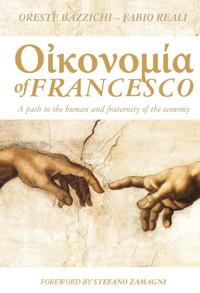
The essay shows a scenario where it appears that medieval society, starting with the monasticism of St. Benedict and continuing with the analysis of the Franciscan School, embraces the heart of the relationship between ethics, market and economy, despite the fact that Max Weber attributes to the influence of Calvinist ethics the origin of the spirit of capitalism. Therefore, from the books of the thinkers of the Franciscan School, whose conceptual elaborations are presented here, combined with some successful practical intuitions, such as the Monti di Pietà, lead to the assumption that the theory and practice of the market economy originated well before Calvin and the founder of economic science, Adam Smith (1776). The socio-economic debate of the Franciscan School can prepare a paradigm shift in the current economy on the path towards a humanism of fraternity. The reader will find the path aimed at enhancing expectations of justice in charity (Deus caritas est, 2005), in truth (Caritas in veritate, 2009), in sobriety, sustainability, integral ecology as lifestyles (Laudato sì, 2015) and in universal fraternity as a prophetic and social utopia (Fratelli tutti, 2020)
Das E-Book können Sie in Legimi-Apps oder einer beliebigen App lesen, die das folgende Format unterstützen:
Veröffentlichungsjahr: 2021
Ähnliche




















CONTENTS
FOREWORD
INTRODUCTION
CHAPTER 1 The XIII-XV centuries: an era of socio-economic and cultural change
1.1. Everyday life
1.2. The social and religious organization of the city
1.3. Civitas et negotia (City and business)
1.4. Monetary theories and doctrines
1.5. Thought of Europe
1.6. Aristotelianism and Thomist socio-economic thought
CHAPTER 2 Towards the social historicization of the Spirit: between Francesco of Assisi and Gioacchino of Fiore
2.1. Bonaventura interpreter of the thought of Gioacchino of Fiore
2.2. Principle of hope as a historical force
2.3. Reception and updating of Gioacchino’s thought
CHAPTER 3 Creativity, the inspiring light of Franciscan social and economic ethics
3.1. The Franciscan paradigm of creative liberty
3.2. Poverty
CHAPTER 4 Fecundity of Franciscan socio-economic and political thought
4.1. Social and economic lexicons and Franciscan thought
Peire de Joan-Oliu
John Dun Scotus
William of Ockham
4.2. Politics at the service of the community
CHAPTER 5Semina humanitatis(seeds of humanity) of Franciscan thinkers
5.1. The Franciscan socio-economic tradition: Bernardino of Siena and Antonino of Florence
5.2. From theory to practice: Monti di Pieta (Pawn banks)
5.3. Natural law and contractualism
CHAPTER 6 From Franciscan socio-economic thinking to civil and communion economy
6.1. The Neapolitan School
Antonio Genovesi
Ferdinando Galiani
6.2. The Milanese school
Pietro Verri
Ludovico Antonio Muratori
6.3. The Scottish School of Glasgow: civil society
Adam Smith
6.4. The decline of the civil economy
6.5. The project Economy of Communion in Liberty
CHAPTER 7 Franciscan socio-economic model: the Samaritan theorem and “Renunciation”
CONCLUSIVE CONSIDERATIONS
BIBLIOGRAPHY
INDEX OF NAMES
CONTENTS
ORESTE BAZZICHI – FABIO REALI
…Οἰκονομίαof Francesco…
A path to humanity and the fraternity of the economy
Foreword by Stefano Zamagni
© 2020 L’Altro Editore
All rights reserved.
© 2020 L’Altro Editore
The rights of translation, electronic storage, reproduction or adaptation in whole or in part by any means whatsoever are reserved for all countries.
No part of this publication may be reproduced, stored in a retrieval system, or transmitted, in any form or by any means, electronic or mechanical, including photocopying, recording and other means, except by a licensee authorized to reproduce the documentation following the terms of the license, or with the prior written permission of the copyright owner. For requests for permission, please contact the Publisher in writing at the following address: [email protected]
Copyright © 2020 L’Altro Editore
© 2020 L’Altro Editore is a brand of the Cooperativa Sociale Agricola “Informaetica”.
ISBN 9788894517903
First Edition: 04 October 2020
For error notifications or suggestions related to this volume, please contact us:
Cooperativa Sociale Agricola “Informaetica”
Via Giacomo Matteotti, 50
03039 Sora (FR)
The Social Cooperative Agricola “Informaetica”, a member of AIPEC, supports and implements integral human development projects in Cuba and Tanzania to create and generate a “humanism of fraternity”. The profits from the book will go to existing projects. Please support us with a donation!
By bank transfer:
Banca di Credito Cooperativo di Paliano - Sora Via Romana Selva, Snc Sora 03039 - FR
IBAN: IT 61 V 0871 77460 0000000040464
Graphics and layout: Marco Di Ruscio
Text revision: Catherine M. Dillon, Yosniel García Morrero, Rita dell’Unto, Sara Succhiarelli.
Finished printing in 2020 at
CANTICLE OF THE CREATURES
Most High, all-powerful, good Lord,
Yours are the praises, the glory, and the honour, and all blessing.
To You alone, Most High, do they belong,
and no human is worthy to mention Your name.
Praised be You, my Lord, with all Your creatures,
especially Sir Brother Sun,
Who is the day and through whom You give us light.
And he is beautiful and radiant with great splendour;
and bears a likeness of You, Most High One.
Praised be You, my Lord, through Sister Moon and the stars,
in heaven You formed them clear and precious and beautiful.
Praised be You, my Lord, through Brother Wind,
and through the air, cloudy and serene, and every kind of weather,
through whom You give sustenance to Your creatures.
Praised be You, my Lord, through Sister Water,
who is very useful and humble and precious and chaste.
Praised be You, my Lord, through Brother Fire,
through whom You light the night,
and he is beautiful and playful and robust and strong.
Praised be You, my Lord, through our Sister Mother Earth,
who sustains and governs us,
and who produces various fruit with coloured flowers and herbs.
Praised be You, my Lord, through those who give pardon for Your
love, and bear infirmity and tribulation.
Blessed are those who endure in peace
for by You, Most High, shall they be crowned.
Praised be You, my Lord, through our Sister Bodily Death,
from whom no one living can escape.
Woe to those who die in mortal sin.
Blessed are those whom death will find in Your most holy will,
for the second death shall do them no harm.
Praise and bless my Lord and give Him thanks
and serve Him with great humility.
Infinitely grateful...
Lidia and Patrizia with Love…
“But God has likewise destined man for civil society according to the dictates of his very nature. In the plan of the Creator, society is a natural means which man can and must use to reach his destined end. Society is for man and not vice versa”. (Pius XI,Divini Redemptoris, 19 March 1937)
“We believers feel in the depths of the soul, and it is urgent to proclaim it: whoever will definitively save society will not be a diplomat, not a scholar, not a hero, but a saint, indeed a community of saints”. (Blessed Giuseppe Toniolo, Trattato di Economia sociale e scritti economici I - V, Città del Vaticano, 1949)
This is the prophetic Blessing that Saint Francis pronounced over Assisi before he died and which you found written in Latin on the Porta Nuova, at East of Assisi:
“May the Lord bless you Holy City faithful to God because through you, many souls shall be saved, and in you, many servants of the Most High will dwell, and from you, many shall be chosen for the Eternal Kingdom”.
“It is no longer possible to claim that religion should be restricted to the private sphere and that it exists only to prepare souls for heaven. We know that God wants his children to be happy in this world too, even though they are called to fulfilment in eternity, for He has created all things “for our enjoyment” (1 Tim6:17), the enjoyment of everyone”. (Pope Francis,Evangelii gaudium, n.182).
FOREWORD
Stefano Zamagni
1. The book by Oreste Bazzichi and Fabio Reali, which is here presented to the Italian and international reader, is unique in its contemporary scientific panorama. It is a frontier work – mephòrios (he who stands on the border) would have been said in ancient Greece – between economy, history, philosophy, and theology. Is this an example of cultural exhibitionism? Quite the contrary. This corresponds to a precise methodological choice: the authors know well that economic discourse is an open structure in a double sense. On the one hand, its foundation does not belong to it, and therefore its assumptions are not scientifically justifiable, while its conclusions are justifiable. This is why no economic theory can claim to be unconditional and self-guaranteed. On the other hand, economics is an open science in the sense that it does not offer an exhaustive knowledge of the reality it deals with, and therefore it cannot fail to maintain close and good relations of proximity with other disciplines contiguous to it. Unfortunately, the path of reductionism overflowing with the economic mainstream, since the last century, has ended up disarming critical thought, with the results that this book does not fail to highlight.
The great theme around which the authors’ work is built well rendered by its subtitle: “a path to humanity and the fraternity of the economy”. The point of attack of the analysis of the authors’ is the eruption, at that time in civil Humanism, of that event of epochal importance that was the birth of the market economy, strictly understood as a specific model of social order and not merely as a marketplace, that is, as a physical place where exchanges take place - a place that already existed in ancient times. From the end of the twelfth century, it started - as we know - a process of a profound transformation of European society and economy that lasted until the middle of the sixteenth century. It began in Italy, in Umbria and Tuscany, but by the end of the thirteenth century, that process had already spread to other regions: in Flanders, northern Germany, and southern France. This was the period when the great mercantile awakening of the previous centuries, in itself linked to the invention of new models of machines capable of increasing productivity significantly, reached full maturity. The new model of social order that came into existence is known as the “urban civilization”, a model that owes much to the theoretical elaboration of what Garin and Pocock called the civil humanists.
These personalities are different from each other, by inspiration and background, but all united by the desire to interpret the res novae (new things) of their time in the light of the thought of the past. Monastic culture was the origin of the first economic vocabulary to spread throughout Europe in the late Middle Ages. The abbeys were the first complex economic structures, from which emerged the need to develop appropriate forms of accounting and management. The Cistercian movement, in particular, under the impulse of Bernard of Clairvaux, was enormously successful in competing with the “rival” abbey of Cluny in Burgundy before overcoming it. After leaving the abbey of Molesme, the Cistercians founded a new monastery in Citeaux in 1098, to build forms of life more in line with the Benedictine charism; there they found themselves immediately faced with two issues of an economic nature. The first of these concerned the approach to work. While for the Cluniacs subsistence had to be ensured by the work of the persons subordinated to them, the Cistercians claimed that it was illegal to live off the fruits of the labor of others. Hence the rejection of all forms of both annuity and tithes - the two primary sources of income for the Benedictines of Cluny. The second issue concerned the system of property ownership. While the Rule of San Benedetto assigned to the abbot the possession of all the goods (individual and collective) with which he had to provide for the needs of the monks, the Cistercians refused all properties, including that of churches and altars. The Carta Caritatis, one of the oldest texts of the order and considered the fundamental Cistercian constitution - the final document dates back to 1147 - is of unshakable firmness on this point. What is the consequence, certainly not intended, nor expected, of this dual attitude? That the lifestyle of the Cistercians, far from the luxury of the Cluniacs and marked by rigor and extreme poverty, ended up attracting the attention of the people who, convinced of the excellent use made of their gifts, flooded their monasteries with donations. As L. Milis documents1 (2003), within a few decades, Bernard’s followers found themselves prisoners of the contradiction that characterized their spirituality: sober life (and therefore low consumption) and highly productive work - the surplus they managed to obtain was higher than that achieved in traditional businesses - had created “an embarrassment of riches”.
It will be up to the Franciscans to find the way out of the embarrassment of riches, through the invention of the market economy. San Francesco, founder of a hermits’ movement, transformed, with rapid development, in a mendicant order, takes in from Bernard both the principle according to which the contemplantes (contemplation) must also become laborantes (laboring), and the rule for which the friars had to renounce even common property. However, a fundamental point stands out: if one wants to find an alternative to the surplus generated in agriculture and mercatura (trade and commerce), and thus overcome the embarrassment of riches, it is necessary to expand the space of economic activity so that everyone can participate. That is, we need to get to the cities, where most of the population to be evangelized lives, creating markets, with all that it involves at the institutional level.
2. A severe fact that characterizes our time is the continuous expansion in our society of the area of social exclusion. In the message to the plenary of the Pontifical Academy of Social Sciences2, Pope Francis focuses on some specific areas of exclusion. A first area is the one that calls the territories into question. What is the symptom of the appearance in the lexicon and political practices of the last thirty years in terms such as sovereignty, nationalism, primacy, populism - words that were thought to have become outdated and therefore no longer proposable? The fact that megalothimia has, for some time, been overtaking isothimia. Some clarification is appropriate. Plato taught us that the fundamental need of the human being is that of recognition (thimos, in fact): we first need to be recognized in our identity and, in this way, understand others. (The animal does not feel such a need: the need for food is its priority). However, there are two forms that recognition can take: that of recognizing oneself as equal to all others in dignity and in the title of rights (isothimia, in other words) and that of accepting oneself, instead, as superior to other subjects (megalothimia). I do not have the time here to illustrate the causes of this dangerous phenomenon. I would just like to point out that one of these is widespread in the meritocratic myth. Grave is the responsibility of those who, not distinguishing between meritocracy and meritoriousness, have let believe that if someone falls behind in the social race and is even discarded (the “human discards” of which Pope Francis speaks), the “guilt” is their own and therefore they can only expect some help from compassion, be it public or private.
A second area where exclusion is increasing tragically is the distribution of income, wealth, and capabilities. One of the most devastating dangers that culture today faces has been adequately described by the twentieth-century writer C. S. Lewis with the expression “chronological snobbery”, to mean the uncritical acceptance of what happens simply because it belongs to the intellectual trend of the present. This is the case with the social injustices that manifest themselves in the endemic increase in inequalities, and of which we now know almost everything: how they are measured; where they are most present; what effects they produce on a plurality of fronts, from the economic to the political to the ethical; what are the factors that are mainly responsible today, and so on. However, we do not know how to conceptualize them, we do not know their ontology, and therefore we end up taking them as something inherent to the human condition or as a sort of evil necessary to allow further progress of our societies. In other words, as something to learn to live with, as in different historical periods, humanity has been faced with the vicissitudes and “extravagances” of nature. The supine acceptance of the factum removes wings and breath from the faciendum. Very few credible proposals have been put forward so far to deal with it. Yet, already in 1794, Condorcet had declared: “It is easy to demonstrate that fortunes naturally tend to equality and that their excessive disproportion either cannot exist or must quickly cease if civil laws do not establish artificial means to perpetuate them or to reunite them”. In other words, the increase in inequalities, is above all, a consequence of the institutional structure of society and the rules of the economic game that it chooses to give itself. This is why we must begin to fight against structural inequality and not only against social inequality. Aporophobia that is the disregard of the poor, of the difference that is spreading even in our country is functional to the preservation of structural inequality.
Finally, another area where the increase in exclusion is perceptible refers to that phenomenon, now known as the “paradox of happiness”: while income and wealth levels are increasing year on year globally, this is not the case for levels of public happiness. (The United Nations publishes the World Happiness Report annually). The grave was the mistake of Jeremy Bentham utilitarianism, passively accepted - with rare exceptions - by the mainstream of the political economy, of having made us believe that utility and happiness were the same things. From that, the rule of thumb: if you want to be happy, see if you can maximize your utility function. However, a little more culture would have avoided big misunderstandings.
The Indo-European etymology derives happiness from the Latin felicitas, a derivation of felix-icis (fertile, fruitful). The first meaning of felix is productive, fruiting, concerning fetus and fecundus. The term “happy” therefore initially has to do with birth and fecundity: one is happy when one is fertile, that is, when one can generate, to nourish. In that sense, happiness is the opposite of contentment. Contentus is the past participle of continere, “to contain, to hold”, so that he is happy who remains within certain limits and does not want more. (As the adage states, “whoever is content, enjoys”). Contentment is, therefore, the positive state of mind of those who are satisfied with their limited desires. Happiness, on the other hand, coincides with the stability of the good, that is, with the full realization of the entity according to its nature. This means that happiness belongs to us. That is why those who find it difficult to accept the two-way link between happiness and goodness prefer to talk about contentment and, therefore, utility. Well, organizing the work process, school, the relationship life, and more in such a way as to prevent people from getting access to happiness are one of the most severe evils that the culture of libertarian individualism, now rampant, is producing.
3. It is a great merit of Christian culture that it has been able to demonstrate, in both institutional and economic terms, the principle of fraternity making it a cornerstone of the social order. It was the Franciscan school of thought that gave this term the meaning it has preserved over time. There are pages of the Rule of Francesco that help us understand the proper sense of the principle of fraternity. That is to constitute, at the same time, the complement and the surpassing of the principle of solidarity. While solidarity is the principle of social organization that allows inequalities to become equals, the principle of fraternity is that principle of social organization that helps already equals to be diverse - mind you, not different. Fraternity allows people who are equal in their dignity and fundamental rights to express their plan of life or charism diversely. The seasons that we left behind, the 1800s and especially the 1900s, were marked by great battles, both cultural and political, in the name of solidarity and this was a good thing; think of the history of the trade union movement and the struggle for the conquest of civil rights. The point is that a good society cannot be satisfied with the horizon of solidarity, because a community that was only solidarity, and not even fraternal, would be a society from which everyone would try to move away. The fact is that while a fraternal organization is also a society of solidarity, the opposite is not exact.
Not only that but where there is no gratuity, there can be no hope. Gratuity is not an ethical virtue, as is justice. It concerns the supra-ethical dimension of human action; its logic is that of superabundance. The philosophy of justice, on the other hand, is that of equivalence, as Aristotle already taught. We understand, then, why hope cannot be anchored injustice. In a perfectly fair society there would be no room for hope. What could its citizens possibly hope for? Not so in a community where the principle of the fraternity had succeeded in putting down deep roots, precisely because hope nourishes itself with superabundance.
Forgetting that it is not sustainable to have a society of humans in which the sense of fraternity is extinguished and in which everything is reduced, on the one hand, to improve transactions based on the exchange of equivalents and, on the other hand, to increase the transfers made by public welfare structures, gives us an idea of why, despite the quality of the intellectual forces in the field, a credible solution to that trade-off has not yet been found. The society in which the principle of fraternity is dissolved is not capable of a future; there is no happiness in that society in which there is only “giving for having” or “giving for duty”. That is why neither the liberal-individualist vision of the world, in which everything (or almost everything) is an exchange nor the state-centric vision of society, in which everything (or almost everything) is a duty, are sure guides to get us out of the shallows in which the second great Polanyan transformation is putting a strain on the resilience of our model of civilization.
Montesquieu wrote that “one need not exhaust an argument to the point of leaving nothing for the reader to do. It is not a question of making people read, but of making them think”3. Indeed, the authors have not exhausted the subject to which they have devoted themselves vigorously - also because for some years now, there has been a promising return of interest in studying this perspective of the Franciscan school and, in particular, of the civil economy. The reader will, therefore, have a lot “to do” and even more “to think about”. But the path of research that is offered to him here is a clear and sure route to go further.
___________________
1 Cf. L. Milis, Monaci e popolo nell’Europa medievale, Einaudi, 2003.
2 L’Osservatore Romano, 29 Aprile 2017.
3C. L. De Montesquieu,Breviario del cittadino e dell’uomo di Stato, Edizioni ETS, 2011, p. 98.
INTRODUCTION
This book intends to present a scenario where it is clear that medieval society, starting from the monasticism of Saint Benedict (famous motto “ora et labora”4) and continuing with the analysis of the Franciscan school, contains within itself the essence of the relationship between ethics, market, and economy – as a substantial, although minority, part of modern economic historiography claims5, although the great German sociologist Max Weber attributes the origin of the “spirit” of capitalism to the influence of Calvinist ethics6.
It is still common practice in the history of economic thought - even in manuals - to attribute the birth of modern economic science to Adam Smith, among other things, who is also considered the father of capitalism (laissez-faire, laissez-passer). Although the thought of the Scottish moral philosopher, flourished in the seventeenth century, it is the result of cultural and socio-economic evolution, born from Italian humanism (the union and synthesis of the human and the Christian) many centuries before the English Industrial Revolution.
Thus, the works of the thinkers of the Franciscan school demonstrates that the theory and practice of the market economy germinated well before Calvin and the founder of economic science. This thesis is supported and also argued by Stefano Zamagni: “Written pages ... to clarify the decisive contribution that Franciscan thought from the beginning, as well as the first great Franciscan friars, has offered to the birth of that model of social order that, later, will be called a market economy”7. We find the same thought in Luigino Bruni’s essay, where he states, “an exercise in economic theology, aimed at showing how much the institution of capitalism in northern Europe and the United States and capitalism in southern Europe in Italy depend on the Protestant Reformation and the Catholic Counter-reformation. Something similar to what Carlo Schmidt attempted in 1923”8.
Our journey, if we wish to call it so, begins with the entrance into the world of the Franciscan movement, and in particular of its school of thought.
Today we live in “liquid”9 and gaseous modernity10, in which unprecedented freedom is counterbalanced by a false joy and an insatiable desire. Our social and individual life takes place in stress, fragility, precariousness, continuous uncertainty, unstable relationships11. We have left behind an economy based on reciprocity, cooperation, trust, respect, and sharing, in the hope that the unlimited greed12, the root of all evils and enrichment of a few was the leading way to the well-being of all13, when, instead, we have received, in the era of globalization, seen as a sphere and not a polyhedron and the financialization of the economy, the highest social inequalities in history14, from which a frightened (illnesses, poverty, death) and helpless society emerge, incapable of imagining alternatives15. Thus, we have arrived at paralysis and collective impotence, from which derive the tormenting existential mistrust, the sense of dissatisfaction and loneliness that characterize the man of the West16, and a crisis of a sense of reality and of the relationship with creation and one's fellow creatures, now dominated by the desire to possess and accumulate.
When ethics is combined with economics or the market, we usually refer to the ethics of utilitarian derivation, which, despite the contemporary debate, is still taken for granted not only in the economic context but also in human ethical research. This presupposes that if the aim of the capitalist economy is the maximum profit, it is also accepted that the aim of human action is fundamentally the maximization of personal profit. Moreover, this is the eternal paradox of the “economic method”, which, on the one hand, allows personal interest, “keeping away from the ethical demands posed by morals and values”17 and, on the other hand, collective well-being.
Speaking about market ethics is a challenging and complex problem that cannot be resolved because, beyond legal norms and fundamental rights, everyone can define their ethics, which may or may not coincide with those of others and vice versa. As Amartya Sen, Nobel Prize winner in economics in 1998, argues, the need to bring economics closer to ethics is not based on the fact that this is an easy thing to do18. For the love of truth, it should be specified that in the history of economic thought, there have been some significant authors who have attempted to reconcile ethics with economics. It is sufficient to remember that in the period of the appearance of capitalism – the Industrial Revolution – economists, connecting themselves to the previous tradition, did not renounce ethics and that only subsequent interpretations and misunderstandings have led to today’s vision of the separation of ethics from the economy. The most misunderstood author in the history of European economic thought – as we shall see – is certainly Adam Smith.
The re-birth of interest in ethics is an effect both of the crisis19 of the ideologies of the twentieth century, dressed up as presumed scientificity, (Communism20: fall of the Berlin Wall 1989 - Capitalism21: the systemic crisis 2007-2008 and the second Great Depression of 202022) and of the ethical challenge in the Fourth Industrial Revolution (Industry 4.0, Agriculture 4.0, Fintech, Blockchain23), which reproposes to the economy the ethical and spiritual demand24. This is not in the moralistic terms of almsgiving or charity to allocate a part of the profits, but through the recovery of the relationship between means and ends, the right balance between profit and gift, responsibility and gratuitousness, and between person and sustainability.
The most critical misunderstood concept was that of “self-interest”, which in its conception does not coincide with selfish interest and utilitarian ethics. Personal interest means the natural, moral, and legal right to satisfy one’s own needs without damaging society. Personal interest can be found in a context of further “moral feelings”, which – as Sen writes – “there is an obvious oddity in considering Adam Smith the supreme supporter of selfishness” and “a fervent denigrator of the importance of moral codes”25. As an exponent of the Scottish Enlightenment, his aim was not the ethical simplification of profit, but the holistic representation of reality. Giuseppe Toniolo rejects the Smithian and Ricardian theories based on the utilitarianism of Jeremy Bentham (1748-1832) and, while convinced that “personal economic interest is one of the greatest impulses of human industriousness”, both individual and civil, a sign of “conservation” and “incessant renewal”, denies that it is the “only engine” to support the political economy26.
It was from the marginalists, whose aim was to bring political economy and its categories closer to increasingly refined mathematical concepts (with logical-mathematical methods and models), that the economy gradually lost its original relationship with ethical complexity, that is, with the variety of human feelings “neglecting the intimate and moral part”. More or less, when the concept of “utility” begins to be delimited within the more restrictive concept of profit maximization for the entrepreneur and the consumer, excluding any ethical perspective, any “transcendence”, any “metaphysical” and religious and spiritual perspective.
Amartya Sen observes that “there is something extraordinary about the fact that the economy has evolved in this way, characterizing human motivation in such incredibly narrow terms”, and goes on to comment that “the true use of the extremely restrictive hypothesis of self-interest driven behavior has seriously limited the scope of predictive economics, and has made it difficult to investigate many important economic relationships operating through behavioral versatility”27. The dominant mainstream economic doctrine stands “on a defective analysis of human nature”, as Giuseppe Toniolo had carefully observed.
Karl Polanyi also spoke out to confirm the thesis of the misunderstanding: “In retrospect, we can say that no misunderstanding of the past has ever proved more prophetic than the future;, while until Adam Smith’s time that propensity had just shown itself on an appreciable scale in the life of any community …, and it had remained at most a subordinate aspect of the economic life, a hundred years later... there was in full action an industrial system that practically and theoretically implied that the human race was pushed in all its political, intellectual and spiritual engagements from that particular propensity”28. “The principle of profit maximization, which tends to isolate itself from any other consideration, is a conceptual distortion of the economy: if production increases, it is of little interest whether it is produced at the expense of future resources or of the health of the environment”29.
It is clear, therefore, that the misunderstanding of the relationship between ethics and economy began with the progressive thematization of political economy, where the primary aim of profit subordinates to itself all the others, those who represented the Western tradition (the whole man in his anthropological complexity, “all entire”). The market itself is not exempt from moral rules but generates its ethics focused on the ultimate aim of the capitalist economy: the pursuit of profit.
At this point, if the market generates30 its ethics, the human space that remains to introduce different ethics that brings the economy back into society with a system of strong values (in the philosophical sense of the term) connected with the idea of growing relations between culture and economic results, remains a complex operation, but not impossible. There is a continuity, for example, between the debate on the medieval interest and today’s criticism of financial speculation. “The exclusive aim of profit, if it is poorly produced and without the common good as its ultimate end, risks destroying wealth and creating poverty”31.
We are convinced that the potential of the themes of debate going back in time can still today suggest new ethical forms for the market economy: more attention to relational goods, including creative freedom, reciprocity, subsidiarity, gratuitousness-giving, fraternity, common good32. To heal evil, in fact, you have to change the premise. The need for a “return of the economy and finance to ethics in favor of the human being”33 to avoid the negative implications of an economy “widowed” by ethics. A market economy is excellent, but we also need an “ethical commitment that creates new social conditions”34.
Even before the fall of the Berlin Wall (9 November 1989) made the collapse of artificial “real socialism”, the liberist revolution Margaret Thatcher, “The Iron Lady”, and Ronald Reagan (1981-89) and its Reaganomics had mainly made the “market” the only cognitive horizon of the Western world. After this metaphorical event, capitalism felt itself the winner, and, in the West, there was a real political-social and anthropological metamorphosis, the negation of the primacy of the human being. It was not so much a matter of political vicissitudes that introduced different strategies to “demolish” the Welfare State (state assistance “from the cradle to the grave”), but it was attenuated – if not even canceled – that pact that had allowed, even in the ambit of a liberal system and competition, the socio-economic development, guaranteeing social security and social dialogue. Paradoxically, the social protection network that was laboriously built in the twentieth century has been brought into question - and so far, the constructive criticism to avoid excesses can be there, as can the need for regulation - but certainly could not be considered morally illegitimate. Therefore, post-modernity (to use an abused term), characterized by the globalization of markets, material and immaterial goods, information technologies, the expansion of consumption, the new dimension of migration of peoples, brings with its destabilization, indifference, uncertainty, and insecurity35. So, communism and capitalism both collapsed, we must also overcome the “globalization of indifference”36 it is necessary to found a new economic paradigm concerning the current system in crisis, not only to “heal the victims”, as Pope Francis argues, but to “build a system where the victims are less and less, where possible they are no longer there” for universal fraternity.
The excessive deregulation of the 1990s, especially with the abrogation of the Glass-Steagall Act of 1933 in the U. S., means higher profits – which also followed the failure of Communism (“reality is more important than the idea” Pope Francis) - and the mobility of capital that has come about through globalization have made the world complex and unmanageable. The market, described by John Paul II in the encyclical Centesimus annus (1991)37, has little to do with the root causes of the current economic and financial crisis; on the contrary, it is precisely the market that has been put at risk, in its most fundamental and ethical characteristics, with disastrous results for all. According to the economist Luigino Bruni, in fact, “the Encyclical (Caritas in veritate) recalls the market to its vocation of gathering free and equal persons and is a radical criticism of capitalism (precisely for this reason the term is never mentioned in the text). We will only save the market and its civilization by overcoming this capitalism...”38.
In the light of this ethical defeat of the contemporary age, the search for a new thought imposes itself that, on the one hand, revives the origin of concepts – by us for many years, and developed several times39–, that find space for reflection in the thought of the medieval and late medieval Franciscan school and the tradition of civic humanism of the fifteenth and sixteenth centuries40, “an opportunity for civilization and integral human development”41; on the other hand, that take the responsibility for cultivating the future “semina” (seeds) of economic science, following them, juncture after junction in the various passages, up to the present cultural perspective, which, rejecting the neo positivist, neoliberal or neostatalist statutes, interprets the entire economy in the light of “a humanism of fraternity”.
Giuseppe Toniolo himself said that capitalism was a degeneration of the market economy, which had developed in a humanistic sense from the Middle Ages (from the fifth to the fifteenth century) until the Protestant Reformation (sixteenth century). A phrase of John Paul II’s prophetic statement is, “We must thank God for the fall of communism. The world crisis is not over and now involving the capitalist system. You will have to see the end of capitalism of speculation and financial degeneration”42. “A science that began as a branch of moral investigation, in the twentieth century, had by then turned into a “cheerleader” of selfish materialism, with little or no interest in ethical research”43.
This double analysis process of the most significant stages requires a new perspective that prepares the basis for a different socio-economic theory. However, where is the fundamental element that holds together the many aspects of thinking and, therefore, of living and, therefore, of producing and redistributing? Retouching is not enough because our economy suffers “from a lack of thought”, Paul VI maintained. It is necessary to act on the cohesive force, on the inspiring motive of being well together, so that change can have an impact on the individual members of society. Well, the first intervention concerns a new conception of welfare, structured in the logic of the two times (first the enterprises produce, then the State distributes), which today no longer works, because the correlation and the coincidence of objectives between the two elements have disappeared. Before globalization, the interests of companies, the State and citizens coincided because there was a close association between the wealth produced and the territory, yet today this mechanism has deteriorated, because the interest of companies has crossed national borders, moving freely in international markets in search of better opportunities for profit. This puts in crisis the logic of the distinction between the two subjects, that of production (enterprises) and that of distribution (State), because the two roles, in order not to aggravate inequalities, must operate at the same time. The enterprise is therefore asked in economic activity to combine efficiency and competition with social dynamics (social responsibility, social balance sheet, the common good, solidarity, etc..); the State must ensure efficient use of resources, avoiding inefficiencies, and waste44.
The second intervention concerns the surpassing of the vision – still prevalent today – which considers the market, on the one hand, as an indispensable means of producing and allocating resources, and on the other, as a necessary evil, which we cannot be renounced, but kept under control with the intervention of the State, without taking into account that the ideology of consumerism forces an indefinite growth of consumer goods, denying the need to review the lifestyle and resort to the ecology of sobriety. In this context, the perspective of the Franciscan school becomes significant and, as we will see in the course of our study, it proposes the need to unite efficiency and solidarity, material goods and relational goods45, economic capital and social capital46.
Therefore, the central idea that we are going to develop, but which we want only to mention here, concerns a social order, based mainly on the activation of three regulatory principles of the market economy (exchange of equivalents, redistribution-equity, and reciprocity), distinct though not independent principles (trade-off), but jointly and in a circular form47.
First of all, the value of man’s creative freedom, which is expressed in the enterprise, which produces ideas, culture, innovation, goods, and services for the good of the community living with themselves and with everyone, and to be in the joy of the community; where competitive production (cum petere, that is, walking together) and efficient use of resources is ensured; where needs are pursued; where exchanges are based on the essential role of trust and take place based on the equal value of giving-receiving-reciprocating. “Dignity generates responsibility; responsibility generates creativity”48.
Secondly, it is not sufficient for an economic-productive system to be efficient in creating income and wealth, but it must find a way to redistribute it fairly among those who have contributed to its generation, not only for ethical and social justice reasons, but also for proper economic reasons of the market system that cannot function for long if it leaves out part of its members without income and, more generally, without wealth and happiness. Here, accepting the market concept of Antonio Genovesi as a place of “mutual assistance”, “man is helped by the other in his needs”.
Finally, it is not sufficient for a society to combine efficiency and equity – which would already be an exceptional milestone; to achieve the common good and not the total good49, it is necessary to include reciprocity, which is the principle that expresses the spirit of the gratuitousness of the gift50, in action and fraternity, today’s key to freedom and peace. Fraternity is not identified – as many believe – with solidarity that is impersonal, paternalistic, philanthropic and directed to an abstract community but is qualitatively superior, because it does not tend to make equal, but different inequality, and in coexistence is implemented in an exclusive relationship, precisely of reciprocity, that generates happiness.
The challenge of the socio-economic model that, based on Franciscan thought, we intend to propose, is to make possible – and also credible – a social system in which all three principles coexist. We certainly need efficiency, but we also need equity and reciprocity. A society that sees in the market and the logic of efficiency, the “golden calf” of today, the solution to all social ills, or vice versa, and sees in the market the place of exploitation and the strong overwhelming the weak (among the most famous theorists are Karl Marx and Karl Polanyi), is destined to the crisis ecological-environmental, promoting exclusion and endemic and systemic increase in inequalities.
The market itself, in order to function, needs not only exchanges of equivalents, but also gratuity and variously articulated forms of income redistribution (State and corporate welfare) beyond charity or assistentialism. As Benedict XVI wrote in his Encyclical Letter Caritas in veritate: “The victory of underdevelopment requires action not only on the improvement of transactions based on exchange, not only on the transfer of public charities but above all on the progressive opening, in a world context, to forms of economic activity characterized by quotas of gratuitousness and communion”51. In this way, alongside the corporations of the capitalist type, the artisan’s workshop, the cooperative, the social enterprise, the communal economy enterprises, the civil enterprises must find a place: all realities that insert into the market values such as reciprocity, cooperation, and gift. With their activity, they are proposing a plural and democratic market, providing for a multiplicity of actors (market, state, civil society or communitas) in which efficiency and competition coexist, but also social and relational practices to ensure economic, financial and social biodiversity. Benjamin Constant, at the beginning of the nineteenth century, wrote: “Variety is organization; uniformity is mechanism. Variety is life; uniformity, death”. “The interactions of the market that is life in common, a cooperative network of relationships of mutual benefit (contract) and mutual assistance (philia and agape), as was pointed out by such great economists of the seventeenth to nineteenth century as Adam Smith, David Ricardo, John Stuart Mill, Alfred Marshall, the Neapolitan Antonio Genovesi, the Milanese Pietro Verri, the Pisan Giuseppe Toniolo”52.




