


Erhalten Sie Zugang zu diesem und mehr als 300000 Büchern ab EUR 5,99 monatlich.
- Herausgeber: CICO Books
- Kategorie: Lebensstil
- Sprache: Englisch
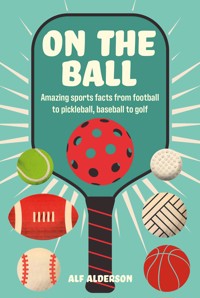
Whether you're a FOOTBALL fan, a PADEL pro, a TENNIS aficionado or a CRICKET enthusiast, you'll love this fascinating collection of *more than 200* sports facts. Did you know... A standard basketball has about 4,118 'pebbles' on its outer surface? All Major League Baseball umpires must wear black underwear in case their trousers split? Padel was invented by a Mexican businessman in the 1960s? Like the sound of these facts and want to know more? Then On the Ball is essential reading. Featuring obscure, unbelievable, intriguing and engaging facts about some of the world's most popular ball sports, discover more than 200 fascinating nuggets of information on the sports, the balls, the players, the history and more. Find out why the number of dimples on a golf ball can make you a better player, what the fastest recorded serve is in a tennis match and who is the world's highest-earning ball player. All this makes this miscellany a must-have for any sports trivia fans.
Sie lesen das E-Book in den Legimi-Apps auf:
Seitenzahl: 69
Veröffentlichungsjahr: 2025
Das E-Book (TTS) können Sie hören im Abo „Legimi Premium” in Legimi-Apps auf:
Ähnliche



















ON THE BALL
ON THE BALL
Amazing sports facts from football to pickleball, baseball to golf
ALF ALDERSON
This edition published in 2025
by Dog ‘n’ Bone Books
an imprint of Ryland
Peters & Small Ltd
20–21 Jockey’s Fields
London WC1R 4BW
and
1452 Davis Bugg Road
Warrenton, NC 27589
www.rylandpeters.com
Email: [email protected]
First published in 2016 as Ball Sport Trivia and in 2018 as What a Load of Balls
10 9 8 7 6 5 4 3 2 1
Text, design, and illustration © Dog ‘n’ Bone Books 2016, 2025 For additional picture credits, see page 96.
The author’s moral rights have been asserted. All rights reserved. No part of this publication may be reproduced, stored in a retrieval system, or transmitted in any form or by any means, electronic, mechanical, photocopying, or otherwise, without the prior permission of the publisher.
A CIP record for this book is available from the British Library. US Library of Congress CIP data has been applied for.
ISBN: 978 1 912983 87 2
E-ISBN: 978 1 912983 91 9
Printed in China
Illustrator: Blair Frame
Editor: Marion Paull
Designer: Jerry Goldie
Desk editor: Imogen Valler-Miles
Senior designer: Paul Stradling
Art director: Sally Powell
Creative director:
Leslie Harrington
Head of production:
Patricia Harrington
Publishing manager:
Carmel Edmonds
The authorised representative in the EEA is Authorised Rep Compliance Ltd., Ground Floor.
71 Lower Baggot Street, Dublin, D01 P593, Ireland
www.arccompliance.com
CONTENTS
INTRODUCTION
BASKETBALL
AMERICAN FOOTBALL
VOLLEYBALL
RUGBY
TEN-PIN BOWLING
FOOTBALL/SOCCER
TENNIS
PADEL
SQUASH
TABLE TENNIS
PICKLEBALL
CRICKET
BASEBALL
LACROSSE
GOLF
SOFTBALL
ACKNOWLEDGMENTS
PICTURE CREDITS
ABOUT THE AUTHOR
INTRODUCTION
It’s a dark, cold winter night and a group of mates are, sensibly, sitting in a warm pub and discussing sport. Apropos of nothing, someone suddenly enquires, “Why are tennis balls fuzzy? And green?”
A second voice pipes up, “Yeah, and what about rugby balls—just why are they oval?”*
All very sound questions, but no one has an answer to any of them.
Then it’s suggested that as the only journalist among the assembled throng, I should make it my job to search out and discover these facts and more about sports balls.
Well, if you think about it, we pretty much take it for granted that a football, a cricket ball, a baseball, or any other sports ball for that matter, is the shape it is, and that’s that.
Yet what the Oxford English Dictionary defines as a “solid or hollow spherical or egg-shaped object that is kicked, thrown, or hit in a game” can be as fundamental a part of life for some people as the change in the seasons.
When a major sporting event such as the World Cup, Super Bowl, Wimbledon, the Masters, the World Series, or the Ashes is underway, life pretty much stops for some of us as we take time off work, skip school, or stay up late to watch a ball hit the back of a net, sail between the posts, or cross a boundary.
So it seems only decent to take a moment or two to consider the history of, and reasons behind, why your favorite sport uses a round or oval ball, a small or large ball, or a heavy or light ball.
For true believers, what Liverpool FC manager Bill Shankly famously said of soccer—known to him and many others as simply football—could be applied to most ball sports: “Some people believe football is a matter of life and death … It is much, much more important than that.” I wouldn’t perhaps go that far, but they’re certainly far from being just a load of balls …
*Actually, rugby balls are not oval—they’re prolate spheres (see page 32)
1
BASKETBALL
“I’m tired of hearing about money, money, money, money, money. I just want to play the game, drink Pepsi, wear Reebok.”
SHAQUILLE O’NEAL former NBA pro turned TV pundit
ODD BALLS
The smallest ever NBA (National Basketball Association) player was Muggsy Bogues at 5ft 3in (1.6m), who played for the Washington Bullets in the 1980s.
The tallest were Gheorghe Mureșan and Manute Bol, both at 7ft 7in (2.31m), who played for the Washington Bullets during the 1980s and 1990s.
Detroit Pistons’ Isiah Thomas scored 16 points in 94 seconds against the New York Knicks in the 1984 NBA playoffs to force the game into overtime—and his team still lost.
The first professional basketball game was played in Toronto, Canada in 1946.
In 1992, two legendary MJs, Michaels Jackson and Jordan, appeared together in the music video for the King of Pop’s single, Jam. A basketball that featured in the video was signed by the pair and, in 2010, was auctioned for a staggering $294,000. Jordan-related memorabilia is in high demand. In 1992, McDonalds released a limited-edition burger imaginatively titled the McJordan. A bottle of McJordan BBQ sauce was sold at auction for $9,995, 20 years later.
Early basketballs were brown.
Orange balls appeared in the 1950s and orange is still the official color for NBA balls.
Other leagues use a variety of colors as well as multicolored basketballs.
Just two of the original NBA teams still exist today—the Boston Celtics and the New York Knicks. Every other original team has either folded or moved since the league started.
“Hockey is a sport for white men. Basketball is a sport for black men. Golf is a sport for white men dressed like black pimps.”
TIGER WOODS professional golfer
“If I weren’t earning $3 million a year to dunk a basketball, most people on the street would run in the other direction if they saw me coming.”
CHARLES BARKLEY former NBA pro turned TV pundit
LEATHER FOR CHOICE
Early basketballs were made from four panels of leather stitched together with a rubber bladder inside. A cloth lining was added to the leather for support and uniformity, and, unlike modern balls, they had lacing. This was eventually abandoned in 1937, by which time basketball had become an Olympic sport, having been introduced the previous year in Berlin.
In 1970, the NBA adopted eight-panel rather than four-panel balls as the official ball, while in 1972, Spalding produced the first synthetic leather ball. But in 1983, the company’s full-grain leather ball became the NBA’s new official ball.
A PEACH OF AN IDEA
Despite being as American as apple pie, basketball was, in fact, invented by a Canadian, James Naismith, in 1891. Naismith was in charge of physical education at Springfield College, Massachusetts, and was looking for an indoor sport to play during the cold winter months.
Naismith’s first version involved lobbing a soccer ball into an old peach basket. By 1893, peach baskets had been replaced by iron hoops and hammock-style baskets so that the referee didn’t have to climb a ladder and remove the ball after every score.
The change to the basket wasn’t the only amendment to Naismith’s original rules. The first draft stated that there were nine players on each team and a “player cannot run with the ball” and “must throw it from the spot on which he catches it.” In 2010, the first copy of the rules was bought by philanthropist David Booth for $4,338,500.
In 1894, at Naismith’s behest, the first purpose-made basketballs were developed by the Spalding Sporting Goods Company. Spalding benefitted enormously from being there at the start, because when the official rules of the game were drawn up, they contained the phrase “… the ball made by A.G. Spalding & Bros. shall be the official ball.”
BOUNCY, BOUNCY
In the nineties, basketballs with a textured pebble surface were introduced. These gave better contact between the players’ finger pads and the ball, so that passing and shooting became more accurate, as well as making it easier to impart spin to the ball.
Today, a standard 29½in (75cm) basketball has about 4,118 “pebbles” on its outer surface, and the pebbles have a diameter of roughly a tenth of an inch (2.5mm).
Another major innovation came in 2001, when Spalding produced the Infusion ball, which had a built-in pump; and then in 2005 came the Never Flat, which the company guaranteed would have a consistent bounce for at least a year.




