


14,39 €
Mehr erfahren.
- Herausgeber: Fernhurst Books Limited
- Kategorie: Lebensstil
- Sprache: Englisch
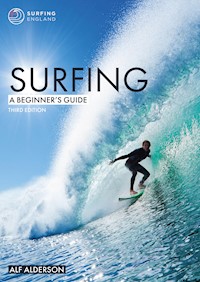
Surfing: A Beginner's Guide has been the go-to surf book for beginners since 1996. This third edition, now with the endorsement of Surfing England, takes you through all the vital steps to become a surfer: you will learn where to surf, when to surf and how to surf safely.You will learn the foundations such as choosing the correct equipment, which is essential to make any progress as a beginner; pre-surf preparation, including getting fit with tips and advice; and your first surfer steps on the beach and in the ocean. All these stages lead up to you catching your very first wave and the surfing bug. The sea is renowned for its beauty, but infamous for its dangers. Alf provides you with transferable skills to safely enjoy your new hobby. Safety features heavily in the book, and you will learn all the basic common-sense aspects of surfing that even the most experienced surfer forgets.
Das E-Book können Sie in Legimi-Apps oder einer beliebigen App lesen, die das folgende Format unterstützen:
Veröffentlichungsjahr: 2018
Ähnliche

















Copyright © 2018 Fernhurst Books Limited
The Windmill, Mill Lane, Harbury, Leamington Spa, Warwickshire, CV32 9HP. UKTel: +44 (0) 1926 337488 | www.fernhurstbooks.com
All rights reserved. No part of this publication may be reproduced, stored in a retrieval system or transmitted, in any form or by any means, electronic, mechanical, photocopying, recording, scanning or otherwise, except under the terms of the Copyright, Designs and Patents Act 1988 or under the terms of a licence issued by The Copyright Licensing Agency Ltd, Saffron House, 6-10 Kirby Street, London EC1N 8TS, UK, without the permission in writing of the Publisher.
Designations used by companies to distinguish their products are often claimed as trademarks. All brand names and product names used in this book are trade names, service marks, trademarks or registered trademarks of their respective owners. The Publisher is not associated with any product or vendor mentioned in this book.
This publication is designed to provide accurate and authoritative information in regard to the subject matter covered. It is sold on the understanding that the Publisher is not engaged in rendering professional services. If professional advice or other expert assistance is required, the services of a competent professional should be sought. The Publisher accepts no responsibilty for any errors or omissions, or for any accidents or mishaps which may arise from the use of this publication.
A catalogue record for this book is available from the British LibraryPaperback ISBN: 978-1-91217712-7eBook ISBN: EPub: 9781912177868Mobi: 9781912177875pdf: 9781912177882
Front cover photography: Epic Stock Media /Alamy Stock PhotoAll photography © 2008 Sean DaveyExcept: P19 (left): Ocean & Earth; P19 (top right): Gul;P19 (bottom right): Surf Ears;P29: keywordphil / Shutterstock.com;P93: Surf Snowdonia
Designed by Daniel Stephen
CONTENTS
FOREWORD
INTRODUCTION
EQUIPMENT
FIRST STEPS
INTO THE SURF
SURFING MANOEUVRES
SAFE SURFING
WAVES AND WEATHER
SURFBOARD DESIGN
CARE AND REPAIR
SURF THE WORLD
APPENDIX
FOREWORD
Surfing England is the recognised National Governing Body (NGB) for Surfing in England. We are a not for profit membership organisation run by surfers for surfers. We are proud to serve the sport of surfing and our membership of surfers, surf coaches, surf clubs and surf schools.
Our primary purpose is to support and develop surfing in England.
It therefore gives me great pleasure to endorse this book: Surfing: A Beginner’s Guide by Alf Alderson.
We want to encourage new people into the great sport of surfing and everyone has to start somewhere. In this book Alf clearly explains how to begin your journey to be a surfer. There is essential background information, the first steps you should take and the manoeuvres you need to master. Importantly it also tells you how to surf safely and about the protection of our surfing environment.
Armed with this book you will be able to become a surfer, get on the waves and go!
But, as Alf says, while the book can teach you the basics of surfing, it is no substitute to direct tuition on the beach and in the surf. For this you should look up an accredited surf school near you on our website (www.surfingengland.org) or the relevant national authority for where you live – conveniently their websites are all listed in the book.
Whether you are in England or not, I welcome you to the surfing family and the fun and excitement that surfing brings – let’s go and catch that wave!
NICK REESOPERATIONS MANAGERSURFING ENGLAND
INTRODUCTION
Since the early 1980s the popularity of surfing has grown almost exponentially and, thanks to improvements in wetsuit technology, there are few coastlines in the world that haven’t been surfed now – even Alaska and Norway have resident surfers these days.
And, of course, surfing is now an Olympic sport, whilst new development in wavepools allow people who may never even have seen the sea to have a go at surfing.
Despite this, surfing is still one of the hardest sports to learn and master. So, in this book you’ll find all the basics you need to get you going – what you won’t find is the lowdown on how to pull aerials or ride 15-foot reef breaks – by the time you’re ready for that, you won’t be needing an instruction book.
Top pro surfer Flynn Novak is captured in action by world-class surf photographer Sean Davey in step-by-step sequences that beautifully illustrate just what it should look like when you get to your feet for the first time or pull off your first cutback. And hopefully the words alongside should help to bring it all together in one neat and easily assimilated package!
If the surf conditions are right, you’re reasonably fit, a competent swimmer and determined enough, you should be able to reach a basic level of surfing within a few days. You may not be ripping the waves apart, but you will be standing up on the board with a modicum of control. Then it’s a case of practice, practice, practice and lots of commitment. I’ve known people who changed their entire lifestyle to improve their surfing, but once you’ve got the basics wired you can still have a great time in the surf even if you never get beyond being a ‘weekend warrior’.
Whatever your aspirations, there are few sports that get you hooked the way surfing does. It doesn’t matter whether you become a contest hotshot or a mellow soul who wants to cruise along on gentle beach breaks – once you’re riding waves you’re guaranteed to be having as much fun (almost …) as anyone can without their clothes on.
ALF ALDERSONST. DAVID’S, PEMBROKESHIRE, SPRING 2018
‘I’M JUST A SURFER WHO WANTED TO BUILD SOMETHING THAT WOULD ALLOW ME TO SURF LONGER’
JACK O’NEILL
BOARDS
The majority of surfers are still riding shortboards, despite the resurgence of longboards, mini-mals, funboards, ‘pop-outs’ and a wide range of ‘hybrid’ designs in recent years.
Choosing the right board is essential if you want to make good progress as a beginner, but it’s not just a case of walking into your friendly local surf shop and sauntering out again 15 minutes later ready to rip.
Surfboard design is an art form in itself, and no two surfers will ride the same board in the same way or get the same out of it. This is not the place to go into detail on the intricacies of board design (see Page 73), but we can take a look at the most popular board designs out there.
SHORTBOARDS
The majority of shortboards will be three fin ‘thrusters’, usually within the size range 5ft 8in / 1.70m to 6ft 8in / 2.0m. Bigger surfers may go for slightly longer boards; longer shortboards (excuse the oxymoron) are used in bigger surf; and some surfers will opt for shorter, high performance models.
Shortboards are basically for more experienced surfers, being highly manoeuvrable but, at the same time, more difficult to control. Various features of the board will be designed to suit a surfer’s riding style. Thickness and width vary from board to board, as do rocker and vee. Rails may be hard or soft, the board may have channels, the fin configuration can differ, and tail shape will also vary. (If all this is as clear as mud, see Page 73 to understand the terminology.) As you can see there’s a lot more to a surfboard than meets the eye, and a lot of time and money is spent on board design and development.
You should forget about getting a high performance shortboard if you’re just starting out — it may look cool on the beach, but it will do you no favours in the surf. You’ll find it difficult to paddle, difficult to catch waves with, and difficult to ride. What you should be looking for is a funboard or a mini-mal.
A modern epoxy shortboard.
A modern custom-made fibreglass shortboard.
FUNBOARDS
Funboards sit mid-way between a shortboard and a longboard. They’ll usually be around 7ft 6in / 2.30m in length, and be wider and thicker than a shortboard, with a more rounded nose. These boards are basically designed for having fun on, as the name implies. They make it easy to catch waves, but are still manoeuvrable enough to allow you to challenge yourself in the surf, and they’re a great option if you surf in an area where the waves are generally small or lacking in power. They’re especially good for beginners but are often used by experienced older surfers looking for an advantage in catching the waves.
THE LARGEST WAVE IN THE WORLD OCCURS EVERY DAY ON EVERY BEACH IN THE FORM OF THE TIDE. IT HAS A WAVE-LENGTH OF HALF THE CIRCUMFERENCE OF THE EARTH, TRAVELS AT 700–800 MILES AN HOUR, AND ‘BREAKS’ ONCE EVERY 12 HOURS AND 25 MINUTES.
A custom-made fibreglass funboard.
LONGBOARDS & MINI-MALS
Longboards are the boards that are associated with the halcyon days of the 60s, when they were known as Malibu boards after the famous California point break. Everyone who was anyone ‘rode the nose’ at every opportunity and drop-knee turns were the only turns worth doing. They were superseded in the late 60s and early 70s by shortboards, but made a come-back in the late 80s, and now most breaks will have a number of longboards out in the line-up.
A ‘longboard’ is generally considered to be over 9ft / 3m in length with a much more rounded nose than the previous two categories, and a wider and thicker template. They may have one or more fins.
Mini-mals are kind of ‘short’ longboards of between 7ft 6in / 2.30m and 8ft 6in / 2.60m in length, and they’re another good option for learning on as they offer a lot of flotation and stability and are easier to paddle. However, in big surf they can be bulky for beginners to handle.
A modern epoxy longboard.
Longboards are the least manoeuvrable of the three main categories, and are ridden in a different way. The style is generally much smoother and more graceful than that of the shortboarder, with an emphasis on ‘walking the board’ (moving up and down on the deck of the board) and nose riding (surfing with five or ten toes over the nose — ‘hang five’ and ‘hang ten’ respectively). Having said that, high performance longboard surfing, featuring shortboard-style moves is becoming increasingly common as well as easier on modern lighter, performance-oriented models.
POP-OUTS
A pop-out can be any of the above designs produced from a mould, whereas a custom board is shaped and finished by hand. A pop-out also makes an excellent first board for a number of reasons. For a start a new pop-out will be about a third of the price of a new custom board, as well as being much sturdier and far less prone to damage. Pop-outs don’t have the same smooth flowing lines as custom boards, being thicker and wider and somewhat more rough and ready due to the moulding process, but at this stage you don’t need the design refinements that custom boards provide.
SOFT BOARDS
Probably the ideal boards for beginners. Generally around 7ft 6in / 2.30m long, soft boards are buoyant and stable and, since they’re made of relatively soft polyurethane foam, they don’t hurt as much if they hit you on a wipe-out. This can be a real confidence-booster for first-timers who are already being knocked all over by the waves without having the additional worry of being hit by a big lump of fibreglass.
STAND-UP PADDLEBOARDS (SUPS)
Stand-up paddleboarding has really taken off in the last ten years, and you’ll often see people out in the waves on these longer, wider, more buoyant craft with paddle in hand. This book is about ‘real’ surfing so we won’t be going into the intricacies of surfing on a SUP other than to say that having a bigger board and a paddle makes it a lot easier to catch waves on a SUP, especially in small, weak swells. But it may not make you too popular with all the dudes using arm power alone to paddle into the waves…
BODY BOARDS
Body boarding / boogie boarding is the easy option for anyone who has neither the time, skill nor patience to learn stand up surfing. But it’s not real surfing, so that’s the last you’ll be hearing of it in this book.
Cheap ‘n’ cheerful – a ‘pop out’, great for beginners.
Easy to learn on (it’s even got handles!) and safe to use – a soft top board.
CHOOSING YOUR BOARD
Get a board that will help you to improve rather than one that simply looks good. A soft board or pop-out is the best option but, if you really want to go for a custom board, a funboard or a mini-mal style is best. What you’re looking for at this stage is flotation and stability in the board, which will make the difficult task of balancing on it that much easier. Ideally you should look for something between 12in / 30cm and 18in / 45cm longer than you are tall. Most boards these days have three fins, although as a beginner a single fin board is perfectly adequate (and is also two less fins to potentially get bashed by when you wipe out).
You’ll find that prices vary from area to area, so shop around. A good surf shop should be able to advise you on what sort of board is most appropriate for your skills. It’s best if you can also take along a friend who already surfs to provide some advice. Unless you have plenty of cash, it’s also well worth considering a secondhand board as at this stage you don’t actually know if you’re going to like surfing (although if you don’t you should seek medical advice as it’s quite possible you’re dead). A good second-hand board can be picked up for around half the price of a new one, and some surf shops may even let you give it a trial run which is rarely the case with a new board.
Be careful with second-hand boards though. They’ve all had their fair share of knocks and, if the foam is starting to discolour in too many places (where it’s let in water through a damaged surface), it’s usually best to leave it. Also check for soft spots on the deck where the fibreglass may be delaminating from the foam. And if the board doesn’t have changeable fins, ensure there are no cracks around the base of the fins where they join the board.
WETSUITS
A wetsuit keeps you warm by trapping a thin layer of water close to your body, which is then warmed by your body heat. This is often flushed out when you wipe-out so the suit needs to be a good fit.




