


Erhalten Sie Zugang zu diesem und mehr als 300000 Büchern ab EUR 5,99 monatlich.
- Herausgeber: The History Press
- Kategorie: Geisteswissenschaft
- Sprache: Englisch
In July 1943, Hitler launched Operation Zitadelle, the last German offensive on the Eastern Front. It was an attempt to shorten the German lines by eliminating the Kursk salient and was designed to result in the encirclement of the Red Army. In reality, the German tanks came up against impenetrable Russian defences: minefields, artillery and anti-tank emplacements, spread through lines 250km deep and manned by Russian troops whose actions often verged on the suicidal. The greatest tank battle in history, Operation Zitadelle assured the Nazis' defeat and was 'the swan song of the German tank arm'. Involving over 9,000 tanks, 5,000 aircraft, 35,000 guns and mortars, 2.7 million troops and 230,000 casualties, the Battle of Kursk's scale and barbarity eclipsed all other clashes in Europe. In this book, historian Mark Healy gives a clear, concise account of those dramatic days in 1943.
Sie lesen das E-Book in den Legimi-Apps auf:
Seitenzahl: 184
Veröffentlichungsjahr: 2012
Das E-Book (TTS) können Sie hören im Abo „Legimi Premium” in Legimi-Apps auf:
Ähnliche
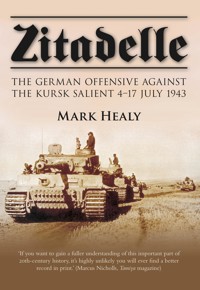



















Front cover illustration: T-34s launch an attack against oncoming Germans.
First published 2012 as Kursk 1943: Battle Story by Spellmount
This paperback edition first published 2023
The History Press
97 St George’s Place, Cheltenham,
Gloucestershire, GL50 3QB
www.thehistorypress.co.uk
© The History Press, 2012, 2023
The right of Mark Healy to be identified as the Author of this work has been asserted in accordance with the Copyrights, Designs and Patents Act 1988.
All rights reserved. No part of this book may be reprinted or reproduced or utilised in any form or by any electronic, mechanical or other means, now known or hereafter invented, including photocopying and recording, or in any information storage or retrieval system, without the permission in writing from the Publishers.
British Library Cataloguing in Publication Data.
A catalogue record for this book is available from the British Library.
ISBN 978 0 75248 128 9
Typesetting and origination by The History Press
Printed and bound in Great Britain by TJ Books Limited, Padstow, Cornwall
eBook converted by Geethik Technologies
CONTENTS
Introduction
Timeline
Historical Background
Conceiving the Plans: Rastenburg and the Kremlin
The Battlefield
The Armies
The Commanders
The Soldiers
The Kit
The Days Before Battle
The German Plan
The Preparatory Period, April–5 July
The Citadel
The German Tactics
The German Offensive
5 July Zitadelle Begins
6–11 July 4th Panzer Army
6–12 July Ninth Army
12–17 July Prokhorovka
The Legacy
The Cost
Orders of Battle
Visiting the Battlefield
Further Reading
INTRODUCTION
On 5 July 1943, the last great German offensive on the Eastern Front began. It was directed at the destruction of the Kursk salient in the eastern Ukraine and constituted a last, supreme effort by the Germans to stabilise the Eastern Front in the face of ever burgeoning Soviet military power. It failed. Thereafter, with the strategic initiative having been irrevocably lost, the Germans began a fighting retreat that did not end until two years later when the Red Army stormed Berlin and Adolf Hitler committed suicide in his bunker.
This was not the outcome envisaged by the German leader when he penned War Directive Number 21, in December 1940. In that document he assumed, as did the senior commanders of the Wehrmacht, that a ‘rapid campaign’ against the Soviet Union would be little different in outcome and just a little longer in duration than that which had brought France, Belgium and Holland to defeat in six weeks half a year earlier. Indeed, Operation Barbarossa – the code name adopted for the invasion of Russia in June 1941 – was based upon a number of fatally erroneous assumptions about Nazi Germany’s eastern ally. Hitler and the Wehrmacht’s low opinion of the Soviet state and its armed forces, his hatred of its communist ideology and above all, his racist perception of its Slavic people as untermenschen – sub humans – all served to feed his conviction that the USSR was ‘a colossus with feet of clay’ such that we ‘have only to kick in the front door and the whole rotten structure will come tumbling down.’
In the months between the invasion of Russia on 22 June 1941 and March 1942, the Wehrmacht had conquered large areas of the western USSR and captured and killed over five million Red Army soldiers. But it had also suffered its first strategic reverse, which served to puncture the reputation for invincibility that the Wehrmacht had acquired since September 1939. The Red Army counter offensive begun on 5 December, which had hurled the German forces back from the approaches to Moscow, had then grown into an effort that embraced the full extent of the Eastern Front by the end of January 1942. When, at the end of March, it petered out owing to the thaw and the exhaustion of the combatants, the Soviet Union was far from being finished, and Nazi Germany a very long way from realising victory over erstwhile ally.
The massive reduction of German military strength incurred in the first ten months of the Eastern Campaign brought about a contraction of Germany’s strategic aspiration for the summer of 1942. Hitler would have no truck with a defensive posture and with the onset of the wider war, it was deemed imperative that the USSR be defeated in 1942. It was to service Germany’s wider war aims and also secure Russia’s collapse that Hitler eschewed any renewed attempt to take Moscow. Rather, the German offensive effort was to be directed towards the realisation of primarily economic objectives. As early as January, Hitler had indicated that the priority objective for the coming summer campaign must be the capture and exploitation of the oilfields of the Caucasus, without which, he told one audience: ‘I must end this war.’ It was for this reason that a secondary objective of Case Blue – as the 1942 offensive had been named – was to bring the city of Stalingrad under fire so as to interdict the oil supplies taken by barge from Baku northward along the river Volga.
It was against this backdrop that Case Blue opened on 28 June. Once more the panzer divisions gobbled up space and advanced headlong across the steppe in the face of what appeared to be a totally demoralised Red Army. But this was more apparent than real as by October the German advance had ground to a halt along the foothills of the Caucasus and Sixth Army was embroiled in a ferocious battle of attrition amidst the ruins of the city of Stalingrad. One month later and the chickens came home to roost. On 22 November, the Red Army launched a major offensive and encircled the city. Hitler’s response was to order Sixth Army to remain in place, ‘on the Volga’.
Hitler now appointed Field Marshal Erich von Manstein to oversee Army Group Don – a new and hastily assembled command – and tasked him with relieving Stalingrad. The day before this formation’s subsequently abortive attack began on 12 December, German forces began their withdrawal from the Caucasus. By the end of the month, the German line along the Don, to the north of Stalingrad, was disintegrating as Axis armies succumbed to the widening Soviet offensive. On 10 January 1943, the Red Army launched the final reduction of the Stalingrad pocket. Hitler ordered 1st Panzer Army out of the Caucasus on 24 January to reinforce Manstein’s weakened forces protecting the Donetz industrial region. Along the Don front, a number of Soviet Fronts had vanquished the remnants of Axis forces, such that by 2 February, the Voronezh Front had crossed the Donets and was threatening Kharkov. Strength returns indicated that as of 23 January, the Ostheer could only field 495 operational tanks.
It was against this backdrop that on 6 February, just three days after the surrender of Stalingrad was announced in Germany, Manstein met with Hitler at his headquarters at Rastenburg in East Prussia. Among the items discussed was the strategy to be adopted by the Heer for the summer. Of the two operational options he proffered to Hitler, Manstein was in favour of the ‘backhand’. This presumed that the Red Army would launch a massive offensive in southern Russia in the summer that should be allowed to mature, with German forces falling back so as to permit the Soviets to overextend themselves. At the right moment, a massive armoured counter attack would be launched, catching the Red Army on ‘the backhand’. This would then drive southward and pin them against the Sea of Azov. The outcome of such a victory would, Manstein believed, generate the conditions whereby the Soviets would be forcibly encouraged into some sort of political arrangement to end the war. Manstein never revealed this political dimension of his proposal, as he knew Hitler would have baulked immediately as the German leader would have no truck with such thinking.
Manstein’s proposals to Hitler for 1943. (A) The backhand – await the Russian summer offensive then defeat it. (B) The forehand – an early offensive to destroy the Kursk salient drawing the Red Army’s teeth for the rest of the summer by the infliction of catastrophic losses.
Manstein’s alternative option, which he called the ‘forehand’, turned on the Germans seizing the offensive initiative to inflict an early and heavy defeat on the Red Army as soon as the weather and ground were dry enough to allow the panzers to operate. Not surprisingly, with the front in the south seemingly on the verge of disintegration, this discussion was not taken further. Nonetheless, a seed had been planted in Hitler’s mind with the ‘forehand’ proposal and this would bear fruit within months with the issue of plans for a limited offensive in the early summer.
By 9 February, Soviet forces were approaching Kharkov from the north and south. Two days later, the SS Panzer Corps had been pushed back into the city. On the 11th, German forces were ordered by Hitler to hold the city ‘at all costs’, whilst in the gap that had opened up in the German front between Kharkov and Orel, General Vatutin, the commander of the Voronezh Front, was prompted by Stalin into ordering his 6th Army to advance and take Zaporozhye. As of 13 January, this vital city crossing point over the Dnieper had become the site of Manstein’s headquarters in his new role as commander of Army Group South.
Matters in Kharkov now came to a head. On the 15th, with the total encirclement of the city in prospect and the inevitable loss of his units in consequence, Obergruppenführer Hausser unilaterally ordered his force to begin withdrawal from the city, only to receive yet another ‘hold’ order. On this occasion Hausser ignored his immediate superior as well as Hitler. The withdrawal proceeded. In an act of unprecedented disobedience, the head of the SS Panzer Corps had chosen to save his force notwithstanding his allegiance to Hitler. By his action, Hausser saved his force to fight another day, and indeed, what was to follow – the German counter offensive that within the month saw the re-capture of Kharkov – would not have been possible had he not done so.
Hitler visited von Manstein for a second time in at Zaporozhye on 10 March 1943. The subject of the summer campaign was discussed.
Hitler now flew out to see Manstein at his headquarters. After days of hard debate, the Führer conceded to the Field Marshal’s demand that in the face of the dire situation facing Army Group South, he be given ‘ a free hand’ to conduct operations as he saw fit.
Manstein now began a concentration and re-deployment of his forces, unleashing his mobile formations on 18 February against a surprised enemy who had totally misinterpreted German intentions. Lulled by wishful thinking, Stavka had attributed the German withdrawals as signs of their imminent complete collapse and evidence of a full-scale retreat westward across the Dnieper. In a classic demonstration of mobile warfare, 1st Panzer Army and Hoth’s 4th Panzer Army, the latter with the three divisions of the SS Panzer Corps operating as its cutting edge, excised enemy mobile spearheads, forcing the remnants of the Soviet South-Western Front and then the Voronezh Front into a hasty retreat on the city of Kharkov and the line of the river Donets. Though it took until 14 March for SS troops from the 1st and 2nd divisions to clear all Soviet opposition from inside Kharkov. Three days later 48th Panzer Corps and the SS Panzer Corps began their drive northward from Kharkov and advanced on the city of Belgorod.
Panzers of the I SS Panzer Grenadier Division Leibstandarte Adolf Hitler move into Kharkov after its recapture, March 1943.
TIMELINE
1943
2 February
Final surrender of all German forces in Stalingrad.
8 February
Soviet forces recapture Kursk
18 February–18 March
German counter-offensive recaptures much territory lost to Red Army. Kharkov retaken with heavy German losses. Manstein closes down all counter-offensive operations.
13 March
Field Marshal von Manstein receives copy of Operational Order No: 5 identifying Kursk Salient as focus of early limited German offensive by forces of Army Groups Centre and South.
25 March
Ninth Army performs completes abandonment of Rzhev Salient. It is earmarked as key offensive formation for Army Group Centre.
8–12 April
Deputy Supreme Commander Marshal Zhukov recommends to Stalin that Red Army embrace a strategic defence in the Kursk salient to defeat German offensive. Stalin concurs on 12 with adoption of a two stage defensive/counter offensive strategy. Orders construction of massive defensive fortifications in and to rear of the salient.
15 April
Operational Order No: 6 supersedes earlier directive naming destruction of the Kursk salient by code name Operation Zitadelle, to begin 3 May.
5/6 May
Intelligence repudiates German assumptions about Russian intentions in the salient. Red Army now drawn up for a massive defensive. Hitler decides to persist with operation but orders first of many delays to permit addition of far larger numbers of tanks to the operation. Within days all Axis forces in North Africa surrender to western Allies.
1 July
Hitler tells his generals that as all now seems quiet in the Mediterranean, he has decided to launch Zitadelle on 5 July.
Operation Zitadelle
1943
5–6 July
Ninth Army/Central Front
Following the onset of the German offensive, General Rokossovsky attempts to discern the primary axis of the enemy assault. By days end this is seen to be directed to the west of the Orel/Kursk railway line. However, Model did not see fit to use his panzer divisions en masse from the outset but choose to feed them in over a number of days. Initial assaults by infantry supported by Tigers, Ferdinands and Assault Guns fails to achieve a rapid breakthrough.
On 6 July, Rokossovsky launches his 2nd Tank Army at the main German thrust line. Subsidiary German thrusts on either flank are held by the Soviets.
The Germans find themselves enmeshed amid minefields, massive fortifications and strong-points and make little headway.
Rokossovsky begins to draw off units from formations on either side of the German flanks to bolster his defences.
5–7 July
4th Panzer Army and Army Detachment Kempf
Unlike Model, Hoth unleashes all of his armoured and formations at the very outset. On the left, 48th Panzer Korps makes slow headway through the Soviet defences over the first two days. On the right, II SS Panzer Korps has greater success, managing to breach the Soviet first line of defence within hours of the opening of the offensive. Although anticipating a rapid advance with Prokhorovka the Korps objective,by the end of day 2 the advance is slowing because of the immense minefields and defences.
Unnerved by the unexpected German progress through their defences, Stalin orders that the 6th Guards Tank Army, initially earmarked for counter offensive operations, be committed to prevent a German breakthrough across the river Psel. 6 GD TA begin its long journey to the Kursk battlefield where it is expected to arrive within five days to prevent a breakthrough by the Germans.
However, the inability of III Pz Kps to fully cross the Donets on Day 1 and its failure to break out of the massive Soviet defensive system by the end of Day 2, means that it is unable to fulfil its task of flank defence for the SS Pz Kps. This poses a major threat to the German timetable in the south.
7–10 July
Ninth Army /Central Front
Model continues to feed in his panzer divisions on a daily basis to secure a breakthrough. By the 10 July, his main thrust has advanced as far as lower slopes of the Olkhovatka heights but it is clear his offensive is running out of steam.
Rokossovsky has continually drawn on other formations of his Central Front not involved in coping with the German offensive and added more and more artillery, katyusha and infantry units to continually augment his defensive field.
The German units, even though supported by extra Luftwaffe units sent north from the south of the salient, cannot achieve the breakthrough and dash themselves against the Soviet defences.
By day’s end on the 10 July Model realises that he does not have the strength to effect the breakthrough and orders his units to engage ‘in a rolling battle of attrition’. Stalin and Zhukov have already agreed on the launch date for Operation Kutuzov – the first counter offensive to be launched once they had sensed that the German offensive tide in the north was ebbing – and directed into the rear of Ninth Army to begin on the 13 July.
Zitadelle has already failed in the north.
On 10 July the Allies invade Sicily.
8–17 July
48th Pz Kps continues its advance on the Psel crossings, but its main offensive asset – the Grossdeutschland Pz Gren Div – now begins to find itself side-tracked into having to shore up other German formations protecting its western flank by Soviet forces that are continually attacking it. By the 10 July, this ongoing problem will see it continually involved in this fashion through to the close down of Zitadelle.
The Russian employ the same tactics on the SS Pz Kps eastern flank which is still devoid of its designated protection from III Pz Kps which is still immured amid the Soviet defensive system.
Nonetheless, by 9 July the SS Pz Kps is approaching the river Psel when late on that evening it begins to regroup and change its axis of advance. On the following day the Kps strikes out toward Prokhorovka.
By this date, 6th Guards TA is within striking distance of Prokhorovka and the first of its units arrive there on the following day. Also due to arrive is 5th Guards Army. German hope of a rapid advance and capture of Prokhorovka is thwarted.
On the 12 July, Totenkopf is engaged on the northern bank of the Psel, the Leibstandarte Adolf Hitler division is in the centre between the river and the Kursk/Orel railway line and Das Reich is operating to its south. Having regrouped his armoured units overnight, the Soviet commander of 5th Guards TA launches his forces at the Germans early on the 12 July. What has become known since as the ‘Tank Battle at Prokhorovka’ carries on throughout the day. Although Soviet tank losses are extremely heavy, they prevent the Germans taking Prokhorovka.
While III Pz Kps finally achieves its breakthrough to the south, it is not on hand to assist the SS Panzer Corps counter 5th GTA as the original planning had envisaged.
13–17 July
Hitler tells von Manstein and von Kluge that he is terminating Zitadelle forthwith. The latter is pleased because he is having to deal with beginnings of a massive Soviet counter offensive against the Orel salient and is already drawing on units from Ninth Army in the salient to contest it. Manstein manages to argue for five days grace from Hitler to enable his forces to continue the destruction of Soviet armour around Prokhorovka. However, on 17 July Zitadelle is terminated as an offensive operation.
3 August
The Red Army launches the second of its planned counteroffensives following on from its defeat of the German attack on the Kursk salient. Its launch marks the irrefutable and irrevocable final transfer of the strategic initiative on the Eastern Front to the Red Army.
HISTORICAL BACKGROUND
Conceiving the Plans: Rastenburg and the Kremlin
When, on 23 March 1943, von Manstein called a halt to all counter-offensive operations by Army Group South, the line reached by the German forces following the capture of Belgorod on 18 February corresponded to what would become the southern face of the Kursk salient. By that date however, Manstein knew that the destruction of the Kursk salient already figured as the primary focus of the ‘limited offensive’ that Hitler wished to launch as soon as the ground had dried out enough for mobile warfare. Contained in Operational Order No 5 it was given the code name Unternehmann Zitadelle – Operation Citadel – and had been received by Manstein ten days before. Hitler had thus embraced Manstein’s ‘forehand’ proposal for an early offensive as it proffered him the opportunity of addressing pressing political, economic and military issues that were crowding his strategic horizon. An early launch of the operation and rapidity in its execution lay at the very heart of the operation. Indeed, in this Operational Order and subsequent iteration, this was deemed by Rastenburg to be its absolute sine qua non.
In Hitler’s mind it was essential that an early and decisive defeat be inflicted on the Red Army that would serve to draw its ‘offensive teeth’ for the rest of the summer. The destruction of the Kursk salient would achieve this by nullifying the massing forces of two Soviet fronts that were deploying within it. He deemed such a victory to be essential to convince his wavering allies, such as the Finns, that the war in the East could still be won.
Furthermore, the immense booty and manpower that would accrue from victory would go far to helping the German war economy. Indeed, a short time before Hitler has signed a secret directive for the ‘Securing of Prisoners of War, Labour Forces and Booty’ that stated that a prime requirement of any offensive operation in Russia must be to secure such resources. OKW estimated that 60 Soviet divisions and between five and six armoured corps were deployed within the salient, so the booty would be extensive. The anticipated trawl of prisoners would yield between 600–700,000 men. It was intended that all would be shipped back to Germany for service as slave labour in the armaments factories and would help alleviate the shortage in manpower in German industry.
Additionally, and perhaps of overriding importance, was the deteriorating situation in the Mediterranean theatre. Following Operation Torch




