


35,99 €
Mehr erfahren.
- Herausgeber: John Wiley & Sons
- Kategorie: Fachliteratur
- Sprache: Englisch
The definitive organization management text for executives and aspiring business leaders
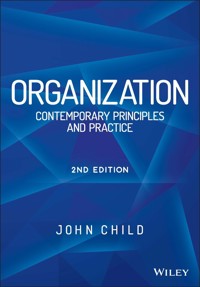
Organization: Contemporary Principles and Practices, Second Edition is the completely updated and revised landmark guide to "macro" organization theory and design, fully grounded in current international practice. International management expert John Child explores the conditions facilitating the development of new organizational forms and provides up-to-date coverage of the key developments driving new organization structure and practice. This revised Second Edition includes a new introductory section on Organization Theory as well as a complete Instructor Manual updated with new material on the basic principles of organizational design.
With detailed case studies and examples from throughout the UK, Europe, Asia and North America, Organization provides a truly international overview for advanced students and business executives who want to be at the forefront of the evolution in Organization Theory. 21st Century organizations will be faced with entirely new challenges and opportunities than those faced by previous generations, and emerging business leaders must understand the new "macro" realities in order to succeed. Organization will help readers:
- Understand the "macro" organization, which is distinct from organizational behaviour
- Explore the way organizations fit into the international business environment and global economy
- Analyze the way organizational structure and design affect management performance
- Apply advanced organization theory and principles to day to day management activities
Written by one of the foremost scholars, the fully updated Second Edition of this successful text provides executives and advanced business students with a wide-ranging and trustworthy guide to organizations as the conditions for their survival in our global business environment change.
Sie lesen das E-Book in den Legimi-Apps auf:
Seitenzahl: 1239
Veröffentlichungsjahr: 2015
Ähnliche


















CONTENTS
Cover
Series Page
Title Page
Copyright
Preface to Second Edition
Preface from the First Edition
Part I: The Broad Picture
Chapter 1: Organization and Its Importance
Purpose and Scope of This Book
Organizing, Organization, and Organizations
Components of Organization
Organizational Choices
Consequences of Deficiencies in Organization
Notes
Chapter 2: Perspectives on Organizational Design until Recent Times
A Brief Look Into History
One Best Ways of Organizing
The Contingency Approach
Notes
Chapter 3: New Conditions, New Organization
The Retreat from Conventional Forms of Organization
New Conditions, New Organization
New Conditions, New Forms Summarized
New and Conventional Organizational Forms Compared
Notes
Part II: New Internal Forms
Chapter 4: Simpler Structures – Reducing Hierarchy
Hierarchy
Downsizing and Delayering
From Hierarchies to Teams
Notes
Chapter 5: Achieving Integration
The Concept
The Need for Adequate Integration
Achieving Integration is a Challenge
Poor Integration Can Lead to Disaster
Good Integration Can Create a Dynamic Capability
Signs that Integration Needs Are Not Being Met
A Diagnostic Tool
The Choice of Integrating Mechanism15
Teamworking: An Aid to Integration
Notes
Chapter 6: Control
An Elusive Concept
Control in Organizations: Key Distinctions
Strategies of Control
Control Strategies and Relevant Contingencies
Notes
Chapter 7: Questions of Reward
The Role of Reward Policies
Extrinsic and Intrinsic Rewards
Criteria Applied to Rewards
Expectancy Theory
Conditioning Theory
Notes
Chapter 8: Payment Systems
The Importance of Pay
Methods of Payment
Considerations in the Choice of a Payment System
Trends in Reward Policies Consistent with New Organizational Forms
Notes
Part III: New Network Forms
Chapter 9: Outsourcing and Offshoring
Outsourcing and Changing Organizational Boundaries
The Scale and Scope of Outsourcing
The Surge in Outsourcing During the 2000s
Attractions of Outsourcing
Problems with Outsourcing
The Reaction to Outsourcing and Offshoring Problems
Reaching a Decision on Outsourcing
Creating Successful Outsourcing Partnerships
Notes
Chapter 10: Virtual Organization
What is a Virtual Organization?
Forms of Virtual Organization
Potential Benefits of Virtual Organization
Conditions for the Viability of a Virtual Organization
Limitations of Virtual Organization
Questions about the Use of Virtual Organization
A Pioneer of Virtual Organization: Dell Inc.33
Notes
Chapter 11: Strategic Alliances
What is a Strategic Alliance?
The Significance of Alliances
Alliance Forms
Organizational and Managerial Challenges Posed by Alliances
Alliance Configurations
Notes
Chapter 12: Organizing Across Borders
Globalization and the Significance of MNEs
Strategies for Global Expansion
Organizational Implications of Different Strategies
New Organizational Arrangements for Organizing Across Borders
New Organizational Approaches within MNEs
Notes
Part IV: Achieving Effective Organizations
Chapter 13: Managing Organizational Change
The Challenge of Achieving Organizational Change
Internal and External Drivers of Organizational Change
Varieties of Organizational Change
Classifying Approaches to Change
Contexts and Choices
Policies for Successful Planned Change
Notes
Chapter 14: Organizing for Learning1
The Strategic Importance of Organizational Learning
The Nature of Organizational Learning: Key Distinctions
Requirements for Successful Organizational Learning
Learning Through Alliances
Implications for Practice
Notes
Chapter 15: Generating and Utilizing Trust1
Introduction
What is Trust?
The Benefits of Trust
Generating and Sustaining Trust
Guidelines for Cultivating Trust
Notes
Chapter 16: Corporate Governance in New Organizational Forms1
Introduction
Growing Concern about Corporate Governance
The Agency Problem
The Double Agency Problem
The Multiple Agency Problem
Implications for Corporate Governance
Applying Organizational Insights to Corporate Governance Practice
Conclusion
Notes
Part V: Designing Organizations for the 21st Century
Chapter 17: Meeting Strategic Business Needs
Strategic Needs
Notes
Chapter 18: Meeting Strategic Social Needs
The Social Problem
Organization As a Culprit
A Concluding Comment
Notes
Author Index
Subject Index
End User License Agreement
List of Tables
Table 1.1
Table 2.1
Table 2.2
Table 2.3
Table 3.1
Table 3.2
Table 4.1
Table 5.1
Table 6.1
Table 8.1
Table 8.2
Table 9.1
Table 9.2
Table 9.3
Table 9.4
Table 10.1
Table 12.1
Table 12.2
Table 12.3
Table 12.4
Table 14.1
Table 16.1
List of Illustrations
Figure 1.1
Figure 5.1
Figure 6.1
Figure 7.1
Figure 11.1
Figure 12.1
Figure 12.2
Figure 12.3
Figure 12.4
Figure 12.5
Figure 12.6
Figure 12.7
Figure 13.1
Figure 13.2
Figure 13.3
Figure 13.4
Figure 14.1
Figure 14.2
Figure 14.3
Figure 15.1
Figure 17.1
Figure 18.1
Guide
Cover
Table of Contents
Begin Reading
Begin Reading
Part 1
Chapter 1
Pages
ii
iii
iv
vii
viii
ix
x
xi
xii
1
2
3
4
5
6
7
8
9
10
11
12
13
14
15
16
17
18
19
20
21
22
23
24
25
26
27
28
29
30
31
32
33
34
35
36
37
38
39
40
41
42
43
44
45
46
47
48
49
50
51
52
53
54
55
56
57
58
59
60
61
62
63
64
65
66
67
68
69
70
71
72
73
74
75
76
77
78
79
80
81
82
83
84
85
86
87
88
89
90
91
92
93
94
95
96
97
98
99
100
101
102
103
104
105
106
107
108
109
110
111
112
113
114
115
116
117
118
119
120
121
122
123
124
125
126
127
128
129
130
131
132
133
134
135
136
137
138
139
140
141
142
143
144
145
146
147
148
149
150
151
152
153
154
155
156
157
158
159
160
161
162
163
164
165
166
167
168
169
170
171
172
173
174
175
176
177
178
179
180
181
182
183
184
185
186
187
188
189
190
191
192
193
194
195
196
197
198
199
200
201
202
203
204
205
206
207
208
209
210
211
212
213
214
215
216
217
218
219
220
221
222
223
224
225
226
227
228
229
230
231
232
233
234
235
236
237
238
239
240
241
242
243
244
245
246
247
248
249
250
251
252
253
254
255
256
257
258
259
260
261
262
263
264
265
266
267
268
269
270
271
272
273
274
275
276
277
278
279
280
281
282
283
284
285
286
287
288
289
290
291
292
293
294
295
296
297
298
299
300
301
302
303
304
305
306
307
308
309
310
311
312
313
314
315
316
317
318
319
320
321
322
323
324
325
326
327
328
329
330
331
332
333
334
335
336
337
338
339
340
341
342
343
344
345
346
347
348
349
350
351
352
353
354
355
356
357
358
359
360
361
362
363
364
365
366
367
368
369
370
371
372
373
374
375
376
377
378
379
380
381
382
383
384
385
386
387
388
389
390
391
392
393
394
395
396
397
398
399
400
401
402
403
404
405
406
407
408
409
410
411
412
413
414
415
416
417
418
419
420
421
422
423
424
425
426
427
428
429
430
431
432
433
434
435
436
437
438
439
440
441
442
443
444
445
446
447
448
449
450
451
452
453
454
455
456
457
458
459
460
461
462
463
464
465
466
467
468
469
470
471
472
473
474
475
476
477
477
479
480
481
482
483
484
485
486
487
488
489
490
491
492
493
494
495
496
497
498
499
500
501
502
503
504
505
506
507
508
509
510
511
512
513
514
515
516
517
518
519
520
521
522
523
“This is an outstanding contribution to literature from a world class academic. His contribution to the field of organizational studies is without parallel and this work is a monumental contribution to the global literature on organizational behavior.”
Sir Cary Cooper, Lancaster University Management School
“John Child has done it again. This accessible and scholarly book brings the analysis of organizational forms where it belongs at the very centre of the fields of organization and strategy.”
Andrew Pettigrew, Saïd Business School, Oxford University
“Conventional, sluggish bureaucracies are being introduced to a new structural vocabulary as they attempt to respond to the challenge of globalization. John Child provides a lucid and engaging guide to this changing world of organizations.”
W. Richard Scott, Department of Sociology, Stanford University
“Written by one of the foremost scholars, John Child captures the leading edge of scientific and practical knowledge about organizations and organizing.”
Andrew H. Van de Ven, Carlson School of Management, Minnesota University
“Professor John Child describes and analyzes clearly some of the important emerging forms of organization and management. The book offers valuable lessons and will appeal to MBA and students in general as well as executives of large and small organizations.”
Marc Verstringhe, Past Chairman, Catering & Allied
“This is more than a reiteration of Child's best-selling textbook. The new work represents a powerful re-statement of the ‘design’ approach to management in the context of today's fluid and indeterminate circumstances.”
Ray Loveridge, Saïd Business School, Oxford University
“A key text which draws together many of John Child's landmark contributions to the field of organization studies. The additional new material in this book reflects an impressive level of scholarly breadth and depth, revealing John Child as a master of understanding complex organizations and processes of organizing.”
David C. Wilson, Open University Business School
“A lucid and comprehensive review of the theory and practice of organization written by one of the world's leading scholars in this field. John Child successfully combines a deep knowledge of organizational theory with acute appreciation of its relevance to modern organizations facing the challenges of the twenty-first century. It will be invaluable both as a text book for students and as a guide for those responsible for running organizations.”
Mark Easterby-Smith, Lancaster University Management School
“Given his years of experience in China and in other international activities, Child has given the book a very intercontinental flavour . . . Its comprehensive review of effective management practices is accompanied by boxed cases that show the practices in action. The book will prove useful to graduate students in business schools, as well as managers in applied settings looking for a new perspective on the problems they face.”
Howard Aldrich, Department of Sociology, University of North Carolina at Chapel Hill
“John Child excels once again at connecting the past, present and future of organizational thought and managerial practice. By deepening its theoretical foundations and expanding its discussion of 21st century topics, this second edition is an exciting and insightful journey for faculty and students alike.”
Guido Möllering, Professor of Organization and Management, Jacobs University Bremen
Organization
Contemporary Principles and Practice
2nd Edition
John Child
This edition first published 2015
© 2015 John Wiley and Sons Ltd
First edition 2005 published by Blackwell Publishing Ltd
Registered office
John Wiley and Sons Ltd, The Atrium, Southern Gate, Chichester, West Sussex, PO19 8SQ, United Kingdom.
For details of our global editorial offices, for customer services and for information about how to apply for permission to reuse the copyright material in this book please see our website at www.wiley.com.
All rights reserved. No part of this publication may be reproduced, stored in a retrieval system, or transmitted, in any form or by any means, electronic, mechanical, photocopying, recording or otherwise, except as permitted by the UK Copyright, Designs and Patents Act 1988, without the prior permission of the publisher.
Wiley publishes in a variety of print and electronic formats and by print-on-demand. Some material included with standard print versions of this book may not be included in e-books or in print-on-demand. If this book refers to media such as a CD or DVD that is not included in the version you purchased, you may download this material at http://booksupport.wiley.com. For more information about Wiley products, visit www.wiley.com.
Designations used by companies to distinguish their products are often claimed as trademarks. All brand names and product names used in this book and on its cover are trade names, service marks, trademark or registered trademarks of their respective owners. The publisher and the book are not associated with any product or vendor mentioned in this book. None of the companies referenced within the book have endorsed the book.
Limit of Liability/Disclaimer of Warranty: While the publisher and author have used their best efforts in preparing this book, they make no representations or warranties with the respect to the accuracy or completeness of the contents of this book and specifically disclaim any implied warranties of merchantability or fitness for a particular purpose. It is sold on the understanding that the publisher is not engaged in rendering professional services and neither the publisher nor the author shall be liable for damages arising herefrom. If professional advice or other expert assistance is required, the services of a competent professional should be sought.
Library of Congress Cataloging-in-Publication Data
Child, John,
Organization : contemporary principles and practices / John Child. – 2nd Edition.
pages cm
Includes bibliographical references and index.
ISBN 978-1-119-95183-4 (pbk.)
1. Organizational behavior. I. Title.
HD58.7.C4853 2015
302.3′5–dc23
2014039494
A catalogue record for this book is available from the British Library.
ISBN 978-1-119-95183-4 (paperback) ISBN 978-1-118-77987-3 (ebk)
ISBN 978-1-118-77990-3 (ebk)
Cover design: Wiley
Preface to Second Edition
The first edition of Organization has been very well received, translated into several languages and used in many countries around the world. It was one of the few comprehensive treatments of its subject that drew on research and experience in order to advance guidelines for policy and practice. Nevertheless, after ten years, a new edition was called for.
My aim in writing this second edition remains the same as that set out in the preface to the original edition (which follows this one). Organization is a vitally important subject that affects our lives in all sorts of ways. Most times it shapes how we work with other people and how we interact with them. The environments in which we spend much of our time, whether work or leisure, are organized ones. This book describes the main features of contemporary organization, looks to their principles or rationales, and places them in a relevant context. My basic intention is to provide the insight that will enable us to appreciate the degree of choice that is available in how we go about organizing our collective activities. While it does not neglect well-established ways of organizing, the book focuses on newer forms of organization that are evolving to cope with the changing conditions of the 21st century. Some of these initiatives point to ways in which we may be able to cope better with the rising expectations we place on organizations. On the whole, there is nowadays much greater scrutiny of how private as well as public organizations perform in terms of both economic and social criteria.
This second edition has been thoroughly revised and updated. In addition, it includes two new chapters. One of them, Chapter 2, reviews the historical development of different perspectives on organization. I have added this chapter in response to suggestions that readers would benefit from having more historical background. It provides an insight into when, how and why conventional thinking on ways of organizing has come about. Despite its past-loading, such conventional thinking continues to exert great influence today.
The addition of the other new chapter, Chapter 18, reflects the fact that how we organize people and their work activities has huge consequences for people's well-being in society at large. Most attention given to organization sees it as a set of arrangements for ensuring that collective tasks are performed well in economic terms, so as to achieve efficiency, adaptation to changing demands and innovation – all in due measure. Chapter 18 examines the other face of organization, which distributes power, rewards, and personal fulfillment often very unequally. The strongly hierarchical basis on which we still tend to organize firms and institutions, particularly larger ones, contributes to a social problem that is growing to alarming proportions. The scale of the problem is borne out by the widespread breakdown of trust in leadership, the growing inequality of income and wealth, and the general sense of powerlessness that threatens the very principle of democracy itself. While there are no easy answers to this dilemma, Chapter 18 explores some of the successful organizational initiatives that can serve to reduce the problem.
A great many friends and colleagues helped and encouraged me to write this book in the first place and they are mentioned with gratitude in the preface to the first edition. Many have continued to play an important role in shaping the knowledge and awareness from which this new edition has benefitted. In particular, I owe a huge debt to my close collaborators Max Boisot (now sadly deceased), Suzana Rodrigues and Kenneth Tse. Homa Bahrami, Stuart Evans, Martin Ihrig, Ray Loveridge, Eugene McKenna, Guido Möllering, and Malcolm Warner have never ceased to encourage me and to feed me with new ideas and insights. I also owe a special debt to Joanna Kamowska who read every chapter in draft, and provided invaluable feedback which it is so difficult to obtain in these times when academics are experiencing ever increasing pressures of work. Jenny Ng, Emma Henshall, and others at Wiley steered the project through many technical difficulties. Rosemary Nixon, formerly at Wiley, kept me focused on the need to produce a second edition and she has constantly encouraged me to publish over the course of many years. I am deeply grateful to all of you and, by no means least, for the tolerance and support that my wife Elizabeth has shown to a project that too often shut me away from her company.
John Child
Birmingham
January 2015
Preface from the First Edition
Organizations in the contemporary world have to adapt and innovate in order to compete if they are firms, or to meet society's growing expectations if they are public service providers. It has become increasingly obvious that conventional forms of organization are not well suited to support these requirements, and a spectrum of alternative approaches is therefore being tried out. These alternatives are usually described as “new organizational forms.”
The emergence of new organizational forms was heralded by Tom Burns and G. M. Stalker's path breaking 1961 book on The Management of Innovation, which identified an “organic” alternative to the machine-like approach of conventional organization. By the 1980s, the so-called “post-bureaucratic” organization was identified, in principle at least, as a clear alternative to the bureaucratic form that had for over a century reflected the philosophy of large-scale, hierarchical, and formalized business. It took until the early 1990s, however, for articles on new and alternative organizational forms to appear with any regularity and for case studies of companies that had applied such forms to become available. Even today, there are remarkably few books that address the subject.
The pace of experimentation and innovation in organizational practice, stimulated by major economic and technological changes, has therefore outstripped the ability of writers on organization to capture and explain what is taking place. The challenge here is not just to offer a systematic description of ongoing changes, important though that is. We also need to make sense of new organizational developments in an attempt to move toward a theory that explains them. Only sound theory can furnish practical guidelines on the consequences of adopting new organizational forms and their relevance to particular situations.
This book aims to describe the main features of contemporary organization, to discern the principles underlying them, and to relate them to their contexts. The intention in so doing is to understand and clarify the choices we have in deciding on particular ways of organizing activities. I believe that such choices should be of great concern to all of us. This is because organization is more than just a set of arrangements for achieving desired results through collective effort, vital though this is. The way we organize and govern our companies and other institutions also affects how benefits, opportunities, and privileges are distributed in society. There is increasing evidence that it has direct effects on our health and personal well-being. This book therefore draws upon research and experience in order to reach an informed view on contemporary organizational practices. Its scope and the contents of each chapter are summarized at the beginning of Chapter 1. Although the book concentrates on the organization of business firms, much of its analysis applies to other areas of organized activity.
Like its ancestor, Organization: A Guide to Problems and Practice (1977, 1984), this book has arisen mainly from my experience in research and consultancy. It has been refined through engagement with the members of MBA classes in the universities of Birmingham, Cambridge, and Hong Kong, who have contributed from their varied experiences of managing and organizing. In writing the book, I have had in mind both people who are practicing management and those who are studying it. For the benefit primarily of students, the chapters close with questions for discussion and endnotes on the main sources used. The endnotes also serve to indicate further reading. Each chapter also begins with a short overview and ends with a summary of key points.
Although organization tends to be regarded as a subject for managers and students of management, I do passionately believe it is a matter of direct and immediate concern to everyone in society. Organization affects all of us in so many ways that we should not be content to leave the decisions on it to “leaders” and “experts.” Organization is not simply a technical matter of finding an optimum solution. It should become apparent from a reading of this book that there are normally alternative ways of organizing to meet a given functional requirement, and that the choice between them is as much a matter of social preference as of scientific rationality. It is important to appreciate that there is some choice in the ways that public, industrial, and other institutions are organized, because it is the expression of a preference between such choices that will take us closer to a fully democratic society.
I have been very fortunate to have enjoyed a great deal of help and encouragement in writing this book. Several friends, especially Homa Bahrami, Ray Loveridge, Eugene McKenna, and Stuart Evans, have for many years been urging me to apply to the contemporary scene the practice-oriented approach I had developed in the earlier book on Organization. It has taken a long time and I hope they feel the result is worth the wait. Suzana Rodrigues, my close collaborator in much recent work, has contributed many telling insights and has never allowed me to stray too far from my roots as a writer on organization despite the competing fascination of China. Periodic engagement with Max Boisot's outstanding analytical mind has been immensely stimulating, as has exposure to the wisdom that Marc Verstringhe has distilled from his career as a successful chief executive. I have also benefited from the exchange of ideas with many colleagues at the Universities of Birmingham, Cambridge, Hong Kong, and Oxford, including Andrew Brown, Peter Clark, David Faulkner, George Frynas, Sally Heavens, Sek Hong Ng, Yigang Pan, Christos Pitelis, Robert Pitkethly, Edmund Thompson, David Tse, and Malcolm Warner. The work of my former doctoral students in those universities has provided many new insights on organization and related topics. Here I should like particularly to mention Roberto Duarte, Said El Banna, Aldemir Drummond, Noreena Hertz, Yuan Lu, Livia Markóczy, Guido Möllering, Stephen Rudman, Terence Tsai, Eric Tsang, Niti Villinger, Roland Villinger, Christine Wong, Daniel Yan, and Yanni Yan.
The years of editing the journal Organization Studies from 1992 to 1996 significantly broadened my appreciation and understanding of the diverse perspectives on the subject of organization. This brings me to express a special appreciation to Sally Heavens, who assisted me in the OS editorial office and then collaborated in work on organizational learning and corporate evolution. Sally has contributed a great deal of editorial effort toward making this book more readable. I am also grateful for the countless ways in which my PA at the Birmingham Business School, Jane Whitmarsh, has helped to deal with many queries at short notice and generally made the preparation of this book run more smoothly. As always, my wife Elizabeth has both offered constructive criticism and suffered the deprivations of having to compete for my time with the word processor.
John Child
Birmingham
June 2004
Part IThe Broad Picture
Chapter 1 Organization and its Importance
Chapter 2 Perspectives on Organizational Design until Recent Times
Chapter 3 New Conditions, New Organization
Introduction to Part I – The Broad Picture
Part I provides some necessary background about organization. It looks at the broad picture rather than specifics. Chapter 1 introduces the nature of organization and the contributions it can make. Chapter 2 then outlines the main developments in organizational design over approximately the past hundred years. Its purpose is to provide an appreciation of what have become “conventional” ways of organizing, which continue to be widely found in practice and are engrained in the thinking of many administrators and managers who make decisions about organization. By contrast, Chapter 3 considers “new” organizational forms in the contexts that have encouraged them to be adopted. The chapter examines the relevance for organization of major developments in the business environment – globalization, new information and communications technologies, the rise of information-intensive and knowledge-based competition, the growing numbers of knowledge workers, and the increasing social expectations being placed on business. The overall message is that new developments in organization can only be appreciated by reference to the changed context in which business now operates.
Chapter 1Organization and Its Importance
What This Chapter Covers
This book focuses on new trends and options in how we organize collective activity. The present chapter defines the key terms organizing, organization, and organizations. It then introduces the components of organization. Some of these are structural in nature, some are concerned with key processes, while others define boundaries. The components of organization are the parameters along which policy choices have to be made. Although there are limits to what the design of organization can achieve, these policy choices are highly consequential because serious problems can arise from inappropriate organization. The chapter closes with examples of such problems and a checklist to help identify their symptoms.
Purpose and Scope of This Book
In contemporary societies most work, and a good deal of leisure activity too, is carried out in cooperation with other people – it is collective. Often people are working with others in the same location, but increasingly it can involve collaboration across physical distances through Internet and satellite connections. The aim of this book is to provide you with useful insights into how good organization is a foundation for success in collective activity.
Although the book focuses on business companies, much of its content is also applicable to the many public and not-for-profit institutions that are also expected to organize themselves for delivering relevant services in an economic manner. The success of any company depends basically on two fundamental requirements: strategy and organization. The two are closely bound together. Strategy “establishes the criteria for choosing among alternative organizational forms.” Yet if its strategy is faulty a company's organization, however sound, cannot compensate for this deficiency. The failure of Kodak to recognize the strategic importance of digital photography is a case in point. On the other hand, an unsuitable organization will handicap a company from delivering sufficiently on its strategy, however well conceived this might be. For example, some business schools fail to capitalize on market opportunities because their faculty are organized in traditional supply-side departments rather than in customer-oriented program teams. Additionally, the formulation of a sound strategy in the contemporary business world relies on knowledge and insight being provided from all levels and units within a company. An inability to motivate and coordinate these inputs because of inadequate organization can prevent a good strategy from being formulated in the first place.
Lesen Sie weiter in der vollständigen Ausgabe!
Lesen Sie weiter in der vollständigen Ausgabe!
Lesen Sie weiter in der vollständigen Ausgabe!
Lesen Sie weiter in der vollständigen Ausgabe!
Lesen Sie weiter in der vollständigen Ausgabe!
Lesen Sie weiter in der vollständigen Ausgabe!
Lesen Sie weiter in der vollständigen Ausgabe!
Lesen Sie weiter in der vollständigen Ausgabe!
Lesen Sie weiter in der vollständigen Ausgabe!
Lesen Sie weiter in der vollständigen Ausgabe!
Lesen Sie weiter in der vollständigen Ausgabe!
Lesen Sie weiter in der vollständigen Ausgabe!
Lesen Sie weiter in der vollständigen Ausgabe!
Lesen Sie weiter in der vollständigen Ausgabe!
Lesen Sie weiter in der vollständigen Ausgabe!
Lesen Sie weiter in der vollständigen Ausgabe!
Lesen Sie weiter in der vollständigen Ausgabe!
Lesen Sie weiter in der vollständigen Ausgabe!
Lesen Sie weiter in der vollständigen Ausgabe!
Lesen Sie weiter in der vollständigen Ausgabe!
Lesen Sie weiter in der vollständigen Ausgabe!
Lesen Sie weiter in der vollständigen Ausgabe!
Lesen Sie weiter in der vollständigen Ausgabe!
Lesen Sie weiter in der vollständigen Ausgabe!




