


33,99 €
Mehr erfahren.
- Herausgeber: John Wiley & Sons
- Kategorie: Geisteswissenschaft
- Serie: Architectural Design Primer
- Sprache: Englisch
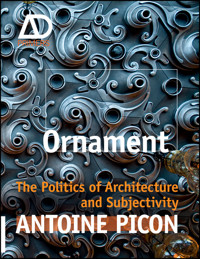
Once condemned by Modernism and compared to a ‘crime’ by Adolf Loos, ornament has made a spectacular return in contemporary architecture. This is typified by the works of well-known architects such as Herzog & de Meuron, Sauerbruch Hutton, Farshid Moussavi Architecture and OMA. There is no doubt that these new ornamental tendencies are inseparable from innovations in computer technology. The proliferation of developments in design software has enabled architects to experiment afresh with texture, colour, pattern and topology.
Though inextricably linked with digital tools and culture, Antoine Picon argues that some significant traits in ornament persist from earlier Western architectural traditions. These he defines as the ‘subjective’ – the human interaction that ornament requires in both its production and its reception – and the political. Contrary to the message conveyed by the founding fathers of modern architecture, traditional ornament was not meant only for pleasure. It conveyed vital information about the designation of buildings as well as about the rank of their owners. As such, it participated in the expression of social values, hierarchies and order. By bringing previous traditions in ornament under scrutiny, Picon makes us question the political issues at stake in today’s ornamental revival. What does it tell us about present-day culture? Why are we presently so fearful of meaning in architecture? Could it be that by steering so vehemently away from symbolism, contemporary architecture is evading any explicit contribution to collective values?Sie lesen das E-Book in den Legimi-Apps auf:
Seitenzahl: 222
Veröffentlichungsjahr: 2014
Ähnliche



















Contents
Cover
Half Title page
Title page
Copyright page
Acknowledgements
Introduction: Architecture as Ornament?
References
Chapter 1: A Problematic Return
The Ornamental Revival in Contemporary Architecture
Textures, Patterns and Topology: A Different Ornament
The Subjective and the Political
References
Chapter 2: Ornament and Subjectivity
The Visage of Architecture
The Architect, between Rules and Invention
Artists, Craftsmen and the Fabrication of Ornament
From Clients to Passers-by
Industrialisation and the Ornamental Impulse
The Ghost of Ornament
References
Chapter 3: Politics of Ornament
From Economics to Politics
Communication and Style
The Power of Architectural Décor
References
Chapter 4: Politics of Ornament
A New Architectural Subject
Political Uncertainties
Meaning and Symbols
References
Bibliography
Key Search Terms
Picture Credits
Ornament
© 2013 John Wiley & Sons Ltd
Registered office John Wiley & Sons Ltd, The Atrium, Southern Gate, Chichester, West Sussex, PO19 8SQ, United Kingdom
For details of our global editorial offices, for customer services and for information about how to apply for permission to reuse the copyright material in this book please see our website at www.wiley.com.
All rights reserved. No part of this publication may be reproduced, stored in a retrieval system, or transmitted, in any form or by any means, electronic, mechanical, photocopying, recording or otherwise, except as permitted by the UK Copyright, Designs and Patents Act 1988, without the prior permission of the publisher.
Wiley publishes in a variety of print and electronic formats and by print-on-demand. Some material included with standard print versions of this book may not be included in e-books or in print-on-demand. If this book refers to media such as a CD or DVD that is not included in the version you purchased, you may download this material at http://booksupport.wiley.com. For more information about Wiley products, visit www.wiley.com.
Designations used by companies to distinguish their products are often claimed as trademarks. All brand names and product names used in this book are trade names, service marks, trademarks or registered trademarks of their respective owners. The publisher is not associated with any product or vendor mentioned in this book.
Limit of Liability/Disclaimer of Warranty: While the publisher and author have used their best efforts in preparing this book, they make no representations or warranties with respect to the accuracy or completeness of the contents of this book and specifically disclaim any implied warranties of merchantability or fitness for a particular purpose. It is sold on the understanding that the publisher is not engaged in rendering professional services and neither the publisher nor the author shall be liable for damages arising herefrom. If professional advice or other expert assistance is required, the services of a competent professional should be sought.
ISBN 978-1-119-96594-7 (hardback) ISBN 978-1-119-96595-4 (paperback) ISBN 978-1-118-58753-9 (ebk) ISBN 978-1-118-65832-1 (ebk) ISBN 978-1-118-58823-9 (ebk) ISBN 978-1-118-58824-6 (ebk)
Executive Commissioning Editor: Helen Castle Project Editor: Miriam Swift Assistant Editor: Calver Lezama
Acknowledgements
A book often begins and develops through a series of conversations. I would like to thank here Sarah Whiting for her initial suggestion to write a book on contemporary architectural ornament. I am indebted to Farshid Moussavi’s pioneering research on the subject. Colleagues on both sides of the Atlantic, Martin Bressani, Preston Scott Cohen, Patricia Falguières and Hadas Steiner, have helped me to hone the argument developed here. Alina Payne has graciously lent me one of the very first published copies of her book From Ornament to Object. Reinhold Martin and Norton Wise have shared with me precious information. My doctoral students Peter Sealy and Marrikka Trotter have been kind enough to read parts of this essay. At Wiley, Helen Castle’s constant support has proved invaluable, and Caroline Ellerby has played an essential role in assembling the illustrations.
My deepest gratitude goes to my colleague Erika Naginski who has read, criticised and edited this book chapter after chapter.
Introduction: Architecture as Ornament?
What if architecture were ultimately about ornament? Even décor. In The Mediation of Ornament, Islamic art specialist Oleg Grabar proposes to interpret it from this very perspective. ‘Good architecture is always meant to be an invitation to behave in certain ways; it always adorns life, and, some exceptions notwithstanding, does not require the emotions surrounding whatever one does in a building, including looking at works of art,’ states Grabar, concluding that ‘architecture is a true ornament (…). Without it, life loses its quality. Architecture makes life complete, but it is neither life nor art.’1
For a designer, there is something profoundly disturbing in the thought that architecture corresponds to neither life nor art, but rather is an ornament for both. The nagging feeling that there might be some truth in this could be partly responsible for the early 20th-century demise of traditional décor, as if the conception of the discipline that it hinted at had become, after centuries of tolerance, all of a sudden unbearable. We will return to Grabar’s assertion about architecture, life and art later. Let us begin by acknowledging the return of ornament in contemporary architecture. This return constitutes the subject of the present book.
From professional journals to scholarly texts, it has become commonplace to evoke this reappearance, as if the reluctance of Modernism to recognise the crucial character of adornment were finally about to be overcome. The role played by the computer has likewise been acknowledged. Design software has enabled architects to play with textures, colours, patterns and topologies in highly decorative ways. However, beyond its evident links with the diffusion of digital tools and culture, the meaning of this evolution remains unclear. What are its long-term implications for architecture? Should one consider that the future of the discipline lies in the design of decorated sheds? Is the reduction of architecture to envelope desirable? One thing is certain: ornament represents a delicate issue.
Lesen Sie weiter in der vollständigen Ausgabe!
Lesen Sie weiter in der vollständigen Ausgabe!
Lesen Sie weiter in der vollständigen Ausgabe!
Lesen Sie weiter in der vollständigen Ausgabe!
Lesen Sie weiter in der vollständigen Ausgabe!
Lesen Sie weiter in der vollständigen Ausgabe!
Lesen Sie weiter in der vollständigen Ausgabe!
Lesen Sie weiter in der vollständigen Ausgabe!




