


32,99 €
Mehr erfahren.
- Herausgeber: John Wiley & Sons
- Kategorie: Geisteswissenschaft
- Serie: Architectural Design Primer
- Sprache: Englisch
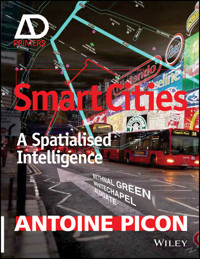
As cities compete globally, the Smart City has been touted as the important new strategic driver for regeneration and growth. Smart Cities are employing information and communication technologies in the quest for sustainable economic development and the fostering of new forms of collective life. This has made the Smart City an essential focus for engineers, architects, urban designers, urban planners, and politicians, as well as businesses such as CISCO, IBM and Siemens. Despite its broad appeal, few comprehensive books have been devoted to the subject so far, and even fewer have tried to relate it to cultural issues and to assume a truly critical stance by trying to decipher its consequences on urban space and experience. This cultural and critical lens is all the more important as the Smart City is as much an ideal permeated by Utopian beliefs as a concrete process of urban transformation. This ideal possesses a strong self-fulfilling character: our cities will become 'Smart' because we want them to.
This book opens with an examination of the technological reality on which Smart Cities are built, from the chips and sensors that enable us to monitor what happens within the infrastructure to the smartphones that connect individuals. Through these technologies, the urban space appears as activated, almost sentient. This activation generates two contrasting visions: on the one hand, a neo-cybernetic ambition to steer the city in the most efficient way; and on the other, a more bottom-up, participative approach in which empowered individuals invent new modes of cooperation. A thorough analysis of these two trends reveals them to be complementary. The Smart City of the near future will result from their mutual adjustment. In this process, urban space plays a decisive role. Smart Cities are contemporary with a 'spatial turn' of the digital. Based on key technological developments like geo-localisation and augmented reality, the rising importance of space explains the strategic role of mapping in the evolution of the urban experience. Throughout this exploration of some of the key dimensions of the Smart City, this book constantly moves from the technological to the spatial as well as from a critical assessment of existing experiments to speculations on the rise of a new form of collective intelligence. In the future, cities will become smarter in a much more literal way than what is often currently assumed.
Sie lesen das E-Book in den Legimi-Apps auf:
Seitenzahl: 248
Veröffentlichungsjahr: 2015
Ähnliche




















This edition first published 2015 © 2015 John Wiley & Sons Ltd.
Registered office John Wiley & Sons Ltd, The Atrium, Southern Gate, Chichester, West Sussex, PO19 8SQ, United Kingdom
For details of our global editorial offices, for customer services and for information about how to apply for permission to reuse the copyright material in this book please see our website at www.wiley.com.
All rights reserved. No part of this publication may be reproduced, stored in a retrieval system, or transmitted, in any form or by any means, electronic, mechanical, photocopying, recording or otherwise, except as permitted by the UK Copyright, Designs and Patents Act 1988, without the prior permission of the publisher.
Wiley publishes in a variety of print and electronic formats and by print-on-demand. Some material included with standard print versions of this book may not be included in e-books or in print-on-demand. If this book refers to media such as a CD or DVD that is not included in the version you purchased, you may download this material at http://booksupport.wiley.com. For more information about Wiley products, visit www.wiley.com.
Designations used by companies to distinguish their products are often claimed as trademarks. All brand names and product names used in this book are trade names, service marks, trademarks or registered trademarks of their respective owners. The publisher is not associated with any product or vendor mentioned in this book.
Limit of Liability/Disclaimer of Warranty: While the publisher and author have used their best efforts in preparing this book, they make no representations or warranties with the respect to the accuracy or completeness of the contents of this book and specifically disclaim any implied warranties of merchantability or fitness for a particular purpose. It is sold on the understanding that the publisher is not engaged in rendering professional services and neither the publisher nor the author shall be liable for damages arising herefrom. If professional advice or other expert assistance is required, the services of a competent professional should be sought.
A catalogue record for this book is available from the British Library. ISBN 978-1-119-07559-2 (paperback) 978-1-119-07560-8 (ebk) ISBN 978-1-119-07561-5 (ebk) 978-1-119-07562-2 (ebk)
Executive Commissioning Editor: Helen Castle Project Editor: Miriam Murphy Assistant Editor: Calver Lezama
Cover design, page design and layouts by Karen Willcox, www.karenwillcox.com Printed in Italy by Printer Trento Srl Cover image © Keiichi Matsuda
Acknowledgements
In a book like this one, exchanges have a special importance. I would like to thank here the individuals involved in digital and smart city development, colleagues and friends, whose input has been very helpful to me. I am indebted to Joëlle Bitton, Jean Daniélou, François Ménard, Dominique Lorrain, François and Manuel Gruson, Nikola Jankovic, Nashid Nabian, Nicolas Nova, Colin O'Donnel, Carlo Ratti, Molly Wright Steenson and Ornella Zaza for their information and ideas. Special thanks to Marie Veltz who has shared with me the abundant documentation that she has gathered on smart cities.
My research has been facilitated by a Canadian Centre for Architecture Senior Mellon Fellowship. I would like to thank here Maristella Casciato, Mirko Zardini and Phyllis Lambert, who have been instrumental in making my stay at the Canadian Centre for Architecture especially fruitful.
Abigail Grater has done a wonderful job translating my sometimes intricate French into English. At Wiley, Helen Castle's constant support has proved invaluable. Caroline Ellerby has played an essential role in gathering the illustrations, a process that has proved quite challenging at times.
My deepest gratitude goes to Virginie Picon-Lefebvre whose careful reading and insightful comments have been, as always, essential.
Contents
Acknowledgements
Introduction A New Urban Ideal
Spatialised Intelligence
Technology, Space and Politics
References
1 The Advent of the Smart City, from Flow Management to Event Control
Defining the Smart City
Self-Fulfilling Fictions
The Sentient and Sensory City
Massive Quantities of Data
What Happens
References
2 A Tale of Two Cities
Neocybernetic Temptation
The Cyborg-City Hypothesis
Spontaneous City, Collaborative City
The Digital Individual
References
3 Urban Intelligence, Space and Maps
Augmented Reality and Geolocation
Towards Three-Dimensional Urbanism
A New Relationship to Infrastructure
The Stakes of Representation
A New Aesthetic
Laboratories of Public Life in the Digital Age
References
Conclusion The Challenges of Intelligence
The Limits of All-Digital Solutions
The Necessary Diversification of Scenarios
Public/Private
From Event to History
References
Bibliography
Index
Picture Credits
EULA
List of Illustrations
Chapter 1
IBM, infographic on ‘building a smarter city and state’, 2013
Aerial view of the Smart City Campus project, Barcelona, Spain, 2014
Looking at smartphones, Kivus, Democratic Republic of Congo, 2012
Human and iCub robot, Institut des Systèmes Intelligents et de Robotique (ISIR), Université de Paris VI, 2013
Henry Howe, 'Map of the Submarine Telegraph between America &Europe', 1858
Screenshot from 'Nokia City Lens', Nokia's augmented-reality application for its Lumia smartphones, 2013
Eric Fischer, map of New York with the location of pictures posted on Flickr by locals and tourists between 5 and 10 June 2010
Ari Ofsevit, map showing the speeds between the docking stations of the bike-sharing system Hubway in Boston, Massachusetts, 2012
IBM Rio de Janeiro Operations Center, 2014
OpenStreetMap mapping party at the Stamen Design office in San Francisco, 26 April 2014
Living PlanIT, concept plan for PlanIT Valley, Portugal, 2010
Living PlanIT, energy mix scheme for PlanIT Valley, Portugal, 2010
Cover of Albert Robida's
Le Vingtième siècle:
La Vie électrique
, Librairie Illustrée (Paris), 1892
Albert Robida,
Téléphonoscope,
from
Le Vingtième siècle: La Vie électrique
, 1892
Screenshot of the 'Foursquare' United States website, 2015
Screenshot of the 'Citizens Connect' application developed for the City of Boston, Massachusetts, 2015
Pervasive computing according to Siemens, 2004
An early Google Glass prototype, 2011
Screenshot of the 'Thingful' search engine, 2015
Lesen Sie weiter in der vollständigen Ausgabe!
Lesen Sie weiter in der vollständigen Ausgabe!
Lesen Sie weiter in der vollständigen Ausgabe!
Lesen Sie weiter in der vollständigen Ausgabe!
Lesen Sie weiter in der vollständigen Ausgabe!
Lesen Sie weiter in der vollständigen Ausgabe!
Lesen Sie weiter in der vollständigen Ausgabe!
Lesen Sie weiter in der vollständigen Ausgabe!




