


Erhalten Sie Zugang zu diesem und mehr als 300000 Büchern ab EUR 5,99 monatlich.
- Herausgeber: Luath Press
- Kategorie: Geisteswissenschaft
- Sprache: Englisch
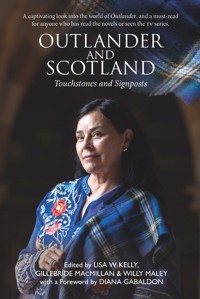
What is the 'Outlander Effect'? How does Outlander shape understanding of clan identity and Jacobite allegiance? How does the series balance modern feminist perspectives with historical realities? How does Diana Gabaldon answer ten key questions about her work? Inspired by Scotland's tumultuous history of 'treachery, betrayal and murder', the Outlander series has fired unprecedented global interest in Highland dress, Scottish history and Gaelic culture. In this landmark book, Diana Gabaldon shares her strong views on cultural appropriation and answers ten key Outlander questions. Outlander and Scotland offers a fascinating and sometimes surprising range of insights. Informed voices from the worldwide Outlander community discuss the storytelling, the characters, the real histories behind the fiction and the questions of gender and power Diana Gabaldon raises.
Sie lesen das E-Book in den Legimi-Apps auf:
Seitenzahl: 541
Veröffentlichungsjahr: 2025
Das E-Book (TTS) können Sie hören im Abo „Legimi Premium” in Legimi-Apps auf:
Ähnliche



















Given Outlander’s transatlantic nature, the publisher has chosen to retain the original author’s or source material’s spelling conventions (eg, American English), rather than converting them to another standard (eg, British English).
First published 2025
ISBN 978-1-80425-333-5
The authors’ right to be identified as author of this book under the Copyright, Designs and Patents Act 1988 has been asserted.
Typeset in 11.5 point Sabon by
Main Point Books, Edinburgh
© the contributors 2025
This book is dedicated to Professor Sir Geoff Palmer 1940–2025
Sir Geoff graced the Glasgow Outlander conference with a wonderful plenary lecture entitled ‘Hands That Took…’, an allusion to a line from Robert Burns’s anti-slavery poem, ‘Ode, sacred to the memory of Mrs Oswald of Auchencruive’. Sir Geoff spoke eloquently without notes for an hour and answered questions with great wisdom and patience. Unfortunately, when we came to publish these essays, Sir Geoff was too unwell to provide a transcript for his improvised presentation. The conference proceedings were not recorded, but the editors wish to record their thanks here in memory of a marvellous contribution, sadly missing from this collection.
Contents
INTRODUCTION
An Outlandish Idea
Lisa W Kelly, Gillebrìde MacMillan and Willy Maley
FOREWORD
My Father’s Sombrero: Cultural Appropriation and What’s So Appropriate About Culture?
Diana Gabaldon
PART ONE: Colonialism · Slavery · Indigenous Communities
An Actor’s Brush with Slavery
Bill Paterson
Outlander and the Wild West of Scotland
Willy Maley
Bloodlines: Scottish and Native American Interactions, Historical Documents, Photographs and Stories
Sharenda Roam
Religion, Feminism and the Colonial Past
Sheila Briggs
PART TWO: Jacobitism · Gaelic · Poetry
Chasing the Jacobite Dream
Jesper Ericsson
‘What Makes Heroic Strife?’: Practical Jacobitism and its Death at Culloden
Darren Scott Layne
From Covenant to Culloden: Paisley’s Jacobite Story
Archie Henderson
The Prince and the Oral Tradition
Gillebrìde MacMillan
‘Beyond the Stones’: A Poet Looks at Identity
Jock Stein
‘She’s even misspelled “help”!’: Outlander’s Fraser Men and Gaelic Education in the Scottish Highlands
Danielle Fatzinger
‘Da mi basia mille’: Ancient Love Poetry and Modern Romance Literature in Outlander
Olivia Happel-Block
A Scottish Mathematician Defending Edinburgh in 1745
Ana María Teresa Lucca
PART THREE: Gender · Feminism · Resilience
Putting Sexual Violence ‘Back into History’: Outlander, Rape and the #MeToo Movement
Katherine Byrne and Julie Anne Taddeo
‘I’m Not the Meek and Obedient Type’: Feminist Characterisation, Anti-Ageism and Sexual Agency in Outlander
Yvette de la Vega
Claire: The ‘Bad’ Historian?
Rosanne S Parent
Outlandish Femininities: Interrogating Feminism, Femme Theory, and Settler Fantasies in Outlander Fandom
Andi Schwartz
A Story of Systemic Resilience
Christie Eppler and Rebecca A Cobb
Outlander as a Therapeutic Tool for Couples: Thoughts of a Psychologist Turned Memoirist
Robyn Irving
PART FOUR: Medicine · Ethics · Environment
The Proximity of the Patient and the Role of Sympathy in Outlander
Jane A Hartsock
Healing the Sick to Delivering Foals: One Health, Comparative Medicine and Outlander
Jamie Rothenburger
Reading and watching Outlander Through an Environmental and Eco-critical Lens
Cornelia Kaufmann
The Fragmented Healer: Claire’s Medical Practice and Narrative of Self in Outlander
Shady Grove Oliver
PART FIVE: Texuality · Materiality
Tartan Through the Stones: Scottish Dress and the Costuming of Outlander
Brenna A Barks
‘A Weapon Into My Hands’: Textuality in the Outlander Series
Svetlana Seibel
Translating Outlander: Titles and Covers in the German Editions
Alexandra Dold
PART SIX: The ‘Outlander Effect’ · Industry · Tourism
A Series of Cycles: Watching Outlander and Visiting Scotland
Teresa Dokey
The ‘Outlander Effect’ on the Scottish-based Freelance Screen Workforce
Nelson Correia
The Outlander Training Programme: Accounts from Below-the-Line Workers in Scotland’s Screen Sector
Lisa W Kelly and Katherine Champion
The Outlander Effect 2.0: A Case Study
Verena Bernardi
The ‘Outlander Effect’ on Scottish Tourism to its Remote Regions
Katherine Chalmers
Integrating Film Tourism into Heritage Management: The Case of Outlander and its Impact on Scottish Heritage Sites
Alexandra Dold, Séverine Peyrichou and Juliette Irretier
Outlander: An Ambassador of Scotland
Ioannis Gigis with Max Chambers
Screen Tourism at the World Tourism Organisation: The Outlander Perspective for Sustainable Tourism
Laura Huici-Sancho
Outlandish Whisky Experience – a Sensory Ethnography Approach to Alcohol in Outlander Novels, Television Series and Tourism
Riitta-Marja Leinonen
Outlander: Comfort and Escapism
Jordan Rich
Border to Reality: How the Performance of Fan Identity Connects Fiction with Reality
Eline Homburg
The Past is a Destination: Outlander and Screen Tourism at Historical Heritage Sites
Charlene Herselman
PART SEVEN: Temporality · Memory
Travelling Back in Time: Readers’ and Audiences’ Experiences of Journeying into the Past with Claire in Outlander
Lorna Stevens
Narratives of Witchcraft: Geillis Duncan, Outlander, and the Politics of Memory
Stephanie Shakay Tierney
The Shifting Paradigm of the Fantastic Marvelous: Time Travel and Genre Hybridity in the Outlander Serial Television Drama
Michael A Unger
And Finally…
Ten Outlander Questions Answered
Diana Gabaldon in conversation with Willy Maley
Acknowledgements
References
Endnotes
Notes on Contributors
INTRODUCTION
An Outlandish Idea
Lisa W Kelly, Gillebrìde MacMillan and Willy Maley
THE NOVELS OF Diana Gabaldon have enthralled millions of readers for over three decades and today hundreds of gatherings and interest groups around the world promote and encourage Outlander fandom. Outlander and Scotland: Touchstones and Signposts arises out of the first major international conference on Outlander. This remarkable gathering in July 2023 was hosted by the University of Glasgow, which provided locations for Outlander, including its famous cloisters, where Claire and Brianna walked when Glasgow stood in for Harvard, and it was outside the City Chambers, standing in for Westminster, that Frank Randall proposed to Claire Beauchamp. The star guest was Diana Gabaldon herself. From the word go, she was a generous, engaging and enthusiastic supporter of the project. This gathering blurred the boundary between academia and fandom: orthopaedic surgeons, veterinary scientists, film critics, anthropologists, translators, linguists, historians, medical ethics experts, agriculturalists, political scientists, philosophers and fans came together to discuss the Outlander phenomenon and the multiple areas of expertise involved in its creation. Outlander’s themes – healing, medicine, war, cultural encounters, witchcraft and emigration – have captured the imagination of millions of readers and viewers. Diana gives scrupulous attention to the minutiae of everyday life in the period – or periods – in which the novels are set. ‘Some people regard facts as inconvenient obstacles to their creativity, while I’m inclined to view them as a trampoline,’ she comments in ‘Ten Outlander Questions Answered’. Her gift for detail is legendary.
The series, launched in book form in 1991 and adapted for TV in 2014, has been transformative for Scotland’s tourism and heritage, generating global interest in the country’s history, languages and landscapes. It maps out the contribution of Scotland to American Independence – and more problematically, to the Atlantic slave trade – and has drawn attention to early Scottish interaction with Indigenous peoples in North America.
Richly researched, the books open up questions about 18th-century Scotland and pivotal events like Culloden to a world readership, at a time when new scholarship suggests that some of this history has still to be written or is in need of revision. A notable feature of these novels is their frank treatment of female sexuality and sexual relations on the whole, including sexual violence. Vivid and visceral, Outlander takes a time-travelling nurse-turned-doctor and propels her from 1946 to 1743, two worlds of war that collide in an elaborate and painstaking reconstruction. The series is an innovative and pioneering rethinking of how we excavate and examine the narratives of the past.
Shot primarily in Scotland, Outlander has been a brilliant boost for the Scottish screen industry and has led to the development of a dedicated studio space and numerous employment opportunities, including a training programme specifically for new entrants, providing an excellent pathway for film and TV students. The main focus of the TV series is not just the rural Scotland of tourist brochures with castles, islands, lochs and mountains; its towns and cities also play a part, and none more notably than Glasgow. A focal point for Outlander and the themes it develops, Glasgow Cathedral, St Andrew’s in the Square and George Square have all been used as locations for key scenes, while West End streets and Kelvingrove Park stand in for Boston. Colleagues at Glasgow University from a range of disciplines have been directly involved in the TV production as researchers, advisors and even cast members – Gillebrìde MacMillan (Senior Lecturer in Gaelic) stars as Gwyllyn the Bard in Season 1 of the TV series. Gillebrìde, who has acted as a Gaelic advisor on the series, also gives his name to a character in the ninth novel, Go Tell The Bees That I Am Gone (2021). Outlander has stimulated considerable interest in the Gaelic language, bringing a wave of new learners.
History has tended to be written from a male perspective, even domestic history, where the main actors are not women. Outlander is different. Women have agency and the central protagonist is an active, engaged, informed, literally world-changing figure. Towards the end of Go Tell The Bees That I Am Gone, Claire reflects that ‘written history has only a tenuous connection with the actual facts of what happened. Let alone the thoughts, actions and reactions of the people involved.’
A distinctive feature of Outlander is the representation of Indigenous communities (including the Gaelic community) and the wider relationship between natives and newcomers. Questions of ethical depiction, accurate representation and an inclusive approach to different cultures are key both to the novels and the TV series. What can film and fiction tell us about history that scholarship can’t? Popular culture, rather than distracting us from ‘real history’, encourages greater understanding of history in its broadest sense.
FOREWORD
My Father’s Sombrero: Cultural Appropriation and What’s so Appropriate About Culture?
Diana Gabaldon
MY FATHER HAD an embroidered sombrero. He never wore it; it floated around the house, appearing here and there among the objets d’… well, ‘d’artes’ isn’t quite the right word. Leave it that all of the people on both sides of my family were money-limited in previous generations (both my parents were born in 1930) and therefore were either Very Thrifty and never threw away anything that might conceivably be used, and/or Total Squirrels, who never threw anything away, no matter what it was.
My Dad’s family members (Hispanic) were of the Thrifty class, while my mother’s (English and German) were plainly Squirrels, back to the Flood.
This is why we had six (new) basketballs, four ten-gallon cast-iron souppots, an antique bottle-capper (we didn’t know what it was, for some time, until a friend who was an amateur brewer recognized it), a child’s china (literally) tea-set, made in (literally) China (circa 1950), hand-painted with versions of Mickey and Minnie Mouse, a stereopticon viewer with complete sets of ‘Views of Croydon’ and ‘Views of the Grand Canyon’, a tattered deer hide, dyed blue (I honestly have No Idea; maybe one of my father’s friends, for whom he butchered deer and elk they’d shot, gave it to him; he was a professional cook, among many other things – the soup-pots and basketballs were emblems of his identity), several green army sleeping bags (my maternal grandfather served in WWI), all the Beatles albums from The Beatles! to Rubber Soul (I didn’t care for the music after that – too affected, smarmy and neither heart nor soul, sorry, Guys), and a lot more Stuff, all communing in the menacing/intriguing, shadowy, dirt-floored Space Under the House, which took my sister and me three days – working like fiends – to clear out, when my stepmother sold the place 50-some years later.
It is therefore Not My Fault that my office is… well, ‘littered’ is appropriate, but only in the generative sense (i.e., it breeds…), rather than the sense of being trash. (Unless you count the empty Diet Coke cans and gnawed bones – gnawed by the resident dogs, not me – and we regard that as incidental detritus, rather than cultural artifact.)
Dad’s sombrero was indeed a cultural artifact, though.
In the 1960s, there was a brief fad among my parents’ friends (all teachers, school principals or coaches) to visit Nogales (Mexico was Extremely Exotic, as almost no one in my parents’ social circles in Flagstaff spoke Spanish, and even the Spanish-speaking ones hadn’t grown up in Mexico) and it was a common supposition that the Mexican Hat Dance (which no one had ever seen performed, save possibly in a Speedy Gonzales cartoon) featured this item.
Footnote: Speedy Gonzales (the fastest mouse in Mexico) was an early victim of political correctness, being seen by white (well ‘not noticeably brown’, let us say) people as ‘demeaning’ to persons of what was still called ‘Spanish’ (as opposed to the déclassé ‘Mexican’) heritage.*
*Au contraire, Señor Speedy was a folk-hero, the rodent equivalent of Zorro; a free spirit who easily outsmarted the forces of official stupidity. While wearing a sombrero.
My father – a notable athlete in his youth and coach/teacher/principal/State Senator in later years – and all his ‘Mexican’ friends – loved Speedy Gonzales and the philosophical crows. Also Zorro. I got a Zorro hat for Christmas one year, with dangling bobbles, and an accompanying mask. No sword, though, which I thought was a cheat.
But that’s not why there was an embroidered sombrero sitting on the fireplace.
It was a Symbol. Both of friendship – travelers to the Border often brought these back to Flagstaff (up in the mountains of Arizona), both for themselves and for their less-traveled buddies – and of our ‘Mexican’ heritage.
That heritage was a major Point in my father’s consciousness, because when he and my mother were engaged to be married, public petitions were taken out, protesting the marriage on grounds of miscegenation. (Well, it was 1950, and my mother was not only white, she was the mayor’s daughter…) ‘If you marry that man, your children will be idiots!’, she was told.
She did it anyway; my mother was very brave. (Though to be completely honest, her side of the family was English, and they basically didn’t consider anybody else’s opinions to be important.)
A person’s culture is plainly an integral part of their identity – but it belongs to a lot of other people, too. To use a custom or wear an item of a culture not your own doesn’t damage or deprive anyone who belongs to that culture of their identity. (Excluding religious customs, obviously.)
On the contrary, the brushing together (or collision…) of cultures much more frequently results in enrichment of both, than in injury, degradation or extinction.
Consider – since we’re in Scotland – the example of the kilt. Plainly, nothing could be more symbolic of Highland culture (and by extension, Scottish culture in general). Yet, far from protesting the wearing of kilts by Strangers, Scottish merchants wisely rent or sell kilts and accessories to anybody who can pay for them. Highland Games, bagpipes, Celtic and Pictish-themed jewelry… use of these things by un-Scottish people isn’t considered ‘cultural appropriation’, nor should it be. It’s business.
(Though if anyone actually has practiced cultural appropriation of the Scots, it would be me. <cough> I’ve made off with large chunks of your history and subverted it to my own ends. And yet, no one has ever protested this appropriation.)
On my last visit to Scotland, I stopped by the Outlander studio. It began as a small, abandoned air-conditioning factory, hastily converted into two sound stages and a hallway of offices. Today, it occupies four city blocks, with eight sound stages, and several small on-site factories, and employs hundreds of people.
I was chatting with the director (of the studio) on my way out, and he thanked me for coming and asked if I knew just how much I’d done. I must have looked slightly blank, because he said, ‘This place employs hundreds of people, most of them young. They start out as interns and apprentices, but they leave as full-fledged journeymen, because they’ve learned their trades, working on the show. You’ve given them all careers.’
That made me cry.
To look at the other side, though – true cultural appropriation isn’t borrowing something from a culture; it’s taking away the culture.
Was it cultural appropriation to exclude the teaching of Gaelic in schools during the last century? You bet it was. To forbid (or impose) a language is a bald assertion of ownership; the first step toward assimilation.
Very recent changes in language and forms of address have often been complicated by the political urges some people have to re-name (and thus to attempt to control) other people.
This is also cultural appropriation, though on a lower level; people who don’t belong to a specific culture trying to impose their ‘improvements’, based on the improvers’ own notions of moral correctness.
On the other hand, if you want to buy a sombrero and dance on it, be my guest…
PART ONE
Colonialism · Slavery · Indigenous Communities
An Actor’s Brush with Slavery
Bill Paterson
Bill Paterson plays Ned Gowan, Edinburgh lawyer to Clan MacKenzie, in Outlander Seasons 1–3. Here (first published in Scottish Review) he reflects on one of the key themes of Outlander, Scotland’s involvement in the slave trade.
DURING LOCKDOWN IN London in 2020, current obsessions and a significant birthday brought some memories bubbling to the surface. Fifty years earlier, in 1970, the Glasgow Citizens Theatre for Youth devised and performed a play for young people called, very succinctly, The Slave Trade. It was one of my first proper paying jobs and from our base at that wondrous theatre in the Gorbals, we toured school halls from Paisley to Cumbernauld and all points in between. Three performances a day to audiences of 11-year-olds. For its time, and for its audience, it was a stark and unsentimental look at the brutalities of the triangular slave trade between Britain, west Africa and the Caribbean and the sufferings it inflicted on millions of Black men and women. Also, for its time, it won’t surprise you to know that we attempted to do this without having a single Black face in our cast of five actors. In our show, the British apex of the triangle was represented by the city of Bristol. That city bore the full brunt of our outrage at the immoral yet lucrative trade that helped build its prosperity. Bristol and, almost by implication, England, was the villain. Eighteenth-century Scotland, and particularly Glasgow and Edinburgh, were innocent bystanders. Never mentioned.
Although we daily passed down streets with names like Jamaica, Virginia, Tobago, Glassford and Buchanan, it never crossed our minds to research and portray the stories behind these names and their hidden connection to human trafficking and suffering. We had cheerfully accepted the myth that Glasgow’s 18th-century wealth and expansion had been brought to us by a group of merchants known, almost affectionately, as The Tobacco Lords. These respected and powerful worthies had imported tobacco and sugar from the Caribbean and the American colonies and selflessly laid the foundations for the city’s commercial growth in later years. In our naivety we must have assumed that they simply sent off a postal order for a consignment of Golden Virginia and two or three months later the unsullied goods were delivered to a warehouse in Port Glasgow or on the Broomielaw. Like today’s online deliveries, we didn’t think much about those trapped amidst the nuts and bolts of that commerce. We certainly didn’t think of their ‘lordships’ possible involvement in the cruel slave labour necessary to actually plant and harvest those commodities. After all, wasn’t that dirty business organised from Bristol?
Despite our best intentions, our little show was complicit in quietly separating Scotland from the reality of the century’s slave trade. In this benighted year of 2020, those 11-year-olds in our audiences will now be approaching pension age and many, like me, will have never questioned that assumption until recent years. Some of them might even be the proud owners of a wee pied-à-terre in the Merchant City, that concocted rebranding ploy for the grid of streets named after many of those tobacco dealers. When Glasgow welcomed that brand image as recently as the 1980s it showed how ignorant we remained of the underbelly of the city’s commerce. This was the Glasgow that was miles better but was still out and proud about its Tobacco Lords. True the new name successfully rescued the area from neglect but from the start it never felt right. These days something more gruesomely accurate might be demanded. We can no longer be quite so innocent of what was done to lay the foundations of the Merchant City. Perhaps best to reinstate its lovely old name of Candleriggs because, as every news bulletin tells us, names have become important again.
Many years later, I had another tiny brush with Scotland’s involvement in the slave trade in the film Amazing Grace about the life and struggles of William Wilberforce. I played Henry Dundas, First Viscount Melville, often known as the ‘uncrowned king of Scotland’, during the time of Pitt the Younger. Dundas paid lip service to the abolition of slavery, but his protection of vested interests actively delayed Pitt and Wilberforce’s anti-slavery legislation. In one crucial scene Dundas persuaded the House of Commons to hold fire on the Abolition Act and only introduce it ‘gradually’. His broad Scots brogue would have made that word ring round the chamber and it kept millions enslaved for a further 15 years. His statue towers over St Andrew Square Garden and we could all name several Dundas and Melville streets in towns and cities all over Scotland. Not to mention a long-demolished bus station. Although there are calls for his removal from that column, at 150-feet above the gardens it might as well be Oor Wullie up there. Better, I think, to inform readers at ground level of Henry Dundas’s real impact on our history. The urge to rebrand every single street name with a dodgy pedigree could be a never-ending and constantly shapeshifting task. I’m hoping that someone is developing an app that can put these names into context. At a click we need never ask again, ‘Who was Glassford? Who was Buchanan? Who was Dundas?’ and be told ‘Oh, they were just some old Scottish worthies. They meant no harm.’
Outlander and the Wild West of Scotland
Willy Maley
IN NOVEMBER 2020, after COVID had put paid to our earlier efforts to host a conference in Glasgow on Outlander, Lisa Kelly and I organised an event entitled ‘The Wild West of Scotland’ for Being Human: A Festival of the Humanities at the University of Glasgow.1 Our aim, reflecting on Outlander’s portrayal of Native Americans in Season 4 of the TV series, was to highlight the historical connections between Scots and Native Americans. We were fortunate to be joined on that occasion from Eagle Butte in South Dakota by Marcella LeBeau, a Lakota Sioux elder who had come to Glasgow in 1995 to make the request for the return of the sacred Ghost Dance Shirt. We were delighted, too, that when the postponed Outlander conference finally went ahead in 2023, we had a session on ‘Representations of Indigenous Communities’.
Scottish–Indigenous Encounters: A Braided History
In June 2018, 100 First Nation Canadians arrived in Scotland to film Season 4 of Outlander (‘Brave the New World’). Based at Faskally Forest, they were standing in, by agreement, for Native Americans. Due to restrictions placed on the series by the Screen Actors Guild – American Federation of Television and Radio Artists (SAG-AFTRA), those Native American tribes – Cherokee and Mohawk – could not play themselves and had to be represented by actors from across the border in Canada. These actors crossing the Atlantic to play their part in a TV series about time travel and historical reconstruction were not the first North American Indigenous performers to arrive in numbers in Scotland for a major cultural event. Their arrival in Scotland in 2018 echoed two earlier Atlantic crossings, and this essay will trace the cultural consequences of those encounters for our understanding of Scotland’s complex colonial history. But before we proceed, some context. Perhaps the most notable modern dramatic depiction of the relationship between Scots and ‘Native Americans’ occurs in John McGrath’s landmark play The Cheviot, the Stag and the Black, Black, Oil, produced in 1973.2 McGrath drew an analogy between the Highland Clearances and other British colonial ventures across the globe, including the experience of Canadian ‘Red Indians’.
In McGrath’s play, a ‘Sturdy Highlander’ steps out of character to say:
But we came, more and more of us, from all over Europe, in the interests of a trade war between two lots of shareholders, and in time, the Red Indians were reduced to the same state as our fathers after Culloden – defeated, hunted, treated like the scum of the earth, their culture polluted and torn out with slow deliberation and their land no longer their own. But still we came. […] The highland exploitation chain-reacted around the world […] In America the plains were emptied of men and buffalo, and the seeds of the next century’s imperialist power were firmly planted and at home the word went round that over there, things were getting better.3
The play’s identification of the enforced migration of land-robbed Scottish Highlanders with that of First Nations drew a mixed reception, for it replayed an old stereotype of Highlanders and Indians as hewn from the same wood. The fact that James Fenimore Cooper took inspiration from Sir Walter Scott adds weight to the idea of a shared romantic perception.4 Some critics concurred with McGrath’s comparison and saw The Cheviot as an anti-colonial play. For Tom Maguire, for example, the play ‘explicitly articulated a postcolonial consciousness in the theatre […] matching what appeared to be a national mood in favour of political devolution, if not complete independence’.5
The Cheviot deals with the aftermath of political union and the effects of the colonialist exploitation of the land. Some critics accepted the Scottish–Indigenous comparison and the analogies drawn between the local exploitation of the Highlands and global exploitation of other local and national economies by multinational companies and colonising states. For others, the comparison proved contentious. Representative of a sceptical current of criticism is a challenging essay by Alan Filewod, who viewed the analogy between First Nations and Scots as an instance of ‘white theft’, appropriating the suffering of others even as it silenced them by denying them a voice. For Filewod:
In a notable moment in the play, the cast follow the cleared Highlanders across the ocean, to Canada, and replay the encounter with aboriginality. We hear the ‘[s]ound of Indian drums, warwhoops, jungle birds, coyotes, hens, dogs barking. […] Enter RED INDIANS. They dance and then freeze’ […] The ‘Red Indians’ creep up on the sturdy Highlanders with ‘tomahawks’ raised, and their dialogue consists of the ‘ug’ that confirms them as cited stereotypes reclaimed from popular culture. […] racial impersonation is a tactic of political alignment and shared history, a point underscored by the ‘French Northwest Trader’ who says of the aboriginal figures, ‘These are my little friends. They give me furs, beaver skins, Davy Crockett hats and all the little necessities of life. I give them beads, baubles. V.D., diphtheria, influenza, cholera, fire water and all the benefits of civilization’ […] It is not enough […] to observe that the re-inscription of minstrelsy that deploys white bodies to revive the cultural memory of racist imaging is problematic at best and callously racist at worst. […] These […] histories are deeply complicit in the fantasy of rescued authenticity that is the vision of theatrical modernism. The failure of postcolonial agitprop lies in this notion of authentic resistance, in which the representation of resistance declares itself as resistance in praxis but in the end licenses the narrative strategies of oppression and replays the genocide that it expropriates.6
Yet despite Filewod’s robust critique, there is a shared colonial history, and one that has been explored in recent Outlander criticism.7 Building on a longstanding tradition of scholarly engagement with the ways in which Scots interacted with Indigenous communities, and vice versa, within the context of the British Empire, Colin Calloway traced a tapestry of connections, including the crucial period in the wake of Culloden:
When the Black Watch Regiment arrived in America at the start of the Seven Years’ War, Indians reputedly ‘flocked from all quarters’ to see them, ‘and from a surprising resemblance in the manner of their dress, and the great similitude of their language, the Indians concluded they were anciently one and the same people, and most cordially received them as brethren.’ […] By the nineteenth century, in western Canada, eastern New York, and the mountains of Tennessee and Montana one could hear Cree, Mohawk, Cherokee, and Salish spoken with Gaelic accents. […] Robert MacDougall, who wrote an Emigrant’s Guide to North America in Gaelic, believed he saw many similarities between Gaels and Indians, particularly in language. The ‘slow, soft, pleasant speech’ he heard among the Algonquians of Canada was, he thought, ‘merely a branch of the Gaelic language,’ and he found words with similar sounds and meanings: the Algonquian word saganash (white man) and the Gaelic term Sassanach (Englishman), for instance.8
Sassenach is a word familiar to Outlander fans, and the Gaelic connection with First Nation peoples has been the subject of recent discussion.9 More broadly, there is an ongoing re-examination of the Scottish–Indigenous relationship as neither unproblematically colonialist nor simply characterised by affinities between colonised communities. Scottish Highlander colonists, concentrated in Nova Scotia, impacted significantly on the territory of the Mi’kmaq, and as John Reid argues, ‘Scottish–Indigenous encounters […] emerge as something more closely definable than a mere subset of imperial–Indigenous relations.’10
The Iroquois Lacrosse Team in Glasgow, 1876
The First Nation actors who came to take part in Outlander were not the first such performers to arrive in Scotland for a major cultural event. In 1876, a team from Montreal Lacrosse visited Scotland, including 12 Iroquois players. Their arrival was heralded in the London press:
It is reported that a couple of crack teams of Lacrosse players have arranged to come over here in May. One of the teams is composed of 12 picked players of the Montreal Lacrosse Club, the other an equal number of Indians, warranted real Iroquois.11
The tour was also reported in Canada.12The Glasgow Herald carried a detailed report on Saturday 20 May 1876 of the lacrosse game that took place on the afternoon of Friday the 19th:
The match was played on the ground of the Caledonian Cricket Club at Kelvin Bridge, Great Western Road, and was timed to commence at three o’clock in the afternoon. […] The Indians were the first to enter the ground, and until their opponents took their places they amused themselves passing the ball one to another, which they did with a skill that called forth the admiration of the spectators. They belong, it may be remarked, to the tribe Iroquois, which is settled at Caughnawaga, at the head of the Lochine Rapids, near Montreal. With perhaps one or two exceptions, and these not very marked, the men are somewhat small in stature, but are well made, and in their movements display great activity. Several of them had their faces slightly painted, and others had a number of feathers stuck into their caps; but beyond these trifling indications of the customs of their race, Wild Wind and his companions were dressed much the same [as] their Canadian opponents.
The report gives the names and player positions of both teams, with the Iroquois team listed thus:
HOME
Pick the Feather
HOME
Flying Name
FIRST HOME FIELD
Outside the Multitude
SECOND HOME FIELD
Deerhouse
THIRD HOME FIELD
The Loon
CENTRE
Crossing the River
THIRD FIELD
Wild Wind
SECOND FIELD
Great Arm
FIRST FIELD
Spruce Branches
COVER POINT
Scattered Branches
POINT
Blue Spotted
GOAL
Hickory Wood Split
A second tour touched once more on the boundary of the University of Glasgow’s recently established West End campus. On Tuesday 15 May 1883, The Evening News and Star reported that
Lacrosse, which will be reintroduced to the Glasgow public this afternoon, will again hold sway to-morrow at Hamilton Crescent, Partick. The game is to be expounded by teams representing Canadians and Indians, and no doubt the exhibition will attract a number of people to see what the national pastime of Canada is like when played by experienced hands.13
Buffalo Bill’s two tours of Scotland are well-documented. The public spectacle of the captured Lakota Sioux can be read alongside the sporting event that preceded it by 15 years. The two tours of the Montreal Lacrosse team deserve to be more widely known. Kevin Meehan observes of the sporting encounters that predated Buffalo Bill’s degrading Wild West Show:
Unlike others, these Indians had not been hired by a white entrepreneur and controlled their own performances […] While Indian ownership was unusual […] in the late 1870s tourists were travelling to the west of the USA in order to watch Indian dances, and some Indians would charge as much as US$6 for their photographs to be taken […] By the time Buffalo Bill’s Wild West arrived in Europe in 1887, they were building on an already established pattern of human exhibition and performance […] as well as the then burgeoning mythology of the Wild West, spread through popular books and the press which included both the real and fictional personas of Buffalo Bill (William Cody) himself.14
The report on the lacrosse match in The Glasgow Herald bears witness to a different kind of encounter than Cody’s colonial display. Freighted with cultural preconceptions of its own, it arguably demonstrates a wish to engage with this new sport, and with its players, on their own terms. One legacy of this historic sporting event is the existence of a street called La Crosse Terrace in the Glasgow neighbourhood that hosted it.
Lakota Sioux Captives in Dennistoun, 1891
The Wounded Knee Massacre of 2 December 1890 was a tragedy that had implications for Scotland, and not just because of historical associations between Indigenous peoples in their treatment by colonial powers, with Culloden viewed recently through an Outlander lens as a precursor of that atrocity.15 When William F Cody brought his ‘Wild West Show’ to Glasgow’s East End in November 1891, 17 of the ‘performers’ he brought with him had been captured in the wake of the Wounded Knee Massacre.16 Cody, better known as Buffalo Bill, opened his show in Glasgow on 16 November, playing to packed audiences in a huge spectacle featuring horse-riding, sharpshooting and battle re-enactments in a pioneering effort to invoke the Wild West in the West of Scotland.
On 17 December 1891, George Carlton Crager, US Special Agent for Indian Affairs, theatrical impresario and Lakota interpreter with the show, wrote to James Paton, Curator of ‘Calvin Grove Museum’ offering among other ‘relics’ the Ghost Dance Shirt. On 19 January 1892 Crager ‘donated’ 14 items to the Kelvingrove Museum. Oglala Sioux member Kicking Bear (Mato Wanartaka, 1846–1904), cousin of Crazy Horse (Tashunca-uitco, c1840–77), made a defiant speech when the show closed on 27 February 1892. Kicking Bear, who was employed by Buffalo Bill as a show Indian, took advantage of his curtain-call in 1892, in Glasgow, Scotland, to give a speech to the assembled crowds recounting his valorous deeds, deeds which conflicted with the version presented by Cody; sadly, because he spoke them in his native tongue, the audience were unaware of his protests.17
Fast forward 100 years: the US Congress passed the Native American Graves Protection and Repatriation Act (NAGPRA), which called for the unconditional return of religious objects. NAGPRA ‘provided for the repatriation and disposition of certain Native American human remains, funerary objects, sacred objects, and objects of cultural patrimony’. In 1992, an American visitor to a Glasgow exhibition on ‘American Indians’ reported the Ghost Dance Shirt’s significance, prompting the first written request for its return.18 In 1995, a Lakota Sioux delegation of the Wounded Knee Survivors’ Association (AKSA) arrived in Glasgow to negotiate the recovery of five items, all associated with the 1890 massacre. In 1998, Glasgow City Council’s Arts and Culture Committee set up a cross-party Working Group to examine the case for repatriation of exhibits. In November 1998, despite one museum professional fearing that it would ‘open the floodgates’ to further repatriation of artefacts, a decision was taken to return it, and on 1 August 1999, the Ghost Dance Shirt was handed over at the site of the Wounded Knee Massacre. In April 2000, considering the implications this historic decision might have for other museums, Glasgow City Council submitted a memorandum to a House of Commons Select Committee in London, detailing the process that they had followed in repatriating the Ghost Dance Shirt. Sam Maddra, a history student at the University of Glasgow, played a key role in facilitating the return of the Ghost Dance Shirt, and her groundbreaking PhD thesis provides a rich account of the first Wild West Tour.19 The University of Glasgow thus played a key role in an episode that entailed a landmark decision in terms of decolonising the museum.
Brave the New World
How do we read Buffalo Bill’s Wild West Show in light of the lacrosse tournament that preceded it? What do these events tell us about contrasting models of exploitation, exhibition and engagement? What are the links between performers as hostages, as exemplary performers, as ambassadors and as actors in a period drama? What can we learn from these episodes about cultural appropriation and the image of Canadians abroad?20 And how does all this link to Outlander? Well, Outlander is set in the 18th century, a hundred years before Wounded Knee, and stages in subtle ways the complex colonial history connections between Scots settlers and Native Americans, connections that go back much further than Buffalo Bill. The 18th century is crucial for understanding how Scottish–Indigenous relations were affected by, and in some ways deviated from standard imperial narratives.21 Scots like Peter Williamson from Aberdeenshire, ‘sold as an indentured servant in Philadelphia in 1743’, and ‘captured […] by Seneca Indians in 1754’, became emblematic of Scottish–American links, bound up with class and national identity.22 Indeed, it has been argued that the Scottish interest in Native American culture that persisted into the 19th century was not driven solely by a romantic preoccupation with primitivism but stemmed from an urge to assert the distinctiveness of Scottish identity. Sir William Drummond Stewart’s time in the Rocky Mountains collecting cultural artefacts was thus part of a project aimed at establishing the relative importance of Scottish Highland culture.23 All of this suggests that the connections made between Scottish and Native American cultures were not merely instances of white theft or cultural appropriation.
Portrait of Kicking Bear taken in Dennistoun Photo Co Studios in Glasgow. Courtesy of Jeff Nelson.
In terms of language and costume, Outlander seeks to present – authentically, inclusively, ethically – the native peoples it depicts. It does not, as Buffalo Bill did, present them for the purpose of exhibiting them, humiliating them and celebrating their defeat. One of the themes of Outlander Season 4, Brave the New World, is the idea of a return. In these episodes, Otter-Tooth, a Native American from the 1960s, has travelled back through time. Meantime, in the 1770s, Young Ian Murray, nephew of Jamie Fraser, is living with the Mohawk and has taken on the identity of his adoptive community, given the name Okwaho’kenha (Wolf’s Brother). It seems Young Ian’s experience is not unusual. One contemporary figure, Alexander McGillivray, the son of a Creek mother and Scottish father, became a leader and historian of his maternal community.24 Another key crossover figure in the period is Scottish-born writer John Norton, who, like Young Ian, was an adopted Mohawk. Norton, who claimed to have a Cherokee father, became an Iroquois (Haudenosaunee) leader. He lived from the 1790s through to the 1820s in the British colony that is now Ontario and wrote a history of the First Nations.25 Chief John Ross, who was of Scottish descent, led the Cherokee to Oklahoma in 1838 through the ‘Trail of Tears’.26
Paths cross, time travels and cultures connect. And it gets us asking ourselves in the here and now: how far have we really come? The University of Glasgow has contributed to Outlander in a variety of ways, from providing academic expertise to offering dramatic backdrops. ‘Decolonising Glasgow’ is one of the University’s objectives and research themes, whether through reparations for slavery or repatriation of artefacts. ‘Being Human’ is about being willing to admit mistakes and trying to make amends. We can’t go back in time, but we can try to atone for past actions and inactions. The image of Scots as colonised people akin to Native Americans may contain a kernel of truth, but the reality is more complex. Discussing 16th-century depictions of those communities, Arthur Williamson concluded that ‘[t]he anglophone image of the American Indian both derived from and shaped the social type created by Englishmen of Scots’.27 The history is fraught, and the Outlander series is arguably more attentive to the nuances than either the critical tradition or romantic myth. It is testament to Diana Gabaldon’s gift as a researcher as well as a storyteller that her narrative does justice to this complexity.
Bloodlines:
Scottish and Native American Interactions, Historical Documents, Photographs and Stories
Sharenda Roam
IN OUTLANDER SEASON 4 Episode 4, ‘Common Ground’, the Frasers interact with Cherokee native people. The relationship between the Cherokee and Scots is a close and historically well-documented one. Scots-Indian John Ross was the principal chief of the Cherokees during the era of Indian Removal around 1830.
Using data from the United States Census, Dawes Rolls and DNA records, this paper shares information about my own Scottish bloodline and Cherokee tribal membership as a modern example of the offspring of these historical marriages. Rare photographs, stories and other US government documentation never gathered in one paper nor presented together in any academic forum, are also included. DNA evidence determines that my maternal bloodline is mainly Scottish; and the Shawnee bloodline is documented in the US Census, the Dawes Rolls and Cherokee enrollment testimonies for the Commission to the Five Civilized Tribes. It seems evident from this study that there were families of mixed Scottish and Native American heritage who travelled to Indian Territory, now located in Oklahoma, from homelands and homesteads, in response to the Indian Removal Act of 1830.
In 1869, a historical agreement was signed in which a small band of 722 Shawnee natives were granted Cherokee citizenship in Indian Territory. After the American Civil War ended in 1865, my ancestral grandmother, Harriet Ross, one of these Shawnee tribal members, traveled with her Shawnee band by walking, wagon and riding horses from Kansas to Indian Territory. Many native tribes sought refuge through being adopted into one of the government-recognised ‘Five Civilized Tribes’, which included the Cherokee, Creek, Choctaw, Chickasaw and Seminole.
Individuals from other tribes had to give testimony in order to be adopted into one of these tribes. If they were able to prove they were of native blood, they received land and provisions after leaving their distant homes and property.
Those who were eligible to be adopted into one of the tribes were given a number and listed on the Dawes Rolls. The Dawes Rolls, also known as the ‘Final Rolls’, do not include those whose applications were stricken, rejected, or judged as doubtful. Individuals found eligible for the Final Rolls were entitled to an allotment of land, usually as a homestead. This 1893 Act of Congress was named after the chairman, Senator Henry Dawes of Massachusetts.
Since my third-great-grandmother, Harriet Ross, was found eligible, her descendants, including her granddaughter, my great-grandmother, Harriett ‘Hattie’ Williams, were given land in Indian Territory. Because of this, Harriett ‘Hattie’ Williams, when she was 18 years old, received an allotment of land, 80 acres, in Oklahoma Indian Territory by the US Government. She and her husband and family created a homestead and farm; and rented out some of the acres to other farmers for growing crops. Eventually, she sold the land and, along with her family, moved to Idaho. Today, because of this bloodline, our family continues to be enrolled members of the Cherokee Nation; although the United States Government recently changed the details to reflect us as ‘adopted Shawnee member of the Cherokee Nation’.
Below is a portion of the testimony of my third-great-grandmother, Harriet Ross, which she gave during examination by the Department of the Interior, Commission to the Five Civilized Tribes in 1900. In this interview she is giving evidence of her Shawnee bloodline so that she and her family might be adopted into the Cherokee Tribe.
Harriet Ross, recalled, further testified:
Examination by P.C. West, Cherokee Representative:
QI want to know which side of the house you claim Shawnee blood?
AMy mother’s.
Interrogatories by W.A. Mallett, Attorney for Applicants:
QDid you know a man by the name of Captain Joseph Parks
AYes, sir.
QWhat relation was he to your mother?
AHe was her brother.
QWas he Shawnee Indian?
AYes, sir.
QHow long did you live in Kansas before you come to this country?
AI lived all my life there.
QFrom your earliest recollection?
AYes, sir
QOn what reservation?
AJohnson County, Kansas.
P.C. West, Cherokee Representative:
QWhen did you come to the Indian Territory?
AI come when they all come.
QWhat do you mean by that?
AThe whole Tribe of Shawnees.
QIs your husband living?
ANo, sir, dead.
QWhen did you marry him?
ASix years ago.
QWas he a white man?
AYes, sir, white man.
J. O. Rosson, being first duly sworn, states that as stenographer to the Commission to the Five Civilised Tribes, he correctly recorded the testimony and proceedings in this case.
Source: National Archives, Native American Heritage, Dawes Records of the Five Civilised Tribes
The US government has multiple case files and first-hand testimonies from my third-great-grandmother, Harriet Ross, as she strived to be enrolled in the Cherokee Tribe for the future of herself, her children and descendants. These legal documents reveal detailed information about her life. She did not know her father but was born while her stepfather was in the penitentiary. Her Shawnee mother died when she was a child and she lived with the Shawnee since she was a child. It is unclear who raised her. Her first husband was a Shawnee man named Lewis Dougherty, who died before she traveled to Indian Territory. They had twin daughters. My second-great-grandmother was one of these twins, named Mary Dougherty. Harriet Ross was married four more times and birthed at least 12 more children. She owned $12,000 worth of real estate in the 1800s. She travelled with 722 Shawnee people from Kansas to Oklahoma and lived in the Cherokee Nation from 1870. In 1908 she was enrolled as an adopted Shawnee citizen of the Cherokee Nation. She was related to Julia Ann Daugherty, the wife of Chief Charles Bluejacket. Her mother, Catherine Parks was the sister of Captain Joseph Parks, the Shawnee chief that moved from Ohio with other Shawnee to Kansas Territory in 1833. The 1865 US Census lists her as Indian, while the 1870 US Census lists her as Mulatto.
An original tin photograph of Marion and Mary Daugherty. (Courtesy Sharenda Roam)
One of Harriet Ross’ twin daughters, Mary Daugherty (1854–1890), traveled with her from Indian Territory in Kansas to Indian Territory in Oklahoma. At 19 years old, Mary Daugherty married Warren Williams (1843–1912), a 30-year-old man. Together they had seven children. She died at 36 years old leaving her husband, Warren Williams, to raise their children. Warren Williams served in the Union Calvary in Civil War 1860s and carried a Bible in the side pocket of his horse’s saddle. The family treasured his watermarked Bible that had been with him as he forded streams of water and lasted through the war.
US documents show that Warren Williams gave testimony of his deceased Shawnee wife in order to have his children enrolled in the Cherokee Tribe. There were no schools near their home in Indian Territory, Oklahoma, at that time so he decided to send the children to Quapaw Indian Mission Boarding School. For his daughter, five-year-old Hattie, it was sometimes difficult finding food, as the children were separated by age and her older sisters could not take care of her. She and another little girl hunted for apple cores and searched for thrown-out doughballs to roast in their room. Eventually, Warren Williams, their father, realized how unhappy the children were and brought them home. He hired a tutor, Ella Constance Torrence, to teach the children. The children loved her, and Warren and Ella eventually married and had more children. One of their cousins, Molly Bluejacket, taught Hattie, my great-grandmother, how to play the family organ.
Warren Williams with his seven children (mother Mary Daugherty not pictured – deceased). (Courtesy Sharenda Roam)
Warren Williams and children after coming home from the Quapaw Indian Mission Boarding School to be tutored by Ella Constance Torrence (on right), who became Warren Williams’s wife. (Courtesy Sharenda Roam)
Frank Yadon and Harriett (Hattie) Williams/Yadon. (Courtesy Sharenda Roam)
Hattie and her sister Grace attended the Cherokee Female Seminary in Oklahoma in 1851. Today, that seminary has become Northeastern State University. The women students called themselves ‘The Rosebuds.’ When Hattie was 18 years old, she married Frank Yadon and inherited 80 acres allotted to her by the US government. One of their children was my grandfather, Charles Haskell Yadon. Charles, a cattle and rodeo cowboy, married Ruth Scott, of Scottish descent. This marriage brought together the Shawnee Cherokee and Scottish bloodlines.
Charles Haskell Yadon (Shawnee Cherokee) and Ruth Angela Scott/Yadon with their six children. My mother, Sharon Yadon/Roam is at the left on the front row. (Courtesy Sharenda Roam)
Together they had six children, one of whom was my mother.
In conclusion, research reveals that individuals descended from European and native descent married and travelled across the United States after the Indian Removal Act. Together they raised children. As men of Scottish descent came into Indian Territory, they met and married native women. Their offspring are evident in the generations today that contain the mixed heritage of Scotland and native North America.
Religion, Feminism and the Colonial Past
Sheila Briggs
THERE IS A lot of religion in Outlander. This is obvious to the readers of the books, less so to those who have viewed only the TV series. One of the reasons for this difference is that long theological conversations and reflections do not transfer well to the visual medium of television drama. Another is that the small details of the Catholic lives of Jamie, Claire and other characters do not in themselves advance the long arc of the television narrative. Yet even the casual viewer of the television series will be aware of the persistence of religion in the background.
Readers of the books and viewers of the television series are both aware of the centrality of gender in Outlander. Since we see the 18th century and the 20th century largely from Claire’s perspective, we see the discrimination and violence that Claire encounters as a self-possessed woman who enters the male realms of science and medicine. Religion underpins the patriarchy that constantly threatens her (although this is more veiled in mid-20th-century America). Claire is a Catholic but not one who feels bound by the traditional gender norms that the church has upheld and certainly not by its moral teachings.
The dynamic interplay of religion and gender runs through Outlander. Religion is by no means always the enemy of strong women and, religious men, even Catholic priests, are not always villains. The complex portrait that Gabaldon paints of religion, gender and their interactions is central to the overarching concern of Outlander: time. Time is the stuff of human life. It is spent and lost; it is remembered and perhaps redeemed. We are all embedded in the epochs in which we live and shaped by the events of our historical era. Gabaldon’s work is not primarily about time travel. Time travel is a narrative strategy that she uses to explore the nature of time and what it means to live in time. Gabaldon’s rules of time travel are in service to what interests her about time and largely exclude what lies outside her concerns. She is interested in historical time, and this determines the sort of stories she is going to tell, about religion and gender as well as about empires, race and colonization.
One important aspect of religion is myth, but myth plays a marginal role in Outlander. Myth is not absent from Outlander, but it is on the margins of the narrative as the unexplained origins of travel across time. Although the stones of Craigh na Dun appear in the opening credits of all seven seasons of the television series, their only role is to transport characters from one time in history to another. Craigh na Dun and the other portals for time travel belong to a different sort of time: mythic time, the primordial past. The religion of mythic time is archaic, ie that which exists at the beginning, the source of time. It is still remembered by those marginalized within historical time. Enslaved Africans and Native Americans still have a connection to it, as do the 20th-century women whom Claire observes at the beginning of Outlander, taking part in an ancient Druid dance. Even in the 20th century her husband Frank and the Reverend Wakefield refer to these women as witches, a word that had historically associated women with pagan ritual, condemned and punished as devil worship. In the 18th century, Claire is accused and tried as a witch and her medical skills are often viewed as magic or sorcery. But Claire is not a witch or any magical figure. She is not a sorceress or even its postmodern equivalent: a superhero with superpowers. She is a scientist with 20th-century medical skills and knowledge. Although she is not living in her time, she is not living outside of historical time.
Outlander also does not provide us with an alternate history. The Scots do not win or avoid the Battle of Culloden; the British do not defeat the American colonists in the War of Independence. Claire and Jamie become painfully aware of their inability to change major historical events. Even below the level of collective historical fate the time travelers of Outlander can also not alter what happens to individuals. Claire does not change the past when she time travels to it. What she does in the 18th century, happened in the 18th century. She existed in the 18th century as part of its unchangeable past as much as she exists in the 20th century. The consensus of philosophers and scientists is that, even if time travel to the past were possible, the time traveler is and always has been part of that past. So, when Claire in the 18th century is able to recreate penicillin with her 20th-century scientific knowledge, what this means is that a woman in the 18th century created penicillin, even if her achievement was not preserved in the patriarchally slanted historical record. The ‘grandfather paradox’ is impossible. A time traveler cannot kill their grandparent before the conception of their parent – at least not in the same universe. Time travel could only occur in ways that do not permit any violation of the self-consistency of the past with its future. An example of this in the Outlander novels is the time travel of the Native American activists in 1968. Otter-Tooth (Robert Springer) and his companions had aimed to travel back in time to arrive before 1600 and warn the Iroquois League of the impending danger of white settlement. Although the 20th-century Native Americans did not believe that they could entirely prevent white settlement, they believed they could persuade the Iroquois League to act against the Europeans while the balance of power was still in their favour, demanding of the Europeans weapons from the start and limiting them to small, unfortified towns. However, time travel foiled the Native American plans. Otter-Tooth realized that he had arrived without his companions and at least a century too late to foil white colonization.
The French historian Fernand Braudel famously remarked,
In truth, the historian can never get away from the question of time in history: time sticks to his thinking like soil to a gardener’s spade.
Just as the soil on a gardener’s spade contains minerals and a local ecosystem of whatever lives within it – worms, roots, millions of invisible microbes – historical time always has particular trends, actors and invisible forces. Gabaldon’s historical fiction is a spade in historical time no less than that of the historian. Gabaldon’s novels teem with hundreds of characters, most of whom do not appear in the necessarily streamlined narrative of the television series. They belong to the historical ecosystems that Claire encounters in the 18th and 20th centuries. When Gabaldon digs into historical time, their individual lives appear embedded in the soil of patriarchy and slavery, racism and colonialism. They are never merely ciphers to explore these larger themes, but their fictional lives are encompassed by the great issues and events of their day. Claire’s moral quandary about how her time travel might affect history is not constructed around the rather artificial scenario of a time traveller who murders their grandparent, but how her choices will affect the lives of the individuals whom she wishes to help and their descendants in societies she wishes to change.
When at the end of the first Outlander novel Claire and Jamie find sanctuary in a monastery, Claire has extended theological conversations with Brother Anselm. Claire reveals to Brother Anselm that she is a time traveler. Their conversation concludes in the novel (but not in the television episode) with Claire asking the moral question of whether she should try to change the past. Brother Anselm remarks, ‘Shall I be astonished that the master of eternity has brought a young woman through the stones of the earth to do His will?’ Does the universe (or God) have a moral purpose behind Claire’s time travel? Claire then asks, ‘If I knew that some harm was going to occur to a group of people, should I feel obliged to try to avert it?’ Claire raises the question: if it were possible to change the past, is the time traveler morally obliged to change it for the better? Claire wanted to stop the British genocide inflicted on the Scottish Highlands in the aftermath of Culloden.
Claire ponders the incalculable consequences of her actions in the 18th century:
I may have affected the future… no, I have affected the future. And I don’t know how, and that’s what frightens me so much.
I will only quote here part of Brother Anselm’s long response:
You say that you are afraid to take any actions here for fear of affecting the future. This is illogical, Madame. Everyone’s actions affect the future. Had you remained in your own place, your actions would still have affected what was to happen, no less than they will now. You have still the same responsibilities that you would have had then – that any man has at any time. The only difference is that you may be in a position to see more exactly what effects your actions have – and then again, you may not.




