


Erhalten Sie Zugang zu diesem und mehr als 300000 Büchern ab EUR 5,99 monatlich.
- Herausgeber: WeQ Institute Horizonte Verlag
- Kategorie: Geisteswissenschaft
- Sprache: Englisch
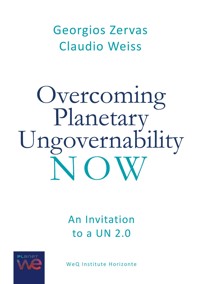
The authors of this book describe the necessary steps to a substantially new quality of peace, security, and sustainable well-being for humanity in a simple yet convincing way. The action steps they propose are highly visionary and yet extremely realistic in a sense that they can actually create and secure planetary peace, security and sustainable fairness, justice and welfare for all. The United Nations with the Security Council and other global organizations such as the World Trade Organization were once set up to achieve these goals. Although these organizations represented very valuable progress compared to the previous world situation, they are now in urgent need of appropriate adaptation. They need to be freed from veto rights and generally from too strong an orientation towards national interests - towards the preservation of peace, security and well-being for humanity as a whole. The Chinese philosopher Zhao Tingyang put it in a nutshell: "World order can only be the order of world sovereignty, guided by the common good of the world." Albert Einstein remarked as early as 1932: "The way to international security is that states unconditionally give up some of their freedom of action or sovereignty, and is should be unquestionable that there is no other way to achieve security." Do we really need another World War to finally overcome planetary ungovernability at its root in clearly vital matters such as world peace and the preservation of ecosystems? How long do we wait to rethink the concept of national interest politics applied to issues that undeniably have a global, a human dimension, and which can only be managed with concepts to planetary sovereignty and the ability to act in a respectful way to the world? The authors of this book propose two new UN ministries on the basis of the new principle of global effectiveness through global validity: The "World Peace Ministry" and "The World Trade Ministry". Today's Security Council should be transformed into a world peace ministry with clear rules for preventive conflict avoidance and a highly effective enforcement capability for effectively ending hot conflicts quickly. The WTO is to be transformed into a strong world trade ministry, which is to lay down globally binding trade rules and ensure compliance with them with the corresponding sanctions. The authors explain what both UN 2.0 facilities could look like in detail so that a global public discussion can be held on this basis.
Sie lesen das E-Book in den Legimi-Apps auf:
Seitenzahl: 149
Veröffentlichungsjahr: 2024
Das E-Book (TTS) können Sie hören im Abo „Legimi Premium” in Legimi-Apps auf:
Ähnliche



















Content
Introduction by Peter Spiegel
Overcoming planetary ungovernability
Foreword by the authors:
Why is this book relevant?
Chapter 1:
How do we rule the world?
Let us finally make the UN powerful and financially strong!
Chapter 2
Two globally effective UN ministries
The World Peace Ministry and the World Trade Ministry
Chapter 3
The World Peace Ministry
Deterrence of violence through a powerful army of the world community
Chapter 4
The World Trade Ministry
Competition-neutral rules of the game for sustainable economic activity
Chapter 5
„Collaboration is the Next Competition”
A collaborative consciousness of the world as the driving force
Chapter 6
A UN for the good of the world
It is possible, we just have to want it!
Epilogue
Links & Literature
The authors
Introduction by Peter Spiegel
Overcoming planetary ungovernability
How can one invite the world to accept an idea, whose value and literal necessity is seen as decisive for the future at a major historical milestone for humanity – perhaps the most significant milestone to date? This book is about nothing less than peace and security as well as the well-being and sustainability of humanity at a stage of its development at which everything is connected. This interconnectivity is no longer theoretical but real. The nature of this planet continuously proves to be an indivisible ecosystem and so is human acting. We live on a “Planet We”. However, many of our ways of action are still far from appropriate or even necessary changes.
The authors of this book describe the necessary steps for action in a simple yet convincing way. These are highly visionary and yet extremely realistic in a sense that they allow for incomparably better chances for a substantially new quality of peace, security, and sustainable well-being for humanity.
The bloodshed of the First World War made it very clear to us that a world order which is dominated by national interest politics is highly dangerous. Nevertheless, since then, our political systems have only slightly moved away from this and are still dominated by national interests: The League of Nations founded in 1920 did not last long – in practice, almost no country was accepting national disadvantages in favor of a group that would really deserve the name – the League of Nations. The veto right for all members served as an “insurance” that the “right of national interests” would continue to retain its dominance.
The Second World War is a consequence of that and was even more cruel and far more cynical in terms of nationalist delusion than the First World War. Subsequently, the founding of the United Nations went beyond the League of Nations. However, the core of the inter-national constitution remained - along with the veto power of the great powers which is implemented through the World Security Council. They were not able to prevent a renewed armament over the last decades and - as we are acutely aware today – they have not provided effective protection against the possibility of a third World War.
This brings up the question if we really need another World War to finally overcome planetary ungovernability at its root in clearly vital matters such as world peace and the preservation of ecosystems? How long do we wait to rethink the concept of national interest politics applied to issues that undeniably have a global, a human dimension, and which can only be managed with concepts of planetary sovereignty and the ability to act in a respectful way to the world? Perhaps the most interesting contribution to this topic – possibly a particular challenge for Western readers - was written by a Chinese philosopher. Here are some quotations from Zhao Tinyang's work “All under Heaven”, published in 2021:
“World order cannot be the order of a world dominated by any hegemonic states or alliances of powerful states, but only the order of a world sovereignty guided by the common good of the world … The real problem of world politics does not lie in so-called failed States but rather in a failed world. If the world continues for much longer as a failed world, then all nation-states, including large and powerful ones, will have a very difficult time overcoming the negative aspects of this world exteriority. It is exceedingly difficult for a world lacking coordination and cooperation to be ensuring security and peaceful development … One reason for this is that the shared interests of the world are not felt to be as pressing as the given objectives of nation-states” (pages 185, 186).
A lot earlier than Tinyang, Einstein recognized the need for global political action, in addition to actions which are valuable to civil society and recognize their global responsibility. As early as in 1932, he wrote in a letter to Sigmund Freud: “The way to international security is that states unconditionally give up some of their freedom of action or sovereignty, and it should be unquestionable that there is no other way to achieve this security.” Hans-Dietrich Genscher and Richard von Weizsäcker spoke of global domestic politics, Mikhail Gorbachev of global perestroika. In 1988 in the United Nations General Assembly, Gorbachev presented the idea of a World Environmental Security Council. Furthermore, he was supportive of the strengthening and consistent democratization of the United Nations. To achieve this, his country was prepared to substantially renounce national sovereignty. Andreas Bummel and Jo Leinen provided the most comprehensive review of such forward thinking in their work “Das demokratische Weltparlament” (The Democratic World Parliament), which was published in 2017 and comprises almost 500 pages.
There is clearly no lack of smart forethought from various authors. Yet, the need for action with regard to challenges that can ultimately only be controlled globally moves even further away from the actual actions that have been agreed and implemented on a global scale. This bring up the question asked by Yehezkel Dror more than 25 years ago in a report to the Club of Rome “Is the Earth still governable?” which remains alarmingly unanswered. Solutions to environmental, human rights, peace, justice, or other fundamental questions of human civilization can only be implemented sustainably in a globalized world if we can actively implement sustainable democratic and constitutional solutions at a global level at the same time. Of course, a system of global action can only be accepted by all if it complies with the highest and most modern democratic principles. How can we ever get to this point if we do not consider a globally responsible governmental construct that is capable of acting in the future and no longer gets caught up in endless loops of national egoism?
The most important and valuable drivers of all agreements of the United Nations about global challenges have not been the individual nations, but the increasingly strong global civil society. More than 3,000 non-governmental organizations with consultative status are now accredited. When we talk about a global civil society, we ultimately mean every single one of us. Let us now take it upon ourselves to ensure a global discussion on how to constructively overcome planetary ungovernability. After all, the Charter of the United Nations is not introduced with the phrase “We, the Nations”, but: “We, the Peoples”. To avoid any misunderstanding: the UN is irreplaceable and will remain a “United Nations Organization”. However, it needs to be improved. The discussion about the goals, nature and design of this necessary and groundbreaking change must be initiated and inspired by “We, the Peoples” - i.e., the peoples, the people of the nations - as all substantial progress in the further development of the UN since its foundation impressively proves.
The authors of this book do not see their proposals as finished and of such maturity that they could immediately be brought to a global vote and to the “the People”. Yet, it has the ambition and the quality, of which I am personally convinced, to inspire the overdue discussion of establishing a UN 2.0 and making it a dominant and constructive issue on a global scale.
Foreword by the authors
Why is this book relevant?
“May you live in interesting times!” - also referred to as a Chinese Curse -, is a proverb whose geographical origin is not for certain established. However, it is usually said to have its origins in the Chinese language. And, we agree with Robert Kennedy, to quote his 1966 speech in Cape Town, “Whether we like it or not, we live in interesting times.” We are at a point today where we talk about a global polycrisis. This illustrates that crisis-like developments in the most diverse areas are interwoven and can no longer be solved in isolation.
As soon as we had left the Corona pandemic behind us, we found ourselves in a cruel war on geostrategically highly sensitive ground in Europe. The epochal global challenges – eradicating mass poverty in a society with a gaping disparity between a rich minority and a poor majority, preserving the biological vitality of our planet, developing humanity in the face of artificial intelligence – have lost priority. Since the Second World War, a feeling of insecurity has been growing and has never been more unsettling as it is today, not even during the Cold War between East and West. Back then, the world was clearly divided, and the good side and bad side were obvious. There were non-aligned countries, which tried not to be drawn into the East-West conflict and the so-called balance of terror provided a certain stability that people on both sides learned to live with. After the end of the Cold War, a lot of hope arose, which has since given way to disillusionment for most of us.
Should we now draw back? Accept our fate of eternal crises and recurring wars? And agree with Hegel, who once said in a lecture on the philosophy of history: “World history is not the soil of happiness. The periods of happiness are empty leaves in it”?
We, the authors of this book, refuse to join this mass pessimism. Yet, we do not want to be naïvely optimistic and ignore the glaring grievances of our time. We see ourselves as realistic optimists who do not want to gloss over the situation but find ways to improve it. We are looking for concrete concepts that are theoretically sound, realistic, and easily financed. Our attention is focused on a world organization which was once associated with great hope, the UN. We believe that the UN should - and can - be awakened from a kind of slumber - to play a crucial role for us and our planet in our century, and possibly beyond. With this book, we want to analyze this role.
Is this book a “political” book? The answer is an unequivocal yes. “Political” yes, but not in the conventional sense. When the media talk about politics, it is mostly about acquiring power, maintaining power, concentrating power, defending power, overpowering power, and losing power. Politics appear to be the means to these power issues, primarily for the benefit of one's own power. A strategically far-sighted, operationally clever, tactically skillful, and sometimes ingenious handling of power demonstrates “political talent”. The transition from the use of power to the misuse of power plays only a subordinate role. For some politicians, the acquisition of power may originally have merely been a means to an end. To achieve something good through a position of power. Over time, however, as one can observe with almost all politicians as well as with practically all political parties on the political spectrum, power became an end in itself. Politics then is understood as: My power is to be increased and protected. In the end, this is used to justify any means: from propaganda to deception and even to the use of violence.
In this sense, our book is not a political book. It is not in the tradition of Niccolo Machiavelli. This book could perhaps be called “trans-political”. It has to do with politics insofar as it is about the prosperous coexistence of humans. Therefore, politics beyond rivalry powers, beyond political camps or parties. We, the authors of this book, are neither right nor left. We are concerned with the weal and woe of all species alive on and because of the earth today and in the future. Our “trans-political” political perspective coincides with what has, since the end of the last Millennium, often been referred to as “world domestic politics”.
Our world in the 21st century increasingly resembles an apartment building with large as well as smaller flats. If the roof is damage and it rains heavily, it would be simply foolish for the owners of the ground floor flat to declare that this only affects the owners of the attic flats, who would have to raise the funds to repair the roof damage alone. If this would then also mean that the ground-floor residents were to insist on their power to control the entrance to the house and thus also access to the attic, the cohabitation would simply be impossible. Does this metaphorically represent the misfunctioning, at least to some extent, of our political systems today?
This book is different and far from this understanding and way of doing politics. From our point of view, all those who play political power games can and may continue to do so, but we are concerned with a higher level of politics with a broader perspective. We would like to invite others to join this perspective, inspired by the fact that we are convinced that many people are just as fed up with political power games as we are and are also longing for a better quality of life for ourselves, our children, and our grandchildren. The word “politics” comes from the ancient Greek word polis. A polis in ancient Hellas was a city-state, a city with an agricultural hinterland to support its inhabitants. Here, the word “politics” combines all matters that affected the entire polis. It could be argued that our world today has turned into a global polis. This global polis and its worldwide population are what this book is dedicated to.
We have tried to keep this book relatively short and concise, yet understandable for readers who do not deal with such topics on a daily basis. For those further interested in one of the mentioned topics, we refer to the bibliography at the end of this book. The list combines our own work with the work of many other experts, including famous works by Nobel Prize winners, all of which contain in-depth information on theoretical backgrounds, empirical research as well as practical examples, which we have deliberately not reproduced in this book.
This book is a continuation of the book “Planet We – Shaping the Economy and World Politics in a Competitively Neutral Way”, published at the beginning of 2023, which was written by one of the authors of this book, Georgios Zervas, together with Peter Spiegel. Overcoming Planetary Ungovernability takes the ideas presented at that time and builds on them. Above all, our book addresses the question: How can good concepts and solutions be implemented in a concrete and timely way? Our focus is the UN. We want to present concepts on how the UN as it works today can be further developed in a concrete and prompt way as well as improve its power and financial stability, for the benefit of the whole world.
Chapter 1
How do we rule the world? Let us finally make the UN powerful and financially strong!
What kind of image do you have of the UN? What is your opinion about it? How do you feel about the UN? Does the UN give you hope, or does it scare you? Or do you feel rather indifferent? Especially when it comes to securing world peace, billions of people are probably disillusioned, if not bitterly disappointed, by the UN. In this chapter, we look at the strength and weaknesses of the current bodies of the UN. Here, the UN Security Council is criticized. However, we do see great potential in a UN 2.0 that is powerful, financially strong, and represents all of us. If the UN improves as such, we can resolve the current planetary ungovernability.
Is the UN a toothless tiger?
This is a statement that we disagree strongly with! The UN has a great track record looking at some of its sub-organizations operating worldwide. The achievements of UNESCO and UNICEF, to mention two examples, are impressive. The work of other “special organizations” associated with the UN (United Nations Special Organizations) is often controversial, such as the WHO (World Health Organization), the WTO (World Trade Organization) as well as the IMF (International Monetary Fund). Questions that are commonly asked are: Who owns these suborganizations? Who finances them? Whose interests do they represent? Who is running the show here?




