


20,99 €
Mehr erfahren.
- Herausgeber: The Crowood Press
- Kategorie: Lebensstil
- Sprache: Englisch
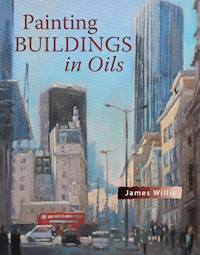
Painting buildings is an exciting and versatile genre - it allows you to enjoy the lines of architecture but also to add feeling and context to a picture. This practical book explains the full depth of the subject, from first sketches to final presentation. Using a range of examples, it is packed with advice and information, and follows the riches of painting the built landscape. Not just a handy reference, this is a beautiful and inspirational guide for every artist who wants to capture and interpret a scene. Topics covered include: Drawing - practise observation and sketching to identify the principal lines of view. Perspective - understand three-dimensional structures and their position to each other and in space. Oils - use the versatility of the paint to express and experiment with your ideas. Location - develop your paintings outdoors and in the studio. Style - add figures, weather and atmosphere to your work to give it character and mood. Finally, Inspiration - learn new ideas and themes from finished examples by a number of leading artists.
Das E-Book können Sie in Legimi-Apps oder einer beliebigen App lesen, die das folgende Format unterstützen:
Veröffentlichungsjahr: 2021
Ähnliche


















Painting Buildingsin Oils
End of Day, Rome (detail); James Willis, oil on canvas.
Painting Buildingsin Oils
James Willis
First published in 2021 byThe Crowood Press LtdRamsbury, MarlboroughWiltshire SN8 2HR
This e-book first published in 2021
© James Willis 2021
All rights reserved. This e-book is copyright material and must not be copied, reproduced, transferred, distributed, leased, licensed or publicly performed or used in any way except as specifically permitted in writing by the publishers, as allowed under the terms and conditions under which it was purchased or as strictly permitted by applicable copyright law. Any unauthorised distribution or use of this text may be a direct infringement of the author’s and publisher’s rights, and those responsible may be liable in law accordingly.
British Library Cataloguing-in-Publication DataA catalogue record for this book is available from the British Library.
ISBN 978 1 78500 841 2
Contents
Preface
Chapter 1Introduction
Chapter 2Oil-Painting Materials and Equipment
Chapter 3Sketchbook Adventures
Chapter 4Some More Ideas about Perspective
Chapter 5Introducing Oil Paint, Colour and Light
Chapter 6Sketches and Outdoor Painting in Oils
Chapter 7Weather and Light on Buildings
Chapter 8Adding Figures, Finding Character in Buildings and Colour Schemes
Chapter 9Working in the Studio
Chapter 10Experiments, Creating New Ideas and Solving Problems
Glossary
Further Information
Acknowledgements
Index
Preface
There are many books about painting, and specifically painting buildings, on the market today. They range from simple guides on how to get started, progressing through technical painting manuals, to detailed histories of painting, architecture and cityscapes. In addition, guides on drawing perspective and oil-painting techniques are readily available.
This book aims to provide inspiration for artists at all levels to explore and enjoy the challenge of painting buildings using oil paints. It has been informed by my own experience over many years of investigating such subjects through research and practice, using sketching and drawing as the starting point for a painting. The following chapters explain my thoughts on how to begin a creative journey, initially using simple tools and materials in sketchbooks, followed by more detailed approaches to drawing perspective, through to developing paintings out of doors as well as in the studio.
James Willis working in the studio.
I have been helped on this journey by other artists working with techniques and approaches that complement those of my own, and which I hope will enrich the reader’s experience. My own painting style could not have evolved without the regular practice of drawing in all forms, and it continues to absorb me. The emphasis on buildings and architecture has long been more than a passing interest: from a very young age I remember the fascination I felt for buildings, their plans and their structures. Like the English artist J.M.W. Turner, if I were able to come back again, I too would be happy to return as an architect.
I have been fortunate enough to work at the celebrated Sir John Soane’s Museum, the former home of the Georgian architect, which houses an important collection of architectural drawings and art. Here, as Soane himself intended, resources and inspiration can be found for artists and architects alike. Similarly, working with Frosso Pimenides at the Bartlett School of Architecture, where concepts and theories combine in a world of creative activity, continues to have a significant influence on the way I see the world.
In painting, that world is very broad. I have been extremely lucky to have been able to travel and experience buildings in different countries both as an individual and as a tutor for groups. Together we have explored the built environment through sketching and painting; each time, new themes and ideas have emerged. These themes germinate for a time before being planted in the studio, nourished by drawings, colour studies, historical research and oil techniques, all of which I have tried to present in the following pages to inspire readers on their own creative journey. There are, of course, many times when the direction of the journey can vary, inspiration can change or dry up, paint seems to have a mind of its own and misbehaves, or new ideas completely take over existing ones to challenge concepts and even working practice.
WORKING UNDER RESTRICTIONS
At the time of writing, the coronavirus pandemic, Covid 19, forced the world into lockdown, leaving all of us in uncharted territory. For artists like myself, whose work relies on working out of doors in cities and small architectural spaces, changes in approach, practice and even concepts were not only needed, but necessary. Unable to visit my studio for weeks, the only spare room in my house, one of minute proportions, had to be suddenly converted into office, studio and, due to the need to operate online lectures, a classroom. Adapting its use was necessary on a daily basis, and became part of the new process of making work. Creative people can find creative solutions, and within a week or two I found a new system of working that was both efficient and effective – but space was still at a premium!
What I found out about myself, and about studio working in particular, is that I needed a lot of space, and that on occasion I could make quite a mess. In my reduced space at home, my practice had to change and therefore neat organization of materials, resources, equipment and even the drying of paintings was essential. However, I soon got used to this new regime, and also the fact that various projects during this period of lockdown had to be shuffled around the room to make the most of the available space.
Technology was another big hurdle to overcome. I was familiar with some basic devices and systems, but learning how to conference call, upload and record online meetings, lectures and painting lessons for large numbers of attendees was a new challenge. However, this change in practice made me realize the importance of exploring every opportunity to make, share and even discuss my work.
All artists, whatever their level of experience, will be able to take advantage of these systems and develop them further in the future for the benefit of creative practice and the visual arts.
During the pandemic, travel was at best limited but more often impossible, and instead I found inspiration in decades worth of sketchbooks. If ever there was a moment when the importance of keeping them needed evidence, then this was it.
Fortunately, art supplies were available from online suppliers as normal, and local shops started operating a door-to-door delivery service. Having managed to grab essentials from the studio at the start of the lockdown, things became relatively straightforward. Restrictions on space did mean the size of my canvases had to be considered, as well as the issues of drying them once they were finished. To avoid stacking them and smudging the wet paint, they had to be distributed in various areas of the house until they were dry enough to store together.
Then a revelation! One of the urban sketchers groups posted online the opportunity to work from live webcams in Venice, Italy, for a weekend. The issue of travel restrictions was solved, and for two days, drawing real-time views of buildings in the changing light and at different times of day and night temporarily, at least, felt like being out of doors. This opportunity could not be missed, and it planted several ideas in my mind for the future. The possibilities of the web and technology opened up subjects, places, and information like never before. If, for any reason, one happens to be restricted on movement, engagement with others, or stuck at home, this experience has proven that artists can find inspiration at the touch of a keyboard or screen.
Virtual Venice, from the Hotel America webcam; James Willis, pen on paper.
Virtual Venice, from the live webcam; James Willis, pen on paper.
Virtual Venice, from the Ruzzini Palace webcam, Santa Maria Formosa; James Willis, pen on paper.When restrictions on movement are forced on artists there are, due to the remarkable technology of today, ways to find inspiration without leaving home. In 2020 during an international lockdown webcams became a substitute for sketching on locations. In fact, many locations could be found around the world to provide inspirational subjects for drawing the built environment.
Lockdown studio, working in restrictions. When space is at a premium every corner of a tiny room gives way to oil-painting equipment and materials. During 2020, restrictions meant working from home rather than the studio.
Pictured are two of the virtual Venetian drawings made at this time. They remind me that artists can create from anywhere and with the minimum of materials, whether outside, in the studio, or even confined at other times. With technology it is possible to find inspiration anywhere and to join with others around the world to share, experience and paint together.
CHAPTER 1
Introduction
‘An architect must have a knowledge of drawing so that he can readily make sketches to show the appearance of the work he proposes.’ So wrote the architect Marcus Vitruvius Pollio in the first century BC. In his ten books on architecture he writes about the training required for an architect in the Roman world. The idea that a budding architect needed the ability to make sketches reveals that drawing underlines the understanding of structures. His knowledge of geometry is also mentioned, and is no doubt, by implication, the method for understanding perspective – or at least a Roman version of it.
For the artist about to paint buildings in oil paint, the same is true: a good understanding of drawing and perspective is essential. Buildings are, after all, three-dimensional structures, and their position in relation to each other and in space is the aspect of painting architecture that defines it as a genre. The principle of optical perspective as well as mathematical perspective theory both contribute to painting the illusion of architectural space.
Afternoon Light in the City (detail); James Willis, oil on canvas.
A basic understanding of the theories first invented by the Renaissance artist and architect Fillipo Brunelleschi (1377–1446) and written down by Leon Battista Alberti (1404–1472) will give an artist an idea of what to look for in a view of buildings, and how the perspective angles work best together to create a sense of space. Once familiar with these rules of perspective, artists are free to interpret them to suit their pictorial vision. In classical perspective, proportions were everything – so much so that artists became totally absorbed by them. The Italian Renaissance artist Paolo Uccello (1397–1475) was so obsessed by perspective that his wife said he thought more of it than he did of her!
Of course, artists can choose to ignore the rules of perspective when painting buildings, and work in a more naïve style. This was an approach adopted in the early twentieth century by the Modernists to try and find a more intuitive and personal response to a subject unrestricted by the rules of Western art developed during the Renaissance.
Out on location, an artist can use a knowledge of perspective to identify the principal lines of a view to transfer into a sketch; with these in place the sketch can take shape. As in all things, the more practice in observation and sketching, the better the understanding of forms and how buildings relate in space and design.
In time, observing and understanding how perspective works becomes second nature, but continued practice, as they say, makes perfect.
Good Morning New York; James Willis, oil on canvas.The stunning view of New York in the early morning was inspired by a trip to the top of the Freedom Tower with some good friends. On this occasion there was not the opportunity to make a drawing, so many photographs were taken as the morning sun dramatically highlighted the tops of those famous skyscrapers. Back in the studio, detailed drawings of the view were made. For this particular painting, the transfer drawing was very minimal and the painting was built up on the bluish mid-tones of the under-painting where colours were blurred together to create a hazy effect. The fuller dark tones and local colours of the buildings were added next, taking care to remember the perspective design and those long avenues that cut through the city.
The oil-painting artist will also need to gather knowledge and skills through the study and use of the medium. Paintings of buildings in oil give the artist a great opportunity to demonstrate the versatility of the medium, using it in a variety of consistencies from thickened paint to thinner glazes. Oil paint has a long history, and experimentation must have happened over the centuries in order for the medium to become the most widely used and expressive in art history. Oil’s rich pigmentation and thick texture allows for it to be used in a variety of ways: thinned with solvents such as turpentine and white spirit, extended with oils and other mediums, or used specifically as impasto straight from the tube. It can even be thickened still further with the addition of wax or thickening impasto medium, and textured with the addition of sand or small beads made especially for the purpose.
Oil paint can therefore be used in its thinnest form right through to specially thickened mixtures to express the artist’s ideas. For textures in buildings it is ideal, and once familiar with the opportunities it provides, the artist can exploit its versatility. Armed with the knowledge of these theories, techniques and skills, and with an enduring interest of architecture, painting buildings in oils can begin.
A BRIEF HISTORY OF PAINTING BUILDINGS IN OILS
The ancient Romans decorated the walls of their homes in fresco paintings, some of which survive in places such as Pompeii and Herculaneum. Purely architectural scenes are rare, but it is in ancient Greece and Rome that something close to paintings of buildings that we would recognize today originated. During the centuries that followed, painting was most commonly used for the church or state, and usually depicted a biblical scene, or illustrated a theological or religious story, or was used for the portrait of a monarch or some other important person. Rarely is anything resembling a building or urban scene the main subject of a painting at this time. Occasionally, however, scenes containing buildings as part of the subject appear in the delightful miniature illuminations in prayer books known as books of hours. The Limbourg brothers, working in fifteenth-century France, are particularly well known for their detailed illustrations in the book the Très Riches Heures du Duc du Berry. None of these were painted in oils, though artists in Germany and Flanders were beginning to use oils for the painting of fine detail on panels. In his drawing, possibly for an unrealized painting of Saint Barbara in the Royal Museum of Fine Arts of Belgium, Jan Van Eyck (1390–1441) shows the saint sitting in front of a large Gothic cathedral of a type being built at that time in northern Europe. The oil technique developed by Van Eyck was perfectly suited for the depiction of fine architectural detail, and can be found in many paintings of that era made in this region.
The Street; Johannes Vermeer, oil on canvas (1658). RIJKS MUSEUM, AMSTERDAMIn this view of buildings in a street in Delft, the artist Vermeer has used all the physical qualities of oil paint to depict the textures of bricks, cobbles, wooden shutters and decaying plaster. His observation of the smallest details makes this one of the earliest realistic street scenes.
It is from the northern artists, and quite possibly from the detailed architecture in the backgrounds of their paintings, that the development of painted buildings in oil really begins. Their work was often sought out by Italian collectors, and moved along the trade routes between the Flemish and German provinces and the wealthy trading cities such as Genoa, Venice and Florence. As a consequence of this, Italian artists saw how oil paint was able to represent realistic detail, colour and textures. In Venice, in particular, oil painting was taken up by Gentile Bellini (1429–1507), his brother Giovanni (1430–1516), Giorgione (1478–1510), Titian (1490–1576) and their contemporaries. In their hands, the limits of oils’ versatility and expressive potential were explored, developed and perfected. Amongst the hundreds of religious altarpieces and portraits made in Venice, architecture began to creep into the backgrounds. In 1496 Gentile Bellini painted the city of Venice as the setting for a procession of figures. The accurate depiction of the Basilica of St Mark’s, the base of the campanile, and the buildings surrounding the piazza must be amongst the first large-scale oil paintings of a city ever made.
The tradition of painting buildings in oils had begun. During the Renaissance, architecture features as a major component in paintings, often to demonstrate the artist’s skill at depicting realistic space with the newly invented rules of perspective. Whereas Venice helped to make the use of oil popular for painting buildings, Holland began to develop the possibility of a cityscape as the sole subject of a painting. In the seventeenth century, Dutch artists painted what they saw in incredible observed detail, building on the earlier traditions of their predecessors centuries before. In his view of Delft, painted around 1660, Johannes Vermeer (1632–1675) concentrates on the buildings of the town seen from across the river. The careful observation of architectural detail, perspectives and composition is surprisingly accurate, leading some to consider that Vermeer used a camera obscura to project the image of the town on to his panel. Although this cannot be proven, it is known that optical devices such as these were around in seventeenth-century Holland.
Venice: The Dogana and San Giorgio Maggiore; J.M.W. Turner, oil on canvas (1834). NATIONAL GALLERY OF ART, WASHINGTONTurner trained as an architect at the beginning of his career, therefore painting buildings was always of interest to him and helped him to learn the art of perspective. Venice: The Dogana and San Giorgio Maggiore was completed after his trip to Venice in September 1833, when views of the city were becoming very popular amongst his contemporaries. The fact that he painted this in oil rather than watercolour reflected the seriousness of his aspirations for this finished painting. The painting has a low perspective, showing that Turner wanted the architecture to be viewed as it would be from the canal.
Perhaps the most famous painter of buildings is the Venetian artist Antonio Canaletto (1697–1768), who specialized in creating pictures of the city. Although views of cities including Venice were painted before him, Canaletto is considered the father of view painting. His light-filled visions of the city, with its picturesque arrangements of towers, domes, palaces and churches set along canals of blue water crowded with gondolas, are amongst the most enticing paintings of buildings ever created. In his paintings Canaletto exploited all manner of oil-paint effects to depict the varied architecture of the city. In his work it is possible to find smooth wet-in-wet effects, impasto textures using a variety of brushes, and even the scratching through of a wet paint surface to score architectural lines and details, which, in themselves, cast shadows and furrows on the surface of his paintings.
Amazingly one of Canaletto’s sketchbooks survives in the Accademia Gallery in Venice, and shows his approach to recording and sketching the city. In his detailed line drawings of the palaces along the Grand Canal and the piazzas he makes careful notes of colours, textures and even where the light and shade fall on both buildings and water. Art historians are still undecided as to whether Canaletto also used the camera obscura for his studies.
In the middle of his career Canaletto travelled to London, where he stayed for about ten years, to paint views of the city and other locations around England. His recording of the unique details of life in eighteenth-century London reveals acute observation of information such as shop signs in Charing Cross and water vessels on the Thames. At the same time, the idea of painting buildings in oil caught on, and artists such as Samuel Scott (1702–1772) and William Marlow (1740–1813) are amongst the first English specialists in the genre.
Joseph Mallord William Turner (1775–1851), working into the middle of the nineteenth century, explored the expressive textures and substance of oil paint like no other artist at the time. His early paintings of buildings (mostly watercolours) are very much in the manner of the traditional architects’ illustration. In fact, he is known to have remarked that if he could have had his time over again he would have liked to have come back as an architect! But it is in oil paintings that his individuality broke through. Buildings are enveloped in scumbles and glazes of paint touching them with the effects of light and shade, as well as a vision of almost abstract intensity where the paint itself becomes the subject of the painting.
During his trip to Venice in 1833, Turner was often observed sightseeing and drawing from a gondola. This is probably from where he first sketched the composition for his painting of one of the greatest and best known views of Venice, looking over the Bacino towards the church of San Giorgio Maggiore with the Dogana (Custom House) located to the right. In it, Turner has used light to his advantage to manipulate colourful washes and reflections, creating a sunny and restful painting, which also highlights Venice’s architectural glories. The depiction of the architecture is contrasted with the way he has used shadows in the foreground and a collection of dark gondolas and shipping, which draws the attention towards the clean lines and brilliant light and colour used for the church and surrounding area, making the architecture more prominent and the focal point of the painting. They also symbolize Venice’s important trading and maritime past – it has been said that Turner was trying to use this painting as a cautionary tale for the new naval power of Britain.
The majestic presence of the buildings also shows the influence of Canaletto on Turner; it was Turner’s wish to imitate Canaletto’s perfectly executed buildings, and then surpass the Venetian master with his own style. This painting was a great success when it was exhibited at the Royal Academy (RA); the Spectator thought it ‘dazzling, like a bright vision of its glory and as unreal’, and the Literary Gazette said it had ‘poetical imagination and splendid colouring’.
Paintings of buildings and cities, real and imagined, continue to develop through the nineteenth century. Travel was possible like never before; further away places were recorded, and paintings brought back to Europe by collectors and tourists and for the growing number of public galleries.
The invention of the paint tube in the nineteenth century meant that artists found it much easier to take their oil paints with them and work on location. In France, the Barbizon school led by Jean-Francois Millet (1814–1875) began finishing works outside, mostly landscape, but buildings also feature in these studies. They inspired the younger generation of painters who were looking to challenge the strict control of the academies and art schools. Claude Monet (1840–1926), Camille Pissarro (1830–1903), Pierre-Auguste Renoir (1841–1919) and their friends set out to work en plein air. Their bold use of oil, mixed and applied on location in a rapid process to capture the immediacy of light on the subject, shocked the art world. Their free and spontaneous approach broke all the rules set by the academies, and acquired the (at the time) derogatory title of Impressionist. As they developed their new approach, buildings and architecture continued as a regular theme. Pissarro painted views of Paris throughout his career. Whole street scenes of light and weather, filled with atmosphere, appear as surfaces of irregular planes of colour modulated in carefully judged tonal relationships.
Rouen Cathedral, West Façade, Sunlight; Claude Monet, oil on canvas (1894). NATIONAL GALLERY OF ART, WASHINGTONMonet found inspiration in the effects of light and weather on architecture. In 1894 he stayed in rooms opposite Rouen Cathedral to paint over thirty canvases showing the façade; each effect was carefully noted on the canvas so he could return to it as the effects returned.
Monet took things even further, becoming obsessed with the ever-changing effects of light on surfaces; in the latter part of his career he developed his famous series paintings, which take the same view seen under different weather conditions. Amongst them the Rouen Cathedral series, painted in 1892–1894, depicts the west front of the building shimmering in the sun or brooding under cloud. The colours harmoniously recreated a particular effect, with the encrusted paint surface becoming almost a sculpture with its thick blobs of impasto paint. Monet’s other architectural series include Westminster Bridge, the Houses of Parliament in London, and views of Vetheuil, on the Seine in Paris, seen shimmering in bright winter sunshine.
Street in Venice; John Singer Sargent, oil on wood (1882). NATIONAL GALLERY OF ART, WASHINGTONSargent made several trips to paint in Venice where he found inspiration in some of the unknown, quieter back alleys and courtyards. Here he composes with an almost neutral palette to describe the decaying buildings of the street, punctuated by the intense dark shapes of three figures that evoke a menacing atmosphere.
The American-European artist John Singer Sargent (1856–1925) was a friend of Monet. He made his reputation as a society portrait painter, but during his extensive travels he painted the architecture of many cities, finally rejecting portraits to concentrate his efforts on landscapes and buildings. In Venice he frequently turned his back on the traditional grand views of the place in favour of the hidden and unknown back alleys and quiet piazzas.
By the beginning of the twentieth century Modernism introduced new ways of thinking, seeing and painting. Pablo Picasso’s (1881–1973) revolutionary views of Gosol turned the plain Spanish town and its buildings into a series of angular planes, an approach that began his exploration of Cubism.
Through the century new approaches and concepts appear. In the works of Alfred Wallis (1855–1942) and L.S. Lowry (1887–1976) a naïve style instinctively rejects the formality of art school training and presents a very personal view of buildings, streets and the people that populate them. Edward Hopper (1882–1967), in the United States of America, brings an emptiness to night-time streets, and Piet Mondrian (1872–1944) abstracts the grid-like plan of New York City to a formal arrangement of rectangles and primary colours.
During World War II, English artists John Piper (1903–1992), Paul Nash (1889–1946) and Graham Sutherland (1903–1980) painted haunting visions of bomb-damaged cities, and recorded buildings threatened by the conflict. Piper explores the effects of texture and collage in his most modern views, using sgraffito and pasted-on paper along with his paint layers as a means to express his interest in the extremes of surface. Sutherland would take one element of a building, a window for example, and turn it into a study of great power, harmonious design and colour whilst retaining the traditions of painting, and with them absorbing the effects of contemporary Modernism.
Buildings as the subject of a painting continue to inspire many artists today. The American-British architect-artist Carl Laubin (1947–) works entirely in oils to create his masterpieces of classically inspired architecture in imaginative capricci and reconstructions. His designs, which involve precise proportions and perspective, are notable for his astonishing ability for composition involving many changes of scale. Laubin’s oil-painting technique is as precise as his draftsmanship, with a clarity of tone, form and colour that communicates the complexity of his vision to the viewer.
Approaching Storm, Westminster (detail); James Willis, oil on canvas.The unusual colour combination of red brick and green copper domes inspired this large painting of London’s Victorian architecture. The high viewpoint revealed buildings across the city from Battersea Power Station in the west to Canary Wharf far away in the east. Using the texture of oil paint in thin and thick layers to build the view added textural interest to the already complicated image.
In contrast, the views of Venice, London and other cities in the work of Ken Howard OBE, RA (1932– ) are informed by the real visual experience and atmosphere of a particular location at a particular time. Howard’s impressionistic brushwork and confident tonality have an immediacy that can only be gained from constant study en plein air.
My own work and interest in buildings started when I was very young. I remember making models of them from old cardboard boxes for my train set, and was always busy with a creative project, painting or drawing. From there it was a simple transition to make paintings in watercolours and, of course, oil paint. From a starting point of location sketching, recording structures and details, my canvases evolved to combine perspective, colour and the textures of oil paint to present my response to the subject. At a distance, the realism of the subject is evident, but close up, the different oil-paint textures and effects appear as a series of abstract marks and patches. I adopt the idea of light and atmosphere and the effects they create on architecture from movements in art history, and combine it with the expressive potential of the medium and colour to communicate my own interpretation of the built environment.
Good Morning City; James Willis, oil on canvas.The painting evolved from a series of studies that explored the effect of different colour combinations to capture the cool, early morning atmosphere in the scene. The view was deliberately chosen to include the contrast between old and new buildings and the movement of people and traffic. Using a variety of expressive and finely detailed brushwork was another choice to create a surface of descriptive as well as visual interest.
ILLUSTRATION OF THE FRONT COVERGOOD MORNING CITY
The final piece completed for this book was the painting of the City of London seen in early morning light. Inspired by location drawings and images made at the same time, it juxtaposes contemporary architecture with that of the past. In Good Morning City, many of the approaches and theories discussed in the chapters in this book have been realized on this canvas. Working in the very confined space of my temporary studio at home was not without its challenges, but they were overcome once the painting was started. My interest in the built environment and architecture, combined with my love of oil paint, its textures and colours, unite in this piece. The colouring of cool blues and warm orange light creates an atmosphere of peaceful calm, which artists can find anywhere despite the hubbub around them.
CHAPTER 2
Oil-Painting Materials and Equipment
If I could say it in words, there would be no reason to paint.
EDWARD HOPPER
The materials and equipment needed to paint in oils is much more than for other media, and can accumulate over time as new items are added to the basics. They will require storage space, which ideally should be located near to the painting environment. Even the simple necessities equate to a fair amount of equipment, which needs storage space or must be left out in the studio. With a little planning and organization, the sprawling tide of painting ephemera can be kept under control and will not take over what might be useful space for other activities. Ideally, in a designated painting space, much of the equipment and paint can be left out without the need to clear it away after each painting session. This includes large items such as easels and palettes as well as brushes, palette knives and other tools.
A colourful array of materials and equipment in the studio.
EASELS
The easel is an essential piece of equipment and will range in size and price. For painting outdoors, small, lightweight sketching easels are readily available, and of course these can also be used in the studio. They are suitable for small to medium-sized canvases. The most useful type of easel for sketching outdoors is designed to fold up, and has three legs, which can be stuck in the ground (when possible) for additional stability. The pochade or box easel has the advantage of having a box attached, in which all the brushes, paints and other paraphernalia needed for a sketching trip can be kept. Everything, including the easel, can be folded into this box and easily carried.




