


28,00 €
Mehr erfahren.
- Herausgeber: L'Erma di Bretschneider
- Kategorie: Geisteswissenschaft
- Sprache: Englisch
Palladio was the first to provide a visual representation of an ancient concrete walling construction method using removable wooden formwork, which he termed maniera riempiuta, a method since used by modern and contemporary architects. The current study traces Palladio' s creative reading of Vitruvius, focusing on the afterlife of Vitruvian emplekton, since it seems to have been equated during the Renaissance with the maniera riempiuta. It also investigates the Classical literary and archaeological sources of the concrete walling methods proposed by Palladio, identifying a forgotten aspect of their enduring impact on European architecture until at least the early nineteenth century.
With a foreword by Howard Burns
Das E-Book können Sie in Legimi-Apps oder einer beliebigen App lesen, die das folgende Format unterstützen:
Veröffentlichungsjahr: 2021
Ähnliche




















lermArte
monografie
26
LOUIS CELLAURO and GILBERT RICHAUD
Palladio and ConcreteArchaeology, Innovation, Legacy
With a foreword by
HOWARD BURNS
«L’ERMA» di BRETSCHNEIDERRoma-Bristol
Louis Cellauro and Gilbert Richaud
Palladio and Concrete.
Archaeology, Innovation, Legacy
With a foreword by
Howard Burns
© Copyright 2020 «L’ERMA» di BRETSCHNEIDER
Via Marianna Dionigi, 57 - 00193 Roma
http://www.lerma.it
70 Enterprise Drive, Suite 2
Bristol, 06010 - USA
Progetto grafico:
«L’ERMA» di BRETSCHNEIDER
Impaginazione:
Dario Scianetti
Sistemi di garanzia della qualità
UNI EN ISO 9001:2015
Sistemi di gestione ambientale
ISO 14001:2015
Tutti i diritti riservati. Testi ed illustrazioni vietati alla riproduzionesenza autorizzazione scritta dell’editore.
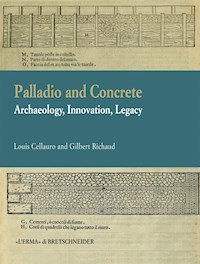
Front cover
Figure above: Andrea Palladio, ‘La maniera riempiuta che si dice ancho à cassa’ (‘The infill method also called coffering’), from Andrea Palladio, I Quattro libri dell’architettura (Venice: Domenico de’ Franceschi, 1570), p. 13, detail, The Getty Research Institute, Los Angeles (86-B23467) (Photo: The Getty Research Institute, Los Angeles).
Figure below: Andrea Palladio, ‘I muri di cementi’ (‘concrete masonry made of small stones’), from Andrea Palladio, I Quattro libri dell’architettura (Venice: Domenico de’ Franceschi, 1570), p. 12, detail, The Getty Research Institute, Los Angeles (86-B23467) (Photo: The Getty Research Institute, Los Angeles).
Louis Cellauro and Gilbert Richaud
Palladio and Concrete. Archaeology, Innovation, Legacy / Roma: «L’ERMA» di BRETSCHNEIDER, 2020. - 114 p.: ill.; 24 cm. - (LermArte; 26)
ISSN: 2612-4718
ISBN brossura: 978-88-913-2109-1
ISBN PDF: 978-88-913-2111-4
ISBN ePub: 978-88-913-2200-5
CDD 724.14
1. Palladio 2. Archaeology
Table of Contents
Foreword
Howard Burns
Acknowledgements
Summary
Introduction
I. The Historical Terminology of Concrete from Antiquity to the Nineteenth Century
II. Vitruvius, Opus Caementicium and the Renaissance
III. Emplekton Walling in Renaissance Architectural Writings before Palladio
IV. Daniele Barbaro and Palladio on Concrete infill Walling
V. The Legacy of Palladio’s Maniera Riempiuta in Late Eighteenth-Century France
Conclusion
References
The Authors
To my parents Prima Giulia Maglio (1914-1986)and Diego Cellauro (1924-2020),Knight of the Order of Merit of the Italian Republic
FOREWORD
Louis Cellauro and Gilbert Richaud present here an illuminating and unfamiliar history of the interest from the Renaissance onwards in ancient Roman techniques of concrete construction using shuttering to form foundations and other structures, such as walls and vaults.
Palladio has a central place in this story. In his Quattro Libri dell’ Architettura (1570) he illustrated and described the various ancient Roman methods of wall construction including what Vitruvius calls emplekton and Palladio the maniera riempiuta, the filled-in method. Palladio was familiar with the mention of this walling technique in Vitruvius and with Alberti’s pioneering discussion of Roman construction. However, in his Quattro Libri he illustrated the maniera riempiuta on the basis of personal observation: he correctly identified an example of this constructional method in the ruins of the large villa complex known as the Grotte di Catullo, at Sirmione on the Lago di Garda. This was a decisive, indisputable and influential insight, whose echoes are traced in this book. The Grotte had been visited by Isabella d’ Este in 1514 and 1535, as the authors recall, and it is interesting to remember that Palladio knew two persons – Giulio Romano and Giangiorgio Trissino – who were acquainted with Isabella: she lent Trissino her gardener to lay out the garden at his newly modernized villa at Cricoli.
Palladio built on the pioneering achievement of Alberti in documenting and uncovering the whole world of ancient Roman architecture, using Vitruvius and other ancient texts and at the same time examining surviving Roman structures from an architectural and structural point of view.
This double approach - study of texts and study of buildings - was an important extension of the methods which humanists had applied to the study of ancient texts. Alberti’s contemporary Flavio Biondo, one can recall, also based his account of ancient Roman houses in his De Roma Triumphante (1459) in part on an examination of the remains of ancient structures.
Cellauro and Richaud contribute here to a reassessment of Palladio as scholar and researcher. His studies of ancient bridges, baths, and other building types constitute a significant contribution to an understanding of the ancient past, while his Quarto Libro, dedicated to Roman temples, offers an extraordinary recovery of knowledge concerning the temples published, based on surveys and a judgement in reconstruction which few of his contemporaries could rival. His comments on the buildings show familiarity with the sources, attention to inscriptions and the ability to date details on the basis of style and workmanship. He also reveals a historian’s capacity to raise questions and speculate, as when he suggests that the irregular layout of the Forum of Augustus was the result of the Emperor’s unwillingness to expropriate the properties of local residents.
The story recounted here, however, does not stop with the publication of Palladio’s book in 1570. The Quattro Libri was much read, reprinted and translated. Cellauro and Richaud write: ‘One of the central claims of the present study is that Palladio was the first to illustrate the process, which has subsequently been used to construct concrete walls in modern and contemporary architecture.’ This is a large and intriguing claim, amply supported in this book – a work of scholarship which is an important contribution to a knowledge of Palladio’s interests, and which reveals a hitherto unrecognised aspect of his impact on architecture and construction long after his death.
Howard BurnsEmeritus Professor,Scuola Normale Superiore di Pisa,President of the Consiglio Scientifico,Centro Internazionale di Studidi Architettura ‘Andrea Palladio’, Vicenza.
ACKNOWLEDGEMENTS
Louis Cellauro gratefully acknowledges the support of the Graham Foundation for Advanced Studies in the Fine Arts, which made possible the early stages of his research on Palladio and Vitruvius in 2011. His sincere thanks go to the Collegium Helveticum (ETH), Zurich for awarding him a Senior EURIAS Fellowship (2015-16), co-funded by the European Commission (Marie-Sklodowska Curie Actions – COFUND Programme – FP7). Gilbert Richaud would like to thank Nathalie Mathian and Laurent Baridon, participants in the programme, Les enjeux techniques et matériels de l’architecture, at LARHRA (Laboratoire de recherche historique Rhône-Alpes), who encouraged his research on the first modern concretes. Both authors would like to express their deep gratitude to Howard Burns, Pierre Gros, and especially to Charles Hope for their close reading, helpful comments on, and critique of, various drafts of the text. The authors are immensely indebted both to Elisabetta Roffia for providing valuable and detailed information on the Grotte di Catullo at Sirmione and to Elizabeth McGrath for her translation into English of a passage in Latin taken from Daniele Barbaro’s 1567 edition of Vitruvius (Barbaro 1567b: 74). Feedback from the anonymous reviewers of the Journal of the Warburg and Courtauld Institutes, to which an earlier version of this study was submitted, helped improve its content considerably. Finally, the authors are particularly grateful to Helen Shiner for her translation from the French and for her careful editing of the final version of the manuscript.




