


38,99 €
Mehr erfahren.
- Herausgeber: John Wiley & Sons
- Kategorie: Fachliteratur
- Serie: Wiley Trading Series
- Sprache: Englisch
A detailed guide to financial market performance during financial crises
With the financial markets seemingly careening from one crisis to another, it's vital for today’s investors and traders to have an historical perspective on market performance during times of great turmoil. In this book, Tim Knight provides an exhaustive analysis of financial market behavior prior, during, and following tumultuous events since 1600.
Making copious use of charts and basic technical analysis, Knight demonstrates how external shocks tend to create extreme reactions in the financial markets and how these predictable reactions provide opportunities for investors and traders to profit. Knight traverses five centuries of financial market history, from Tulipmania in the 1600s to the contemporary sovereign debt crisis. He looks at each event from the prism of the financial markets, examining the market climate prior to the event, during the event, and following the event.
- Draws essential lessons from history providing investors and traders with guidelines to better navigate markets in today's tumultuous times
- Offers valuable insights on understanding and anticipating market responses to shocks and crises
- Companion website with a Q&A section contains charts from key moments in past financial crises and asks readers to choose whether to go long, short, or step aside
If you're looking for a better way to make it today's dynamic markets, look no further than this timely book.
Das E-Book können Sie in Legimi-Apps oder einer beliebigen App lesen, die das folgende Format unterstützen:
Seitenzahl: 711
Veröffentlichungsjahr: 2014
Ähnliche


















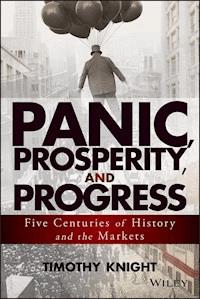
PANIC, PROSPERITY, ANDPROGRESS
Founded in 1807, John Wiley & Sons is the oldest independent publishing company in the United States. With offices in North America, Europe, Australia, and Asia, Wiley is globally committed to developing and marketing print and electronic products and services for our customers' professional and personal knowledge and understanding.
The Wiley Trading series features books by traders who have survived the market's ever changing temperament and have prospered—some by reinventing systems, others by getting back to basics. Whether a novice trader, professional, or somewhere in-between, these books will provide the advice and strategies needed to prosper today and well into the future.
For more on this series, visit our website at www.WileyTrading.com.
PANIC, PROSPERITY, ANDPROGRESS
Five Centuries of History and the Markets
Timothy Knight
Cover Design: Wiley Cover Illustration: top: © gettyimages.com/Robin Bartholick; background: © gettyimages.com/Keystone-France; bottom: © gettyimages.com/DEA/A. Dagli Orti
Copyright © 2014 by Timothy Knight. All rights reserved.
Published by John Wiley & Sons, Inc., Hoboken, New Jersey. Published simultaneously in Canada.
No part of this publication may be reproduced, stored in a retrieval system, or transmitted in any form or by any means, electronic, mechanical, photocopying, recording, scanning, or otherwise, except as permitted under Section 107 or 108 of the 1976 United States Copyright Act, without either the prior written permission of the Publisher, or authorization through payment of the appropriate per-copy fee to the Copyright Clearance Center, Inc., 222 Rosewood Drive, Danvers, MA 01923, (978) 750-8400, fax (978) 646-8600, or on the Web at www.copyright.com. Requests to the Publisher for permission should be addressed to the Permissions Department, John Wiley & Sons, Inc., 111 River Street, Hoboken, NJ 07030, (201) 748-6011, fax (201) 748-6008, or online at www.wiley.com/go/permissions.
Limit of Liability/Disclaimer of Warranty: While the publisher and author have used their best efforts in preparing this book, they make no representations or warranties with respect to the accuracy or completeness of the contents of this book and specifically disclaim any implied warranties of merchantability or fitness for a particular purpose. No warranty may be created or extended by sales representatives or written sales materials. The advice and strategies contained herein may not be suitable for your situation. You should consult with a professional where appropriate. Neither the publisher nor author shall be liable for any loss of profit or any other commercial damages, including but not limited to special, incidental, consequential, or other damages.
For general information on our other products and services or for technical support, please contact our Customer Care Department within the United States at (800) 762-2974, outside the United States at (317) 572-3993, or fax (317) 572-4002.
Wiley publishes in a variety of print and electronic formats and by print-on-demand. Some material included with standard print versions of this book may not be included in e-books or in print-on-demand. If this book refers to media such as a CD or DVD that is not included in the version you purchased, you may download this material at http://booksupport.wiley.com. For more information about Wiley products, visit www.wiley.com.
ISBN 9781118684320 (Hardcover) ISBN 9781118746172 (ePDF) ISBN 9781118746110 (ePub)
This book is dedicated to Lee Barba, a fellow historian and student of the markets. Thank you for taking the risk that others lacked the courage to take.
CONTENTS
Cover
Half Title
Series Page
Title Page
Copyright Page
Dedication
Preface
Chapter 1: Tulip Madness
An Introduction to the Flower in Question
Rise of the Tulip
Market Frenzy
The Bloom Is off the Rose
The Compost Heap
Chapter 2: The Mississippi Scheme
Law’s Early Life
Franco Finances
Paper Money
A Golden Opportunity
An Expansion of Power
Absorption and Ascent
The Frenzy Begins
A New Venue and a Plateau
Cracks in the Mississippi
Economic Dictatorship
A Rush and a Crush
Aftereffects
Chapter 3: The South Sea Bubble
Sovereign Debt and an Idea
A Useless Monopoly
The Bubble Companies
Newton’s Folly
Whirlpool in the South Sea
Chapter 4: American Revolution in the Colonies
Prosperous Colonies
Intolerable Changes
Protests
Continental Paper
Peaceful Resolution
Economic Constitution
Chapter 5: The Panic of 1837
The Nation’s Central Bank
Jackson’s Mistrust of Paper
Biddle versus Jackson
Death of the Second Bank
Waging a War with Words
A Flood of Paper for Land
The Endangered Specie Act
Chapter 6: California Gold
An Empty State
A Challenging Trek
Disappointed Latecomers
A Distorted Economy
On the Farm
Chapter 7: The American Civil War
Antebellum Nation
The Modern North
The Confederacy
The Greybacks
Bonds before Bombs
Legal Tender
Gold and a Hoax
A Nation Transformed
Chapter 8: The Panic of 1893
The Robber Barons
Silver and Gold
Panic Sets in
Cleveland and Morgan
The Man behind the Curtain
Chapter 9: The Rich Man’s Panic of 1907
A Simpler Time
The Copper Magnate
Cornering United
The Bank Runs Begin
The Stock Exchange Teeters
Roosevelt’s Reluctant Aid
Jekyll Island
Chapter 10: Billion-Dollar Bread—The Weimar Hyperinflation
Funding a War
An Expensive Peace
The Printing Presses
Widespread Suffering
A Nation of Speculators
The Retenmark Miracle
Lingering Aftereffects
Chapter 11: The Roaring Twenties
The Great War’s End
Lower Taxes, Higher Growth
Consumerism Blossoms
The Florida Land Rush
A Nation of Speculators
Chapter 12: The Great Depression
The Orgy of Speculation
Stock Mania
The Market Cracks Wide Open
Smoot-Hawley Tariff
Business Council
The Slide Resumes
The Golden Lattice
The Bonus Army
Regime Change
Grinding to a Halt
Shuttering the Banks
Putting People Back to Work
A Regulatory Framework
The Depressing Facts
A Double Dip
The World Returns to War
Chapter 13: Postwar Prosperity
A Return to the Depression?
The Great Transition
Leader of the Free World
Lifestyle Transition
End of an Era
Chapter 14: Energy, Politics, and War
The Birth of OPEC
War and Embargo
Don’t Be “Fuelish”
Iran and Iraq
Invasion of Kuwait
The Hundred-Hour War
An Uneasy Partnership
Chapter 15: Precious Metals and the Destruction of a Billionaire
Melting Down Saint-Gaudens
The Hunt Fortune
The Hunt Children
The Next Best Thing to Gold
Muammar Gaddafi
The Accumulation Accelerates
A Rising Asset
Hostile Management and Friendly Arabs
Changing the Rules of the Game
Putting an End to It
Silver Thursday
The Bailout
Gold Riding Shotgun
The Double Eagle Returns
Bankrupt Billionaires
Chapter 16: Latin American Debt Crisis
A Healthy Development
Oil Money Hunts for a Home
Interest Rate Shock
Baker and Brady
Hyperinflation
Subprime Parallels
Chapter 17: The Reagan Revolution and Crash
The Death of Inflation
Rebirth of the Stock Market
A Business-Friendly Nation
Bonds and Inflation Signal a Change
Three Days in October
A Worrisome Weekend
Black Monday
Turnaround Tuesday
Sorting Out the Reasons
Chapter 18: The Rising and Setting Sun of Japan
The Early Economic Structure
The Aftershocks of War
The United States Rebuilds
From Dodge to Independence
Thing-Making
The Soaring Sixties
OPEC and Little Japanese Cars
Electronics Giant
The Bubble Swells
Unparalleled Property Prosperity
The Japan That Can Say No
The Big Crash
Damaging Demographics
The Lost Decades
A Perpetual State of Recovery
Chapter 19: The Savings and Loan Debacle
Good Intentions and Honest Growth
Loaning to Lose
Overly Deregulating
The Real Estate Boom Goes Bust
Keating’s Lincoln
A New Foundation
Chapter 20: Fall of the Soviet Union
Back in the USSR
Gorbachev
The August Coup
Private Enterprise
Satellites Adrift
Chapter 21: The Asian Contagion
The Booming Decades
Liberal Lending
A Subtle Slowdown
The Thai Baht Bomb
Instantly Expensive
The Big Economies Join the Drop
The World Turns Another Corner
Chapter 22: Russian Crisis of 1998
After the Fall
Loans Instead of Growth
Welcome to the Club
Strains in the Kremlin
Moratorium
The Have-Nots
LTCM in America
Russian Resurgence
Chapter 23: Captured by the Net
Living History
Fuel for the Fire
The Foundation is Laid
Raging Bulls
Netscape
Yahoo! and Irrational Exuberance
The Cackle Heard around the World
The Madness Goes Exponential
A Las Vegas in Every Home
Century’s End
Analysts as Oracles
Mountains of Money
The WebVan Peak
An Adoring Press
Peak and Fall
Burning Up
Startup.com—The Movie
Horror and Terror
Picking Up the Pieces
The Bubble’s Legacy
Chapter 24: The Great Recession
The American Dream
A Yield-Seeking Ocean of Money
Unreliable Ratings
Bubble Denial
Financial Fissures
Fiscal Free-Fall
Bailout
A Nation on the Mend
Chapter 25: History in the Making
The Ties That Bind
What Makes an Event a Historical Force?
The Road Ahead
About the Author
Index
PREFACE
As I suspect the case is with many others, my interest in history did not reveal itself until long after my formal education was complete. A school’s offering of dates, places, and long-forgotten names captures the interest of very few children, and unfortunately it usually snuffs out any latent desire they might have to explore tales of the past that can offer up wisdom, insight, and previously unseen linkages.
For most of my adult life, I have had a deep and abiding interest in two related subject areas: history and financial markets. While the two might seem to be only obliquely related, they are actually engaged in a constant dance, with one informing the actions of the other. Historical events move currencies, stocks, debt, and all other flavors of fiscal instrument, and likewise movements—particularly exaggerated movements—in the financial markets can drive the decisions that shape history in real time.
When I first developed the outline of this book, I tried to gather up what I suspected were the most interesting and market-moving developments of the modern age. To my surprise, some of the events that I thought would have a major impact (such as the Kennedy assassination in 1963 or the London subway bombing of 2005) were, as far as financial markets were concerned, virtually immaterial; it was if they had never even happened. However, other topics I had initially left out, such as the Russian debt crisis of 1998, turned out to be monumentally important.
The completed book you are holding contains two dozen chapters of what I consider the most interesting and important episodes over five centuries that have had an impact on the thinking and behavior of financial markets. There are manias, panics, battles with inflation, the travails of war, and stories of riches both won and lost. The tales extend from early seventeenth-century Holland up to the twenty-first-century United States.
My hope is that, having read these accounts, the reader can gain perspective—specifically, perspective of how consistent human behavior has been over the centuries, and how in spite of extraordinary technological, political, and legal changes, the templates that govern humanity’s relationship with both opportunity and fear are surprisingly steady.
There will undoubtedly be new “chapters” in your own lifetime of globally important events that move both markets and sentiment. In the end, I hope the reader can be better armed to comprehend the world’s complexities and changes by way of the knowledge and insights this book endeavors to provide.
Tim Knight Palo Alto, California August 1, 2013
CHAPTER 1
Tulip Madness
In popular culture, there is probably no better-known event in the lexicon of unusual financial history than the tulipmania that seized Holland in the early seventeenth century. Whenever there is a financial bubble in modern times, the term tulipmania is bandied about, but few commentators who use the term have a grasp as to what actual events occurred.
It is a fascinating tale—perhaps somewhat apocryphal—and, if nothing else, entertaining. And it is surely the only chapter in this compendium of financial history that involves not one but two important biological maladies that shaped the story: a flower-distorting virus and a deadly human plague.
■ An Introduction to the Flower in Question
If you’ve ever grown tulips, you know all too well that, while beautiful, the tulip is a temperamental and relatively weak plant whose bloom is short-lived and whose likelihood of returning the next year is far from certain.
The flower itself was unknown to most of Europe in the sixteenth century, but around 1554, the Pope’s ambassador to the Sultan of Turkey was charmed by the flower and collected seeds and bulbs for distribution. (The word tulip itself is said to be derived from the Turkish word for “turban,” since the bloom somewhat resembles the same).
Cultivation spread throughout the region we today call the Netherlands as tulip bulbs found their way to Vienna, Antwerp, and Amsterdam. Planters took pleasure in the vibrant blooms and the fact that the plants were more tolerant of the harsher climate of the lower countries.
The bulbs themselves were classified into three groups: the single-colored, the multicolored, and the “bizarres.” This last category is most germane to the tale of tulipmania, as bizarres were the rarest and most sought-after tulip. The reason these unusual flowers came about was a virus that interfered with the plant’s ability to create a uniform color on the petal. It is today known as a “breaking” virus, since it breaks the plant’s lock on a single petal color, although it does not kill the plant itself. The effect on the flower was striking, producing mosaic-like flames of color on each petal.
Even regular, single-colored tulips are difficult to grow from seeds. It took anywhere from 7 to 12 years to produce a flowering bulb from a seed, and once the bulb was at long last established, it would create only one or two clones (or “offsets”) in a given year. The mother bulb itself would last only a few years before it died.
As challenging as it was to propagate regular tulips, it was even harder to do so for the exotic varieties, since the virus weakened the plant somewhat, and it usually failed to create offsets, meaning that any bizarre varieties required new plants be created from seeds. The length of time required for that growth meant that the most appealing varieties of tulips remained rare.
As knowledge of tulips spread, collectors of the bulbs began to give the exotic varieties inventive names such as “Admiral” and “General” to suggest the boldness of the plant’s appearance. A sort of one-upmanship developed with the naming, leading to exalted titles like “Admiral of Admirals” and “General of Generals.” For years, the cultivation and selling of tulip bulbs was little more than a curious hobby among horticulturists and the well-to-do.
■ Rise of the Tulip
As the sixteenth century turned over to the seventeenth, Holland was on the ascent. The area, formerly known as the Spanish Netherlands, had won its independence. Amsterdam, the capital of Holland, found itself as the driving force behind commerce, particularly as a trading partner with the East Indies. Newfound wealth and prosperity flooded the region, with single trading voyages yielding profits upwards of 400 percent to the financiers backing them.
A merchant class arose, and the new money in the area sought ways to show off its wealth. Grand estates begin springing up around Amsterdam, and nothing framed a handsome home better than a vibrant display of flowers in the surrounding gardens. And, naturally, there were precious few flowers more showy and eye-catching than the tulip.
The tulip’s reputation was on the rise, and by 1634, anyone with money but without tulips was judged simply to have bad taste. Whereas tulip bulbs used to be sold by the pound, their rising popularity and prices made them exponentially more precious, and soon much tinier weights were used as the basis of the tulip trade. A concurrent demand from French speculators for the bulbs only pushed the price higher.
The trading of the bulbs was framed by the growing season of the flowers themselves. Tulips bloom in the springtime for just a few weeks, and they enter a dormant phase from June through September. It is at this time they can be safely uprooted and moved about, so actual physical trades took place around this time of the year.
Because speculators did not want to confine their trading to just a few months, they put together what could be considered a futures market. Two traders could sign a contract in front of a notary, pledging to buy a certain quantity, type, and quality of bulb at the end of the season for a certain price. These contracts soon found an aftermarket of their own, so that people begin trading the paper instead of the physical bulbs.
■ Market Frenzy
In 1636, the tulip bulb was the fourth leading export of Holland (if you are curious, the leading three were gin, herring, and cheese). Because the margin requirements for tulip futures were minimal, the price of the contracts began to soar spectacularly. Some historians have noted that, due to the presence of the bubonic plague at the time, some individuals viewed life quite fatalistically, leading some speculators to trade with complete imprudence.
The Calvinists of Amsterdam viewed with dismay and concern the speculative frenzy that was springing up in their native land. The virtues of discretion, moderation, and hard work seemed to be shoved aside for the easy profits of trading in paper. The appeal of the profits at the time was understandable, however, as prices lurched forward. By 1637, a single bulb could fetch the equivalent of 10 years’ salary of a skilled craftsman. Entire estates—one reported to be a full 12 acres—could be had for a single exotic “bizarre” bulb.
One of these bulbs, named the Semper Augustus (see Figure 1.1), was particularly coveted. In 1636, there were only two such bulbs in all of Holland. As trading spread throughout the country, it became impractical for speculators to make the trip to Amsterdam, so smaller exchanges appeared in the taverns of small towns using similar trading rules as had been established in the capital city. To create an atmosphere of prosperity and opulence, these taverns were often adorned with large vases of tulips in full bloom and sumptuous dinners that traders could enjoy while doing their business.
FIGURE 1.1Semper Augustus was one of the most-prized varieties of tulip.
The final spasm of buying was promulgated by a decision made in February 1637 by the self-regulating guild of Dutch florists. They agreed that, by their new rules, all the futures contracts that had been put in place since November 30, 1636, could henceforth be considered options contracts. This wasn’t the exact language they used, of course, since such terms for financial instruments did not exist, but the effect was the same.
The difference between a futures contract and an options contract is subtle but crucial: with a futures contract, the buyer agreed to buy a certain quantity of a product at a certain price on a certain date; the obligation to buy was firm. With an options contract, the buyer had the right—but not the obligation—to execute a purchase based on the same terms.
To cite an example, if a person bought an option contract when the underlying asset had a value of 500, and the asset’s value went to 800 by the expiration date of the contract, the buyer would presumably be glad to honor the terms of the agreement and purchase the product at 500 (since the market price was already up 60 percent). However, if the price had dropped to 250, the buyer could simply let the contract expire, losing only a small transaction fee equivalent to about 3.5 percent of the contract price.
With this new rule proposed, which the Dutch Parliament ratified, the risk of engaging in these contracts to the buyers decreased dramatically (indeed, by 96.5 percent). The reason is that those trading in tulip futures now bore very little risk, since they could simply walk away from the agreement if prices didn’t behave favorably. If tulips ascended in price, the speculators made a lot of money. If the tulips fell in price, speculators lost only a small amount of risk capital.
It was at this time that trading reached its peak, in terms of both price and volume. Some bulb agreements changed hands 10 times in a single day.
The market finally broke down during a routine bulb auction held in Haarlem, Holland. A mass of sellers showed up to conduct business, but there wasn’t a single buyer to be found. Some believe a severe outbreak of the bubonic plague kept the buyers away (although it seems to have done nothing to deter the sellers), but the simple fact is that the normal spot market for bulbs was suddenly one-sided and thus nonexistent. All sellers and no buyers does not a market make.
Within days, panic spread across the country, as people soon realized that their enormous trading profits were no more valuable than the paper on which the agreements were written (see Figure 1.2).
FIGURE 1.2 After peaking in early February, tulip prices crashed hard, erasing the entirety of prior gains.
Source: Used with permission from Jay Henry.
■ The Bloom Is off the Rose
The crash in tulip prices was even more rapid than the ascent. One bulb that had risen in price 26-fold by January 1637 lost 95 percent of its value in just one week. Speculators around the nation were facing losses that were in some cases ruinous.
Citizens demanded that their government do something about it, so the matter was referred to the Provincial Council of The Hague. After three months of discussion and debate, the Council made their announcement, which was this: they had no decision, and they would need more information. Not surprisingly, this provided cold comfort to the distressed populace.
The Council’s follow-up suggestion wasn’t much more helpful: they advised that every seller should meet with each corresponding buyer and, in front of witnesses, offer the tulips to the purchaser for the previously agreed price. If the buyer refused to complete the deal, the tulips could be put up for sale in a public auction, and the buyer would be held responsible for the difference in price.
In a market that had lost virtually its entire peak valuation, this was obviously a bad situation for buyers and sellers alike (but significantly worse for the sellers, who were stuck with bulbs that now weren’t worth much more than onions).
There was no legal recourse to be had, either. The judges in Holland considered all the financial agreements pertaining to the tulip frenzy to be nothing more than gambling debts and, as such, were unrecognized by the legal system. Even if buyers were deemed responsible for the agreed-upon payments to sellers, those sums were unenforceable, and thus everyone who owed money simply ignored the entire matter.
As a final effort to shore up the badly rattled economy, the government offered to void any existing contracts for a fee equal to 10 percent of the contract price. Because prices had already plunged even more than 90 percent, this offer likewise provided no meaningful relief. In the end, most participants in the tulip madness suffered economic hardship, and the psychological scars would be with the nation for decades to come.
■ The Compost Heap
The events surrounding Holland’s tulipmania have become the stuff of financial legend to this day, but modern historians speculate that perhaps the magnitude of the event was much smaller than some believe. Although there was indeed enthusiastic trading of tulip bulbs around 1636, it may have been confined to a very small number of merchants and craftsman, who for a time wanted to ape the exciting high-finance behavior of the nobility.
Some of the famous stories related to this time seem hard to believe. One oft-cited tale is of a sailor who, hungry while visiting a friend, plucked up a tulip bulb from his friend’s table (thinking it was an onion), slipped it into his pocket, and boiled and ate it later. Once discovered, the poor sailor was pursued, captured, and thrown into jail for consuming a bulb whose value was equal to all the food the entire crew on the sailor’s ship would require for a year.
Setting aside the fact that a tulip bulb bears little resemblance to an onion, eating a tulip bulb would be a wholly unappealing experience. The taste would be terrible, and even if the fellow managed to choke it down, the effects on his body would have been toxic. It seems a story such as this is more of an invention of propaganda than an account of an actual event.
The Dutch lunacy spread somewhat beyond its borders, creating miniature tulip frenzies in London and France, but attempts by brokers to push tulip prices to the levels seen in Amsterdam met with only moderate success. Even if the tale of flower-bulb speculation from long-ago Holland is more fiction than fact, it still is a fascinating anecdote into how the novelty of a new product (in this case, a flower, as opposed to an iPhone) can capture the public’s imagination, if only for a few months (see Figure 1.3).
FIGURE 1.3 Jan Breughel’s famed The Folly of Tulip Mania, painted in 1640 and displayed at the Frans Hals museum in Haarlem.
CHAPTER 2
The Mississippi Scheme
It seems hard to believe that an obscure Scotsman born over 350 years ago would have profound effects that persist in the financial world to this day, but it is true, and that man's name was John Law. The events surrounding Law’s actions in the eighteenth century are the stuff of legend, and Law is considered by some economists to be the world’s first Keynesian—that is, a person who supports the notion that flooding an economy with government spending is the best way to address a weak economy. Even the everyday English word millionaire was coined during the mania of Law and his so-called Mississippi Scheme. In this chapter, we will explore what led up to the scheme, its construction, and the devastation it wrought.
■ Law’s Early Life
John Law was born in Edinburg, Scotland, in 1671. He was the oldest son of a banker, and as was the custom at the time, young Law apprenticed in his father’s business beginning at the age of 14. For three years he worked in his father’s counting house, learning the principles of banking.
In spite of being in a family of bankers and goldsmiths, Law did not have a passion for the business, and after his father died in 1688, the young Law took the opportunity to leave the family enterprise for an activity with far greater personal appeal: gambling. He set out for London and tried to apply his knowledge of statistics and probabilities to forge success as a professional gambler.
He did quite well for a while, managing to live a life of pleasure, pursuing his passion, but after nine years, Lady Luck began to neglect Law, and he lost more money than he could repay.
Law’s plight was soon to exceed that of a mere gambling debt. He was quite taken with a lovely young woman named Elizabeth, and a suitor of hers, one Edward Wilson, didn’t take kindly to the competition. Wilson challenged Law to a duel, which was unfortunate on his part, because Law shot him dead with a single shot.
Duels were a widespread custom in the eighteenth century, but they were not part of the actual rules of society, so Law was arrested and charged with murder. He soon stood trial at the Old Bailey before a judge who was known as a sadistic “hanging” judge who had no compunction about handing down stiff sentences to criminals. True to form, the judge sentenced Law to death after he was found guilty of murder.
Happily for Law, and for our story, his sentence was commuted to a fine, based on a decision that the killing was manslaughter and not murder. Wilson’s brother was outraged and, while Law was still imprisoned, sought to have a harsher punishment foisted on his brother’s killer. Law, however, managed to escape from prison and reached the continent of Europe, far away from London judges and grieving brothers.
On the European continent, Law resumed his gambling, spending three years both trying to earn a living and studying the monetary and banking affairs of the various countries he visited. The middle of the eighteenth century was an exciting, dynamic time for Europe, full of new ideas about science, the economy, and social experiments, and Law’s penchant for numbers and knowledge of banking made him a quick study.
■ Franco Finances
The currency of old France was known as the livre tournois. The livre was originally established by Charlemagne as a unit of account equal to a pound of silver, and it was divided into 20 parts (called sous), which itself was further divided into 12 parts (deniers). (Note: To make reading and understanding the events in this chapter easier, I’ll refer to the unit of currency as the dollar, although that is not the historically-accurate term.)
In the early 1700s, the French economy was a mess. King Louis XIV (see Figure 2.1) had waged a number of wars that left his country a financial basket case, and the country was at the brink of financial ruin. The national debt was about $3 billion, and the wealth of the nation (largely in the form of precious metals) was mostly spent. Indeed, the shortage of precious metals meant that not enough money was in circulation.
FIGURE 2.1 Louis XIV, King of France, by the French engraver and artist Robert Nanteuil.
Source: Yale University Art Gallery.
Using the metaphorical image of the French economy as a body, the blood flowing within that body (in this case, gold and silver) had been largely drained away, so the body’s health was in great danger. There simply wasn’t enough blood to go around, since it had been spilled for unproductive wars.
It’s important to know that during the course of Law’s travels, he had become friends with the Duke of Orléans, who was the nephew of King Louis XIV. Although Law could not have foreseen the value of this friendship in years to come, being close to a royal family member usually isn’t a bad connection to have.
Second, in spite of the shambles of the French economy, France did hold a vast expanse of territory in North America surrounding the Mississippi River known as Louisiana (of course, this territory was far greater in size than the state of Louisiana we know today, spanning from the Gulf of Mexico up into Canada). France was the first European country to settle this area, and the territory was larger than France itself.
As gigantic a piece of real estate as Louisiana was, virtually nothing was being done with it, and the vacuum of knowledge about the place was quickly filled with legend. Rumors began to circulate that Louisiana was rich in vast deposits of precious metals. It was heralded as a kind of paradise where beautiful but naïve natives would cheerfully exchange enormous chunks of gold and silver for whatever knives, magnifying glasses, or other near-worthless trinkets Europeans wanted to offer.
The notion of Louisiana being an utterly unexploited bed of wealth even conjured up a tale of an enormous mountain on the Arkansas River made of emeralds. And, in addition to all of the precious stones and metals said to be just beneath the surface of the landscape, it was also believed that a wide variety of furs were available from the fauna of the land, similar in value to the pelts actively traded with Canadian trappers. The truth is that any furry creature unfortunate enough to live in a climate like that of the Deep South would have perished long before.
In spite of all this folklore, the reality was that hardly any Europeans had colonized Louisiana, and those who were there found life to be extremely hard. Some attempts had been made to colonize the area with workers willing to till the land for its agricultural potential, but precious few French wanted to be involved in such a hard life in a strange and mysterious land. The government of France was so eager to prop up the image of its Louisiana territory that it hired artists who had never set foot outside of Paris to draw lush and inviting landscapes of the North American territory as if it were a differently situated French Riviera.
■ Paper Money
During the years that Law worked at his family’s counting house, gambling his way through Europe and attending the salons of both royalty and common folk, he became somewhat of an economic philosopher. Quite aware of the stifling effect that the lack of precious metals was having on some European economies, he took the view that replacing metallic money with something more convenient and representative of a store of value would be superior.
In Law’s mind, gold and silver coins were a crude and outdated method of exchange and that the currency that circulated through an economy didn’t have to be wealth itself but merely serve as a means of exchange. National wealth, after all, depended on trade both within and without a country’s borders, and the more currency that could flow within an economy, and the more effortlessly it could flow, the better it would be for the nation’s collective fortune (see Figure 2.2).
FIGURE 2.2 John Law shown in a contemporary lithograph.
Back in his native Scotland, Law published a proposal for what he called a Land Bank. The idea was relatively simple: a given country (in this instance, Scotland, Law’s native land) would “deposit,” in a sense, the value of all its land holdings into a national bank. The bank, in turn, would issue notes whose collective value would never exceed the entire value of the land on deposit. These notes, each of which represents a tiny portion of the country’s land-based wealth, would be the kind of paper money that Law envisioned as a more efficient means of exchange. It was a way of monetizing the value that the country already owned but had not yet unlocked—in this instance, the land—and pumping that value into the nation’s economy.
Although the proposal garnered some scattered interest, it was not embraced by the Scottish government, and a disappointed Law abandoned his dreams of bringing his vision of paper money to his homeland and returned to his familiar role as a gambler. The idea did not leave him, however: in his own words, “When blood does not circulate through the body, the body languishes; the same way with money which does not circulate.”
He spent the next 10 years moving between France and the Netherlands. During this time, he renewed his friendship with the Duke of Orléans. During their conversations, the duke was increasingly impressed with Law’s apparent financial prowess, and he eagerly sought his advice on how to deal with his country’s financial maladies. Louis XIV’s reckless spending had put France in a bind, and there wasn’t a clear way out of it.
As with Scotland, the notion of paper money was alien to the French, who perceived “money” as being either silver or gold.
■ A Golden Opportunity
As fate would have it, France’s sovereign, Louis XIV, died in 1715, when the heir to the throne was still a young child, wholly incapable of leading a great European state (see Figure 2.3). That task therefore fell to none other than the Duke of Orléans, friend of John Law.
FIGURE 2.3 Louis XV as a child in his coronation robe, as painted by Hyacinthe Rigaud, on display at the Metropolitan Museum of Art in New York City.
The duke was not himself made king, but he assumed the reins of government until such time as the young Louis XV reached majority age. Law shrewdly seized upon the opportunity and presented himself to the court, where he was warmly received.
Law proposed to the court that a great nation such as France should not be shackled by the inadequacies of a metal currency. France need not be a pioneer in this area, either, as both Great Britain and Holland had adopted paper money with success. Law proposed the establishment of a new bank that would manage the royal revenues and issue notes based on landed security, very similar to the scheme that had been rejected by Scotland.
France was far more eager than Scotland to embrace Law’s idea—and, given its dire straits, it perhaps felt there weren’t any better choices to be had—so a royal edict was issued on May 5, 1716, granting Law the right to establish a bank.
The bank would be capitalized with one-fourth precious metal coinage and three-fourths French bonds. The capitalization was fixed at a sum of $6 million in the form of 12,000 shares at $500 each. The bank would also be responsible for the collection of taxes. The structure wasn’t everything Law had proposed, but it was a good start, and the duke was willing to grant more privileges once Law and his bank proved themselves.
The public was all too willing to make use of the new, convenient banknotes as a form of payment. For one thing, the notes were assigned a specific value, backed by bonds and metal, which was permanently fixed. In prior years, the state had no misgivings about devaluing the metal coinage, which meant that a citizen could wake up poorer one morning not because of any fewer coins in his pocket but merely by those coins being deemed of lesser value by royal decree. These new paper notes, however, were not subject to that kind of depreciation, and the public appreciated the greater reliability of this new currency.
The name of Law’s newfound institution was Banque Générale, and it was effectively the first central bank of the nation. The bank’s notes were payable on sight, and the bank’s issued paper was swiftly regarded as more valuable than the silver coinage that most citizens used, since the latter had a nominal value that was at the mercy of the state. Indeed, over the course of a year, the paper notes rose 15 percent in value based on their purchasing power. It seems that this modern view of money was swiftly accepted by the public with greater success than anticipated. Paper was evidently not just as valuable as metals— it was actually perceived as being safer and more valuable.
■ An Expansion of Power
So impressed was the French court by Law that it granted him a new title—Comptroller General of Finance—and greater powers to accompany his new title. Law set out to take down what he saw as encumbrances to the economy, such as canal tolls and overly large land holdings; he encouraged the building of new roads throughout France; and he put in place incentives, such as below-market low-interest loans, for new industries.
As France’s de facto treasurer and finance secretary, Law also focused on the revival of overseas commerce. These pro-business measures aided the country with an increase in industrial output of 60 percent over two years. One simple metric that illustrates the power of Law’s actions was that the number of French ships engaged in export jumped from merely 16 to a full 300 (see Figure 2.4).
FIGURE 2.4 Philippe II, Duke of Orléans, was instrumental in putting Law in a position of great influence and power. He is shown here in a painting by Jean-Baptiste Santerre.
Riding high on the success of Banque Générale, Law submitted a second major proposal to the regent: the creation of a new company that would have the exclusive privilege of trading with the province of Louisiana. This territory, stretching for 3,000 miles from the Mississippi Delta up to the frozen mountains of Canada, was rich with natural abundance, and Law saw it as a vast and untapped resource for France.
As with the national bank, the proposed capitalization and business of this new company was quite simple: Law proposed that the organization be capitalized with French bonds as well as the valuable exclusive trading rights with Louisiana. Shares in the company would be sold to the public, and that cash could be used to retire the aforementioned bonds (thus saving France the burden of continued interest payments on the bonds themselves).
The royal court agreed to Law’s proposal, and in August 1717, Compagnie d’Occident (the Company of the West) was founded. The firm’s capital was divided into 200,000 shares at a value of $500 each, and it was granted exclusive trading privileges with the Louisiana territory for 25 years, as Law had requested.
In spite of the attractive makeup of this new organization, the value of the shares languished. As mysterious as Louisiana was, it was generally recognized that very little was actually going on there, particularly since hardly any French citizens emigrated there to work the land, trap furs, or seek out fictional mountains made of emeralds. The shares in the Company of the West sank from $500 to $300, and Law’s sterling reputation started to get tarnished.
Law then hit upon a simple but effective plan to reverse the poor showing of the company’s shares. He announced that, in six months’ time, the company would pay $500 for a certain number of shares in the company. This was the equivalent of a board of directors in a modern-day corporation issuing a stock-buyback program, and the effect was swift and exactly as Law had hoped. Individuals being told that a share that presently cost $300 could be sold for a 66 percent profit in a half-year’s time pushed the price back up to its original offering value. The idea worked.
More important, the public surmised that the company’s prospects must be far healthier than they had imagined, if the company itself was willing to pay such a premium on its own shares. It seemed to the investing public that the management was in the best position to know about its firm’s prospects, so it was suspected that the Company of the West was being very discrete about just how bright its future looked.
■ Absorption and Ascent
The role of the Banque Generale took a dramatic turn in 1718 when it became the Royal Bank. Now the notes were not simply the paper produced by a private enterprise; they were now backed by the full faith and credit of the crown itself. The notes were guaranteed by King Louis XV. No guarantee had more strength or credibility.
Other important changes took place as well. The company acquired the right to mint new coins; it was made responsible for all of France’s money minting and finances; and it had the right to collect most French taxes. Indeed, what had started out as an experiment quickly developed into France’s first central bank and all its associated powers, with Law at the helm.
The Royal Bank was then made into a conglomerate. It absorbed the Company of the West as well as similar French companies, such as the China Company, the India Company, and other rival trading outfits. Law had, in the span of just two years, created the most successful conglomerate in all of Europe, with vast powers to tax, coin money, enjoy worldwide trade monopolies, and retire the debt of the state. It was even granted a monopoly on the sale of tobacco.
The French national debt was about $1.5 billion, a vast sum at the time. The Royal Bank bought large amounts of this debt, which paid an interest rate of 4 percent, and extracted interest from France at a rate of 3 percent. From the crown’s point of view, it was almost like free money: the state was able to eliminate a 4 percent debt burden in exchange for a 3 percent burden by means of an enterprise of its own creation. This was beneficial to the Royal Bank as well, since it was assured a healthy flow of dividends from the state to fund its future endeavors.
■ The Frenzy Begins
Law and his Royal Bank had magnificent prospects. He had exclusive privileges of trading in the East Indies, China, the South Seas, and, of course, Louisiana. His optimism manifested itself in a pledge of a yearly dividend of $200 per share, which, given the share price of $500, was an obscenely rich bounty for investors.
The investing public became increasingly enamored with shares of the Royal Bank, and a virtuous cycle was in place: paper notes, ostensibly backed by gold and bonds, were easy for the state to print; the public was all too eager to take these notes and give them to the Royal Bank in exchange for stock certificates in the Mississippi Company; and the trading public began trading the increasingly limited quantity of publicly traded shares among themselves, making its original offering price of $500 a distant memory.
Between May 1719 and August 1719, shares rose from $500 to $1,000, doubled again, and doubled yet again. Part of the reason for the near-vertical ascent in the share price was the very limited quantity of shares made available. Every couple of months or so, fresh shares would be made available to the public, and the men and women of Paris would stampede for the opportunity to get their hands on them.
The use of margin also poured fuel onto the proverbial fire, as it became a common practice for a buyer of shares to be given an entire year to actually pay for those shares. Thus, a person who wanted to acquire shares could do so on a 12-month installment plan. Given the near-vertical ascent of the company’s stock, it seemed to be the closest thing to free money ever created. Law himself wrote at the time, “The gates of wealth are now open to all the world. It is that which distinguishes the fortune of the old administration from those of the present” (as quoted in Charles Mackay’s Extraordinary Popular Delusions and the Madness of Crowds, published 1841).
Newfound wealth in sums formerly reserved for the highest ranks of the nobility found itself in the hands of the unwashed masses. Tales of vast fortunes being made by the lowest of society only exacerbated demand for the shares. There were tales of the chimney sweep who made $30 million in profits and the shopkeeper who amassed $127 million.
Even Law’s own coachman appeared in front of his master one day to present two other coachmen as replacements. “But I only require one coachman!” said Law. His then-servant replied, “Yes, I know. The other one I shall engage myself.”
There was no particular building in Paris dedicated to the exchange of common shares, but a narrow little street known as the Rue de Quincampoix took on the role (see Figure 2.5). This little lane became a daily frenzy of activity, with two gates set up on each end: one for the well-to-do, and the other for the common people. At a predetermined morning hour, both gates were opened, and people from both sides of the street rushed forward to begin the day’s frenetic trading.
FIGURE 2.5 The Rue de Quincampoix. The street, near the Bourse, in which Law established his Banque Generale in 1716: after a contemporary engraving.
Of course, those lucky enough to own property on the heretofore unremarkable street enjoyed the dividends of this mania. Homes that in saner times had rented for $1,000 per year now yielded 16 times that amount. A cobbler rented out his tiny stall for $200 per day so that a trader could have a reliable and comfortable location from which to trade. It is said that even a hunchbacked man seized upon the entrepreneurial idea of lending out his misshapen back as a writing desk to eager speculators.
In the autumn of 1719, as the share price vaulted to $7,000, $8,000, and $9,000, the financial orgy was in full swing, and Rue de Quincampoix was the epicenter.
■ A New Venue and a Plateau
Law recognized the need for a more civil place for traders of his wildly successful enterprise to convene each day—accidents among the swarming crowds were becoming commonplace—so he made an agreement with a French prince to rent out the Hotel de Soissons. It boasted a multi-acre garden, which would provide ample space for the swarms of traders, and the elegant statues and fountains in the garden certainly had greater appeal than the filthy road in which speculators were presently crowding.
As soon as Law had secured the property, an edict was passed stating that the only lawful place for the trading of securities was within the gardens of Hotel de Soissons (see Figure 2.6). Amidst the trees of the gardens, no fewer than 500 small tents were set up so that traders could conduct their business with some shade as well as a sense of place. The prince, already wealthy, enjoyed an avalanche of cash, as each of the tiny tents rented out for $500 each month, yielding a quarter-million dollars in pure profit merely for the use of the prince’s enormous backyard.
FIGURE 2.6 Copperplate engraving of the Hôtel de Soissons drawn circa 1650 by an unknown artist.
As the share price lurched toward $10,000—a 20-fold increase in less than a year’s time—the volatility of the share price became extreme. Prices could fluctuate 10 percent or 20 percent in the course of a few hours, and it was said that a man could rise poor in the morning and go to bed in affluence that very night.
Noblemen began to view the nouveau riche with scorn if not amusement, as the uneducated from the lower classes might have acquired some of the wealth of their betters but none of the refined mannerisms.
It should be remembered that all of this newfound wealth was not realized in the form of wheelbarrows of gold and silver being pushed throughout the streets of Paris. The nation’s precious metal supply was safely tucked away in the vaults of the Royal Bank, and the people of France had wholly accepted the lightweight, convenient, foldable money stuffed into their pockets as being “good as gold.” After all, any of the notes could be submitted to the bank at any time in exchange for the promised amount of “real” money.
Unknown to the common citizenry, however, was the fact that the value of the tidal wave of paper money flooding the citizens of Paris had long surpassed the value of the gold actually on hand. The royal court had become intoxicated with the sudden positive turn its financial situation had purportedly taken.
Sovereign debt was being retired, the economy was humming with the steady flow of this new paper currency, and the crown could dispatch with the fiscal woes that had plagued it only a few years earlier. Since wealth seemed as simple as cranking out fresh banknotes, the temptation was too great to resist.
Notes were not hoarded simply for the pleasure of having a large bank balance. New houses sprung up in every direction of the countryside, and a feeling of prosperity accompanied the “wealth effect” of rapidly escalating share prices. Luxury goods, formerly enjoyed only by the noble few, suddenly became commonplace.
Statues, paintings, linens, tapestries—all manner of high-quality manufactured goods began to grace the rooms of the middle class. It seemed that wealth was within the grasp of anyone willing to participate in the frenzy, and the pleasures of what can be acquired with wealth were likewise at hand for even the lowly born.
■ Cracks in the Mississippi
Unlike many modern legislative bodies, the French Parliament did not accept the financial machinations happening around them lightly. Parliament had, by and large, protested the introduction of paper money, and even as apparent prosperity pulsated through Paris, the Parliament viewed it with great skepticism.
A few of the more astute traders, however, sensed that the party would soon come to an end. Quietly, and in small quantities, savvy traders began making trips to the Royal Bank and exchanging handfuls of paper notes for gold coins. Some went even farther, not only exchanging notes for gold, but placing that gold within the safety of neighboring countries, just in case their country’s disposition toward the metal and its confiscatory value might one day change. England and Holland became favorite storehouses for the coinage.
One astute trader is said to have exchanged a million dollars of bank notes for the equivalent amount of gold and, after dumping the metallic fortune into a cart, covered it with cow manure and escorted it far out of the city, unnoticed. He even went so far as to dress himself in the filthy clothes of a peasant so that his departure with such a vast fortune would attract no attention.
At the beginning of 1720, shares of the Mississippi Company started to succumb to gravity, which, given the highly leveraged ownership of many of the traders involved, caused alarm and concern.
Law proclaimed that the company would, in fact, guarantee the purchase of shares at a fixed price of $10,000, which pegged the price at that level for several months. The stock price wasn’t falling, but the fact it wasn’t rising anymore didn’t go unnoticed. The only reason the share price was holding firm at $10,000 was that Law’s company had pinned its pledge at that price.
All of the paper money circulating through France began to have the same effect that any overabundance of money has in any economy: it created inflation. Prices for houses, consumer goods, food, and everything else that could be bought with bank notes was on the ascent, and in early 1720, inflation was raging at a pace of 23 percent per month. As the paper notes could pay for less and less, confidence in the paper notes declined as well, while the perceived value of gold began a swift ascent.
Law began to view the situation with alarm, and wanting to suppress the public’s newfound affection for gold, he had the crown issue an edict stating that payments in gold or silver for anything over $100 in value were prohibited, and that ownership of over $500 in gold was illegal. This is somewhat akin to all the financial institutions in the United States decreeing that credit cards could not be used for any charges greater than $20 and no card would be permitted a credit line greater than $250. The effect on the economy was stifling and immediate.
■ Economic Dictatorship
Because so much gold had already fled the country, spirited away by those prudent enough to ditch their paper money for something more tangible before the masses got wise to the situation, there was little coinage left in the country. The scarce quantity of gold and silver coins that were still around were hoarded, and the merchants in the economy, increasingly disinterested in accepting paper notes for transactions, brought business to a near standstill.
The crown began issuing edicts to take its economic dictatorship to a greater extreme. In February 1720, it was laid down that coins were banned as legal tender altogether, and only the notes from the Royal Bank could be used to transact business. The purchase of small and valuable hard assets, such as jewelry and precious stones, was likewise forbidden, and the citizenry was encouraged to police itself, offering handsome rewards to anyone who turned in a friend, neighbor, or family member for violating any of the economic decrees.
Thus, neighbor turned against neighbor. No evidence was required for a police investigation; mere suspicion was adequate to search a person’s home and belongings for anything in excess of the tiny amounts of precious metals that were allowed.
The Royal Bank also took measures to try to slow down the extraction of real money from its vaults. For example, if a person came to withdraw gold in exchange for notes, the teller would count out the change at a comically slow pace, thus frustrating the others in line and reducing the amount that could be physically taken out in the business day before closing time.
Another trick was to put clerks in line who were instructed to withdraw some gold and then simply return the coinage to the vault immediately afterward, thus slowing down legitimate customers even further merely by making the lines longer.
As another desperate measure, Law ordered that a pile of banknotes be set ablaze in a bonfire, to try to convince the public of the growing scarcity of the notes. One can be excused for puzzling over why Law would think this a convincing display, since ink and paper are usually in abundant supply, bonfires be damned, but considering the pressures on the man, perhaps he wasn’t thinking altogether clearly.
Shares of the Mississippi Company entered a free-fall, plunging from $10,000 to $4,000 in just a couple of weeks.
Another especially comic effort was made to try to convince the public that the Louisiana Territory was about to offer up untold bounty: Law arranged for 6,000 prisoners to be put into work clothes, equipped with shovels and pickaxes, and paraded around the streets of Paris before their purported departure to Louisiana.
Day after day, thousands of ostensibly Louisiana-bound workers made a show of it, but once their duties were done, they headed out to the countryside, sold the tools for whatever they could, and dispersed themselves, never to be heard from again.
So incensed was the president of the French parliament at these developments that he told the king to his face that he would rather have $100,000 in gold coin that $5 million in bank notes. Given that such an outburst to a crown would normally put one’s life in jeopardy, it only goes to show how livid the French were becoming with the rapidly declining state of affairs.
■ A Rush and a Crush
The public became increasingly panicked about the dwindling value of their shares and the bumbling state of the economy. The rush to convert paper money into actual coinage became literally a life-or-death task, as the crush of humans at the bank’s doors became fatal on a regular basis.
On one particular day, 15 individuals were crushed to death under the feet of desperate fellow countrymen. The enraged mob put three of the corpses onto stretchers, paraded en masse to the gardens of the royal palace, and screamed in fury for the king to see what misfortune his economic innovations had brought to the people of his land.
As runaway inflation continued to maul the economy, the increasingly haphazard Law urged the crown to devalue the currency in order to put a stop to inflation. Thus, yet another edict was issued, this one decreeing that, over the course of several months, step by step, the value of the currency would be trimmed by half.
Of course, when it is decreed that a given means of exchange is going to be cut 50 percent, it doesn’t matter whether the trimming is instantaneous or scheduled to take place years ahead of time; the effect will be the same: an immediate drop of 50 percent in the value of a given currency. Shortly after this edict was issued, the Parliament overturned it, surely leading to maddening confusion among the increasingly frustrated citizenry, as well as the country’s merchants
The share price of Law’s firm continued to drop, first to $2,000 in September 1720 and, by December, to $1,000, a 90 percent plunge since the peak at the beginning of the year. Opposition to Law became so intense that the man began to fear for his own safety (see Figure 2.7).
FIGURE 2.7 The stock price of Law’s firm from 1719 to 1721, illustrating its steady rise and sudden, dramatic collapse.
A group of wealthy men decided to convert all their notes to coin en masse in order to exhaust the Royal Bank of its remaining supply of bullion. As a next step, they sought out all shareholders with questionable title to shares (mainly due to the fact they were purchased on credit) and confiscated the shares, thus reducing the public holdings of the stock by two-thirds. This greatly diminished ownership of the stock allowed Law’s enemies to take control of the company altogether.
Clever corporate schemes were not the only tool used by the public to vent their fury against Law. As Charles Mackay tells it in his 1841 book Extraordinary Popular Delusions and the Madness of Crowds:
When John Law, by the utter failure of his best laid plans, rendered himself obnoxious, satire of course seized upon the French and the streets presented with songs in which neither he nor the king were spared. Many of these songs were far from decent, and one of them in particular counseled the application of all his [bank] notes to the most ignoble use to which paper can be applied.
The royal court itself began to strip the Royal Bank




