


Erhalten Sie Zugang zu diesem und mehr als 300000 Büchern ab EUR 5,99 monatlich.
- Herausgeber: The Crowood Press
- Kategorie: Lebensstil
- Serie: Small Crafts
- Sprache: Englisch
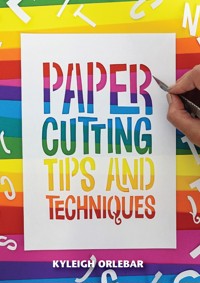
Discover the wonderfully relaxing art of papercutting and create stunning designs. This gorgeous book explains the absorbing and rewarding art of papercutting. Packed with ideas and enthusiasm, it takes you through the whole process from first picking up a scalpel to displaying your work of art. Kyleigh generously shares her skills and her amazing designs to present a book that inspires as well instructs. Guides to Materials, Techniques, Display, Templates and step by step guides.
Sie lesen das E-Book in den Legimi-Apps auf:
Seitenzahl: 162
Veröffentlichungsjahr: 2023
Das E-Book (TTS) können Sie hören im Abo „Legimi Premium” in Legimi-Apps auf:
Ähnliche



















CONTENTS
Introduction
1 Tools
2 Paper
3 Let’s Practise
4 Papercut Templates
5 Cutting a Simple Template
6 Cutting an Intermediate Template
7 Cutting an Intricate Template
8 Creating Templates versus Buying them
9 Displaying your Papercut
Appendix
Practice Sheets
Simple Template
Intermediate Template
Intricate Template
Index
INTRODUCTION
Are you ready to kick-start your wonderfully relaxing papercutting hobby? My name is Kyleigh and I am a professional full-time papercut artist and designer. My aim is simple: to spread the joy of papercutting to all, regardless of how creative you might or might not be.
If you think that the reason to take up papercutting is for the beautiful artwork you create, you’d only be half right. The act of papercutting is, in itself, so wonderfully relaxing it’s almost meditative. Since 2014 I’ve had the pleasure of teaching over one thousand students the joys of papercutting, and the same thing happens on every workshop without exception: there is a moment when a comfortable hush descends as the students lose themselves cutting their creations.
The reason is this: papercutting is a craft that gets you into a ‘flow state’ – a mental state in which a person is completely immersed in a single task or activity. It can be challenging, but not so challenging that it becomes frustrating. It can relax and calm a frazzled mind, and you’ll find that time passes in the blink of an eye. This ‘flow state’ is, in itself, reward enough. But of course what you are also getting in the process is a gloriously intricate piece of artwork that you created – and from the humblest of materials: a piece of paper.
In this book I’ll introduce you to the tools you need to get going on your new obsession, and you’ll gain an understanding of what paper you need so you’ll be knowledgeable when it comes to buying the right thickness for your projects. I’ll guide you through the different types of scalpel available, and I’ll teach you step by step how to use them as we cut the practice sheets and the three beautiful typographic designs given right here at the back of this book.
With your new skills emerging we’ll discover the different ways you can display your creations, from mounting on colour, playing with the shadows, and mounting in a ‘floating’ frame. You might need to warn your family and friends to expect nothing but papercut gifts in the future as you dive headlong into a hobby that enables you to gift your artwork, no matter how creative you are. And if you want to have a go at designing your own templates I’ve got you covered with that, too. I’ll explain how to design a papercut using paper and pencil, as well as run through the basics of designing a template using a computer. You don’t even need to design your own templates as I’ll explain where to find and buy templates for your future projects.
I am hoping to take you on a relaxing journey to find your new obsession, and I invite you to carve time out of your busy schedule to immerse yourself in an activity that is deeply satisfying, both in terms of the final creation and also the journey creating it. A rewarding and relaxing flow state awaits, so put on your favourite podcast or audiobook, make a cup of tea, and let’s get cutting.
CHAPTER 1
TOOLS
To get started on your papercutting journey it is important to have the right tools. In this chapter I’ll share with you all the essentials you’ll need, as well as ideas on storage and desk set-up.
FIXED-BLADE SCALPEL
Scalpel, craft knife, hobby knife, precision knife, utility knife – call it what you like, you will be needing one of these. Essentially a scalpel is a type of knife with a pen-like long handle and a sharp blade for cutting with precision in a crafting/hobby capacity. The term ‘fixed blade’ refers to the fact that the long blade is fixed and doesn’t move, unlike a swivel scalpel, which moves 360 degrees (more on that shortly).
There are so many fixed-blade scalpels on the craft market that knowing which one to choose can be quite overwhelming. It seems that when it comes to scalpels the choice is completely subjective, and comes down to what feels the most comfortable in your hand. Just like a favourite pen, some people will opt for an expensive Parker pen, others can’t use anything other than a rollerball with a rubber grip, and others swear by the trusty Bic Biro! And so it is with scalpel choice.
There is a large variety of fixed-blade scalpels on the market.
My advice is to buy any scalpel and start using it (they are luckily quite inexpensive), and that way you will be better able to judge if it feels right in your hand. If you get on well with your chosen knife, then that’s great! If not, then you’ll be in a better position to know what you need from a scalpel.
Let’s look at the differences in the most popular brands: Swann-Moreton make surgical scalpels for the medical profession, but their scalpels are used by the craft community due to the high quality and comfortable handles. The handles are made of surgical steel, and are flat with ridges in the metal for grip. There are over thirty different Swann-Moreton scalpel handles and over 100 different blade shapes. But unless you’re a surgeon, my advice for papercutting is to use a No. 3 handle with a 10A or 11 blade. However, unlike some of the other craft knives listed below, this one doesn’t come with a safety cap, and the blade is sharp. When the blade is not in use I push it into a small eraser. This is my scalpel of choice, but there are plenty more.
If you prefer a tubular handle that is more pen-like to hold, then the ‘X-ACTO #1 Z Series’ or ‘Excel Blades Hobby Knife’ might be better for you. These are both made from aluminium and are nice to hold. A great feature of both is that they come with a safety cap, which is invaluable when the blade is not in use (providing you remember to put on the cap, of course!). With this type of craft knife, changing the blade is quick and easy. Simply unscrew the grip, which in turn releases the blade. Then it’s a case of placing a replacement blade into the slot and screwing back the grip over the top.
There are craft knives on the market that come with a rubber grip as part of the handle. ‘Fiskars Soft Grip Art Knife’ and the ‘Excel Blades Soft Grip Hobby Knife’ have been designed for a more comfortable grip and are slightly thicker and more ergonomic to hold than the thin, pen-like scalpels mentioned above. These can be a particularly good choice for those with grip problems caused by arthritis or carpal tunnel syndrome.
New to the market are the ‘Slice’ range of craft knives, with high-tech ceramic blades that are safer than traditional steel blades, making them finger friendly and a good choice for older children wanting to experiment with crafting (keep younger children away from all blades, obviously!).
Then there are the finger handles such as the ‘Fiskars Softgrip FingerTip Art Knife’, which have a curved, hoop-like handle ergonomically designed to be held with your index finger or middle finger through the handle. They come in fixed blade and swivel blade (more on swivel blades later). Some find this grip to be beneficial, others can’t get on with this type at all. For example, the swivel scalpel in this design is my ultimate favourite for cutting curves, while I can’t get on with the fixed blade version at all!
So as you can see, when it comes to fixedblade scalpels there are a lot of different knives to choose from. In fact, during my research for this book I looked up a lot of craft knives from various online sources and the reviews are always so polarised – some love a particular knife, some hate it! Therefore, my advice is to try before you buy if you can. If you can’t try before you buy (not a lot of places allow this), then buy whichever one you’re drawn to. But if you don’t get on with it, please don’t let this discourage you. Your love (or not) of papercutting can come down to your tools and how it feels to cut the paper. If you don’t get on with a particular scalpel, try another until you find one to best suit your grip. You’ll know when you’ve found ‘the one’ as cutting even the most intricate of shapes will feel smooth and effortless, and I guarantee you will fall in love with the mindful art of papercutting, savouring the relaxing, almost meditative state it brings you.
CHANGING A BLADE ON A SWANN-MORETON SCALPEL
Removing an Old Blade
With the Swann-Moreton logo facing upwards (ruler side down), tilt the handle about 10 degrees away from the cutting mat holding the handle. With the other hand, place one finger on the very tip of the blade (be careful not to touch the sharp edge).
Put the blade on a cutting mat and place a finger over the tip.
While pressing the tip, slowly tilt the handle up, keep pressing and it should snap the tip of the blade off.
Press down as you tilt the handle up to snap off the tip of the blade.
Be careful with the little bit of blade left on the handle, as there’s still a little sharp bit right at the top.
Be careful with the little bit of blade left on the handle.
Use a thumbnail at the bottom to prize it off away from you.
Use a thumbnail at the bottom to prize it off away from you.
Both bits of blade should now be disposed of properly (do not put them in a bin): I use a small plastic box to collect up all my used blades, which can then go into a purpose-made sharps bin.
Dispose of the used blade in a makeshift sharps bin.
Inserting the New Blade
The foil replacement blade pack for Swann-Moreton scalpels contains five replacement blades. Tear open the foil wrapping down one edge and remove one of the paper-covered blades.
Unwrap a new blade and hold it by the end.
Unwrap a blade and hold it towards the handle. You need to match up the bottom angle on the blade with the groove on the handle.
Match up the bottom angle on the blade with the groove on the handle.
Notice the bottle-shaped hole in the middle of the blade? Place it on top of the blade and rest it on the shoulders of the bottle shape (where it narrows) on to the grooves at the end of the handle. When it is resting on the grooves – stop.
Rest the hole inside the blade on the grooves at the end of the handle.
Do not try to push it on any further with your fingers: this is very important as the blade is super sharp, and your fingers are super soft!
Don’t push it any further with your fingers.
Slowly turn it upside down so the tip is resting on a cutting mat (more about cutting mats later) and the handle is vertical.
Place it facing down on a cutting mat.
Hold the handle and press down firmly until you hear a satisfying click as the blade moves to the correct position.
Press down firmly until you hear a click.
If it is in the correct position, you’ll see it is nestled perfectly in the angle at the bottom; the blade is firmly in place with no gaps.
The blade should be firmly in place with no gaps.
SWIVEL SCALPELS
Swivel scalpels have small blades designed to swivel 360 degrees, enabling the crafter to cut intricate shapes with more ease than a regular fixed-blade scalpel. They are wonderful to use but it might take a little perseverance to get used to using them.
Swivel scalpels have small blades designed to swivel 360 degrees.
You might be intrigued to learn that in all my years of teaching papercutting here in my studio, one thing is a constant – swivel scalpels completely polarize the class. In each of my workshops, roughly half loves to cut with a swivel scalpel, and the other half hates it. There is no in-between. If you want to find out if you’re a lover or a hater, then here is a brief overview of some of the swivel scalpels on the market at present.
My swivel scalpel of choice is the Fiskars ‘Softgrip Fingertip Swivel Knife’, which has the same ergonomic finger handle of the ‘Fiskars Softgrip FingerTip Art Knife’ mentioned earlier, but with a tiny blade that turns 180 degrees. It has been designed to be held by putting either your index or middle finger through the handle and then gripping as you would a pencil or pen. I ignore the handle completely and hold it like a pen with the curved handle resting in my hand. If you do want to put your finger through, make sure the Fiskars logo is facing upwards. This is because the handle has a gentle bend upwards, and if it is facing downwards then your finger movement would be restricted. There is more detail about holding and cutting with this swivel scalpel later.
My swivel scalpel of choice is the Fiskars ‘Softgrip Fingertip Swivel Knife’.
There are also swivel scalpels on the market with more pen-like handles, such as the ‘Modelcraft Swivel Craft Knife’ or ‘Xcut Swivel Knife’. Like the fixed-blade version mentioned above, this has an aluminium tubular handle, and the swivel scalpel blade is screwed into the top.
CHANGING A BLADE ON A FISKARS SOFTGRIP SWIVEL KNIFE
Holding the white handle firmly with one hand, use the other hand to unscrew the orange rubber-tipped grip.
Unscrew the orange rubber-tipped grip.
When this is removed, tip out the swivel blade, which is inside a small metal blade holder. Place the used blade in a suitable sharps bin.
Tip out the small blade from inside the blade holder.
Take out a new blade from the replacement blade pack and, holding the small metal blade holder with the smallest hole face down, insert the new blade down the tube blade first.
Insert a new blade into the holder blade-first.
With the blade inside, place the blade holder into the orange rubber-tipped grip.
Place the blade holder into the orange rubber-tipped grip.
With the blade and blade holder inside the orange rubber-tipped grip, screw that into the handle. Screw it on tightly. The blade should be able to move 180 degrees freely.
Screw the orange rubber-tipped grip into the handle.
CUTTING MAT
To protect your table, desk or surfaces when papercutting it is important to use a self-healing cutting mat. This is so called because when you cut through with a blade they appear to ‘heal’ and no marks are left after the knife has cut on to it. Made from very small pieces of material such as PVC pressed together to create a solid surface, they allow a blade to move between them before closing together again, appearing to ‘heal’. They can ‘heal’ time and again, and can last years (depending on how much you cut on them of course).
To protect your surfaces when papercutting it is important to use a self-healing cutting mat.
They can be found in most craft stores or haberdashery stores, and they tend to be inexpensive. There are many sizes available – here in the UK they are based on our paper sizes A0, A1, A2, A3 and A4 – and all should have a thickness of at least 3mm. In most projects I would recommend an A4-size cutting mat, but if you intend on creating and cutting larger designs, then an A3-sized one is plenty big enough.
Cutting mats not only protect your desk or table from scalpel slices, but using a cutting mat will also help make your papercutting flow more easily. If you have ever tried cutting on to a piece of cardboard used over and over or an old cutting mat, then you’ll know that even the steadiest hand can’t stop the blade finding its way into an old cutting groove on the mat below and potentially ruining a papercutting project. So always use a self-healing cutting mat, and cut down on to it at 90 degrees so the blade is ‘absorbed’ by the microscopic fibres.
If you cut at an angle into the cutting mat, you risk cutting into the mat, which could result in leaving a groove in the mat that won’t heal. And you can be sure that your scalpel will find that groove and that it will pull the scalpel blade off its course – and this is obviously not ideal for intricate work, as you can imagine.
When using an A4- or A3-sized cutting mat, it is best practice to get into the habit of moving your mat as well as the paper each time you need to position your template to cut at a new angle. This is because as you progress and your papercut becomes more and more intricately cut, it also becomes very delicate. Therefore care is needed to move it into position. Moving the cutting mat with the papercut on top will minimize the risk of catching the papercut on the corner of the board and tearing your hard work. So bear that in mind as you progress, and remember to move the cutting mat and the paper. There will be reminders in the later chapters as we cut together step by step.
DESK SET-UP
It is important to think about where you will be doing your papercutting – unlike other crafts such as knitting or crochet, papercutting can’t be done in front of the television with one eye on the project and one on your favourite programme. Position yourself at a table or desk with a chair that is at a good height for you, enabling you to sit upright with your back supported. You might be bending over your papercutting as you cut so it is important to be able to sit back to rest your back periodically.
A small desk lamp that can be angled towards your work can be useful.
Light is a big factor that needs to be considered when you’re positioning yourself. If your kitchen table or desk is near a window that lets in a lot of natural light, then this is great, especially on bright days (though beware of any gusts of wind blowing your hard work on to the floor if the window is open!). Positioning yourself under a ceiling light is also all right, but far better is investing in a small desk light that can be angled towards your work. Be prepared to move the lamp to the left or the right so it shines light on to your work without your hand throwing the template into shadow. You’ll be amazed how many people in my workshops don’t realise they can move their anglepoise lamp to suit their needs – shadows be gone!
KNOWING WHEN TO REPLACE A CUTTING MAT




