


13,99 €
Mehr erfahren.
- Herausgeber: The Crowood Press
- Kategorie: Lebensstil
- Sprache: Englisch
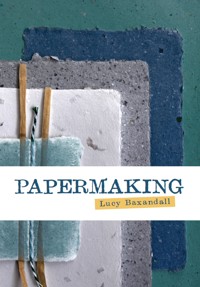
Papermaking is truly a craft for everybody – it is accessible, sustainable and enjoyable for all ages. This book is a step-by-step guide for everyone who wants to make paper at home or in a classroom setting. With clear instructions and over 140 photos, it explains how to make a range of paper from simple sheets to three-dimensional objects. Topics covered include advice on materials and equipment; getting started; adding colour; embellishing and personalizing your paper and exploring the various papermaking techniques. This is an invaluable and handy guide to this wonderful craft first invented by the Chinese in the first century CE.
Das E-Book können Sie in Legimi-Apps oder einer beliebigen App lesen, die das folgende Format unterstützen:
Seitenzahl: 144
Veröffentlichungsjahr: 2022
Ähnliche


















First published in 2022 by
The Crowood Press Ltd
Ramsbury, Marlborough
Wiltshire SN8 2HR
www.crowood.com
This e-book first published in 2022
© Lucy Baxandall 2022
All rights reserved. This e-book is copyright material and must not be copied, reproduced, transferred, distributed, leased, licensed or publicly performed or used in any way except as specifically permitted in writing by the publishers, as allowed under the terms and conditions under which it was purchased or as strictly permitted by applicable copyright law. Any unauthorised distribution or use of this text may be a direct infringement of the author’s and publisher’s rights, and those responsible may be liable in law accordingly.
British Library Cataloguing-in-Publication Data
A catalogue record for this book is available from the British Library.
ISBN 978 1 78500 998 3
Cover design: Sergey Tsvetkov
Photograph: Sinéad Kempley
Acknowledgements
To my teachers, my students and my family, with thanks
All photos are by Sinéad Kempley unless specified otherwise.
CONTENTS
INTRODUCTION
1 EQUIPMENT AND MATERIALS
2 GETTING STARTED
3 ADDING COLOUR
4 LAYERING AND WORKING WITH SHAPE
5 TEXTURE AND WATERMARKS
6 EXPLORING PLANT FIBRES
7 WORKING IN THREE DIMENSIONS
8 NEXT STEPS: TAKING YOUR PAPER FORWARD
GLOSSARY
INFORMATION SOURCES
SUPPLIERS
INDEX
INTRODUCTION
Why Make Your Own Paper? Accessibility, Sustainability and Joy
Paper is everywhere. We write and print on it, communicate with it, package other things in it, clean our homes and ourselves with it, celebrate and decorate with it. In spite of all the technological advances promising a paperless society, paper is flourishing, and is even enjoying a renaissance on the high street as supermarkets try to cut down on plastic food packaging. But our relationship with paper goes deeper than utility, as I discovered when I started making my own paper over twenty years ago.
There are probably as many reasons to make your own paper as there are people who make it. My starting point was making a little book, and despite living in a city with plenty of choice in the shops (internet shopping was still in its infancy), I could not find the papers I wanted. The content of the book was personal, and its surfaces needed to be personal too. I bought a simple kit, gathered some junk mail, some sweet wrappers and a brown paper bag, and fired up the blender on the kitchen table. Within an afternoon, I can honestly say I was hooked. I still keep samples of those first sheets on the studio wall.
Sample sheet: the very first papers I made using a simple home set-up. Ingredients were added progressively to the vat every few sheets in order to observe the changes in colour and texture.
In a previous life, I designed, made and sold jewellery. I loved both process and product, but metalwork is messy, hot, and potentially hazardous with its naked flames and acids. After a move to a new country and a rented flat with no dedicated workspace, that chapter was sadly over. When I discovered papermaking, one of its biggest appeals was its accessibility.
You can make paper on a small scale almost anywhere: kitchen, dining room, bathroom or balcony. One of my London students gleefully reported cooking up cowpats for papermaking on her small high-rise balcony, but more of that in Chapter 6. The worst-case scenario probably involves starting your blender with the lid off by mistake and getting pulp on the ceiling and water on the floor. Clearing up when it’s time to use the kitchen for its original purpose again always seems to come too soon, but once you have your papermaking equipment organized, it’s the work of minutes to get started again. It’s safe and enjoyable for all ages. Recycled materials are free. Basic equipment is inexpensive, usually easy to find and often multi-purpose.
There are few crafts where you can create an excellent finished product purely from discarded materials, while lightening the load on your recycling and compost bins. Practised with care, papermaking is wonderfully sustainable. You will need to use a certain amount of water and a bit of electricity, but water left over at the end of the process can be used for watering plants or even saved to make your next lot of paper.
Less of a practical consideration than accessibility and sustainability, but just as important, is the sheer joy of creating. Papermaking adds an extra layer of enjoyment; while the beauty and tactility of the paper itself is satisfying enough, you will also have the anticipation of the future projects you can use your paper for. We will explore some of the many possibilities in the last chapter.
This book is intended to help you discover a magical and transformative process. Once you get the papermaking bug, there is a whole world of further knowledge waiting out there to be tapped in books, periodicals, online groups and classes. Welcome to hand papermaking.
An Extremely Brief Timeline, from East to West
Thick volumes have been written about the long and fascinating history of paper (see Further Reading section at the end of this book) and that is not the purpose of this book. However, it is interesting to know, particularly if you choose to experiment with local plant fibres, just a little about the progression of papermaking from China in the first century CE via Japan and Korea and on through the Middle East. The Arabs brought paper to Europe via Spain, and from there it travelled to the New World. New discoveries are still being made about paper’s ancient origins.
The Industrial Revolution and the discovery of wood pulp as a cheap, raw material for mass production saw the quality of most paper take a dive, although there were, and still are, mills making high-quality rag paper for artists. Some European mills have histories stretching back centuries, and visitors can witness the traditional methods still being used. A list of these mills is included at the end of the book. The same is true in Japan, Nepal and many other countries, each showcasing their own fibres, traditions and working methods.
The Arts and Crafts movement helped to revive interest in hand papermaking in the West: American papermaker Dard Hunter led this endeavour, and the US currently leads the way in terms of education facilities and numbers of hand papermakers. There are also flourishing papermaking communities in Europe, the Middle East and Australia, often led by makers who use paper as an artistic medium for their own work, as well as making paper for other artists to use. Master papermakers in Japan, Korea, China and Vietnam continue their individual traditions from which all subsequent papermaking endeavours emerged.
How to Use This Book
This book is intended as an introduction to the craft of papermaking and is aimed squarely at the home or classroom papermaker. I have weighted the content towards basic equipment and processes with a firm grounding in proper sheet formation as all the more advanced and complex skills build on this one. The later chapters describe more creative techniques, but we are still just hinting at the infinite possibilities of the craft.
I have chosen the topics based on the techniques that my students most often ask about and give step-by-step instructions for each. You will find a list of further reading at the end of the book, and as with any craft, each teacher will have something new and individual to offer you. Above all, if the papermaking bug bites you, I would heartily recommend taking classes in the areas that interest you most. You will get the opportunity to use equipment and facilities you may not have access to at home, and learning with a group of like-minded students is a wonderful and inspiring experience. There is a list of teaching institutions at the end of the book, along with a glossary of papermaking terms, suppliers and interesting places to visit. The internet is now a global source for tutorials on everything imaginable, varying in quality from questionable to excellent, and papermaking is no exception. I have added some useful links in the Further Reading section, but of course there are more arriving online all the time. The more creative corners of social media can also be rewarding. Explore and enjoy.
I should emphasize that the illustrations were photographed in my workshop, which is a busy and often messy place of production. They may not be the prettiest pictures, but I hope they are helpful and give an insight into the everyday processes of getting from fibre to finished paper.
My hope is that your copy of this book will end up crinkled with water and spattered with pulp like a favourite cookbook as you consult it at each stage of your papermaking journey.
CHAPTER ONE
EQUIPMENT AND MATERIALS
In this chapter, we will source all the equipment and materials you need to start papermaking. Many of them will already be in your home, or easy and inexpensive to acquire. The instructions for using them will follow at the appropriate points in later chapters. With some of the more specialized techniques, additional materials are listed later along with the instructions so as not to overwhelm at the beginning, but Chapter 1 will get you up and running.
Where to Work
Picture a warm day without too much wind. A large, waterproof table stands under an airy veranda, protected by a roof against sudden showers. A tiled floor allows water to drain easily away. A convenient water source is close at hand, along with a press, and a drying rack stands ready to receive your freshly made sheets of paper. If this is your reality, rejoice and enjoy.
Simple outdoor set-up: you can work on any surface, be it table or worktop, indoors or outdoors, that won’t be harmed by water. This was a workshop at a microbrewery in Lebanon. (Author's photograph)
It is much more likely that you will be working either indoors or, weather permitting, in a garden, or perhaps on a balcony. The first things you need to make sure of are a work surface and a floor that will not be damaged by water. If you have wooden or carpeted floors, you can cover them with plastic sheeting, but tape down the edges so as not to create a trip hazard. Likewise, a wooden table or work surface can be protected with plastic sheeting. Keep a mop and bucket handy to deal with spills and prevent slipping, especially when working with children.
A waterproof apron and non-slip footwear are recommended. You will probably get small amounts of pulp on your clothes and shoes, but it will brush off easily when dry.
Raw Materials (Recycled and Virgin Fibres)
All true paper is made from cellulose, the basic building block of plants. The interaction between cellulose and water is harnessed to produce the mat of interlinked fibres that we know as a sheet of paper. Because industrially produced paper is intensively processed and altered by chemicals to produce an even, smooth and uniform sheet, it’s hard to see the individual fibres in the sorts of paper we use every day (printer and copy paper, for example) without a microscope, but they are definitely there. As you develop your skills and start to use more varied raw materials, the fibres will start to reveal themselves.
Recycled Fibres
When starting to make your own paper, by far the easiest and cheapest raw material to source and use is the paper you already have at home or work. Office paper, junk mail, gift wrap, packaging and drawing paper all have their place.
Office paper, gift wrap, junk mail, art papers: almost any good-quality paper is suitable for recycling into brand new sheets.
It’s important to remember that the quality of the paper you make will reflect the quality of the paper you start with. Newsprint, for instance, will yield a paper that yellows and becomes brittle just as old newspapers do. Offcuts of good drawing paper, on the other hand, will produce a stronger, longer-lasting sheet that will be a pleasure to use. You will quickly learn the knack of mixing different types of paper to get varied results. Below are some types of paper you might use and the results you can expect.
Office paper
Machine-made wood pulp sheets and envelopes make a good general-purpose paper. Inkjet printing will largely be dispersed by water, while laser printer toner will yield a speckle in your finished paper. The blue security printing on the inside of many envelopes may add a pale bluish tinge, depending on how many you use. Be sure to remove any staples or plastic envelope windows before making your pulp. Envelope glue is not a problem and may even help to strengthen the paper a little.
Cartridge paper, watercolour paper and other art papers
Most papers made for drawing and painting (with the exception of sugar/construction paper; see ‘Papers requiring caution’ section opposite) contain high-quality wood or rag fibre and are very suitable for recycling into handmade paper. If you are lucky enough to have access to a printer’s workshop or printing firm, make friends with them and offer to take any offcuts they might be throwing away.
Junk mail and magazines
The leaflets and menus that appear daily on the doormat can be put to good use as a source of new paper, either alone or mixed with other types. If the paper has a shiny coating, this will break up on processing and produce a decorative speckled effect in your paper. You may see the water go cloudy as this type of paper contains a lot of fillers and whiteners; these are inert substances like kaolin (china clay) and titanium dioxide (also used in white paint) and are not harmful. The same applies to glossy magazines.
Surplus festival programmes have been coarsely blended to add interest and texture to newly made sheets.
Packaging
Cardboard is simply thick paper and can be used in the same way as thinner sheets. Brown board – and indeed brown kraft paper – make strong and attractive sheets, and the colour can be adjusted by adding lighter or darker paper to the mix. Board will need longer soaking before processing.
Gift wrap
Like junk mail, a lot of gift wrap is heavily coated, but it is particularly useful for adding decorative effects (more details in Chapter 3). Many wrapping papers are not suitable for conventional recycling, so using them this way helps to keep them out of landfill. Tissue paper breaks down easily and is great for adding colour – be sure to check that it is the colour-fast type. The type which bleeds colour can be used for decoration, but it’s better to add this by hand later to avoid the dye leaking into all your sheets (more on this in Chapter 3).
Papers requiring caution
Some readily available papers do require a bit of thought before using for papermaking. As already mentioned, newsprint will not produce a good-quality result, either in its unprinted form or as printed newspapers. Again, newspaper can be used selectively later as a decorative inclusion, but a stronger base paper is definitely recommended. Newsprint has often been recycled before, which means it will already have shorter, weaker fibres. Newspaper ink creates a greasy, grey pulp which is not particularly pleasant to work with and leaves residue on containers, equipment and hands. Newsprint, and paper made from it, will yellow and become brittle over time as it has a high lignin (acid) content. Pages from old books which are starting to discolour will have the same issue. That said, newsprint is excellent for mopping up spills and as an absorbent layer on the work surface, so certainly has its important place in the papermaking process.
Another paper to beware of is the coloured sugar paper we all know and love from primary school wall displays. It’s inexpensive and very useful for art and craft projects, but the colour is not at all lightfast, so if you use it, be aware that the colour will fade quickly when exposed to sunlight.
Finally, if you use glossy magazines or brochures with thick covers, be on the lookout for paper which has a solid plastic coating laminated onto it. This can be hard to detect until you try to tear the cover and meet a lot of resistance. These plastic-coated pages may damage equipment and should be set aside. Chunks of plastic won’t enhance your paper either.
Papers and other materials for embellishment
We’ll go into techniques later, but here are some items to collect and create a stash for adding to your papers: ornate gift wrap, sweet wrappers, postage stamps, out-of-date maps, old sheet music, event tickets, thread, scraps of ribbon, twine, fine wire – and that’s just for starters. You will quickly develop an eye for things you might wish to include.
Virgin or New Fibres
While the possibilities for working with recycled materials are practically unlimited, if you catch the papermaking bug and want to expand your horizons, you will eventually want to explore virgin fibres. These fibres have come straight from their plant of origin and not been made into paper before. They will have been processed to varying degrees depending on their source. In Chapter 6 we will look at harvesting plants and using their fibres in your papermaking in combination with recycled and other materials. This is truly papermaking from scratch.
A wide variety of decorative materials can be added to pulp to embellish plain sheets.




