


16,99 €
Mehr erfahren.
- Herausgeber: John Wiley & Sons
- Kategorie: Geisteswissenschaft
- Serie: China Today
- Sprache: Englisch
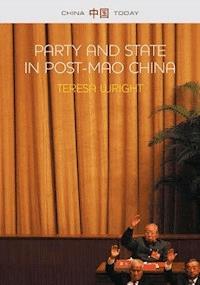
In recent decades, China has become a quasi-capitalist economic powerhouse. Yet it continues to be ruled by the same Communist Party-dominated government that has been in power since 1949. But how has China’s political system achieved such longevity? And what does its stability tell us about the future of authoritarian versus liberal democratic governance?
In this detailed analysis of the deeply intertwined relationship between the ruling Communist Party and governing state, noted China expert Teresa Wright provides insightful answers to these important questions. Though many believe that the Chinese party-state has maintained its power despite its communist and authoritarian features, Wright argues that the key to its sustained success lies in its careful safeguarding of some key communist and authoritarian characteristics, while simultaneously becoming more open and responsive to public participation. She contends that China’s post-Mao party-state compares well to different forms of political rule, including liberal democratic government. It has fulfilled the necessary functions of a stable governing regime: satisfying key demographic groups and responding to public grievances; maintaining economic stability and growth; and delivering public services - without any real reduction in CCP power and influence.
Questioning current understandings of the nature, strengths, and weaknesses of democracy and authoritarianism, this thought-provoking book will be essential reading for all students and scholars of Chinese politics and international relations.
Sie lesen das E-Book in den Legimi-Apps auf:
Seitenzahl: 365
Veröffentlichungsjahr: 2015
Ähnliche



















China Today series
Greg Austin,
Cyber Policy in China
David S. G. Goodman,
Class in Contemporary China
Stuart Harris,
China's Foreign Policy
Elaine Jeffreys with Haiqing Yu,
Sex in China
Michael Keane,
Creative Industries in China
Joe C. B. Leung and Yuebin B. Xu,
China's Social Welfare
Pitman B. Potter,
China's Legal System
Xuefei Ren,
Urban China
Judith Shapiro,
China's Environmental Challenges
LiAnne Yu,
Consumption in China
Xiaowei Zang,
Ethnicity in China
Copyright © Teresa Wright 2015
The right of Teresa Wright to be identified as Author of this Work has been asserted in accordance with the UK Copyright, Designs and Patents Act 1988.
First published in 2015 by Polity Press
Polity Press
65 Bridge Street
Cambridge CB2 1UR, UK
Polity Press
350 Main Street
Malden, MA 02148, USA
All rights reserved. Except for the quotation of short passages for the purpose of criticism and review, no part of this publication may be reproduced, stored in a retrieval system, or transmitted, in any form or by any means, electronic, mechanical, photocopying, recording or otherwise, without the prior permission of the publisher.
ISBN-13: 978-0-7456-6384-5 (hardback)
ISBN-13: 978-0-7456-6385-2 (paperback)
ISBN-13: 978-0-7456-9149-7 (epub)
ISBN-13: 978-0-7456-9146-6 (mobi)
A catalogue record for this book is available from the British Library.
Library of Congress Cataloging-In-Publication Data
Wright, Teresa.
Party and state in post-Mao China / Teresa Wright.
pages cm.
Includes bibliographical references and index.
ISBN 978-0-7456-6384-5 (hardback) – ISBN 0-7456-6384-2 (hardcover) – ISBN 978-0-7456-6385-2 (paperback) 1. Zhongguo gong chan dang–History. 2. China–Politics and government–1976-2002. 3. China–Politics and government–2002- 4. China–Economic conditions–1976-2000. 5. China–Economic conditions–2000- I. Title.
JQ1519.A4W75 2015
324.251'075–dc23
2014038111
The publisher has used its best endeavors to ensure that the URLs for external websites referred to in this book are correct and active at the time of going to press. However, the publisher has no responsibility for the websites and can make no guarantee that a site will remain live or that the content is or will remain appropriate.
Every effort has been made to trace all copyright holders, but if any have been inadvertently overlooked the publisher will be pleased to include any necessary credits in any subsequent reprint or edition.
For further information on Polity, visit our website: politybooks.com
Chronology
1911
Fall of the Qing dynasty
1937–45
Japan invades China
1945–9
Civil War between Nationalists (KMT) and Communists (CCP)
1949
Mao Zedong founds People's Republic of China (PRC); KMT retreats to Taiwan
1950
Land Reform Law
1950–3
Korean War
1953–7
First Five-Year Plan: PRC adopts Soviet-style economic planning
1954
Constitution of the PRC implemented; first meeting of the National People's Congress
1957
Hundred Flowers Movement
1958–60
Great Leap Forward
1959
Ministry of Justice eradicated from PRC state apparatus; Tibetan uprising and departure of the Dalai Lama for India
1959–61
Widespread famine, tens of millions of deaths
1960
Sino–Soviet split
1966–76
Great Proletarian Cultural Revolution
1968
Liu Shaoqi, President of PRC, publicly branded China's “number one capitalist-roader,” stripped of all Party and state posts, and jailed
1969
Liu Shaoqi dies in prison; Deng Xiaoping publicly branded China's “number two capitalist-roader,” sent to countryside to engage in manual labor
1971
PRC regains UN seat and Security Council membership
1972
“Shanghai Communiqué,” issued during Richard Nixon's visit to China, pledges to normalize US–China relations (February)
1974
Zhou Enlai, Vice-Chair of CCP and Premier of PRC, convinces Mao to “re-habilitate” Deng Xiaoping; Deng becomes Vice-Premier of PRC
1976
Death of Zhou Enlai (January)
1976
CCP Central Committee criticizes Deng; Deng removed from high-level Party and state posts (February)
1976
Mass public outpouring of grief over Zhou Enlai's death, support for Deng Xiaoping, at Beijing's Tian'anmen Square (April)
1976
The Great Tangshan Earthquake: Largest earthquake of the 20th century by death toll (July)
1976
Death of Mao Zedong (September)
1976
Hua Guofeng becomes Chair of CCP and CMC; Maoist “Gang of Four” arrested (October)
1977
Deng restored to high-level CCP and state posts, including Vice-Chair of CCP Central Committee
1978–80
Democracy Wall Movement
1978
Deng Xiaoping consolidates power as top CCP leader; 3rd Plenum of 11th CCP Central Committee repudiates Great Proletarian Cultural Revolution, endorses economic reform (November)
1979
US and PRC establish formal diplomatic ties; PRC invades Vietnam; introduction of one-child policy, restricting married, urban couples to one child; Ministry of Justice restored as part of PRC state
1980
Special Economic Zones endorsed; PRC joins International Monetary Fund and World Bank
1981
Hu Yaobang replaces Hua Guofeng as Chair of CCP
1982
Locally elected community mediation committees encouraged; title of CCP “Chair” changed to “General Secretary”; small-scale private businesses officially allowed
1983
Rural “household responsibility system” endorsed nationwide
1984
New state-sector workers hired without guarantees of lifetime employment or “iron rice bowl” benefits; Sino-British Joint Declaration agreeing to return Hong Kong to the PRC in 1997
1986–7
Student protests at University of Science and Technology and other universities; Hu Yao-bang, General Secretary of the CCP, forced to resign; Zhao Ziyang becomes General Secretary of the CCP (Winter)
1987
New law establishes the right to hold elections for rural village councils; Deng Xiaoping steps down as chair of CCP Central Advisory Commission
1988
PRC Constitution “encourages” and “supports” the development of China's private sector; Ministry of Civil Affairs establishes province-level guidelines for implementing 1987 village council law
March 1989
University students attempt to submit petition to National People's Congress, asking for amnesty for political prisoners
April 1989
Hu Yao-bang dies, mass mourning turns into student-led Tian'anmen Square movement
1989
Chinese military uses force to end Tian'anmen Square movement; up to 2,000 killed (June 3–4)
1989
Zhao Ziyang, General Secretary of the CCP and President of PRC, forced to resign, placed under house arrest; Jiang Zemin becomes General Secretary of the CCP (June)
1989
Jiang Zemin replaces Deng Xiaoping as chair of Central Military Commission (CMC) (November)
1990
New law calls for the election of urban residents' committees
1992
Deng Xiaoping's Southern Tour re-energizes economic reform; 14th meeting of National Party Congress calls for the establishment of a “socialist market economy” and declares that economic growth is the country's highest priority; migration restrictions eased; Chinese universities begin to charge tuition
1994
PRC's first Company Law passed; uniform national tax code instituted; citizens granted legal right to sue government officials for abuse of authority or malfeasance; “Friends of Nature” becomes China's first officially recognized environmental NGO
1995
Central Party-state leaders announce intention to “keep the large” state-owned enterprises (SOEs) and “let the small go”
1997
Death of Deng Xiaoping (Feb.); Hong Kong returned to PRC (July); 15th National Party Congress describes private enterprise as an “important” element of China's economy, introduces plan to privatize SOEs; all CCP Politburo and SC members over the age of 70 (aside from Jiang Zemin) step down (September)
1998
Large-scale SOE privatization begins; National People's Congress expands 1987 law on rural village council elections, grants deliberative rights to village assemblies
1999
National People's Congress approves Jiang Zemin as President of PRC, amends Constitution to describe private enterprise as “important” element of China's economy; CPPCC adds special “economic” constituency that includes roughly 100 private entrepreneurs (March); students engage in street protests in response to US bombing of Chinese embassy in Belgrade (May)
2000
Central leaders stipulate that urban residents' committee leaders should be directly nominated and elected by local residents
2001
PRC joins World Trade Organization; all new lawyers required to pass a “bar” exam
2002
16th Plenum of the National Party Congress, Hu Jintao replaces Jiang Zemin as General Secretary of the CCP; NPC endorses Jiang's “Three Represents,” effectively embracing the entry of private entrepreneurs into the CCP; large-scale protests in NE China by laid-off state-owned enterprise workers; local rural taxes and fees banned
2003
Hu Jintao replaces Jiang Zemin as President of PRC; Jiang Zemin remains chair of CMC; remaining SOEs placed under control of State-owned Assets Supervision and Administration Commission (SASAC)
2004
Constitution amended to include right to protection of private property; Hu Jintao replaces Jiang Zemin as chair of CMC
2005
Student anti-Japan street protests; Zhao Ziyang dies, still under house arrest; PRC begins to allow value of the Chinese yuan to drop relative to the US dollar
2006
“New Socialist Countryside” initiative announced
2007
Two non-CCP members of CPPCC appointed to State Council; CCP Constitution amended to give public and private sectors equal economic standing; PRC overtakes the USA as the world's biggest emitter of CO
2
2008
Violent clashes in Tibet, foreign criticism and protests, domestic counter-protests; Sichuan earthquake; Beijing Summer Olympic Games; dissident Liu Xiaobo arrested for “Charter 08”; central government passes US$585 billion economic stimulus package
2009
Violent clashes between ethnic Uighurs and local Han Chinese in Xinjiang; national pension program enacted to cover all elderly rural residents
2010
Liu Xiaobo awarded Nobel Peace Prize, while in prison; Shanghai World Expo
2011
Citizens given legal right to sue government for release of information; major crash on China's new bullet train
2012
18th National Party Congress approves Xi Jinping as General Secretary of the CCP and chair of CMC; official media report “rigorous rule” that Politburo SC members must retire by age 68
2013
12th National People's Congress approves Xi Jinping as President of PRC; 3rd Plenum of 18th CCP CC states that market plays a “decisive” role in the economy; Xi Jinping launches anti-corruption campaign and calls for more comprehensive cadre evaluation criteria, including the “people's livelihood,” the “development of local society,” and the “quality of the environment” in the area under an official's purview; CCP issues “Document 9,” warning of the threat of “false ideological trends, positions and activities;” SUV in front of Tian'anmen Square bursts into flames and runs into a group of bystanders; Shanghai Pilot Free Trade Zone announced
2014
CCP Central Committee announces stricter scrutiny of and higher standards for new and existing members; individuals of Uighur ethnicity wielding knives and axes attack passengers at a train station in Kunming; train station bombed and car crashes into bystanders at public market in Xinjiang; armed clashes between Uighur protestors and government forces in Xinjiang (June)
Acknowledgments
Writing a book is never easy – at least not in my experience. It takes a village to see it through. Several years ago, Louise Knight contacted me with the idea of writing a book for Polity about China's government. I balked at the thought of slogging through the details of CCP and state structures. But with Louise's encouragement, I was able to formulate an outline that I felt inspired to take to fruition. Louise has been a model editor – smart, reasonable, and cheerful. Similarly, my work with Polity's Pascal Porcheron has been an absolute pleasure.
This book has benefited tremendously from the input of colleagues – none of whom, of course, bears any responsibility for my errors or omissions. I am grateful to the members of my department (Political Science) at California State University, Long Beach who read portions of the manuscript and offered helpful suggestions. I feel lucky to have such a wonderful group of colleagues. The book also was improved by the opportunity to present parts of it at academic conferences. For this, I thank Sujian Guo and the Fudan Institute for Advanced Study in Social Science; Zhiqun Zhu and Bucknell University; Arthur Ding, Chih-shian Liou, and the Institute of International Relations at National Chengchi University; and Jane Golley and the Australian National University Centre on China in the World. Further, I thank Nancy Lewis and the Research Program at the East–West Center for providing me with a place of refuge where I could think and write.
Beyond help with the content of the manuscript, I could not have persevered without the support of many others. Amelia Marquez, my main administrative assistant, has through her tireless efforts and positive attitude made it possible for me to keep a handle on my duties as Department Chair and still find time to write. My parents, Pete and Nancy Wright, have been a constant source of encouragement, and I will never be able to thank them enough for their love and support. I am particularly grateful to my mom for her research assistance; many of the articles that she mailed to me informed my thinking for the book. My gratitude also is deep for Ty Von Hoetzendorff, whose words and actions kept me focused and happy through one deadline after another. And I thank my amazing children, Nicholas and Anna, for their patience as I sit in front of the computer, and for surrounding me with their kindness, compassion, and joy.
Acronyms
Lesen Sie weiter in der vollständigen Ausgabe!
Lesen Sie weiter in der vollständigen Ausgabe!
Lesen Sie weiter in der vollständigen Ausgabe!
Lesen Sie weiter in der vollständigen Ausgabe!
Lesen Sie weiter in der vollständigen Ausgabe!
Lesen Sie weiter in der vollständigen Ausgabe!
Lesen Sie weiter in der vollständigen Ausgabe!
Lesen Sie weiter in der vollständigen Ausgabe!
Lesen Sie weiter in der vollständigen Ausgabe!




