


18,00 €
Mehr erfahren.
- Herausgeber: Molino Verlag
- Kategorie: Geisteswissenschaft
- Sprache: Englisch
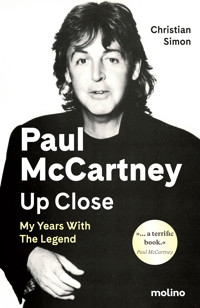
"... a terrific book." – Paul McCartney Christian Simon invites you on an extraordinary journey through his years alongside one of the greatest music legends of our time: Paul McCartney. With refreshing authenticity and intimate storytelling, Simon reveals the person behind the star, avoiding over-the-top theatrics in favour of genuine insight and heartfelt moments. These memoirs offer a rare glimpse behind the curtain – not just into the music, but into the creative processes, triumphs, and setbacks that have shaped Paul McCartney's remarkable life. It's a tale of friendship, passion, and the legacy of an icon who has profoundly influenced the world of music for decades. Thoughtful, unpretentious, and deeply engaging, this is 100% Paul McCartney in a single book!
Das E-Book können Sie in Legimi-Apps oder einer beliebigen App lesen, die das folgende Format unterstützen:
Seitenzahl: 271
Veröffentlichungsjahr: 2025
Ähnliche
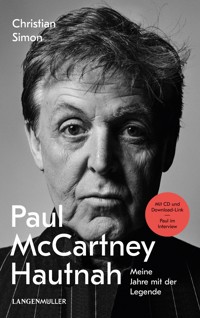














Paul McCartney Up Close
Molino GmbH
Otto-Hahn-Str. 17
71069 Sindelfingen
First published in Germany in 2020 by Langen Müller Verlag,
Thomas-Wimmer-Ring 11, 80539 München
This paperback edition published in 2025 by Molino,
Otto-Hahn-Str. 17. 71069 Sindelfingen
Text copyright © Christian Simon, 2020
English translation by Christian Simon and Garry Preston, 2024
Pictures by Christian Simon Productions and Monica Simon
Cover photo: Stevie Hughes
The Author asserts the moral right to be identified as the author of his work.
All rights reserved. No part of this publication may be reproduced, stored in a retrieval system, or transmitted, in any form or by any means, electronic, mechanical, photocopying, recording or otherwise, without the prior permission of the copyright owner.
A CIP catalogue record for this book is available from the British Library.
ISBN 978-3-911682-14-5
Typeset and layout by Molino GmbH, Otto-Hahn-Str. 17, 71069 Sindelfingen
Christian Simon
Paul McCartney Up Close
My Years with the Legend
Content
With a Little Help from My Friends
Forewords by Geoff Baker and Mark Featherstone-Witty
Prolog
An Egyptian Railway Station, a Musical City Tour and a Pub Concert in Liverpool
Chapter 1
The Long and Winding Road •
On the Way to Paul McCartney
Chapter 2
London Town •
At MPL in London
Chapter 3
When I Get Home •
At Paul’s Home in Sussex, Film Projects and the »Liverpool Oratorio«
Chapter 4
Here, There and Everywhere •
John Lennon, the Beatles and Freedom
Chapter 5
Get Back •
The Hamburg Premiere
Chapter 6
Penny Lane •
For the First Time in Liverpool
Chapter 7
Paperback Writer •
A Book and with Paul in the London Groucho Club
Chapter 8
Off the Ground •
A Concert at the London Docklands Arena and with Paul & Linda in Frankfurt
Chapter 9
A Shot of Rhythm and • Blues
A Meeting with Linda in Frankfurt
Chapter 10
Live and Let Die •
LIPA Successes and the Big Bang at the »New World Tour« in Stuttgart
Chapter 11
A Day in My Life •
Paul’s Documentary Film »Movin’ On«, a Classic Premiere and the »Anthology«
Chapter 12
Her Majesty •
The LIPA Opening and with the Queen in Liverpool
Chapter 13
Flaming Pie •
With Paul on Abbey Road, a »Flammkuchen-Interview« and Paul’s Second German Radio Show
Chapter 14
My Love •
Farewell to Linda, a ›Devilish‹ Rock’n’roll Album and with Paul in Cologne
Chapter 15
What Goes On •
Once Again in Liverpool and Cologne
Chapter 16
Hello, Goodbye
A Termination, a ›Heather Experience‹, a New Love and New Tours
Epilogue
The End, the Fascination of Paul McCartney, a Dream Come True and One Last Word
Silly Love Songs
What Paul Told Me about His Songs
Picture Explanation
With a Little Help from My Friends
Forewords by Geoff Baker and Mark Featherstone-Witty
During the time that I worked for Paul McCartney – 1989–2004 – Christian Simon became the one person in Germany who most regularly interviewed Paul and Linda. I cannot think of anyone else in Germany who interviewed them more. He was a great supporter of their vegetarian drive, their photography and art, LIPA, and, of course, the music and gigs. Christian was always very enthusiastic to help publicise and promote whatever project Paul and Linda were doing and they seemed pleased to see him, relaxed when chatting with him and I believe they appreciated his keenness to help. As a result, Paul’s and Linda’s interviews with Chris were very interesting and informative and I am sure that this collection of those interviews will now help others to be inspired by their essential good messages: peace, love and kindness to animals.
Geoff Baker, Lyme Regis, 10/02/2018
I met Christian when Paul and I were trying to set up The Liverpool Institute for Performing Arts. He was working for a radio station and threw his considerable energies into what he could to make our dream into a reality. This included a special book, radio interviews and audition events. And the all important fund-raising. Without being asked, Christian took part in all of it. For us, he was Mr. Germany.
Sir Mark Featherstone-Witty OBE
Founding Principal / CEO
The Liverpool Institute for Performing Arts
Learning Group
Mount Street, Liverpool L1 9HF
2nd October 2018
Prolog
An Egyptian Railway Station, a Musical City Tour and a Pub Concert in Liverpool
It’s a sunny autumn afternoon. I’m sitting at my desk, working on this book and listening to ›Egypt Station‹, the new CD from Paul McCartney. A few days ago, on September 7th, 2018, Paul’s highly acclaimed album was released, which he recorded with his band at home in the Hog Hill Mill in Sussex, in the London ›Abbey Road Studios‹ and in Los Angeles.
The two pre-released singles »I Do Not Know» and »Come On To Me» already suggested it: here comes a sensational new album. And so, as expected, the CD reached top positions in the charts worldwide and it’s Paul’s first number one album in the United States after ›Tug Of War‹ (1982). The critics are great… »Egypt Station« is a wonderful, new piece of music by McCartney that reminds us of the »Sgt. Pepper« album.
When an album is released there’s always plenty of promotion. Paul always has plenty of very special ideas. This time he played a free concert in the hall of New York’s Grand Central Station on the day the album was released. There were also famous stars like Meryl Streep and Jon Bon Jovi among the approximately 300 fans.
But the absolute highlight, a real sensation, is the film ›Carpool Karaoke‹ for James Corden’s TV Show »The Late Late Show«. I don’t know how many emails and phone calls I got with everybody asking me: »Have you seen the Liverpool film with Paul?« Of course I had … James Corden drives with Paul through the streets of his hometown. They visit well-known places from the old Beatles days, Paul’s parents’ house and the old, still existing hairdressers. They sing songs together and finally they end up in a pub.
But the guests at the pub were not expecting the ›Big Surprise‹. Paul’s amplifier system (PA) was set up and his band was on stage behind a curtain. James Corden stands behind the counter and encourages people to turn on the jukebox. A girl goes and presses a number. And now, nobody can believe it, the curtain opens and Paul plays live some chords of ›A Hard Day’s Night‹. Then the curtain closes again – leaving everyone bewildered – was that real or a just a mirage? Again, someone presses a number on the jukebox and this time people hear ›Ob-La-Di, Ob-La-Da‹. Oh my god, it is him, Paul McCartney – he and his Band play a small concert in the Philharmonic Dining Rooms, 36 Hope Street, Liverpool. I know that pub well, it is close to Paul’s old school … which is nowadays called ›The Liverpool Institute for Performing Arts‹ … or LIPA for short.
I look out of the window as my mind wanders back a few years – moving pictures in my head, images in Technicolor. It’s not a dream – just magnificent memories of wonderful, unforgettable experiences: my first Beatles record, my Beatles life-size poster from »Bravo« magazine, the radio shows with the ›Fab Four‹, my first meeting with Paul McCartney at his windmill in Sussex, my first interview with Linda McCartney, the offer to be their ›German link‹, many days in London and Liverpool together with the McCartneys, our meetings and the intense conversations. But it was a long and winding road to get there …
Chapter1
The Long and Winding RoadOn the Way to Paul McCartney
Duisburg / Germany, Christmas 1964 – I was thirteen years old. There were two gifts from my parents under the Christmas tree: a record player and two singles – the ›Old Shatterhand-Melody‹ by the orchestra Martin Böttcher and ›I Want to Hold Your Hand‹ by the Beatles. We lived in a three-story post-war rental house with four other families, with whom we all had a very good relationship. The landlords were three old ladies. They were sisters and lived on the ground floor. The Haberland siblings were extremely conservative and loved classic music. There was a large black piano in their living room, which they regularly used to organise domestic music evenings.
Since I was a kid, it had somehow become a tradition for me to go downstairs on Christmas Day to wish them a Merry Christmas and to show them my pressies. This year I carefully placed my new record player on their piano and put on the first record. The ›Old Shatterhand-Melody‹ is a nice orchestral piece and they liked it a little. Now the Beatles single followed and the foreseeable ›Christmas catastrophe‹ began. Already after the first notes of ›I Want to Hold Your Hand‹ the siblings clasped their hands over their heads and asked me to stop it. That’s when I thought that I had a ›brilliant‹ idea: I explained that the Beatles also appreciate classical music.
The proof would be the B side of the record: ›Roll over Beethoven‹, in this case, however a tribute by the Beatles to their rock’n’roll idol Chuck Berry. The world view of the three ladies was permanently shaken from that moment on. »Beethoven would turn in his grave«, I still remember this sentence until today. I quickly left the sisters and returned to my room on the third floor to rehearse ›Roll over Beethoven‹ on my 1950s Framus acoustic guitar.
»You have to Go to the Radio!«
At the time I didn’t know that Paul McCartney had been a rock’n’roller since the 1950s and that he was already imitating Little Richard and Buddy Holly. But from that point, the Beatles and their music would inspire me until day. After my high school band ›The Dukes‹ had split up, I swapped the guitar for the microphone. Dance schools organized a competition together with a radio station and a magazine to find the ›best German youth disc jockey‹. I won the Duisburg city championship, came first in the North Rhine-Westphalia Competition and second in the German championship. Then I had a lot of gigs in dance schools, discotheques and at beat music festivals – always with Beatles records in my luggage.
Through my job as an advertising specialist primary in film, radio and television, I met the actor Dieter Eppler during a commercial production. He was very well known in Germany and I told him about my ›career‹ and he said: »You have to go to the radio!« But what can I do? I had often sent demos to German radio stations, but always received the same answer: unfortunately, we have no vacancies at the moment …
But Eppler had good contacts and recommended me to Manfred Sexauer, who was a famous radio presenter at that time. However, he refused me with very friendly words. But my motto is: never give up! Dieter also knew Frank Elstner, with whom he had acted in the Baden-Baden theatre in earlier days. In the meantime, Frank became programme director of Radio Luxembourg’s German programme. Eppler called him and one evening my phone rang: »My name is Frank Elstner. Why do you need another person to contact me? You can call me directly.« Then he invited me to audition.
I will never forget that. I was sweating buckets that day in the studio! Then I had to wait. I was sitting in an uncomfortable room. RTL announcers went in and out and thought I was a promoter for a record company. After an hour, Frank asked me to come to his office and he said: »If you really want to become a radio DJ, I have some good advice – start with us on October 1st!». That was in 1974. Frank later became a German television icon. We both live in Baden-Baden and are still close friends to this day.
A World Premiere
Radio Luxembourg was the first private station (founded 1959) and in the 60s and 70s so popular that not only national but also international artists, stars and managements had great interest in being included in the programme, especially since we could be listened to all over Europe and programmes were also broadcast in French and in English.
Radio Luxembourg was also hugely popular in England and many UK disc jockeys became household names and superstars. DJ Tony Prince told me that the Beatles, especially Paul McCartney and John Lennon, listened to Radio Luxembourg regularly in their early days to make sure that they were always up to date with the latest rock’n’roll records. This encouraged me to hope that I would also get Paul on my show one day.
On August 29th and 30th, 1965, the Beatles recorded their concerts again at the Los Angeles ›Hollywood Bowl‹, after the first recordings from August 23, 1964, were simply bad and unusable. Beatles producer George Martin said: »The screeching from 17,000 healthy young people would have drowned out even a jet.« It wasn’t until 1970 that the Beatles asked him to rework the 1965 tapes. It would take another seven years until the LP ›The Beatles at the Hollywood Bowl‹ was released on May 4, 1977 – the Fab Four’s first and only official live album.
I found out about this very early on from Klaus, a promoter at EMI Cologne at that time. With his help I managed to turn a crazy idea into reality: I wanted the world premiere of this Beatles record for RTL! Klaus had very good contacts with the EMI bosses, who liked our project and supported it. The EMI headquarters in London also agreed and I couldn’t believe it when Klaus called me: »You have the world premiere and can play the record on May 2nd on Radio Luxembourg!«
All that was missing now was an original voice, an interview or a statement from one of the Beatles. Paul McCartney was my favourite, especially since he had his office in London and could be reached there by phone. Despite all the support from EMI, the music publisher and the mates from the English Radio Luxembourg programme all efforts were unsuccessful. No answer from London. I was a little disappointed, but the world premiere alone was a radio highlight and reason enough for a Germany-wide press release.
»You Have to Learn That!«
RTL called me in the morning on the day of the premiere: »Bad news, Christian! The new Beatles album was already on the morning show on SWF radio!« I immediately drove to the studio. Crisis meeting! Director Frank Elstner was on a business trip and the programme manager decided: »We’re doing it as planned!« The radio show was a great success and the response from the listeners was overwhelming.
Two days later Frank called me early in the morning: »Christian, it’s about your so-called Beatles premiere. Please come to me immediately.« Frank’s office was in the tower of the RTL headquarter ›Villa Louvigny‹ and I took the lift to the third floor. My boss looked at me with a serious face: »You promised me a world premiere!
We communicated this all over Europe by means of the press and SWF radio in Germany played the record before us. You are now off duty and you have three days to prove to me that you are innocent of the whole thing.«
Shocked and with tears in my eyes, I got back into the lift and pushed the button for the ground floor. But suddenly the lift stopped on the first floor, the door opened and Frank stood in front of me. He’d run down the stairs to intercept me. Frank put his arm around me: »Christian, you also have to get to know the hard side of our business, because that’s also part of our job. You have to learn that! I will stick to my decision, but I’m sure you’ll get out of this well.«
A small consolation, but I had to react now! After all it was about my job! I immediately called EMI in Cologne to speak to the managing director Günter Ilgner. He was already active as head of production at Ariola in the early 60s. And it was he who had the idea to produce the German versions of the Beatles songs ›She Loves You‹ and ›I Want to Hold Your Hand‹ during their concerts in Paris on January 29, 1964, at EMI studio ›Pathé Marconi‹. The German lyrics for the two songs were written overnight by the former RTL radio announcer Camillo Felgen under the pseudonym Jean Nicolas‹.
I explained my situation to Ilgner. He promised me that he would clear things up and let me know about it later.
Since there was no fax, e-mail, SMS or WhatsApp at that time, I sat in front of the teletypewriter all day waiting for a message from Cologne. The redeeming answer didn’t come until the evening. Ilgner informed me that bootlegs were discovered in the USA before the official release. Therefore, EMI had sent out some limited records with the result that other radio stations had already played songs from the LP ›The Beatles at the Hollywood Bowl‹. »This makes it clear that you are no way at fault in connection with the originally planned and promised world premiere!«
I immediately called Frank at home, but he was still in the office. Again, I took the lift to the third floor. The lights were still on in his office. Extremely relieved, I handed him Ilgner’s statement. This time he looked at me with a smile and said: »I knew all that since ten o’clock this morning. But you had to go through that now and I hope you learned something from it. Don’t be so gullible and make sure you’re protected on all sides before you start something like that again. Well, after this scare, you have a day off tomorrow.» It took a load off my mind.
Shortly afterwards I was informed that Günther Ilgner had found an excuse not to reveal the real reason. The night before my ›world premiere‹, a well-known radio DJ drove from Baden-Baden to EMI in Cologne to get a ›Hollywood-LP‹ out of the safe from an EMI employee who was a friend of his. With this record he drove back and played the LP that morning on his SWF radio show, a few hours before Radio Luxembourg. The EMI employee was fired.
On the Show, But Not Live
Making radio shows was fun, but there was something else that appealed to me – television! That was my next goal. I wrote some ideas for TV shows and sent it to Peter Gerlach, the entertainment director of the ZDF (Second German Television, public broadcaster) at that time. I will never forget when I received a letter from him inviting me to come for an interview. ZDF was looking for a presenter for a new music show. A casting should take place at the Berlin ›Funkausstellung‹ (radio and television trade fair). I was sent into the race with two other guys. We had to announce different artists on an open-air stage in front of the cameras. The whole thing took over a week, day after day… and no decision.
Then an article appeared in a tabloid newspaper that one of the competitors, another radio DJ, will get the show. Only at ZDF nobody knew anything about it. Whoever initiated this article, it backfired. On the last day in Berlin, Peter Gerlach suddenly joined me in the elevator of our hotel and said: »Christian, it’s you! No word to anyone – especially not to the press.«
A few weeks later I read a headline in a Sunday newspaper: ›Christian Simon gets a Saturday night show on ZDF‹. A new era began. In 1978 I left Luxembourg and moved to Munich, where my new show ›Rockpop‹ was produced. It soon became a popular show with famous international artists. Elton John, Leonard Cohen, AC/DC, Santana, Queen, Rory Gallagher, Roxy Music, Kiss, Donovan, Chris de Burgh, Fleetwood Mac … the list of the stars is endless.
Now I saw another chance to get to Paul McCartney. The LP ›Back to the Egg‹ was announced for June 1979, a pre-release single for March and a UK tour for the end of the year. Reason enough for Paul to do some promotion and for me the motivation to invite him to my show. Paul McCartney & The Wings live on ›Rockpop‹ – the best promotion for their new album in German-speaking countries! Paul’s German record label EMI saw it the same way. However, someone in England thought otherwise: why do it live with all the hassle when it could be so much easier. They sent us the video clip ›Goodnight Tonight‹, so Paul was on my show, but not live. You know my motto: never give up. So, I didn’t give up my plan to meet him, but many years would go by before that happened.
Chapter2
London TownAt MPL in London
In the following years I worked for several public radio and television broadcasters and switched to private broadcasters at the end of the 1980s. In 1990 I was a journalist and presenter at ›Radio Victoria‹ in Baden-Baden and produced a series with the title ›The Beatles Story‹. I had some old interview recordings from Paul, John, George and Ringo and tapes of press conferences. Now there was the chance again to meet Paul Mc-Cartney personally.
I had booked a short trip to London privately with my wife Moni. My plan: I’ll go to Paul’s management, tell them about my Beatles documentary and ask for a few original statements on tape. I asked EMI in Cologne for Paul’s London office address. »We’re not allowed to give it out,« was the answer. But I didn’t want to be fobbed off so easily. So I called EMI in London and used a white lie: »I have some radio tapes and should hand this stuff in to Paul McCartney’s office …« It worked – I got the address and phone number from MPL and called the management immediately. A very kind lady was on the phone. She connected me with Paul’s former manager Richard Ogden. I told him the whole true story about all of my efforts and said finally: »A documentary about the Beatles without Paul is like having thunder without lightning!«. Richard Ogden laughed and answered: »Well, come over.»
»Full Power«
Two days later, on December 11, 1990, I was standing with my wife at the MPL reception in Soho Square early in the morning. We received a very friendly welcome from Geoff Baker, Paul’s publicist. We talked for a while and Geoff gave me some interesting stuff for my radio shows. Then he asked me if there was anything else he could do for me. »Yes, I would like to have an interview!« »Paul’s not in,« said Geoff and I answered: »No, I would like an interview with you.« Geoff seemed surprised and also pleased.
I had my tape recorder with me and we went up a narrow wooden staircase to a quiet room so as not to be disturbed. That was Paul’s office. I had seen photos of it and immediately recognized the old Wurlitzer jukebox and the upholstered furniture with the music notes woven into it. It was a strange feeling. I had made it and was standing in the headquarters of one of the greatest musicians of our time. Geoff Baker lit a cigarette and started talking:
»I started to work with Paul in 1989. Instead of a promoter, he wanted an experienced journalist for his ›World Tour‹ … and that’s me. I accompanied him the whole tour and did his press work every day. Whatever the reason, the tour is over and fortunately I’m still part of McCartney’s company and continue to work for Paul and Linda. That’s the best job ever!«
Geoff had grown up with Beatles music and many songs brought back memories for him. This is what happens to many people in the world, regardless of nationality or age. Each generation rediscovers the Beatles for itself. Geoff continued: »Young people think ›Birthday‹ is a new song and in the streets they sing ›Let It Be‹ because they keep hearing it on the radio. These four guys from Liverpool wrote songs that were revolutionary. I’m a real Beatles fan and every morning I pinch myself and think: »what the hell, you’re working for a Beatle.«
There were only a few days left until Christmas, but Geoff was still very busy! The long ›World Tour‹ was over – it started on July 29, 1989, in London and ended on July 26, 1990, in Chicago – but there was always something going on with Paul and that also means »full power« for his PR manager: »Tomorrow Paul will get the ›Guinness Book of Records Award‹ for the biggest rock concert by a solo artist that ever took place in the history of rock’n’roll. (Note: that was the tour concert at the Maracana Stadium in Rio de Janeiro, where Paul had played in front of more than 184,000 people.) That was absolutely amazing! We also won the ›Billboard Award‹ 1990 for the ›Top Act of the Year‹. Paul is number one, the Rolling Stones are second. We wrote a letter to Mick Jagger and warmly congratulated him on placing number two.« The album ›Tripping the Live Fantastic‹ was also released for the tour with three LPs or as a double CD. But there was no rest break for Paul. Geoff: »He’s currently working on new songs and with Elvis Costello. The two wrote four songs together in three days. Now Paul has called the band together. They want to record a new studio album that will be released in early ’91. Then we’ll go on tour again. It will be another world tour and we’ll call it ›World Tour 2‹. That’s great, you know! This will be gigantic! Paul loves being on stage!«
»You Can’t Keep a Good Man Down«
Geoff lit another cigarette: »Do you know that Hamburg was one of the best concerts on the whole tour? The audience was incredible. It was magic! There were a lot of memories of the old Beatles days…also with Paul. We had a press conference in the Kaiserkeller on the Reeperbahn. Horst Fascher, a mate of the boys from the Hamburg days, also came. Paul invited him to the concert in the evening and Horst was standing next to the stage. Paul saw him and dedicated the song ›Ebony and Ivory‹ to him. Horst Fascher is a very tough guy … there he stood and tears ran down his face. I will never forget this moment. Someone told me it felt like a Beatle was born again. This guy wasn’t wrong.« I understood what Geoff was trying to say. Paul had problems playing the old Beatles songs for a long time. Now he performed it live on stage again. He played ›Sgt. Pepper‹, ›Hey Jude‹ and many more.
»Paul feels how much the audience loves that stuff and he wants to play more Beatles hits on the next tour. He thinks of ›Here, There and Everywhere‹, ›I’m Down‹ or ›She’s A Woman‹ … and imagine, one day he came to me and said that he wants to play ›Helter Skelter‹. I wasn’t very surprised because Paul’s passion is to rock. He also wants to pick up the electric guitar more and not just play bass. And Paul can rock, you know! People have known this since The Beatles played in the Liverpool’s ›Cavern‹ or Hamburg’s ›Star Club‹. It’s quite strange, but his biggest hits were ballads, even though Paul is a real rock’n’roller. He’s a noisy rock’n’roller.«
During the talk I noticed how close Geoff had become to Paul and how well he knew him.
»I would say Paul has started a new life. As much as he loves country life, the peace and his studio work … that’s not all. That alone isn’t enough. He needs the balance between country life and life on the road – and that includes playing rock’n’roll concerts and being on stage. He needs that! That’s a part of Paul McCartney, you know! He has always been like this… since the sixties when it all started. And that hasn’t changed until today.
Paul keeps on rocking. I always say about Paul: ›You can’t keep a good man down‹. And everything what happens here comes from Paul himself. Whether it’s the shows, the tours, the concepts for the albums, the cover photos … it all comes from Paul. He is involved in everything. That’s the reason why everything goes hand in hand and works so well. That’s Paul’s secret of success!«
Then Geoff told me some more news: »Paul always has new ideas. He would love to do something about the Beatles. He has lots of home videos that he has recorded and collected over the years. He calls it ›The Long and Winding Road‹. So much has been written about the Beatles and a lot of it is false, made up, just bullshit. Paul wants to tell the real Beatles story. He has already spoken to George and Ringo. He would like to revise the old material with them and even release something completely new by the Beatles. However, it will be a big surprise!«
By the way, this idea from Paul resulted in the three-part CD/album ›The Beatles Anthology‹, which was released in 1995/96. The book about it was published in 2000. Having learned so much from Geoff about Paul’s plans, I asked him: »Geoff, I would like to report on everything in Germany, about the new album, the upcoming tour and whatever else is happening. Do you think I could get an interview with Paul?«
»Why not«, Geoff replied, »I’ll see what I can do for you.« From that moment on I knew that I couldn’t let go anymore. I kept in close contact with Geoff, sent him tapes of my ›Radio Victoria Beatles Story‹ and called him regularly. Small talk: How you’re doing, what’s about Paul, there’s something new … and: can I meet Paul?
The Countdown Before the Big Day
This went on for months until one evening in August 1991 my phone rang. »Hi, it’s Geoff. Good news, Chris! Paul is at MPL in London on September 4th and you’ll get your interview! Let’s meet a day before and discuss all details.
»I could hardly believe it. I’d met some big stars on my radio and television shows, but Paul McCartney was more than that. He was an institution, a man who had shaped and influenced my childhood and youth in many ways. I belonged to the first Beatles generation – with them I experienced the revolution of the sixties. I had my hair like the Beatles, which didn’t exactly delight my parents. My mother even went to my hairdresser and persuaded him to cut my hair short again next time.
But it wasn’t just music or fashion – it was the new freedom, the new way of life. We wanted to escape the stuffy and strict upbringing of the post-war years. It was the beginning of a new age! Leave old paths and find new ways, have the courage to rebel against the long-established and to enter new territory. Whether it was the school band, the gigs as a disc jockey, the work in the somewhat crazy advertising industry or the step into show business – somehow it all had to do with rock’n’roll, the Beatles and thus also with Paul McCartney.
Now I should get to know him, an icon of the ›Swinging Sixties‹ and to this day a living legend. Of course I had to be well prepared. Garry Preston, a friend of mine, was an Englishman and came from Preston near Liverpool. He taught me a little about the special language of the ›Liverpudlian‹, whose slang is unmistakable. Maybe I could surprise Paul with some idioms.
And I wanted to bring him a gift. But what do you give a multimillionaire? It had to be something personal, something individual. Then I had an idea. In 1964 the first book about the




