


18,99 €
Mehr erfahren.
- Herausgeber: John Wiley & Sons
- Kategorie: Geisteswissenschaft
- Sprache: Englisch
In recent years there has been a tendency to intervene in the military, political and economic affairs of failed and failing states and those emerging from violent conflict. In many cases this has been accompanied by some form of international judicial intervention to address serious and widespread abuses of international humanitarian law and human rights in recognition of an explicit link between peace and justice.
A range of judicial and non-judicial approaches has been adopted in recognition of the fact that there is no one-size-fits-all model through which to seek accountability. This book considers the merits and drawbacks of these different responses and sets out an original framework for analysing transitional societies and transitional justice mechanisms.
Taking as its starting point the post-Second World War tribunals at Nuremburg and Tokyo, the book goes on to discuss the creation of ad hoc international tribunals in the 1990s, hybrid/mixed courts, the International Criminal Court, domestic trials, truth commissions and traditional justice mechanisms. With examples drawn from across the world, including the former Yugoslavia, Rwanda, Cambodia, Timor-Leste, Sierra Leone, Uganda and the DRC, it presents a compelling and comprehensive study of the key responses to war crimes.
Peace and Justice is a timely contribution in a world where an ever-increasing number of post-conflict societies are grappling with the complex issues of transitional justice. It will be a valuable resource for students, scholars, practitioners and policy-makers seeking to understand past violations of human rights and the most effective ways of addressing them.
Sie lesen das E-Book in den Legimi-Apps auf:
Seitenzahl: 489
Veröffentlichungsjahr: 2013
Ähnliche



















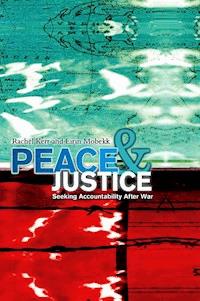
Peace and Justice
Peace and Justice
Seeking Accountability after War
Rachel Kerr and Eirin Mobekk
polity
Copyright © Rachel Kerr and Eirin Mobekk 2007
The right of Rachel Kerr and Eirin Mobekk to be identified as Authors of this Work has been asserted in accordance with the UK Copyright, Designs and Patents Act 1988.
First published in 2007 by Polity Press
Polity Press65 Bridge StreetCambridge CB2 1UR, UK
Polity Press350 Main StreetMalden, MA 02148, USA
All rights reserved. Except for the quotation of short passages for the purpose of criticism and review, no part of this publication may be reproduced, stored in a retrieval system, or transmitted, in any form or by any means, electronic, mechanical, photocopying, recording or otherwise, without the prior permission of the publisher.
ISBN-13: 978-0-7456-5775-2
A catalogue record for this book is available from the British Library.
Typeset in 10.5 on 12 pt Plantinby Servis Filmsetting Ltd, ManchesterPrinted and bound in India by Replika Press PVT Ltd, Kundli, India
The publisher has used its best endeavours to ensure that the URLs for external websites referred to in this book are correct and active at the time of going to press. However, the publisher has no responsibility for the websites and can make no guarantee that a site will remain live or that the content is or will remain appropriate.
Every effort has been made to trace all copyright holders, but if any have been inadvertently overlooked the publishers will be pleased to include any necessary credits in any subsequent reprint or edition.
For further information on Polity, visit our website: www.polity.co.uk
Contents
Acknowledgements
List of Abbreviations
Peace and Justice: An Introduction
Transitional/Post-Conflict Justice
Risks and Dangers
Context, Context and Context
The Book
1 The Nuremberg Legacy
Nuremberg and Tokyo
International Humanitarian Law post-1945
International Criminal Law (ICL)
Human Rights Law
Conclusion
2 Ad hoc International Criminal Tribunals: The ICTY and ICTR
International Judicial Intervention
Establishing a Court and Launching Investigations
Jurisdiction and Procedure
State Cooperation and Judicial Assistance
Justice, Peace and Reconciliation
Conclusion
Box 2.1: The Yugoslav War
Box 2.2: Rwanda
3 The International Criminal Court
Establishing the Court: The Rome Statute
Jurisdiction and Admissibility
Applicable Law
The ‘Essential Paradox’ of Complementarity
The Role of the Prosecutor
The Relationship with the Security Council
The United States and the ICC
International Criminal Justice and International Peace and Security
Engaging the Local Population and Meeting Victims’ Needs
Peace and Justice?
Conclusion
Box 3.1: Situations and cases
Box 3.2: Universal jurisdiction
4 ‘Internationalized’ Courts
A New Breed of Tribunal?
Justice, Peace and Reconciliation
Conclusion
Box 4.1: The Special Court for Sierra Leone
Box 4.2: Regulation Panels in Kosovo
Box 4.3: Special crime panels in Timor-Leste
Box 4.4: ‘Extraordinary chambers’ in Cambodia
5 Domestic Trials
Rights and Obligations in International Law
Judicial Reform: A Primary Hurdle for Domestic Trials
Political and Practical Obstacles to Domestic Trials
Benefits of Domestic Trials
Conclusion
Box 5.1: Rwanda
Box 5.2: The Indonesian ad hoc Human Rights Court
Box 5.3: The Supreme Iraqi Criminal Tribunal
6 Truth Commissions
Definitional Clarity
Design and Resources
‘Truth’ and ‘Reconciliation’
Restorative Justice: Healing and Retraumatization
Additional Benefits and Limitations of Truth Commissions
Conclusion
Box 6.1: The Truth and Reconciliation Commission in the DRC
Box 6.2: The Truth and Reconciliation Commission in South Africa
Box 6.3: The Commission on the Truth for El Salvador
7 Traditional Informal Justice Mechanisms
Conceptual Clarity
The Context of TIJM
Dealing with Past Crimes: Challenges of TIJM
Promoting Reconciliation
Conclusion
Box 7.1: Timor-Leste
Box 7.2: Gacaca courts in Rwanda
Conclusion
Justice, Peace and Reconciliation
Capacity-building and the Rule of Law
Context
Engaging the Local Population
Integrated and Complementary Approaches
Managing Expectations and Setting Realistic Goals
Notes
Selected Bibliography
Index
Acknowledgements
This book has been many years in the making. As with the issues discussed here, it has undergone several different phases and reflects the development of our own thinking on these matters over the past decade. Hence, there are many who have contributed to this book by offering their own reflections and encouraging us to consider additional questions and issues as they arose.
We first started discussing these issues together at a series of graduate conferences organized by King’s College London Department of War Studies under the auspices of the Regional Security in a Global Context Programme, supported by the John D. and Catherine T. Macarthur Foundation. Our ‘Peace and Justice road-show’ went on to perform at a number of other conferences where we jointly and individually presented papers over the years. The feedback from fellow panelists and others at these conferences helped considerably in the development of our thinking. We are also grateful to the War Crimes Research Group at King’s College London and the Africa seminar series for the opportunity to deliberate on the issues discussed in the book with others working in the field, who brought historical, sociological, legal and area studies perspectives to bear. We would like to thank especially Madoka Futamura, James Gow, Claire Gunter, Jessica Lincoln, Tony Millett and Ivan Zverzhanovski as well as students on the ‘Prosecuting War Crimes’ course and others who have contributed by providing feedback and being generally engaged with the work, in particular Funmi Olonisakin, Vesselin Popovski, Jason Ralph and Nathalie Wlodarczyk. Thanks should go also to the Geneva Centre for the Democratic Control of Armed Forces for encouraging discourse and arranging workshops where transitional justice issues were on the agenda, and which have been most useful in the process of writing this book. Any errors or omissions that remain are, of course, our own.
In addition, we would like warmly to thank the British Academy for their support, without which the fieldwork for this book could not have been undertaken. In this connection, the input of Jo Spear and David Held was invaluable. The interviews undertaken during this fieldwork were of critical importance to the research and we would accordingly like to thank all the individuals who gave up their time to speak to us, both those working in the field in the Democratic Republic of Congo, Sierra Leone, Kosovo, East Timor, Haiti and The Hague, and those working out, particularly at the United Nations Headquarters in New York and the International Centre for Transitional Justice. Without their willingness to share their experiences, expertise and insights, this book would have been substantially lacking in substance.
Finally, heartfelt thanks to all at Polity, and especially to Louise Knight and Emma Hutchinson for their enduring patience and tolerance of missed deadlines. And also to our friends and family, especially Rachel’s beautiful daughter Catherine, whose impending arrival hastened the book’s completion by imposing her own non-negotiable deadline!
RK & EM
Abbreviations
AFRC
Armed Forces Revolutionary Council
ATCA
Alien Tort Claims Act
BCS
Bosnian, Croatian, Serbian
CAVR
Commission of Reception, Truth and Reconciliation (Timor-Leste)
CDF
Civil Defence Force
CDR
Coalition for Defence of the Republic
CEC
Cambodian Extraordinary Chambers
CEDAW
Convention on the Elimination of Discrimination against Women
CEH
Historical Clarification Commission (Guatemala)
CNRT
National Council of Timorese Resistance
DJA
Department for Judicial Affairs
DRC
The Democratic Republic of Congo
EU
European Union
FAR
Rwandan Armed Forces
FMLN
Farabundo Marti National Liberation Front
FRY
Federal Republic of Yugoslavia
HRC
Human Rights Court
ICC
International Criminal Court
ICCPR
International Covenant on Civil and Political Rights
ICL
International Criminal Law
ICTs
International Criminal Tribunals
ICTR
International Criminal Tribunals for Rwanda
ICTY
International Criminal Tribunal for the former Yugoslavia
IER
Equity and Reconciliation Commission (Morocco)
IFOR
Implementation Force (Bosnia-Herzegovina)
IHL
International Humanitarian Law
IJPs
International Judges and Prosecutors
ILC
International Law Commission
INTERFET
International Force for Timor-Leste
JEM
Justice and Equality Movement
KFOR
Kosovo Force
KLA
Kosovo Liberation Army
KWEEC
Kosovo War and Ethnic Crimes Court
LMG
Like-Minded Group
LRA
Lord’s Resistance Army
MONUC
UN Mission in Congo
MRND
National Republican Movement for Development
NATO
North Atlantic Treaty Organisation
NGOs
non-governmental organizations
NMOG I
Neutral Military Observer Group
NRC
National Reconciliation Commission, Ghana
OAU
Organization for African Unity
OTP
Office of the Prosecutor
P5
5 permanent members of the Security Council
RPA
Rwandan Patriotic Army
RPF
Rwandan Patriotic Front
RUF
Revolutionary United Front
SCSL
Special Court for Sierra Leone
SFOR
Stabilisation Force (Bosnia-Herzegovina)
SFRY
Socialist Federal Republic of Yugoslavia
SICT
Supreme Iraqi Criminal Tribunal
SLM/A
Sudan Liberation Movement/Army
SRSG
Special Representative of the Secretary-General
TACJPS
Technical Advisory Commission on Judiciary and Prosecution Service
TC
Truth Commission
TIJM
Traditional Informal Justice Mechanisms
TNI
Tentara Nasional Indonesia
TRC
Truth and Reconciliation Commission
UDHR
Universal Declaration of Human Rights
UN
United Nations
UNAMIR
United Nations Assistance Mission for Rwanda
UNDP
United Nations Development Programme
UNMIK
United Nations Mission in Kosovo
UNOMUR
United Nations Observer Mission for Uganda and Rwanda
UNPROFOR
United Nations Protection Force in Bosnia
UNTAES
United Nations Transitional Authority in Eastern Slovenia
UNTAET
United Nations Transitional Administration in Timor-Leste
UNPOL
United Nations Civilian Police
WW1
World War One
WW2
World War Two
Peace and Justice: An Introduction
In the two decades or so since the end of the Cold War, we have witnessed significant changes in the conduct of international relations and contemporary warfare. One important element of change was an increased tendency towards intervention in situations that would hitherto have been deemed to be beyond the purview of an outside entity, and a marked increase in the number and scope of peace operations, in some cases involving the rebuilding of state structures. Together with economic, military and political intervention came an emerging trend of ‘international judicial intervention’ to address serious and widespread abuses of international humanitarian law and human rights.1 Beginning with the establishment of ad hoc international criminal tribunals (ICTs) for the former Yugoslavia and Rwanda (ICTY and ICTR), and culminating in the establishment of a permanent International Criminal Court (ICC), there appeared to be a new normative trend of using international judicial mechanisms to address past crimes in war-torn societies. Each new initiative was welcomed as potentially offering advantages over other approaches, from the ‘shiny new hammer’ of the ICTY to the ‘magic-bullet’ solution offered by universal jurisdiction and the ICC to combat impunity. Meanwhile, scholars and practitioners debated the role of amnesties, truth commissions and traditional informal justice mechanisms in fostering restorative rather than retributive justice in light of the increasing implementation of non-judicial mechanisms for accountability. In the late 1980s and early 1990s, this focused on countries in transition from dictatorship or tyranny to democratic rule, in Latin America (Argentina, Chile, Brazil, Uruguay) and Southern and Eastern Europe (Spain, Greece, Poland, East Germany, Hungary) and, in a different, but critical context, South Africa. More recently, it has been revived in relation to countries emerging from violent conflict, such as Sierra Leone, Liberia, the Democratic Republic of Congo, Timor-Leste, Sudan and Uganda.
In his 2004 report, ‘The rule of law and transitional justice in conflict and post-conflict societies’, the United Nations Secretary-General formally acknowledged that some form of transitional justice mechanism is crucial for societies emerging from violent conflict as the task of addressing past crimes is seen as essential to building sustainable peace.2 Peace, justice and reconciliation go hand in hand, as mutually reinforcing objectives. The link between international peace and security and international criminal justice had already been made explicit with the establishment by the Security Council ten years earlier of the ICTY and then the ICTR – judicial institutions with a mandate to contribute to the restoration and maintenance of peace. Although concerns are still raised in relation to the potentially destabilizing impacts of transitional justice, and about sequencing of peace and justice processes, the debate now has largely shifted from whether to pursue some form of transitional justice, to what form it should take, what the degree of international involvement should be and who should be targeted.
In order to take this debate forward, we need to understand better what the relative merits and drawbacks are to the range of possible mechanisms. The debate needs to move on from a knee-jerk reaction to the perceived failures of the last attempt, so that, rather as generals ought to avoid fighting the last war, those planning for transitional justice ought to avoid the pitfalls of simply correcting the last effort. This could be seen through the 1990s, when frustration at the length and cost of trials at the international criminal tribunals and their remoteness from the affected population prompted a search for better alternatives. To correct the apparent shortcomings of the ICTs, ‘mixed’ or ‘hybrid’ courts have been established, involving domestic and international elements in, for example, Sierra Leone, Cambodia, Timor-Leste and Kosovo. But, although the lessons of what has gone before are extremely valuable, we need to be careful about taking these out of context and wary of a ‘one-size-fits-all’ solution that can be grafted onto any post-conflict situation. Advancing justice, peace and reconciliation in a fragile post-conflict setting requires careful planning and a solid understanding of what might be possible. It is important to consider issues of complementarity between a range of different approaches, and to be realistic in setting expectations. Moreover, whilst there may be a formal acknowledgement of the link between justice and peace as mutually reinforcing rather than mutually incompatible objectives, reconciliation is still frequently described as incompatible with justice, and justice with peace, leading some to argue for a necessary, if unpalatable, trade-off between these three objectives.
Lesen Sie weiter in der vollständigen Ausgabe!
Lesen Sie weiter in der vollständigen Ausgabe!
Lesen Sie weiter in der vollständigen Ausgabe!
Lesen Sie weiter in der vollständigen Ausgabe!
Lesen Sie weiter in der vollständigen Ausgabe!
Lesen Sie weiter in der vollständigen Ausgabe!
Lesen Sie weiter in der vollständigen Ausgabe!
Lesen Sie weiter in der vollständigen Ausgabe!
Lesen Sie weiter in der vollständigen Ausgabe!
Lesen Sie weiter in der vollständigen Ausgabe!
Lesen Sie weiter in der vollständigen Ausgabe!




