


9,99 €
Mehr erfahren.
- Herausgeber: Warren Feld Jewelry
- Kategorie: Geisteswissenschaft
- Sprache: Englisch
PEARL KNOTTING
Doesn’t Need To Be Hard
In this very detailed book, with thoroughly-explained instructions and pictures, you are taught a non-traditional Pearl Knotting technique which is very easy for anyone to learn and do. Does not use special tools. Goes slowly step-by-step. Presents a simple way to tie knots and position the knots to securely abut the bead. Anticipates both appeal and functionality. Shows clearly how to attach your clasp and finish off your cords. And achieves that timeless, architectural perfection we want in our pearl knotted pieces.
Most traditional techniques are very frustrating. These can get overly complicated and awkward. They rely on tools for making and positioning the knots. When attempting to follow traditional techniques, people often find they cannot tie the knots, make good knots, get the knots close enough to the beads, nor centered between them. How to attach the piece to the clasp gets simplified or glossed over.
Fortunately, Pearl Knotting doesn’t need to be this hard.
Pearl Knotting…Warren’s Way teaches you how to:
- Hand-knot without tools
- Select stringing materials
- Begin and finish pieces by (1) attaching directly to the clasp, (2) using French wire bullion, (3), using clam shell bead tips, or, (4) making a continuous piece without a clasp
- Add cord
- Buy pearls, care for them, string and restring them, store them
Das E-Book können Sie in Legimi-Apps oder einer beliebigen App lesen, die das folgende Format unterstützen:
Veröffentlichungsjahr: 2025
Ähnliche



















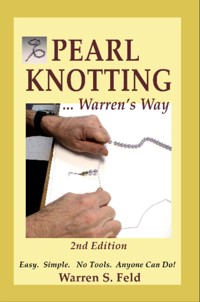
PEARL KNOTTING … Warren’s Way
Easy. Simple. No Tools. Anyone Can Do!
by Warren Feld
Classic Elegance! Timeless! Architectural Perfection!Learn a simple Pearl Knotting technique anyone can do. No special tools. Beautiful. Durable. Wearable.
Warren Feld Jewelry, Publisherwww.warrenfeldjewelry.comColumbia, Tennessee2nd Edition, 2025
PEARL KNOTTING … Warren’s Wayby Warren Feld
Published by Warren Feld Jewelry627C S. James M. Campbell Blvd, #315Columbia, TN 38401www.warrenfeldjewelry.comwww.patreon.com/warrenfeldjewelryCOPYRIGHT © 2025, 2nd Edition, Warren FeldAll rights reserved. This book or parts thereof may not be reproduced in any form, stored in any retrieval system, or transmitted in any form by any means—electronic, mechanical, photocopy, recording, or otherwise—without prior written permission of the publisher, except as provided by United States of America copyright law and fair use. For permission requests, contact: Warren Feld, [email protected], 615-479-3776.Cover by Warren FeldISBN # 979-8-9865354-7-0 Kindle (2nd Edition)ISBN # 979-8-9865354-6-3 E-Book (2nd Edition)ISBN # 979-8-9865354-8-7 Print (2nd Edition)
Disclaimers: This book and its content provided herein are simply for educational purposes. For those aspects of jewelry making and design which require legal or accounting advice, the information provided here is not a substitute for that advice. Every effort has been made to ensure that the content provided in this book is accurate and helpful for my readers. No liability is assumed for losses or damages due to the information provided. You are responsible for your own choices, actions and results.
Library of Congress Control Number: 2024925420 (2nd Edition)
PEARL KNOTTING … Warren’s WayA Simple Technique Anyone Can Do
by Warren Feld
TABLE OF CONTENTS
WHAT YOU WILL LEARN
INTRODUCTION WITH ACKNOWLEDGEMENTS
PEARL KNOTTING IS FOR YOU: An Introduction
MATERIALS, TOOLS AND YOUR WORK SPACESupply List
ALL ABOUT PEARLS3a. Some History3b. About Choosing Beads3c. About Re-Stringing Your Jewelry3d. About Buying3e. About Caring For3f. About Styles and Lengths of Pearl Necklaces
ALL ABOUT HAND-KNOTTING PEARLS 4a. Whether to use a non-traditional or traditional technique4b. Choosing beads4c. Choosing clasps, clasp assemblies and support systems4d. Choosing stringing materials4e. How to tie knots and the function of knots4f. Things about glues and glue-ing4g. What tools, if any, you might use4h. About drilling pearls4i. Selling your pearl knotting skills
DESIGN CONSIDERATIONS5a. Selecting Materials5b. Key, Diagram, Sketch5c. Points of Weakness5d. Visualizing Process5e. Organizing Workspace
MEASUREMENTS
SELECTING AND TESTING BEAD CORD
VARIATIONS IN STARTING/ENDING PIECES
8a. VARIATION #1: ATTACHING DIRECTLY TO THE CLASPSummary of Steps, (#1)Basic Steps, (#1)
8b. VARIATION #2: USING FRENCH WIRE BULLIONSummary of Steps, (#2)Basic Steps, (#2)
8c. VARIATION #3: USING CLAM SHELL BEAD TIPSSummary of Steps, (#3)Basic Steps, (#3)
8d. VARIATION #4: CONTINUOUS PIECE WITHOUT CLASPSummary of Steps, (#4)Basic Steps, (#4)
8e. A NOTE ABOUT ADDING MORE CORDBasic Steps, (Adding Cord)
9. HANDLING CONTINGENCIES
9a. The knots are too small9b. Some areas feel too loose9c. Piece is too short or too long9d. The final glued knot looks bad9e. Your fixed needle on the cord breaks9f. The beads on the strand are not lining up perfectly9g. If you run out of cord…9h. Difficulty getting needles through bead holes
10. FINISHING TOUCHES
FINAL WORDS OF ADVICE
THANK YOU – REQUEST FOR REVIEWS
ABOUT WARREN FELD
OTHER ARTICLES AND TUTORIALS BY WARREN FELD
PEARL KNOTTING … Warren’s WayWhat You Will Learn
PEARL KNOTTING Doesn’t Need To Be Hard
In this very detailed book, with thoroughly-explained instructions and pictures, you are taught a non-traditional Pearl Knotting technique which is very easy for anyone to learn and do. Does not use special tools. Goes slowly step-by-step. Presents a simple way to tie knots and position the knots to securely abut the bead. Anticipates both appeal and functionality. Shows clearly how to attach your clasp and finish off your cords. And achieves that timeless, architectural perfection we want in our pearl knotted pieces.
Most traditional techniques are very frustrating. These can get overly complicated and awkward. They rely on tools for making and positioning the knots. When attempting to follow traditional techniques, people often find they cannot tie the knots, make good knots, get the knots close enough to the beads, nor centered between them. How to attach the piece to the clasp gets simplified or glossed over.
Pearl Knotting doesn’t need to be this hard.
Pearl Knotting…Warren’s Way teaches you how to:
Hand-knot without tools
Select stringing materials
Begin and finish pieces by (1) attaching directly to the clasp, (2) using French wire bullion, (3), using clam shell bead tips, or, (4) making a continuous piece without a clasp
Add cord
Buy pearls, care for them, string and restring them, store them
By the end of this book, you will have mastered hand-knotting pearls.
I know you are eager to begin. Let’s get started.
NOTE: This book is also available as a video tutorial. Click here.
https://so-you-want-to-be-a-jewelry-designer.teachable.com/p/pearl-knotting-warren-s-way
PEARL KNOTTING … Warren’s Way
Intro To Book and Acknowledgements
ACKNOWLEDGEMENTS
For Jayden Alfre JonesJewelry DesignerLife Partner
The Debates
We set up a jewelry design educational program in 2000. A pearl knotting class was part of that curriculum. From the start, we felt that the traditional pearl knotting technique was too difficult for most students to learn. We explored ways of adapting it. But it was a long road until we figured out a better way. That was in 2014.
Along the way, I had three different pearl knotting instructors. Each had their own adaptive version. And each was a disappointment. Their students could not get their knots close enough to the beads. Even each instructor had difficulty with getting consistently well-tied and well-positioned knots.
In 2014, I convened a meeting with two of the instructors and myself. For two hours, they argued with each other about which strategies and steps were best. Which bead cord to use. How to tie a knot. How to get the knot tied closely abutting the bead. Whether to take one cord through the bead or two. Which knots to glue. What glue to use. Where to tie the final knot. Whether to use French wire bullion or clam-shell bead tips or attach the cord directly to the clasp. There was no meeting of the minds. No compromising. No give and take. I cut the meeting short.
I had to figure this out myself. I did some research in books, magazines and online. I found 14 significantly different pearl knotting approaches. I implemented them all and took notes about what I liked and what I didn’t like.
I developed some criteria for evaluation, based on my understanding of both aesthetic as well as architectural goals. Simply, the finished pieces had to look good, function well, and be secure over time. Again, it was important that my students could learn the technique quickly, apply it during class, and easily come back and apply it once they left the class.
There were three core problems that had to be resolved:
Pearl holes are very sharp and can easily shred the stringing material. The technique had to minimize the movement of the pearl up and down between knots, as well as the rotation around the cord.
Glued knots, incorrectly sized knots, and off-centered knots minimize the ability of the knots to adequately respond to stresses and strains on the piece when worn.
Starting and ending a piece – that is attaching to either side of the clasp assembly – is not as straightforward and without complications that you might think. You do not want the clasp assembly to be insecure, look ugly, or compete visually with the pearl knotted piece itself.
The resulting technique and approach which is detailed in this book is what I came up with – Warren’s Way. I chose a technique which does not use tools because I found tools get in the way of tying good and well-positioned knots. I decided to bring two cords through the bead to minimize any negative effects resulting from the pearl rotating around the cord. I only have you glue one knot in the piece. I use a simple overhand knot which is easily centered. I developed a rule for choosing the thickness of your bead cord. I lay out different steps for starting and ending a piece, based on how you want to attach the piece to your clasp assembly.
There are four very simple variations. Each variation has pros and cons. The steps for hand-knotting between beads is the same, no matter the variation.
(a) Attaching bead cord directly to the clasp, (b) Using French wire bullion, (c) Using clam-shell bead tips, and (d) Making a continuous piece without a clasp assembly.
Additionally, I specify a technique for adding in more cord, should you desire a longer piece, or should the cord break while pearl knotting.
Thank You
We organized a community group made up of jewelry making instructors, advanced students, and bead store staff. They were tasked with coming up with a design-focused educational curriculum useful for bead stringing, bead weaving and wire working. The goal was to come up with something that takes the student beyond craft – that is, beyond merely following a set of step-by-step instructions. It was important to educate students on both aesthetic, artistic requirements as well as architectural, functional ones. This group did an excellent job. But our Pearl Knotting class was one of the few areas where adaptation was difficult.
I want to thank the group for their hard and insightful work, but particularly Connie Welch, who spearheaded many ideas and efforts.
My three Pearl Knotting instructors tried their best, and did come up with some good adaptations along the way. These were Reesha Leone, Margerie Miller, and Jayden Jones.
Second Edition
This second edition takes fuller utilization of technical options for the E-book version. Additional information, clarifications and summaries of ideas are added throughout. Instructions for Variation #3: Using Clam Shell Bead Tips is simplified a little bit.
~~~~~~~~~~~~~~~~~~~~~~~~~~~~
Other Books By Warren Feld
https://www.warrenfeldjewelry.com/wfjarticles.htm
So You Want To Be A Jewelry Designer
Becoming a Jewelry Designer is exciting. With each piece, you are challenged with this profound question: Why does some jewelry draw people’s attention, and others do not? Yes there are some craft and art aspects to jewelry making. But when jewelry designers turn to how-to books or art theory texts, however, these do not uncover the necessary answers. They do not show you how to make trade-offs between beauty and function. Nor how to introduce your pieces publicly. You get insufficient practical guidance about knowing when your piece is finished and successful. In short, you do not learn about design. You do not learn the essentials about how to go beyond basic mechanics, anticipate the wearer’s understandings and desires, or gain management control over the process. So You Want To Be A Jewelry Designer reinterprets how to apply techniques and modify art theories from the Jewelry Designer’s perspective. This very detailed book reveals how to become literate and fluent in jewelry design.
The major topics covered include,
Jewelry Beyond Craft: Gaining A Disciplinary Literacy and Fluency in Design
Getting Started
What Is Jewelry, Really?
Materials, Techniques and Technologies
Rules of Composition, Construction and Manipulation
Design Management
Introducing Your Designs Publicly
Developing Those Intuitive Skills Within: Creativity, Inspiration and Aspiration, Passion
Jewelry In Context
Teaching Disciplinary Literacy In Jewelry Design
600pp, many images and diagramsApril, 2022
~~~~~~~~~~~~~~~~~~~~~~~~~~~~
Conquering The Creative Marketplace
Many people learn beadwork and jewelry-making in order to sell the pieces they make. Based both on the creation and development of my own jewelry design business, as well as teaching countless students over the past 35+ years about business and craft, I want to address what should be some of your key concerns and uncertainties. I want to share with you the kinds of things (specifically, a business mindset and confidence) it takes to start your own jewelry business, run it, anticipate risks and rewards, and lead it to a level of success you feel is right for you. I want to help you plan your road map.
I will explore answers to such questions as: How does someone get started marketing and selling their pieces? What business fundamentals need to be brought to the fore? How do you measure risk and return on investment? How does the creative person develop and maintain a passion for business? To what extent should business decisions affect artistic choices? What similar traits to successful jewelry designers do those in business share? How do you protect your intellectual property?
The major topics covered include,
Integrating Business With Design
Getting Started
Financial Management
Product Development, Creating Your Line, and Pricing
Marketing, Promotion, Branding
Selling
Professional Responsibilities and Strategic Planning
Professional Responsibilities and Gallery / Boutique Representation
Professional Responsibilities and Creating Your Necessary Written Documents
548pp, many images and diagrams
April, 2023
~~~~~~~~~~~~~~~~~~~~~~~~~~~~
So You Want To Do Craft Shows
Doing craft shows is a wonderful experience. You can make a lot of money at craft shows, you meet new people, you have new adventures. You learn a lot about business and arts and crafts designing.
IF… you do your homework when selecting them, and verify all information
IF… you are very organized in preparing for them, setting up, selling and re-packing up
IF… you promote, promote, promote.
In this book, I discuss 16 lessons I learned, Including How To...
Find, Evaluate and Select Craft Shows Right for You
Determine a Set of Realistic Goals
Compute a Simple Break-Even Analysis
Develop Your Applications and Apply in the Smartest Ways
Understand How Much Inventory to Bring
Set Up and Present Both Yourself and Your Wares
Best Promote and Operate Your Craft Show Business
198pp, many images and diagrams
July, 2022
~~~~~~~~~~~~~~~~~~~~~~~~~~~~
Basics of Bead Stringning and Attaching Clasps
There is an art and skill to stringing beads. First, of course, is the selection of beads for a design, and the selection of the appropriate stringing material. Then is the selection of a clasp or closure, appropriate to the design and use of the piece.
You want your pieces to be appealing. You want them to wear well. You want someone to wear them or buy them. This means understanding the basic techniques, not only in terms of craft and art, but also with considerations about architecture, mechanics, and some sociology, anthropology and psychology.
In this book, I go into depth about:
Choosing stringing materials, and the pros and cons of each type
Choosing clasps, and the pros and cons of different clasps
All about the different jewelry findings and how you use them
Architectural considerations and how to build these into your pieces
How better designers use cable wires and crimp, as well as, use needle and thread to string beads
How best to make stretchy bracelets
How to make adjustable slip knots, coiled wire loops, and silk wraps
How to finish off the ends of thicker cords or ropes, so that you can attach a clasp
How to construct such projects as eyeglass leashes, mask chains, lariats, multi-strand pieces, twist multi-strand pieces, and memory wire bracelets
How different teaching paradigms – craft vs. art vs. design – might influence the types of choices you make
452 pages, many images and diagramsApril, 2023
Thank you. I hope you found this introduction useful.
Also, check out my website (www.warrenfeldjewelry.com).
Join our jewelry designers’ hub (https://www.patreon.com/warrenfeldjewelry )
Enroll in my jewelry design and business of craft Video Tutorials online. Begin with my ORIENTATION TO BEADS & JEWELRY FINDINGS COURSE.
Follow my articles on Medium.com.
Subscribe to my Learn To Bead blog (https://blog.landofodds.com).
Visit Land of Odds online (https://www.landofodds.com)for all your jewelry making supplies.
Check out my Jewelry Making and Beadwork Kits.
Add your name to my email list.
My ARTIST STATEMENT
My TEACHING STATEMENT.
My DESIGN PHILOSOPHY.
My PROFESSIONAL PROFILE.
My PORTFOLIO.
PEARL KNOTTING … Warren’s Way
1. Pearl Knotting Is For You
Classic Elegance! Timeless! Architectural Perfection!Learn a simple Pearl Knotting technique anyone can do. No special tools. Beautiful. Durable. Wearable.
“Over the years, I have found it very difficult for most students (and even my instructors) to get good knots and good hand-knotted construction using tools. It is difficult to maneuver the knot close to the bead, and it is difficult to keep sufficient tension on your bead cords, as you make the knot. After much trial and experimentation, I developed this set of non-traditional steps. My students usually master this approach on their very first try!” – Warren
There is no need to be intimidated by the idea of hand-knotting between pearls. What is important, however, is not only to learn the basic technique, but also to understand how each design and technical choice leads to a more finished and durable piece, one that will provide pleasure for years and years.
Pearl knotting is a relatively easy technique. There are many variations in how to implement the technique. Here we present the steps for a non-traditional approach to pearl knotting. We feel that, for most people, the traditional approach, without a lot of practice, can be a bit awkward, and result in a less-than-desired functional outcome. The non-traditional approach we present here is easier to achieve a better outcome.
There are 4 different ways for starting and finishing off your pearl-knotted piece. How-to steps for each way are presented.
In this approach, we do NOT use any tools -- like tweezers, awls, or tri-cord knotters -- to make our knots. We do, however, pull two thicknesses of bead cord through each bead, as does the classical version of the traditional methodology. We minimize the use of glue.
What You Will Learn
Buying, caring for, re-stringing and storing your pearls
Discussion of differences between traditional and non-traditional
techniques for knotting pearls
Selecting and testing out bead cords
Discussion about support functions of knots, and some glue-ing considerations (architectural considerations)
Design considerations when beginning a hand-knotted piece of jewelry
Measurement considerations
Attaching cord directly to a clasp
Making knots between pearls
Using French Wire Bullion
Using bead tips (knot covers)
Making pearl knotted necklace without a clasp(continuous piece)
Adding more cord to make longer necklaces
The instructions take you step-by-step to make a 16-18” hand-knotted pearl necklace. This necklace should take about 2-3 hours to complete.
Four Variations
Simple How-To instructions are detailed, with diagrams and images, for the following four pearl knotting variations. Each variation has some pros and cons, and these are discussed.
1. Selecting and Testing Bead Cord
2. Variation #1: Attaching Clasp Directly to Beginning and Ending of Necklace
(most difficult, but uses more techniques involved; when I teach pearl knotting, I usually teach with this variation)
3. Variation #2: Using French Wire Bullion
(easiest, but the bullion darkens and gets dirty over time)
4. Variation #3: Using Clam Shell Bead Tips (aka, Knot Covers) [Only useful is cord thickness is Size 8 (Griffin line) .80mm (.032") or thinner; otherwise knots will be too big to fit within the closed clam shell]
(most flexible, and what I use most of the time; the full clasp assembly, though, is not the most attractive)
5. Variation #4: Making A Pearl Knotted Necklace Without A Clasp (Continuous)
(difficult)
6. A NOTE ABOUT ADDING MORE CORD
The Design Perspective
These Instructions are written from what is called The Design Perspective.




