


23,99 €
Mehr erfahren.
- Herausgeber: The History Press
- Kategorie: Geisteswissenschaft
- Sprache: Englisch
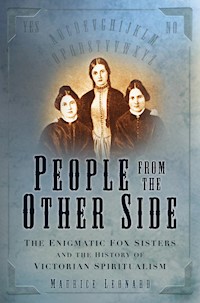
Kate, Leah and Margaret Fox were three young sisters living in upstate New York in the middle of the nineteenth century who discovered an apparent ability to communicate with spirits. When this became known, they quickly found themselves at the core of an emerging spiritualist movement, and their public seances in New York City were attended by many. the movement gained considerable popularity, although Margaret would later admit to producing rapping noises by cracking her toe joints and both she and Kate eventually died in poverty. Spiritualism nonetheless became something of a Victorian phenomenon, both in America and Britain, with figures such as James Fenimore Cooper and Arthur Conan Doyle amongst its adherents. Maurice Leonard's account of the lives of the Foxes is a fascinating and informative look at the birth and early days of spiritualism, a belief that remains popular to this day.
Das E-Book können Sie in Legimi-Apps oder einer beliebigen App lesen, die das folgende Format unterstützen:
Veröffentlichungsjahr: 2011
Ähnliche



















THE ENIGMATIC FOX SISTERS
AND THE HISTORY OF
VICTORIAN SPIRITUALISM
First published 2008
The History Press The Mill, Brimscombe Port Stroud, Gloucestershire, GL5 2QGwww.thehistorypress.co.uk
This ebook edition first published in 2011
All rights reserved © Maurice Leonard, 2008, 2011
The right of Maurice Leonard, to be identified as the Author of this work has been asserted in accordance with the Copyrights, Designs and Patents Act 1988.
This ebook is copyright material and must not be copied, reproduced, transferred, distributed, leased, licensed or publicly performed or used in any way except as specifically permitted in writing by the publishers, as allowed under the terms and conditions under which it was purchased or as strictly permitted by applicable copyright law. Any unauthorised distribution or use of this text may be a direct infringement of the author’s and publisher’s rights, and those responsible may be liable in law accordingly.
EPUB ISBN 978 0 7524 7238 6MOBI ISBN 978 0 7524 7237 9
Original typesetting by The History Press
CONTENTS
Acknowledgements
Introduction
Chapter 1
Chapter 2
Chapter 3
Chapter 4
Chapter 5
Chapter 6
Chapter 7
Chapter 8
Chapter 9
Epilogue
Notes
Bibliography
ACKNOWLEDGEMENTS
Thanks are due to many sources and people; without co-operation no biographical work would ever get written. Research, of course, started with the Fox sisters themselves who, between them, wrote quite a bit about their lives and opinions. Since I began this book, two other biographies have been published: Talking to the Dead by Barbara Weisberg, which concentrates on Kate and Maggie, and The Reluctant Spiritualist, a life of Maggie by Nancy Rubin Stuart.
I have tried to acknowledge help I received in the relevant pages, but among those due special thanks are: Nellie and Tony Liddell; Christina Hatt; Kevin Hubbard; Alan Woodhouse; Sarah Warre; Richard Wiseman, Professor of the Public Understanding of Psychology at the University of Hertfordshire; Peter Katin; John Lill; Earle E. Spamer of the American Philosophical Society; The Leslie Flint Educational Trust; The Theosophical Society; websites of the Elisha Kent Kane Historical Society; the Literary Network website; survivalafterdeath.org; all those colourful mediums who so enriched my youth; and, most particularly, the willing and able help of the magnificent British Library: so many exotic secrets buried in its archives.
INTRODUCTION
My early childhood was spent propped up on cushions, on a chair, sitting round a table in a room full of women, each of whom had one finger on an upturned glass frantically trying to hold on to it as it whizzed around, spelling out messages from letters cut out of newspapers, or else handwritten, which had been placed around the edge of the table.
The sound of the Cossor radio, buzzing away in the background, was often drowned by the noise of the glass, as it skidded over the wood before jerking to rest in front of whatever letter it wanted. Someone had a pencil and paper and would jot down the letter, then the glass would whiz off again until a message was written.
This was a normal evening during those blitz-ridden nights in London’s war-scarred Tooting Broadway.
There was not much else to do. All places of entertainment were closed, due to the fear of air raids. Not that there were many places of entertainment to close, apart from the cinema.
As with Mrs Gaskell’s Cranford, Tooting Broadway was a society ‘in possession of the Amazons’; that is, there were no men about, just kids and old-timers. All able-bodied men were away defending us against the Nazis.
We could make our homes cosy, but outside it was pretty unwelcoming. Unless there was a moon, it was Stygian gloom; there were no streetlights, or lights from windows, due to black-out restrictions, and there was virtually no traffic. It was not a neighbourhood where many possessed cars, and with the majority of drivers being men, they were all away anyway.
What few cars did venture into the neighbourhood, and I seem to remember a battered Austin Seven with a discoloured windscreen that caused great excitement, had to crawl along with dim pin-point lights so as not to be visible to enemy planes overhead.
If people were walking at night – visiting relatives usually, as there was nowhere else to go – and bumped into each other (literally, as they couldn’t see), they linked arms to avoid smashing into lamp posts – my grandmother suffered a bleeding nose through this – or twisting ankles by stumbling down kerbs. If the moon came out that was a bonus. God was on our side.
There was a great deal of laughter, and sometimes we’d sing songs as we blundered about in the dark, unable to see street names.
Enemy planes used to liven the place up as, when they approached, there would be dog-fights as they were repelled by our fighters, the sky lacerated with searchlights which appeared by magic. Spotlit, the two planes would fight to the death, the battle heralded by the ululating sirens. If a Nazi plane was shot down, plunging to the earth in a ball of fire, we cheered. If a British plane caught it, that was a terrible sadness; another brave man gone, another barrier less between Nazi domination and us.
People were killed all the time. Those at home never knew if their loved ones, who were at war, were dead or alive. We never knew if we’d survive the night. Only the spirits knew these things, but they would tell us.
It’s not surprising that séances were popular. They were as routine as being woken up, under the protection of the cage-like, indoor Morrison shelter, by the crash of the plywood which had been nailed to the window frames in lieu of glass, as it was smashed against the wall opposite by bomb blasts. The glass had gone ages ago and there was none on sale to replace it, not that anyone would have bought it if there had been. That would have been a waste of time and, worse, a waste of money.
Spirits were a part of our lives, invariably friends, and we contacted them daily. We were warned by them that dark forces existed, that there were ‘possessions’ out there, lost souls killed in the mayhem who didn’t know they were dead, and that there were also evil and frightened entities waiting to pounce on the unprotected (us) and live vicariously through us. But, providing we said prayers before the séances and ensured our guides were guarding us, then we would be safe. And for those who weren’t safe, all was not lost, for there were ‘rescue’ mediums about, those who specialised in releasing possessions and putting them on the path to redemption. These ‘rescue’ circles could be pretty scary, with mediums threshing about and moaning before their guides achieved control of the possession. Only the strongest sitters joined forces with the ‘possession’ mediums, to help them in their Godly work.
My mother heard voices. Not all the time and not often, but when they came they were always accurate, although not always welcome. Once, my Aunt Ethel brought round for us to see a stray puppy she’d adopted. Homes were bombed all the time so there were plenty of lost, traumatised pets roaming the sites. You could hear the dogs whimpering at night, but seldom cats – they were too self-sufficient for that. Everyone in Tooting seemed to love animals and no matter how mean the rations, or short the money, there was always enough to scrape together some scraps to feed a dog and cat.
We all hugged the puppy but mother told me, after my aunt had left with the tail-wagger, that she’d gone cold when she held it. The voices had come: ‘He won’t live,’ something horrid had whispered in her ear. The poor thing was soon run over by a 94 bus.
One of my grandmothers had died during the war and she and my mother had had words before she went. Upsets were not unusual and had that quarrel been put right another would undoubtedly have taken its place, but my mother was sad. At one of the table sessions the whizzing glass spelled out, ‘I understand … Mother.’ With that it turned on us all, knocked every letter off the table and refused to move again for the night. Always the spirits were capricious.
My Aunt Win was a medium, a tubby (but not jolly, rather sour if anything) lady who had never been young, with wiry auburn curls – her best feature everyone said – little piggy green eyes behind specs and an unkind tongue. She had been pushed out of her home at fourteen, as there was no place for her to sleep when her brothers came along, and was sent ‘into service’, starting off as a scullery maid and becoming a cook for a rich household.
She was well treated and enjoyed the camaraderie. But the war changed the circumstances of many. There was a great levelling of society; when peace came few houses could afford staff and Win lost her job. She became a school cook instead which, somehow, did not have the same cachet, even though she could sometimes nobble a bit of extra margarine or the like, which made her a useful contact.
She had never met a man who could love her. She had never ‘known’ a man in her lonely life: the archetypal Old Maid. This, coupled with her plain face, thick ankles attached to little feet always jammed into low-heeled court shoes, high blood pressure and a dodgy heart, gave her – understandably – a grudge against the world. She hated most people, but loved me. It was reciprocal: I adored her far more than my parents, and spent hours sitting with her. The spirits were her best friends.
She rented two rooms at the top of a house from a nice old drunk called Mrs Anstey. However hard-up Aunt Win was, she always seemed to have a good fire blazing away, its smoke adding to the smog that hung over London in the winter. It was quite smoky inside, too, as she was a devotee of Capstan Full Strength, and puffed away most of the time, whether delivering spirit messages or not. Her top lip was permanently stained with nicotine.
During the war, word had got round that Aunt Win was a medium and, at times, when we were sitting by her fire, there would be a knock at the front door. Mrs Anstey would open it and footsteps would plod up the stairs towards us. It would be a woman – it had to be, there were no men – sometimes young and sometimes not, driven mad with worry about her man. Would Win give her a sitting? Money never changed hands for this but sometimes an inducement might be brought, a skinned rabbit in those food-scarce times or, perhaps, a piece of cheese. Whatever.
Not that Win ever wanted anything; in truth, she did not want to give the reading, as it was a terrible responsibility. I would sit on my chair at the table while the tears flowed from the recipient as Win brought the spirits through and delivered messages.
By the time I was at school the war had ended. I was given an embossed V for Victory teaspoon to mark the occasion, which I slung away, now to my regret, as it would be worth a fortune.
Blackouts had been taken down and light poured from windows, streetlights were lit, the cinema opened and we were allowed a quarter of a pound of sweets a week, on the ration book, of course, but none of that stopped the spirits calling at Aunt Win’s.
There were no improvised planchette boards there, she was above that. She and I communicated with the spirits mind to mind; or, rather, she did, I listened. Sometimes, of course, they read my mind. While other lads were out booting balls across streets and pillaging bombed-out houses, of which there were many (and I did my share of that, too), I sat with Aunt Win and the spirits. It was fun, they’d tell me what I’d done at school, who I’d met and, on occasion, even what I had in my pockets. Sometimes Aunt Win had a few colleagues round from the Spiritualist church; she felt a tepid warmth for fellow Spiritualists. They were all elderly, or seemed so to me, and this impressionable child would sit among them as the spirits chatted with us, through them. I’d be wide-eyed at all the things they knew.
It was much later, when I was at work and had graduated to sitting in circles with other mediums, that I heard of the Fox sisters. I was told about them by Madame Yolande, a professional and exceptionally accurate palmist, who had a pitch on a seaside pier (I’ve forgotten which one) during the season and sat with us in the winter.
Madame Yolande told me that Spiritualism had started in America in the nineteenth century, not in the Hollywood of film magazines, but in a remote country village, when two young girls, Kate and Maggie Fox, had heard inexplicable knockings in the night. Eventually, these knocks had been recognised as spirit raps. It was the Great Breakthrough and we, us sitters, were only doing what we did as a result of the pioneering Fox sisters. I was fascinated by them.
Florrie Gooch was the medium of a circle in Streatham in which I sat for years. Florrie was hoping for the Direct Voice that she had been promised, by Spirit, would come. Alas, it never did. Her great hero was Leslie Flint, probably the most famous Direct Voice medium in the world; our whole circle would troop on the bus to his Paddington home for an advisory séance once a year. It was a grand occasion.
Whereas Aunt Win hated everybody, Florrie’s hatred centred on men. She had been married, but that had turned out wrong, which was why she hated all men.
Her séances followed a pattern. We sat in black silence for an hour or so, harmonious thoughts concentrated on Florrie who sat in her ‘cabinet’, a curtained-off corner of her bedroom. She was quite grotesque looking really, scrawny, with a distended stomach, and years before someone had made the grave error of telling her she had lovely hair. It was now a nasty urine yellow streaked with grey, which she wore unbecomingly long for her age.
Such impressions, however, are retrospective. I did not allow them to enter my head at the time. And, in order to encourage harmonious vibrations, and thus attract the right sort of spirit rather than the wrong, I used to try to envisage Florrie, during the séances, in the midst of a golden cornfield, wearing a halo of scarlet poppies, Bambis playing nearby. Like something from Fantasia. We’d sing a song if things got a bit heavy; nothing sacred, just a pretty tune or two.
Now and then a visiting medium would join us; no one famous, just someone known locally. I nearly shot out of my chair one evening when I was sitting with Florrie, envisaging the Bambis and poppies, when Betty, a visitor, suddenly yelped out, extremely loudly, a tuneless rendition of The Roses Round the Door, Make Me Love Mother More. The shock nearly gave me a stroke; it was horrible. ‘That’ll liven things up,’ said Betty. It did the reverse, it killed the evening stone dead. If any sensible spirits had been around they’d have shot for cover. As much as their capriciousness, spirits are also noted for their love of fine music. Betty’s was not fine music and try as I might I could find little that was spiritual in the lyrics. It certainly wouldn’t attract me if I were dead: quite the reverse, I’d have gone somewhere else.
The highlight of the circle came at the end. We would be addressed by one or, on special occasions two, of Florrie’s three principal guides. These were an Indian (as in Native American) chief, as popular in the 1950s as they had been in the times of the Foxes, called Red Feather, who shattered the room with his guttural bass, a sort of pretend Oxbridge fractured by an indefinable accent; a frail nun who’d had a terrible tragedy somewhere in her earthly past but never directly referred to it; and the inevitable spirit child, Wong. He was for light relief and we always screamed with laughter when he announced his presence, albeit he wasn’t all that funny. But he tried.
At least twice a week, my girlfriend Iris and I, with a few lady Spiritualists, attended either Balham Spiritualist church or Tooting Bec. Poor Iris wasn’t really interested but I was, so she had to come, that was the deal. She had to sit in the circle, too. Small wonder she married someone else.
Balham church had a stained-glass window that faced the setting sun. I remember the sun streaming through that lovely window; it seemed so appropriate for the higher teachings we were receiving. For all spirit communications were higher teachings. They lived on an elevated plane so naturally they were more highly evolved than us.
Each week there were visiting mediums who, through their psychic ability, would prove there was no death. Not that anyone doubted it. We were all believers. Most of the mediums were pretty good clairvoyants. There was Florrie Something-or-other, who wore her hair plaited earphone style and who suffered from indigestion. She sometimes burped when relaying messages, and when this happened would put her hand over her tummy and apologise, ‘Sausages.’
My favourite was Ivy Scott, a plump lady, still good-looking, firmly against book reading (she couldn’t read much herself) who had been on the stage and had a gorgeous soprano voice. She would sing the hymns beautifully, her eyebrows lifting as she took her petal-soft high notes.
Her guide was summoned by Hushed Was the Evening Hymn. Unless this was sung he did not come through—sensible spirit, it was delightful. Mrs Scott did it full justice, her sweet voice bringing to life the meltingly beautiful melody to which the inspired words of James Drummond Burns are set. Life had few pleasures to vie with that performance, with the stained-glass window as its backdrop. No wonder her guide delivered such convincing service.
I had a private sitting with her once. Her opening words were, ‘Who was Arthur? Shot down in an aircraft?’ My uncle Arthur had been a rear-gunner in a plane and had been shot down in the war. I did not know that at the time and only found out when my mother, his sister, told me later, when I told her about Ivy’s sitting. So how did she know that? A lucky guess? Very lucky to get the right name, right occupation and right manner of death in one sentence. I don’t think so.
There were blatant frauds, of course, such as a South African lady who wandered around the hall accompanied by electronic-sounding squeaks. We were informed this was her guide’s direct voice. It sounded more like something operated by a battery to me. Whatever it was it was gobbledegook.
There was another one, a ghastly Scottish chap, who announced on one occasion that he had a message in Hebrew for the recipient. He could not speak Hebrew but would repeat what his communicator was saying. He intoned the single word shalom. Equivalent to someone saying they couldn’t speak French, but would a Frenchman understand oui. There were a few embarrassed faces and a stifled giggle or two. Who did he think he was kidding? To the recipient’s credit she sat there straight-faced and dignified and murmured ‘Thank you’.
Divine healing was popular, particularly among the healers. They would positively tout for customers. I’m sure many gave relief to their patients but there was a dreadful old scoundrel called Mr Scholes, tiny with a bald head with a cyst on top like a nipple—I wonder he didn’t get someone to heal that for him.
He was particularly keen on healing the chests of several of the well-upholstered ladies of the congregation. Much to his annoyance he had to do this in company, in the midst of the circle, while we sitters sat around him to strengthen the power.
On high days and holidays there was the Spiritualist Association of Great Britain, housed at 33 Belgrave Square, the heart of embassy land.
This was a much grander affair altogether. The building was, and is, elegant, a pleasure from outside and a joy to walk into. Someone told me the lease was bought in 1955 for £24,500. You couldn’t get a parking space for that now.
In those days, if you arrived a bit early, there was a lovely little café on the premises where tea and home-made cakes were served by a mumsy lady in a sunny room that overlooked the small garden.
Then, as you entered the public demonstration room, a dear old queen, with an amethyst on her pinkie, would be gently stroking out I’ll Walk Beside You from the organ keys, or a similarly delightful tune. You could sit and meditate before the service, and ignore the occasional bickering of the women if someone had taken their favourite seat. It would all settle down eventually; after all, they were there for the higher teachings.
These were lively, fun and, occasionally, inspiring times. Times when you could leave a demonstration pondering on what you’d heard. The pondering might still happen now, but those halcyon days have gone, of course, and with them some of their magic. Or is it just youth that’s gone? Nowadays things seem more Spartan, more practical. There seems to be less daring, less controversy in the air, and that’s a shame. For Spiritualism was born of controversy; its pioneers were nothing if not controversial.
Albert Einstein wrote, ‘The most beautiful thing to be felt by man is the mysterious side of life;’ Raymond Chandler, ‘Show me a man or woman who cannot stand mysteries and I will show you a fool;’ and Quentin Crisp, ‘Is not the whole world a vast house of assignation to which the filing system has been lost?’
Spiritualism may not have deciphered the filing system but it spends time and effort trying.
This book concentrates on those heady days of the beginning of Spiritualism and also offers an insight into twentieth-and twentyfirst-century Spiritualism, for it is a movement that is still world-wide and thriving. It centres on the Fox sisters who, of course, are Spiritualism, but also the many peripheral figures, including the magnificent and extraordinary Madame Blavatsky, who peopled those early séance rooms and brought their own particular colour and gifts to the scene.
And what exactly was the significance of those happenings on that magical, mystical night in bleak New York State on the 31 March 1848?
1
‘Her life a beautiful memory’
‘His absence a silent grief’
‘Remember! and wait for me.’
Can the dead read their epitaphs? Do they watch us weeping over their graves? Can they guide us?
Ghosts have always been with us; their appearances random and fleeting – sometimes comforting, often alarming. Perhaps they glimpse us in the same way?
The first time in modern history that a ghost seems to have succeeded in making an organised breakthrough was in the March of 1848. This was no spirit scientist, no manifestation of Isaac Newton or Galileo come to enlighten humanity, but an uneducated pedlar called Charles Rosna, who claimed he had had his throat slit for his money, his gushing blood collected in a kitchen basin which was then, with his body, chucked into a cellar.
His motive was revenge and his instruments of communication two adolescent farm girls – Kate and Maggie Fox.
March can be a vicious month upstate New York, and it was particularly so in 1848, when much of the land was undeveloped and a frozen wind whipped across the desolate plains. Yet the worst of the winter was over with, sometimes, even a taste of spring in the air, but as soon as this appeared it was quickly soured by the constant and pelting icy rain. Where the ground wasn’t still frozen solid it had deteriorated into a sucking marshland. What houses there were clustered together for warmth.
In the hamlet of Hydesville, where Kate and Maggie lived, the only heat and light came from open fires, candles and oil lamps. At night the wind gathered strength and tore through the loose-fitting doors and window frames, making them rattle like dancing skeletons, and the candles flicker eerily.
Outside the darkness was unbroken apart from the sporadic moon-light, which silverly lit the barren landscape when the clouds were blown away for a few seconds. Then the darkness returned, and the pelting rain, reaching into the sodden infinity.
It was easy to believe that the dead walked those lonely moors and many believed they did.
Gathered round the fire in the evenings, Kate and Maggie would listen to their mother’s ghost stories, clutching each other in ecstatic fear. It all seemed very real – too real, sometimes.
Margaret Fox, devoted and good mother that she was, believed in ghosts and had no quibbles about letting her daughters know this. She needed someone sympathetic to talk to and got nowhere on this subject with her wiry, dour husband, John. He didn’t want to know. An alcoholic, off the booze at the time, John didn’t want to know about much.
A blacksmith, they’d married when they were both sixteen, but after four children he left her for a decade or so while he plied his trade, and whatever else he could, on the Erie Canal.
This was not as callous as it sounds. Although four children did not make for a particularly big family then, they still had to be provided for. The canal offered enormous financial opportunities.
Opened in 1825, its construction was the greatest engineering feat of its day. With a length of 363 miles, it stretched from Albany to Buffalo, and contained 83 locks and 18 aqueducts. It was built mostly by man and horse or mule power, the animals towing the laden barges along its length. It brought thousands of settlers. The land was rich and the mobility offered by the canal – roads were built just to get to it – transformed New York into the most important commercial city in America. It also offered great opportunities for a blacksmith.
America was developing fast. Railways were being built and swamps cleared. Tree felling was taking place and forests larger than Ireland, from where many of the immigrant workers came, were cleared. Ireland itself was in the midst of one of its several tragedies, a potato blight was causing famine and widespread emigration to America.
The Fox marriage was not a match made in heaven. John had finished with his life of wine, women and gambling but this was not through any strong paternal urge to be with his family. Having been on the road as a blacksmith for a decade or so, he was getting too old for his peripatetic existence and felt the need for home comforts: a warm bed and regular cooked meals.
Giving up booze had strengthened his religion, which had clearly lapsed during his canal work. Both he and Margaret were Methodists and Methodists are staunchly against the abuse of alcohol. It was with born-again religious fervour that he resumed his position as nominal family head, sired Maggie and Kate, and looked forward to the cosiness of an abstemious home life. He didn’t find it: instead of enjoining his new young family to an existence of blameless Godliness, they were to plunge him into a maelstrom of blasphemous controversy.
Kate and Maggie were both born in Consecon, Canada, Margaret’s homeland just across the border from New York. Margaret was from Franco-Dutch stock and John had German roots – the family name had originally been Voss. Kate, or Catherine, their youngest, was born on 27 March 1837 and Maggie, or Margaretta, 7 October 1833. After the birth of the children they moved to Rochester, New York, then on to Hydesville.
Their cottage at Hydesville was only ever meant as a standby. Margaret’s family were comfortably off, which was as well for they had helped support her during John’s prolonged absence, when payments from him had been irregular. John was now building a new house for the family near the village smithy, where he would work, but in the December of 1847 – when bad weather forced him to stop – he’d taken the cottage as a stopgap. Kate was nearly 11 by now and Maggie getting on for 15, virtually a young lady.
The elder four Fox children, adults now, had long since set up their own homes. Ann Leah, who preferred to be known as Leah, was in her 30s, born 8 April 1813. A natural musician with a good singing voice, she earned her living by teaching children piano and singing and lived with her only child, her teenage daughter Lizzie, in the up-and-coming town of Rochester about twenty-five miles away.
Leah claimed to have been married to a Mr Bowman Fish at the age of 14 and, indeed, was known as Mrs Fish to the local community. Whether they were legally married or just lived together is uncertain, and no one in their orbit would have been overly perturbed either way providing they adhered to the outward proprieties. Mr Fish abandoned Leah soon after Lizzie was born, which made life financially hard but did not trouble her too much emotionally. Apart from the money she felt better off without him. Leah was an excellent manager and quite capable of bringing up her child alone, and 14 had been an early age to commit to a life-long union.
Perhaps Lizzie’s birth was the reason for her husband’s departure. Or perhaps the fact that Lizzie was their only child indicated other problems, for they were together a few years, certainly long enough to have had other children. Leah was fond of children, maternal by nature, and the sort to have as many as possible. She welcomed visits from her nieces and nephews and clearly enjoyed their company. The only child she seemed to have had reservations about was her own daughter, Lizzie. Perhaps she blamed Lizzie for the breakdown in her relationship? She brought back too many unwelcome memories.
Margaret, John, Kate and Maggie had stayed with Leah and Lizzie for a while when first moving to New York. She had enjoyed their company and missed them when they left. As life was to prove, Leah was fiercely ambitious, and there were times when the calm respectability of her music-teaching life, fell well short of fulfillment. She felt her resources were not being tapped. Surely life had more to offer? The Foxes had another two daughters, both married. Elizabeth lived in Canada and Maria nearby, married to her cousin. Marriage to relatives was not uncommon. They were not to play an important role in either Kate or Maggie’s lives.
The only son, David, in his late 20s, was a big, bluff and popular man, married with three children. He lived close to Hydesville, one of the reasons the Foxes had moved there. He had put them up before they had moved into the cottage. He was a successful peppermint farmer with a large homestead. In the season the pungent smell of his plants permeated the atmosphere and their pink flowers could be seen for miles. It was a peaceful place, and in times of crisis family members converged there. With the good-hearted, down-to-earth David in charge, it seemed a secure haven.
John found it difficult to take over the reins of his new family. He’d been away too long to assert authority. Margaret had run things on her own for over a decade and did not intend to alter her ways now. Although a God-fearing Methodist she had a distinct respect for, and belief in, the supernatural. Her grandmother, so she would tell, had been blessed with foresight, being able to decipher omens, and was uncomfortably accurate in predicting deaths. This clearly ran in the family as grandmother had had a sister who had successfully predicted her own death date. This was common talk in the house.
It wasn’t until 29 March 1848 that the family was disrupted by noises at night. The days were still short then, and the whole family retired soon after dark. These noises were not the normal nocturnal scuffles of wild animals, nor the sighs of a house cooling down, but distinct knocks as though someone were trying deliberately to attract attention.1 The cottage was two stories high, a single large room above four rooms below, comprising of a sitting room, two bedrooms and a kitchen. A pantry in the kitchen opened onto steps leading down to a cellar. Margaret and John occupied one bedroom and the girls the other. The noises were coming from the girls’ room.
These sounds were not terrible in themselves and not particularly loud, but it was their manifestation in the dead of night that made them so frightening. They were loud enough to wake John and Margaret who lit a candle and went to the girls’ room to investigate. The noises continued while they were there, seeming to centre on the girls’ bed. There seemed to be two types of knocks: distinct clicks and a heavier, thudding sound. The latter seemed to make the floor vibrate.
John looked through the other rooms but there was nothing unusual there. The sounds were certainly coming from the vicinity of the girls. All four looked at each other in silence. The girls were so frightened they refused to sleep alone so their bed was moved into their parents’ room. But the sounds continued there. John prayed and Margaret wrung her hands but the noises did not stop. Eventually, with great difficulty, the family drifted into troubled sleep.
As dawn lit the house and the countryside, things didn’t seem so terrible. Margaret half-heartedly suggested it might have been neighbours playing a trick on them or, perhaps, even the nearby cobbler working late. Even as she spoke she knew this was nonsense. Why would their practical, hard-working neighbours do such a stupid thing as make jokey noises in the dead of night? And the cobbler? He’d never kept such hours before. But it was something to cling to.
That evening before sunset, as they settled round the blazing fire, the talk returned to the raps, which they’d been thinking about all day anyway. Margaret, with her superstitious nature, was certainly not going to let it drop. The children were nervous but excited. Would the sounds come again?
They could hardly miss them.
Loud knocks, even more insistent than those of the previous night, started as soon as they went to bed. The girls were still in their parents’ room. This time they seemed to come from all round, on the furniture, floor and even the door. Then footsteps were heard, heading to the pantry and, seemingly, continuing down the stairs to the cellar. Margaret wrote in her statement a few days later, ‘I then concluded that the house must be haunted by some unhappy restless spirit.’ She thought it was her dead, psychic grandmother. John agreed with his wife’s statement and added, ‘I do not know of any way to account for those noises, as being caused by any natural means.’
The raps came to a head the next night, Friday 31 March 1848, the date when the new religion of Spiritualism was officially born. It seemed the Gods had something fanciful in mind for the weather had worsened during the day and a downfall of sleet was being pelted by an angry wind against the cottage. It was no weather to be out in. But David called and was upset by the nigh hysterical state of his mother. She told him of the two frightening nights the family had endured. Knowing her fanciful disposition he didn’t take it too seriously but comforted her, saying there was probably a natural reason for it all. Odd things happened in the country at night.
This could not continue. Margaret decided that whatever happened that night, even if the raps caused the roof to fall in, they would not rise from their beds. She was determined they would all get some sleep. She was, after all, a mother.
Her resolution was dashed as soon as night fell. With the exception of John, who was sitting up on guard, they all went to bed early, before nightfall in fact, to try to make up for all the sleep they had lost. The raps started at once. Whatever was causing them seemed annoyed at being ignored and was determined to be noticed. They were more insistent, more regular, and unrelenting.
Margaret moaned while the girls huddled together in bed. John checked the window frames to make sure no draught could be causing the noises, there were loose planks outside – he knew no wind could produce such a rhythmic pattern, but with a terrified wife and two young daughters, he was desperate. He had to do something.
The children seemed less afraid now, it was almost as if they had formed some rapport with the sounds; as though the noises had got through to them. To Margaret’s horror, Kate had got up and was standing by her bed, listening.
Now, in addition to the knocks there was also the sound of muffled laughter but this had no supernatural source. Torn between fear and exhaustion the youngsters had a fit of hysterical giggles. This was to be a pattern throughout Kate’s life. Often, when phenomena was at its height she would nervously giggle.
‘Mr Splitfoot, do as I do!’
Margaret jumped out of her skin. The voice seemed to come from the depth of a tomb — but it was no spirit speaking, it was Kate. A single candle lit the bedroom and the words cut through the shadows.
‘Mr Splitfoot’ was a colloquial name for the devil. On a night such as this, with the wind howling and the spirits knocking, the last thing Margaret wanted was for the devil to be called up. She watched aghast as Kate clapped three times. Was her daughter possessed? She was even more aghast when three raps echoed the rhythm of the claps. In the silence that followed all that could be heard was the howling wind. Then Maggie spoke.
‘Now, do just as I do,’ she said slowly, in a similarly deep voice to the one Kate had used. ‘Count one, two, three, four.’ She clapped her hands four times. Four raps followed, again in the same rhythm. The girls suddenly seemed to realise what was happening and grew frightened. There was silence for a while. All sorts of fears crashed through Margaret’s mind. Was a Satanic spirit in the room with her two virgin daughters? It was too ghastly to contemplate.
‘Oh, mother, I know what it is,’ Kate said weakly. ‘Tomorrow is April Fool day, and it’s somebody trying to fool us.’
Margaret seized on that as a life belt. That’s what it was, of course, an April Fool’s prank. But who was playing it? She dismissed the idea even as it entered her head. It was impossible for anyone to have entered the house unknown and make these noises. She now took command and devised a test to determine if it was a neighbour or not. Although she could not bring herself to address the spirit as Mr Splitfoot, for she was convinced it was a spirit, she nervously spoke to it.
‘Can you rap out the different ages of my children,’ she asked. None of the neighbours, to her knowledge, knew their exact ages. Mr Splitfoot seemed to.
He rapped out correctly the ages of her six children and then, after a pause, gave three more raps. Margaret had actually had seven children but one, a girl, had died at the age of three, long before the births of Kate and Maggie. Margaret was sure this was information none of the neighbours knew. She wasn’t even sure that Kate and Maggie knew.
‘Is this a human being that answers my questions so correctly?’ she asked nervously.
Silence.
‘Is it a spirit? If it is, make two raps.’ Two distinct raps.
‘Is it an injured spirit?’
Two loud raps. In her statement she says that these raps made the house tremble. Gathering courage, she asked:
‘Were you hurt in this house?’ Two raps.
‘Is this person living that injured you?’ Again two loud raps.
Margaret carried on with the questions and the spirit divulged the grisly information that he had been a man of 31, and had been murdered in the house and his body dumped in the cellar. Margaret thought of the footsteps she had heard the previous night going down to the cellar. It was harrowing.
‘Will you continue to rap if I call my neighbours that they may hear it too?’ She was in dire need of support. The girls seemed stunned into silence and John could do nothing. He was standing uselessly by, not quite believing what was happening.
Two raps.
There was no way Margaret was going out into the night herself. She sent John, who was quite glad to get out. It was still only about 7.30 but inky black and icy cold. The elements refreshed him. They seemed wholesome after what had gone on. He went to fetch Mrs Redfield, their nearest neighbour. This was a good choice, she was a down-toearth, practical sort and fond of the girls. Margaret described her as ‘candid’. John was by no means convinced it was spirits rapping, but he could think of nothing else. And he did believe in the forces of evil.
Mrs Redfield had actually met Kate coming home from the village school after the first night of disturbances. The excited girl had babbled to her about the knocks, although Mr Splitfoot had yet to make his debut. Mrs Redfield had taken it with a pinch of salt. She’d never been impressed by John and knew how he’d abandoned his wife for years. She was even less impressed with him now as, in grunted monosyllables, he related the ridiculous story. She did not believe for one minute that spirits were knocking at the Fox cottage. John told her Kate had said something about an April Fool’s joke and she thought so, too. She thought it was the girls. But she went readily enough with John. What else was there to do in that remote hamlet? A break in routine was welcome, particularly if it was fun, as this promised to be.




