


Erhalten Sie Zugang zu diesem und mehr als 300000 Büchern ab EUR 5,99 monatlich.
- Herausgeber: Arena Sport
- Kategorie: Lebensstil
- Sprache: Englisch
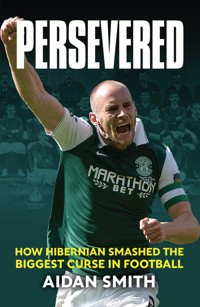
One hundred and fourteen years and no Scottish Cup for Hibernian. It could be considered the biggest curse in football. Cock-up after near-miss after not-a-hope. Over the years Hearts fans have even tried to get the term 'Hibsing it' – to chuck away a vital game from a favourable position – included in the dictionary. Every year would come the mention of 1902, the last time Hibs had won the cup. 1902, when Buffalo Bill still alive and the bra was newly invented. And then came 2016 and a run all the way to the final at Hampden. Hibs couldn't finally, at long, long last, win the infernal, blasted thing ... could they? Aidan Smith takes us on the turbulent journey that was Hibs' 2016 Scottish Cup Campaign, through a season of peaks and troughs which, despite everything, finally delivered that elusive Cup victory Hibs fans have craved for so long.
Sie lesen das E-Book in den Legimi-Apps auf:
Seitenzahl: 341
Veröffentlichungsjahr: 2016
Das E-Book (TTS) können Sie hören im Abo „Legimi Premium” in Legimi-Apps auf:
Ähnliche

















First published in Great Britain in 2016 byARENA SPORTAn imprint of Birlinn LimitedWest Newington House10 Newington RoadEdinburghEH9 1QS
www.arenasportbooks.co.uk
Copyright © Aidan Smith, 2016
ISBN: 9781909715479eBook ISBN: 9780857909213
The right of Aidan Smith to be identified as the author of this work has been asserted by him in accordance with the Copyright, Designs and Patents Act 1988.
All rights reserved. No part of this publication may be reproduced, stored or transmitted in any form, or by any means electronic, mechanical, photocopying, recording or otherwise, without the express written permission of the publisher.
Every effort has been made to trace copyright holders and obtain their permission for the use of copyright material. The publisher apologises for any errors or omissions and would be grateful if notified of any corrections that should be incorporated in future reprints or editions of this book.
British Library Cataloguing-in-Publication DataA catalogue record for this book is available on request from the British Library.
Designed and typeset by Polaris Publishing, Edinburghwww.polarispublishing.com
Printed in Great Britain by Clays, St Ives
CONTENTS
INTRODUCTION
ONE
v: Hibs it
TWO
‘Yee-ha!’
THREE
‘I want to take all the cancer from Alan . . .’
FOUR
‘He jumped from somewhere and smicked the ball away’
FIVE
‘Mind where yer pittin’ yer fit . . .’
SIX
‘I knew something was fundamentally wrong . . .’
SEVEN
Vale of tears
EIGHT
‘He’s better than Zidane . . .’
NINE
‘That was the game where everything changed . . .’
TEN
The horror! The horror!
ELEVEN
‘Demonic electronic supersonic mo-mo-momentum’
TWELVE
‘I love “Sunshine on Leith”. I just wasn’t hearing it enough . . .’
THIRTEEN
‘There was something almost moving in their noble failure’
FOURTEEN
Diminutive, dark-haired, dumpy, thunder-thighed
FIFTEEN
‘Stokesy reckoned the Championship was the hardest league. Defenders wanted to kick him . . . because he was Anthony Stokes’
SIXTEEN
‘The referee, Brian McGinley, wasn’t going to give up the beach for any more of this Escher-like exploration of infinity . . .’
SEVENTEEN
Ye olde fiery spheres
EIGHTEEN
‘“Hibsing it” was an attempt to degrade our players and I wasn’t having that.’
NINETEEN
‘I told them they were going in the sea if they didn’t clear off’’
TWENTY
‘Go out there and gie them “The Reel o’ Tulloch”’
TWENTY-ONE
‘See you at the wee barrier’
TWENTY-TWO
‘You reach a moment when you start to think things might be happening for a reason’
TWENTY-THREE
‘The Aldershot fans were singing “You’re just a fat Peter Schmeichel”’
TWENTY-FOUR
‘The fans who’ve thrown their scarves away, will they get them back?’
TWENTY-FIVE
‘No Rangers, no Anthony Perkins in a dress. Properly deprived.’
TWENTY-SIX
‘There was cereal and toast available from 9.15 p.m. . . .’
TWENTY-SEVEN
Time for Heroes
TWENTY-EIGHT
‘I ran into Taff’s big jacket in floods of tears and he kept me in there for a good two minutes’
TWENTY-NINE
‘There’s some people on the pitch . . .’
THIRTY
‘Stokesy never gave anything away and you never got close to him. I didn’t mind that.’
THIRTY-ONE
‘Someone told me it would be busy’
For Archie
INTRODUCTION
HIGH SUMMER IN the Lang Toon. A mother screams at her daughter dressed in a matching shellsuit outside a Cash Generator. A seagull swoops on a discarded fudge doughnut. Three boys with fishing rods point and laugh at the encumbered bird’s struggles to regain altitude. I have returned to where it all began and Kirkcaldy is beautiful.
The oldest football competition in the world, featuring the most blighted, benighted, winless and wobegone, hapless and hoodoo-ed club on the planet. Hibernian’s epic disinclination towards the Scottish Cup was a gripping, macabre tale, re-told every year, and always ending the same way: with defeat. Sometimes at Hampden, the national stadium, other times in tough little towns like this, where tough little teams lurk.
Shops are closed because they’re on holiday although many are on permanent vacation. In the High Street there’s a pawnbroker face-off and presumably these rival bawbees-for-cash outlets regularly knock three bells out of each other to offer the best deals. But if that suggests a place down on its luck, who was really going to flog the family jewels so they could place a bet on Hibs ending the curse after 114 years and lifting the trophy, especially when their entry into the 2015-16 competition was an away tie at Raith Rovers?
There’s plenty of local colour here with which to compose an over-the-top epitaph for an underachieving football team. There’s a bar called The Exchequer which, even if there’s no connection with the former Chancellor and Rovers fan, prompts you to wonder: what would a Gordon Brown theme pub actually be like? There’s a nightclub called Blue Monday and much as I hoped to find a ‘Closed on Mondays’ notice on the door I have to be truthful and say that in Kirkcaldy the 1980s retro beat seems pretty relentless. And there’s a baker’s shop that’s been going since 1857, longer even than Hibs’ cup affliction, its success based on products which haven’t failed to rise, haven’t gone all gooey in the middle when a tougher consistency was ordered, unlike the team from across the water in the port of Leith.
This will be no obituary.
1902 was when the cup was last returned to Hibs’ home, Easter Road, but we don’t need to hear of it again. No more Buffalo Bill, no more Edward VII, no more Charles R. Debevoise. These three can go back to being regular 1902 dudes and stop piggybacking on the club’s failure.
One was a hero of the American Wild West and would turn up in accounts of Hibs’ regular flopping simply because in 1902 he wasn’t yet dead and namechecks usefully illustrated just how long the jinx had been in existence. Another was sat on the throne in 1902 while the third, who was similarly rescued from dusty history books to enjoy unexpected attention, invented the brassiere that year.
Two cups? Hibs just wanted one.
But I’ve come back to Kirkcaldy to walk up to Raith’s stadium, Stark’s Park, wondering if I’ll return regularly now. Wondering indeed if there’s a small-business opening for a heritage trail, a green plaque-dotted tour which would have to begin right here, close to the pentecostal church promoting ‘Faith, hope, love’. The strolling lecture would tell how Hibs ended the cycle of despair and stopped being the biggest joke in Scottish football, the most tragic case in the game globally. These weren’t official titles but we were claiming them anyway. For long enough, they were just about all we had to our name.
This is how Hibs won the Scottish Cup. Yes, they actually did it: Hibs won the Scottish Cup. First, though, a keen academic debate . . .
ONE
V : HIBS IT
IT IS MARCH 2016 and in the offices of the Oxford English Dictionary, words and phrases fly around all day long. New words and perky phrases, all of them seeking acceptance. It is the job of the staff to sort the wheat from the chaff, to say nothing of the chavs, and distinguish between the neologisms which add to the gaiety of the nation and describe The Way We Live Now – and those chancer, too-trendy buzzwords which are mere fluff and will be quickly forgotten.
Hibsing it.
But it’s a war of words in this place. There are in fact two offices: the original, more than a century old with staff not much younger, and the newish extension. One – dusty, fusty – looks like a place of work while the other seems to be a place of play. Parked between items of dayglo furniture are kiddies’ trikes. These are clichés of groovy office-life but this room’s bearded hipsters – another cliché – don’t care about that. They ride the trikes, chasing each other, pursuing words.
The two divisions don’t get on, there’s a deep mistrust. They’re separated by some high filing cabinets; the oldsters wish for a moat with huge vats of oil suspended above, nicely boiling. The oldsters think the youngsters too impetuous; the young brigade think their elders too resistant to change. But there has to be change. According to the most recent survey, people are using fewer and fewer words. They’re trying to get through their daily lives with the bare minimum, an average of seventeen at the last count. The language is dying.
Hibsing it.
So the oldsters, who have the last word on new words, are bombarded with recommendations from their wacky colleagues. Some are scrawled on paper aeroplanes and fired at them. Others are sent by email, suddenly bursting onto the screens of the dictionary veterans and flashing in big capital letters to blaring pop music. Generally baffled by computers, the oldsters have to call the kids over to get the would-be words removed.
HIBSING IT!
The greyhairs are particularly unimpressed by applications for sports words, believing that football people have mangled quite enough of the lexicon already. Managers and players are reckoned to have been poorly-educated, a problem compounded by media-training which ensures they say nothing original or interesting. Post-match, the dry, stale air of low-ceilinged interview rooms is filled with hackneyed comments about taking each game as it comes, giving the other team respect and normally landing in row Z with that kind of shot, to be fair. A new football word would have to be remarkably clever, witty and vital to impress the grizzled and grumpy guardians of the OED.
The bid to have ‘Hibsing it’ ratified and verified comes from a Heart of Midlothian supporter. Hearts, the Jam Tarts, the Jambos, are the Edinburgh rivals of Hibernian, Hibs, the Hibees. Hearts fans enjoy seeing Hibs suffer, fail, be relegated, almost die, lose cup finals, lose to anyone, but there’s a kind of losing which Jambos reckon Hibs do better and more consistently than anyone else – that is to lose from a highly advantageous position, when you really should be winning. To snatch defeat from the jaws of victory. To do a Devon Lock, after the horse cantering to glory only to perform the splits just before the finish-line. To do a Don Fox, in the style of the Rugby League Challenge Cup hero-apparent who sliced what should have been the winning kick. To be Wile E. Coyote, having snared the Roadrunner at last, only to be flattened by a plummeting boulder. To be Tom, cooking himself a Jerry-based dinner at last, only to be pancaked by a flying anvil. To be Tom Courtenay in Billy Liar, who wins gorgeous Julie Christie then lets her leave town on a train. This is Hibsing it.
The phrase gets the full backing of the young bucks at the next applications meeting and there’s predictable harrumphing from the dictionary’s senior division. You cannot really believe that in 2015 these guys passed sexting and twerking and shiny-bum the year before. The younger element press the case, tell the story of the club, how they were formed in 1875, won the Scottish Cup a couple of times around the turn of the century, won three league titles with a brilliant forward line called the Famous Five and were the first British club to compete in the European Cup, produced some fine sides after that, notably Turnbull’s Tornadoes, and although they occasionally lifted the League Cup, the Hibee narrative is invariably one of flattering to deceive.
The grandads, as the kids call their long-serving colleagues, are made to watch a film of Hibs purporting to Hibs it, including a number of games against Hearts. There’s the one where the Hibees captain taunted Jambos with ‘7-0’ dyed into his hair in recognition of a famous derby drubbing only for his team to throw away a two-goal lead in stoppage time. There’s the one where Hibs fans turned up with balloons and streamers to hold a ‘relegation party’ for their doomed foes, only to lose the game and end up being demoted along with them.
And there’s the playoff which condemned them to that fate when, as the Scottish Premiership team, they’d won 2-0 at Hamilton Academical from the lower division and would surely secure their safety at home, only to be dragged down into the Championship after a penalty shootout. They’re still there now.
Unimpressed, the carriage-clock contenders acknowledge Hibs are a biggish club who should have achieved more, and that, yes, the manner in which they’d contrived to blow some games was pretty spectacular, but don’t all teams do this now and again? And anyway, how bad could Hibs really be if they’d managed to win the Scottish Cup a couple of times around the turn of the century?
No, not the turn of this century, the turn of the last one. Their previous victory was way, way back in 1902.
The oldsters are stunned. That’s very nearly as ancient as the dictionary!
TWO
‘YEE-HA!’
MAY, 2001, HIBS versus Celtic, won by the Glasgow team, three goals the margin. On paper this doesn’t sound terribly dramatic. In the context of Hibs’ Scottish Cup travails it sounds standard-issue. Celtic had previously lifted the cup by inflicting that level of defeat on the Hibees and would do so again later.
But the one in 2001 turned ninety-nine into a hundred. Turned up the pressure, turned up the joke count. A whole century of failure transformed 1902 into a stonker of a year.
Nestling in the history books between 1901 and 1903, 1902 had no idea it would become so desperate for Hibs fans and so beautiful to supporters of Hearts. It had to wait until Hibs failed to win the cup at the ninety-ninth time of asking but the team duly obliged. Sure, it was mentioned previously as Hibs tried and failed, more and more often as the wait got closer and closer to a hundred years. Then 1902 became properly sexy.
It became a specialist subject for Jambos keen to test their brainpower on Mastermind. ‘You have two minutes to answer questions on ‘Other Things That Happened in 1902 Besides the Frankly Hilarious Fact of it Being the Year Hibernian Last Won the Scottish Cup’. Your time starts ... now:
‘Who was William Frederick Cody better known as?’
‘Buffalo Bill.’
‘What did he have to do to earn the nickname?’
‘Win an eight-hour bison shoot.’
‘What was the final result?’
‘He shot sixty-eight bison to William Comstock’s forty-eight.’
‘In an eighteen-month period between 1867-68 what was the total number of bison brought down by Buffalo Bill?’
‘4,282.’
‘Name five other notable events which occurred in 1902.’
‘Edward VII was crowned King of Great Britain. The brassiere was invented. The vacuum cleaner was invented. The Boer War ended. Real Madrid were formed.’
This was undoubtedly impressive. Maybe the Jambos consulted their leatherette-bound Reader’s Digest to end up so knowledgeable although in any case 1902-centred info was churned out by TV and the newspapers in handy history fun-pack form every time Hibs resumed the quest for the cup, and especially after the defeat in 2001.
But when Hibs played Celtic that year, something happened which would eventually change the club’s image, status, personality, DNA, everything. Only we didn’t know it back then and neither did Celtic’s half-time substitute.
This wasn’t the cup final but the dress-rehearsal in the Scottish Premier League three weeks before. The game at Easter Road was televised live, with the odd kick-off time of 6.05pm on a Sunday evening. Because of this, and the fact the teams would soon be meeting at Hampden in a more glamorous context, the crowd was a modest 8,728.
There was fantastic talent on show. Henrik Larsson, Lubomir Moravcik, Franck Sauzee and Russell Latapy were among Scottish football’s greatest-ever foreign stars, although something else we didn’t know was that this would be the last occasion Latapy would pull on a too-big Hibs shirt and take the ball for an extensive meander.
The Hibs manager, Alex McLeish, bombed out the little Trinidadian playmaker after a drinking session ended with him in a car trundling the wrong direction down a one-way street. Could Latapy have won Hibs the cup? McLeish’s team were attractive and yet strong, two qualities which for Hibs don’t often mix. But their fine form had slipped from the first half of the season when they thumped Hearts 6-2 and split the Old Firm going into the winter break. The magic usually came from the patter-merchant Latapy, though, and the fans would debate whether the manager’s disciplinarian rule, doubtless learned from playing under Alex Ferguson, served Hibs best or whether you should always make allowances for tearaway genius.
Hibs put up a decent show in the final. Close, as Buffalo Bill might have said, but no clay pipe. Larsson scored a late penalty to give his team a comfortable 3-0 victory.
Alan Stubbs was a substitute that day, as he had been in the league game, which marked his comeback after a six-month battle against cancer. When he took the field at Easter Road just after seven o’clock on a beautiful late spring evening he was greeted with warm applause – not just from the Celtic fans but the Hibs supporters too. The big Scouser was touched, even more so when he scored the fourth of Celtic’s five goals and Hibbies chanted his name.
Stubbs never forgot that welcome; it confirmed Hibs as a good club with decent values. Obviously, a new manager doesn’t choose his first post based purely on an emotional impulse. Stubbs will have given pragmatic consideration to all the options before deciding to take the job. But to have so many fans of a rival club rooting for him as he returned from the darkness undoubtedly played a part in his decision.
‘To get a reception like that is something that will live with me to the very end,’ Stubbs said in June 2014 on his first day as Hibs boss. ‘This is a chance for me to repay it and hopefully the fans will give a reception to my team when they see the type of football they play. I want them to be proud of the team, that’s the most important thing.’
In 2001 the only consolation that seemed available to Hibs for losing that final was in the living-history project they became for the nation so everyone could learn a little bit more about what life was like at the turn of the previous century. Journalists worked diligently to provide this detail. Instead of chasing up-to-the-minute news they competed with each other for the most fancy-that facts about 1902 to better emphasise the boggling amount of time elapsed since the trophy engraver last steadied his hand to make the telling gouge ‘Hibernian’.
When editors were satisfied that all of Scotland knew that Buffalo Bill was still alive and well in 1902 they reckoned the masses were keen for more info on the celebrity bison-basher so they put their most dogged, married-to-the-job, sleep-in-their-cheap-suits investigative reporters on the case. The newshounds discovered that around the same time Bill was a touring Wild West roadshow superstar shooting up Scotland with his yee-ha spectacular. This was a stunning revelation, and more incidental detail with which to embroider the sorrowful Hibee saga of the ever-elusive cup. Bill left a trail of mayhem including burned-down Dundee goods yards and deserted Aberdeenshire trawlers – the price of fish rocketed because the crews were all at his show. He climbed Edinburgh’s Calton Hill, declaring ‘Ain’t she a beaut!’, and even attended a Rangers-Queen’s Park match.
Hearts fans loved this. ‘Let’s all laugh at Hibees,’ they taunted. Mock photos of the 1902 victory parade appeared, showing the most antiquated of horse-drawn transport options, in truth not much older than the vehicle used in the procession. Hibbies could do little but add to the mirth. ‘When the Hibs go up to lift the Scottish Cup,’ they sang in 2001, ‘we’ll be dead.’
But as the sun set on Russell Latapy’s career, it was ever so slightly starting to rise on that of a future Hibs hero. There was sunshine on Leith when Alan Stubbs ran onto the pitch in that league game, a few years before the song was ever heard at games.
THREE
‘I WANT TO TAKE ALL THE CANCER FROM ALAN . . .’
AN OLD LECTURER at journalism college, when he was explaining the art of writing a newspaper story and how you had to hook the readers with a smart intro, liked to replay his greatest hits from long years in the ink trade. ‘Women look much smaller with their clothes off,’ he once declared apropos of nothing, ‘but footballers look much smaller with theirs on.’
You couldn’t get away with that sort of thing now. But was it even true? Alan Stubbs, fully clothed, has just appeared in the doorway of the cafe and he’s filling it like the bad guy in a comic-strip and blocking out the sun. He’s immense.
The point I guess my tutor was trying to make about footballers is that when you meet them away from the pitch out of their kit they shrink. Footballers can certainly look huge when you’re a small boy peering over the terrace wall at them thrashing your team. In 1968, when I was deemed old enough for a match featuring the Old Firm, Celtic came to Easter Road and said to Hibs: ‘Go on, dare to take the lead. With only eleven minutes left, see if we don’t roar back with four great goals.’
Celtic were terrifying just running onto the park. Three regular Gigantors led the way: Billy McNeill, Bobby Murdoch, John Hughes. Maybe it was those hoops stretched across barrel chests which made them seem so much bigger than the Hibs players. Even wee Jimmy Johnstone – who I thought was no taller than the boys kicking empty fag packets in pub doorways while their fathers downed pints of heavy inside – cast a long cartoon shadow that day. The final score was Hibs 2, Celtic 5, just as it had been in Stubbs’ comeback game at Easter Road.
The first time I met Stubbs he was just a few days into the job of Hibs manager. This was in Portobello – Edinburgh’s Venice Beach, his home for the duration. Porty is a place of shifted sand – the seafront is partly-imported – but the man wasn’t wobbling, despite the challenges facing him. The eighth boss in ten years, he was unperturbed by the post appearing a thankless task, a near-impossible one. The manager immediately before him presided over a horrific transmogrification of a Jekyll & Hyde nature – or a Preston North End 26, Hyde 0 nature – as they went from Euro hopefuls to relegation chumps. The manager before him had been responsible for monumental stinkers, the two worst results in the club’s history.
Stubbs dominates the room but in a quiet way. He impresses with his determination but this is football, nothing more life-or-death than that: worse things happen to people than their teams failing to fulfil sometimes over-inflated aspirations. He repeats what he said on his first day in the job of wanting to make the supporters proud. The man has undoubted presence.
Stubbs’ battles with cancer have left him with one fewer testicle and a scar from surgery, after which forty staples were needed to put him back together. ‘They opened me up and moved various organs out and to the side to get to the tumour,’ he told me. Cancer took Stubbs to ‘the darkest, darkest places’ and the pain was overwhelming. ‘I could feel the staples, I could feel my insides, I could feel everything.’
He talked freely about all of this. ‘I live with cancer,’ he said. He spoke movingly of his dad Ronald who delivered cigarettes for a living but crucially drove the youngest of his five children to juvenile games in and around Kirkby, the Liverpool overspill which became a town, and who developed cancer at the same time as Stubbs and would eventually die of it. ‘Dad told a friend of mine: ‘I want to take all the cancer from Alan, take it with me so he’ll be alright.’ That was typical of him, selfless to the last.’
Stubbs made Ronald proud when he signed for Everton, the team they supported together, and during our chat that day he conveyed the sense he’s striving to demonstrate his gratitude to his father for his football life. But this is not a tense or wound-up fellow; he has a ‘carefree’ air. That’s down to having fought cancer and won. ‘I live for each new day. What’s the point in worrying?’ Maybe other better-qualified candidates for the Hibs job were scared off by the high casualty rate but not Stubbs.
The cynic will say that having coached at Everton but never managed before, he’s a cheap option for a club which doesn’t like to splash the cash. If it’s not working come the autumn he can be removed and an old hand in a dugout duvet shuffled into position. But there’s something tantalising about the appointment: Stubbs hails from England’s redoubtable north. He was a centre-back. He played for Celtic. Wasn’t that Tony Mowbray, too? Mowbray’s Hibs were a bonnie side; a similar model will be most welcome after much recent grimness.
Hibs, Hearts and Rangers, all fighting for the Championship title and automatic promotion, will make 2014-15 a second-tier season like no other in Scottish football history, and a far more cut-throat league than the Premiership. But Stubbs doesn’t need presence in his first few breathless weeks in the job; just points. His goalie scores the winner in the opening game against Livingston and then the team lose three in a row, including the Edinburgh derby, never a smart thing to do.
Maybe the rookie deserves some sympathy. Stubbs took over with half the old squad having been invited to find new employment after demotion and those that remained still staggering around in shock. He had to find new players, his feet and a feel for the Scottish game – all at once and quickly. Then comes the first eye-catching result: a win at Ibrox. It’s choreographed by Scott Allan, one of the new signings. An enormously talented attacking midfielder who’s wasted a couple of years of his career, Allan suddenly starts demanding the ball for ninety minutes, reverse-passing teams to death and by the season’s end will be Scottish football’s hottest property. His manager is credited with the transformation; he says it’s all down to the player.
Hearts get off to a flier and don’t let up. Hibs are unlucky in the next two derbies and then they beat their city rivals. Rangers are thrashed at Easter Road, then Hibs win again at Ibrox. Hibs finish runners-up only for Rangers – by then on their third manager of the season – to find a way to squeeze them out in the playoffs. The promotion campaign has been a failure but in the final minutes of the final match applause ripples round Easter Road. The fans – among Scotland’s grouchiest, grumbliest and hardest-to-please – don’t normally greet non-achievement so warmly. Stubbs, though, has given them back their football team.
The Hibs way. Trapping it under a jam-jar is tricky, just as trapping the ball was tricky for some reluctant Easter Road legends down the years. Does it exist?
Hibs fans, obviously, think it does. They like the team to have flair; thus Hearts supporters sneeringly call them flairists. Actually, Jambos call Hibbies poncing delusional snobs and borderline-Nazi master-race purists who perpetuate a myth of Brazil-influencing attacking aesthetics and who have actually borne witness to some chronic rubbish down the years.
It’s true; they have. But Hibs fans don’t appoint the club’s managers, or hand them scribbled notes before kick-off suggesting how best to bring about a total fitba afternoon. There are managers who will come along and decide Hibs should be tougher, more direct, more prosaic. All supporters want to see their team win but some place a slightly greater premium on winning with style. If your father was fortunate enough to witness the Famous Five, then if you and he were lucky enough to watch Turnbull’s Tornadoes together, it’s an inevitable and entirely permissible reaction when the ball is hoofed long and high to weep into your velvet sleeve, your snuff box or your first edition written by one of the French intellectuals.
Stubbs’ predecessor was Terry Butcher. The faithful readied themselves for one of those eras where it was decreed the team would have to win ugly. Imagine how the fans felt, then, having to watch Hibs lose ugly. But they approve of Stubbs, his diamond formation, his charging wing-backs, his choice of Liam Fontaine as a ball-playing centre-back in the manager’s own image, his trust in the creative workshop operated by Scott Allan and fellow midfielder Dylan McGeouch, his astute parenting of the young striker Jason Cummings to find a balance between responsibility and radgeness, increasing the boy’s wisdom without compromising the fearlessness, and last but not least his wild-card pick – an example of that carefree nature, perhaps – of the occasional dazzle of Dominique Malonga. ‘Stubbsy, Stubbsy,’ chorus the fans, happy with their team again.
The Scottish Cup in 2014-15? Hibs receive favourable draws all the way to the semi-finals but that means Hampden where they usually lose. This defeat is the eleventh out of fifteen visits since the century began. So maybe Stubbs won’t be able to overcome the hoodoo which has broken far more experienced men. Anyway, promotion is the main aim, isn’t it?
*
Stubbs’ second season starts like the first: slowly. Rangers want Scott Allan, table a couple of derisory bids, he eventually goes to Celtic, but Rangers benefit anyway because Hibs’ preparations are disrupted.
This colours relations between Hibs and Rangers, two clubs who’re never spliff-sharing Cheech & Chong at the best of times. Rangers are now managed by Mark Warburton, a former City trader and a feisty character easily wound up by Stubbs. Their exchanges ensure the Championship is no less fascinating for Hearts having left it. Plus, Falkirk’s boss, Peter Houston, wants in on the mind games and wind-ups.
Stubbs has brought John McGinn from St Mirren and Liam Henderson on loan from Celtic to ensure the Hibs midfield is no less fascinating for Allan having left it. After losing their opening two matches, Hibs stay unbeaten for four months and are neck-and-neck with Rangers at the top of the Championship. In the League Cup there are handsome wins over Premiership opposition, Aberdeen and Dundee United. Hibs are playing with verve, the fans chant ‘Stubbsy, Stubbsy’, the second half of the season holds considerable promise but the man himself is keeping cool. You never see Stubbs roaring his head off, bouncing around on the touchline, reminding everyone he’s the manager – and you certainly don’t see him taking the acclaim when his song starts. He likes to stay in the dugout with a cup of coffee, only approaching the pitch at the end to shake the hands of the opposition players. The fans like Stubbs’ style. They like his team’s style, very much the Hibs way. As Christmas approaches I don’t reckon the supporters are thinking about the Scottish Cup this season. The league is tense, all-consuming and vital. The cup, the bloody cup, can surely be put on hold. I mean, when the wait gets to 114 years, what’s another one or two or ten?
The draw for the fourth round is made on 1 December. Hibs will start away to Raith Rovers. Stubbs says: ‘The Scottish Cup is the Holy Grail, isn’t it? Well, it can be won. Just ask Indiana Jones . . .’
FOUR
‘HE JUMPED FROM SOMEWHERE AND SMICKED THE BALL AWAY’
‘The future is bright with promise and the hope may be expressed that the team’s little eccentricities will belong in the past, and that they will achieve fresh glories and add new lustre to the “ould name”.’
WELL, THAT DIDN’T quite happen, did it?
The words come from the Edinburgh Evening News in its match report of Hibs’ last Scottish Cup triumph. On 26 April, 1902 Hibernians, as they were known then, beat Celtic 1-0. When the trophy was presented to the team, Easter Road chairman Phil Farmer declared: ‘We have attained our hearts’ desire and I am the proudest man in Great Britain.’
The Evening News painted a picture of a club always striving, always in vain, and of the huge effort spent in trying to match their only other success in the tournament in 1887, and the relief and joy of this finally being achieved:
‘Since that famous day at Hampden when Willie Groves flashed down the wing and enabled Pat Lafferty to outwit [Jimmy] McCauley, Dumbarton’s great custodian, the Hibernians have travelled far and fared variously, and now that they stand on the highest pinnacle, those who stuck by them through the long and weary way may be well satisfied.’
Long? Weary? Fared variously? The delay in once again getting their hands on the trophy ending after a piddling fifteen years, Hibs would go on to prove them themselves world-class at faring variously in the cup and those little eccentricities would fester, balloon and suppurate, driving the people of Leith half-mad and resulting in a giant cross being painted on all entrances to the port, warning of a terrible plague. Not for nothing is Leith’s motto Persevere, as in ‘to continue in a course of action even in the face of difficulty or with little or no indication of success’.
Hibs must have been pleased it was Celtic they vanquished. The Hibees had been formed to keep young men from Edinburgh’s Cowgate – ‘Little Ireland’ where survivors of the potato famines had sought a new life – out of the alehouses. The year after their first cup triumph they loaned players to Celtic, not yet properly established, and then had their best men poached by the Glasgow club.
Hibs’ victorious manager in 1902 was Dan McMichael, Bobby Atherton was captain and the goal which would haunt his successors in green and white for 114 years was scored by Andrew McGeachan. The final was played at Celtic Park following the disaster at Ibrox – venue for the first finals of the new century – a few weeks before when a stand collapsed killing twenty-five spectators and the mood of the 16,000 crowd was sombre.
The game did little to lift their spirits. The Evening News wrote of the ‘ghastly poverty’ of the play, with the goalposts being viewed as ‘superfluities’ by the shot-shy forwards, and added: ‘From beginning to end there was scarcely sufficient action to impact a tremor or quicken the beat of a single pulse.’ The Edinburgh Evening Dispatch reckoned it ‘the poorest final on record’.
That title was almost certainly grabbed by other finals which followed but fans of the victors are generally unperturbed by the non-classic tag, especially if their team have mustered a great effort and deserved to win, which was the case with Hibs that fabled year.
The defence was heroic and Robert Glen was the star man in this department for how ‘in the nick of time [he] jumped from somewhere and smicked the ball away’. Even when ‘cooped and cornered’ he would ‘resort to overhead kicks and trick football of the neatest kind’. Half-backs James Harrower and Bernard Breslin ‘constituted a rock on which the Celtic attack was split into atoms’. Up front Patrick Callaghan ‘worked like a Trojan’ while McGeachan displayed ‘capital dribbling powers’.
The breakthrough fifteen minutes from the end resulted from a corner. In Hibs’ long and painful cup history, Callaghan’s delivery would go down as the corner of the century. ‘The ball dropped about the middle of the goal,’ reported The Scotsman, ‘Atherton jumped and let it pass, and McGeachan sent it between [Hugh] Watson and [Willie] Lonie into the net, [Robert] McFarlane not seeing it until it had passed the goal line.’
After a winners’ reception at Glasgow’s Alexandra Hotel, a ‘hurricane of cheers’ propelled the team’s train back to Edinburgh. When they arrived at Haymarket Station, the tune was ‘See the Conquering Hero Comes’. Newhaven Brass Band had been ‘retained for eventualities’, wrote the Dispatch, and then the bandsmen got into a brake which led the players’ four-in-hand carriage for the procession along Princes Street and a ‘demonstration of a most enthusiastic nature’.
Thousands crammed the thoroughfare and progress of other transport ‘was indeed threatened’. At Register House the team were ‘completely circled by a moving mass’ and on the tramcars forced to a halt the people waved handkerchiefs and hats. ‘“Good old Hibs” was the cry on almost everybody’s lips,’ confirmed The Scotsman.
The four-in-hand inched down Leith Street. ‘At London Road,’ reported the Evening News, ‘it was thought advisable to try to shake off the crowd, and for this purpose the horses were put into a sharp trot, but the spirit of the enthusiasts was too great.’
What a great day. These Hibs had been cooped. They’d been cornered. They thought they might have been cursed not to win the cup a second time. Their successors would dream of decisive corners and delirium on the streets and gridlock at Register House but every year this would be frivolous fantasy.
FIVE
‘MIND WHERE YER PITTIN’ YER FIT . . .’
9 January 2016Raith Rovers 0 Hibernian 2
THE OPENING ROUND of the cup for the big boys – and even for less-than-studious types like Hibs who’ve been put back a year or two – usually happens in the first fortnight of January when it can stay gloomy all day, no one has any money left after Christmas and grounds like Raith Rovers’ Stark’s Park can seem even more careworn than usual.
And be just as deadly for the unsuspecting, the ill-prepared and, especially, the history-haunted.
Stark’s Park looks, well, stark. Advertising for Blind Davy’s – a shop selling blinds, presumably run by Davy, who may not be visually impaired – dwarfs the stadium’s name on the front elevation. It is one day out from being exactly twenty-five years since I was last here and a great chunk of the terracing where I stood with my father has disappeared. In its place are a couple of metal boxes, the kind of windowless compartments you see on building sites where if the foreman and his five labourers were to pass wind simultaneously after Steak Bakes all round from Greggs, the stench might kill you. It is here that Alan Stubbs will come post-match to explain, in the event of a defeat, that the league was always the number one priority or, should Hibs win, that the cup’s a nice bonus but promotion’s the thing.
And that Stark’s Park encounter a quarter of a century before? Oh, Hibs lost.
The team Stubbs has picked for the tie doesn’t suggest an all-out targeting of the holy grail, the holey pail. There’s no Jason Cummings, sparking rumours he might be sold in the transfer window, might even be on his way already, although it turns out he’s unwell. In his place is Chris Dagnall, a striker who’d scuffed around England’s lower divisions before a move to Kerala Blasters of the optimistic-sounding Indian Super League. Another short-term loanee making his debut is Norwegian defender Niklas Gunnarsson.
You wonder what Dagnall will make of Kirkcaldy. Perhaps surprisingly, there isn’t a curry-house here called the Taj Mahal. And you continue to wonder what Dominique Malonga makes of Scotland, its physical, urgent football and seepingly damp winters. This is a French-born Congolese forward of delicious ability and dubious attention-span. Apparently constructed from pipe cleaners, he moves like a push-up wobbly toy. On his day he’s unplayable. The other days he might as well not be playing.




