


126,99 €
Mehr erfahren.
- Herausgeber: John Wiley & Sons
- Kategorie: Fachliteratur
- Sprache: Englisch
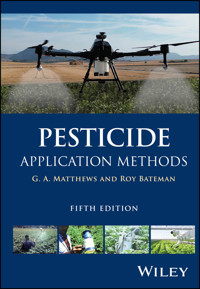
The definitive guide to modern pesticide application methods for effective and sustainable crop protection
As precision agriculture continues to evolve, Pesticide Application Methods serves as an essential reference for professionals in crop protection. With comprehensive and up-to-date coverage of pesticide application technologies, this leading guide covers the foundational principles of pesticide application whilst delving into advanced techniques that enhance efficiency, reduce environmental impact, and integrate seamlessly into sustainable agriculture practices. Drawing on decades of practical expertise, authors Graham Matthews and Roy Bateman provide a thorough grounding in both the theory and practice of pesticide application, ranging from traditional hydraulic sprayers to cutting-edge drone technology.
The fifth edition of Pesticide Application Methods offers substantial new and updated content, reflecting the latest advancements in crop protection and application technology. This edition incorporates emerging practices in regenerative agriculture, with a focus on selecting pest-resistant crop varieties to reduce chemical dependency. New coverage includes unmanned aerial systems (UAS) for targeted application, electrostatic sprayers that minimise drift and enhance precision, and the integration of sustainable biopesticides and biorationals into pest management strategies. Throughout this edition, updated regulatory insights and training standards ensure that practitioners remain compliant with evolving safety protocols, including the EU “Green Deal” objectives on sustainable pesticide use.
Continuing to set the standard for professionals in crop protection, Pesticide Application Methods, Fifth Edition:
- Offers in-depth guidance on modern pesticide application techniques, with a focus on sustainable practices and precision targeting
- Contains essential information on operator training, equipment maintenance, and certification requirements for pesticide application
- Features dedicated chapters on specialised techniques such as robotic applications and aerial spraying
- Provides guidelines for maintaining and calibrating application equipment to enhance longevity and efficiency
- Includes clear and practical diagrams, photos, and colour illustrations to enhance understanding of complex equipment and techniques
Incorporating the latest research in Integrated Pest Management (IPM) and Good Agricultural Practice (GAP), Pesticide Application Methods, Fifth Edition is ideal for upper-level students in agricultural sciences, crop protection, entomology, and plant pathology programmes, as well as for crop protection specialists, plant scientists, agricultural consultants, and agrochemical industry professionals.
Sie lesen das E-Book in den Legimi-Apps auf:
Seitenzahl: 366
Veröffentlichungsjahr: 2025
Ähnliche



















Table of Contents
Cover
Table of Contents
Title Page
Copyright Page
Preface to fifth edition
References
Acknowledgements
Conversion tables
Pesticide calculation
Units, abbreviations and symbols
Chapter 1: Biological and chemical control in integrated pest management
The increase in the use of pesticides
Integrated pest management
Resistant varieties
Crop rotations
Cover crops, catch crops and green manures
Intercropping
Push–pull
Timing of application
Resistance to pesticides
Resistance to fungicides
Resistance to herbicides
Economic thresholds
Traps can be used to assess the presence of pests
Application sites and placement
Biotech crops
References
Chapter 2: Targets for pesticide deposition and their detection using drones and robotic equipment
What volume of spray is required?
References
Chapter 3: Formulation of pesticides and bio‐pesticides
Ultra‐low volume formulations
Wettable powders
Emulsifiable concentrates
Invert emulsions
Fog formulations
Pressure packs/aerosol cans
Adjuvants
References
Chapter 4: Spray droplets
Importance of droplet size in pest management
Determination of spray droplet size
References
Chapter 5: Nozzles – hydraulic and pulse‐width modulation
Hydraulic nozzles
Nozzles
Deflector nozzle
Even spray fan nozzle
Standard fan nozzle
Cone nozzle
Plain jet or solid stream nozzle
Foam or air‐aspirating nozzle
Pulse‐width modulation
Checking the performance of hydraulic nozzles
References
Chapter 6: Portable carried hydraulic sprayers
Knapsack compression sprayers
References
Chapter 7: Power‐operated hydraulic sprayers (electric power)
Swath matching
Filling the sprayer
Portable line sprayers
Precision (patch) spraying
The future for tractor sprayers?
References
Chapter 8: Air‐assisted sprayers
Fans
Motorised knapsack mistblowers
Arable crop sprayers with downwardly directed air assistance on boom sprayers can be used to treat relatively small plants, in contrast to orchards
Orchard sprayers
References
Chapter 9: Controlled droplet application
Hand‐carried, battery‐operated spinning‐disc sprayers and their power sources
Disc design
Portable electric power for sprayers
Disc speeds: objectives and control
Control of flow rate
Formulations for ultra‐low‐volume and very low‐volume spraying
Packaging of formulations
Spraying procedures
Placement spraying
Portable air‐assisted spinning‐disc sprayers
Vehicle‐mounted sprayers with centrifugal‐energy nozzles
Boom sprayers
Shrouded rotary atomisers
Conclusions
References
Chapter 10: Electrostatic chargedsprays
Induction charging
Ionised field charging
Direct contact charging
Hydraulic nozzles
Spinning disc atomisers
Air‐shear nozzles
Ionised field charging nozzles
Electrodynamic nozzles
Tractor mounted electrostatic sprayer
References
Chapter 11: Using drones to spray crops
Power supply
Drone controller when spraying crops
Precision spraying
Bird's‐eye view
Aerial sprays
Reduced blind spots
Retention of spray deposition
Improved efficiency
Safety and adaptability
References
Chapter 12: Aerial spraying using manned aircraft and helicopters
Aircraft flying height
Global positioning system (GPS)
Swath width
References
Chapter 13: Spray drift
Strategies for spray drift management
Reducing spray drift
References
Chapter 14: Seed treatment, dust and granule application
Granular pesticide formulations
Granular application
References
Chapter 15: Space treatment by fogging
Cold foggers
References
Chapter 16: Specialist application techniques using robots
References
Chapter 17: Application of bio‐pesticides
Microbial Control Agents: their Formulation and Spray Tank mixtures
Application equipment and MCA delivery: the importance of numbers
Control of migratory pests: application of
Metarhizium acridum
to Locusts
Bio‐pesticide application to forests
Crop disease management
Other application techniques
Summary
References
Chapter 18: Equipment for laboratory and field trials
Field trials
References
Chapter 19: Training spray operators
Legal requirement – the safe use of pesticides
Codes of practice
Purpose of the manual and how to use it
References
Chapter 20: Regulations related to toxicity of pesticides and labelling
Classification and labelling legislation
Active substances
Safeners and synergists
Co‐formulants
Adjuvants
Biocides
Pesticide labelling and regulations
Plant protection
Chapter 21: Safety precautions when applying pesticides
Protective clothing
Symptoms of poisoning
First aid
Combination of chemicals
Pesticide packaging and labelling
Container and washing disposal
Noise
Code of conduct
References
Chapter 22: Standards for application equipment
Assisted by Tom Bals
Chapter 23: Maintenance of equipment
Problems with the spray system
Problems with motorised equipment
Maintenance in the field
Storage of equipment
Index
End User License Agreement
List of Tables
Chapter 2
Table 2.1 Volume rates in litres per hectare that have been used for differ...
Table 2.2 Optimum droplet size ranges for selected targets.
Table 2.3 Lifetime and fall distance of water droplets at different tempera...
Chapter 3
Table 3.1 Mortality of Mexican bean beetles caused by malathion.
Table 3.2 Increase in cotton production in West Africa 1975–1984.
Table 3.3 Volatility of single compounds from cellulose papers at 25°C.
Table 3.4 Physical properties of solvents, italic type signifies undesirable...
Chapter 4
Table 4.1 Classification of sprays
a
according to droplet size.
Table 4.2 Some examples of spray droplet size data for different nozzles.
Table 4.3 Volume median diameter (VMD) and percentage of droplets less than...
Table 4.4 Terminal velocity (m/sec) of spheres and fall time in still air....
Chapter 5
Table 5.1 Different types of nozzle and their main uses.
Table 5.2 Code for describing nozzles.
Table 5.3 Colour code for fan nozzles, based on nozzle output.
Table 5.4 Spray quality – effect on retention and spray drift.
Table 5.5 Effect on throughput and spray angle of certain combinations of d...
Chapter 7
Table 7.1 Summary of types of pumps.
Table 7.2 Record of calibration.
Chapter 9
Table 9.1 Characteristics of selected electrical batteries (indicative from...
Table 9.2 Estimated time* (hours and minutes) of spray operation for 1 hect...
Chapter 12
Table 12.1 Data on certain fixed‐wing aircraft used in agriculture.
Table 12.2 Data on certain helicopters used in agriculture.
Table 12.3 Droplet size in relation to rotational speed of the Micronair 5,...
Table 12.4 Comparison of two aerial spray treatments in a forest.
Chapter 13
Table 13.1 Droplet sizes from hydraulic spray nozzle 11,003 fan nozzle at 3...
Chapter 15
Table 15.1 Performance of two cold fogging machines with vortical nozzles....
Chapter 17
Table 17.1 Selected microbial control agents and their application.
Chapter 21
Table 21.1 Insecticide contamination using the knapsack sprayer fitted with...
Chapter 23
Table 23.1 Faults with two‐stroke engines and their remedies.
Table 23.2 Faults with lever‐operated knapsack sprayers (Piston and diaphrag...
Table 23.3 Faults with compression sprayers.
Table 23.4 Faults with hand‐carried battery‐operated spinning disc sprayers...
List of Illustrations
Chapter 1
Figure 1.1 Spraying a highly hazardous insecticide on cotton in India while ...
Figure 1.2 Million tonnes of pesticides used in different areas of the world...
Figure 1.3 Quantities of herbicides, fungicides, insecticides and other pest...
Figure 1.4 The quantities applied per hectare were highest in the Americas....
Figure 1.5 Global temperatures from 1860 to 2000.
Figure 1.6 Using a combination of different control methods.
Figure 1.7 Data from routine scouting pests in a cotton crop showing when di...
Figure 1.8 A scout inspecting a cotton crop for bollworm eggs and using a pe...
Figure 1.9 Example routes to examine different areas in a field.
Figure 1.10 Principle components of an arable field margin with buffer zone ...
Figure 1.11 Field edge where there is no spray applied to the buffer zone an...
Figure 1.12 Sequence of different insecticides used to control aphids in the...
Figure 1.13 Rotation of acaricides to control red spider mite.
Chapter 2
Figure 2.1 Bollworm eggs on leaves. (a)
Diparopsis
red bollworm. (b)
Helicov
...
Figure 2.2 A simple ‘peg board’ to record the presence of two species of bol...
Figure 2.3 Tailboom with increase in nozzles as plants increased in height....
Figure 2.4 ULV spraying cotton in Malawi.
Figure 2.5 Rotary atomiser on truck.
Figure 2.6 Aerial application aiming to control hoppers before swarms develo...
Figure 2.7 An assessment of spray deposition downwind with different spray n...
Figure 2.8 Processes involved in pesticide transfer from a nozzle and deposi...
Figure 2.9 Relation between droplet numbers, diameter and volume application...
Figure 2.10 Relation between toxicity, droplet diameter and concentration of...
Chapter 3
Figure 3.1 Heavier rain also removes from lower surfaces of leaves.
Figure 3.2 Rain moving pesticide from plants into soil and ultimately stream...
Figure 3.3 Adding more liquid dilutes the spray.
Figure 3.4 Cross‐section of a typical pressure pack.
Figure 3.5 Impact on Sauter mean diameter of droplets for eight adjuvants co...
Figure 3.6 Different types of adjuvants.
Chapter 4
Figure 4.1 Diagrammatic representation of the VMD – half of the volume of sp...
Figure 4.2 Diagrammatic representation of spatial and temporal sampling.
Figure 4.3 Malvern panalytical spraytec.
Chapter 5
Figure 5.1 (a–c) Nozzles used in 1890.
Figure 5.2 Example of the distribution by volume and number of droplets in a...
Figure 5.3 Hydraulic nozzles, male and female nozzle body (a) (Photo: Sprayi...
Figure 5.4 Strainer, 50‐mesh and 100‐mesh filters.
Figure 5.5 Deflector nozzles. Credit: Adapted from WHO (1974).
Figure 5.6 (a) Nozzle designed to spray at two different angles. (b) One noz...
Figure 5.7 (a) Spray pattern with a fan nozzle, compared to (b) Spray patter...
Figure 5.8 Alternative designs of flat fan nozzle, including a deflector noz...
Figure 5.9 (a) Standard fan nozzle. (b) Deflector nozzle. (c) Air induction ...
Figure 5.10 A cone nozzle.
Figure 5.11 (a) Solid cone. (b) Hollow cone nozzle‐disc type. (c) ‘Cone Jet’...
Figure 5.12 A ‘Raindrop’ nozzle.
Figure 5.13 ‘Air‐Tec’ twin‐fluid nozzle.
Figure 5.14 Flow diagrams of the (a) air‐pinch PWM valve (b) conventional el...
Figure 5.15 Images of PWM valves from different manufacturers showing their ...
Figure 5.16 Automated spray nozzle patternator.
Chapter 6
Figure 6.1 Lever‐operated knapsack sprayer with piston type pump (a) or diap...
Figure 6.2 To spray a crop that increases in height the nozzles should be on...
Figure 6.3 Compression Sprayer.
Figure 6.4 Compression Sprayer used to treat houses to control mosquitoes tr...
Figure 6.5 Change in spray output at the nozzle with a compression sprayer w...
Figure 6.6 Fan nozzle with control flow valve.
Figure 6.7 Indoor residual spraying inside house to control mosquitoes.
Figure 6.8 A battery‐powered knapsack sprayer.
Chapter 7
Figure 7.1 Tractor fitted with sprayer using a wide boom.
Figure 7.2 Tractor cab with additional equipment.
Figure 7.3 Layout of a tractor‐mounted Sprayer.
Figure 7.4 Correct overlapping of the spray pattern is required across the b...
Figure 7.5 Different systems of fitting nozzles to spray booms. Different sy...
Figure 7.6 Horizontal boom equipped with vertical booms to enable spray to b...
Figure 7.7 Using animal‐drawn sprayer with engine driven pump.
Figure 7.8 (a) Diaphragm pump with diagram showing position of the diaphragm...
Figure 7.9 (a) A piston pump, cutaway and complete. With (b) diagram to show...
Figure 7.10 (a) Centrifugal pump, (b) turbine pump, and (c) cutaway to show ...
Figure 7.11 A gear pump.
Figure 7.12 Nozzle body with capstan to allow rotation up to 80
o
.
Figure 7.13 Varidone sprayer.
Figure 7.14 Formation of tramlines by matching seed drill, fertilizer spread...
Figure 7.15 Sequence of spraying a field. Never spray while doing a turn.
Figure 7.16 Low‐level induction bowl.
Figure 7.17 Servo‐operated system with separate chemical and diluents tanks ...
Chapter 8
Figure 8.1 Air assistance pictograms.
Figure 8.2 Motorised mistblower showing simplest type of nozzle.
Figure 8.3 A tunnel sprayer in an orchard.
Figure 8.4 (a) Axial fan. (b) Cross flow fan.
Figure 8.5 (a) An attachment for low and ultra‐low volume pest control on a ...
Figure 8.6 Knapsack sprayer being used to spray a cotton crop.
Figure 8.7 Tractor air‐assisted sprayer applying an insecticide on a cotton ...
Figure 8.8 Electrafan A mains electric or battery‐powered air‐assisted CDA s...
Figure 8.9 Relative position of airflow from air sleeve and spray from the n...
Figure 8.10 Twin‐fluid nozzle on drop leg unit.
Chapter 9
Figure 9.1 High‐speed photographs of single droplet, ligament and sheet form...
Figure 9.2 Atomiser and reservoir of Ulva+ spinning disc sprayer.
Figure 9.3 Droplet size spectra of rotary atomisers (VMD with D
[v,0.1]
and D
Figure 9.4 Optional knapsack tank to refill ULVA+ sprayer in the field.
Figure 9.5 ‘Handy’ herbicide applicator.
Figure 9.6 Final droplet diameter (%: bold line) with various levels of non‐...
Figure 9.7 Overlapping swaths when using downwind movement of spray from spi...
Figure 9.8 Measuring wind velocity with (a) pith‐ball and (b) electronic ane...
Figure 9.9 (a) Position of Herbi sprayer at relative positions to spray oper...
Figure 9.10 (a) Electrafan 12 sprayer. (b) Flying Doctor multiple Electrafan...
Figure 9.11 (a) Ulvamast sprayer mechanism. (b) Ulvamast sprayer in use agai...
Figure 9.12 (a) ‘Micromax' unit. (b) Tractor boom fitted with Micromax nozzl...
Figure 9.13 (a) Undavina sprayer unit. (b) Undavina sprayer in orchard.
Chapter 10
Figure 10.1 (a) Electrostatic sprayer to apply insecticides and disinfectant...
Figure 10.2 Electrostatic added to sprayer in a vineyard in Spain.
Figure 10.3 (a) Hydraulic nozzle with induction charging. (b) Position of el...
Figure 10.4 Spinning disc nozzle with induction charging.
Figure 10.5 Twin‐fluid nozzle with induction charging.
Figure 10.6 Corona charging of spinning discs.
Figure 10.7 Twin‐fluid nozzle with induction charging.
Figure 10.8 (a) Electrodynamic sprayer. (b) A ‘Bozzle’.
Figure 10.9 Prototype electrostatic sprayer being tested in Sudan.
Figure 10.10 Subsequent version of electrostatic sprayer used in Brazil to s...
Figure 10.11 Nozzle, space cloud and induced charge effects on deposition.
Figure 10.12 Diagram showing electrostatic sprayer.
Figure 10.13 Using an electrostatic sprayer in Brazil.
Figure 10.14 Sprayer when applying sprays on soybeans.
Figure 10.15 Soybean grain yield provided by air assistance at 21, 25 and 30...
Chapter 11
Figure 11.1 Unmanned remote‐controlled helicopter.
Figure 11.2 A diagram of a hexcopter drone with six rotors developed in Chin...
Figure 11.3 UAV (MG‐iK) at a farm.
Figure 11.4 Drones fitted with rotary atomisers.
Figure 11.5 An example: the range of droplet sizes with rotary atomiser. See...
Figure 11.6 Initially when drones were first used some involved in applying ...
Figure 11.7 Using a drone to target an insecticide by applying the spray to ...
Figure 11.8 Early use of a drone applying a spray with hydraulic nozzles.
Figure 11.9 Drone spraying a vineyard quicker than using ground equipment.
Figure 11.10 Locust hoppers in Somalia sprayed with a bio‐pesticide.
Figure 11.11 Without a drone, the bio‐pesticide to control locusts in Somali...
Chapter 12
Figure 12.1 (a) Trailing vortex behind an aircraft. (b) Aerodynamic trailing...
Figure 12.2 (a) Diagram of spraying system for small fixed wing aircraft. (b...
Figure 12.3 Aircraft flying over a line of table tennis balls to determine t...
Figure 12.4 Helicopter spraying a cotton crop.
Figure 12.5 (a) Micronair AU 5000 aerial atomiser. (b) Micronair electricall...
Figure 12.6 Typical layout of Micronair AU 5000 installation.
Figure 12.7 Droplet size in relation to the rotational speed of the Micronai...
Figure 12.8 Speed of rotation of AU 5000 unit in relation to aircraft speed,...
Chapter 13
Figure 13.1 Stable inversion conditions.
Figure 13.2 Air turbulence caused by surface heating—super‐adiabatic lapse r...
Figure 13.3 Air turbulence caused by surface friction. Movement of droplets ...
Figure 13.4 Range of droplets from a rotary atomiser set at a specific speed...
Chapter 14
Figure 14.1 (a) Rotostat seed treatment machine. (b) Low‐cost pedal‐powered ...
Chapter 15
Figure 15.1 Thermal fogging nozzle.
Figure 15.2 Thermal fogger being used in a glasshouse.
Figure 15.3 Distribution of a pesticide applied with (a) stationary fogger o...
Figure 15.4 Pulsejet thermal fogger (a) Biosystem to cool fog. (b) Standard ...
Figure 15.5 Vortical nozzle – Liquid fed into airstream, droplets fed into a...
Figure 15.6 Cold fogger to treat a Glasshouse to protect crops.
Chapter 16
Figure 16.1 Robot equipped with spray nozzles to treat weeds.
Figure 16.2 Tractor sprayer fitted with cameras to detect areas with weeds t...
Figure 16.3 Using a robot to treat a crop inside a glasshouse.
Chapter 17
Figure 17.1 Mass production of
Metarhizium acridum
: a highly effective contr...
Figure 17.2 Rhinoceros beetles, a major pest of palms controlled by
M. majus
Figure 17.3 Particle size spectra of formulations, obtained with a Malvern ‘...
Figure 17.4 The MycoHarvester v.6: particle size classification of fungal co...
Figure 17.5 Interpreting droplet size spectra. Droplet size spectra of three...
Figure 17.6 Droplet size spectra of four motorised mistblower nozzles showin...
Chapter 18
Figure 18.1 Potter tower (Burkard scientific).
Figure 18.2 Wind tunnel.
Figure 18.3 A sprayer with rotary atomiser being tried in Malawi.
Figure 18.4 Swath pattern overlapped as operator moves upwind.
Chapter 19
Figure 19.1 Collecting information.
Figure 19.2 Information flows.
Figure 19.3 Cotton Handbook c 1960 and later updated in Zimbabwe.
Chapter 21
Figure 21.1 (a) Routes of exposure to pesticides. (b) Absorption of pesticid...
Figure 21.2 (a) Lance on knapsack sprayer (b) nozzles on a ‘tailboom’ behind...
Figure 21.3 showing distribution of lines of film on parts of the operator's...
Figure 21.4 Operator holding lance downwind from his body.
Figure 21.5 An operator is mixing wettable powder pesticide in water, but th...
Figure 21.6 Using a fogging machine in a glasshouse, but this operator is no...
Figure 21.7 Spray operator is incorrectly without any protection of face, ar...
Figure 21.8 Spray operator with some protection by directing the spray downw...
Figure 21.9 An operator with good protection with face mask, gloves and cove...
Figure 21.10 Examples of pictograms.
Figure 21.11 Key items shown in pictograms.
Guide
Cover Page
Table of Contents
Title Page
Copyright Page
Preface to fifth edition
Acknowledgements
Conversion tables
Pesticide calculation
Units, abbreviations and symbols
Begin Reading
Index
Wiley End User License Agreement
Pages
iii
iv
vii
viii
ix
xi
xii
xiii
xv
xvi
1
2
3
4
5
6
7
8
9
10
11
12
13
14
15
16
17
18
19
20
21
22
23
24
25
26
27
28
29
30
31
32
33
34
35
36
37
39
40
41
42
43
45
46
47
48
49
50
51
52
53
54
55
56
57
58
59
60
61
63
64
65
66
67
68
69
71
72
73
74
75
76
77
78
79
80
81
82
83
84
85
86
87
88
89
90
91
92
93
94
95
96
97
98
99
100
101
102
103
104
105
106
107
108
109
110
111
112
113
114
115
116
117
118
119
120
121
122
123
124
125
126
127
128
129
130
131
132
133
135
136
137
138
139
140
141
142
143
144
145
146
147
148
149
150
151
152
153
154
155
156
157
158
159
161
162
163
164
165
166
167
168
169
170
171
172
173
174
175
176
177
178
179
180
181
182
183
184
185
186
187
188
189
190
191
192
193
194
195
196
197
198
199
200
201
202
203
204
205
206
207
209
210
211
212
213
214
215
216
217
218
219
220
221
222
223
224
225
226
227
228
229
230
231
232
233
235
236
237
238
239
240
241
242
243
244
245
246
247
248
249
250
251
Pesticide Application Methods
Fifth Edition
G. A. Matthews
Roy Bateman
This edition first published 2025© 2025 by John Wiley & Sons Ltd
Edition History© 2000, 1992, 1979 by Blackwell Publishing Ltd.© 2014 by John Wiley & Sons Ltd
All rights reserved, including rights for text and data mining and training of artificial intelligence technologies or similar technologies. No part of this publication may be reproduced, stored in a retrieval system, or transmitted, in any form or by any means, electronic, mechanical, photocopying, recording or otherwise, except as permitted by law. Advice on how to obtain permission to reuse material from this title is available at http://www.wiley.com/go/permissions.
The right of G. A. Matthews and Roy Bateman to be identified as the authors of this work has been asserted in accordance with law.
Registered Office(s)John Wiley & Sons, Inc., 111 River Street, Hoboken, NJ 07030, USAJohn Wiley & Sons Ltd, New Era House, 8 Oldlands Way, Bognor Regis, West Sussex, PO22 9NQ, UK
For details of our global editorial offices, customer services, and more information about Wiley products visit us at www.wiley.com.
The manufacturer’s authorized representative according to the EU General Product Safety Regulation is Wiley‐VCH GmbH, Boschstr. 12, 69469 Weinheim, Germany, e‐mail: [email protected].
Wiley also publishes its books in a variety of electronic formats and by print‐on‐demand.Some content that appears in standard print versions of this book may not be available in other formats.
Trademarks: Wiley and the Wiley logo are trademarks or registered trademarks of John Wiley & Sons, Inc. and/or its affiliates in the United States and other countries and may not be used without written permission. All other trademarks are the property of their respective owners. John Wiley & Sons, Inc. is not associated with any product or vendor mentioned in this book.
Limit of Liability/Disclaimer of WarrantyWhile the publisher and authors have used their best efforts in preparing this work, they make no representations or warranties with respect to the accuracy or completeness of the contents of this work and specifically disclaim all warranties, including without limitation any implied warranties of merchantability or fitness for a particular purpose. No warranty may be created or extended by sales representatives, written sales materials or promotional statements for this work. This work is sold with the understanding that the publisher is not engaged in rendering professional services. The advice and strategies contained herein may not be suitable for your situation. You should consult with a specialist where appropriate. The fact that an organization, website, or product is referred to in this work as a citation and/or potential source of further information does not mean that the publisher and authors endorse the information or services the organization, website, or product may provide or recommendations it may make. Further, readers should be aware that websites listed in this work may have changed or disappeared between when this work was written and when it is read. Neither the publisher nor authors shall be liable for any loss of profit or any other commercial damages, including but not limited to special, incidental, consequential, or other damages.
Library of Congress Cataloging‐in‐Publication Data Applied for:
Hardback ISBN: 9781394262205
Cover Design: WileyCover Image: Courtesy of Micron Sprayers Ltd, Courtesy of Graham Matthews, © piranka/Getty Images
Preface to fifth edition
In crop protection the chemical weapon must be used as a stiletto, not as scythe.
A.W.A Brown (1951)
The development of equipment to apply the pesticides dates back from 1890 in the United States and France to apply Bordeaux mixture to protect vineyards, as first reported in a book by Lodeman, published in 1896. Lodeman also noted that if rain followed a spray, the farmer needed to spray the pesticide again.
This edition includes additional sections and chapters to deal with new methods of spray application, notably the use of an “unmanned aerial system” that in Japan resulted in a modified helicopter, controlled by a person near the crop, and has resulted in a new design with 4 or more rotors being a key part of keeping the spray tank, power supply and nozzles positioned so that operator near the crop can position the drone just above the crop. This reduces the risk of losing spray droplets that occurred when an aircraft was positioned high well above the crop and could result in any wind blowing droplets away from the crop.
By using rotary atomisers, the range of the droplet size also minimised to avoid waste if some droplets were too large or too small, and thus with the aid of downward airflow, deposition of the spray droplets on the crop is improved.
This will require more education for farmers and others involved in the production and marketing of products designed to protect crops. In addition, it will be necessary for more detailed inspections to ensure that farmers are following the safety requirements and the efficient use of pesticides. Apart from the use of drones, this edition includes additional sections and chapters to deal with new methods of spray application.
We also examine recent developments in the use of robots, fitted with cameras to detect and contrast weeds with crops, especially when applying herbicides. In addition, there is concern that when a pesticide is mixed with water, rain can wash the droplets off foliage, so the pesticide is moved to the soil and can be absorbed by the plant roots which can result in some food items containing too much pesticide or rivers get polluted with the pesticide. In response, this edition provides the importance of applying pesticides formulated with an oil to improve deposition of spray droplets on foliage and avoid the pesticide being washed off from plants by rain as climate changes can increase rainfall. In addition, there has been development of rotary atomisers and the use of electrostatic sprayers to improve deposition of pesticides on crops.
In addition, farmers now have to consider the impact of climate changes, which has already affected the movement of insect pests, such as the fall armyworm Spodoptera frugiperda (Kasoma et al., 2021), which spread from America to Africa in 2016 and then to Asia and Australia as the moths have been lifted higher in warm air and then carried by air streams to other continents.
References
Brown, A.W.A. (1951)
Insect Control by Chemicals
. John Wiley/Chapman & Hall, London.
Kasoma, C., Shimelisa, H. and Laina, M.D. (2021) Fall armyworm invasion in Africa: implications for maize production and breeding.
Journal of Crop Improvement
35
, 111–146.
Lodeman, E.G. (1896)
The Spraying of Plants
. Macmillan & Co., New York, London.
Acknowledgements
Since the last edition was published in 2014, there has been major development on the use of drones, and the concern of deposits on crop foliage using sprays mixed in water gets removed by rain and enters the soil and some pollutes rivers. So with climate change affecting the deposits on foliage has required new ways of spraying. In Japan, there have been major developments in drones designed to replace the initial use of an unmanned helicopter, which was controlled using global positioning to spray crops closer than it was done using aircraft. Quite rapidly, drones were introduced in many countries with further developments in their design to reduce the volume of spray applied per hectare to minimise the frequency of refilling a spray tank. The reduction in volume of spray has also favoured the use of rotary atomisers to minimise spray drift affecting areas downwind of the sprayed crops.
I asked Dr Roy Bateman to again contribute two chapters, and I have asked others to assist by checking draft chapters and add specific information where possible. I thank the following contributors for their assistance.
Dr Simon Cooper for his experience using robots (Harper Adams University), John Clayton (MICRON SPRAYERS LIMITED) regarding the introduction of drones and the use of rotary atomisers, Mike Sides (EMist) and Dr Guilherme Sousa Alves (Jacto) for adding to the development of electrostatic sprayers, Hans Dobson (University of Greenwich) for his comments on the chapter about training and Tom Bals for his help with the chapter on standards for application equipment.
G. A. Matthews
Conversion tables
A
B
A → B
B → A
Weight
oz
g
× 28.35
× 0.0353
lb
kg
× 0.454
× 2.205
cwt
kg
× 50.8
× 0.0197
ton (long)
kg
× 1016
× 0.000984
ton (short)
ton (long)
× 0.893
× 1.12
Surface area
in2
cm2
× 6.45
× 0.155
ft2
m2
× 0.093
× 10.764
yd
2
m2
× 0.836
× 1.196
yd2
acre
× 0.000207
× 4840
acre
ha
× 0.405
× 2.471
Length
mm
mm
× 0.001
× 1000
in
cm
× 2.54
× 0.394
ft
m
× 0.305
× 3.281
yd
m
× 0.914
× 1.094
mile
km
× 1.609
× 0.621
Velocity
ft/s
m/s
× 0.305
× 3.281
ft/min
m/s
× 0.00508
× 197.0
mile/h
km/h
× 1.609
× 0.621
mile/h
ft/min
× 88.0
× 0.0113
knot
ft/s
× 1.689
× 0.59
m/s
km/h
× 3.61
× 0.277
cm/s
km/h
× 0.036
× 27.78
Quantities/area
lb/acre
kg/ha
× 1.12
× 0.894
lb/acre
mg/ft2
× 10.4
× 0.09615
kg/ha
mg/m2
× 100
× 0.01
mg/ft2
mg/m2
× 10.794
× 0.093
oz/yd2
cwt/acre
× 2.7
× 0.37
gal (Imp.)/acre
litre/ha
× 11.23
× 0.089
gal (USA)/acre
litre/ha
× 9.346
× 0.107
fl oz (Imp.)/acre
ml/ha
× 70.05
× 0.0143
fl oz (USA)/acre
ml/ha
× 73.14
× 0.0137
oz/acre
g/ha
× 70.05
× 0.0143
oz/acre
kg/ha
× 0.07
× 14.27
Dilutions
fl oz/100 gal (Imp.)
ml/100 litres
× 6.25
× 0.16
pint/100 gal (Imp.)
ml/100 litres
× 125
× 0.008
oz/gal (Imp.)
g/litre
× 6.24
× 0.16
oz/gal (USA)
g/litre
× 7.49
× 0.134
lb/100 gal (Imp.)
kg/100 litre
× 0.0998
× 10.02
Density of water
gal (Imp.)
lb
× 10
× 0.1
gal (USA)
lb
× 8.32
× 0.12
lb
ft3
× 0.016
× 62.37
litre
kg
× 1
× l
ml
g
× 1
× l
lb/gal (Imp.)
g/ml
× 0.0997
× 10.03
lb/gal (USA)
g/ml
× 0.1198
× 8.34
lb/ft3
kg/m3
× 16.1
× 0.0624
Volume
in3
ft3
× 0.000579
× 1728
ft3
yd3
× 0.037
× 27
yd3
m
× 0.764
× 1.308
fl oz (Imp.)
ml
× 28.35
× 0.0352
fl oz (USA)
ml
× 29.6
× 0.0338
gal (Imp.)
gal (USA)
× 1.20
× 0.833
gal (Imp.)
litre
× 4.55
× 0.22
gal (USA)
litre
× 3.785
× 0.264
cm3
m3
× 10‐6
× l06
cm3
mm3
× l012
× 10‐12
Pressure
lb/in2
kg/cm2
× 0.0703
× 14.22
lb/in2
bar
× 0.0689
× 14.504
bar
kPa
× 100
× 0.01
lb/in2
kPa
× 6.89
× 0.145
kN/m2
kPa
× l
× l
N/m2
kPa
× 0.001
× 1000
lb/m2
atm
× 0.068
× 14.696
Power
hp
kW
× 0.7457
× 1.341
Temperature
C
F
° C + 32
(° F‐32)
Specific energy (gravimetric energy density)
W·h/kg
kJ/kg (SI)
× 3.6
× 0278
BTU/lb
kJ/kg
× 2.326
× 0.43
Pesticide calculation
To determine the quality (
X
) required to apply the recommended amount of active ingredient per hectare (
A
) with a formulation containing B percentage active ingredient.
Example: Apply 0.25 kg a.i./ha of 5% carbofuran granules
To determine the quantity of active ingredient (
Y
) required to mix with a known quantity of diluent (
Q
) to obtain a given concentration of spray.
Example
: Mix 100 litres of 0.5% a.i., using a 50% wettable powder
Example
: Mix 2 litres of 5% a.i. using a 75% wettable powder
Units, abbreviations and symbols
A
ampere
atm
atmospheric pressure
bar
barometric pressure
cd
candela
cm
centimetre
dB
decibel
fl oz
fluid ounce*
g
gram
g
acceleration due to gravity (9.8 m/sec
2
)
gal
gallon*
h
hour
ha
hectare
hp
horsepower
kg
kilogram
km
kilometre
kN
kilonewton
kPa
kilopascal
kW
kilowatt
L
litre
m
metre
mg
milligram
mL
millilitre
mm
millimetre
μm
micrometre
N
newton
μP
micropoise
P
poise
p.s.i.
pounds per square inch
pt
pint
s
second
V
volt
A
area
a
average distance between airstrip or water supply to fields
a.c.
alternating current
ADV
average droplet volume
AGL
above ground level
a.i.
active ingredient
AN
Antanov aircraft
BPMC
fenobucarb
C
average distance between fields
CDA
controlled droplet application
CFD
computional fluid dynamics
CU
coefficient of uniformity
D
diameter of centrifugal energy nozzle of opening of nozzle
d
droplet diameter
DCD
disposable container dispenser
‘D’
a standard size dry battery
d.c.
direct current
DMI
demethylation inhibitor
DUE
deposit per unit emission
EC
emulsifiable concentrate
EDX
energy dispersive X‐ray
EPA
Environmental Protection Agency (USA)
F
average size of field
FAO
Food and Agriculture Organization of the United
FN
flow number
FP
fluorescent particle
GCPF
Global Crop Protection Federation
GIFAP
Fabricants de Produits Agrochimiques (International Group of National Associations of Manufacturers of Agrochemical Products)
GIS
geographical information system
GPS
global positioning system
GRP
glass‐reinforced plastic
H
height
HAN
heavy aromatic naphtha
HCN
hydrogen cyanide
HLB
hydrophile‐lipophile balance
HP
high power battery
HV
high volume
Hz
hertz
ICM
integrated crop management
ID
internal diameter
IGR
insect growth regulator
IPM
integrated pest management
IRM
insecticide resistance management
ISA
International Standard atmosphere
K, k
constant
kV
kilovolt
L
length
LAI
leaf area index
LD
50
median lethal dose
LERAP
local environmental risk assessment for pesticides
LIDAR
light detection and range
LOK
lever‐operated knapsack (sprayer)
LV
low volume
MCPA
4‐chloro‐o‐tolyloxyacetic acid
MRL
maximum residue level
MV
medium volume
N,
n
number of droplets
NMD
number median diameter
NPV
nuclear polyhedrosis virus
OES
occupational exposure standard
P
particle parameter
PDS
pesticide dose simulator
PIC
prior informed consent
PMS
particle measuring system
PPE
personal protection equipment
PRV
pressure‐regulating valve
PTFE
polytetrafluoroethylene
p.t.o
power take‐off (tractor)
PVC
polyvinyl chloride
Q
application rate (litre/ha)
q
application rate (litre/m2)
Q
a
volume of air
Q
f
quantity of spray per load
q
n
throughput of nozzle
Q
t
volume applied per minute
rev
revolution
r.p.m.
revolutions per minute
S
swath
s
distance droplet travels
SC
suspension concentrate
SP
single power battery
SMV
spray management values
SR
stability ratio
T
temperature
T
r
time per loading and turning
T
w
turn time at end of row
TDR
turndown ratio
TER
toxicity exposure ratio
U
,
u
wind speed
UBZ
unsprayed buffer zone
UCR
unit canopy row
ULV
ultra low volume
UR
unsulfonated residue
UV
ultraviolet light
V
velocity
V
f
velocity of sprayer while ferrying
V
s
velocity of sprayer while spraying
VAD
volume average diameter
VLV
very low volume
VMD
volume median diameter
VRU
variable restrictor unit
W
width
w
angular velocity
WG
water‐dispersible granule
WHO
World Health Organization
WP
wettable powder
γ
surface tension
η
viscosity of air
ρ
a
density of air
ρ
d
density of droplet
<
is less than
>
is greater than
*Volume measurements may be in Imperial or American units as indicated by (Imp.) or (USA).
Chapter 1Biological and chemical control in integrated pest management
Integrated pest management was first introduced in 1959 (Stern et al., 1959) but was confined to monitoring the crop and only applying an application of a pesticide if the monitoring had shown the pest population would cause significant damage to the crop and result in a low yield. Another publication from Africa, however, also required the cotton plant variety with hairs on the leaf surface to show resistance to jassids, a sucking pest. It also wanted cotton plants from the previous season to be completely removed for 2 months before the next crop of cotton could be sown, in case early emergence of moths enabled the pest population to expand before the new cotton had established (Tunstall et al., 1959).
The use of chemical insecticides was then criticised by Rachel Carson (1962) who accused the chemical industry of spreading disinformation and public officials of accepting the industry's marketing claims unquestioningly. The impetus to her writing the book was when a friend described the death of birds around her property in Massachusetts, which was the result from the aerial spraying of DDT to kill mosquitoes.
The WHO Recommended Classification of Pesticides by Hazard was approved by the 28th World Health Assembly in 1975. The list of pesticides included rated toxicity from 1a (extremely hazardous) and 1b (highly hazardous), ii (moderately hazardous), iii (slightly hazardous) and U (unclassified). A new version was published in 2009. Whilst there is currently much greater awareness of the detrimental impacts on human health caused by highly hazardous pesticides in developed countries, many developing countries have been slow to react. Although the most toxic pesticides are no longer registered for use within Europe, there have been many tragedies caused by the application of hazardous pesticides in other areas of the world. For example, in India, the spraying of the organophosphate insecticide, monocrotophos, listed as highly hazardous by the World Health Organisation (WHO) has resulted in the death of many farmers growing cotton when using a knapsack sprayer and holding the nozzle at head height in front of their face (Figure 1.1).
Figure 1.1 Spraying a highly hazardous insecticide on cotton in India while walking into the spray. This resulted in breathing in toxic droplets See Chapter 21.
Source: The Indian Express.
The European Parliament Committee on the Environment, Public Health and Food Safety (ENVI) did propose regulation to reduce the use of chemical plant protection products by at least 50% and the use of ‘more hazardous’ products by 65% or 50% in the EU by 2030. The proposed regulation would also ban the use of chemical pesticides within 5 m of sensitive areas such as parks, playgrounds, recreation areas and public paths. Nevertheless, the agrochemical industry considered that apart from reducing the use of the hazardous chemicals, there were chemicals that could still be applied. Users of chemical pesticides should always check whether the product is approved and what protective equipment should be used. With careful application using a minimum volume of spray just where the pest is located in the crop.
Each member state needs to adopt national targets and strategies, based on the substances sold per year, their hazard level and the size of their agricultural area. Specifically, member states must also have in place crop‐specific rules for at least five crops where a reduction in the use of chemical pesticides would have the biggest impact and ensure that chemical pesticides are only used as a last resort, as required in integrated pest management. In addition, the aim is to accelerate the authorisation process of low‐risk pesticides including bio‐pesticides as lengthy procedures are a significant obstacle to their uptake, as well as encourage biocontrol, by improving encouraging crops that favour the survival of natural enemies of pests.
The use of bio‐pesticides is not new, but historically, while certain plant extracts were effective in killing insects when applied inside buildings, they were not sufficiently persistent when applied on crops, due to exposure to sunlight. The pyrethrins derived from Chrysanthemum plants were an important bio‐pesticide. Subsequent research resulted in the development of pyrethroids by Elliott (1976) at Rothamsted.
However, after Dieldrin was no longer recommended for controlling locusts, research enabled the development of Metarhizium acridum as a fungal bio‐pesticide, which was registered for use in Somalia and effectively controlled locusts without affecting bees (Ower and McRae, 2022).
Another factor being considered is to have more sustainable packaging with labelling of pesticide containers, which should provide separately a booklet with detailed recommendations on how the product should be applied. All packaging placed on the EU market will have to be recycled.
The increase in the use of pesticides
Data from FAO has shown the increased use of pesticides from 1990 to 2021, particularly in the Americas with least in Africa (Figure 1.2). However, with the impact of the COVID‐19 virus, the use of pesticides did decline in 2021–2022, and according to the European Pesticide Action Network (PAN Europe) and its members, who analysed more than two dozen samples from surface and groundwater from 10 European Union countries, PFAS – polyfluoroalkyl substances with a long‐life were found in all the samples.
The increase in the use of herbicides was more than other pesticides (Figure 1.3). The amount of pesticide applied per hectare was highest in the Americas (Figure 1.4).
According to Pimental (1990) and Pimental (1995




