


Erhalten Sie Zugang zu diesem und mehr als 300000 Büchern ab EUR 5,99 monatlich.
- Herausgeber: The History Press
- Kategorie: Geisteswissenschaft
- Sprache: Englisch
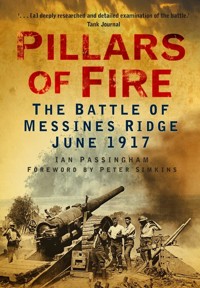
'Gentleman, we may not make history tomorrow, but we shall certainly change the geography.' So said General Plumer the day before 600 tons of explosives were detonated under the German position on Messines Ridge. The explosion was heard by Lloyd George in Downing Street, and as far away as Dublin. Until 1918, Messines was the only clear cut Allied victory on the Western Front, coming at a time when Britain and her allies needed it most: boosting Allied morale and shattering that of the Germans. Precisely orchestrated, Messines was the first true all-arms modern battle which brought together artillery, engineers, infantry, tanks, aircraft and administrative units from a commonwealth of nations to defeat the common enemy. So why is its name not as familiar as the Somme, Passchendaele or Verdun? This book examines the battle for the Messines-Wytschaete Ridge from the British, ANZAC and German perspectives. Illustrated with archive photographs and maps, it is a major contribution to our understanding of one of the seminal battles of the First World War.
Sie lesen das E-Book in den Legimi-Apps auf:
Seitenzahl: 366
Veröffentlichungsjahr: 2012
Das E-Book (TTS) können Sie hören im Abo „Legimi Premium” in Legimi-Apps auf:
Ähnliche



















To Sally, Joe and Ellie,
for their support, patience and encouragement over the years;
In loving memory of my father and mother,
who remain a inspiration;
and
to the men who fought at Messines
and deserve perpetual recognition
for their skill, courage, sacrifice and achievement.
Acknowledgements
My first association with the remarkable story of the Battle of Messines came whilst on a battlefield tour in 1996 when Professor Peter Simkins was the guest speaker and I was amazed to discover that no book existed that covered the successful assault by the BEF’s Second Army in June 1917 in a singular way. I was encouraged to fill the gap and did so, with the excellent help of the then Sutton Publishing in November 1998, which was followed by the paperback edition in 2000. Now The History Press has agreed to republish Pillars of Fire to mark the 95th Anniversary of the battle and I am delighted to have the opportunity to make it available for a new generation of historians and also to those whose relations may have fought at Messines and wish to augment their family histories and learn more about a remarkable achievement of one of their kith and kin in a war that remains so often clouded by failure, rather than ultimate victory. The process of turning ideas into the printed word is a fascinating and complex one and therefore help, contributions, opinions and good advice, whether small or large, are always most welcome. I have realised over the passage of time that research and authorship of military history, in this case, cannot be achieved in splendid isolation.
Therefore, the extensive list of acknowledgements provided in the original edition of Pillars of Fire remains extant and is reproduced below; but others should be acknowledged here. First and foremost, Jo de Vries, Senior Commissioning Editor Military History at The History Press, has been instrumental in bringing this book, as well as that on the German Army on the Western Front, All the Kaiser’s Men, into the public domain once more. The History Press has kept faith with my previous work and has more recently commissioned another book, based on medical support to a frontline Australian infantry battalion on the Western Front in 1917 and 1918, to be published in 2013. While every effort has been made to contact and acknowledge copyright holders of the references and illustrative material used in this publication, if any copyright holders inadvertently have been omitted they should contact The History Press directly.
Over the past decade or so I have had outstanding assistance from the Imperial War Museum Library and Archive, Department of Printed Books, Photographic, Map and Sound Archives and particular assistance from Mary Wilkinson, Simon Robbins, Stephen Walton, Angela Wootton, Chris Hunt, Colin Bruce and Peter Hart. The same goes for the National Archive (formerly PRO), plus the Bundesarchiv and the German Historical Institute, as well as other sources of the German perspective for the book. Peter Liddle and Matthew Richardson gave me free access and considerable assistance in trawling through the Liddle Collection at the Brotherton Library, University of Leeds and the staff of both the Royal Engineers Library & Museum and The Royal Regiment of Artillery Institution at Woolwich were most helpful in guiding me through the extensive primary and secondary source material held there.
My visit to the Australian War Memorial, Canberra, was pivotal in my research. The help from all the staff and resources provided there was outstanding. My particular thanks must go to Peter Stanley for his eager encouragement of my journey ‘down under’ in the first place; Ian Smith, Head of the Research Department and every one of his staff; Tim Roberts and the Photographic Archive; Peter Londey; Ashley Ekins and Peter Burness. I am most grateful to Dr Robin Prior, the Australian Defence Force Academy (ADFA), the University of New South Wales, for his interest and comments on my views. The AWM gave me access to the extraordinary collection of diaries, letters and memoirs which have also helped me to paint a more vivid picture of the period by those who were there to experience it.
Other individual contributions were extensive: veterans, especially Walter Humphrys, and the narratives of many others, including Sapper John McCreesh, Kiwi ‘Sapper’ Edward Leslie (Les) Hughes and Ky Walker were all brought back to the fray so vividly by their families who I was immensely privileged to meet. Other considerable help was offered and gratefully received from Jacques Ryckebosch, Albert Ghekiere, Alexander Barrie, Philip Robinson, Peter Barton, Peter Oldham, Dr Bill Philpott, Giles Allen and Cyril Coombes, as well as the many Holts’ travellers and members of the Western Front Association (WFA) who have shared a comment or two with me and helped to keep me on the right track; and to Freddie Cohen for providing some excellent photographs that were donated from the private Plumer family collection.
I shall be forever indebted to Holts Battlefields and History Tours for giving me the opportunity to travel on the ‘Australians on the Western Front’ trip in September 1996 that led to Pillars of Fire with the encouragement, faith and stoicism of the former Managing Director, Isobel Swan, who ‘challenged’ me to fill the gap in the historiography of military history at a bar in a certain hotel in Ypres (The Ariane) all those years ago!
To John Lee, Stephen Young and Joy Thomas I pass on my heartfelt acknowledgement of their assiduous work in reading and adding clarity to my original draft. Above all, I send my special thanks to Marie Joly for taking my rough sketches and often dubious ideas on graphics and creating such professional maps covering Messines and Third Ypres in particular.
Finally, Professor Peter Simkins agreed to write the foreword for the original publication and has kindly done so for this latest edition, for which I am even more grateful. It has been my immense privilege to have worked with and enjoyed his company on further historical tours and at conferences, seminars and other functions at the University of Birmingham, the Western Front Association (WFA) and British Commission for Military History (BCMH), amongst others, over the years.
Contents
Title
Dedication
Acknowledgements
List of Photographs and Plates
Maps/Diagrams
Glossary and Introductory Notes
Foreword
Preface
1 Prelude
2 An Orchestra of War
3 Instruments of War
4 Across the Wire: Towards ‘Soldatendämmerung’
5 Overture: 1–6 June
6 ‘The Messines Symphony’ – First Movement and Phase One:
‘Soldatendämmerung’: a.m. 7 June
7 Second Movement and Phase Two: ‘Strike the Chord’: p.m. 7 June
8 Third Movement: ‘Not a Retreat, merely a Withdrawal’: 8–14 June
9 Fourth Movement: ‘Opportunity Gained … and Lost’
10 Finale: Repercussions – Third Ypres, Cambrai and Crisis
11 Coda: The Legacy of Messines
12 Postscript: ‘To my chum’
Appendix 1
Appendix 2
Select Bibliography
Copyright
List of Photographs and Plates
1 Gen Erich von Ludendorff and FM Paul von Hindenburg with the Kaiser. (IWM: Q23746)
2 Maj-Gen Sir John Monash, GOC 3rd Australian Division at Messines. He was to become Commander of the Australian Corps in 1918. (IWM: E (Aus) 2350)
3 Pte Walter Humphrys and his colleagues prior to leaving for the Western Front. (Private Collection)
4 Capt Oliver Woodward and fellow officers of 1st Australian Tunnelling Company, June 1917. (RAE Archives and AWM P02333.002)
5 FM Sir Douglas Haig, Commander-in-Chief (C-in-C) BEF from December 1915. (IWM)
6 Gen Sir Herbert Plumer, Commander Second Army, with Gen Horne (First Army) and Gen Sir Edmund (‘Bull’) Allenby (Third Army), Army Commanders’ Conference concerning plans for 1917, held on 14 February 1917. (IWM: Q1764)
7 British Prime Minister Lloyd George, who had succeeded Herbert Asquith in December 1916. (IWM: Q72740)
8 Gen Sir Hubert Gough, Commander Fifth Army. (Q 2176)
9 Headquarters (HQ) Second Army: Commander and Staff, June 1917. (Courtesy of Plumer family private collection)
10 Maj-Gen W.B. ‘Willie’ Hickie, GOC 16th (Irish) Division, with Cardinal Bourne and Brig F.W. Ramsey (48th Brigade). (IWM: Q1650)
11 Troops from 3rd Australian and 25th Divisions study the scale model of the battlefield, 6 June. (IWM E (Aus) 632/IWM: Film Archive, IWM 197 Reel 1)
12 Troops of 3rd Australian Division leaving the scale model area. (IWM: Film Archive, IWM 197 Reel 1)
13 Troops of the New Zealand (NZ) Division conduct rehearsals near Scherpenberg for the forthcoming battle, 2 June 1917. (IWM: NZ H29)
14 Interior of an Artillery Group HQ dugout. (IWM: E (Aus) 690)
15 British 18-pounder battery in action. (IWM: Q2.296)
16 Messines preliminary bombardment: 6-inch Mk VII gun in action on 5 June. (IWM: Q5459)
17 Messines preliminary bombardment: 8-inch Mk V Howitzer in action, 31 May. (IWM: Q2297)
18 Messines preliminary bombardment: battery of guns of NZ Division in a wood, 5 June. (IWM: NZ H54)
19 Preliminary bombardment of Messines in early June. The shell explosion on the horizon marks the site of Messines church. (IWM: Q2295)
20 Messines: the shell-blasted church, 1917. (Courtesy of the Liddle Collection)
21 Sopwith triplanes. (IWM: Q66794)
22 SE 5 aeroplane. (IWM: Q67000)
23 Spad S7 Scout. (IWM: MH3381)
24 German Albatros. (IWM: Q69327)
25 Mk II supply tank and Mk IV fighting tank, Messines Ridge. (IWM: E (Aus) 1419)
26 Sappers building a light railway towards forward positions. (IWM: 2814)
27 Major John Norton-Griffiths (hands in pockets) ‘on tour’, Ypres Salient. (Courtesy of RE Library and Museum, Chatham)
28 Sapper John McCreesh (sitting), 250 Tunnelling Company. Sapper Henry James Gibson is standing on the end of the second row and behind McCreesh. (Mr Terry Middleton)
29 A typical tunnel. (IWM: E (Aus) 2095)
30 Laying a mine. (IWM: Q115)
31 A tunneller demonstrates the Proto-Mask, used for mine rescue work. (IWM: E (Aus) 1683)
32 Australian sappers at the main entrance to the Catacombs, Hill 63. (IWM: E (Aus) 4487)
33 Gen der Kavallerie von Laffert, Commander Gruppe Wytschaete. (Times Illustrated History of the Great War/IWM)
34 Gen Sixt von Armin, Commander German Fourth Army. (Times Illustrated History of the Great War/IWM)
35 German defences within the Wytschaete-Bogen: I (‘Bild 18’: Courtesy of Peter Oldham)
36 Crown Prince Rupprecht. (Bundesarchiv)
37 German defences within the Wytschaete-Bogen: II (‘Bild 19’: Courtesy of Mr Peter Oldham)
38 German machine-gun crew. (IWM: Q23.709)
39 German 77mm field gun in action. (IWM: Q23.701)
40 German Eingreif (counter-attack) troops taking cover in a shell hole. (IWM: Q23934)
41 3rd Bavarian Tunnelling Company troops. (Bundesarchiv)
42 The inner chamber of a German tunnel. (Bundesarchiv)
43 The effects of a British camouflet after it had destroyed the same chamber. (Bundesarchiv)
44 Dogs were used to bring rations, water and ammunition to the German defenders of Wytschaete-Bogen. (IWM: 23700)
45 The effects of a large mine, similar to those blown at Messines. (IWM: Q572)
46 The craters caused by the Petit Bois mines. (Courtesy of the Liddle Collection)
47 Spanbroekmolen after the mine had ripped it apart. (Courtesy of the Liddle Collection)
48 A view from inside the crater at Spanbroekmolen. The men at the rim provide an excellent idea of the scale. (Courtesy of the Liddle Collection)
49 The effects of the mines blown at Trench 122 by Capt Cecil Hall. A German bunker turned upside down at Factory Farm. (IWM: E (Aus) 1269)
50 The leading battalions of the NZ Division advance towards Messines on the morning of 7 June. (IWM: NZ H29)
51 Pte John Carroll VC, 33rd Battalion, 9th Brigade, 3rd Australian Division. (AWM D15)
52 L/Cpl Samuel Frickleton VC, NZ Rifle Battalion, NZ Division. (IWM)
53 Messines after its capture: general view. (Courtesy of Liddle Collection)
54 Messines after its capture: ruined houses and remains of the German defences. (Courtesy of Liddle Collection)
55 Sappers and infantry pioneers dig communication trenches during the battle. (IWM: Q5788)
56 Troops carrying supplies forward using Yukon packs. (IWM: Q2815)
57 Pack-mules move up the line: p.m. 7 June. (IWM: Q2318)
58 The devastated village of Wytschaete after it had fallen to 16th Irish and 36th Ulster Divisions. (IWM: Q5460)
59 German prisoners and wounded move past Mk IV tanks, 7 June. (IWM: E (Aus) 3931)
60 German prisoners en masse, 8 June. (IWM)
61 NZ Pioneers lay a new road immediately after the taking of Messines village and the Ridge. (IWM: NZ H61)
62 A typical Eingreif (counter-attack) soldier. Counter-attack troops were the backbone of the new flexible (or elastic) in-depth defence adopted by the German army in the West in 1917. However, they were to prove ultimately as vulnerable to British artillery and direct-fire weapons as their predecessors had been in the early months of the Somme campaign. (Courtesy of the German Historical Institute)
63 NZ Sapper Edward Leslie (‘Les’) Hughes before the battle. (Courtesy of Mrs Y. Fitzmaurice)
64 Capture of the Oosttaverne Line, p.m. 7 June: looking east from Wytschaete to Oosttaverne Wood. (Courtesy of Liddle Collection)
65 Capture of the Oosttaverne Line, p.m. 7 June: looking east from Messines. (Courtesy of Liddle Collection)
66 Capt Bob Grieve VC, 37th Battalion, 3rd Australian Division. (AWM)
67 German artillery shells hit the road near Red Lodge (Hill 63 area). (IWM: E (Aus) 609)
68 A British barrage seen from the air on 7 June. (Courtesy of the Liddle Collection)
69 The terrible effects of a heavy artillery bombardment. (IWM: Q3117)
70 German prisoners sleep after their ordeal. (IWM: 2281)
71 German prisoners and wounded: all exhausted. (IWM: Q2282)
72 British wounded: p.m. 7 June. (IWM: Q5473)
73 NZ Division Advanced Dressing Station (ADS) near Messines, a position occupied by Capt William Aitken, an RMO during the battle on 7 June. (IWM: NZ H62)
74 German retaliation later in the battle: heavy shelling of Messines. (IWM: Film Archive, IWM 197 Reel 1)
75 Pte William Ratcliffe VC, 2nd Battalion the South Lancashire Regiment (Prince of Wales’s Own), 25th Division. (IWM)
76 Sapper Les Hughes after the battle – just to let everyone back home that he was still OK. (Courtesy of Mrs Y. Fitzmaurice)
77 Writing home from Oosttaverne Wood. (IWM: Q2308)
78 Pte Walter Humphrys and his platoon at St Omer ‘at rest’ after the battle, 17 June 1917. (Courtesy of Humphrys’ private collection)
79 ‘And Irish eyes are smiling’: the Royal Dublin Fusiliers clowning around with their trophies. (IWM: Film Archive, IWM 197 Reel 2)
80 British gunners struggling to haul an 18-pounder out of the mud, 9 August 1917. (Third Ypres). (IWM)
81 Australian troops march through the ruins of Ypres, September 1917. (IWM: E (Aus) 1171)
82 German prisoner ‘in the bag’ after Broodseinde, 5 October 1917. (IWM: Q3067)
83 Slugging it out on both sides of the wire, mid-October 1917. (IWM: E (Aus) 1200)
84 ‘We will not be beat.’ Keeping warm through another perishing winter. (IWM: E (Aus) 1224)
85 FM the Viscount Plumer ‘of Messines’, 1919. (Courtesy of the Plumer family)
86 Messines Ridge today: facing Messines church, looking from Messines Ridge Commonwealth War Graves Commission (CWGC) Cemetery. (I.P.)
Maps/Diagrams
Map 1: The Western Front. (I. Passingham/Geocad April 1998)
Map 2: The Ypres Salient (1917). (I. Passingham/Geocad April 1998)
Map 3: Plan for a Flanders Campaign, February 1917. (Official History: 1917, vol. II: Sketch 2; Historical Section, Military Branch; Courtesy of Mary Wilkinson, Department of Printed Books, IWM)
Map 4: Second Army Area railways and railheads, June 1917. (Official History: 1917, vol. II: Sketch 4; Historical Section, Military Branch; Courtesy of IWM)
Map 5: Siegfried Stellung – the Hindenburg Line – April and May 1917. (German Official History, vol. 12 (1917): Map set No. 7: Die Siegfried Bewegung, ‘Ende März/Mai 1917)
Map 6: Messines, June 1917. Outline plan for 7 June. (I. Passingham/Geocad April 1998)
Map 7: Wytschaete: Second Army/IX Corps Intelligence estimate of enemy dispositions as at 22 May 1917. (PRO: WO 153/234/235: Scale 1:5,000; dated 22 May 1917)
Map 8: Messines: principal defensive layout, 1917. (Adapted from NZ Divisional Map, 1917, courtesy of IWM)
Map 9: Messines, June 1917: dispositions of RFC squadrons. Adapted from H.A. Jones, The War in the Air: Official History, 1914–1918, vol. II (London, HMSO/Hamish Hamilton, 1936/1969). (I. Passingham/Geocad April 1998)
Map 10: Messines, June 1917: front lines and mines. (I. Passingham/Geocad, April 1998)
Map 11: The Messines mines – particulars. (Source: PRO: Appendix 3 to WO 106/387: Maj-Gen R.N. Harvey, Mining in France 1914–1918)
Diagram: Mining and tunnelling (horizontal and vertical sections). (I. Passingham, 1998)
Diagram showing a ‘clay kicker’. (Source: W. Grant Grieve and Bernard Newman, Tunnellers (London, Herbert Jenkins Ltd, 1936), p. 34)
Map 12: The ‘Berlin’ Tunnel. (Source: PRO: Appendix 3 to WO 106/387: Maj-Gen R.N. Harvey, Mining in France 1914–1918)
Map 13: German zones in flexible (elastic) defence-in-depth. Adapted from Timothy T. Lupfer, The Dynamics of Doctrine: the changes in German tactical doctrine during the First World War (Fort Leavenworth, Combat Studies Institute, 1981)
Map 14: Enemy dispositions, Second Army front, 4 June 1917. Assessment corrected to situation just three days prior to Second Army’s attack. Note that 3rd Bavarian Division is still expected to act in its Eingreif (counter-attack) role. (PRO: WO 153/238. Map Scale: 1:40,000, Ordnance Survey, 2 FSC 1830 18 April 1917, intelligence map update 4 June 1917)
Map 15: Messines, June 1917: battle map. (I. Passingham/Geocad, April 1998)
Map 16: Messines, June 1917: Second Army attack map (negative, showing battle phase lines). (PRO: WO 153/237 & WO 256/19; vol. XVII, June 1917)
‘La Victoire des Sapeurs Anglais – Messines’: French cartoon, Le Petit Journal, 12 June 1917. (Liddle Collection)
Map 17: Battle of Messines: X Corps area. (Liddle Collection)
Map 18: Battle of Messines: IX Corps diagram of IX Corps area and the attack. (PRO: WO 153/234/235: Scale 1:20,000; Ordnance Survey GSGS 2742, dated June 1917)
The Kiwis (NZ Division) storm Messines, a.m., 7 June. The bombers are holding a point of vantage while Lewis guns are hurriedly brought up. (Illustrated London News/IWM)
Map 19: Die Schlacht im Wytschaete-Bogen im Juni 1917 (German Official History, map of the battle, showing direction of abortive counter-attacks on 7 June. (German Official History, vol. 12, (1917)
Map 20: The situation at Messines at 11.30 hours on 7 June. (From: C.E.W. Bean, Official History of Australia in the War: vol. IV, The AIF in France, 1917 (Sydney, Angus & Robertson, 1938–42)) (AWM)
Map 21: ‘Strike the Chord’, Phase Two: the assault on the Oosttaverne Line/plan of attack and the ground to be captured on 7 June. (From: C.E.W. Bean, ANZAC to Amiens: A Shorter History of the Australian Fighting Forces in the First World War (Canberra, AWM, 1946); courtesy of the Australian War Memorial) (AWM)
Map 22: Messines, June 1917: the end of the battle. (I. Passingham/Geocad)
Map 23: Die Schlacht im Wytschaete-Bogen – Die Lage am 12 Juni 1917. German Official History map of the battle, showing the situation on 12 June, from German intelligence and operational reports. (German Official History, vol. 12 (1917)
Map 24: German Flanders positions (July 1917). (I. Passingham/Geocad)
Map 25: Third Ypres campaign: 31 July to 6 November 1917. (I. Passingham/Geocad)
Map 26: Cambrai: 20 November to 6 December 1917. (Official History, 1917, (Volume III), Cambrai; Map Sketch A. (Reproduced courtesy of Mary Wilkinson, Department of Printed Books, IWM)
Glossary and Introductory Notes
AA&QMG
Assistant Adjutant & Quartermaster General.
A Branch
Adjutant General’s Branch of the General Staff: responsible for administration, discipline and awards.
ADMS
Assistant Director of Medical Services.
ADS
Advanced Dressing Station – most forward medical treatment posts behind the Regimental Aid Post (RAP).
AHQ
Army Headquarters.
AMC
Army Medical Corps: later to become Royal Army Medical Corps (RAMC).
Anzac
Australian and New Zealand Army Corps (used as term for all Australian and NZ troops).
AP
(Medical) Aid Post.
APM
Assistant Provost (Military Police) Marshal.
Area Shoot
Term used for artillery/mortar saturation bombardment of a targeted enemy area.
Army Troops
Supporting units (e.g. transport, services, logistics units in general) attached to divisional order of battle from army resources for miscellaneous duties.
Arty
Artillery.
ASC
Army Service Corps (Logistics support units), later to become Royal Army Service Corps (RASC).
Aus
Australian.
Aussie
Australian.
BAB
‘Bab code’ British telephone code-book post-1916.
Banjo
Australian slang for a spade.
Barrage
Artillery bombardment (different types shown in glossary).
Battery
Artillery sub-unit, level equivalent to an infantry company. Commanded by a Major.
Battle bowler
British slang for the steel helmet.
Battle Order
Reduced infantry order of dress and equipment, worn for action. Also known as ‘fighting order’, it disposed of the main back-pack and consisted of steel helmet, gas-mask, haversack for emergency rations and spare ammunition, webbing-belt, water bottle(s) and ammunition pouches. This facilitated freedom and speed of movement in battle.
Bde/bde
Brigade – infantry bde – fighting unit of four infantry battalions, plus supporting artillery, engineer and other support units – approximately 5,000 men. Commanded by a Brigadier/Brigadier-General.
BEF
British Expeditionary Force (original term was used for the British force sent to France and Belgium in 1914, although the term was used throughout the war to describe the total British and Empire forces deployed in the conflict).
BGGS
Brigadier-General, General Staff.
Bn/bn
Battalion (infantry, approximately 650–800 men in 1917, comprising four rifle companies, support (heavy weapons) company and HQ company). Commanded by a Lieutenant-Colonel.
BGHA
Brig-Gen Heavy Artillery.
BGRA
Brig-Gen Royal Artillery. Commander of the Corps artillery units.
BGRE
Brig-Gen Royal Engineers. Commander of the Corps engineer (‘Sapper’) units.
‘Black Hand Gang’
Expression used for a trench-raiding party.
Blighty
Common expression used for Britain (or the mother-country for some Empire troops) – ‘Getting a Blighty one’ meant being wounded seriously enough to be evacuated home: those who did were often a source of envy for their mates who had come through a battle unscathed.
‘Blue Caps’
Nickname for the Royal Dublin Fusiliers (dating back to the Indian Mutiny).
Boche
French term for German and adopted by most Allied troops. (Sometimes seen as Bosche.)
Bomb
British term for hand-grenade.
Bombardier
RA rank equivalent to corporal.
Bomber
Infantry soldier tasked as grenade-man for attacks against enemy positions.
Bomb-proof
Well-defended position, position or dug-out which is well protected against enemy artillery or mortar bombardments. Also used colloquially to describe a lucky or clever soldier or officer.
Bomb-stop
Barricade built within a trench as an obstacle to enemy attackers.
Bonk/Bonking
To shell/shelling the enemy.
Bonzer/Bonza/bosker
Australian slang for good, or very good.
Box barrage
Artillery barrage targeted on a small (‘box’) area, often to protect troops carrying out a limited attack, such as a trench raid.
Bracket
Artillery method of finding the correct range to a target. Guns would ‘bracket’ and fire on a target area, observed by an artillery (gunner) forward observation officer (FOO). The FOO would then correct the range and direction of the guns via telephone reports to the artillery gun-line until the shells were landing ‘on target’.
Brass/The Brass
Generally derogatory term used by the troops and more junior officers for senior officers and the General Staff officers.
Brig/Brig-Gen
Brigadier/Brigadier-General.
Bully Beef
Canned corned beef; as the hors d’oeuvre to ‘Plum and Apple’ jam, the staple diet of most of the BEF!
Bung
Processed cheese issued to the men: also known as ‘cheese possessed’. Known as ‘bung’ for its uncanny ability to reduce the need to visit the latrines.
Bunker
German protective position, normally reinforced concrete, designed to protect HQs, medical units and shelter for forward troop concentrations etc.
Cable
Telephone land-line, generally buried to protect it against artillery fire.
Cage/PW Cage
Prisoner of War (PW) cage – a fenced and guarded PW camp close to the front line.
Camouflet
Counter-mining explosives-chamber used for destroying or disrupting the use of enemy mine-tunnels.
CB fire
Counter-Battery fire: artillery bombardment to neutralise or destroy enemy artillery batteries.
CCS
Casualty Clearing Station – main medical site behind the front-lines. Site would be tented or hutted camp.
CEF
Canadian Expeditionary Force.
CHA
Commander Heavy Artillery (of a corps).
C-in-C
Commander-in-Chief.
CO
Commanding Officer (normally of a battalion-sized unit), usually Lt-Col rank.
Company/Coy
Company. Infantry company: a tactical sub-unit of four platoons, plus company HQ. Approximately 150 men in 1917. Commanded by an OC (Officer Commanding), a Major or Captain.
‘Cord’ road
Corduroy trackway laid over uneven, broken or muddy ground, built from cords of wood laid at right angles to the direction of the path.
Corps
Formation usually consisting of three or four infantry divisions, with artillery, engineers, tanks, cavalry and other supporting and logistic units as part of the order of battle (ORBAT). Commanded by a Lieutenant-General (Lt-Gen) as General Officer Commanding (GOC).
CRE
Commander Royal Engineers.
Creeping barrage
Artillery bombardment (designed to protect advancing infantry while neutralising enemy defenders) which extends its range at timed intervals. Introduced to BEF in September 1916, as an improvement to the ‘lifting barrage’.
Crump
Shell-burst.
CSM
Company Sergeant Major.
CT
Communication Trench: narrow trench dug at an angle to a defensive trench to permit concealed entry to the trench.
Curtain fire
Artillery barrage, like creeping barrage, designed to provide a ‘curtain’ of artillery fire between advancing troops and the enemy.
DAG
Deputy Adjutant General.
DAQMG
Deputy Adjutant & Quartermaster General.
DCM
Distinguished Conduct Medal.
DGMS
Director General Medical Services.
Digger
Australian (though also used at the time to describe New Zealanders; the generic term referred to the early gold miners in both countries).
Dinkum
Australian slang for good news, or an excellent comrade (as an example, ‘a dinkum’ was a Gallipoli veteran).
Direct Fire
Small-arms, machine-gun, tank and gun fire which is observed by the firer and therefore aimed directly at the target. (Compare indirect fire.)
Div
Division: Allied: tactical formation of three infantry brigades, with artillery, engineers, and other supporting arms and services under command. Approximately 15,000–20,000 men, depending on its role. Commanded by a Major-General as GOC.
Division
German: tactical formation of two or three infantry regiments, with artillery, engineers, and other supporting arms and services under command. Approximately 12,000–17,000 men, depending on its role. Commanded by a Colonel or Major-General.
DOW
Died of Wounds.
DQMG
Deputy Quartermaster General.
Dreckfresser
‘Mud eater’: German slang for an infantryman.
Drumfire
Artillery barrage fired by each gun in succession, rather than a salvo (simultaneous firing of the guns). So called because of the drum-roll sound of its effect.
DSO
Distinguished Service Order.
Duckboard
Wooden paletted plank used to cover trench floors or cross muddy ground.
Dug-out
Shelter made in the wall of a trench, ranging from a small alcove (‘funk-hole’) to large underground rooms (normally HQs, medical aid posts, etc).
Egg grenade
Small German egg-shaped hand-grenade.
E-in-C
Engineer-in-Chief: Chief Sapper, based at GHQ.
Eingreif-
German independent counter-attack unit (Regimental or Divisional level), specifically trained for counter-attack tactics.
‘Erk’
Fitter/mechanic in Royal Flying Corps or RAF, (abbreviation of ‘air mechanic’).
Feldwebel
German rank, equivalent to company sergeant major (CSM).
Festung
German term for fortress.
Fire trench
Front line trench.
Five-nine
British term for the German 5.9-inch shell.
Flight
Smallest RFC sub-unit, consisting of five or six aircraft.
FOO
Forward Observation Officer – artillery/mortar spotter of indirect fire.
Funk-hole
Individual dug-out.
Gefreiter
German rank, equivalent to lance-corporal.
GHQ
General Headquarters, BEF.
GOC
General Officer Commanding.
Gruppe
German Corps, its principal resource being infantry divisions, artillery and engineer units, plus supporting logistic and administrative units.
GS
General Service.
GSO
General Staff Officer.
Gunner
Officer or soldier serving in the Royal Artillery (RA).
HAG
Heavy Artillery Group.
Hard tack
British army biscuits (iron rations).
HE
High Explosive.
HQ/Hqrs
Headquarters.
Hun
Allied slang for Germans.
‘I’ Branch
Intelligence branch of HQs at battalion-level and above.
Identity (‘ID’) Disc
Also known as ‘Dog-tag’. Name-tag bearing the name, initials, service number, unit and religion of an individual. Made of metal, or more commonly a form of compressed fibre. From 1916/1917, British servicemen wore two: One to remain on the body to ensure proper identification for reburial and the second, removed and passed through the reporting chain as proof of death.
Indirect Fire
Artillery, mortar and machine-gun fire which is not observed by the firers, but predicted or observed and adjusted by forward observation officers (FOOs).
Interdiction
Long-range artillery fire and bombing from the air to destroy or neutralise enemy lines of communication, supply dumps and troop concentration areas; designed to isolate the main battlefield from reinforcement and resupply.
Iron ration
Emergency rations carried by men in battle order: normally bully beef, biscuits (hard tack), tea, sugar, extra water bottle and a ‘brew kit’ to allow for boiling of water.
Jerry
German.
Jump
To jump off was to begin an attack. Jumping-off positions, or jumping-off lines were the equivalent of the start-line (SL), or in more current military terms, the line-of-departure (LoD).
Kamerad
German for comrade or friend. Used as a gesture of surrender.
‘K’ ammunition
German armour-piercing bullets with steel core, (German: Kern-Munition). An effective anti-tank bullet against the earlier types of British tank, but ineffective against the Mk IV type used at Messines and subsequent battles.
KIA
Killed in Action.
‘Kite’ balloon
Observation balloon, so called as it was attached to a cable to control it from the ground.
Kiwi
New Zealander.
Maj-Gen
Major-General.
MG
Machine gun.
MGRA
Maj-Gen Royal Artillery. Commanding artillery at Army HQ.
MIA
Missing in Action.
Minenwerfer
Also called ‘Moaning Minnie’: German trench mortar.
MM
Military Medal.
MO/RMO
Medical Officer/Regimental Medical Officer. Term normally refers to a doctor attached to a battalion or regiment (rather than a doctor at a hospital).
Mop-up
To neutralise or destroy pockets of enemy resistance.
MT
Motor Transport.
NCO
Non-Commissioned Officer. Any rank from lance-corporal (L/Cpl) to Warrant Officer Class I, normally a Regimental Sergeant Major (RSM). (Commissioned officers hold the ranks from Second-Lieutenant (2/Lt) to the most senior officer ranks, the highest being Field Marshal.)
No Man’s Land
Territory between the respective front lines.
NZ
New Zealand.
OC
Officer Commanding (normally of a company-sized unit): Captain or Major rank.
OHL
Oberste Heeresleitung – German General HQ.
OP/‘O. Pip’
Observation Post (‘O. Pip’).
ORBAT
Order of Battle.
Oz/Ossie
Australian.
PBI
‘Poor Bloody Infantry’: British slang to describe the eternal condition of life as an infantry officer or soldier.
Phonetic Alphabet
Introduced to avoid confusion in communications – certain letters of the alphabet were given distinctive pronunciations: A-Ack, B-Beer, D-Don, M-Emma, P-Pip, S-Esses, V-Vic; hence ‘O. Pip’, ‘Toc. H’, etc.
Pillbox
Reinforced concrete machine-gun or field-gun post.
Platoon
Infantry sub-unit comprising four sections and platoon HQ in 1917. Section is the smallest fighting group, approximately 8–10 men, commanded by a corporal. Platoon commanded by Lieutenant/ Second-Lieutenant (Lt/2/Lt), assisted by a Platoon Sergeant.
‘Possy’ or ‘Possies’
Australian slang for a defensive or other battle position(s).
‘Push’
Common expression for a major offensive.
RA
Royal Artillery.
RE
Royal Engineers.
Recce
Abbreviated term for reconnaissance.
Redoubt
Strongly fortified position in a trench system, with a labyrinth of tunnels and alternative defensive positions within it.
Regiment
Allied – Cavalry, RE unit, level equivalent to infantry battalion.
Regiment
German – Unit of three battalions, roughly equivalent to a British Brigade.
Register
Confirming fall of artillery or mortar rounds by firing ‘trial’ shots to observe and adjust them on to their target.
RFA
Royal Field Artillery.
RFC
Royal Flying Corps.
RGA
Royal Garrison Artillery.
RNAS
Royal Naval Air Service.
Rocade
Light trench railway which ran parallel to the front line.
RSM
Regimental Sergeant Major. The most senior NCO in a unit such as an infantry battalion, RA regiment, etc.
Russian sap
Narrow trench dug as if a mine shaft, allowing attacking infantry to cross under part of no man’s land without being detected by the enemy.
Salient
Bulge in front line which protrudes (often precariously) into enemy territory. The ‘Ypres Salient’ is the most enduring example of the First World War.
Sap
Narrow trench dug at an angle from an existing trench for a number of tasks in trench routine. It could be for a listening/observation or machine-gun post, as a communication sap between trenches, or as a covered approach to a main dug-out.
Sapper
Military engineer. Generic term for ‘combat’ and ‘support’ engineers in field companies and the ‘Tunnellers’.
SB
Stretcher Bearer (‘SB’ normally shown on SB’s armband with Red Cross to signify medical personnel).
SFA/San Fairy Ann
Sweet Fanny Adams – nothing! General expression of resignation to fate: San fairy Ann, a British version of the French expression: Ça ne fait rien: it doesn’t matter.
Shrapnel
Steel balls thrown out by an exploding shell. Shrapnel is a more commonly used term to describe shell splinters. These are the razor-sharp shards of metal which fly out on a shell’s detonation and which cause devastating damage to their victims.
Sicherheitsbesatzung-
German front line and main defensive garrison.
SIW
Self-inflicted wound.
SOS
Emergency protective artillery barrage on one of a number of pre-registered target areas. Normally ordered by the FOO attached to the threatened front line unit using a target number by telephone, or in extremis, by a series of coloured flares.
Stosstruppen
Local counter-attack troops of a sub-unit within a German division defending a front line.
Strafe
Bombardment or hail of fire, most commonly associated with the actions of the RFC/RAF fighter pilots in the last eighteen months of the war.
Stunt
Generally, a soldier’s term for an attack.
Sturmtruppen
German infiltration and specialist attack troops, their tactics developed in the latter part of 1917, and later used en masse for the German offensive (Kaiserschlacht) of 1918.
Subaltern
Officer with the rank of Lieutenant or Second-Lieutenant.
Suicide Club
Bombers (grenade-men in a raiding party, or in a major attack).
Tapes
Lines of tape, white or green, laid out to denote the jumping-off line prior to an attack.
Toc H
Talbot House, Poperinghe, near Ypres. An Everyman’s Club founded in 1915 on the suggestion of Colonel Reginald Talbot, whose brother Gilbert had been killed in the Ypres Salient. The Reverend ‘Tubby’ Clayton became its first warden. It was a haven for thousands of troops thereafter, its ethos encapsulated by the sign by the front door which, in effect, reads: ‘Abandon rank all ye who enter here’. It remains open as a ‘working museum’ to this day.
Tour
Period of front line service of a unit, routinely 4–7 days.
Trench-foot
Fungal infection suffered by the troops as a result of repeated exposure to wet and cold conditions. Often became gangrenous if not treated quickly.
Unteroffizier
German rank for NCO equivalent to senior corporal or Sergeant in BEF.
Very
Very light – flare fired from the Very pistol (named after the inventor).
WO
Warrant Officer or War Office.
Woodbine(s)
Australian nickname for British soldier, on account of the universally-smoked issued Woodbine cigarettes.
Woolly Bear
British term for the burst of a German shell, due to the amount and shape of the black smoke thrown out.
Zero
zero day – the day on which an attack or more general offensive began.
zero hour – the exact time at which the attack/ offensive would begin.
Introductory Notes
I have attempted to ensure that all abbreviations are used in full initially within the text. They appear in the glossary also.
The spelling of Flemish names varies, but for the purposes of this book, Mesen, the appropriate Flemish name, is replaced by Messines. Wytschaete (popularly known throughout the war as ‘Whitesheets’) is also used rather than Wijtschate which is seen on many more current maps. Bois de Ploegsteert/Ploegsteert Wood and Ploegsteert village are noted in the text as shown, or as ‘Plugstreet’ as it is still popularly known today. Many maps and books or pamphlets will show St Elooi, although St Eloi is preferred in the text of this book. The Flemish name for Ypres is Ieper, although Ypres is used throughout this text.
All German personalities, terms and units are shown throughout the text in italics to distinguish them from British personalities, terms and units.
The term ‘Soldatendämmerung’ alludes to Richard Wagner’s ‘Ring Cycle’ (Der Ring des Nibelungen), specifically to the ‘Götterdämmerung’ (‘The Twilight of the Gods’), indicating their imminent destruction.
The study has used the British, German, Australian and New Zealand Official Histories, Flandern 1917, and Alexander Barrie’s excellent War Underground as its main secondary sources, with the kind permission of the Imperial War Museum (IWM), Bundesarchiv, Australian War Memorial (AWM) and Alexander Barrie respectively. Naturally, many other primary and secondary sources were used, as the text and bibliography reflect.
Foreword
by
Peter Simkins
For the British and Dominion divisions serving on the Western Front under Field-Marshal Sir Douglas Haig, 1917 was a year of transition and mixed fortunes. In the collective folk-memory of Britain, Australia, Canada and New Zealand, the story of the fighting in France and Belgium that year is still largely dominated by images of the lunar landscape of the Ypres Salient and of the mud of Passchendaele, in which hope itself seemed to have drowned. There can also be little doubt that Haig’s forces – compelled by the French Army mutinies to bear the main burden of Allied offensive operations on the Western Front – were showing distinct signs of strain at the end of 1917. The war correspondent Philip Gibbs wrote that, for the first time, ‘the British Army lost its spirit of optimism, and there was a sense of deadly depression among the many officers and men with whom I came in touch’.
Such gloomy observations notwithstanding, the fact remains that the British Expeditionary Force (BEF) did not crack under the terrible pressure and was the only army on the Western Front capable of undertaking sustained offensive operations until the closing weeks of the year. The Etaples mutiny in September, which occurred at an infantry base camp and was prompted by a harsh training regime, did not represent a major collapse of morale in front-line units. Indeed, for those willing or able to take the long view, there had been some heartening achievements during 1917. These included the brilliant assault on Vimy Ridge by the Canadian Corps, and an advance of 31⁄2 miles by the British XVII Corps near Arras on 9 April; the storming of Messines Ridge in June; the methodical and powerful blows struck by Plumer’s Second Army at Ypres between 20 September and 4 October; and the penetration of the Hindenburg Line, facilitated by the massed deployment of tanks, at Cambrai on 20 November.
There is now growing agreement among historians that these successes are evidence of a discernible ‘learning process’ in the BEF during 1917 – a process of improvement which, however bloody, ultimately placed it at the technological and tactical cutting edge of the Allied armies on the Western Front by the final months of the war. Artillery provided the key to its successes. Creeping barrages – protective screens of shells moving in front of the advancing infantry – became a standard feature of attacks. Greater accuracy was ensured by better ammunition, by taking more account of meteorological conditions, and by making allowances for the individual characteristics, such as barrel wear, of each gun. German gun positions were more efficiently pinpointed by sound-ranging, flash-spotting and aerial photography. All these techniques made it possible to eliminate the need for lengthy preliminary bombardments and so restore surprise to the battlefield.
With the reorganization of the platoon, the infantry now attacked in more flexible formations, which encouraged initiative and manoeuvre, and they carried extra firepower in the form of rifle grenades and Lewis guns. Trench mortars and heavy machine-guns, often firing barrages, offered additional close support. Tanks, though prone to breakdowns and vulnerable to German artillery, helped the infantry to assault enemy trenches, overcome machine-gun nests and, sometimes, to advance beyond the range of their own artillery, while aircraft were also beginning to be used increasingly in a ground-attack role.
Given that many historians would judge the outstanding assault on Messines Ridge in June 1917 to be one of the most important indicators of the BEF’s ‘learning process’, it is perhaps all the more remarkable that so few detailed analyses of the battle have been published, particularly in recent years. Of course, one would not deny that the Messines attack is inextricably linked with the Third Battle of Ypres, to which it was the essential prelude and with which it is frequently bracketed by historians. Nevertheless, Messines has long merited a separate study and this lively, fascinating and timely account by Ian Passingham – himself a former infantry officer – will therefore do much to fill an obvious gap in the historiography of the First World War. Not the least of the author’s own achievements in this – his first – book is that he has paid due attention to what was happening on the German side of no-man’s-land, an aspect of First World War battles all too often ignored, avoided or, at best, sketchily covered by British writers, apart from Jack Sheldon. For these and other reasons, Ian Passingham’s contribution to the existing corpus of works on the Western Front in the First World War remains most welcome.
Peter Simkins
March 2012
Preface
In the public domain, the First World War casts a dark shadow over our history. It is a shadow which has generated all-encompassing myths about incompetent leadership, careless attitudes towards human life and the dreadful conditions which ‘our boys’ were forced to endure. All of these things did happen, and much of the First World War was characterised by siege warfare and stalemate which was broken only by often apparently futile and costly offensives. Also, the more objective narrative does not suit the idea that virtually every campaign was fought through clinging, sucking, porridge-like mud where British soldiers and their animals were dragged to their deaths as they struggled to advance a yard or two closer to the enemy front line. Certainly, these things did happen. There is no attempt here to suggest that they did not, or that when they did, the futility of war was apparent to even the most hardened soldier in any army. Nevertheless, that is not the whole story.
The problem with such sweeping perceptions of the First World War in particular is that in the past the importance of Allied successes has been qualified by subsequent failures and the view that the German army on the Western Front was able to inflict insufferable casualties without suffering similar or greater casualties. The German situation ‘across the wire’ as I prefer to call it, has been generally neglected. Stray shells or machine-gun bullets have never respected either rank or the colour of a uniform; clinging, sucking mud was just as effective in gripping a floundering jackboot as it was a hob-nailed one.




