


164,99 €
Mehr erfahren.
- Herausgeber: John Wiley & Sons
- Kategorie: Fachliteratur
- Serie: Polymer Science and Plastics Engineering
- Sprache: Englisch
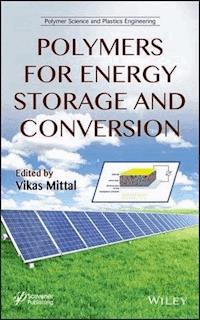
One of the first comprehensive books to focus on the role of polymers in the burgeoning energy materials market Polymers are increasingly finding applications in the areas of energy storage and conversion. A number of recent advances in the control of the polymer molecular structure which allows the polymer properties to be more finely tuned have led to these advances and new applications. Polymers for Energy Storage and Conversion assimilates these advances in the form of a comprehensive text that includes the synthesis and properties of a large number of polymer systems for applications in areas such as lithium batteries, photovoltaics, and solar cells. Polymers for Energy Storage and Conversion: * Introduces the structure and properties of polymer hydrogel with respect to its applications for low to intermediate temperature polymer electrolyte-based fuel cells * Describes PVAc-based polymer blend electrolytes for lithium batteries * Reviews lithium polymer batteries based on ionic liquids * Proposes the concept of the solar cell with organic multiple quantum dots (MQDs) * Discusses solvent effects in polymer-based organic photovoltaic devices * Provides an overview of the properties of the polymers that factor into their use for solar power, whether for niche applications or for large-scale harvesting * Reviews the use of macroporous organic polymers as promising materials for energy gas storage Readership Materials scientists working with energy materials, polymer engineers, chemists, and other scientists and engineers working with photovoltaics and batteries as well as in the solar and renewable energy sectors.
Sie lesen das E-Book in den Legimi-Apps auf:
Seitenzahl: 349
Veröffentlichungsjahr: 2013
Ähnliche


















Contents
Cover
Half Title page
Title page
Copyright page
Preface
List of Contributors
Chapter 1: High Performance Polymer Hydrogel Based Materials for Fuel Cells
1.1 Introduction
1.2 Hydrogel Electrolyte
1.3 Poly(vinyl alcohol) Hydrogel
Summary
References
Chapter 2: PVAc Based Polymer Blend Electrolytes for Lithium Batteries
2.1 Introduction
Conclusion
References
Chapter 3: Lithium Polymer Batteries Based on Ionic Liquids
3.1 Lithium Batteries
3.2 Lithium Polymer Batteries Containing Ionic Liquids
Glossary
References
Chapter 4: Organic Quantum Dots Grown by Molecular Layer Deposition for Photovoltaics
4.1 Introduction
4.2 Molecular Layer Deposition
4.3 Concept of Solar Cells with Organic Quantum Dots
4.4 Polymer Multiple Quantum Dots
4.5 Molecular Multiple Quantum Dots
4.6 Waveguide-Type Solar Cells
4.7 Summary
References
Chapter 5: Solvent Effects in Polymer Based Organic Photovoltaics
5.1 Introduction
5.2 Solar Cell Device Structure and Prepartion
5.3 Spin-Coating of Active Layer
5.4 Influence of Solvent on Morphology
5.5 Residual Solvent
5.6 Summary
Acknowledgment
References
Chapter 6: Polymer-Inorganic Hybrid Solar Cells
6.1 Introduction
6.2 Hybrid Conjugated Polymer-Inorganic Semiconductor Composites
6.3 Conclusion
References
Chapter 7: Semiconducting Polymer-based Bulk Heterojunction Solar Cells
7.1 Introduction
7.2 Optical Properties of Semiconducting Polymers
7.3 Electrical Properties of Semiconducting Polymers
7.4 Mechanical Properties Polymer Solar Cells
7.5 Processing of Polymers
7.6 State-of-the-art of the Technology
References
Chapter 8: Energy Gas Storage in Porous Polymers
8.1 Introduction
8.2 Microporous Organic Polymers
8.3 Characterization of MOPs
Conclusion
List of Abbreviation
References
Index
Polymers for Energy Storage and Conversion
Scrivener Publishing 100 Cummings Center, Suite 541J Beverly, MA 01915-6106
Polymer Science and Plastics Engineering
The “Polymer Science and Plastics Engineering” series publishes both short and standard length monographs, textbooks, edited volumes, practical guides, and reference works related to all aspects of polymer science and plastics engineering including, but not limited to, renewable and synthetic polymer chemistry and physics, compositions (e.g. blends, composites, additives), processing, characterization, testing, design, and applications. The books will serve a variety of industries such as automotive, food packaging, medical, and plastics as well as academia.
Series Editor: Srikanth Pilla, PhD Wisconsin Institute for Discovery University of [email protected]
Publishers at Scrivener Martin Scrivener ([email protected]) Phillip Carmical ([email protected])
Copyright © 2013 by Scrivener Publishing LLC. All rights reserved.
Co-published by John Wiley & Sons, Inc. Hoboken, New Jersey, and Scrivener Publishing LLC, Salem, Massachusetts. Published simultaneously in Canada.
No part of this publication may be reproduced, stored in a retrieval system, or transmitted in any form or by any means, electronic, mechanical, photocopying, recording, scanning, or otherwise, except as permitted under Section 107 or 108 of the 1976 United States Copyright Act, without either the prior written permission of the Publisher, or authorization through payment of the appropriate per-copy fee to the Copyright Clearance Center, Inc., 222 Rosewood Drive, Danvers, MA 01923, (978) 750-8400, fax (978) 750-4470, or on the web at www.copyright.com. Requests to the Publisher for permission should be addressed to the Permissions Department, John Wiley & Sons, Inc., 111 River Street, Hoboken, NJ 07030, (201) 748-6011, fax (201) 748-6008, or online at http://www.wiley.com/go/permission.
Limit of Liability/Disclaimer of Warranty: While the publisher and author have used their best efforts in preparing this book, they make no representations or warranties with respect to the accuracy or completeness of the contents of this book and specifically disclaim any implied warranties of merchantability or fitness for a particular purpose. No warranty may be created or extended by sales representatives or written sales materials. The advice and strategies contained herein may not be suitable for your situation. You should consult with a professional where appropriate. Neither the publisher nor author shall be liable for any loss of profit or any other commercial damages, including but not limited to special, incidental, consequential, or other damages.
For general information on our other products and services or for technical support; please contact our Customer Care Department within the United States at (800) 762-2974, outside the United States at (317) 572-3993 or fax (317) 572-4002.
Wiley also publishes its books in a variety of electronic formats. Some content that appears in print may not be available in electronic formats. For more information about Wiley products, visit our web site at www.wiley.com.
For more information about Scrivener products please visit www.scrivenerpublishing.com.
Library of Congress Cataloging-in-Publication Data:
ISBN 978-1-118-34454-5
Preface
Polymers are increasingly finding applications in the areas of energy storage and conversion. A number of recent advances in the control of the polymer molecular structure control which allows the polymer properties to be more finely tuned, have led to these advances and new applications. This book is an attempt to assimilate these advances in the form of a comprehensive text which includes the synthesis and properties of a large number of polymer systems for applications in the areas such as lithium batteries, photovoltaics, solar cells.
Chapter 1 introduces the structure and properties of polymer hydrogel with respect to its applications for low to intermediate temperature polymer electrolyte-based fuel cells. In recent years, there has been extensive research on the development of high performance electrochemical devices which can generate and store energy at low cost. Fuel cells have been receiving attention due to their potential applicability as a good alternative power source. Chapter 2 describes PVAc-based polymer blend electrolytes for lithium batteries. Among the different kinds of batteries, Li-ion secondary batteries play a key role in the development of modern technologies especially in the portable electronic devices and in heavy electrical vehicles because of advantages such as high theoretical capacity, improved safety, lower material costs, ease of fabrication into flexible geometries, and the absence of electrolyte leakage. Chapter 3 reviews the lithium polymer batteries based on ionic liquids. A very promising approach for overcoming the existing drawback is represented by the addition of ionic liquids, as co-salts, into the polymer electrolytes. Ionic liquids, molten salts at room temperature, have very interesting properties such as high chemical, thermal and electrochemical stability, high conductivity, no measurable vapor pressure and non-flammability. In Chapter 4, the concept of the solar cell with the organic multiple quantum dots (MQDs) is proposed. Next, molecular layer deposition (MLD) processes for the polymer MQDs and the molecular MQDs are described, and experimental results of absorption spectra and surface potential are presented to confirm that designed MQD structures are constructed by MLD actually. In Chapter 5, solvent effects in polymer-based organic photovoltaic devices are discussed. The example of using solvents with different boiling points (choice of solvent) to control the morphology and crystallinity due to the evaporation rate and interaction with the polymers are discussed. Moreover, solvent molecules remaining inside the active layer are presented. Chapter 6 suggests that conjugated polymer-inorganic semiconductor composite has come a long way and still remains a matter of research interest, so as to exploit unique properties of conjugated polymers and inorganic semiconductors in single and tandem devices. Numerous challenges still exist to obtain device performance matching to polymer-fullerene counterpart cells. However, with further engineering of polymer and inorganic materials, followed by effective device design and processing steps, there is still room to raise device performance with new breakthroughs. Chapter 7 provides an overview of the properties of the polymers which factor into their use for solar power, whether for niche applications or for large scale harvesting. Chapter 8 reviews the use of macroporous organic polymers as promising materials for energy gas storage with the distinguished advantage in the diversity in synthetic chemistry and versatility in post-modifications.
Vikas MITTAL Abu Dhabi February 20, 2013
List of Contributors
Ali Almansoori holds a PhD in chemical engineering from Imperial College, London. He is currently an Associate Professor and Chairman of the Chemical Engineering Department at the Petroleum Institute in Abu Dhabi. His main research interest is the area of process systems engineering. He also conducts general research in the area of hydrogen systems and storage. He has published 15 refereed journal articles, 2 book chapters, and more than 20 conference presentations.
Giovanni Battista Appetecchi graduated in industrial chemistry in 1993 and has been working since 1992 on basic and applied research devoted to electrochemical energy storage systems. He is author/co-author of about 120 publications in peer reviewed international scientific journals, 2 book chapters, 103 communications, 2 invited lectures and 2 patents.
Ashish Dubey is a graduate student in the Department of Electrical Engineering at South Dakota State University. He received his Master degree in nanotechnology from Amity University, India. His research interests include, organic-inorganic hybrid solar cells, morphological studies of donor-acceptor blend films, and their optical and electrical characterization.
Joel Fawaz graduated with a BS in chemical engineering (Honors with Distinction) from the Petroleum Institute, Abu Dhabi, U.A.E. She was in the Provost’s list during all her student years (2008-2011). She completed her internship at the University of Minnesota, U.S. Currently, Ms. Fawaz is pursuing a Master of Science in chemical engineering at the Petroleum Institute. Her research interests include polymers, catalysis and reaction engineering.
Jia Ma received her PhD in materials science and engineering from the Ohio State University under the supervision of Dr. Yogeshwar Sahai. Dr. Ma is working as a postdoctoral researcher on the development of polymer membrane and electrode for fuel cells. She is the first author of eight journal papers.
Maria Montanino obtained her doctorate degree in chemical science in 2007. As a researcher at ENEA, she is working on the research and development of electrochemical storage systems based on ionic liquids. She is the co-author of 30 manuscripts in peer reviewed international scientific journals and 2 book chapters.
Peter Müller-Buschbaum is full university professor at Technische Universität München, heading the Chair of Functional Materials in replacement for Professor Petry, and heads TUM Solar and the network ‘Renewable Energies’ of the Munich School of Engineering. He has 211 peer-reviewed publications to his credit and his research focus is on polymer and hybrid nanostructures.
R. Nithya is working as a lecturer in the Department of Physics, Shanmuganathan Engineering College, Pudukkottai, Tamil Nadu, India. The author has completed her MSc in physics during the year of 2008 where she was awarded University 1st Rank (Gold medalist). She has also completed her M.Phil in physics at the Alagappa University in 2009. The author has also published many research articles in various reputed international journals.
Stefano Passerini is a professor in the Institute of Physical Chemistry and co-founder of the MEET battery research centre at the University of Muenster, Germany. His research activities are focused on electrochemical energy storage in batteries and supercapacitors. He is the co-author of more than 200 scientific papers, a few book chapters and several international patents. In 2012 he was awarded the Research Award of the Electrochemical Society Battery Division. Since 2013 he has been appointed has European Editor of Journal of Power Sources.
Qiquan Qiao is an assistant professor in the Department of Electrical Engineering and Computer Sciences at South Dakota State University. He was a recipient of the 2011 College of Engineering Young Investigator Award. Dr. Qiao was granted an Early Career Award from the National Science Foundation, and in 2009 he received the Bergmann Memorial Award from the US-Israel Bi-national Science Foundation.
S. Rajendran is a professor and has been associated with the research in the field of solid state Ionics for more than 32 years. He has guided 12 scholars for PhD programme and 48 scholars for M.Phil programme. At present, he is guiding 7 PhD scholars. He has been awarded various fellowships like INSA, KOSEF, and has published 103 research articles in various international journals and presented more than 100 papers at many national and international conferences.
Matthias A. Ruderer received his Doctorate Degree in Physics from the Technische Universität München (TUM) in 2012 with the highest distinction. His main research interest is the investigation of the structure-function relationship of polymer-based photoactive films. To date Matthias A. Ruderer has published 24 peer-reviewed publications in the field of polymer physics.
Yogeshwar Sahai is a Professor in the Materials Science & Engineering Department at The Ohio State University, Columbus, USA. He obtained his PhD from Imperial College of Science and Technology, University of London, England in 1979. His research is in clean energy areas, including fuel cells, batteries, polymeric electrolyte membranes, and catalysts for electrochemical applications. Dr. Sahai has published over 140 technical papers in peer reviewed journals and refereed proceedings, and has published 5 books and 5 patents.
Niyazi Serdar Sariciftci is a full professor in the Institute for Physical Chemistry at the Johannes Kepler University in Linz, Austria. He is the founder and head of the Linz Institute for Organic Solar Cells (LIOS). In 2010, he was ranked 14th of the top 100 material scientists by ISI. In 2012 he received the highest Austrian award for science, the Wittgenstein Prize.
M. Ulaganathan is currently working as a Research Fellow in the Energy Research Institute at the Nanyang Technological University, Singapore. The author has published many research articles in the fields of polymer electrolytes, fuel cells in many international journals. One of his research articles published in Materials Chemistry and Physics was placed in the hottest top-25 articles list during the period of July-September 2011. Nowadays, the author is mainly concentrating in the field of redox flow batteries especially in vanadium redox flow batteries, flexible Li-ion full cell batteries, ion exchange membranes, gel electrolytes for Li-ion batteries.
Kean Wang is an associate professor in the Department of Chemical Engineering at the Petroleum Institute, Abu Dhabi. His research areas include membrane separation and adsorption science. He has published 4 book chapters, more than 70 research papers and has been awarded one patent. Energy gases (CH4 and H2) storage in nanoporous adsorbents is one of his key research interests.
Matthew White is an assistant professor in the Institute for Physical Chemistry at the Johannes Kepler University in Linz, Austria. He received his Bachelor’s degree in physics and mathematics from the University of Washington in 2003, and his PhD in Physics from the University of Colorado, Boulder in 2009.
Tetsuzo Yoshimura received BSc from Tohoku University and MSc and PhD in physics from Kyoto University. He then joined Fujitsu Laboratories and Fujitsu Computer Packaging Technologies, Inc., San Jose, California. He is a professor in Tokyo University of Technology and studies molecular layer deposition and self-organized optical circuits for photovoltaics and optical interconnects.
Chapter 1
High Performance Polymer Hydrogel Based Materials for Fuel Cells
Yogeshwar Sahai and Jia Ma
Department of Materials Science & Engineering, The Ohio State University, Columbus OH USA
Abstract
In recent years, there has been extensive research on the development of high performance electrochemical devices which can generate and store energy at low cost. Fuel cells have been receiving attention due to its potential applicability as a good alternative power source. Polymer hydrogel electrolyte is prospective material to deliver high performance at low cost in fuel cells which use polymer membrane as electrolyte and separator. This chapter introduces structure and properties of polymer hydrogel with respect to its applications for low to intermediate temperature polymer electrolyte-based fuel cells.
Keywords: Fuel cell, polymer hydrogel, electrolyte
1.1 Introduction
A fuel cell is an electrochemical device that produces electrical energy via electrochemical reactions between the fuel and the oxidant. Unlike a battery, which stores a finite amount of energy, a fuel cell continues to produce energy as long as the oxidant and the fuel are fed into it. Energy generation from combustion in a heat engine is intrinsically inefficient and also causes environmental problems. On the contrary, a fuel cell is inherently energy efficient, environmentally friendly, and silent.
Lesen Sie weiter in der vollständigen Ausgabe!
Lesen Sie weiter in der vollständigen Ausgabe!
Lesen Sie weiter in der vollständigen Ausgabe!
Lesen Sie weiter in der vollständigen Ausgabe!
Lesen Sie weiter in der vollständigen Ausgabe!
Lesen Sie weiter in der vollständigen Ausgabe!
Lesen Sie weiter in der vollständigen Ausgabe!
Lesen Sie weiter in der vollständigen Ausgabe!
Lesen Sie weiter in der vollständigen Ausgabe!




