


70,99 €
Mehr erfahren.
- Herausgeber: John Wiley & Sons
- Kategorie: Geisteswissenschaft
- Sprache: Englisch
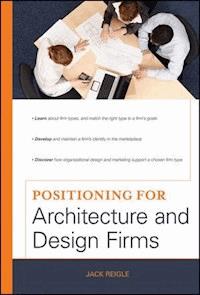
An essential guide for a firm of any size to effectively position itself in the marketplace For an architecture or design firm to survive and prosper in the new economy, it needs to redefine and reinvigorate its position in the marketplace. With dozens of how-to cases, examples, and guidelines, Positioning for Architecture and Design Firms provides the entire menu of tools, plus the inspiration needed, for making the changes required to stay competitive in the design world. Offering strategies for leveraging a firm's strongest assets into the formulation of a successful long-term plan, this book breaks with tradition to introduce the latest concepts specifically developed for building future business opportunities in an unstable economic landscape marked by shifts in competition, technology, and client expectations. With a wealth of information targeting the subject of positioning, readers will learn: * Why the aftershocks of the Great Recession are likely to linger, and what you can do about it in relation to your firm's success * How the coming generational shift will change the design business * What positioning is, and how it needs to be developed to support and implement your strategic vision * How your firm can establish a robust identity and operating model * The importance of your firm's essential purpose * How to turn your marketing department into a true marketing system, transforming it from production mode into an integrated positioning machine * Why it is important to engage in advanced research and open innovation initiatives Addressing issues of firm identity, including an understanding of how to create the market positioning desired, Positioning for Architecture and Design Firms shows how a design firm--large or small, new or well established--can position itself to gain greater control over its destiny, and reach loftier levels of achievement. * Learn about firm types, and match the right type to a firm's goals * Develop and maintain a firm's identity in the marketplace * Discover how organizational design and marketing support a chosen firm type
Sie lesen das E-Book in den Legimi-Apps auf:
Seitenzahl: 354
Veröffentlichungsjahr: 2011
Ähnliche




















Contents
Cover
Title Page
Copyright
Preface
Acknowledgments
Introduction
Chapter 1: Future Tense
THE BIG SHIFT
THE FOURTH TURNING
PRAGMATISM
THE EFFECTS OF SUSTAINABILITY
Chapter 2: Positioning
POSITIONING DEFINED
THE POSITIONING PLATFORM FOR DESIGN FIRMS
Chapter 3: Firm Identity And Purpose1
FIRM IDENTITY
NOW FOR SALE: OUR CULTURE, OUR PROCESSES
CONDUCTING A STAFF RETREAT TO ADDRESS POSITIONING AND FIRM IDENTITY
SUMMARY
Chapter 4: Markets And Services
MARKET SELECTION, PENETRATION, AND INFLUENCE
POSITIONING WITHIN MULTIPLE MARKETS
THE CONVERGENCE OF IDEAS ESSENTIAL FOR THE DESIGN INDUSTRY
GEOGRAPHIC REACH AND POSITIONING
COMMODITIZATION OF DESIGN SERVICES
SERVICE DEVELOPMENT
Chapter 5: The Marketing System
ESTABLISHING A MARKETING SYSTEM MINDSET
METHODS BUYERS ARE USING TO PROCURE SERVICES
Chapter 6: Organizational Development
PRIMARY ARENAS FOR ORGANIZATIONAL DEVELOPMENT
LEADERSHIP DEVELOPMENT
THE LEARNING ENVIRONMENT
FIRM VALUES
MEASURING FOR SUCCESS
Chapter 7: Advanced Research And Open Innovation
ADVANCED RESEARCH
OPEN INNOVATION
Appendix: The Sparks Framework Assessment: Charting Yourpreferences
INTRODUCTION TO THE ASSESSMENT
WHO SHOULD PARTICIPATE IN THE ASSESSMENT?
INSTRUCTIONS
THE SPARKS FRAMEWORK ASSESSMENT: TWENTY CRITICAL CHOICES FOR FIRM LEADERS
Afterword
THE FUTURE OF THE DESIGN PROFESSION
Index
This book is printed on acid-free paper.
Copyright © 2011 by John Wiley & Sons, Inc. All rights reserved.
Published by John Wiley & Sons, Inc., Hoboken, New Jersey. Published simultaneously in Canada.
No part of this publication may be reproduced, stored in a retrieval system, or transmitted in any form or by any means, electronic, mechanical, photocopying, recording, scanning, or otherwise, except as permitted under Section 107 or 108 of the 1976 United States Copyright Act, without either the prior written permission of the Publisher, or authorization through payment of the appropriate per-copy fee to the Copyright Clearance Center, Inc., 222 Rosewood Drive, Danvers, MA 01923, 978-750-8400, fax 978-646-8600, or on the web at www.copyright.com. Requests to the Publisher for permission should be addressed to the Permissions Department, John Wiley & Sons, Inc., 111 River Street, Hoboken, NJ 07030, 201-748-6011, fax 201-748-6008, or online at http://www.wiley.com/go/permissions.
Limit of Liability/Disclaimer of Warranty: While the publisher and author have used their best efforts in preparing this book, they make no representations or warranties with respect to the accuracy or completeness of the contents of this book and specifically disclaim any implied warranties of merchantability or fitness for a particular purpose. No warranty may be created or extended by sales representatives or written sales materials. The advice and strategies contained herein may not be suitable for your situation. You should consult with a professional where appropriate. Neither the publisher nor author shall be liable for any loss of profit or any other commercial damages, including but not limited to special, incidental, consequential, or other damages.
For general information on our other products and services, or technical support, please contact our Customer Care Department within the United States at 800-762-2974, outside the United States at 317-572-3993 or fax 317-572-4002.
Wiley also publishes its books in a variety of electronic formats. Some content that appears in print may not be available in electronic books.
For more information about Wiley products, visit our Website at http://www.wiley.com.
Library of Congress Cataloging-in-Publication Data:
Reigle, Jack. Positioning for architecture and design firms / by Jack Reigle. p. cm. ISBN 978-0-470-47225-5 (cloth); ISBN 978-0-470-91869-2 (ebk); ISBN 978-0-470-91870-8 (ebk); ISBN 978-0-470-91871-5 (ebk); ISBN 978-0-470-95029-6 (ebk); ISBN 978-0-470-95054-8 (ebk) 1. Architectural services marketing. 2. Design services–Marketing. 3. Market segmentation. I. Title. NA1996.R36 2011 720.68–dc22 2010025644
Preface
After I completed my previous book, Silver Bullets: Strategic Intelligence for Better Design Firm Management, I knew there was more to put in writing. Once I determined that the positioning topic was ripe for exploration and development, I approached John Czarnecki, senior acquisitions editor at John Wiley & Sons, about the idea, and we proceeded on our way. There was one small bump in the road, however. We initially discussed the concept for this book in September of 2008—the same moment when the entire world seemed to be collapsing around us, economically speaking. Clearly, the outline I had developed for the positioning book didn’t take into account enough about a future that very suddenly seemed in tremendous peril.
The more I spoke with clients, and heard and read the accounts of firms attempting to make it through the storm, the more I knew that we should wait. When more daylight and perspective were available, we would all be able to see the situation more clearly. That time arrived after the summer of 2009. There was a change in tone and an uptick in confidence, albeit only because the economy had survived so far. What was confirmed for many people as 2009 came to a close was that we were in for a long, uphill struggle. The world hadn’t ended, but the end appeared to be close enough to shake loose all but a few basic expectations and beliefs.
Reembarking on the positioning book in late 2009, I discovered that a wealth of new perspectives was indeed developing. Firm leaders were sorting through any number of critical choices, in addition to keeping their firms alive and breathing.
As I thought more deeply about the positioning topic, I realized that it filled a significant gap between strategic planning, where I had been spending most of my time, and the daily tasks of the firm’s projects and business functions. I could then reimagine the topic of positioning not just as a word that seems interchangeable with strategy or marketing, but as a real issue that firm leaders needed to focus on. One of the dangers of strategy is that it gets dragged down too quickly by the demands of daily production on projects, and loses its meaning. This realization led me to see the positioning activity as a bridge between strategy and the real life of projects, not merely as another word that gets used in generalizations.
Waiting for the clouds to clear also aided the “how to” aspects of this book, which were always part of the plan. All of the cases included here were developed after the crisis period had passed, so I’m hopeful that readers looking for new ideas or for confirmation of their own ideas will appreciate the willingness of the case contributors to share their stories.
When I look back on my original outline for this book, prepared in August 2008, it’s clear to me how much my perspective has been adjusted. While many aspects of the original material do appear here, the context and emphasis have shifted markedly. I’m not a pessimist or skeptic at heart, but something tells me the process still has a long way to go—for our country, the design industry, and ourselves as individuals. Thank you for taking the time to read the fruits of my labor, and I sincerely hope you’ll find a few good ideas here that can help along the way.
Jack ReiglePalm Beach Gardens, Florida
Acknowledgments
Having been a part of the design industry for 20 years, as a strategy and organizational consultant, I have learned the most from the clients I’ve worked with and for. Their professional dedication, stellar work ethic, and probing questions have taught me about myself, and provided a remarkable platform for my consulting and writing endeavors. My thanks to each of them for allowing me to share in their journey.
I knew that I wanted to include a significant number of case studies in the book, so I reached out to a few colleagues to assist with that process. My thanks go to Mike Reilly of Reilly Communications in Boston, Massachusetts, for his contribution of the Bioengineering Group case study. Similar gratitude goes to Terry Casey for her contribution of the GeoDesign case. Her business is On Target Marketing & Communications in the Hartford, Connecticut, area, and, like Mike Reilly, she runs a public relations consulting firm with a focus on design and construction. The KPS Group case came about through Cliff Moser, FAIA, of CADFORCE, Inc. Cliff was kind enough to point me to a member of his firm’s alliance network, and lo and behold, the KPS Group case study became the quintessential case story of recent times for many design firms.
My continued thanks to Ellen Flynn-Heapes, SPARKS founder and developer of the Framework Assessment tool. Much of the writing in the chapter on firm identity and purpose is based on her previous contributions.
I want to thank John Czarnecki, senior acquisitions editor at John Wiley & Sons, for working with me. My thanks also go to Seema Michon, who assisted me with any number of administrative and organizational tasks as I raced to complete the manuscript.
I wish to express my deepest appreciation to my wife, Yvonne, who was unwavering in her support of this effort, and as patient as anyone could be as I spent nights and weekends holed up with my computer or simply gazing skyward for inspiration.
And to other family and friends I’ve neglected or lost touch with during this trek, I do apologize, and look forward to engaging with you again soon!
Introduction
As we prepare to enter the second decade of the twenty-first century, the unease of the past few years remains with us. While the financial system didn’t completely collapse, and overall economic signs suggest a nascent recovery, much of what has been seen as “business as usual” is no longer evident. Companies have made large cutbacks in staff, expansion plans, and expenses. The government has taken unprecedented steps to prop up the economy, add jobs, and begin to deal with the systemic entanglements that led to the near meltdown. Many previous downturns were characterized as “inventory-driven”; companies had become overconfident and had overproduced, requiring a period of adjustment to rebalance the system. In those terms, the office glut of the late ’90s and the dot-com bust of the new millennium were relatively isolated blips on the screen of economic health. Not so this time.
Within this context, the design and construction industry has been among the hardest hit. Canceled and delayed projects have resulted in layoffs, office closings, severe spending reductions, and a greater sense of uncertainty than most firm owners have ever experienced. Even with a number of projects moving ahead, there are relentless cash flow issues. Problems collecting receivables have led to the inability to meet payroll, and many firms have found it necessary to shop for new banking relationships as lending standards have tightened.
Survival has been the word for recent times, and the harshness of the situation for most firms cannot be overstated. Yet, in the middle of this storm, many firms are beginning to find their footing. With a combination of bold decisions, practical expectations, and a belief that they can turn this phase into an opportunity, they are moving ahead with new plans, strategies, and programs. They are reassessing their position in the marketplace with clear-eyed pragmatism born of necessity and a determination to endure as both business entities and contributors to society.
In the first chapter of this book, “Future Tense,” we explore the larger context for considering the state of our times and the generational cycles that are shaping the next major phases. Although many ideas are being written, blogged about, and presented as the latest ways to make it through the uncertainty, very often the best answers don’t come from experimentation but from viewing the situation with clarity and with commitment to one’s original mission. What would you have done differently if you had known that your business would be cut in half in 2009? Would you have turned down work in the good years? Would you have chosen different markets and clients? And now that the challenge of the future has arrived in full force, are you being shaped by the issues at hand, or are you determined to fulfill the purpose you defined long ago—albeit within changed circumstances? A tense future will remain with us for quite a while, if current readings are accurate. Remaking many of the structures of our economy and society will be arduous, and historic decisions will have to be made. As this process unfolds, the Boomers will be winding down their careers and relinquishing their dominant role in society. A new generation will be stepping in to take over the reins, and they will be faced with many difficult choices. One thing that’s certain is that this new generation will think and act differently as leaders and problem solvers. They will be responsible for helping resolve the long-term effects of the recent crisis, or for actively managing new phases of greater crises, if they arrive. This role will lead to a more practical view of the world and how to proceed. A new pragmatism will be on display, focused on results as opposed to grand experimentation or risks. With over 500 years of history pointing to this next generational phase, we might consider surrendering any remnants of the idea that recent occurrences will blow over and all will be back to normal soon.
The term “positioning,” while familiar to us all, has been loosely applied in most industries. Its strictest application has been in the consumer product markets, where branding and messaging have become an art form indispensable to the science of volume and pricing. In the second chapter of this book, appropriately called “Positioning,” we define positioning for design firms as comprehending a macro-view of the firm and the marketplace. As stated in the Preface, positioning isn’t just another word for marketing strategy; it’s a holistic, systems-driven viewpoint and approach that firms need to add to their business-planning arsenal. Positioning is the tool to use to create the critical alignment between strategic planning and operations, and to keep that alignment intact. If strategy is the picture window of the firm’s future, positioning comprises the panes within that window that define, stabilize, and manage the entire view.
Strong strategic positioning relies heavily on a firm’s ability to develop and maintain its identity in the marketplace. The third chapter of the book, “Firm Identity and Purpose,” provides the foundational material and tools firms can use to make these choices and to create the essential framework for developing their positioning program. The SPARKS Framework Assessment, provided in the Appendix, organizes these crucial choices and decisions into six primary archetypes. It provides perspective on the importance of a firm’s operating model, allowing for sturdier development of key business functions as well as greater control over the firm’s infrastructure and systems. Although defining a firm’s purpose is a very individual consideration, we explore it as a baseline methodology that provides the perspective firms and leaders need to rise above the fray of competition, as well as to construct highly rewarding and satisfying careers.
Chapter 4, “Markets and Services,” follows, showing how firms can make decisions to implement core positioning strategies. Whether it’s a new or strengthened service offering, a decision to expand geographically, or a model for developing deeper market expertise, these decisions embody the firm’s ability to fulfill the promise of their purpose. The chapter includes a number of case studies that profile real firms and leaders in their quest for their strongest positioning alternatives and outcomes. We also investigate the topic of design fees and commoditization, a lingering problem for the industry that must be addressed more effectively through stronger firm positioning.
Chapter 5, “The Marketing System,” provides a detailed view of many of the core elements of marketing that every firm needs to develop. Some of these are traditional elements such as proposals, speaking and writing for recognition, and the like. Others, such as the explosion of social media, may be new to many firms, while public relations is an area typically needing more attention and creativity to make it most effective. Positioning and the marketing aspects within that context are systems problems to be solved, not simply tasks to be completed. A firm that recognizes the importance and power of a holistic approach to developing and managing these vital functions will be able to fulfill their potential in a much more effective and efficient manner.
The sixth chapter, “Organizational Development,” discusses a fundamental imperative that is a traditional weakness within the design industry. Whether it’s due to concerns about overhead, lack of information, or simply the demands of running an unfocused consultancy, many organization-related initiatives remain unexplored or overlooked—yet, successful positioning relies heavily on the right organizational design, in good times or bad. Smart firms are taking the opportunity to rethink their approach to this need, within the scope of the lingering uncertainties around us, and are acting to effect important changes that move beyond cost savings. Is your firm one of them?
“Advanced Research and Open Innovation” is the final chapter, and it provides a view of methodologies for raising a firm’s game by means of a stronger leadership position based on ideas, trends, collaboration, and the creative process. Competition will continue to increase over the coming years, and the speed of change will accelerate again and again. New networks of experts and learners are forming every day to explore ways to capitalize on the latest technologies and approaches that will feed the machinery of the design industry for many years to come. Each firm needs to find the right connections to these nearly invisible forces around us, participating in and contributing to the advancement of the industry, for the ultimate benefit of the firm and of society as a whole.
The Appendix contains the aforementioned SPARKS Framework Assessment instrument. It can provide firms with the essential elements of discussion and choice necessary to determine their core identity. With that as a starting point, firms can build strategy, vision, purpose, and the ultimate positioning plan needed to guide their development on a more holistic level through the coming years.
This book comes at a time when the world is still lurching from a fairly violent shock. It’s easy to believe that we’re still in a wait-and-see mode, that we should hunker down, watch the cash flow, try reviving a few small projects to get through the next year. With history as a guide, however, we see that nothing could be further from the truth. Now is the time to act, and to make the types of changes in thinking and approach that only a crisis can inspire. Hopefully, this book’s big-picture themes, combined with practical how-to examples, will lead many readers to explore a new vision for transforming their firms, preparing them for the long march into one of the most challenging periods of modern times.
Chapter 1
Future Tense
THE BIG SHIFT
One way to view the events of the past few years is to recognize that the future is now upon us. It’s a bit more uncertain than we expected. “Future tense” means that the next 10 years will deliver more larger-than-life anxieties, significant changes, surprises, and sharp edges than we’ve been used to. The era of normal is over. And despite all the talk about a “new normal,” it will take a while to arrive. The United States, along with most of the civilized world, has undergone a system failure unfamiliar to all but those of quite advanced age and scientifically improbable memories. The list of culprits has now become familiar: global climate change, terrorism, economic excess, federal debt burdens, the opacity of the bond markets, demographic shifts, and the sense that these disasters are bearing down on us all at once. Few industries and professions are flourishing, and many are braced for aftershocks that are yet to arrive.
Lesen Sie weiter in der vollständigen Ausgabe!
Lesen Sie weiter in der vollständigen Ausgabe!
Lesen Sie weiter in der vollständigen Ausgabe!
Lesen Sie weiter in der vollständigen Ausgabe!
Lesen Sie weiter in der vollständigen Ausgabe!
Lesen Sie weiter in der vollständigen Ausgabe!
Lesen Sie weiter in der vollständigen Ausgabe!
Lesen Sie weiter in der vollständigen Ausgabe!
Lesen Sie weiter in der vollständigen Ausgabe!




