


69,99 €
69,99 €
-100%
Sammeln Sie Punkte in unserem Gutscheinprogramm und kaufen Sie E-Books und Hörbücher mit bis zu 100% Rabatt.
Mehr erfahren.
Mehr erfahren.
- Herausgeber: John Wiley & Sons
- Kategorie: Fachliteratur
- Sprache: Englisch
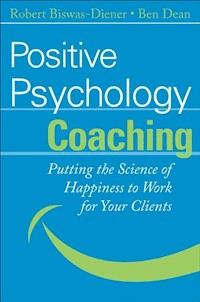
Positive psychology moves psychology from a medical model toward a strengths model to help clients shore up their strengths and thereby lead happier, more fulfilling lives. Positive Psychology Coaching: Putting the Science of Happiness to Work for Your Clients provides concrete language and interventions for integrating positive psychology techniques into any mental health practice.
Sie lesen das E-Book in den Legimi-Apps auf:
Seitenzahl: 379
Veröffentlichungsjahr: 2010
0,0
Bewertungen werden von Nutzern von Legimi sowie anderen Partner-Webseiten vergeben.
Legimi prüft nicht, ob Rezensionen von Nutzern stammen, die den betreffenden Titel tatsächlich gekauft oder gelesen/gehört haben. Wir entfernen aber gefälschte Rezensionen.
Ähnliche

















Table of Contents
Title Page
Copyright Page
Introduction
Acknowledgements
CHAPTER ONE - The Coaching Paradox and the Positive Psychology Solution
FOUNDATION I: HAPPINESS AND POSITIVITY
FOUNDATION II: CHARACTER STRENGTHS
SPECIAL TOPICS IN POSITIVE PSYCHOLOGY COACHING
A NOTE ON SCIENCE AND COACHING
FOUNDATION I - Happiness and Positivity
CHAPTER TWO - Happiness: The Goal We Rarely Talk About
DOES HAPPINESS HAVE A PLACE IN COACHING?
VERY HAPPY PEOPLE
A SCIENTIFIC HISTORY OF HAPPINESS
A NOTE ON THE WORD “HAPPINESS”
FINDINGS FROM SUBJECTIVE WELL-BEING
HAPPINESS PROCESSES
CIRCUMSTANTIAL HAPPINESS
FURTHER READING
CHAPTER THREE - Choosing Happiness: Goals, Relationships, and Positive Thinking
GOALS
SOCIAL RELATIONSHIPS
THINKING STYLE
CONCLUSION
FURTHER READING
CHAPTER FOUR - Solid Happiness Interventions
EMPIRICALLY VALIDATED HAPPINESS INTERVENTIONS
CONCLUSION
FURTHER READING
FOUNDATION II - Character Strengths
CHAPTER FIVE - Strengths Coaching
BACKGROUND TO STRENGTHS
ASSESSING YOUR CLIENTS’ STRENGTHS
STRENGTHS INTERVENTIONS
FURTHER READING
CHAPTER SIX - Coaching to Personal Strengths
INTRAPERSONAL STRENGTHS
FURTHER READING
CHAPTER SEVEN - Coaching to Social Strengths
YOUR CLIENT AS A SOCIAL ANIMAL
RECOGNIZING AND VALUING SOCIAL STRENGTHS
COACHING SOCIAL STRENGTHS
STRENGTHS OF HUMANITY
STRENGTHS OF JUSTICE
FURTHER READING
Special Topics in Positive Psychology Coaching
CHAPTER EIGHT - Helping Clients Craft the Perfect Job
BACKGROUND TO WORK ORIENTATION
ASSESSMENTS
FURTHER READING
CHAPTER NINE - The Future of Positive Psychology Coaching
WHAT MAKES POSITIVE PSYCHOLOGY USEFUL
FUTURE DIRECTIONS OF POSITIVE PSYCHOLOGY
FUTURE DIRECTIONS OF POSITIVE PSYCHOLOGY COACHING
CONCLUSION
APPENDIX - Planning Positive Psychology Coaching Sessions
Notes
Index
This book is printed on acid-free paper.
Copyright © 2007 by Robert Biswas-Diener and Ben Dean. All rights reserved.
Published by John Wiley & Sons, Inc., Hoboken, New Jersey. Published simultaneously in Canada.
Wiley Bicentennial Logo: Richard J. Pacifico
No part of this publication may be reproduced, stored in a retrieval system, or transmitted in any form or by any means, electronic, mechanical, photocopying, recording, scanning, or otherwise, except as permitted under Section 107 or 108 of the 1976 United States Copyright Act, without either the prior written permission of the Publisher, or authorization through payment of the appropriate per-copy fee to the Copyright Clearance Center, Inc., 222 Rosewood Drive, Danvers, MA 01923, (978) 750-8400, fax (978) 646-8600, or on the web at www.copyright.com. Requests to the Publisher for permission should be addressed to the Permissions Department, John Wiley & Sons, Inc., 111 River Street, Hoboken, NJ 07030, (201) 748-6011, fax (201) 748-6008, or online at http://www.wiley.com/go/permissions.
Limit of Liability/Disclaimer of Warranty: While the publisher and author have used their best efforts in preparing this book, they make no representations or warranties with respect to the accuracy or completeness of the contents of this book and specifically disclaim any implied warranties of merchantability or fitness for a particular purpose. No warranty may be created or extended by sales representatives or written sales materials. The advice and strategies contained herein may not be suitable for your situation. You should consult with a professional where appropriate. Neither the publisher nor author shall be liable for any loss of profit or any other commercial damages, including but not limited to special, incidental, consequential, or other damages.
This publication is designed to provide accurate and authoritative information in regard to the subject matter covered. It is sold with the understanding that the publisher is not engaged in rendering professional services. If legal, accounting, medical, psychological or any other expert assistance is required, the services of a competent professional person should be sought.
Designations used by companies to distinguish their products are often claimed as trademarks. In all instances where John Wiley & Sons, Inc. is aware of a claim, the product names appear in initial capital or all capital letters. Readers, however, should contact the appropriate companies for more complete information regarding trademarks and registration.
For general information on our other products and services please contact our Customer Care Department within the United States at (800) 762-2974, outside the United States at (317) 572-3993 or fax (317) 572-4002.
Wiley also publishes its books in a variety of electronic formats. Some content that appears in print may not be available in electronic books. For more information about Wiley products, visit our web site at www.wiley.com.
Library of Congress Cataloging-in-Publication Data:
Biswas-Diener, Robert.
Positive psychology coaching : putting the science of happiness to work for your clients / Robert Biswas-Diener and Ben Dean. p. cm.
Includes bibliographical references.
ISBN-13: 978-0-470-04246-5 (cloth)
1. Personal coaching. 2. Positive psychology. I. Dean, Ben. II. Title. BF637.P36B56 2007 158’.9—dc22
2006038754
Introduction
A few years ago, as the world prepared for the change of the millennium, I was living in Calcutta and researching happiness among people living in the slums. I have long had a soft spot in my heart for people living in poverty and have often been inspired by the ways they sometimes rise to the challenges facing them. For anyone who has ever been to Calcutta or traveled through other poor parts of the world, you know the sight of abject poverty can be heartbreaking as well as guilt producing. My time in Calcutta had me thinking about what kind of impact I could make on the lives of the people with whom I was conducting my research. I paid my participants and donated money to neighborhood associations, local slum clinics, and doctors. In the end, though, I saw that I was taking information away from India—I was collecting data that would ultimately benefit a Western understanding of psychology—and not giving any education back. Through my interpreter, I began setting up a series of lectures, at local universities and even in slum schools, in which I could teach the citizens of Calcutta about the latest findings from social and personality psychology. The lectures were well attended, well received, and it felt great to work outside my basic job description and give a little something back.
One of the aspects of positive psychology I have long been attracted to is the sense that it is for the public good. As such, it is—relative to other systems of change—being given away free. As yet, you will not find much in the way of proprietary assessments or expensive, formulaic trainings. No positive psychology researcher worth his or her salt is charging big money for “five ways to discover happiness” or “three things that are interfering with your fulfillment” or “My private tool for measuring positivity.” At its heart, positive psychology is a science and, as such, is part of the public domain. The latest research findings are published in professional journals, many of which can be accessed online. Top scientists have web sites that, rather than trying to keep a lid on their proprietary findings, clearly spell out the details of research for anyone who is curious enough to look. University of Pennsylvania psychologist Martin Seligman, the founder of positive psychology, once said that this dynamic new field was, in part, about “increasing the total tonnage of happiness in the world.” That’s a hefty mission, and one very much in line with the philosophy that underlies all coaching. Of course, just as coaches charge for services positive psychologists charge speaking fees, workshop tuition, and write for-profit books. But in each of these cases, the men and women behind the science are being paid for their expertise, rather than some secret happiness system they have devised, trademarked, and sold to the public. Within the confines of positive psychology, you will see exemplars of generosity such as the Values in Action Institute, funded by the Mayerson Foundation, which provides a free, online assessment of strengths that could be generating millions of dollars in income. Or, the Center for Applied Positive Psychology, in England, a nonprofit center running educational programs in positive psychology. Or, the Hero Within Charter School, a fledgling positive psychology school serving low income kids in inner city Philadelphia. The list goes on. Not only do people recognize the value of positive psychology, they recognize the value of giving it away.
Which brings me to my co-author, Ben Dean. I first met Ben at a conference on positive psychology, where he was eagerly learning the latest findings from the field. He is a psychologist who is passionate about positive psychology and coaching, has been involved with the field from its early days, and firmly believes in disseminating it as widely as he can. In fact, publishing articles in professional journals and giving talks at conferences are just not enough for Ben, he wants to make sure that the theories, assessments, and applications of positive psychology make their way into mainstream life. For example, Ben partnered with Martin Seligman to deliver the Authentic Happiness Coaching Program™ that—between 2003 and 2005—trained professionals from 19 nations to apply Seligman’s work on positive psychology to their work and lives. He runs MentorCoach®, the first coach training school in the world to specifically focus on positive psychology and coaching. As if that were not enough, Ben also writes a free electronic newsletter on positive psychology with 131 thousand readers worldwide and presents on coaching and positive psychology throughout North America. Ben impressed me with his value-laden attitude toward bringing positive psychology to the world. In fact, his orientation toward service is so sincere that I once saw him arrange for pro bono positive psychology coaching services for a flight attendant who was suffering through a financial crisis.
This book is the natural product of two people who would like nothing more than to get the story of positive psychology out of the ivory towers and into the mainstream . . . as well as into other professions, such as coaching, for which it is particularly well suited. We will not get rich from this book, nor do we care to. We are interested in showing readers and coaches of all stripes that there is an exciting new science available to inform their assessments and interventions. We are thrilled about the fact that much of what coaches do has now been shown to pass scientific muster, and we are excited about what this means for the future development of the profession. We think positive psychology is just too good to hide from the public, and we hope that you agree.
What is positive psychology anyway? In short, it is a new branch of psychology that focuses on what is going right, rather than what is going wrong with people. If traditional psychology has emphasized the understanding and treatment of depression, schizophrenia, and anxiety, then positive psychology takes aim at happiness, optimism, and character strengths. Positive psychologists are researchers who investigate the dynamics of healthy relationships, the factors that lead to highly functioning work groups, and what leads to lasting personal fulfillment. Positive psychology asks important questions about the human condition and provides compelling answers. In the years since it was founded, this new branch of science has grown to include a cutting-edge professional journal, a string of fascinating books, a new master’s degree program at the University of Pennsylvania, and some highly effective workplace consultancy programs. In this book, we give you a nutshell education about positive psychology.
Much of this book focuses on happiness. To some extent, everybody wants to be happy, although few of us agree on what this means or how best to achieve it. Fortunately, modern science has some fresh new insights into the age-old question of the secret to happiness. Among the most important and novel insights provided by research in positive psychology is the fact that happiness is much more than a destination. Study after study shows that happiness is actually beneficial. Feeling positive is like having money in the bank that can be spent in the pursuit of other goals. The fact that happiness is associated with better health, more creativity, higher income, and better workplace evaluations ought to catch the attention of any coach or consultant. We spend time covering modern happiness research including how it is defined, how it is measured, how much is enough, and which routes to happiness are worthwhile and which are deadends. In each case, we tie together the research findings with helpful suggestions for how the information can be used to help your coaching practice and help your clients succeed.
We also spend a great deal of time discussing personal strengths. The idea of tapping client strengths will not be new to you, but positive psychology offers some wonderful new ways to do so. Chris Peterson and Martin Seligman worked with a team of brilliant colleagues to develop a classification of character strengths that exist in cultures all around the world. The team developed the innovative online assessment of strengths (and it’s free of charge!). These thought leaders commonly espouse the idea that there is as much mileage to be gained from harnessing strengths as there is from shoring up weaknesses. This radical notion is more than simple opinion; positive psychologists provide the empirical research and firm data to back up just these types of claims.
From executive coaching to life coaching, from psychotherapy to consultancy, the new science of positive psychology offers a little something for everyone. It is a solid science with empirically supported assessments, validated interventions, and exciting new theories that can revolutionize your practice. Best of all, positive psychology is a discipline that is compatible with what you are already doing and need not be swallowed whole or exchanged for what you already know works. Instead, it can be an adjunct to your current practice, and one that will be attractive and helpful to your clients. Positive psychology is yours every bit as much as it is ours, and we hope you enjoy it!
Acknowledgments
I owe an enormous debt of gratitude to my father Ed Diener, and Martin Seligman, as well as to George Vaillant, Mihaly Csikszentmihalyi, and the many other courageous researchers who have pioneered the field of positive psychology. Without you, the world would be a little less happy.
This book never would have progressed beyond an idea at a cocktail party if not for the support and encouragement of our editor, David Bernstein. Thanks for your patience, kindness, and insight.
I would like to thank my co-author, Ben Dean. Ben, I have learned much about coaching from you and have enjoyed watching you give positive psychology away.
I would also like to thank the many people who helped in the preparation of this manuscript by submitting to an interview, giving wise counsel, or commenting on the ideas contained herein. This group includes Betsy Bass, Susan David, Sandra Foster, Michael Frisch, Carol Kaufmann, Michelle Marks, James Pawelski, Carol Ryff, Nicole Stettler, and Lauren Vannett. Thanks to you all. I also owe an extra special thanks to Alex Linley for the last-minute advice.
Finally, I would like to thank my wife, Keya, and my children for supporting me through the writing process. The three of you put up with far more than I deserve. I love you.
R. B-D.
I’m especially grateful to Martin Seligman, whose phone call in 2002 ultimately led me into the field of positive psychology. Our two-year collaboration in delivering the Authentic Happiness Coaching Program™ has been one of the high points of my career.
My thanks to Chris Peterson, for his leadership in spearheading the Values in Action (VIA) project and whose research and teaching in positive psychology have been so important for me and many others.
I owe a great debt of gratitude to Robert Biswas-Diener. What began as a joint project has clearly become his book. I first met Robert in 2005 while reading about, of all things, Joan Didion’s reaction to his work in The Year of Magical Thinking. I’ve come to value his keen intelligence, his research and field work in subjective well-being, his extraordinary ability to integrate and write about science in multiple domains, and his friendship.
I would like to thank David Bernstein, an exceptional editor and central figure in bringing coaching to the helping professions.
I would like to thank the wise thought leaders I interviewed including: Bonni Akalis, Vikki Brock, Jocelyn Davis, Catherine Fitzgerald, Dan Gilbert, Jon Haidt, Richard Kilburg, Amanda Levy, Christine Martin, Ellen Ostrow, Chris Peterson, Peter Redding, Pam Richarde, Geno Schnell, Tracy Steen, Bruce Taylor, Patricia Wheeler, and Nancy Whichard,
I especially want to thank Anne Durand, an incomparable executive coach and friend, who has been instrumental in leading MentorCoach®.
I owe a great debt of gratitude to all the brilliant, gifted souls in MentorCoach®, in the MentorCoach Alliance for Positive Psychology, the MCP Trainer Team, the (131,000 strong) Coaching Toward Happiness and eMentorCoach communities, and the graduates of the Authentic Happiness Coaching Program™ who share my passion for the field and continually teach me.
And, finally, I’m deeply grateful to Janice, my wife, and our children, David and Sara, for being with me every step of the way.
B. D.
CHAPTER ONE
The Coaching Paradox and the Positive Psychology Solution
Coaching, as a profession, is at an exciting turning point. The work of the brave and talented people who pioneered the field has finally paid off: Coaching is widely accepted as an important tool in the business world, coach training programs are improving their curricula in an effort to meet more rigorous standards for credentialing, and private practices are flourishing. Even universities are beginning to take notice of our profession, and graduate degree and certificate programs in coaching are popping up on several continents. The tiresome days of explaining the difference between athletic coaching and working as a personal change agent are rapidly drawing to a close. We, as coaches, are no longer struggling to find basic acceptance as a legitimate profession. In so many ways, we have arrived, and it feels good. It feels good to open major newspapers and see articles on the benefits of coaching and profiles of leading coaches. We experience vicarious pride when we see the success of our peers who design and implement coaching workshops for organizations, or witness the financial success of a colleague. It can be tremendously rewarding to speak with enthusiastic new students in coach training programs, a sign that our profession is growing. At last, we can bask in the same optimism that we attempt to instill in our clients.
Yes, we have finally arrived. But, now that we are here, what are we going to do? As a group of individuals and as a profession, we are just too energetic, too dynamic, and too motivated to sit idly for long. You probably recognize that achieving one goal, while cause for celebration, also clears the way to begin working toward the next. Change is inevitable, and what could be more interesting than considering the ways in which coaching might change over the next decade? In which directions coaching might move, and how our interventions and services might evolve in the near future. The possibilities are fascinating to consider. Advances in technology, for instance, will undoubtedly affect the professional tides. Similarly, widespread public understanding and acceptance of the coaching endeavor and its many benefits will impact our chosen vocation in exciting new ways, as will breakthroughs in psychological research. The field of psychology, our professional cousin, is a wonderful resource for sophisticated assessments, clever interventions, and research validation that can—and will—advance our work by leading to better service and “proof” that coaching works. This book describes one such breakthrough—the new field of positive psychology—and explains the many ways in which positive psychology can inform coaching practices of all kinds. Positive psychology is the first of many stimulating answers to the question: “Where do we, as a profession, go from here?”
Coaching has long been a powerful force for transformation in people’s lives. Whether conducted with executives, schoolteachers, graduate students, work-from-home Internet entrepreneurs, or small business owners, coaching is about harnessing the best in people and inspiring them to live out their potential. Coaching is a wake-up call, challenging folks to tap their inner abundance. Because of this natural leaning toward positivity, growth and optimism coaching has attracted practitioners who value service work and clients who are achievement oriented. If you consider the ways in which you and your clients are similar, it is likely that placing a premium on self-growth is one area of common ground. Those of us who have worked with or worked as coaches recognize the frequent times in sessions when a self-imposed limit is lifted, when an “aha” moment is reached, or when we catch an emotional second wind. These are the gems of coaching and, when coaching is done well, they tend to be common. It is this proof of positive change in action that makes coaching a worthwhile endeavor for both the practitioner and the client.
But beneath this veneer of positivity and effectiveness, there is an irony in the profession that we think of as the coaching paradox: For a profession that systematically helps people aspire to and reach their innate potential, coaching has not yet reached its own potential. In fact, although coaching—in its modern form—is a couple of decades old, it is still in its relative professional infancy. Indeed, the hallmarks of youth are readily apparent. Coaching lacks a coherent, widely agreed on definition, coach training varies in content (although less now than in recent years), and coaching interventions differ greatly. Some coaches work with inspirational stories and games, others rely heavily on assessments, and still others focus on goals and behaviors. In short, coaching is still a broadly defined endeavor in need of refining. The profession of coaching is fortunate to have so many skilled and imaginative people working toward this end. But our chosen line of work needs more than isolated breakthroughs and good ideas that are implemented in only a handful of private practices. Coaching is just too good to be undermined by a sense that we are “winging it.” Our professional service—whether it takes the form of executive, entrepreneurial, or life coaching—will improve when we develop an agreed on definition for coaching and systematic sharing of the high quality interventions in our craft.
To be sure, progress has been made in these areas. The International Coach Federation (ICF), the largest governing body of the profession, has made gains in establishing both a code of ethics for practice and standards for the training of new coaches. Steve Mitten, former president of the ICF, made the professionalization of coaching a major part of his presidential platform. Mitten was invested in establishing coaching as a bona fide profession, with clear standards for training and practice.1 Similarly, in England, members of the British Psychological Society have formed a special working group to advance a program of coaching psychology. 2 Despite this forward progress, even seasoned coaches agree that the profession is in its formative stages. Carol Kaufman, for instance, a coach and psychologist at Harvard’s medical school, distinguishes between “first and second generation coaching.”3 The first generation of coaches, according to Kaufman, was made up of the visionary and courageous individuals who helped to establish their services as a viable enterprise. Now, says Kaufman, we are on the brink of the second generation of coaching, in which the discipline needs to grow through the development of explicitly defined theories of human development and research on coaching effectiveness. Just as medicine has advanced through the discovery of viruses and the use of antibiotics, coaching is ready for sophisticated theories and exciting new interventions.
One of the recent pushes toward the development of a more mature coaching profession has been increased attention to the many benefits of science. In 2003, Anthony Grant, a coach who teaches at the world’s first university-based coaching psychology program in Sydney, Australia, issued a call to ICF members to turn to science as a method and body of knowledge to help guide practice.4 The ICF responded by sponsoring annual research symposia, in which the scientific method was used to investigate issues ranging from the effectiveness of working with cultural minorities to understanding client perceptions of coaching.5 In later years prominent coaches such as Diane Stober6 and W. Barnett Pearce7 have echoed the original call to embrace research as a powerful tool to improve the practice and effectiveness of coaching. In 2006, ICF president Pamela Richarde spoke with the heads of Accredited Coach Training Organizations (ACTO), reaffirming the organization’s commitment to supporting a research program on coaching.8 Similarly, psychologists and coaches in London, Sydney, Philadelphia, and New York have looked at the role of science in coaching by forming special coaching psychology task forces, hosting academic conferences, launching peer reviewed journals, and developing university-based curricula. Simultaneously, professional books on evidence-based coaching or those adapting well-researched psychological theories and techniques have begun appearing. If these trends are any indication of the direction in which coaching is moving, it is reasonable to assume that at least one arm of the profession, in the future, will be scientifically grounded coaching, in which many practitioners will have graduate degrees from accredited universities, and in which many clients will want to see empirical validation of coaching services. We do not mean to imply that this is the only direction in which the coaching profession will evolve, but this is one likely route. Regardless of the background of individual coaches, now or in the future, it is certain that those on the cutting edge of science will have additional tools in their professional toolboxes.
In this book, we propose that the dynamic new field of positive psychology—described in detail next—is a branch of science that shows tremendous potential as a natural interface with the profession of coaching. Because it is grounded in sophisticated scientific methodology, positive psychology offers an answer to the call for an increased role of research in coaching. What’s more, as an applied science, positive psychology offers theories, interventions, and assessments that form a valuable addition to current coaching tools. Among the most elegant aspects of a marriage of coaching and this new science is the fact that positive psychology is not dogmatic, proprietary, or incompatible with existing approaches to coaching. Positive psychology is a body of theory, research, and practical tools that can be added to any coaching practice, regardless of theoretical orientation, or whether you conduct life coaching or work with executives. Further, we argue here that such an addition is good for individual coaches as well as for the profession as a whole.
Although we are attracted to the creativity that permeates the profession of coaching, we argue that the movement toward empirically-based interventions and solid theoretical frameworks for practice is in the best interest of both individual practicing coaches and the coaching profession. Coaches Dianne Stober and Anthony Grant argue that such a trend will boost the credibility of the profession and provide the foundation for higher quality coach training.9 We live in an age where science is the pre-eminent system of inquiry. The claims of science are testable, and the results of careful studies are both replicable and generalizable. Because the scientific method is so widely accepted, coaching practices that are grounded in science will be easier to “sell” to a skeptical public or potential clients, and especially to organizations that want reassurances that the service will be effective. Susan David, founding member of Evidence Based Psychology, a consultancy firm with corporate clients in the United States, Australia, and Asia, encourages coaches to set their services on a foundation of solid empiricism. “Companies and executives have gotten savvier when talking about psychological topics,” she told us in a recent interview. “It makes sense to them that mood can affect worker performance. The people I deal with at pharmaceutical companies and accounting firms ask intelligent questions about the research behind my services, and I have to be ready with answers.” Our prediction is that coaches who can honestly claim to work from a foundation of the latest scientific research and theory will have a tremendous market advantage over their peers. Not only will prospective employers look favorably on them, they will enjoy the comfort of knowing that their interventions are tested, effective, and—where possible—appropriate to their unique client base. The addition of a scientific basis to coaching is one of the greatest potential growth areas for second-generation coaches.
The importance of science to our field was recently noted in a dramatic way by Jim Clifton, the CEO of the Gallup Corporation, the company famous for its polling services. In late 2005, Clifton addressed a large group of psychologists and coaches at a meeting at the Gallup office in Washington, DC. Clifton has a sharp mind and a flair for strong, provocative words. “Gallup uses positive psychology,” he began, “because positive psychology works. If the data showed that yelling at my employees was more effective, then I would do that instead.”10 Regardless of how literally Clifton intended this statement to be taken, his point was clear: Businesses and other clients want to invest in workshops, trainings, and services that work. They want proof that the methods and assessments they buy are actually valuable, and not simply the flavor of the month. In this way, coaches can make science, and psychological science in particular, work for us as we develop our profession.
What might a scientifically driven coaching practice look like? Anthony Grant and others originally trained in clinical psychology have pointed to the “scholar-practitioner” model in which most psychologists are trained.11 In this educational model, students are taught to design research studies, analyze statistics, and evaluate the relative merits of other people’s research in addition to developing clinical acumen. The underlying rationale for this model is that graduates will enter the workplace as informed consumers of the research that guides their own clinical practices. Unfortunately, as sensible as this strategy is for psychologists, it is not easily applicable to coaching. Many coaches do not have a background in research methods or statistics, nor a background in psychology, and an emphasis on these skills is unlikely to have newcomers flocking to our profession. Although it is likely that in the future many coaches will hold master’s degrees in coaching psychology from major universities, it seems doubtful that in the short term all coaches—or even the majority of coaches—will have a background in psychology. Therefore, evidence-based coaching ought to rest on the aspects of science that are accessible to coaches of diverse educational backgrounds. We have identified three areas in which coaches of any educational or professional background can easily employ science:
1. Survey readings of relevant background material could greatly benefit coaches. We have great faith in the intelligence of coaches and believe that they can easily understand versions of major studies. This allows for the fact that not everyone attracted to the profession thinks in the rigorous, questioning way common to researchers. For those with a primary interest in the direct contact with clients and an emphasis on the service aspect of the work, a general familiarity with relevant background research is probably adequate. But basic knowledge of the scientific literature may also be necessary. In our experience, the most innovative coaches are those individuals who challenge themselves by reading and learning about the change process. Whether it is essays by Abraham Maslow, leadership books by Robert Quinn, or professional journal articles, keeping up with major theories and new interventions gives coaches a competitive edge. We encourage coaches of all stripes and persuasions to become acquainted with the relevant psychological research literature, if even in a cursory way. We encourage you to extend this learning well beyond the covers of this book and into other informative domains such as trusted web sites and professional journals.
2. The second natural intersection of science and coaching is to be found in well-validated measurement tools. Empirically validated and widely used assessments can be enormously useful to coaches. Many coaches are already familiar with tools like the Myers-Briggs Type Indicator (MBTI) and Firo-B, and know that these instruments can help the work of coaching in important ways. But, formal measures of personality, ability, preferences, and other related assessments have historically been the domain of psychologists—created by psychologists, administered by them, and interpreted by them. In addition to the information they provide, formal assessments can be interventions when they are used to identify strengths or areas needing attention, and they can also guide practice by measuring outcomes of interest. Although it is true that many coaches currently use some stock-in-trade assessments, such as the MBTI, many coaches are unaware of other useful measures available to them, including many that are easy-to-take, easy-to-interpret, and free of charge.
3. Research is fundamentally important to coaching because it can provide a basis for evaluating interventions. Studying the nuts and bolts of our actual work can tell us much about why certain interventions work, when they work, and with whom they are most effective. Take, for instance, the research conducted by Suzy Green on the effectiveness of Solution-Focused Life Coaching, in which she and her colleagues found that coaching produced appreciable gains in hope, happiness, and goal striving for the clients in their study. 12 Without this kind of careful, systematic evaluation of our interventions, coaching is reduced to a series of well-meaning hunches and guesswork. Knowledge of the empirical underpinnings of interventions actually allows coaches to break out of a one-size-fits-all mindset. Results from studies can tell us how gender, culture, or educational background might play an important moderating role in the coaching process. Familiarity with such research makes coaches both responsible and increasingly competitive. Science can help us understand the nuances of interventions, an awareness that might separate good coaches from great coaches.
Science is much more than artificial laboratory studies and boring, structured results. The scientific process includes the development, testing, and revision of important theories. Now, at a time when the coaching profession is growing—both intellectually and in terms of number of practitioners—theoretical foundations for practice are more necessary than at any point in the profession’s history. Theoretical orientations are world-views that guide practice. For example, the “medical model,” an orientation subscribed to by most modern doctors, holds that a physician’s job is to diagnose illness, discover the cause of the symptoms, and develop and implement treatments. While there is no question that modern medicine under this model has produced amazing gains in the treatment of illness it is also unclear whether this is the best, or only, way to look at the mission of doctors. For example, Albert Schweitzer, the Nobel Prize-winning medical missionary, often spoke of his desire to collaborate with patients in an effort to “awaken the healer within.” We suggest that the underlying view of our work is as important as the practical strategies of coaching itself, and encourage coaches to continually evolve their own theories of change and human nature. Unfortunately, although coaches share, at the broadest level, a common vision of coaching as including a focus on helping clients achieve their goals, there is much that remains uncertain about our task as facilitators of change. What is the best way to help clients achieve their goals? Is it more important to help remove obstacles, or should we focus on developing strengths, or some combination of both? Similarly, should we help clients to achieve goals that are highly inconsistent with our own values, or those that common wisdom tells us are not likely to produce lasting well-being? For that matter, are client-driven goals the only yardstick for the measure of coaching success? An explicitly defined theoretical orientation can be a map that guides us through this uncertain territory.
Positive psychology is just such a map. In this book, we suggest that the interface of positive psychology with coaching is a natural step toward answering the call to address the coaching paradox and develop the profession in new and dynamic ways. Positive psychology was originally introduced by Maslow who, in addition to his famous “hierarchy of needs,” also wrote extensively on peak experiences, existential growth, and the importance of building on personal resources for success in life.13 Unfortunately, much of Maslow’s brilliant writing was largely overlooked by both the general public and practicing psychologists. In recent years, however, legendary psychologist and former president of the American Psychological Association (APA) Martin Seligman succeeded in touting the importance of the development of a strength-based positive psychology. When he assumed the reins of leadership of American psychology’s professional body, Seligman made the bold claim that psychology, in its present form, was really only half a discipline.14 According to Seligman, the lion’s share of research and treatment in the field had focused on pathology and on answering the question: “What is wrong with people?” While this emphasis undoubtedly led to important breakthroughs in the understanding and treatment of depression, it did little to provide insight into the everyday experience of the majority of people. What does psychology have to offer the masses, asked Seligman, those countless individuals who successfully raise families, work at good jobs, and do not suffer from clinical disorders? The professional literature has been conspicuously silent on the matter of personal strengths, happiness, and engagement at work and in relationships. Seligman popularized the positive psychology movement as a means of rewarding the few researchers who were already working in these areas, cobbling together a cohesive understanding of human flourishing, and attracting new scholars to the discipline.15 Positive psychology is psychology’s answer to the other crucial question: “What is going right with people?”
We propose that positive psychology is a natural fit with coaching because both rest on the assumption that people are basically healthy, resourceful, and motivated to grow. What’s more, because positive psychology is a theoretical orientation built on a foundation of science, it contains the many virtues of scientific studies with broad samples and the ability to replicate findings. This means that research on positive psychology, unlike inspirational anecdotes, can provide insight into how to provide effective services for the widest range of people by looking at individual differences, the timing of interventions, and including surprising, counterintuitive results. Results from research in positive psychology, for instance, suggest that focusing on strengths and developing the positive in people are actually more effective than addressing weakness and problems. Further, there are surprising findings that suggest that goals, that Holy Grail of coaching, may differ in how much they contribute to our clients’ well-being. Positive psychology provides a systematic way to implement a positive worldview, and offers unique insights that lie outside the bounds of traditional wisdom and intuition.
In short, Gallup CEO Jim Clifton is right when he says positive psychology works. Exciting new research from a wide variety of domains shows that strengths, optimism, and happiness are psychological capital with tangible benefits. To skeptical readers, the idea of selling happiness to large companies might seem preposterous. While the word happiness might be off-putting in an organizational setting, the scientific findings from positive psychology are greatly reassuring. For instance, a recent review of the benefits of pleasant emotions such as happiness conducted by University of California-Riverside psychologist Sonja Lyubomirsky and her colleagues shows that happy people make more money, take fewer sick days from work, get along with their colleagues better, spend more time volunteering, are more likely to help strangers, receive better supervisor evaluations on the job, are rated more highly by customers, and exhibit less work turnover than less happy individuals. 16 These are bottom-line facts that tend to be welcomed by managers and executives. On the flip side, the organizational culture that effective positive psychology interventions tend to produce is often welcomed by employees who are overjoyed by bona fide efforts to improve their welfare while on the job. Not only is a positive approach a win-win in the workplace, it is good news for positive psychology coaches.
Even better news is the fact that you do not need to be a trained research scholar to understand and use the literature on positive psychology. Unlike mathematical theories of light refraction or the cellular development of mycosis fungoids, psychology is a commonsense science that is easily accessible to all. What’s more, by the time studies are printed in refereed journals, they have already passed muster with ethics review boards as well as expert peer reviewers. On this issue, we take the same view of our readers that we do of our clients: We assume you are smart, resourceful, and certainly capable of understanding the content of this book. Thus, in the pages that follow, we have included a broad survey of the most important topics in positive psychology and tied them together with specific applications to coaching. In Part I of Positive Psychology Coaching, we present a core foundation of positive psychology coaching: the definition, cultivation, maintenance, and benefits of happiness. In Part II of Positive Psychology Coaching, we cover an additional pillar of positive psychology, the development and use of character strengths and virtues. Finally, in Part III, we apply positive psychology coaching to the workplace, as well as discuss ways to use positive psychology to build your practice.
FOUNDATION I: HAPPINESS AND POSITIVITY
The first foundation of Positive Psychology Coaching is happiness. Lasting personal fulfillment is a concern that touches us all. Happiness is the pot of gold at the end of the emotional rainbow, and it permeates Western culture from its inclusion in the American Declaration of Independence to the happy endings of Hollywood films. Experienced coaches realize that clients rarely, if ever, seek out our services with the explicit goal of increasing happiness. Nobody takes advantage of a free coaching session to increase happiness 1 or 2 points on a 10-point scale. Perhaps this is because happiness is implicitly understood to be the single ultimate goal underscoring all other goals that grace the minutes of our coaching sessions. Perhaps it is because happiness is commonly seen as trivial, lighthearted emotional happenstance, which ought to take a back seat to weightier matters of work and family. Despite the fact that clients aren’t knocking down our doors or ringing our phones off their hooks in the pursuit of happiness, research shows this emotion is far more than a goal . . . it is of vital importance to healthy functioning. In fact, happiness is probably one of the greatest personal resources your client is currently overlooking.
Research on happiness shows there is much more to emotion than meets the eye. For instance, most people think of happiness as a desirable outcome, something to be achieved through the enjoyment of creature comforts, a bit of good luck, or through a job well done. Happiness, in this view, is the emotional paycheck for effort and achievement. As commonsense as this notion is, research on the topic paints a very different picture. For instance, studies show that happiness is actually beneficial in and of itself, and acts as important psychological capital, which can be spent while working toward other goals. For example, happier people tend to be more helpful, creative, prosocial, charitable, altruistic, and healthier. Happier people also live longer, are more likely to marry, tend to stay married longer, tend to have more close friends and casual friends, and actually earn more money. As if this weren’t enough, happier people also win out in the workplace, with better organizational citizenship, performance evaluations, and increased productivity.17 Thus, happiness can be looked at as a means to a valued end rather than a goal in itself. The take-home message is that by encouraging optimal levels of happiness in your clients, you can actually open the door to a whole new set of emotional resources for them to tap en route to their dreams.
But how can clients be encouraged to be happier? Is there a magic formula, a new pill, or a secret mantra that can bestow fulfillment? Such ideas seem laughable. In the absence of a miracle emotional cure, it makes sense to continue questioning:
• How is happiness achieved by any of us?
• Is happiness a matter of changing material life circumstances like making more money or moving to a nicer house in a more desirable neighborhood?
• Is happiness a matter of psychological gymnastics such as seeing the glass half-full or overlooking failures and setbacks?
One of the most promising ways to facilitate emotional flourishing in your clients is to work with them to set realistic expectations about happiness. Happiness, as it turns out, is not a bottomless pit or overflowing cup. There is, in fact, an optimal level of happiness that is mildly pleasant rather than ecstatic and euphoric. The world’s leading expert on the science of subjective well-being, Ed Diener, suggests that one of the most powerful interventions for increasing happiness is to educate folks not to expect fulfillment to be extremely intense or permanent.18 Clients who can accept the realities of day-to-day pleasantness and satisfaction, rather than chasing the elusive emotional highs that accompany rare life events such as promotions and weddings, set themselves up for emotional success. Clients who view mild satisfaction as a success, rather than seeing it as the failure of not having achieved complete satisfaction, are typically more motivated, optimistic, and positive about future outcomes. This one small area of success sets them up for future successes in other areas of their lives.
In addition to the interesting findings on optimal happiness, there is a line of research that suggests that helping clients focus on existential challenges such as mastery, connectedness, and self-acceptance, can be an important and fruitful route to happiness. In fact, happiness research contributes to our innate understanding of this prized emotion by providing several useful definitions—such as existential challenge—based on careful examination of religious, philosophical, and psychological texts. In this way, well-being researchers add insights that extend well beyond common sense or armchair theories. The results of their studies point to useful strategies for achieving and maintaining happiness that include attention to physical circumstances, personal attitudes, subjective evaluations, and social capital.
Research on happiness shows that two variables are of key importance to achieving and maintaining subjective well-being: goals 19 and social relationships.20




