


22,49 €
Mehr erfahren.
- Herausgeber: The Crowood Press
- Kategorie: Lebensstil
- Sprache: Englisch
Bonsai, the art of growing a tree in miniature, has fascinated and captured the imaginations of people worldwide for hundreds of years. This book will show you how to establish a collection, from first tree acquisitions to quickly creating your own bonsai from ordinary garden material. Step-by-step demonstrations, real examples and helpful advice then ensure you can develop and refine your trees in line with your aspirations. Key coverage includes: both indoor and outdoor bonsai; the best equipment and materials to use; the established bonsai styles and the different approaches required for various tree species; detailed advice on how to keep your tree strong and healthy; guidance on watering, positioning, feeding, pests and problems and an analysis of roots and the process of repotting. There are separate detailed chapters on trunks, branches and twigs with guidance on design considerations; practical styling techniques; bonsai aesthetics, including sources of inspiration, tree styling and pot choice, and finally, detailed case studies, spanning many years, documenting the development of a range of trees.
Das E-Book können Sie in Legimi-Apps oder einer beliebigen App lesen, die das folgende Format unterstützen:
Seitenzahl: 282
Veröffentlichungsjahr: 2022
Ähnliche



















This maple was in my collection for many years and is seen here showing off its autumn colours. The tree was awarded a prize for its amazing flared root base by Mr Daizo Iwasaki at one of the Ginkgo Bonsai Exhibitions in Belgium.
THE PRACTICAL ART OF
BONSAI
JOHN HANBY
First published in 2022 by
The Crowood Press Ltd
Ramsbury, Marlborough
Wiltshire SN8 2HR
www.crowood.com
This e-book first published in 2022
© John Hanby 2022
All rights reserved. This e-book is copyright material and must not be copied, reproduced, transferred, distributed, leased, licensed or publicly performed or used in any way except as specifically permitted in writing by the publishers, as allowed under the terms and conditions under which it was purchased or as strictly permitted by applicable copyright law. Any unauthorised distribution or use of this text may be a direct infringement of the author’s and publisher’s rights, and those responsible may be liable in law accordingly.
British Library Cataloguing-in-Publication Data
A catalogue record for this book is available from the British Library.
ISBN 978 1 78500 986 0
Cover images
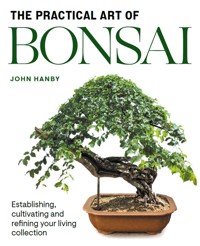
Front cover: Sageretia theezans from the private collection of John Hanby.
CONTENTS
Introduction
Chapter 1: Bonsai Origins
Chapter 2: Starting Out – Your First Bonsai
Chapter 3: Next Steps – Initial Styling
Chapter 4: Indoor Bonsai
Chapter 5: Outdoor Bonsai
Chapter 6: Repotting – Root Considerations and Problems
Chapter 7: Trunks and Main Branches
Chapter 8: Secondary Branches and Twigs
Chapter 9: Bonsai Aesthetics
Chapter 10: Your Bonsai Collection
Glossary
Further Information
Acknowledgements
Index
INTRODUCTION
It’s hard to believe that I started my bonsai journey more than thirty years ago. Just like you, I was fascinated by the idea of having a miniature version of a full-size forest tree growing in a pot on my windowsill. There was definitely something magical or mystical about this concept and my curiosity was aroused. I had no idea what I was letting myself in for or how it would change and shape the rest of my life. I joke with my students on a beginner’s class that just like cigarettes, bonsai should come with a warning note, ‘this product can seriously damage your wealth!’; but when I think of the pleasure, enjoyment and satisfaction this hobby has given me, the people and trees I have been fortunate to meet, this product is priceless.
Miniaturizing and growing a tree in a small pot just captures the imagination.
I had tried some seeds but that was a disaster, not one green shoot appeared. Next came a mail-order bonsai, which, the label informed me, was a Japanese temple tree. Unfortunately, this tree did not survive for long, but now I realize I was trying to keep an outdoor tree alive in a totally inappropriate indoor environment. I was determined not to give up and, subsequently, acquired a juniper that I did manage to keep alive for many years, despite its early existence being, again, mistakenly confined to indoors. I suppose my early attempts were not so much thwarted by bad advice but by no real sound advice at all! So, if you are in the same predicament that I was in, I hope that you will find some of the early chapters in this book really useful. The first two chapters should help you in the acquisition of your tree, whilst the practicalities of keeping it alive and healthy are discussed in Chapters 4 and 5, depending on whether it is an indoor or an outdoor tree.
A Bonding with Nature
Our fast-paced lives today are dominated by the high-tech industrialized civilizations we are a part of. The idea of a slow-paced, gentle, rural environment seems to have all but disappeared. Somewhat surprisingly, the amount of leisure time we have does seem to be increasing and there is a prevailing trend to want to escape to the countryside. The interest in gardening is also becoming more popular with large garden-centres extremely busy in the summer months and more gardening programmes being shown on television. Bonsai allows us to take this connection with nature to another, much closer, level.
Outdoor bonsai thriving and brightening up the garden but close enough to the house to be enjoyed from within.
To develop a bonsai, you need to harness nature, to work with nature in order to achieve a desired goal or shape. Some of the tasks involved in shaping your bonsai will result in you having to go over every branch of the tree on a regular basis. You will get to know your tree intimately; you will understand and bond with your tree. The transformation is immediately satisfying when you create a bonsai out of a piece of raw material, but then it becomes even more rewarding when you see the tree back-budding and evolving appropriately because of your intervention. Chapters 7 and 8 on branch development should help you in your partnership with nature to build up the structure of your tree and then refine it further.
In my other life, before bonsai, I was a chartered surveyor with my own estate agency business. As my interest in the hobby grew, I found that working on one of my trees was so engrossing it was the only time I could truly forget about work and any other ongoing problems. In addition to this therapeutic quality, you will find that, like most pastimes connected with nature and gardening, bonsai is spiritually uplifting. It will lead you through the seasons, there is always something to enjoy and something to look forward to. Throughout this book I have tried to refer to seasons of the year rather than months in order to make it easier for you to appreciate the timing of tasks. My bonsai experiences are centred around Yorkshire, England, in a temperate climate. Using this information, you will have to adapt the advice given to coincide with the season and climate in your particular location.
Time
Planning your life now will generally involve thoughts and discussions around today, tomorrow, next week and, inevitably, next month. When you start making plans for your bonsai, suddenly you are talking about next year or the year after; days and weeks are replaced by growing seasons. Your concept of time takes on a whole new perspective. Maybe it’s not such a bad thing that nature is trying to slow the pace of your life down and instil in you a greater sense of patience. This might sound daunting and long-winded, but it is surprising how quickly time goes by and how your trees will change. People say you should enjoy the bonsai journey and not just the arrival at the destination. But you don’t want to be stuck at a station, time is precious and it is much nicer to arrive within a reasonable period of time. I have viewed the collections of some enthusiasts after twenty years’ involvement in the hobby and their trees have changed little. As a bonsai teacher, I do find this frustrating when I know how much a tree can be improved in just five years. However, if they have enjoyed their trees and had much pleasure from the hobby over the years, who am I to criticize? But people can lose interest in the hobby and become disappointed or frustrated when they are failing to make progress. Most of my students are excellent bonsai technicians and they just seek some input from me to point them in the right direction to take their trees to the next level. For things to change and to move in the right direction, it is important that you are performing the right tasks at the right time. Mr Takeo Kawabe, the bonsai master I studied with in Belgium, instilled in me the principles of ‘watch and wait’. Leave your trees alone, let them grow, watch them and wait until the time is right to intervene again to carry out the next task. Enthusiasts often do too much to their trees in too short a time and the trees suffer as a result. They need time to recover.
One of my privet stumps pictured in June 2002 having been retrieved from a hedge.
The same privet stump pictured in July 2017 after fifteen years of bonsai cultivation.
I hope the information in this book will inspire you and encourage you to make those correct decisions on your trees to develop them and, ultimately, refine them to a higher level. The many case studies and examples will show you just how much your trees can progress in a relatively short space of time.
Two old bonsai in part of a display garden I created for one of my Newstead Bonsai Extravaganzas.
If you buy an expensive specimen bonsai from Japan, you are basically paying for time; for the fact that someone in Japan may already have invested thirty years in the tree’s development. It is much more satisfying if you have created the same sort of bonsai yourself from a garden bush or stump. It can also be a good investment in that your tree may now be considerably more valuable, whilst the enjoyment and pleasure you have experienced is, again, priceless.
A Living Work of Art
There is a strong bias in this book towards the horticultural aspect of bonsai, after all this is the information you need to keep your tree alive and healthy. If you have a sick tree, you can do nothing but wait for it to recover. If you have a strong, healthy tree, then you can utilize the other horticultural techniques explained to develop and refine your tree. But we must not forget that bonsai should really be viewed as a work of art and respected accordingly. Each created bonsai represents a vision of the artist and his or her interpretation of how a tree can look, whether it be a perfect miniaturized replica of a stately, full-grown tree or a more conceptual ‘living sculpture’. The aura surrounding a well-executed bonsai is much more at home in a gallery situation than it is in a horticultural tent. Having mastered the horticultural side of bonsai, I hope that the principles and philosophies of art in bonsai, explained in Chapter 9, will enable you to successfully combine the two and further improve your trees.
With other art forms there is a beginning and a definite end. Once painted, a picture can be framed and hung on the wall, a statue can be mounted and placed for all to admire. With bonsai there is a beginning but there is no ending – it has that extra dimension, life itself! In creating your work of art, you have to allow for its future development, its seasonal changes and plan ahead to carry out the work required to eventually achieve the image that you have in your mind. Then you have to improve and maintain that image.
Something to Think About
I was once interviewed for a bonsai magazine and was asked where my knowledge and inspiration had come from. I told the interviewer that I had learned from my mentors, my students and my mistakes. (If my students read this they will be trying to charge me for the privilege!) The fact that you are working with a natural, living plant does mean, regrettably, that fatalities will occur. Sometimes the cause is down to nature and beyond your control. Sometimes it is down to you, making mistakes, perhaps expecting too much from your tree, bad repotting or inadequate watering. Over the past thirty years I have lost trees, I have made mistakes, but through my school, and now this book, in the ensuing chapters I hope you can learn from my mistakes and keep your trees alive and healthy. Don’t get too disheartened if you do lose a tree, but try to learn from the experience and move forward. I remember a story about a bonsai enthusiast once talking to John Naka, a famous bonsai pioneer in America. The despondent student was telling John about some of his trees struggling and not looking good. It was perhaps even more frustrating to visit John’s nursery and see all his benches full of trees looking so strong and healthy. John turned around and quietly enlightened the student, ‘It’s not that I don’t have any sick or dead trees, I just don’t put them on display’.
How my Euonymus looked when I acquired it after it had two owners. It started life in Sheffield and then went to the Isle of Man.
The tree when I exhibited it in Belgium in 2016, after which it appeared in an international bonsai magazine.
What you will be surprised to find is that the problem will, inevitably, become totally reversed. When we talk about ‘our trees’ I suppose we are guilty of being a bit blasé. We are, after all, very much a servant to our trees. We take care of their every whim and no expense will be spared in ensuring that they have the best possible conditions and husbandry to survive and flourish. In this scenario they are capable of outliving us by many years, even hundreds of years! For the time they are in our possession, we really are no more than custodians, humble servants. As your collection develops, it is certainly worthwhile trying to encourage your children or grandchildren to take an interest, if only to ensure that your beloved trees’ progress will survive through future generations.
It would be great if a bonsai came with a ‘log book’ that chartered its history and previous owners. Some trees I have sold have passed through my hands several times and just from what I know of them they have quite a story to tell. Trees suffer adversity, they are restyled, they are given a new pot or different planting angle. A pictorial record would be really interesting and invaluable, especially when some bonsai, like in Japan, are hundreds of years old. Chapter 10 will help you to put your trees and your collection into perspective with advice on starting your own bonsai records.
CHAPTER 1
BONSAI ORIGINS
A Brief History
China
Contrary to what most people would think, it is generally accepted that bonsai originated in China, rather than in Japan. Ancient manuscripts and paintings confirm that artistic pot plants were being grown in China as early as ad700.
The Chinese have a great practical love for flowers and plants, whilst their spiritual heritage has strong links between humans and nature. There was something mystical about nature and especially the mountains. Being able to recreate a mountain landscape in their own garden would have been highly regarded.
I used the raft planting technique to create this mountain scene as a demonstration for a bonsai club.
The same Juniperus communis as raw material prior to the demonstration.
When we go for a walk in the hills and mountains today we capture the scenery with an image on our phone or camera. It is so easy for us to access this and to share the image with family and friends. In those early years the Chinese would use rocks, mosses and plants to try to recreate a landscape they had been inspired by, in their own garden. This would have been a valuable source of contemplation and meditation, which could be shared with visitors.
Chinese bonsai are often associated with the distinctive ‘S’-shaped trunk and the separate foliage pads/ clouds. I was once told by a friend with strong Chinese connections that the separate foliage clouds represented the steps to heaven. The curves in the trunk were put in place because they believed evil spirits could not change direction, so this would stop them pursuing you on your upward journey.
Japan
Buddhist monks are credited with spreading the idea of miniature landscapes and trees into Japan from around the twelfth century. When you think of Zen Buddhism, the idea of peaceful contemplation and intuitive meditation, there is again a strong link between humans and their natural surroundings. Ancient traditions, and this strong spiritual bond between humans and nature, no doubt played its part in the early development of the bonsai art.
Many homes in Japan have a tokonoma – a niche or alcove where they can mount a display. Entire books have been devoted to the selection and arrangement of the display elements.
Over the years, as bonsai gained popularity, the trees that were created in Japan became much more refined, especially in the last century. The Japanese took bonsai to a whole new level and have become renowned throughout the world for this art form. They still seem to be able to combine an appreciation of the natural tree image, whilst creating trees that sometimes appear to be almost too perfect.
The magnificent bonsai created in Japan are the inspiration for many of the trees created in the rest of the world today. In my early bonsai days, I had been teaching the hobby quite successfully for several years and considered myself to be reasonably competent. Then I came into contact with enthusiasts in Europe who had been taught by the Japanese. It was like starting out all over again!
A thriving business has evolved, in both China and Japan, exporting bonsai trees, pots and accessories to many countries.
The West
The first significant introduction of bonsai to the Western World appears to have been towards the end of the nineteenth century. Aristocrats and Victorian plant-hunters were searching the world for new and interesting artefacts and plants; they returned from the east with tales of miniature trees artistically twisted and contorted.
The intervention of two world wars in the twentieth century certainly seems to have slowed down the interest in, and the development of, a bonsai hobby. However, in the USA it gained in popularity after World War II, probably due to soldiers being stationed in Japan.
In the 1960s and 1970s there was certainly a thirst for knowledge and more people were beginning to dabble with creating miniature trees. My own personal bonsai story was sparked in the 1980s and it’s surprising how many of my contemporaries started their bonsai journeys at around the same time.
Satsuki azalea bonsai on display at my own Newstead nursery. Every two years, for one weekend my main greenhouse was transformed into an amazing exhibition hall.
Today
Bonsai today is a thriving and rewarding hobby enjoyed by people across the world. Most countries have a network of bonsai clubs and groups where people can come together locally to share knowledge or to show off their latest creation. You may be surprised to find that there is a group of likeminded enthusiasts local to you or within reasonable travelling distance. Many local and regional horticultural shows now incorporate a bonsai section or display. Local, regional and national bonsai exhibitions are held regularly in most countries. These shows are a great source of inspiration and pleasure. International bonsai exhibitions are also held annually or biennially; for example, the Kokufuten in Japan, the Trophy show in Belgium and the US National exhibition in America. These shows attract exhibitors and visitors from across the world.
There are many established bonsai nurseries where you can pick up supplies locally and perhaps source your next tree (see the stockists listed in the Further Information section at the end of the book). Of course, we now also have the internet and, like everything else we need to survive on this planet, everything bonsai can be purchased online.
Dispelling the Myths
Definition
Most people are familiar with the concept of bonsai. They see it basically as a full-size tree that somehow has been miniaturized and is kept in a tiny pot. Having encountered the full-size version in the wild, there is this fascination and something magical about how the tree can be kept small and survive in such a limited amount of soil. They see bonsai appearing regularly as a background item in films and television dramas, most noticeably in The Karate Kid. Some people even think it is cruel; that the trees are starved, strangled with wire and wedged into a pot that is ten sizes too small. Speak to the partner of a bonsai enthusiast and, if reincarnation is on offer, you will find that they will all be coming back as a bonsai; the care, love and devotion lavished on these small trees is beyond reproach.
A common error is for people to think that bonsai is a special type of tree. So, just like we have an oak and a pine tree, they think we have a bonsai tree. The literal translation of bonsai is ‘a tree in a tray’. So the definition is more about the concept rather than a specific type of tree.
If a bonsai tree were removed from its pot, planted back in the ground and allowed to grow unchecked then it would revert back to being a full size natural tree. It would take many years for the tree to reach its normal natural height and girth. This would be influenced by the local climate, soil, and how favourable the growing conditions are.
Age
Bonsai are quite capable of living as long as many of the trees growing naturally in the wild. In Japan, some bonsai have well-documented histories revealing that they are over 500 years old. They are handed down through the generations just like family heirlooms that we are familiar with in the West.
On one of my classes with Japanese bonsai master Takeo Kawabe, at the bonsai school in Belgium, we were discussing a juniper that had originally been collected off the mountains in Spain. After discussions between the master and some Spanish students in the class, they estimated its age to be in the region of 500 to 600 years. When you think what has happened in the world whilst this small tree has been growing, it makes you truly appreciate what you are working on, what you have in your hands; it is a humbling experience.
So, age can be important but don’t get carried away with it. Some people will exaggerate the age of their trees, especially if they are trying to sell it to you. It is often a guess anyway; trees don’t generally come with a birth certificate. Just because a tree is old does not mean that it is automatically a good tree. I have seen people pay high prices for yamadori raw material that had very limited potential to make good bonsai. The best basic advice is to buy a tree because you really like it.
Yamadori Bonsai
This Japanese term describes bonsai that are collected from the wild. Many of the famous trees in Japan, and some of the top-quality bonsai in Europe, were created from material dug up off the mountains. I have heard stories of people hiring helicopters to bring trees home from the higher mountain regions. It is not uncommon for a yamadori collector to be seen hurtling down a mountainside on skis with the upper branches and foliage of a tree sticking out of his backpack.
The attraction of this material is that it already is an old tree with matured bark, aged deadwood and twisted/contorted branches but remains small. It has been dwarfed naturally by the harshness of its location – avalanches, cold temperatures, the weight of snow and strong winds. It takes skill and experience to be able to remove an old tree from its mountainous home and accustom it to life in a container whilst keeping it alive and healthy.
You should always seek permission before removing a tree from land that does not belong to you. In some cases, for example National Parks, the fines imposed for unauthorized removal of plants and trees can be very high.
For and against
The practice has been going on for centuries and will be encountered in some form by every bonsai enthusiast. I do not advocate wholesale indiscriminate removal and vandalism of the countryside: please note the need to obtain permission and the possibility of heavy fines being applied.
Self-sown seedlings often grow like weeds in some areas, and their removal can be welcomed by some landowners. The Forestry Commission will often let bonsai collectors access specific sites to remove unwanted young material on the edges of plantations.
Every year, people clear shrubs and trees from their gardens to make way for home or garden improvements, depositing them in skips or on bonfires. Some of this material has excellent bonsai potential – you just have to be in the right place at the right time. It can be a similar situation when local authorities are clearing roundabouts and other areas of public land: one bonsai enthusiast found excellent old pine material on a walk in the Scottish highlands. He faced a lot of red tape to remove these trees. The next time he went up the grouse moor had been set on fire and all the trees had been totally destroyed.
The yamadori bonsai collector is more interested in saving trees and plant material, looking after it and taking it to a whole new level.
Like most things, there are arguments for and against. You will no doubt make up your own mind, but it is my duty to present to you what is a valuable part of the hobby.
Size
Bonsai come in all shapes and sizes. There are many named size classifications to have come out of Japan and these have given rise to much discussion and conflict. Basically, it doesn’t really affect you unless you intend to exhibit your tree. In which case, the rules adopted by the exhibiting body may determine specific sizes for each class and, ultimately, which section your tree will be placed in.
This larch was originally collected from the Alps. It has been wired and styled and is just coming into leaf.
A display of shohin bonsai at my Newstead Bonsai Exhibition in 2010.
What it does mean is that you can have a reasonable bonsai collection in whatever size space you have available, be it a balcony or a large garden.
Before I acquired a small hydraulic lift, if I wanted to work on some of my trees I had to make sure my helpers brought them into the studio before they went home. Generally speaking, the older you get, the smaller your trees tend to become, at least in theory!
Unlike some commodities, the size of the bonsai has no significant bearing on price or value. For example, you could have a large, partly trained tree of reasonable appearance worth a few hundred pounds and a specimen shohin bonsai of really good quality worth a few thousand pounds.
Common Size Classifications and their Approximate Dimensions
Mame
5–15cm (2–6in)
Palm-size bonsai.
Shohin
13–20cm (5–8in)
You can hold it comfortably in one hand.
Medium size
25–75cm (10–30in)
Within this section, you may come across ‘Kifu’ and ‘Chuhin’ classifications.
Large size
75–120cm (30–48in)
These are often divided into two-person, three-person or four-person trees, which is the number of people required to move the tree from one place to another.
Patio bonsai
Over 120cm (48in)
These larger trees are more like patio trees sitting in an almost permanent position due to the effort required just to move them.
Your Bonsai Origins
How Did You Arrive Here?
Maybe you have that fascination with these miniature trees we mentioned earlier and are just eager to find out more information. Could this be a new hobby you want to get involved in? Many people are introduced to bonsai because they have received one as a gift, often as a Christmas or birthday present. In this modern age, if people want something, they tend to go out and buy it, so it becomes increasingly difficult to buy a gift for people who literally have everything they need. It’s that magical and mythical aura that surrounds bonsai that makes it an ideal gift; most people are really happy to receive one.
Unfortunately, many people then have to confess that they have killed a bonsai, largely due to bad advice or not being given any correct instructions in the first place – a problem this book hopes to try to resolve.
For some people, bonsai is a natural progression from a love of nature or horticulture. People who like gardening will inevitably dabble with bonsai at some time. The interest may be generated by something so simple as self-seeded saplings that they find in their garden or whilst out walking.
How you arrived here and what you are looking for can have a big impact on how far you go and where you finish up with this intriguing hobby.
Future Considerations
If you have received a bonsai tree as a gift, you may simply want to acquire sufficient information to be able to keep the tree alive and in reasonable shape. In the vast majority of cases, the bonsai gift tends to be an indoor tree (see Chapter 4). People want to enjoy their gift as much as possible and, therefore, it is kept in a prominent position within the home.
A typical Chinese elm bonsai tree sold as an indoor variety and the first direct contact many people have with bonsai.
Your outdoor bonsai display can become an important feature in your garden. This may then lead to the acquisition of additional features, such as the Japanese water-basin and watering-can.
If you come from a strong gardening background, or start to show more interest in the hobby, then you will soon realize that the outdoor varieties (see Chapter 5) are the more popular trees, offering much greater diversification and potential.
The design of your house and garden could play an important part in what type of bonsai you grow. A flat with a small balcony may dictate that you stick to indoor bonsai or just have a few small outdoor trees. If you have a young family demanding a lawn on which to play, the siting of your outdoor bonsai display could be crucial to avoid damage from footballs and other unidentified flying objects.
The local climate could have a strong bearing on the types of trees you can grow successfully. If your garden is exposed and subject to strong, cold winds, then maples are unlikely to flourish. If your garden is heavily shaded by neighbouring trees, then you may have to consider species that will thrive in this type of environment. Explore your local area and see what types of trees are growing naturally in the neighbourhood. If you can make contact with local bonsai enthusiasts, they will soon be happy to tell you which trees grow well and which ones tend to struggle.
How much time and money do you want to invest in the hobby? One of the good things about bonsai is that it is very adaptable in terms of these two constraints. As you will see in later chapters, you can create your own bonsai from very inexpensive material, virtually nothing. Alternatively, you may wish to invest money in an established bonsai that has been imported from Japan, an object of beauty to give immediate pleasure; basically you are buying time. If you have a demanding job and a busy lifestyle, then you may only be able to devote a small amount of time to your hobby. This could dictate that you only have a few manageable trees. The more time you have, the more trees you can have and the more effort you can put into working and refining your trees. For many retired people who suddenly have a lot of free time, bonsai as a hobby can be life enhancing.
It is hard to resist a Satsuki azalea bonsai in full flower, especially when you get different-coloured flowers on the same tree.
With strong summer growth this bonsai is reverting back to being a bush, but is a subject that ticks all the boxes for many enthusiasts. Maples are generally popular but the red new growth of this Deshojo variety shows just how stunning the tree looks in spring when it is completely crimson.
After a short pruning session, order is restored, and this natural looking forest planting can be truly enjoyed. Forest plantings enable us to replicate a dramatic landscape in miniature. Furthermore, we only put this group together a few years ago with relatively young, inexpensive material.
Once you get more involved with the hobby, you may find that you discover your own niche. You may be drawn towards the powerful, classical, evergreen bonsai subjects, like pines and junipers. I have had some students with a bonsai collection centred entirely around the deciduous maples and the many different varieties available. Another student loved flowering trees, so she tried to build a collection that gave her flowers all the year round: as one tree faded, another one would just have the flower buds opening.
You may be drawn to a certain size of tree. Some enthusiasts have collections based entirely on smaller size mame and shohin bonsai.
It may seem that there is much to consider, but the hobby is so adaptable it can give you great pleasure and satisfaction, whilst accommodating your lifestyle, budget and location.
Indoor or Outdoor Bonsai
Most of the trees sold as indoor bonsai in the West are imported from China. In their natural environment they are sub-tropical or tropical species, which grow naturally outside. When you keep this tree inside your home, you are basically trying to recreate its natural environment artificially. If you live in a more tropical climate, then you would be able to grow these species as outdoor bonsai.
Outdoor bonsai are the same species that you see growing naturally all around you. Just like their full-size counterparts they need the seasons, the changes in temperature, the winter dormancy and so on. They include the classic bonsai species – pines, junipers, maples – and are the trees grown by the vast majority of bonsai enthusiasts.




