


Erhalten Sie Zugang zu diesem und mehr als 300000 Büchern ab EUR 5,99 monatlich.
- Herausgeber: The Crowood Press
- Kategorie: Geisteswissenschaft
- Sprache: Englisch
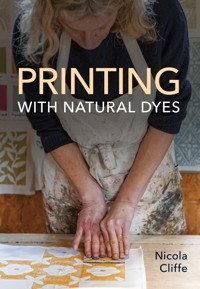
This practical guide explains the techniques and provides ideas and inspiration to get you printing with natural dyes at home. It shows you how even with basic materials (such as the potato) you can make stunning patterns and get hooked on printmaking. It goes on to introduce more advanced processes, and suggests new ways to experiment with the age-old craft of relief printing.
Sie lesen das E-Book in den Legimi-Apps auf:
Seitenzahl: 139
Veröffentlichungsjahr: 2024
Das E-Book (TTS) können Sie hören im Abo „Legimi Premium” in Legimi-Apps auf:
Ähnliche




















CONTENTS
Introduction
1The Workspace
2Relief Printing
3Screen Printing
4Eco Printing
5Plant Dyes
6Printing Recipes and Cloth Preparation
7Designing Your Prints
Last Words
Contributors
Bibliography and Further Reading
Index
INTRODUCTION
Welcome to the world of printmaking and the beauty of home-made natural dyes. You may be completely new to printing or looking to discover new techniques – whatever your background, this book aims to inspire and foster new skills as you embark on your printmaking journey. I hope, like me, you will discover a passion for the wonder and richness of natural dyes and learn new print methods for making anything from a simple birthday card to undertaking major projects including curtains and furnishing fabrics.
Fabrics printed with Madder Cutch & Co’s natural dyes.
I have been on a mission to introduce plant dyes into our homes for more than ten years and it is a pleasure to share my discoveries and printmaking techniques with a wider audience. There is no doubt a resurgence of interest in natural dyes is timely. In our current world we need to aim for a circular economy, a model of production that involves sharing, leasing, reusing, repairing, refurbishing and recycling existing materials and products for as long as possible. The best methods we can use are those that produce items that are sustainable and minimise waste. What could be more ethical than hand printing with natural dyes?
To get you started, I have included a general overview of what equipment and sundries you will need for several printmaking processes, guiding you as you create your own patterns to turn into prints. Within these pages you will find a wealth of information about plant dyes, which colours are best and how to turn them into eco-friendly, easy-to-make printing pastes. Each chapter sets out projects and suggests ways in which you can experiment to achieve different results. By the end of the book, I hope you will feel confident to draw and transform your own designs and patterns using inspirational resources you have discovered and mastered for yourself. You can either read the book from start to finish or dip into it as a useful reference source as your skills improve.
The printmaking processes explored within these pages include screen printing, block printing and eco printing. I must admit I am most at home with screen printing – I love the speed of print production once the screen is made and the crispness of the finish that is accurately reproduced in every print.
Block printing is a therapeutic process that embraces errors and mistakes more than any other printing method. In fact, imperfections make the craft come alive, as confirmed by Michael Silver, Director of Christopher Farr Cloth. He refers to the work of Barron and Larcher, two women who revived block-printed fabrics in the 1920s and 1930s to create an amazing textile collection: ‘They were not trying to make bold statements, yet the designs had huge presence and the use of natural dyes, which restricted the colour palette, resulted in nuances, imperfections and tonal irregularities that enhanced the beauty of the work.’
Eco printing, as its name suggests, is perhaps the most environmental way of getting plant colours onto cloth. In this book I explain how to use plants directly onto your choice of material employing a variety of new and old techniques. The effects are stunning and unpredictable and yet this is the easiest process to embrace.
My own introduction to natural dyeing came through chemistry, and I left a long career in teaching to go to art college as a very mature student. It was at the Chelsea College of Art and Design, and with a love of all things William Morris, that I was finally able to indulge my passion and research natural plant dyes in depth, to learn their ancient history and how to use them. I spent years searching for recipes and methods that I could borrow and update and quickly discovered there was more than one way to achieve spectacular results. Eight years ago, I Iaunched my business Madder Cutch & Co, specialising in screen printing linen for home furnishings and running workshops for creative people. I am also very keen to support textile students looking for work placements at the start of their creative journeys. I am constantly inspired by other printmakers and designers and am indebted to all those who agreed to share their skills in this book.
As you embark on your own printmaking journey it is worth looking at the history of natural colours. For most of human history the only sources of colour were plants, some insects and pigments from the earth. Techniques for dyeing cloth were developed in every part of the globe, the knowledge and skills carefully being passed down through generations and over the centuries. But nothing seems to have been documented until, according to Simon Garfield, in 1823 in New York, William Partridge published A Practical Treatise on Dying of Woollen, Cotton and Skein Silk. It was only at this point that many skilled and well-practised recipes became available in a written format. A change then came around 150 years ago when the first synthetic dyes were discovered and made by the chemist, William Henry Perkin.
Different techniques and processes have since been invented depending on available local resources and materials. Of course synthetic colourants have replaced natural dyes for numerous reasons – in my opinion not necessarily because they look better – but for reasons of practicality, production, application and cost.
There is no doubt that natural dye colours are beautiful, but they will never once again become our primary cloth colourant. However, I am heartened by the resurgence of interest in natural dyes and they are certainly being used more and more by craftspeople and those with the best eye for colour. You are now part of that journey, drawing from traditions and histories that have gone before and taking them with you as you travel forward.
I have put together the basic components you need to start printing with plant dyes and I hope that the projects, information and insights in this book will give you the inspiration and confidence to embark on your own print projects. Do let me know how you get on and I hope you will share your ideas with others in this worthwhile, and creative, craft community.
Nicola Cliffe
CHAPTER 1
THE WORKSPACE
The main purpose of this book is not only to get you printing with natural dyes, but also to give you an opportunity to experiment with different techniques in order to find the ones you love the most. As you develop, you will organise your space and workroom to suit your chosen craft. While some of the equipment will vary with each printing process, your workspace can easily be adapted for all techniques covered in this book. Essentially you will need three main areas: a wash area, a dye-making area and a worktable.
Storage jars on shelving. Your workspace will be a nicer place to work if you are well organised and know where to find everything.
Of course, a spacious, well-lit and stocked studio is the desired set-up, but there is nothing wrong with starting out on a thoughtfully prepared kitchen table, with all of your accessories and equipment close to hand in a storage box that can be pulled out when you are on a mission to print yourself something.
Next, I am going to describe the areas that would be useful to have in your ‘ideal’ workroom, if you have the space (even if you don’t, you should be able to see how the zones will work). For example, you can do all of the block carving, mixing and testing on a print table; you just need to work efficiently, cleaning up and packing away as you go. This can be scaled and refined, depending on how your processes develop and how addictive printing becomes for you.
WORKROOM SPACE
It is important that you are well organised and have everything to hand for your preparations in your workroom – whether it is your kitchen or a room especially for crafting. If you are going to prepare your dye pastes, cut blocks and screen print in your kitchen, it is important not to mix cooking utensils with ones used for mordanting and dye plant mixing (see Note overleaf). It’s a good idea to have all of the essentials close to hand and to set up your table and wet area within a reasonable proximity to each other.
Setting up zones for different tasks will help to keep your workspace tidy and clean. The main printing table can be used for designing and preparations prior to printing.
When working with paints, inks or dyes, it is sensible to be in a space with a washable floor; one that you are not too bothered about if it gets stained. You shouldn’t be making much mess – when printing it is important to work as cleanly as possible – but any surfaces that are vulnerable or precious should still be protected and easy to clean.
The best set-up would be a designated room with a good solid table, plenty of natural light and ventilation, and a sink with a large draining board and running hot and cold water. A separate table that can be used to set up the hotplates and have all of the components to hand for mixing up the dye pastes is useful. The print table can be used for artwork and carving blocks and then transformed into a printing table at the printing stage.
NOTE: When working with inedible substances, it is important to be careful and treat all substances that are not for normal kitchen cooking as chemicals. Take care to cleanse surfaces and keep dyeing utensils separate from your usual cooking ones.
MIXING AREA
This area will be important as you learn how to extract the colours from dye plants and turn them into a suitable printing medium. You will need to have enough space to house a portable tabletop stove, some weighing scales, and mixing and grinding vessels, as well as some storage pots for the dye plant material. A shelf that is out of reach of children is a good idea for all of the ‘chemical’ components.
Storage Pots
Good storage pots are essential. While glass containers are the most sustainable, we do need to be careful when handling them. Kilner-style jars, used washed-out jam jars and similar are all worth saving for this purpose.
When the printing pastes are made and ready to be used, a suitable vessel will be needed to hold the ink to take to the printing table. It might make sense to invest in some standard plastic pots with good snap lids (unfortunately plastic still makes the best pots). As long as they are used again and again, it’s not going to be a disaster.
Store all chemicals and sundries on a shelf out of the reach of children and with a clear labelling system.
Recycled jam jars and Kilner-style jars are good for keeping dyestuffs dry and organised.
Steaming Vessels
A steaming vessel is needed when eco printing and printing with direct dye pastes. The fabrics will need to be steamed to fix the colours into the cloth. It is a very easy piece of kit to assemble using a large pan but may only be suitable for steaming smaller pieces of fabric. If larger pieces need steaming, you can adapt other vessels for this purpose. I find a catering-style water heater works well to take larger rolled-up pieces of fabric, using chicken wire that has been moulded to make a stand inside it above the water level.
Steaming pots can be adapted. Here a tinfoil tray with pierced holes works well for smaller printed pieces.
NOTE: It is very important that your steamer doesn’t boil dry, so keep checking the water level when you are carrying out the steaming process.
Labelling System
It is good practice to put as much information on the labels as possible, for example where the material comes from, dates collected or to be used by and obviously what it is.
Mixing Utensils
These utensils will be similar to those used in the kitchen. Repurposed ones that are not good enough for cooking any more are always a good find. I like to keep mine in utensil-type pots, storing wooden spoons and spatulas in one and metal measuring spoons and stirrers in another.
Waste Bin
A large waste bin divided into compost, recycling and other is a good idea in this area.
Damp Sponge
I like to have a damp sponge on the table when I am working with dye extracts, just in case of spillage.
TESTING AREA
A small space could be given over to a testing station that is set up to test colours and consistency. It could also be an area in which you keep your records and experimentation notes. A pinboard or rail would be handy to hang test prints to dry.
If you intend to be consistent with the colours that you make to print with, a good record-keeping habit is essential. This area could just be a small space at the end of your table or a shelf on the wall for books and tiles.
A testing area is a good place to keep notes and records.
ARTWORK AND PRINTING TABLE
You can use the same table for artwork and printing. The block carving and stencil cutting steps are slow processes so you will need a good table at the right height for sitting down. A cutting mat and a heavy-duty cloth to cover the area (for ease of cleaning up debris from carving the blocks) are handy. Good lighting is essential for close-up work; when tracing patterns a small light box will be useful.
A light box can be useful when tracing intricate designs.
A heavy, sturdy table is best for printing – one that will not move when you lean on it and that is big enough to take all the pieces of fabric you want to print. The top will need to be covered to give the table a slightly cushioned surface, which will help to imprint the design onto the cloth without it slipping. To achieve this, a blanket or towelling fabric can be placed under a calico or canvas cover. The covers can be washed from time to time to keep the heavier underfabrics clean. The cloths can be fixed to the table with bulldog clips, and if the underfabrics are quite heavy and the tabletop is not too slippery, they tend to just stay in place. (There are various anti-slip table coverings that can be bought if necessary.)
Here the table has a cushioning layer and a calico protective layer, ready to pin or clip down.
It’s always more relaxing to work in a space that is tidy, where you have room to move around, so plan for plenty of storage space and organise the printing area so there is enough room to manoeuvre all the way around the print table. The area under the table can be used for storage and to help keep things neat. I always think it is better to print standing up, therefore chairs and stools should be kept out of the way when printing.
WASHING-UP ZONE
If, like me, you don’t like getting your hands too dirty and stained, a pair of surgical gloves can be worn. However, it can often be tricky to keep these clean and you are also more likely to contaminate your surroundings because you can’t feel the ink on your hands. A deep sink with warm running water, some nice soap and a clean towel to hand is always my preferred option. A sink and draining board are essential – it’s the space where dirty things are allowed to land.
The sink and draining board is the most important area of your workroom.
EQUIPMENT AND UTENSILS LIST
Washing-up Zone
• Aprons
• Tea towels (old ones no longer good enough for the kitchen)
• Hand towels
• Dustpan and brush
• Washing-up cloths or sponges
• Handwashing soap
• Washing-up liquid
• Pots to stack drying utensils
• Scrubbing brush
• Scouring pad
Mixing Area
• Hob/heating element (this can be your normal kitchen cooking top, but a portable electric hob in a designated zone is more desirable)
• Steaming pot
• Muslin cloths for steaming
• Weighing balance (electronic ones that measuring to one decimal place are ideal)
• Measuring vessels (or folded scrap paper can be used)
• Large pans (jam-making pot)
• Mixing bowls (ones discarded from the kitchen)
• Wooden spoons
• Tongs
• Wooden or silicone spatulas
• Storage pots
• Ink tray
Table
• Layer of insulation material (curtain wadding or a blanket)
• Calico or canvas, large enough to cover table
• Bulldog or artboard clips (if necessary)
• Light box (optional)
• Overhead light or a task light
• Cutting mats
Block-printing Kit
• Woodblock carving tools
• Pencils and rubbers
• Artwork materials
• Woodcutting tools
• Standard linocutting tools
• Woodblocks
• Lino blocks
• Tracing paper
• Sponges
• Bench hook




