


5,49 €
Mehr erfahren.
- Herausgeber: WriteLife Publishing
- Kategorie: Ratgeber
- Sprache: Englisch
“Laugh! Cry! G-A-S-P!"
This heart-wrenching and triumphant love story is a tale of advocacy and caregiving. Donna's husband, David, stumbled into their bedroom, his hand covering a blood-filled eye from a brain hemorrhage.
Donna called 9-1-1. David slipped into a coma. At that moment, Donna was thrust onto the path of caregiver for her best friend and the love of her life.
In her debut memoir, Donna shares how a neurosurgeon said that David would make a "great organ donor." She writes of arrogant doctors, uncaring visitors, insensitive ambulance drivers, and problematic nurses. She also tells of the many compassionate doctors, nurses, therapists, staff, strangers, family members, and friends who helped them on their journey.
Donna compellingly describes her ability to appear positive as she experiences the horror of making life-or-death decisions. As her world crashes, she credits laughter as her lifesaver. More than thirteen years later, Donna and David are living a "new normal" together.
Das E-Book können Sie in Legimi-Apps oder einer beliebigen App lesen, die das folgende Format unterstützen:
Veröffentlichungsjahr: 2018
Ähnliche




















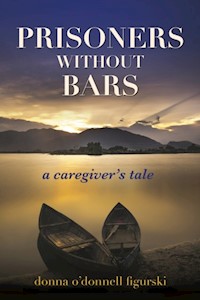
Prisoners without Bars: A Caregiver’s Tale
© 2018 Donna O’Donnell Figurski. All rights reserved.
No part of this book may be reproduced or transmitted in any form or by any means, electronic or mechanical, including photocopying, recording, or by any information storage and retrieval system, without permission in writing from the publisher.
This story is told from the author’s experience and perspective. Some names and identifying details have been changed to protect the privacy of individuals.
Published in the United States by WriteLife Publishing
(An imprint of Boutique of Quality Books Publishing Company)
www.writelife.com
978-1-60808-205-6 (p)
978-1-60808-206-3 (e)
Library of Congress Control Number: 2018956542
Book design by Robin Krauss, www.bookformatters.com
Cover design by Marla Thompson, www.edgeofwater.com
First editor: Olivia Swenson
Second editor: Caleb Guard
Praise for Prisoners without Bars
“Most stories about tragedies or medical journeys focus on the patient. Donna O’Donnell Figurski’s Prisoners without Bars: a caregiver’s tale is such a compelling read because it looks at traumatic brain injury through the caregiver’s lens. I related to so much of what Donna describes―from the low moments of despair to celebrating the small and large victories.”
― Lee Woodruff, caregiver and author with Bob Woodruff of
In an Instant: A Family’s Journey of Love and Healing
“Prisoners without Bars author, Donna O’Donnell Figurski, unabashedly asks, ‘How was my vibrant, so-smart husband reduced to this?’ when her husband, a respected Columbia professor with a PhD in molecular biology, struggled with the simplest of daily activities after his cerebellar hemorrhage. Her book is a testament to the importance of patient advocacy after brain injury, and their story of reinvention and resilience is a testament to the healing power of love.”
― Rosemary Rawlins, caregiver for her husband, Hugh,
who has a brain injury; author of Learning by Accident;
editor for BrainLine
“Only someone who has been on this journey could ever begin to understand that, with all the pain, we are still so very grateful for our new life. Donna O’Donnell Figurski tells her story of grace, love, frustration, anger, disappointment, strength, joy, and above all hope. I believe Donna and David’s beautiful, painful, and inspiring story will bring comfort, insight, and the hope that all does not have to be lost, even for a prisoner without bars and the person who loves him or her.”
― Judy Thau, caregiver for her husband,
Steve, who has a brain injury
“In my darkest days, I was praying I would meet someone like Donna who understood the life of being a caregiver for a brain-damaged husband. It’s not an easy task. Donna has been a great teacher and example for me. I appreciate her zeal for knowledge and her helping others through their hardships. The brain-damage world is such a mystery to many. I appreciate Donna for all she does to help educate others.”
―Cyndy Feasel, former caregiver for her husband, deceased
former Seattle Seahawks lineman Grant Feasel, who suffered
from a brain injury; author of After the Cheering Stops
“Donna and David Figurski are a power couple, personifying courage and dignity in the face of unspeakable odds. Theirs is a story of medical tragedy and personal triumph: David, having suffered a hideous brain-bleed, battled, along with Donna, to find a new normal. . . Written with detailed candor that lacks medical mumbo-jumbo, this is also a love story―love in the thick of a crisis. It is an honest, wise, gutsy book that informs and inspires those who are struggling with TBI, their support-teams, and all who might one day encounter this devastating injury. In short, this book is an important read for everyone.”
―Nancy McDonough, retired 2nd grade teacher and mentor;
reviewer for the National Science Teachers Association;
reviewer for the International Literacy Association
To my best friend and husband, David—not only a survivor of traumatic brain injury, but also a conqueror. Your road back from the other side was an arduous one, yet you executed each step with grace and poise. You are as amazing as you were on the first day I met you. There was magic then. There still is. Thank you for staying with me. Of course, you know I would never have forgiven you if you had left me too soon. I love you—always will. Three squeezes!
CONTENTS
Foreword by Dr. Michael Kailas
Preface
Prologue
Chapter 1: Everything’s Blurry
Chapter 2: Paramedics Don’t Always Rush
Chapter 3: No. I Mean, Yes
Chapter 4: Unthinkable Odds
Chapter 5: Calling the World
Chapter 6: Breathe, David, Breathe!
Chapter 7: The Squeeze Game
Chapter 8: Over the River
Chapter 9: What a Mess!
Chapter 10: Packing for Uncertainty
Chapter 11: Hearths
Chapter 12: Rip Van Winkle
Chapter 13: Campuses
Chapter 14: Surprises
Chapter 15: Emotional Roller Coaster
Chapter 16: Third Time’s a Charm
Chapter 17: Phew!
Chapter 18: Colorful Roommate
Chapter 19: Befriending the Staff
Chapter 20: Catching Up
Chapter 21: “Don’t Worry” Means “Worry”
Chapter 22: “I Love You!”
Chapter 23: Music for Healing
Chapter 24: ETR (Expected Time for Recovery)
Chapter 25: Close Living Wears Thin
Chapter 26: Prisoners without Bars
Chapter 27: April Fool’s Joke?
Chapter 28: Barely Staying Sane
Chapter 29: Betty
Chapter 30: An Invitation to Speak
Chapter 31: Open-air Gym
Chapter 32: Definitely Not a Vacation
Chapter 33: Kristin
Chapter 34: Parade of Helpers
Chapter 35: Angela
Chapter 36: Returning to Work
Chapter 37: Monique
Chapter 38: Rocky Look-alike
Chapter 39: Wind River
Chapter 40: Invisible TBI
Chapter 41: New Normal
Epilogue
Afterword by David Figurski
Acknowledgments
Additional Information
About the Author
FOREWORD
David and Donna’s story is one of the tragic possibilities that life affords us. We must exercise our abilities to their fullest extent to make the best of our most challenging trials. This is exemplified not only by Donna’s family trauma, but also by their progressive and heartfelt triumph. Donna’s narrative explains traumatic brain injury and its multiple destructive tentacles, while showing us the power of love, dedication, and persistence.
I admire and respect David and Donna’s battle to overcome what so many of us cannot imagine. They have reintroduced us to the meaning of our existence and to the sanctity of its preservation.
This account has reinforced my dedication to my profession. Medicine for me has always been a unique privilege to heal and comfort. A physician’s knowledge and training must provide thorough and evidence-based competence, but always with compassion and professionalism. Every day, I am reminded of my oath to serve as a healer by being a trusted liaison between formidable illness and human beings.
David and Donna have my admiration, and I thank them for allowing me to assist in their quest to overcome incredible adversity.
Michael Kailas, MD
Neurologist
New Jersey
PREFACE
When my husband, David, suffered what the neurosurgeons called a traumatic brain injury (TBI) in January of 2005, his world was upended. Mine was redesigned. I never intended to write his story. My expertise lies in writing for children, not adults. Besides, I had no time. I barely survived each day as I took up residence in whichever of the three hospitals David was a “guest.” Writing this book never crossed my mind.
But I did write. I wrote wordy informational emails to family and friends across the country, explaining each minute detail of David’s day. I called the emails “updates.” They were my lifelines to folks outside my immediate world. Until I began work on this book a year later in 2006, I didn’t realize how crucial those emails were, as were the digital recordings I scrupulously kept each time I spoke with a doctor, nurse, or therapist. Without these histories, I would’ve had to rely on sketchy memories.
Though I made no conscious effort to write this book, words flowed late each night, after I put David to bed and when my defenses were fragile. That is when I cried. Releasing suppressed emotions and tears allowed me to face each new day. In this way, David’s story unfolded, and I realized I had to tell it. I expect that the writing of this book, memories stumbling across my mind and words spilling onto the screen, was therapeutic.
David emerged on the other side of TBI, though he didn’t arrive unscathed. Neither of us had. He had, and still has, many obstacles to overcome, but David’s story is how one man survived and is conquering traumatic brain injury with patience, persistence, and grace. He is an inspiration not only to family and friends, but also to everyone he meets—and especially to me, who lives his daily struggle.
My sincere wish is that survivors of traumatic brain injury can identify with and relate to David’s story and gain solace from it. I hope those with TBI—either through closed-brain injuries like David’s, or from an unfortunate accident or from the ravages of war (many of our returning soldiers are afflicted with TBI)—know that they are not alone. I feel for their caregivers, and I want to offer them my encouragement. I hope that David’s story will inspire other survivors as Jill Bolte Taylor’s book, My Stroke of Insight: A Brain Scientist’s Personal Journey; Lee and Bob Woodruff’s book, In an Instant: A Family’s Journey of Love and Healing; Gabrielle Giffords and Mark Kelly’s book, Gabby: A Story of Courage, Love and Resilience; and Rosemary Rawlins’ book, Learning by Accident: A Caregiver’s True Story of Fear, Family, and Hope, inspired both David and me. Finally, I hope that Prisoners without Bars: A Caregiver’s Tale will provide a thread of hope to all and offer a slice of a new life after TBI.
Donna O’Donnell Figurski
Arizona
PROLOGUE
Before David ‘s traumatic brain injury, we lived a normal life. We both grew up in Erie, Pennsylvania. I went to a girls’ high school; he went to the boys’ school. I lived on the west side of town, while he lived on the east side. On that starry night in 1965 when I met him, I knew he would be my life partner. He didn’t know it yet. He knew by 1969, when we said our vows. I was twenty and he was twenty-two.
We lived a normal life. David finished college and went on to graduate school. I went to cosmetology school at night and cared for our daughter during the day. We moved from Pittsburgh, Pennsylvania, to Rochester, New York, to San Diego, California, to Tenafly, New Jersey, adding another child, our son, along the way.
We lived a normal life as David went from assistant professor to full professor at Columbia University, and I earned my teaching certification from William Paterson University. I then taught first or third grade at Honiss School in Dumont, New Jersey, the town in which we raised our children.
We lived a normal life as we watched our children grow. We spent our time at gymnastic studios, soccer fields, cross-country courses, and softball fields. We went to parent-teacher conferences and back-to-school nights. We watched proudly as both children graduated college and took up their own lives.
We lived a normal life as empty nesters in New Jersey. We continued our date nights on Friday and Saturday, and sometimes, for extra measure, we had one mid-week too. We both enjoyed our jobs, and life was good.
We lived a normal life until the dawn of January 13, 2005. Then we didn’t.
CHAPTER 1
Everything’s Blurry
Each morning, David slipped from bed at 4:00 a.m.—quietly, so as not to wake me. He went to his home office across the hall and spent forty minutes in a series of exercises. He put on his headset and listened to “Sun Spirit” by Deuter or Chinese bamboo flute music as he performed his version of tai chi. It was his way of getting ready for the day. Then he showered, did a few chin-ups, and got dressed. Before he left for his lab, he would creep into our bedroom and leave a kiss on my cheek. Sometimes I pretended to be asleep. Sometimes I sleepily waved goodbye. Other times I pulled him down for just one more “real” kiss before he left. Then I would roll over, pull up the blankets, and wait for my alarm to ring at 5:50 a.m. It was his schedule, and it was mine.
Ever since 9/11, when overwhelming traffic into New York City turned a thirty-minute commute into a one- to two-hour nightmare, David began this unrealistic schedule. Rising early to beat the morning traffic and not returning home until well after rush hour—7:00 or 8:00 p.m.—was a very long day.
On January 13, 2005, David’s morning started much the same as it did each day. The only difference was that he delayed his rising by one hour. He planned to work at home that morning, preparing a talk about his research that he expected to deliver at Wesleyan University in Connecticut on Saturday. A long-time professor-friend was retiring from the faculty, and David was a featured speaker at his retirement symposium. It was an invitation and an honor that may have saved David’s life.
If David’s morning had been routine, he would have been in his laboratory at Columbia University in New York City by 6:00 a.m.—long before his students arrived. If the morning had been routine, he would have been at his computer returning email, poring over recently collected data, and conducting business in his office, a beautiful room flanked by his two laboratories overlooking the George Washington Bridge on Manhattan’s Upper West Side. If the morning had been routine, I wouldn’t be writing this story. The morning was not routine, and that is why David lived through January 13th.
I was dressed and had applied the finishing touches to my makeup—“Brush and apply,” as my friend Danielle always teased me. I looked at the clock. It was 7:00 a.m. I’m okay, I thought. If I left by 7:20 a.m., I could make it to school with plenty of time to prepare. The children arrived at 8:40 a.m. I used to live in the same town where I taught first and third grade on alternate years. It was a roll-out-of-bed commute—only five minutes from school. So easy! But in 2001, David and I moved to a new home in a community fifty minutes away.
I loved our new home, but I was not crazy about my commute. Half of it was highway driving, and the traffic could be unpredictable in the City area. A fifty-minute, no-traffic commute could take just that, or it could take up to ninety minutes. I always left extra time for snarls or accidents. Throw in an early morning Pupil Assistance Committee meeting or a parent-teacher conference, and I had to leave even earlier. Thursday, January 13, 2005, started out as a relatively normal day. I planned to leave by 7:20 a.m. But I didn’t.
Just after 7:00 a.m., David stumbled into our bedroom. His hand covered his right eye. “I can’t see!” he cried, panic in his voice. “Everything’s blurry!”
Pain etched his face as he collapsed on the bed. When he removed his hand, his right eye was filled with blood. He told me he had been doing chin-ups. He did thirteen of them—one more than he had done the day before. That’s David—always pushing, trying to surpass his last accomplished goal, only to surpass that achievement the next time. I remember thinking, Why? Why did you have to do one more? Why wasn’t twelve enough? Or ten or even five? But it wasn’t enough. It never was.
I wanted to call the paramedics. I had the phone in my hand. It was like a lifeline, but David refused to let me call. He wanted to wait a few more minutes to see if his pain subsided. He sat at the edge of the bed, continuing to cover his eye. Soon the pain spread. I told him to tell me what was happening in case I had to tell a doctor. The pain spread down his cheek, then through his forehead. As it intensified, it moved quickly to the back of his head, and I would wait no longer. He agreed. I dialed 9-1-1.
The dispatcher sounded bored. I guess after hearing emergency calls day and night, the essence of emergency wears off, and anyhow, it wasn’t her emergency. It wasn’t her husband who was suffering. To me, the call was surreal. It seemed to be matter-of-fact, business-as-usual for her. “What is the nature of your emergency?” she asked (sip of coffee). “What is your address?” (bite of bagel). If we had been talking about the weather, there would have been more emotion.
“Can you believe it’s been raining for two weeks?”
“I know! Make it stop!”
The dispatcher showed no emotion, and my emotion soared off the scale. It would have been helpful if she had shown some compassion, even pretended to understand the crisis David and I were trapped in.
Dictionary.com defines “emergency” as “a sudden, urgent, usually unexpected occurrence or occasion requiring immediate action.” I wanted immediate action, but the paramedics were not magically at the door as soon as I dropped the receiver into the cradle. I wrapped my arms around David, who was writhing and groaning in pain on the bed.
“They’re coming, David. They’re coming. Everything’s going to be all right. Just hang on, David. I love you so much. I love you. I love you!” I spouted this litany like a broken record.
If love or words could have made a difference, the emergency would have ended immediately. Love was not enough, and it didn’t end. David kept saying variations of “Donna, I love you. My life has been good. We’ve had a good life. I love you!” And he added, “Tell the kids I love them too . . . and Treska and Kaya. Everything you need is in the file. The papers are in the file.” The papers! I didn’t want to hear about papers. That was too serious. The papers meant only one thing: David didn’t think he would come home again. I couldn’t let my mind go there. I wouldn’t listen. I had a general idea of where the papers were, but I wanted nothing to do with them.
“David, I don’t need the papers! Don’t worry about that. Everything’s going to be okay. I love you!”
Where were the paramedics? I ran to the window. No sign of them. Panic struck me—I had forgotten to give the dispatcher the gate code. It was too early for the guard to be on duty. How would they get in? I dialed 9-1-1 again. Same dispatcher. (I hope she finished her bagel.)
“Sorry to interrupt again, but I forgot to tell you the code to the gate.” I rattled off the numbers. It didn’t occur to me that emergency vehicles would have access to the code at the gate. But they surely didn’t have access to my front door, and it was locked. I ran down two sets of stairs in our brownstone-like townhouse. Slipping and sliding would be a better description, as I took the stairs two at a time. When I nearly tripped on the first staircase, I realized I had better slow down. I would be no help to David with a twisted ankle, but I needed to get to the door. I wanted to leave the door open, so the paramedics could rush in and take charge.
By the time I got back upstairs, David writhed on the bed, moaning, and sweat poured from his body. I could do nothing but rub his arm and try to comfort and reassure him that everything was going to be all right. But I didn’t believe it. I had never been so scared. Though he was the one in physical danger and pain, I saw my life draining away. We had lived a normal life, and now we were sharing a tragedy.
CHAPTER 2
Paramedics Don’t Always Rush
Finally, the ambulance arrived. I dashed again to the door to guide the paramedics to the bedroom. I expected them to rush. Instead, they slowly ambled around their truck to gather their equipment. Then they slowly climbed the stairs to the bedroom. They asked David what was bothering him. David attempted to speak, but his words tumbled over each other. He was nearly unintelligible. Maybe he should have said, “Oh geez, I have a headache!”
These guys must be related to the dispatcher, I thought. I wondered why they didn’t comprehend the urgency. David continued to writhe and moan as I recounted the details—the thirteen chin-ups, something bursting in David’s head, the rapid spread of pain. When one member of the crew finally placed an oxygen mask over David’s face, relief came. David became silent, and I was grateful. He looked peaceful. I later realized that David had slipped into a coma. That was bad, but at least for the moment, it brought him peace.
The paramedics strapped David to a gurney, securing him for the trip down the stairs. It was a good thing too, because they bounced him and the gurney off of our newly painted walls—black smudges on Sugar Cookie in the hallways and black splotches on Suntan Yellow in the foyer. Later, I tried to scrub away these reminders of this unpleasant memory, but they could not be erased. Dabs of paint would cover them in time, but my memory of that morning would never be erased.
“Which hospital do you want to go to?” one paramedic asked me.
“Columbia-Presbyterian,” I quickly answered. “David works at Columbia. It’s where he will want to be.”
“Sorry,” he said. “We don’t go to the City.”
“But that’s always been our hospital of choice.”
“Can’t cross the George Washington Bridge. It’s out of our jurisdiction,” he told me. “Sorry.”
I didn’t know what to do. I didn’t know any hospitals here. We had moved to the area a few years ago, and hospitals were not on our minds. I guess we should have thought of it. We should have had a plan, but we didn’t. I asked the paramedics to suggest a good hospital. They skirted my question, as if they knew there were good hospitals and ones not so good, but they refused to recommend one. That was likely protocol, and I understood their need to remain impartial, but it did not seem fair. This was life or death, and the right hospital could make the difference. I am sure, with all of their transports, they knew the best hospitals.
Since they would not suggest one, I asked which hospitals were nearby. A paramedic suggested several. Two were fifteen minutes away. At least now I had a choice—Sierta Hospital or Blum Hospital. I had never heard of Blum, but I had passed Sierta while running errands. Though I never paid it much mind, at least it sounded familiar. We went to Sierta.
The paramedics loaded David into the back of the ambulance. David tells me now that he vaguely remembers being jostled in, but he remembers nothing after that. I wanted to ride in the back with David, but the driver firmly suggested I sit up front. Though he did not say anything, I could discern the seriousness on his face. I realized I would only be in the way. I debated following in my own car. When I asked the paramedics if they could return me home after David was through, their incredulous expressions helped me realize how out of it I was. It was my first experience riding in an ambulance. I had no idea when I left my home that morning that it would be days before I returned.
As I rode in the front, I could not see what was happening in the back, but I could hear. It didn’t sound good. About a mile from our home the ambulance pulled to the curb, near Dunkin’ Donuts. What’s happening? Why are they stopping? We are supposed to be rushing to the hospital. This is an emergency! These thoughts rambled through my head. The driver told me not to get out. I did not. I was too scared. Another ambulance pulled up behind us, and another crew hopped aboard. We were off again.
They began to work on David. I don’t know what they were doing, but one attendant kept yelling at the driver to go more slowly. More slowly? We were only going twenty miles per hour. I wanted to go eighty, a hundred, but even at twenty, every bump seemed like being dropped from a cliff. I thought that an ambulance would provide a soft, gentle ride—like riding in a limousine. Not true! It was more like being pulled down a dirt road in a rickety red wagon. How can this be good for an injured person? Slowly, slowly we continued our “fifteen-minute” journey to the hospital, which took more than double that time.
When I finally saw the hospital, I breathed more easily. Now everything will be all right, I thought. The emergency doctors and nurses will make David better. The ambulance stopped at the emergency entrance. I hopped out and went to the back of the truck. The doors did not open. I sensed movement and heard voices inside, though they were indiscernible. What was taking them so long? Hurry! Another ambulance pulled up. I wanted David’s ambulance doors to fly open, and I wanted the paramedics to rush him into the emergency room. I did not want some other emergency to go ahead of him. What if there was only one doctor? What if this were like the deli, and we had to take a number?
I paced, and I waited, and my mind screamed. I could do nothing . . . but wait. I would be perfecting my skill of waiting over the next few years. Finally, the doors to the ambulance opened, and I sighed in relief. I saw David on the gurney, his eyes closed, not moving. I looked for the rise and fall of his chest. The blanket moved slightly, but it did move. Then the legs on the gurney dropped down, and David was pushed through the doors marked “Emergency.”
CHAPTER 3
No. I Mean, Yes
The paramedics pushed David down the short hall into a little cubicle, an examining room. They moved him from the gurney to the observation bed. The doctor and nurses quickly took over. They did not pull the privacy curtain closed, and though I was surprised, I was grateful. I did not want to be separated from David. I needed to know what was happening.
I watched from the reception desk, where I had to produce my insurance card. I hoped it was in my wallet. I rarely used it. It is the kind of thing you put there and forget about. I found it and handed it to Janis, the receptionist. She did not seem particularly friendly or compassionate—what you would expect from someone in this position, who sees emergencies and distraught people every day. She was business-like, just doing her job.
She handed me a clipboard. I sighed as I glanced at the numerous forms and endless questions. This was the beginning of the paperwork, which would stalk me throughout this journey. When I completed the forms and returned them to her, she had even more questions. But she probably got more than she asked for.
Janis asked if I had called my family. I shook my head no. I said I had a cousin who lived down the street from me, but she was in Florida visiting her parents. Her husband, who had remained home, was working in the City, and I didn’t want to bother him. I had another cousin who lived about a half hour from the hospital, but she and her husband were also working. They were not an option either. I explained that we were all from the Pittsburgh area and that we had all moved here at different times. Essentially there was no one to call. I told her that the next nearest relative was David’s father, who lived in Erie, about 450 miles away. There was no point in calling. I did not want to scare him. I would tell him when this was over . . . when everything was better. I could handle this. Sure I could! I bit my lip to hold back the tears.
I would not cry. I needed to feel in control. I didn’t want to break down. I could not take the chance of David seeing my tears or sensing my anxiety. I believe that, although a person is unconscious or in a coma, he or she is aware at some level. My desire to convey confidence may have made me seem cavalier, but I wanted David, if he was aware, to feel that all would be fine. It was going to be fine! It had to be. I was being stoic for him and probably more for me. I knew if I cried, if I broke down and lost control, then I was accepting defeat. I would be admitting that there was a serious problem, and I was not willing to accept that. I would be unable to do what I needed to unless I stayed strong. I would do whatever it took.
Completing the paperwork and my discussion with Janis probably took three times longer than it would have if I hadn’t been stealing glances toward the examining room. My mind was not on the paperwork. When I finished, I went into the examining room—right up to the head of the bed. I held David’s hand, and my litany started again. “I love you. Everything’s going to be all right, David. I love you.”
The doctors and nurses were patient with me. They welcomed me. Nina was the nurse in charge of David in the emergency room. She was gentle and seemed genuinely concerned. I wanted to hug her. The cubicle was small with machines and cabinets pushed against the wall, and yet Nina and Dr. Faber worked around me. I soon realized that I was in the way, and my selfish need to be with my husband could impede their efforts to make him better. I told them I would wait outside. Nina declined my offer and pointed to a chair along the wall. Still they crawled over me. They continued their examination, probing and sticking David with needles and attaching tubes and questioning me. I recounted what I had already told the paramedics and what I would be retelling repeatedly for the following weeks, even months, to various physicians, nurses, and therapists.
“David was exercising. He was doing chin-ups. He did thirteen of them, one more than he did the day before, and something burst inside his head.”
After more probing by the doctor and what seemed to be endless assessment by Nina, she asked me if I had any children. When I nodded yes, she asked if I had called them.
“No,” I said and shook my head. “Do you think I need to?”
“You should call them.” She emphasized each word.
A wave of panic engulfed me, and I shook it off. An ostrich with her head in the sand—that was me, and that was how I wanted to be. If I pushed this reality away, if I did not believe this horror, then it could not really be happening. Could it?
Soon they rushed David upstairs for a CT (CAT, or computed tomography) scan. Nina said to wait in the waiting room and she would find me when they returned. I did not see a waiting room. I stood by the reception desk, looking like a pitiful soul or someone who had just lost her best friend. I guess both were true.
Janis, the receptionist, took pity on me. She again asked if there was anyone I could call to be with me. She too asked if I had any children.
“Could they come?”
“No,” I replied. “I mean yes.”
She looked confused, and I did not blame her. I was not making sense, and I tried to clarify. “They live a world away. My son lives in California, and my daughter lives in New Mexico. I don’t want them to worry. Besides, they are busy in their lives.”
Janis was surprised to learn that I had children that old. She wanted to know more. Perhaps this was her way of distracting me from the present trauma. It did not, but it did make waiting for David to return from the CT scan more bearable.
I told her that my son, Jared, graduated from the University of California at Santa Cruz (UCSC) with a degree in marine biology. He worked at the university after graduation and was now doing his graduate work to earn his PhD in the same field. I told her that, as a child, Jared voraciously read every fish magazine he could find. His bedroom was filled with aquariums and fish equipment. I smiled as I remembered how Jared invented a device, using tubing and a plastic liter bottle, to separate brine shrimp hatchlings from their eggshells. I prattled on about how Jared got hooked on marine biology when he caught his first fish on a string and a paperclip in the stream behind my father’s house in Fairview, Pennsylvania. Jared was only four years old.
With my mind alert for David’s return, I continued to chatter distractedly. I told Janis story after story. If I had not been surrounded with white-frocked doctors rushing by, the incessant buzzing of various monitors, and the occasional code alert from the PA system, I could almost imagine I was socializing at an afternoon tea. It was a good distraction, and Janis was a good listener.
I told her how Jared had worked at the Maria Mitchell Aquarium on Nantucket during his high school summers. He went out in the Zodiac, an inflatable boat with an outboard motor, to collect samples from the ocean. He set up aquariums to display his treasures. He conducted tours and taught youngsters and their parents about underwater life. I also explained that Jared was a diver and had been the captain of the Paragon, the university’s thirty-two-foot research vessel, before beginning his graduate research. I told Janis that I would call Jared later, if it became necessary.
I then rambled on about my daughter, Kiersten. She had gone to Bard College, an impressive school. The student-professor ratio is 10:1, and students are encouraged to design their own curricula. I explained how a group of students wanted to learn German, and a course was established to immerse them in the language. After two intense terms, they went to Germany to study at Heidelberg University. I explained that Kiersten had become fluent and returned to Germany after she graduated. When Kiersten was living with friends in Regensburg, she met her husband-to-be, Falko, and they moved to Leipzig, where they became the parents of two lovely daughters, Treska and Kaya. Kiersten taught English as a second language there, but after the birth of her daughters, she desperately wanted to be a midwife. Though her initial plan was to train in Germany, where she had lived for nearly eight years, research on the web brought her to the Northern New Mexico Women’s Health and Birth Center and the National College of Midwifery.
After three days of rigorous interviews, Kiersten was chosen as one of two students accepted into the program. She was overjoyed. Kiersten, Falko, and the girls moved to the States. I was happy too, expecting that they would be easier to visit now that we were all on the same continent. Not true! It usually took about fifteen hours to get to Leipzig door-to-door. With a three-hour drive from the airport in Albuquerque to their home in Taos, it took about the same time. I was not inclined to call her to make that long trip. I could handle this. I told Janis that I would call Kiersten later, if it became necessary.
As I spilled bits and pieces of my life, Janis lost her business-as-usual demeanor and invited me to sit with her behind the reception desk. I guessed she did not want me to be alone. I did not want to be alone either. Not ever! I babbled on. I told her that David was a professor of microbiology at Columbia University and that he was the healthiest person I knew. He was fanatic about taking care of himself, eating well, and exercising. David even put vitamins on the counter for me each morning.
“He shouldn’t be here,” I said. “What went wrong?”
I also told her how lucky we were because neither of us had left for work. I told her that he was my best friend and I could not lose him. I held back my tears, but I think a few seeped out anyway. I told her how David and I met at a dance when I was only sixteen, and how I told my mother that I would marry him someday. I knew! Just as I knew he had to get better. He was my whole life. I rambled on, and Janis listened as I waited.




