


21,99 €
Mehr erfahren.
- Herausgeber: Hogrefe Publishing
- Kategorie: Fachliteratur
- Serie: Advances in Psychotherapy - Evidence-Based Practice
- Sprache: Englisch
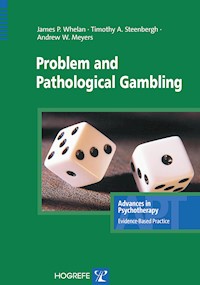
Over the past 30 years there has been a dramatic increase in the availability of convenient and legal gambling opportunities. Accompanying this proliferation of gambling is a growing understanding that between 5% and 9% of adults experience significant to severe problems due to their gambling activities. These problems have become a real health concern, with substantial costs to individuals, families, and communities. The objective of this book is to provide the clinician – or graduate student – with essential information about problem and pathological gambling. After placing this behavioral addiction and its co-occurring difficulties in perspective, by describing its proliferation, the associated costs, and diagnostic criteria and definitions, the authors present detailed information on a strategy to assess and treat gambling problems in an outpatient setting.
Das E-Book können Sie in Legimi-Apps oder einer beliebigen App lesen, die das folgende Format unterstützen:
Seitenzahl: 237
Veröffentlichungsjahr: 2007
Ähnliche


















Problem and Pathological Gambling
About the Authors
James P. Whelan, PhD, is Associate Professor of Psychology and Director of Clinical Training at the University of Memphis, as well as codirector of the Institute for Gambling Education and Research and the Gambling Clinic. He has also served as Director of Clinical Training and has won awards for his engaged scholarship. Dr. Whelan’s research spans several areas, including efficacy for psychological treatments, problem gambling, and sport and exercise psychology.
Timothy A. Steenbergh, PhD, is Associate Professor of Psychology and Director of the Lilly Student Research Initiative at Indiana Wesleyan University. Dr. Steenbergh’s research on addictive behaviors has focused primarily on problem gambling. In addition to his research, Dr. Steenbergh also enjoys teaching and providing psychotherapy at a small clinical practice in Marion, IN.
Andrew W. Meyers, PhD, is Professor in the Department of Psychology and Vice Provost for Research at the University of Memphis, as well as codirector of the Institute for Gambling Education and Research. Dr. Meyers has served on the editorial boards of the Journal of Consulting and Clinical Psychology, Behavior Therapy, Health Psychology, and Cognitive Therapy and Research, and for the past 25 years has maintained a private practice focused on addictions and health behavior.
Advances in Psychotherapy – Evidence-Based Practice
Danny Wedding; PhD, MPH, Prof., St. Louis, MO
(Series Editor)
Larry Beutler; PhD, Prof., Palo Alto, CA
Kenneth E. Freedland; PhD, Prof., St. Louis, MO
Linda C. Sobell; PhD, ABPP, Prof., Ft. Lauderdale, FL
David A. Wolfe; PhD, Prof., Toronto
(Associate Editors)
The basic objective of this series is to provide therapists with practical, evidence-based treatment guidance for the most common disorders seen in clinical practice – and to do so in a “reader-friendly” manner. Each book in the series is both a compact “how-to-do” reference on a particular disorder for use by professional clinicians in their daily work, as well as an ideal educational resource for students and for practice-oriented continuing education.
The most important feature of the books is that they are practical and “reader-friendly.” All are structured similarly and all provide a compact and easy-to-follow guide to all aspects that are relevant in real-life practice. Tables, boxed clinical “pearls,” marginal notes, and summary boxes assist orientation, while checklists provide tools for use in daily practice.
Problem and Pathological Gambling
James P. Whelan
Gambling Clinic and The Institute for Gambling Education and Research at The University of Memphis, Memphis, TN
Timothy A. Steenbergh
Department of Psychology, Indiana Wesleyan University, Marion, IN
Andrew W. Meyers
Gambling Clinic and The Institute for Gambling Education and Research at The University of Memphis, Memphis, TN
Library of Congress Cataloging in Publication
is available via the Library of Congress Marc Database under the LC Control Number 2007922289
Library and Archives Canada Cataloguing in Publication
Whelan, James P.
Problem and pathological gambling / James P. Whelan, Timothy A. Steenbergh, Andrew W. Meyers.
(Advances in psychotherapy – evidence-based practice)
Includes bibliographical references.
ISBN 978-0-88937-312-9
1. Compulsive gambling. 2. Compulsive gambling – Treatment. 3. Compulsive gamblers – Rehabilitation. I. Steenbergh, Timothy A. II. Meyers, Andrew W., 1949-III. Title. IV. Series.
HV6710.W48 2007
616.85’841
C2007-900942-5
© 2007 by Hogrefe & Huber Publishers
PUBLISHING OFFICES
USA:
Hogrefe & Huber Publishers, 875 Massachusetts Avenue, 7th Floor, Cambridge, MA 02139Phone (866) 823-4726, Fax (617) 354-6875; E-mail [email protected]
EUROPE:
Hogrefe & Huber Publishers, Rohnsweg 25, 37085 Göttingen, GermanyPhone +49 551 49609-0, Fax +49 551 49609-88, E-mail [email protected]
SALES & DISTRIBUTION
USA:
Hogrefe & Huber Publishers, Customer Services Department, 30 Amberwood Parkway, Ashland, OH 44805Phone (800) 228-3749, Fax (419) 281-6883, E-mail [email protected]
EUROPE:
Hogrefe & Huber Publishers, Rohnsweg 25, 37085 Göttingen, GermanyPhone +49 551 49609-0, Fax +49 551 49609-88, E-mail [email protected]
OTHER OFFICES
CANADA:
Hogrefe & Huber Publishers, 1543 Bayview Avenue, Toronto, Ontario M4G 3B5
SWITZERLAND:
Hogrefe & Huber Publishers, Länggass-Strasse 76, CH-3000 Bern 9
Hogrefe & Huber Publishers
Incorporated and registered in the State of Washington, USA, and in Göttingen, Lower Saxony, Germany
No part of this book may be reproduced, stored in a retrieval system or transmitted, in any form or by any means, electronic, mechanical, photocopying, microfilming, recording or otherwise, without written permission from the publisher.
Format EPUB
ISBN 978-1-61334-312-8
Preface
The mathematician Amir Aczel (2004) introduced his book on probability and gambling with the following statement, “The twin forces of chance and mischance have beguiled humanity like none other.” Amir noted that gambling has been a common recreational activity since the earliest of human cultures. Of course, the games have changed over time. The sheep knuckle dice thrown by the early Greeks barely resemble the smooth, uniform cubes we toss across felt tables. What has remained constant is our fascination with gambling, the possibilities of winning and the threat of losing everything.
Today gambling is a vital part of many economic systems. Consider the history of gambling in the United States where there have almost always been forms of legal gambling and some amount of illegal gambling has been tolerated. In fact, lotteries were sanctioned during the American Revolution to raise revenue for the continental armies. Since that time the laws and public opinion concerning gambling in the U.S. have cycled to allow and then contain gambling. The most recent widespread legalization of gambling began in 1970. Twenty years later, the gross gambling revenue from legal forms of gambling was reported to be 73 billion U.S. dollars. By 2006 some form of legalized gambling was available in every state other than Utah and Hawaii, with 43 states running their own lotteries. Despite the availability of legalized forms of gambling, illegal gambling still exists and, by some accounts, flourishes in the U.S.
Some of the hoped for economic benefits to the communities with legal gambling has occurred. Revenues from state lotteries fund a variety of social support activities, including public education, public housing, health care programs, transportation, senior citizen programs, and property tax decreases. It has been argued that continued government support for these social programs relies on gambling revenue. For example, Hurricane Katrina in 2005 eliminated 13 casinos along the state’s Gulf of Mexico coast. The state of Mississippi reported losing approximately $500,000 per day in tax revenue and the governor hurriedly called a special legislative session in order to encourage casino corporations to rebuild in the region.
The recent expansion in gambling availability has been fueled by the tremendous popularity of gambling as a recreational activity. In 1999 and 2000, Welte and colleagues (Welte, Barnes, Wieczorek, Tidwell, & Parker, 2002) completed a random digit dialing survey of over 2,500 individuals over the age of 18 years. With this survey they collected considerable detail about respondents’ gambling behavior during the previous year. The results, statistically weighted to match the U.S. census, showed that 82% of respondents had gambled during the past year and 23% gambled weekly. By way of comparison, 15% of American adults attended a live theater performance and 43% read a book during the previous year.
For most people gambling offers a fantasy we may not be able to create in any other way. As we pull the handle on the slot machine, push the poker chips to the middle of a table, or pick the lucky number of the multimillion dollar lottery, we wonder what we would do if we won more money than we could earn in a week, a year, or many lifetimes. Regrettably, the cost of misfortune can be destructive. What helps us to understand the homemaker who slips off to the casino as soon as her children leave for school? Why does she believe that she will soon win enough money to replenish her children’s education fund? What about the 41-year-old restaurant manager who skims money from daily receipts in order to bankroll his next poker game? Can we make sense of the accountant who takes the $500 remaining in his checking account to place bets on next weekend’s football games in the hope of paying off his $1,200 credit card bill? For some, gambling is clearly more than risking money on a game of chance.
Like Aczel’s book, ours focuses on playing games of chance and the experience of luck. Unlike Aczel, our interest is in how to provide assistance to those who have been captivated and then seriously harmed by gambling. In the first three chapters of this book we provide background information about problem and pathological gambling, current models for understanding these problems, and information we believe is relevant for assessment and treatment. Chapter 4 presents details about using our treatment for gambling problems, “Guided Self-Change for Gambling.” This is followed in Chapter 5 with a presentation of a gambler who presented in our treatment clinic. The final chapters of the book provide other tools and information that you might find helpful. We hope by reading this book you gain an understanding of gambling behavior, the problems it can produce, and guidelines for effectively treating problematic gambling.
Acknowledgments
There are a number of people that we would like to acknowledge as valuable contributors to this project. First we thank Danny Wedding and Robert Dimbleby for their guidance, patience, and support. We would also like to thank our former and current graduate students for their creative input in our discussions about gambling, our understanding about gambling problems, and our success as a research team. In particular, we thank Ryan May for his enthusiastic insights as we developed and piloted our treatment. We also thank Damon Lipinski for his careful attention to detail and his willingness to take on all challenges. The other bright minds who made valuable contributions include: Angie Sheffield, Kim Floyd, Jeremiah Weinstock, Emerson Wickwire, Andrea Booth, Adrienne Studaway, Don Yorgason, Rebecca West, and Claudia McClausland. We also appreciate the efforts of Brian Fry for his feedback on early drafts. Finally, we are greatly indebted to Linda and Mark Sobell. Their pioneering efforts to treat addictive behavior and their tireless dedication to the science of clinical psychology have been inspiring. In particular, Linda’s generous support in helping us learn how to think about addiction and gambling problems has been instrumental to our work.
Dedication
We would like to dedicate this book to our families.
Ginger, Ellen, and Zoe Whelan
Tracey, Jackson, and Molley Steenbergh
Lee, Brian, and Abby Meyers
Table of Contents
Preface
Acknowledgments
Dedication
1 Description of Problem and Pathological Gambling
1.1 Terminology
1.1.1 Gambling as Recreation
1.1.2 Continuum of Gambling-Related Harm
1.2 Definitions
1.2.1 Pathological Gambling
1.2.2 Problem Gambling
1.3 Epidemiology
1.3.1 Vulnerable Populations
1.3.2 Types of Gambling and Gambling Problems
1.3.3 Impact of Gambling Availability
1.3.4 Demographic Correlates
1.4 Course and Prognosis
1.4.1 Negative Effects
1.4.2 Natural Recovery
1.5 Differential Diagnosis
1.6 Comorbidity
1.6.1 Substance Use Disorders
1.6.2 Mood Disorders
1.6.3 Anxiety Disorders
1.6.4 Axis II Disorders
1.7 Diagnostic Procedures and Documentation
1.7.1 Diagnostic Interview for Gambling Severity (DIGS)
1.7.2 South Oaks Gambling Screen (SOGS)
1.7.3 Lie/Bet Questionnaire
1.7.4 Gambling Timeline Follow-Back (G-TLFB)
1.7.5 Addiction Severity Index – Gambling Subscale (ASI-G)
1.7.6 Gamblers Belief Questionnaire (GBQ)
1.7.7 Gamblers Self-Efficacy Questionnaire (GSEQ)
2 Theories and Models
2.1 Gambling as an Addictive Behavior
2.2 Learning Theories
2.3 Cognitive Theories
2.4 Biological Theories
2.4.1 Family and Genetic Studies
2.4.2 Neurotransmitter and Neuroanatomical Theories
2.5 Disease Model
2.6 An Integrated Model of Problem Gambling
2.7 Guided Self-Change
2.7.1 Harm Reduction
2.7.2 Rapid Change Response
2.7.3 Self-Change
2.7.4 Motivational Approach
3 Diagnosis and Treatment Indications
3.1 Diagnostic Assessment
3.2 Treatment Indications
3.3 Clinical Assessment
3.3.1 Gambling Behavior
3.3.2 Assessment of Possible Treatment Mediators
3.3.3 Systemic Factors
3.3.4 Comorbid Psychopathology
3.4 Treatments
4 Treatment
4.1 Method of Treatment
4.1.1 Basic Principles
4.1.2 Phase 1: Running Start Assessment
4.1.3 Phase 2: Motivational Feedback
4.1.4 Phase 3: Triggers and Consequences
4.1.5 Phase 4: Options and Action Plan
4.1.6 Phase 5: Relapse Prevention
4.1.7 Follow-Up
4.2 Mechanisms of Action
4.3 Efficacy and Diagnosis
4.4 Variations and Combination Methods
4.5 Problems in Carrying Out Treatment
4.6 Multicultural Issues
5 Case Vignette
5.1 Phase 1: Running Start Assessment
5.2 Phase 2: Motivation and Feedback
5.3 Phase 3: Functional Analysis of Gambling
5.4 Phase 4: Implementation of Alternative Behaviors
5.5 Phase 5: Relapse Prevention
5.6 Six Month Follow-up
6 Further Reading
7 References
8 Appendices: Tools and Resources
1
Description of Problem and Pathological Gambling
1.1 Terminology
Gambling defined
Gambling can be defined as any behavior involving the risk of money or valuable possessions on the outcome of a game, contest, or other event in which the outcome is at least partially determined by chance. There are many forms of gambling: purchasing lottery tickets, participating in sports pools, an evening at the casino, wagers on the golf course, or speculating on the futures and stock markets. Sometimes we actually call it gambling; other times we use terms that are less pejorative, such as gaming, investing, or a friendly wager.
Lesen Sie weiter in der vollständigen Ausgabe!
Lesen Sie weiter in der vollständigen Ausgabe!
Lesen Sie weiter in der vollständigen Ausgabe!
Lesen Sie weiter in der vollständigen Ausgabe!
Lesen Sie weiter in der vollständigen Ausgabe!
Lesen Sie weiter in der vollständigen Ausgabe!
Lesen Sie weiter in der vollständigen Ausgabe!




