


25,99 €
Mehr erfahren.
- Herausgeber: John Wiley & Sons
- Kategorie: Fachliteratur
- Sprache: Englisch
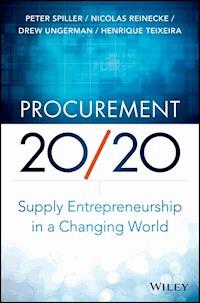
How to achieve procurement excellence today and evolve to be ready for tomorrow Procurement entrepreneurship pays. High-performing procurement teams can deliver huge value to their companies--regardless of industry. The best companies are advancing talent-management strategies into the heart of their procurement organizations with huge success. In addition to an estimated $84 billion in yearly cost savings, companies who give procurement leaders prominence deliver superior returns from their operations as well as lower their costs of goods sold. This book, written by a group of purchasing and supply management practice experts, shares the hard-earned insights of more than ten years of dedicated procurement research conducted with leading academic institutions and practical experience with marquee clients in the field of procurement. It is also a natural successor to the many articles McKinsey & Company has published on the topic. This reliable resource skillfully explains and codifies the best practices that leading companies have pioneered in procurement as well as frames how procurement must evolve to grapple with new global, social, and economic issues affecting business over the next decade. * Details the four key dimensions of procurement excellence * Showcases the five megatrends that will change the way business is done in the next decade * Provides strategies that business leaders can adopt in the face of these megatrends, together with practical advice about next steps and case examples The road ahead will require you to redefine your vision for procurement and implement the required changes. Procurement 20/20 will show you how.
Sie lesen das E-Book in den Legimi-Apps auf:
Seitenzahl: 276
Veröffentlichungsjahr: 2013
Ähnliche


















Contents
Preface
Introduction: The Procurement Advantagex
Part 1: From Good to Great Procurement
Chapter 1: The Drivers of Sustainable Procurement Performance
Procurement Pays
Capabilities and Culture—Recognizing Talent as the Key Asset in Procurement and Investing Accordingly
Category Management and Execution—Improving Effectiveness through Advanced Procurement Tools and Approaches
Structure and Systems—Organizing for Economies of Skill
Integration and Alignment—Using Success in Cost Management to Advance toward a Truly Strategic Role for Procurement
Practical Tips for Improving Category Management Performance
Chapter 2: The Megatrends That Impact Competitive Advantage
Megatrend 1: The Great Global Rebalancing
Megatrend 2: The Productivity Imperative
Megatrend 3: Big Data and the Global Grid
Megatrend 4: The Volatile New Normal
Megatrend 5: The New Economic Drivers
Part 2: Responding to the Megatrends of the Next Decade
Chapter 3: The Great Global Rebalancing: Building a Dynamic Sourcing Footprint
Dynamic Sourcing in a Rebalanced World
What Factors Will Shape the Global and Dynamic Sourcing Footprint?
Capabilities for Defining a Dynamic Footprint
Chapter 4: The Productivity Imperative: Orchestrating the End-to-End Value Chain
The Rise of Functional Specialists
What’s Driving the Shift?
The Need for an Orchestrator
A Natural Role for Procurement
What Are the Possibilities?
Stepping Up to the Role
Chapter 5: Big Data and the Global Grid: Procurement’s New Role in Data-Driven Decision Making
New Insights and Collaboration at Scale Enhance Data-Driven Decisions
Opportunities in Core Procurement Activities, and Beyond
Capabilities to Capture the Opportunities
Chapter 6: Volatility as the New Normal: Translating Sourcing Risk into Competitive Advantage
An Era of Greater Volatility
The New Model of Agile Procurement
How to Think about Creating Preemptive Agility
Reacting Faster and Smarter Than the Competition
Building Agile Procurement in Three Steps
Making Agile Procurement Stick
Chapter 7: The New Economic Drivers: Capturing the Total Impact of Environmental, Social, and Regulatory Factors
ESR Issues Take Center Stage in Procurement
New Costs, Risks, and Opportunities
How Can Procurement Cope?
New Roles and Capabilities for Procurement
Part 3: The Road Map to Procurement 20/20
Chapter 8: Getting Ready for Real Change: Steps for Starting the Journey toward Procurement 20/20
Aspire to a Clear Procurement Vision
Assess Your Current Performance
Architect the Change Program
Act to Deliver the Program
Advance the Changes
Chapter 9: Your Agenda Now
About the Authors
Acknowledgments
Index
Additional Praise ForProcurement 20/20
“Shaping new products through early involvement, bringing outside perspectives to better design a company’s value chain, or fully managing a company’s outsourcing network—the expectations for CPOs are rising constantly. Procurement 20/20 compellingly explains what CPOs should expect, and how they can shape the future.”
—Fredrick Spalcke, EVP Procurement, Philips
“Procurement 20/20 provides valuable insights into the impact globalization and volatility will have throughout the value chain. Leaders will benefit in understanding how these factors and others will shape their sourcing strategies today and into the future.”
—Michael Radojevic, Managing Director of Technology and Corporate Services Procurement, United Airlines
“In today’s fast changing world, managing to a benchmark is important but simply not enough. Future development and trends have to be anticipated and management adjusted accordingly. In this spirit Procurement 20/20 is an excellent resource for any CPO. It provides compelling visions for the future of the function and hands-on solutions for a challenging business environment. A must read!”
—Rüdiger Eberhard, CPO, Evonik
“Procurement 20/20 looks beyond the classical sourcing tasks and explores how to establish strategic business models with the supply base, reduce risks, and drive growth to create more value along a company’s full value chain. An inspiring thought-piece for any procurement professional.”
—Albie van Buel, CPO, Vestas Wind
“We aspire to mastering all opportunities offered by the rapidly changing marketplace, and this book provides an excellent road map for the journey that lies ahead of us.”
—Hans Melotte, Vice President and Chief Procurement Officer, Johnson & Johnson
“Procurement 20/20 takes a bold look into the future and explores the changes that the procurement function needs to make. It is a must read for the ambitious CPO.”
—Babara Kux, Member of the Managing Board, Siemens AG
“The next decade will require the procurement function to better understand the dynamic and volatile world, particularly where sourcing strategies must be flexible and creative to operate in a global footprint. This book provides the CPO and the procurement team with several provocative trends that will shape the coming years, and a structured road map to address the opportunities.”
—Luiz Lissoni, Vice President of Supply Chain, Brasil Foods
“Procurement 20/20 is an inspiring invitation to stop and reflect on the ‘new normal’ for procurement. And it sends a clear message to CPOs: It’s time to get ready for the next decade!”
—Bertrand Conqueret, CPO, Henkel
“This book explores very convincingly how CPOs and their organizations need to adapt to deal with the challenges of the future.”
—Vicente San Miguel, Chief Procurement Officer, Telefónica
“A highly inspiring book: The strategic insights draw the necessary change agenda for all CPOs. It is written in a most engaging style, provides numerous examples relevant to today’s world, establishes the burning platform, and outlines the key elements that the new procurement agenda must address. If there ever was a book to motivate the CPO to action, this is it!”
—Alan Hustwick, CPO, Pacific Aluminium
“Today’s global megatrends make the strategic side of procurement increasingly vital for the success of any business, from strategic supply management to sourcing innovation. A revealing book on supply entrepreneurship.”
—Paul van Attekum, EVP Supply Management, ASML
“A must-read for practitioners and academics alike.”
—Christian Terwiesch, Andrew M. Heller Professor at the Wharton School of the University of Pennsylvania
Cover Design: Wiley
Cover Image, top: © iStockphoto/traffic_analyzer
Cover Image, bottom: © iStockphoto/krystiannawrocki
Copyright © 2014 by McKinsey & Co., Inc. All rights reserved.
Published by John Wiley & Sons, Inc., Hoboken, New Jersey.
Published simultaneously in Canada.
No part of this publication may be reproduced, stored in a retrieval system, or transmitted in any form or by any means, electronic, mechanical, photocopying, recording, scanning, or otherwise, except as permitted under Section 107 or 108 of the 1976 United States Copyright Act, without either the prior written permission of the Publisher, or authorization through payment of the appropriate per-copy fee to the Copyright Clearance Center, Inc., 222 Rosewood Drive, Danvers, MA 01923, (978) 750-8400, fax (978) 646-8600, or on the Web at www.copyright.com. Requests to the Publisher for permission should be addressed to the Permissions Department, John Wiley & Sons, Inc., 111 River Street, Hoboken, NJ 07030, (201) 748-6011, fax (201) 748-6008, or online at http://www.wiley.com/go/permissions.
Limit of Liability/Disclaimer of Warranty: While the publisher and author have used their best efforts in preparing this book, they make no representations or warranties with respect to the accuracy or completeness of the contents of this book and specifically disclaim any implied warranties of merchantability or fitness for a particular purpose. No warranty may be created or extended by sales representatives or written sales materials. The advice and strategies contained herein may not be suitable for your situation. You should consult with a professional where appropriate. Neither the publisher nor author shall be liable for any loss of profit or any other commercial damages, including but not limited to special, incidental, consequential, or other damages.
For general information on our other products and services or for technical support, please contact our Customer Care Department within the United States at (800) 762-2974, outside the United States at (317) 572-3993 or fax (317) 572-4002.
Wiley publishes in a variety of print and electronic formats and by print-on-demand. Some material included with standard print versions of this book may not be included in e-books or in print-on-demand. If this book refers to media such as a CD or DVD that is not included in the version you purchased, you may download this material at http://booksupport.wiley.com. For more information about Wiley products, visit www.wiley.com.
Library of Congress Cataloging-in-Publication Data:
Spiller, Peter, 1972–
Procurement 20/20 : supply entrepreneurship in a changing world / Peter Spiller, Nicolas Reinecke, Drew Ungerman, Henrique Teixeira.
pages cm
Includes index.
ISBN 978-1-118-80008-9 (cloth); ISBN 978-1-118-80047-8 (ebk); ISBN 978-1-118-80070-6 (ebk)
1. Industrial procurement. I. Title.
HD39.5.S6866 2014
658.7’2—dc23
2013038860
Preface
For decades, McKinsey & Company has worked with clients to improve their procurement practices and achieve distinctive and sustainable impact. We have averaged more than 250 engagements per year and served chief procurement officers (CPOs) from Fortune 100 companies and startups alike. Those companies have come from industries ranging from automotive and assembly, chemicals and basic materials, electronics and high tech to energy, banking, and other services. Many of them have been long-standing clients, served on a broad range of strategic and operational topics, and a large share we have been advising at different procurement inflection points over time: when a new CPO came on board, a merger required significant synergy contributions from procurement, a general reorganization offered the opportunity to strengthen the central procurement governance, or when new sourcing markets had to be explored.
In working with our clients on these engagements, we have been exposed to the most important questions faced by CEOs and CPOs around the world—such as how do we develop cutting-edge sourcing strategies, exploit favorable market conditions, and optimize supply chains to reduce cost across the value chain? How do we build a base of external suppliers that give us the first access to their proprietary innovations so that we can jointly develop the products consumers want, more profitably and more quickly? How do we manage a vast and complex network of suppliers and contract manufacturers to ensure constant supply in a world where supply chains are globalizing, lengthening, and susceptible to more volatility? And how do we make our procurement practices robust enough to avoid the increasing scrutiny of environmental, safety, and regulatory demands, magnified by vastly different expectations from a diverse set of consumers and governments?
This book shares the hard-earned insights from more than 10 years of dedicated procurement research conducted with leading academic institutions and practical experience with marquee clients in the field of procurement and is the natural successor to the many articles we have published on the topic. As such, we’ve attempted two things with this book: to explain and codify the best practices that leading companies have pioneered in procurement and to frame how procurement must evolve to grapple with new global, social, and economic issues affecting business over the next decade. We wanted it to be as forward thinking and strategic as you’ve learned to expect from our publications, yet practical enough to spark a conversation between a CEO and CPO about the near-term actions their procurement organizations must take to stay ahead in the new world. And while this book is focused on procurement, any company executive—from CEO to COO to CPO—will find relevance in our discussion of the five major megatrends that will impact every function across the business.
Why are we devoting an entire book to procurement excellence today and how it must evolve to be ready for tomorrow? We look at procurement’s past evolution for an answer. In his 1983 article “Purchasing Must Become Supply Management,” our former colleague Peter Kraljic noted, “A decade ago, any chief executive who was losing sleep over his company’s procurement function might be thought to have had his priorities wrong. Today, the likelihood is that he is simply more alert than his competitors to the new and potentially dangerous strategic dimension that materials sourcing has taken on.” As a result, Kraljic argued, procurement must transition from a tactical, operational mind-set to one that is strategic and fully integrated with other key functions in the business.1 Even back then, Kraljic argued that procurement could deliver significant impact by responding to the increasing risks of resource depletion and raw-material scarcity, intensified competition, political turbulence and government intervention in supply markets, and accelerating technological change. In fact, the past 10 years have provided a natural conclusion to what Kraljic predicted: The digitalization of information spread the news of the 2008 Lehman Brothers bankruptcy in seconds, causing world stock exchanges to plunge simultaneously and putting companies out of business; the 2011 Japanese earthquake and tsunami sent reverberations across global supply chains; and the 2010–2011 Arab Spring resulted in instability and speculation across the most oil-rich region in the world. The decade ahead will be no less tumultuous, and procurement’s role will be more important than ever before in maintaining constant supply, best cost, reduced volatility, faster and improved innovation, and positive corporate-brand image. Our purpose is to take Kraljic’s view deep into the twenty-first century by describing the next step in the evolution, the step in which supply management must become supply entrepreneurship.
Toward that goal, we have brought to bear our insights, which have, time and again, proven their entrepreneurial and strategic effectiveness as our external partners compete in the global economy. We have drawn on more than 1,500 global procurement studies from the past five years that optimized in excess of U.S. $200 billion of spend, examinations of more than 700 procurement organizations, and 2,000 hours of interviews with CPOs and their staffs across every industry to determine the key dimensions of procurement excellence and its link to corporate performance. The research presented in this book is unique because of the challenges inherent in measuring the success of a single company function. Enlisting top academic institutions, we have developed a framework to isolate the performance and impact of a single business function and to evaluate its impact with a very high confidence level using partial least squares (PLS) statistical methods and multiple-level blind interviews. This framework is, in our view, unrivaled in its detail and provides essential insights for other organizations seeking to remain competitive into the future. The McKinsey Global Institute, our business and economic research arm, has partnered with our strategy practice to identify the five fundamental megatrends that will shape the next decade and beyond. On the basis of the implications of these megatrends, we have tapped into our global network of C-suite officers across leading companies to help define how procurement must evolve. And finally, we’ve drawn on our organization practice to provide practical advice on how to accomplish transformational change—from defining the aspirations to executing them so that they become part of your function’s DNA.
Numerous executives and companies were involved in the development of this book. In particular, we would like to thank the more than 700 clients who took part in our Global Purchasing Excellence survey and served as the inspiration behind the disguised case examples that bring to life the concepts in this book. We would also like to thank the many CPOs who have shared their insights on the book’s content during roundtables and conferences and on a one-on-one basis, ensuring it is simultaneously inspirational, relevant, and actionable.
Hindsight is 20/20, and in 10 years, we’ll have the benefit of knowing much more than we do today. And at that point, our hope is that you might be browsing your library or your tablet and thinking, “I’m glad I read this.”
Let the journey to Procurement 20/20 begin.
Peter Spiller
Nicolas Reinecke
Drew Ungerman
Henrique Teixeira
McKinsey & Company
Purchasing and Supply Management Practice
1Peter Kraljic, “Purchasing Must Become Supply Management,” Harvard Business Review, September/October 1983.
Introduction: The Procurement Advantage
It is becoming more and more important for every senior executive to know how to manage the external parts of the company’s value chain.
The evidence is all around us. Look at the news headlines and the experiences you or others in your organization have faced in recent years. Natural disasters and scarcities of raw materials have exacerbated volatility in supply chains, disrupted operations, and caused significant swings in input pricing. As one example, Honda had to weather a tripling of its raw material index between 2009 and 2012; was hit hard by the tsunami in Japan and floods in Thailand, causing a 59 percent profit drop; and has to deal with business-endangering materials scarcity, for example in some specific rare earths like lanthanum. External functional specialists—contract manufacturers and third-party logistics providers, to name just two categories—have proliferated, in both the developed and the emerging worlds, and they regularly deliver new levels of innovation and efficiency up and down the value chain. And yet increasingly stringent ethical, social, and governmental requirements mean that if those specialists have a slipup, it can spoil the brand image of the company whose procurement organization is sourcing from them.
Lesen Sie weiter in der vollständigen Ausgabe!
Lesen Sie weiter in der vollständigen Ausgabe!
Lesen Sie weiter in der vollständigen Ausgabe!
Lesen Sie weiter in der vollständigen Ausgabe!
Lesen Sie weiter in der vollständigen Ausgabe!
Lesen Sie weiter in der vollständigen Ausgabe!
Lesen Sie weiter in der vollständigen Ausgabe!
Lesen Sie weiter in der vollständigen Ausgabe!
Lesen Sie weiter in der vollständigen Ausgabe!
Lesen Sie weiter in der vollständigen Ausgabe!
Lesen Sie weiter in der vollständigen Ausgabe!
Lesen Sie weiter in der vollständigen Ausgabe!
Lesen Sie weiter in der vollständigen Ausgabe!
Lesen Sie weiter in der vollständigen Ausgabe!
Lesen Sie weiter in der vollständigen Ausgabe!




