


Erhalten Sie Zugang zu diesem und mehr als 300000 Büchern ab EUR 5,99 monatlich.
- Herausgeber: Books on Demand
- Kategorie: Lebensstil
- Sprache: Englisch
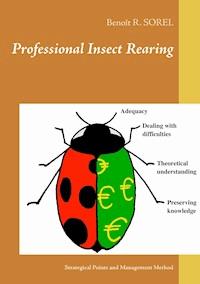
STRATEGICAL POINTS AND MANAGEMENT METHOD FOR PROFESSIONAL INSECT REARING You wish to : - start up a professional insect rearing ? - upgrade your rearings and are looking for theoretical and practical ways for innovation ? - increase the reliability and the adaptability of your rearings ? In order to identify the specific characteristics of insect rearing systems and in order to evaluate and enhance your own experience, we propose a ready-to-use management method. It is based on a unique combination of quality management according to A. Deming with elements of sociology of science and technology according to B. Latour. With this perspective, we can highlight the strategical points of professional insect rearing and help you identify rearing types and rearing techniques which are adapted to the variations of the production specifications. The questions : - How to use the entomological literature ? - How to identify, prevent and deal with major difficulties ? - How to manage insect’s quality ? - How to create and preserve know-how ? are explained on the theoretical level and illustrated with practical indications for the setup phase, the daily maintenance and the evolution of the rearings on the long term, in order to help you produce at all times insects of high quality.
Sie lesen das E-Book in den Legimi-Apps auf:
Seitenzahl: 73
Veröffentlichungsjahr: 2015
Das E-Book (TTS) können Sie hören im Abo „Legimi Premium” in Legimi-Apps auf:
Ähnliche


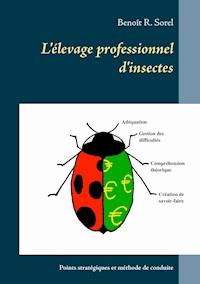








TABLE OF CONTENT
INTRODUCTION
Insects in our modern society
The objective of professional insect rearing
Particularities of the activity of insect rearing
3.1. Rearing simulation
3.2. Strategical points
3.3. Definition of insect rearing management
3.4. Utility and limits of the specific literature
3.5. The difficulties of insect rearing
3.6. Terminology of insect rearing
Utility of a management method
PRELUDES
Definition of “experience and “know-how”
Insect rearing as a production system
2.1. The production specifications
2.2. The responsibilities of the project leader
2.3. The means of production
2.4. The resources
THE MANAGEMENT METHOD
Conceiving an adequate production system
1.1. Knowing the insects in situ
1.2. Choosing the rearing types
1.3. Choosing effective rearing procedures
Dealing with difficulties
2.1. The process of dealing with difficulties
2.2. Factors of causes
2.3. Categories of solutions
2.4. Possible outcomes
2.5. Worst-case difficulties
2.6. Sanitary issues
2.7. Working atmosphere: personnel management
2.8. Further practical indications
Summary of the preceding chapters
Acquiring theoretical understanding
4.1. Definition and utility
4.2. Models of the configuration of the rearing
4.3. Documentation of the production quality
Preserving and transmitting the knowledge
5.1. Situations of experience acquisition
5.2. Documentation of the experience
5.3. Managing knowledge
CONCLUSION
The principles of professional insect rearing
Professional versus hobby insect rearing
Academical knowledge
Pledge for a science of insect rearing
4.1. It increases the value of the enterprise
4.2. It improves the ethical responsibility
4.3. It improves the social recognition
LITERATURE
ABSTRACT
We present a management method for identifying and coordinating the inherent issues of professional insect rearing, meaning insect rearing submitted to material, financial and timely obligations of production. This method is valid for all insect species as well as for many arthropods and is not restrained to particular taxa. It is conceived to be used as a working document by the persons in charge of such rearings.
We explain that the activity of insect rearing is often reduced to biological and technical considerations, and that it lacks specific terminology in order to address economical considerations. We identify the economically strategical points of professional rearing and we identify the issues to be dealt with in order to take decisions at these strategical points on an objective basis. These issues are: the adequacy of the rearing to the production specifications, dealing with difficulties, theoretical understanding of the operation of the rearing and the creation and transmission of knowhow. These issues are generally not addressed in the entomological literature.
We go into the details of the management method: it consists of systematically identifying and managing these issues in situ. The method is based on the combination of perspectives: quality management, scientific methodology, knowledge, experience and personnel management. Such a multidisciplinary approach allows us to identify the ins and outs of the issues cited above, and to propose a panel of practical indications in order to correctly guide the rearing at the strategical points that is, for maintaining in the long term the quality of the produced insects whatever the changes of economical con text may be.
INTRODUCTION
1 Insects in our modern society
Insects production (and other arthropods such as spiders and mites) fulfils many functions in our modern society:
Agriculture and forestry
Production of insects as biological agents to be used against plant pests in the agriculture and in the forestry (for example parasitic wasps against aphids)
Production of insects with controlled phenotype, destined to be released in the nature in order to reduce the natural populations of plant pests (for example production of sterile males in order to reduce populations of fruit flies)
Production of insects for human food indirectly (bee rearing for honey production) or directly (depending on the culture of the country)
Production of insects for silk
Research
Production of insects for fundamental biological, ecological and chemical research purposes
Production of insects for applied biochemistry research: identification of molecules with interesting technical properties (for example the proteins of spider webs)
Health
Production of insects as healing agents (wound healing with ants and fly larvae)
Production of insects which secrete healing substances (for example propolis from bees)
Production of insects with controlled phenotype, destined to be released in the nature in order to reduce the natural populations of pathogenic hosts (example of target: the anopheles mosquito carrying the malaria pathogen)
Leisure
Production of insects destined to be presented in zoos and insectariums
Production of insects as food for zoo animals and pets (reptilians or birds for example)
Production of insects as fishing baits (fly larvae for example)
In comparison with traditional rearings (such as cattle rearing for example), insect rearing more diverse, and unexpected, functions, but it remains a niche activity. There exist some syndicates of producers: Producers of insects as biological agents are represented on the international level by the Invertebrate Biocontrol Agents (IBCA) group of the International Biocontrol Manufacturer Association (IBMA) and by the International Organisation of Biocontrol (IOBC).
Asides from these professional insect rearings exist amateur rearings, made by private persons, schools or associations. Example of such rearings can be found on www.insectclopedia.com.
2 The objective of professional insect rearing
It is the following one: to produce insects of constant high quality, in other words insects that constantly fulfil the product specifications, even when these specifications vary. The product specifications are the characteristics of the insects which are required by the client or the future user of the insects. These characteristics (for example quantity, development stage, sex-ratio, fertility, emerging date...) ensure that the insects will conform to their future use (for example as biological agents in greenhouses, as live food for animals, as exhibition specimens expected to fly among the visitors of a zoo...) The client or the future user should not be disappointed by the quality of the insects you will deliver, whether he orders huge quantities on a regular basis or small quantities now and then. You must expect that the money income and the delays will vary: it is you responsibility to successfully deal with such variations of resources (increase or diminution) in order to always fulfil the product specifications. We will see that this requires creativity! Failing the production specifications will result in economically damaging consequences (loss of the client’s trust).
3 Particularities of the activity of insect rearing
3.1. Rearing simulation
We will introduce some particularities of insect rearing with the help of a simulation: you are in charge of setting up a rearing and adapting it to the demand.
3.2. Strategical points
The simulation illustrates obligatory strategical points which determine the economical profitability of the rearing:




