


27,59 €
Mehr erfahren.
- Herausgeber: Packt Publishing
- Kategorie: Fachliteratur
- Sprache: Englisch
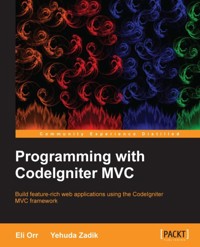
The CodeIgniter Model-View-Controller framework provides genius simplicity, flexibility, and efficient resource usage, boosting performance and reusability.
"Programming with CodeIgniter MVC" reviews the unique features of CodeIgniter using simple, easy-to-follow, and practical examples.
Programming with CodeIgniter MVC provides a simple step-by-step guide to efficiently utilizingthe CodeIgniter MVC framework for developing web applications. This book is packed with engaging examples to understand the usage of controllers, libraries, and (Codeigniter) CI Models. This book commences with a quick discussion of the CodeIgniter Integration with external plugins such as Flickr API, Google Maps and more will be reviewed with clear usage examples. It will then cover CI naming convention rules, mandatory and optional configurations, and usage within a CI project. It will also cover user defined configurations.
By the end of this book, you will not only understand user-defined libraries in a CI framework, but also their services, role, usage, and scope with the help of an example-based approach. The book also covers helpers, models, and views, as well as their usage.
Using this book, youwill soonbe able to develop feature-rich web applications using the CodeIgniter MVC framework. "Programming with CodeIgniter MVC" is a one-stop solution to developing solutions with CodeIgniter MVC.
Das E-Book können Sie in Legimi-Apps oder einer beliebigen App lesen, die das folgende Format unterstützen:
Seitenzahl: 190
Veröffentlichungsjahr: 2013
Ähnliche


















Table of Contents
Programming with CodeIgniter MVC
Programming with CodeIgniter MVC
Copyright © 2013 Packt Publishing
All rights reserved. No part of this book may be reproduced, stored in a retrieval system, or transmitted in any form or by any means, without the prior written permission of the publisher, except in the case of brief quotations embedded in critical articles or reviews.
Every effort has been made in the preparation of this book to ensure the accuracy of the information presented. However, the information contained in this book is sold without warranty, either express or implied. Neither the authors nor Packt Publishing, and its dealers and distributors will be held liable for any damages caused or alleged to be caused directly or indirectly by this book.
Packt Publishing has endeavored to provide trademark information about all of the companies and products mentioned in this book by the appropriate use of capitals. However, Packt Publishing cannot guarantee the accuracy of this information.
First published: September 2013
Production Reference: 1160913
Published by Packt Publishing Ltd.
Livery Place
35 Livery Street
Birmingham B3 2PB, UK.
ISBN 978-1-84969-470-4
www.packtpub.com
Cover Image by Abhishek Pandey (<[email protected]>)
Credits
Authors
Eli Orr
Yehuda Zadik
Reviewers
Jason Hamilton-Mascioli
Muhammad Faisal Shabbir
Acquisition Editor
James Jones
Commissioning Editor
Shreerang Deshpande
Technical Editors
Dylan Fernandes
Dipika Gaonkar
Kapil Hemnani
Copy Editor
Brandt D'Mello
Aditya Nair
Alfida Paiva
Laxmi Subramanian
Project Coordinator
Deenar Satam
Proofreader
Maria Gould
Indexer
Tejal Soni
Graphics
Ronak Dhruv
Production Coordinator
Melwyn D'sa
Cover Work
Melwyn D'sa
About the Authors
Eli Orr brings over 30 years of experience in the high tech industry, mainly in software product development. Eli published articles in several magazines such as Wireless Systems Design, Telephony-Online, CommsDesign, EE Times, and for various emerging technologies. Currently, Eli is a PHP Advanced Web Application Developer, focused on CodeIgniter based projects for the last two years for rich functionality heavy-duty web applications.
Prior to that, as an entrepreneur, Eli established LogoDial Zappix Ltd., and had the role of CTO and server-side developer. Zappix enables dynamic visualization of call center voice menus, which are currently available in USA and Israel on iOS and Android-enabled smartphones.
Prior to that, Eli developed telecom solutions for Unified Communications with AT&T. Prior to that, Eli developed VoIP developer toolkits as a product manager with Radvision Ltd. During that period, he was an active member with the ITU-T Signaling Group 16 for defining VoIP protocol standardization, mainly the H.323.
Prior to that, Eli led development teams with IAI (Israel Aircraft Industries) ELTA based C and C++ programming languages. Eli can be contacted through his website, http://EliOrr.com.
Wring a book about the CodeIgniter Framework that I use daily and love was a great, thrilling challenge for me.
I would like to thank Yehuda Zadik who assisted me in writing this book as well as the Packt Publishing team for advising and assisting me through the entire book-writing process. In addition, I would like to thank Asher Efrati who is a strong CodeIgniter supporter, who assisted me by reviewing the book drafts and commenting on them. Finally, I would like to thank my daughter Hila Orr who supported me in my effort of writing this book.
Yehuda Zadik has over 20 years of experience in the IT industry, where he mainly specialized in software development based object-oriented programming (OOP) technologies.
Yehuda has over 8 years of experience developing with PHP OOP and open source Linux environments for developing web-based applications. Yehuda used state-of-the-art technologies for building dynamic web-based applications that were e-commerce enabled as well as social network integrated. Yehuda has a vast knowledge for integrating third-party plugins for network, mobile, and social environments' integration. Among the environments, Yehuda integrated with Facebook API, LinkedIn API, and various others.
Yehuda is an enthusiastic CodeIgniter developer who has been developing rich functionality and heavy traffic web-based applications over the last two years. Among Yehuda's clients are several major academic institutes. Yehuda can be contacted through his website, http://yudazdk.co.il.
Writing this book has been a challenging experience for me. My purpose was to write a practical book for developers that includes many examples.
First of all, I would like to thank my family members, my wife, Elana, and my son, Avishay, for their understanding and support during the writing of this book.
I would like to thank Eli Orr a lot for assisting me in writing the book and his helpful and fruitful feedback.
I would like to thank my clients: Omer Weissbein, CEO of Ontxt, for his advice and support; and Merav Babai, CEO of Pro Man and a LinkedIn expert, for her LinkedIn tips.
Finally, I would like to thank the Packt Publishing team for advising and assisting me throughout the book-writing process.
About the Reviewers
Jason Hamilton-Mascioli leads the growth of 77robots.com, the Canadian-based web development company he founded in 2005. Jason's role is to find and work with entrepreneurs to produce sustainable online businesses including solutions that aid early-stage startups.
With over 15 years as a senior web developer, Jason has worked with over 100 online startups globally, in addition to providing consulting services and mentorship to early-stage startups and entrepreneurs. For over 6 years, Jason has taught the Building Database-Driven Websites course at McMaster University Continuing Ed based in Hamilton, Ontario, Canada.
Muhammad Faisal Shabbir works as a senior software engineer at Strategic Systems International. Faisal has more than 6 years of extensive experience in software architecture, design, agile development, and deployment. Faisal completed his BS (Information Technology) from Virtual University. He can be reached at <[email protected]>.
Special thanks to my mother, wife, and kids, who pushed me up to do such activities.
www.PacktPub.com
Support files, eBooks, discount offers and more
You might want to visit www.PacktPub.com for support files and downloads related to your book.
Did you know that Packt offers eBook versions of every book published, with PDF and ePub files available? You can upgrade to the eBook version at www.PacktPub.com and as a print book customer, you are entitled to a discount on the eBook copy. Get in touch with us at <[email protected]> for more details.
At www.PacktPub.com, you can also read a collection of free technical articles, sign up for a range of free newsletters and receive exclusive discounts and offers on Packt books and eBooks.
http://PacktLib.PacktPub.com
Do you need instant solutions to your IT questions? PacktLib is Packt's online digital book library. Here, you can access, read and search across Packt's entire library of books.
Why Subscribe?
Free Access for Packt account holders
If you have an account with Packt at www.PacktPub.com, you can use this to access PacktLib today and view nine entirely free books. Simply use your login credentials for immediate access.
Preface
This book aims to teach you how to develop web applications efficiently with the Ellis Labs CodeIgniter platform. The CodeIgniter platform is an object-oriented Model-View-Controller development platform. For more on MVC, please refer to http://en.wikipedia.org/wiki/Model-view-controller. The reader of this book is expected to be familiar with at least the PHP programming language, specifically with PHP OOP (object-oriented programming) and its usage, as well as with MySQL.
CodeIgniter (referred to as CI in this book) is an Application Development Framework, a toolkit for people who build websites and web applications using PHP. CodeIgniter is a smart application development skeleton framework, with flexible and expandable core powered high performance and low footprint. The CodeIgniter framework (OSL 3.0 open source license), developed and maintained by Ellis Labs, powers an echo system of developers across the globe. The first public version of CodeIgniter was released on February 28, 2006. It got very good feedback from web application professional developers. During November 2010, the CodeIgniter development project was added to the well-known GitHub community projects, and got increasing interest and usage by developers worldwide, as well as more and more third parties providing more add-ons with a better maturity and functionality set.
There is a rising trend of web applications based on OOP (object-oriented programming) frameworks using MVC (Model-View-Controller) development patterns, described in the next section, for developing advanced web applications. CodeIgniter is such a framework. It seems that CodeIgniter is continuously increasing its popularity as it has a simple yet high quality OOP core that enables great creativity, reusability, and code clarity naming conventions, which are easy to expand (user class extends CI class), while more third-party application plugins (including views/controllers/models/libraries/helpers providing application-oriented solutions such as CMS, shopping carts, or table grid navigators) and add-ons of libraries/helpers are becoming available.
The MVC concept is a development pattern or an application framework for a computer user interface that separates the representation of information from the user interacting with it. MVC has been adopted as a successful architecture for web application developments. The model consists of application data and provides services to manipulate them. The controller handles business rules and executes requests to the models and views. The controller mediates between the input, mostly received from a user interacting with a web browser that executed the rendered view. The browser runs a received rendered view by the controller through an HTTP protocol. The controller is the heart of the application. It performs model/database updates, business logic calculations, renders views to the user, and responds to an asynchronous AJAX (Asynchronous JavaScript and XML) request sent from the client side. The view code defines the presentation and user input logic to be rendered by the controller as HTML and JavaScript to the browser. The browser receives the rendered view via the HTTP response to be executed locally. The browser executing that content can present data, such as a mix of text, charts, diagrams, and images.
There are legacy CMS (Content Management System) web development platforms focused on CMS functionality and maintenance, such as a mature platform named DRUPAL. It might be very useful for content-oriented projects, but less appealing if the project aims to develop a new rich set of functionality, that is, web apps with many inputs and customized UI operations. If the project's requirements involve a low footprint and fast response/high performance, CodeIgniter is found to have excellent results.
To sum up in terms of flexibility, code reusability, light infrastructure, enabling developer creativity, code clarity, highest performance, minimal footprint, and fast learning curve, CodeIgniter seems to be the best choice. Furthermore, it is part of a proactive improvement process thanks to the growing developer's community worldwide.
What this book covers
Chapter 1, Getting Started, introduces the CodeIgniter framework, while initially getting started with web-based applications.
Chapter 2, Configurations and Naming Conventions, reviews the CI naming convention rules, style guide, and spirit as well as the mandatory and optional configurations and usage within a CI project, with several examples. The practice of user-defined configurations will be reviewed as well.
Chapter 3, Controllers, reviews the CI controller and the user-defined controllers extending the CI controller. The CI controller class services, role, definition, usage, and scope will be reviewed with several examples to clarify.
Chapter 4, Libraries, reviews the user-defined libraries in a CI framework. Their services, role, definition, usage, and scope will be reviewed with several examples to clarify. Several examples for defining libraries and using them will be provided.
Chapter 5, Helpers, introduces you to the CI helpers and user-defined helpers' reusability value, definition rules, scope, and usage. Several examples for defining helpers and using them will be provided.
Chapter 6, Models, covers CI models and user-defined models' reusability value, definition rules, scope, and usage. Several examples for defining the models, extending the CI model, and using them will be provided.
Chapter 7, Views, explains the CI views concept as the generators for the client-side visualization and user interaction provided via HTTP. The view of the PHP part and scope, visual content (HTML/CSS), and program (JavaScript/AJAX/jQuery) for the client browser will be reviewed. The view's scope, definition, and controller rendering guidelines with practical practice and tips and tricks will be covered in this chapter.
Appendix, Appendix References, refers to recommended external resources related to CodeIgniter's formal resources as well as the ECHO system of the developer's community.
What you need for this book
In order to understand this book's content, the user is required to at least have PHP programming language experience with some PHP OOP (object-oriented programming) and MySQL knowledge.
Who this book is for
This book is for PHP web application developers who are interested in developing applications using OOP MVC concepts and specifically the CodeIgniter platform.
Conventions
In this book, you will find a number of styles of text that distinguish between different kinds of information. Here are some examples of these styles, and an explanation of their meaning.
Code words in text are shown as follows: "We can include other contexts through the use of the include directive."
A block of code is set as follows:
When we wish to draw your attention to a particular part of a code block, the relevant lines or items are set in bold:
Any command-line input or output is written as follows:
New terms and important words are shown in bold. Words that you see on the screen, in menus or dialog boxes for example, appear in the text like this: "clicking the Next button moves you to the next screen".
Note
Warnings or important notes appear in a box like this.
Tip
Tips and tricks appear like this.
Reader feedback
Feedback from our readers is always welcome. Let us know what you think about this book—what you liked or may have disliked. Reader feedback is important for us to develop titles that you really get the most out of.
To send us general feedback, simply send an e-mail to <[email protected]>, and mention the book title through the subject of your message.
If there is a topic that you have expertise in and you are interested in either writing or contributing to a book, see our author guide on www.packtpub.com/authors.
Customer support
Now that you are the proud owner of a Packt book, we have a number of things to help you to get the most from your purchase.
Downloading the example code
You can download the example code files for all Packt books you have purchased from your account at http://www.packtpub.com. If you purchased this book elsewhere, you can visit http://www.packtpub.com/support and register to have the files e-mailed directly to you.
Errata
Although we have taken every care to ensure the accuracy of our content, mistakes do happen. If you find a mistake in one of our books—maybe a mistake in the text or the code—we would be grateful if you would report this to us. By doing so, you can save other readers from frustration and help us improve subsequent versions of this book. If you find any errata, please report them by visiting http://www.packtpub.com/support, selecting your book, clicking on the errata submission form link, and entering the details of your errata. Once your errata are verified, your submission will be accepted and the errata will be uploaded to our website, or added to any list of existing errata, under the Errata section of that title.
Piracy
Piracy of copyright material on the Internet is an ongoing problem across all media. At Packt, we take the protection of our copyright and licenses very seriously. If you come across any illegal copies of our works, in any form, on the Internet, please provide us with the location address or website name immediately so that we can pursue a remedy.
Please contact us at <[email protected]> with a link to the suspected pirated material.
We appreciate your help in protecting our authors, and our ability to bring you valuable content.
Questions
You can contact us at <[email protected]> if you are having a problem with any aspect of the book, and we will do our best to address it.
Chapter 1. Getting Started
This chapter covers the basics of the CI development framework and its usage by reviewing some fundamental web application examples. We will start with a basic hello world example and move to an interactive contact-form integration with a database. We will construct the CI applications by following a step-by-step method. Throughout this chapter, we need to remember that the CI development framework is an MVC-based development architecture (for more information, refer to the Wikipedia definition at http://en.wikipedia.org/wiki/Model-view-controller).
This chapter will primarily focus on the following topics:
By reviewing these examples, we will get the basics of using CI resources. We will begin by briefly reviewing the CI resources used. Then we will review a web application code that loads a static view page. Next we will use the model to retrieve data from a database and show it in a view. Finally, we'll add a view with a contact form to enter input and save it by calling a controller method into the database.
Installing CodeIgniter
First of all, we need to have a hosted PHP server (Version 5.3 or later) and a MySQL (one of the latest versions) server, where we know the database credentials. Local database access from the PHP is recommended for simplicity.
Note that the server will operate in a CGI (Common Gateway Interface) fashion in order to let CI operate. We can have a local web development environment on our PC or a remote server hosted and dedicated.
Once we've set up a local web development environment, we'll need to download the latest version of CI, which is Version 2.1.2 at the time of writing this book. The link to download the latest version is http://codeigniter.com/downloads/. Now, if we look inside the CI folder, we should see the following directory tree:
Folders overview
The root folder contains the index.php file, which handles all the URI requests. The index.php file will process them with the CI core, and apply our application controllers using the models, libraries, and helpers loaded by the controllers and rendered views, license.txt, which is the CI's license file. .htaccess is used for configuring the CI routing and removing index.php




