


37,99 €
Mehr erfahren.
- Herausgeber: John Wiley & Sons
- Kategorie: Geisteswissenschaft
- Sprache: Englisch
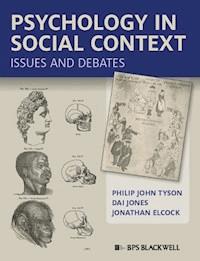
Psychology in Social Context: Issues and Debates provides a critical perspective on debates and controversies that have divided opinion within psychology both past and present. * Explores the history of psychology through examples of classic and contemporary debates that have split the discipline and sparked change, including race and IQ, psychology and gender, ethical issues in psychology, parapsychology and the nature-nurture debate * Represents a unique approach to studying the nature of psychology by combining historical controversies with contemporary debates within the discipline * Sets out a clear view of psychology as a reflexive human science, embedded in and shaped by particular socio-historical contexts * Written in an accessible style using a range of pedagogical features - such as set learning outcomes, self-test questions, and further reading suggestions at the end of each chapter
Sie lesen das E-Book in den Legimi-Apps auf:
Seitenzahl: 634
Veröffentlichungsjahr: 2011
Ähnliche




















Contents
About the Authors
Preface
1 The Nature of Psychology
2 Psychology and Society
3 Psychology, Intelligence, and IQ
4 Psychology and Race
5 Psychology and Women
6 Beyond Nature Versus Nurture
7 Psychology in Service to the State
8 Ethical Standards in Psychology
9 Personality and Personality Tests
10 Psychology and Mental Health
11 Freud and Psychology
12 Parapsychology
13 Psychology in Everyday Life
14 Further Issues in Psychology
15 Psychology at Issue?
Selected Glossary
References
Index
Psychology in Social Context
This edition first published 2011© 2011 Philip John Tyson, Dai Jones, and Jonathan Elcock
BPS Blackwell is an imprint of Blackwell Publishing, which was acquired by John Wiley & Sons in February 2007. Blackwell’s publishing program has been merged with Wiley’s global Scientific, Technical, and Medical business to form Wiley-Blackwell.
Registered OfficeJohn Wiley & Sons Ltd, The Atrium, Southern Gate, Chichester, West Sussex, PO19 8SQ,United Kingdom
Editorial Offices350 Main Street, Malden, MA 02148-5020, USA9600 Garsington Road, Oxford, OX4 2DQ, UKThe Atrium, Southern Gate, Chichester, West Sussex, PO19 8SQ, UK
For details of our global editorial offices, for customer services, and for information about how to apply for permission to reuse the copyright material in this book please see our website at www.wiley.com/wiley-blackwell.
The right of Philip John Tyson, Dai Jones, and Jonathan Elcock to be identified as the authors of this work has been asserted in accordance with the UK Copyright, Designs and Patents Act 1988.
All rights reserved. No part of this publication may be reproduced, stored in a retrieval system, or transmitted, in any form or by any means, electronic, mechanical, photocopying, recording or otherwise, except as permitted by the UK Copyright, Designs and Patents Act 1988, without the prior permission of the publisher.
Wiley also publishes its books in a variety of electronic formats. Some content that appears in print may not be available in electronic books.
Designations used by companies to distinguish their products are often claimed as trademarks. All brand names and product names used in this book are trade names, service marks, trademarks or registered trademarks of their respective owners. The publisher is not associated with any product or vendor mentioned in this book. This publication is designed to provide accurate and authoritative information in regard to the subject matter covered. It is sold on the understanding that the publisher is not engaged in rendering professional services. If professional advice or other expert assistance is required, the services of a competent professional should be sought.
Library of Congress Cataloging-in-Publication data is available for this publication
HB: 9781405168243PB: 9781405168236
A catalogue record for this book is available from the British Library.
This book is published in the following electronic formats: ePDFs 9781444396225;ePub 9781444396232
To Jacob, Christiana, Mona, Ken, and all the other Tysons who've taken an interest in this project
Phil Tyson
To my mother with love
Dai Jones
To Kathleen May Elcock
Jonathan Elcock
About the Authors
Dr. Philip Tyson is an academic psychologist with a special interest in mental health, neuropsychology, and critical psychology. He did his undergraduate psychology degree at Middlesex University, then completed an MSc in cognitive neuropsychology at the University of Essex. He then moved to the University of Hull to study for his PhD. His thesis here investigated the cognitive effects of medication used to treat schizophrenia. He has worked at the University of Gloucestershire since 2003, where he pursues his joint passions of research and lecturing.
Dai Jones has been a lecturer in psychology at the University of Gloucestershire for 15 years, teaching in the areas of conceptual and historical psychology, cognitive psychology, and research methods. He is co-author (with Jonathan Elcock) of History and Theories of Psychology, and contributed four chapters on historical and conceptual issues to Davey’s Complete Psychology. He has been consulting editor for books on historical and conceptual issues in psychology for BPS Blackwell. His scholarly interests include history of psychology, psychology and social issues, psychological language, and e-pedagogy.
Jonathan Elcock is a senior lecturer at the University of Gloucestershire, where he has worked for 18 years. He has co-authored with Dai Jones Histories and Theories of Psychology, and has publications in human–computer interaction, research into cognitive problems in older adults diagnosed with dementia, and discourse analysis of rave culture. His current scholarly interests include historical and conceptual issues in psychology, and how psychology interacts with social class, gender, and sexuality.
Preface
Recent years have seen an increasing recognition of issues with psychology, and a growth in critical approaches to the discipline. However, existing texts in critical psychology are rather advanced for most readers. This book provides an accessible introduction to ideas in critical psychology, highlighting key debates about the assumptions, practices, and claims of the discipline. It takes a distinctive approach of considering historical controversies in psychology to show the ways in which psychology is embedded within particular sociohistorical contexts. Using a range of examples – including IQ measurement, gender, ethics in psychology, parapsychology, and the nature–nurture debate – we show that the discipline is shaped by the ways in which it interrelates with society, and that positions taken towards fundamental issues in psychology are reflections of that social context. The approach we take has a number of advantages over more conventional treatments of issues and debates in psychology, which discuss them in isolation and in quite abstract terms. Our approach allows us to provide concrete examples of the impact of these debates on psychological thought and practice. Our emphasis is on understanding issues in psychology in the context of wider psychological thought, and in the context of society. Thus, for example, bias is considered in talking about psychology’s dealings with gender and with race, and also in considering methodology; while the discussion of ethics considers how ethical standards are constructed by society, but are challenged by the demands of governments and other organizations. In addressing these debates, we develop a conceptual framework for understanding the nature of psychology as a reflexive human science.
The material covered in the book is intended to address the topic area of conceptual and historical issues in psychology, as outlined in the British Psychological Society’s syllabus requirements for accredited undergraduate courses in psychology, and in the UK Quality Assurance Agency for Higher Education’s subject benchmarks for psychology degrees. It shows how the lessons of history can inform understanding of contemporary psychology, and applies that understanding to issues such as the status of scientific psychology, reductionism, the nature–nurture debate, and ethics in psychology research and practice. A particular emphasis is placed on understanding the extent to which psychology is constructed within particular social and cultural contexts, and the ways in which psychological concerns are intertwined with political and moral concerns. The book presents an image of psychology as a distinctively human science that is shaped by, and in turn reflexively shapes, the sociohistorical contexts in which it develops.
The book will be useful for specific courses in conceptual and historical issues in psychology, and courses covering controversies in psychology. In addition, specific chapters of the book will be valuable for courses in other areas of psychology; for example, the chapter on intelligence will give useful background for courses on individual differences. The book is organized in such a way as to establish a broad framework for understanding issues in psychology, and to apply this framework to a range of controversies and debates. The framework is established in chapters 1 and 2, which introduce the notion of psychology as a reflexive discipline shaped by society; and chapters 14 and 15, which consider some fundamental issues before drawing conclusions about the nature of psychology. Other chapters consider specific issues, and are designed to be self-contained to a large extent. The intention is for the reader to be able to select from these chapters according to their own interests and needs. Because of this, there is sometimes a small degree of overlap between chapters, which provides multiple perspectives on particular topics.
Each chapter incorporates a number of pedagogical features to aid the reader. Chapters open with a brief introduction, which gives an overview of what the chapter will cover. Each chapter has a consistent structure with sections and subsections, and concludes with a summary. Box-outs are used to focus on specific examples or to suggest activities to advance learning. Chapters conclude with a set of self-test questions to test your understanding, and a set of thinking points to encourage the application of the ideas in the chapter to wider issues. Suggestions for further reading help you to pursue the topic in more depth. These features are intended in part to support the SQ3R reading method, a study skill strategy for improved comprehension and retention. The method has five steps, from which its acronym derives: survey, question, read, recite, and review. The survey stage involves forming an overview of the text: the chapter introductions and summaries, and the consistent structure of each chapter, are intended to facilitate this. The question stage involves developing a set of questions about the material, as a set of study goals, based on the initial survey. The self-test questions included with each chapter can be used directly for this purpose, and can inspire your own further questions. The read stage, as the name suggests, involves reading the target material and making notes as required. The recite stage involves recalling the material: after reading a section, try to remember the material, and to answer your set questions from memory. The review stage is an ongoing process where you look back over your notes on a regular basis, and check that you can still answer your questions.
A consistent theme throughout the book is that the work done by psychologists – the research they choose to conduct, and the interpretations they make – is informed by the pre-existing views of the psychologist. We shall see this, for example, in the work of the “scientific racists” in the early twentieth century, whose search for differences between racial groups was inspired and shaped by their pre-existing belief that those differences existed. This observation is, of course, as true for the authors of this book as for those the book discusses. It is reflected in the choice of material to include in the book, the ways in which we discuss the material, and the claims we make about the nature of psychology. It’s important, therefore, to know and consider our views when reading the text. We all describe ourselves as left of centre politically, and socially liberal, with a particular concern with equality and ethics. We openly acknowledge the influence of these views on the material we present, believing this to be a more honest approach than striving for unattainable objectivity. We attempt to be fair in our coverage of the material throughout the book, but it is impossible to adopt a truly objective stance. Indeed, we argue in the text that claims of objectivity are often used to obscure the subjectivity of those making the claim. Objectivity is often confused with neutrality – the attempt to give equal coverage to different sides in a debate. However, neutrality comes with its own problems. In particular, giving equal weight to competing views may have the effect of validating claims that are rightly seen as marginal; or, conversely, may lead to claims being seen as true solely because they’re believed by the majority of people, rather than because they provide the best explanation of a phenomenon. In this book, we give our own evaluation and interpretation of the material we present, because it’s impossible to do otherwise. However, we encourage you to consider this as one possible reading amongst many, and to perform your own interpretation in coming to your own position. We want to encourage you to think critically about the issues we address, and part of this entails evaluating the effect of our subjectivity on what we write, and the effect of your own subjectivity on what you believe.
We’d like to acknowledge a number of individuals without whom the book would never have been completed. Our thanks go to Andrew McAleer and Karen Shield from our publishers, for believing in the project and guiding it to fruition. We’d also like to thank our students for acting as guinea pigs for the ideas contained herein. Particular thanks go to Graham Richards for introducing us to a new way of thinking about the nature of psychology. The authors have been greatly influenced by Graham’s ideas, as may be reflected in the material that follows. The book is co-authored, and the named writers share responsibility for the content, including any errors and omissions. However, individual chapters have an identified lead author, reflecting his particular interests and expertise. Any queries about the content should be directed to the relevant named author in the first instance.
1
The Nature of Psychology
DAI JONES
Contents
Learning Outcomes
Introduction
1.1 What Is Psychology?
Focus Box 1.1 Psychology and psychology
1.1.1Popular views of psychology
Figure 1.1 The relationship between the discipline of psychology and its subject matter
1.1.2Defining psychology
1.1.3The emergence of psychology
1.1.4Contemporary approaches to psychology
1.2 Psychology as Science
1.2.1The appeal of science
1.2.2The nature of science
1.3 Issues in scientific psychology
1.3.1Issues in the quality of scientific psychology
1.3.2Issues with bias in scientific psychology
1.4 Chapter Summary
Self-test Questions
Thinking Points
Further Reading
Learning Outcomes
When you’ve finished reading this chapter, you should be able to:
Understand views of psychology as the systematic study of mind and behaviour.Identify the range of approaches adopted in finding explanations in psychology.Recognize the ways in which psychology can be approached scientifically.Evaluate arguments about the appropriateness of scientific psychology.Introduction
This book introduces a range of issues and debates in psychology by looking at how psychology is actually done. We’ll look at several examples of how psychology has engaged with controversial social issues, and use these examples to highlight debates about the way in which psychology is conducted, presented, and understood. Along the way, we’ll see that the discipline of psychology is a socially embedded activity that uses a number of methods to produce knowledge about human nature and human behaviour. This activity is conducted by psychologists with multiple purposes behind what they do. This range of methods and purposes leads to psychology being a very diverse discipline, investigating every aspect of human life from a variety of perspectives (Richards, 2010). The result is that different kinds of psychology produce different kinds of knowledge about mental life and behaviour.
Although there is great diversity in the discipline, there is a standard view of psychology that is most commonly presented in popular writing, most often taught in institutions, and most frequently practised by researchers and practitioners. This view sees psychology as an objective science that uncovers the truth about human behaviour (Fox & Prilleltensky, 1997). Most kinds of psychology conform to this view to varying degrees, but there are some psychologists who have fundamental disagreements with it. Such psychologists describe themselves as critical psychologists, and emphasise the ways in which the discipline has particular relationships with its members, its host society, and its subject matter (Jones & Elcock, 2001).
In this book, we’ll consider some of the claims of critical psychologists by looking at examples of what psychology has done, and what it has claimed, from the past and present. In looking at these examples, we’ll consider why psychology has produced the knowledge that it has, and evaluate the extent to which the standard view of psychology is accurate, or the claims of critical psychologists are valid. Before we can do this, we need to describe the standard view of psychology more fully. We do that in this chapter. We start by considering what the discipline of psychology claims to be, and where it comes from, before looking at the range of theoretical approaches that psychologists adopt in trying to explain human behaviour. We’ll then look particularly at how scientific method can be applied to psychology, before considering some debates about whether such a scientific approach is appropriate.
1.1 What Is Psychology?
The term psychology is much used, but also much mis-used. Throughout this book, we will use the term to refer to the academic and professional discipline that investigates mental events and behaviour, and dysfunctions of these. There is a problem here, though, because those things the discipline investigates – mental health, behaviour, and so on – are also called psychology. So, psychology is the discipline that has as its subject matter psychology! Focus Box 1.1 discusses the relationship between the discipline and its subject matter in more depth.
Focus Box 1.1 Psychology and psychology
The term psychology can refer to a particular subject matter – mental states, behaviour, disorders, and the like – and to the academic and professional discipline that investigates that subject matter. This distinction between the discipline and its subject matter is important. The standard view of the discipline is that it is separate from its subject matter, and is able to objectively observe and theorise about it. So, just as a physicist can investigate gravity objectively, without affecting it, so can the psychologist investigate attitudes without affecting them. This view supports the use of the scientific method to investigate topics in psychology, just as it is used in natural sciences like physics.
Lesen Sie weiter in der vollständigen Ausgabe!
Lesen Sie weiter in der vollständigen Ausgabe!
Lesen Sie weiter in der vollständigen Ausgabe!
Lesen Sie weiter in der vollständigen Ausgabe!
Lesen Sie weiter in der vollständigen Ausgabe!
Lesen Sie weiter in der vollständigen Ausgabe!
Lesen Sie weiter in der vollständigen Ausgabe!
Lesen Sie weiter in der vollständigen Ausgabe!
Lesen Sie weiter in der vollständigen Ausgabe!
Lesen Sie weiter in der vollständigen Ausgabe!
Lesen Sie weiter in der vollständigen Ausgabe!
Lesen Sie weiter in der vollständigen Ausgabe!
Lesen Sie weiter in der vollständigen Ausgabe!
Lesen Sie weiter in der vollständigen Ausgabe!
Lesen Sie weiter in der vollständigen Ausgabe!
Lesen Sie weiter in der vollständigen Ausgabe!
Lesen Sie weiter in der vollständigen Ausgabe!




