


20,99 €
Mehr erfahren.
- Herausgeber: The History Press
- Kategorie: Lebensstil
- Sprache: Englisch
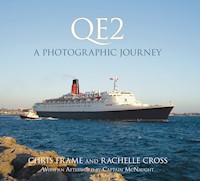
Since her maiden voyage in 1969 the QE2 has delighted the thousands of guests who have been lucky enough to spend time aboard this world-famous ship and fascinated many more. She is the most famous ocean liner of our time and has achieved iconic status worldwide. Now, after four decades in the limelight, QE2 will be retiring in November 2008 to begin a new life as a hotel in Dubai. QE2: A Photographic Journey marks the end of an era by taking the reader on a voyage of appreciation of the most loved ocean liner in the world. Readers can stroll the decks, visit the various bars and lounges, take high tea in the Queen's Room and retire to their cabin without leaving their armchair! Each public room is detailed with colour photographs and historical commentary, including quirky and amusing anecdotes and snippets of information about the ship and some of the many characters who have sailed aboard her. Written by two enthusiastic fans and frequent QE2 travellers, this book is beautifully illustrated with over two hundred colour photographs, and complemented by new information from Commodore R.W. Warwick, former master of QE2 and the son of the first captain. This affectionate record provides the most fitting of souvenirs as the QE2 sails into history.
Das E-Book können Sie in Legimi-Apps oder einer beliebigen App lesen, die das folgende Format unterstützen:
Veröffentlichungsjahr: 2013
Ähnliche



















(Courtesy of Cunard Line)
For Neville & Elvie
ACKNOWLEDGEMENTS
We would like to thank everyone who helped us in our writing journey.
Special thanks to:
Bill Miller for his continual encouragement, writing the foreword and providing publication advice; Commodore R.W. Warwick for providing us with insight into the running of the ship from a captain’s perspective, and for providing photographs; Captain Ian McNaught for organising the absolutely amazing tour ‘QE2 Behind the Scenes’ as well as his encouragement, enthusiasm and writing the afterword; Commodore Rynd for sharing his perspective of commanding QE2; Chief Engineer Paul Yeoman for taking us through the Engine Room; Ed Stickley, Donyin Lin and Andrea Kaczmarek for taking us ‘behind the scenes’ and Gregory Dorothy for the tour of the storerooms; Thad Constantine, Michael Gallagher of Cunard Line, Jochen Gielen, Alex Lucas, Howard Massey, Pam Massey, and Leighton Schembri for their photographic assistance; Amy Rigg, Emily Locke, Christine McMorris, Glad Stockdale and the team at The History Press for all their hard work; Rob Lightbody and the whole team at the QE2 Story Forum for keeping the legend alive; Catherine van Niekerk for providing inspiration; Jan, John, Vicki and our families for supporting us.
All photos, unless otherwise credited, were taken by Chris Frame or Rachelle Cross.
CONTENTS
Title
Dedication
Acknowledgements
Foreword by William H. Miller Jnr
A Royal Introduction
Looking Back
Welcome Aboard
Accommodation Aboard
Grill Class Accommodation
Caronia Accommodation
Mauretania Accommodation
Restaurants
Queens Grill
The Princess Grill
The Britannia Grill
Caronia Restaurant
Mauretania Restaurant
The Lido
Midnight Buffet
The Pavilion
Bars and Lounges
Funnel Bar
Queens Grill Lounge
The Boardroom
Crystal Bar
Golden Lion Pub
The Casino
The Grand Lounge
Yacht Club
The Chart Room
Queens Room
Princess Grill Lounge
Public Areas
Royal Promenade
Theatre
Library & Bookshop
Purser’s Office
Computer Learning Centre
The Synagogue
Royal Cunard Spa
Seven Deck Pool and Gymnasium
For the Kids
Getting Around
Art Aboard
Models and Collections
On Deck
Boat Deck
Observation Deck
‘Doggy Deck’
Sports Centre
One Deck Pool
Crew Only
The Bridge
Behind the Scenes
The Stores
Power Plant
The Master’s Duty
The Role of the Captain
The Warwicks
A Special Ship
A Regal Profile
Elegant Lines
The Funnel
The Mast
Dressed Up
Pilot Boats
The Tugs
Meeting of the Queens
Sisters in Sydney
A Royal Rendezvous
Cruising the World
Farewell
Afterword by Captain Ian McNaught
QE2 Facts
Glossary of Nautical (and
QE2
) Terms
Bibliography
Copyright
FOREWORD
BY WILLIAM H. MILLER JNR
Especially in recent years, but perhaps for a much longer time, there has been no more beloved and cherished ship, liner or otherwise, than the Queen Elizabeth 2. She is the longest-lasting super liner; the longest-serving Cunarder, having steamed more miles, carried more passengers, visited more ports, sailed on more itineraries. Back in 1969, when she was commissioned, Cunard could not have guessed that she would be so incredibly successful. She has legions of fans. There are travellers (and I’ve met some of them), who will sail on no other ship, except maybe the Queen Mary 2, her nearest relative. The QE2, as she is best known, is rich in charm. She’s like, in her increasing old age, a venerable seaside hotel – warm, comforting, always welcoming. A friend once compared her to a good rocking chair. You just want to be there! Myself, I’ve made some thirty trips on her – and hope for more – including crossings, cruises, specialty trips such as the YPO (Young Presidents’ Organisation) Charter Cruise in October 1990 and her 30th Anniversary Cruise in June 1999. I was aboard her then fleet mate, the Vistafjord, as we anchored across from the Queen during Cunard’s 150th Anniversary Celebrations off Spithead in July 1990.
I was aboard a chartered excursion vessel, one that normally shuttled the likes of Midwestern tourists and school groups between Lower Manhattan and the ever popular Statue of Liberty in New York’s Lower Bay. We met the QE2 as she arrived for the first time on an otherwise grey May morning in 1969. At first sighting she was big, imposing, quite regal, certainly modern. But she was also quite different, almost radical with her single, pencil-like white funnel, the lack of traditional Cunard black and red-orange funnel colours and, in red lettering, the name Cunard written across her forward superstructure, as if she were some new, high-tech container ship or something.
We studied her from every angle as she slowly, quite gracefully, made her way up along the Hudson to her West Side berth at West 52nd Street. Horns, whistles and sirens sounded in royal salute. But greater, more eye-opening impressions were to be made once we boarded. Indeed, as Cunard called her, she was ‘the ship of tomorrow’. That circular entrance foyer hinted of Star Wars, for example, while the Queens Room had white scoop chairs and fluted Formica columns and then there was a circular glass and stainless steel stairway in the Double Down Room. Yes, she was different – but quickly became the hottest ticket in town.
Everyone, or so it seemed, wanted to sail on the QE2. I had my first trip in November 1970, flying to the Caribbean and then taking her northbound to New York. We were thrilled!
I met Chris Frame and Rachelle Cross on board the Queen Mary 2, during a celebratory voyage from San Francisco to Sydney. I was deeply impressed with their fascination, interest and high knowledge of this beloved Cunarder. Personally, I believe there can never, ever be enough books or other documentation or commemoration of the QE2. So, it is with the greatest pleasure that I offer this short foreword to a book of splendid photos; a photographic tour of one of the greatest liners, grandest Cunarders, one of my favourite liners of all.
So, the lines are being let go. The whistles are sounding. We are off on a literary voyage in this marvellous book. Three blasts for the QE2!
Bill Miller
New Jersey
A ROYAL INTRODUCTION
For over forty years the QE2 has been touching people’s lives. She sailed more than 5.8 million miles, carrying nearly 3 million passengers in style, comfort and elegance.
Throughout these countless voyages millions of memories have been created. Some passengers remember a taste, perhaps one of the thousands of meals served every day. Others remember the feel of the ship as she gently rocks you to sleep on a calm summer night. For others it was the friends they met aboard, something funny they said or did in the Queens Room or Yacht Club.
No matter what the memory, it will undoubtedly be a special one, retold with enthusiasm and excitement as the past guest regales those back at home with their special experience aboard the one and only QE2.
She is unique in a world where conformity seems to rule the waves. QE2’s quirks delight and frustrate guests, with corridors and stairways that lead to nowhere and odd-shaped cabins on Four Deck and Five Deck.
These unique features of a true ocean liner are rare in today’s world and should be cherished. In service with Cunard from 1969 to 2008, QE2 was kept in good condition, evolving through various refurbishments to become a cosy and elegant English country house at sea.
This book has been created to give a lasting memory of Cunard’s QE2, her rooms, decks, exterior profile, facts and amusing stories that you can cherish for a lifetime.
LOOKING BACK
Unlike Cunard ships of the past, QE2’s biggest rival was not another liner, but the jet aeroplane. Rather than purpose building her for the North Atlantic run alone, QE2’s design allowed for the flexibility of cruising. The last liner to be built on British soil, she was constructed by John Brown & Co., Clydebank (Scotland) and her keel was laid on 5 July 1965. In Cunard tradition, she was known only by her building number, 736.
(Courtesy of Commodore R.W. Warwick, QE2: The Cunard Line FlagshipQueen Elizabeth II)
Number 736 was christened on 20 September 1967 by the reigning monarch, Queen Elizabeth II. Cunard had agreed to name the ship Queen Elizabeth after the elder Cunard liner, which would be retired by the time the new ship entered service, however the Queen refused the envelope containing the ship’s name and uttered the words, ‘I name this ship Queen Elizabeth the Second’. To avoid confusion, Cunard opted to use the numeral ‘2’ for their ship and QE2 was born.
After extensive fitting out and trials, the ship was accepted by Cunard Line on 20 April 1969, some four months late. Her maiden voyage left Southampton on 2 May 1969 bound for New York.
Over nearly forty years of Cunard service, QE2 has led an interesting and varied life. This started early in her career, when she was the first vessel to assist the stranded passengers of the burning French Liner Antilles in January 1971.
During a May crossing in 1972, QE2’s captain received notification that there was a bomb aboard his vessel and that it was timed to go off during the voyage. A search by crew members proved fruitless and a bomb disposal unit was flown out and parachuted into the sea close to the ship. The incident turned out to be a hoax but the FBI succeeded in arresting the culprit.
QE2’s life changed dramatically in 1982 when the ship was requisitioned to serve as a troop carrier during the Falklands War. The ship’s captain and officers heard this news on 3 May 1982 via BBC radio, before any official communication had been received from Cunard Line. Conversion work involved the addition of helicopter flight decks, which required cutting away the aft of Upper and Quarter Decks to provide the necessary space.
The ship set sail with the troops of the 5th Infantry Brigade aboard on 12 May 1982, arriving in the Falklands on 27 May. Due to the threat of Argentinean air reconnaissance she was kept in the relative safety of Cumberland Bay and, after taking aboard the survivors of HMS Ardent, Antelope and Coventry, sailed north towards safety.
Aerial shot of QE2 at sea in her original layout. (Courtesy of Commodore R.W. Warwick)
During her military career QE2 successfully sailed over 14,900 miles, consuming more than 10,200 tons of fuel to deliver 3,000 troops to the war zone. Upon her arrival home she was met by the Royal Yacht Britannia and a flotilla of smaller boats.
QE2 has undergone many refits over the years, one of the most distinctive being her post-war conversion after which she appeared, for a time, with a pebble-grey hull.
Another of her major refits was the 1986/87 engine conversion. This involved removing the original steam turbine engines and replacing them with nine diesel–electric engines. This was, at the time, the largest maritime conversion ever undertaken.
(Courtesy of Commodore R.W. Warwick, QE2: The Cunard Line Flagship Queen Elizabeth II)




