


21,99 €
Mehr erfahren.
- Herausgeber: John Wiley & Sons
- Kategorie: Fachliteratur
- Sprache: Englisch
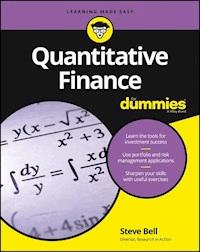
An accessible introduction to quantitative finance by the numbers--for students, professionals, and personal investors
The world of quantitative finance is complex, and sometimes even high-level financial experts have difficulty grasping it. Quantitative Finance For Dummies offers plain-English guidance on making sense of applying mathematics to investing decisions. With this complete guide, you'll gain a solid understanding of futures, options and risk, and become familiar with the most popular equations, methods, formulas, and models (such as the Black-Scholes model) that are applied in quantitative finance.
Also known as mathematical finance, quantitative finance is about applying mathematics and probability to financial markets, and involves using mathematical models to help make investing decisions. It's a highly technical discipline--but almost all investment companies and hedge funds use quantitative methods.
The book breaks down the subject of quantitative finance into easily digestible parts, making it approachable for personal investors, finance students, and professionals working in the financial sector--especially in banking or hedge funds who are interested in what their quant (quantitative finance professional) colleagues are up to. This user-friendly guide will help you even if you have no previous experience of quantitative finance or even of the world of finance itself.
With the help of Quantitative Finance For Dummies, you'll learn the mathematical skills necessary for success with quantitative finance and tips for enhancing your career in quantitative finance.
Get your own copy of this handy reference guide and discover:
- An easy-to-follow introduction to the complex world of quantitative finance
- The core models, formulas, and methods used in quantitative finance
- Exercises to help augment your understanding of QF
- How QF methods are used to define the current market value of a derivative security
- Real-world examples that relate quantitative finance to your day-to-day job
- Mathematics necessary for success in investment and quantitative finance
- Portfolio and risk management applications
- Basic derivatives pricing
Whether you're an aspiring quant, a top-tier personal investor, or a student, Quantitative Finance For Dummies is your go-to guide for coming to grips with QF/risk management.
Sie lesen das E-Book in den Legimi-Apps auf:
Seitenzahl: 596
Veröffentlichungsjahr: 2016
Ähnliche



















Quantitative Finance For Dummies®
Published by: John Wiley & Sons, Ltd., The Atrium, Southern Gate, Chichester,www.wiley.com
© 2016 by John Wiley & Sons, Ltd., Chichester, West Sussex
Media and software compilation copyright © 2016 by John Wiley & Sons, Ltd. All rights reserved.
Registered Office
John Wiley & Sons, Ltd., The Atrium, Southern Gate, Chichester, West Sussex, PO19 8SQ , United Kingdom
For details of our global editorial offices, for customer services and for information about how to apply for permission to reuse the copyright material in this book, please see our website at www.wiley.com.
All rights reserved. No part of this publication may be reproduced, stored in a retrieval system or transmitted in any form or by any means, electronic, mechanical, photocopying, recording, scanning or otherwise, except as permitted by the UK Copyright, Designs and Patents Act 1988, without the permission of this publisher.
Designations used by companies to distinguish their products are often claimed as trademarks. All brand names and product names used in this book are trade names, service marks, trademarks or registered trademarks of their respective owners. The publisher is not associated with any product or vendor mentioned in this book.
LIMIT OF LIABILITY/DISCLAIMER OF WARRANTY: WHILE THE PUBLISHER AND AUTHOR HAVE USED THEIR BEST EFFORTS IN PREPARING THIS BOOK, THEY MAKE NO REPRESENTATIONS OR WARRANTIES WITH RESPECT TO THE ACCURACY OR COMPLETENESS OF THE CONTENTS OF THIS BOOK AND SPECIFICALLY DISCLAIM ANY IMPLIED WARRANTIES OF MERCHANTABILITY OR FITNESS FOR A PARTICULAR PURPOSE. IT IS SOLD ON THE UNDERSTANDING THAT THE PUBLISHER IS NOT ENGAGED IN RENDERING PROFESSIONAL SERVICES AND NEITHER THE PUBLISHER NOR THE AUTHOR SHALL BE LIABLE FOR DAMAGES ARISING HEREFROM. IF PROFESSIONAL ADVICE OR OTHER EXPERT ASSISTANCE IS REQUIRED, THE SERVICES OF A COMPETENT PROFESSIONAL SHOULD BE SOUGHT.
For general information on our other products and services, please contact our Customer Care Department within the U.S. at 877-762-2974, outside the U.S. at 317-572-3993, or fax 317-572-4002. For technical support, please visit www.wiley.com/techsupport.
Wiley publishes in a variety of print and electronic formats and by print-on-demand. Some material included with standard print versions of this book may not be included in e-books or in print-on-demand. If this book refers to media such as a CD or DVD that is not included in the version you purchased, you may download this material at http://booksupport.wiley.com. For more information about Wiley products, visit www.wiley.com.
A catalogue record for this book is available from the British Library.
Library of Congress Control Number: 2016939606
ISBN: 978-1-118-76946-1
ISBN 978-1-118-76946-1 (pbk); ISBN 978-1-118-76942-3 (ebk); ISBN 978-1-118-76943-0 (ebk)
Quantitative Finance For Dummies®
To view this book's Cheat Sheet, simply go to www.dummies.com and search for “Quantitative Finance For Dummies Cheat Sheet” in the Search box.
Table of Contents
Cover
Introduction
About This Book
Foolish Assumptions
Icons Used in This Book
Where to Go from Here
Part 1: Getting Started with Quantitative Finance
Chapter 1: Quantitative Finance Unveiled
Defining Quantitative Finance
Wielding Financial Weapons of Mass Destruction
Analysing and Describing Market Behaviour
Managing Risk
Computing, Algorithms and Markets
Chapter 2: Understanding Probability and Statistics
Figuring Probability by Flipping a Coin
Defining Random Variables
Introducing Some Important Distributions
Chapter 3: Taking a Look at Random Behaviours
Setting Up a Random Walk
Averaging with the Central Limit Theorem
Moving Like the Stock Market
Generating Random Numbers on a Computer
Simulating Random Walks
Moving Up a Gear
Reverting to the Mean
Part 2: Tackling Financial Instruments
Chapter 4: Sizing Up Interest Rates, Shares and Bonds
Explaining Interest
Sharing in Profits and Growth
Taking the Pulse of World Markets
Defining Bonds and Bond Jargon
Swapping between Fixed and Floating Rates
Chapter 5: Exploring Options
Examining a Variety of Options
Reading Financial Data
Getting Paid when Your Option Expires
Using Options in Practice
Trading Options On and Off Exchanges
Relating the Price of Puts and Calls
Chapter 6: Trading Risk with Futures
Surveying Future Contracts
Seeing into the Future
Rolling a Position
Converging Futures to the Spot Price
Using Futures Creatively
Seasonality in Futures Prices
Part 3: Investigating and Describing Market Behaviour
Chapter 7: Reading the Market’s Mood: Volatility
Defining Volatility
Using Historical Data
Shrinking Time Using a Square Root
Comparing Volatility Calculations
Estimating Volatility by Statistical Means
Going Beyond Simple Volatility Models
Estimating Future Volatility with Term Structures
Chapter 8: Analysing All the Data
Data Smoothing
Estimating More Distributions
Modelling Non-Normal Returns
Chapter 9: Analysing Data Matrices: Principal Components
Reducing the Amount of Data
Applying PCA to Yield Curves
Using PCA to Build Models
Part 4: Option Pricing
Chapter 10: Examining the Binomial and Black-Scholes Pricing Models
Looking at a Simple Portfolio with No Arbitrage
Pricing in a Single Step
Branching Out in Pricing an Option
Making Assumptions about Option Pricing
Introducing Black-Scholes – The Most Famous Equation in Quantitative Finance
Solving the Black-Scholes Equation
Properties of the Black-Scholes Solutions
Generalising to Dividend-Paying Stocks
Defining other Options
Valuing Options Using Simulations
Chapter 11: Using the Greeks in the Black-Scholes Model
Using the Black-Scholes Formulae
Hedging Class
That’s Greek to Me: Explaining the Greek Maths Symbols
Rebalancing a Portfolio
Troubleshooting Model Risk
Chapter 12: Gauging Interest-Rate Derivatives
Looking at the Yield Curve and Forward Rates
Modelling the Interest-Rate
Part 5: Risk and Portfolio Management
Chapter 13: Managing Market Risk
Investing in Risky Assets
Stopping Losses and other Good Ideas
Hedging Schemes
Betting without Losing Your Shirt
Evaluating Outcomes with Utility Functions
Using the Covariance Matrix to Measure Market Risk
Chapter 14: Comprehending Portfolio Theory
Diversifying Portfolios
Minimising Portfolio Variance
Capital Asset Pricing Model
Assessing Portfolio Performance
Chapter 15: Measuring Potential Losses: Value at Risk (VaR)
Controlling Risk in Your Portfolio
Defining Volatility and the VaR Measure
Constructing VaR using the Covariance Matrix
Estimating Volatilities and Correlations
Simulating the VaR
Validating Your Model
Including the Average VaR
Estimating Tail Risk with Extreme Value Theory
Part 6: Market Trading and Strategy
Chapter 16: Forecasting Markets
Measuring with Technical Analysis
Making Predictions Using Market Variables
Predicting from Past Values
Chapter 17: Fitting Models to Data
Maximising the Likelihood
Fitting and Overfitting
Applying Occam’s Razor
Detecting Outliers
The Curse of Dimensionality
Seeing into the Future
Chapter 18: Markets in Practice
Auctioning Assets
Looking at the Price Impact of a Trade
Being a Market Maker and Coping with Bid-Ask Spreads
Trading Factors and Distributions
Part 7: The Part of Tens
Chapter 19: Ten Key Ideas of Quantitative Finance
If Markets Were Truly Efficient Nobody Would Research Them
The Gaussian Distribution is Very Helpful but Doesn’t Always Apply
Don’t Ignore Trading Costs
Know Your Contract
Understanding Volatility is Key
You Can Price Options by Building Them from Cash and Stock
Finance Isn’t Like Physics
Diversification is the One True Free Lunch
Find Tools to Help Manage All the Data
Don’t Get Fooled by Complex Models
Chapter 20: Ten Ways to Ace Your Career in Quantitative Finance
Follow Financial Markets
Read Some Classic Technical Textbooks
Read Some Non-technical Books
Take a Professional Course
Attend Networking Meetings and Conferences
Participate in Online Communities
Study a Programming Language
Go Back to School
Apply for that Hedge Fund or Bank Job
Take Time to Rest Up and Give Back
Glossary
About the Author
Advertisement Page
Connect with Dummies
End User License Agreement
Guide
Cover
Table of Contents
Begin Reading
Pages
i
ii
v
vi
vii
viii
ix
x
xi
xii
1
2
3
4
5
6
7
8
9
10
11
12
13
14
15
16
17
18
19
20
21
22
23
24
25
26
27
28
29
30
31
32
33
34
35
36
37
38
39
40
41
42
43
44
45
46
47
48
49
50
51
52
53
54
55
56
57
58
59
60
61
62
63
64
65
66
67
68
69
70
71
72
73
74
75
76
77
78
79
80
81
82
83
84
85
86
87
88
89
90
91
92
93
94
95
96
97
98
99
100
101
102
103
104
105
106
107
108
109
110
111
112
113
114
115
116
117
118
119
120
121
122
123
124
125
126
127
128
129
130
131
132
133
134
135
136
137
138
139
140
141
142
143
144
145
146
147
148
149
150
151
152
153
154
155
156
157
158
159
160
161
162
163
164
165
166
167
168
169
170
171
172
173
174
175
176
177
178
179
180
181
182
183
184
185
186
187
188
189
190
191
192
193
194
195
196
197
198
199
200
201
202
203
204
205
206
207
209
210
211
212
213
214
215
216
217
218
219
220
221
222
223
224
225
226
227
228
229
230
231
232
233
234
235
236
237
239
240
241
242
243
244
245
246
247
248
249
250
251
252
253
254
257
258
259
260
261
262
263
264
265
266
267
268
269
270
271
272
273
274
275
276
277
278
279
280
281
282
283
284
285
286
287
288
289
290
291
292
293
294
295
296
297
298
299
300
301
302
303
304
305
306
307
308
309
310
311
312
313
314
315
316
317
318
319
320
321
322
323
324
325
326
327
329
330
331
332
333
334
335
336
337
338
339
340
341
342
343
344
345
346
347
348
349
350
351
352
353
354
355
356
357
358
359
361
362
363
364
365
366
367
391
392
393
394
395
396
Introduction
Quantitative finance is about applying mathematics and statistics to finance. For maths lovers that’s exciting, but for the rest of us it may sound scary and off-putting. But I guide you step by step, so no need to worry. Quantitative finance helps you to price contracts such as options, manage the risk of investment portfolios and improve trade management.
I show you how banks price derivatives contracts based on the statistics of stock and bond price movements and some simple rules of probability. Similar maths help you understand how to manage the risk of investment portfolios. Quantitative tools help you understand and manage these systems, and this book introduces you to many of the most important ones.
About This Book
This book should be helpful for professionals working in the financial sector – especially in banking. It won’t take you to the level of doing the maths for pricing the latest derivative contract, but it can help you to contribute, perhaps as a programmer, data scientist or accountant. It should also be helpful for those taking a masters course in finance or financial analysis and who want help in a module on quantitative finance. Enough detail is included to really help in understanding key topics such as the Black-Scholes equation. The book also has breadth so you can discover a range of key financial instruments and how they’re used as well as techniques used by traders and hedge fund managers. Whether you plan a career as a corporate treasurer, risk analyst, investment manager or master of the universe at an investment bank, this book should give you a boost.
This book isn’t a traditional textbook and isn’t a traditional book on quantitative finance. It is significantly different from either in the following ways:
The book is designed as a reference so that you can dive into the section of most importance to you. I include lots of cross references to clearly point you to other sections and chapters that may have additional or complementary information.
The maths is at the minimum level required to explain the subjects. I made no attempt to impress with fancy mathematical jargon, lengthy proofs or references to obscure theorems.
It’s about applying mathematics and probability to finance. That includes derivatives but also includes tools to help you with trading and risk management. Finance is a subject centred on numbers, so maths is a natural way to help you get to grips with it.
It includes real-world examples so you can relate quantitative finance to your day-to-day job.
If you haven’t done any algebra for a while, remember that mathematicians like to write products without multiplication signs. So P(H)P(H) is shorthand for the probability of heads multiplied by the probability of heads. For maths with actual numbers, I use the symbol * to indicate multiplication. This avoids any confusion with the variable x, which is a favourite of mathematicians to signify an unknown quantity.
Within this book, web addresses may break across two lines of text. If you’re reading this book in print and want to visit one of these web pages, simply key in the web address exactly as noted in the text, pretending the line break doesn’t exist. If you’re reading this as an e-book, you’ve got it easy — just click the web address to be taken directly to the website.
Foolish Assumptions
I don’t assume that you have any previous experience of quantitative finance. I don’t even assume that you’re familiar with the world of finance except for the apocalyptic stories you read in the press about crises, greed, bonuses and debt. However, I’m assuming that you’re reading this book because you’re working in a financial institution such as a bank or a hedge fund and want to know what those clever quants (quantitative finance professionals) are doing. Alternatively, you may be studying for a Masters in Finance and looking for help with those quantitative modules.
I assume that you’re familiar with mathematics such as logarithms, exponentials and basic algebra. In some parts of the book, I also assume some knowledge of calculus both differentiation and integration. The online Cheat Sheet at www.dummies.com/cheatsheet/quantitativefinance is a good place to visit if you need to brush up on some of this maths. Some of the sections with the heaviest maths have Technical Stuff icons, which means that you can skip them if you wish.
Where I use algebra, I try to take you through it step by step and introduce all the symbols before the equations so that you know what they’re about. I also include a few example calculations to help you become familiar with them and see how to use the equations in practice.
Quantitative finance is what it says it is and involves numbers and maths but you don’t need to become bogged down by it. Only then will you see that the numbers are useful in real life in your job.
Icons Used in This Book
Icons are used in this book to draw your attention to certain features that occur on a regular basis. Here’s what they mean:
This icon is to give those grey cells a little jolt. It’s so easy to forget what you learned in school.
This icon points to helpful ideas that can save you time and maybe even money.
Skip paragraphs marked with this icon if you don’t want to go into the gory mathematical details. But if you do manage them, you’ll really glow with achievement.
Sometimes things can go badly wrong. Follow these sections to avoid disasters.
Where to Go from Here
The obvious answer is to start with Chapter 1. In fact, that’s a good idea if you’re not too familiar with quantitative finance as Chapter 1 is a bit like the book in miniature. I hope it will fire you up ready to read the rest of the book. Another obvious answer is to go to the table of contents. Just find the topic you’d like to know about and go straight there – no messing about. The book is designed to be used like that. Check out the topics you want to know about and skip what you’re not interested in. A third obvious answer is to use the index, which has been conveniently arranged in alphabetical order for you. If some quantitative finance jargon is bugging you, go to the Glossary at the back. Finally, if you’re really in a hurry, try Chapters 19 and 20. They give quantitative finance to you in ten bite-sized sections.
And you can use some free online material to help. The Cheat Sheet is a goldmine of handy formulae used in quantitative finance. To view this book’s Cheat Sheet, go to www.dummies.com and search for “Quantitative Finance For Dummies Cheat Sheet” for additional bits of information that you can refer to whenever you need it.
Part 1
Getting Started with Quantitative Finance
IN THIS PART …
Realise that the chart of a stock price can look jumpy and rather random because market prices are indeed very close to being random.
Get to grips with the mathematics of random numbers and brush up on probability and statistics.
Enter the strange and fascinating world of random walks. Find out how you can use them as models for the price movement of financial assets such as stocks.
Use calculus to analyse random walks so that you can get going on the classic maths for option pricing.
Chapter 1
Quantitative Finance Unveiled
IN THIS CHAPTER
Using probability and statistics in finance
Finding alternatives for cash
Looking at efficient (and not-so-efficient) markets
Tackling options, futures and derivatives
Managing risk
Doing the maths (and the machines that can help)
Quantitative finance is the application of probability and statistics to finance. You can use it to work out the price of financial contracts. You can use it to manage the risk of trading and investing in these contracts. It helps you develop the skill to protect yourself against the turbulence of financial markets. Quantitative finance is important for all these reasons.
If you’ve ever looked at charts of exchange rates, stock prices or interest rates, you know that they can look a bit like the zigzag motion of a spider crossing the page. However, major decisions have to be made based on the information in these charts. If your bank account is in dollars but your business costs are in euros, you want to make sure that, despite fluctuations in the exchange rate, you can still pay your bills. If you’re managing a portfolio of stocks for investors and you want to achieve the best return for them at minimum risk, then you need to learn how to balance risk with reward. Quantitative finance is for banks, businesses and investors who want better control over their finances despite the random movement of the assets they trade or manage. It involves understanding the statistics of asset price movements and working out what the consequences of these fluctuations are.
However, finance, even quantitative finance, isn’t just about maths and statistics. Finance is about the behaviour of the participants and the financial instruments they use. You need to know what they’re up to and the techniques they use. This is heady stuff, but this book guides you through.
Defining Quantitative Finance
My guess is that if you’ve picked up a book with a title like this one, you want to know what you’re going to get for your money. Definitions can be a bit dry and rob a subject of its richness but I’m going to give it a go.
Quantitative finance is the application of mathematics – especially probability theory – to financial markets. It’s used most effectively to focus on the most frequently traded contracts. What this definition means is that quantitative finance is much more about stocks and bonds (both heavily traded) than real estate or life insurance policies. The basis of quantitative finance is an empirical observation of prices, exchange rates and interest rates rather than economic theory.
Quantitative finance gets straight to the point by answering key questions such as, ‘How much is a contract worth?’ It gets to the point by using many ideas from probability theory, which are laid out in and . In addition, sometimes quantitative finance uses a lot of mathematics. Maths is really unavoidable because the subject is about answering questions about price and quantity. You need numbers for that. However, if you use too much mathematics, you can lose sight of the context of borrowing and lending money, the motivation of traders and making secure investments. covers subjects such as attitudes to risk and prospect theory while looks in more detail at the way markets function and dysfunction.
Lesen Sie weiter in der vollständigen Ausgabe!
Lesen Sie weiter in der vollständigen Ausgabe!
Lesen Sie weiter in der vollständigen Ausgabe!
Lesen Sie weiter in der vollständigen Ausgabe!
Lesen Sie weiter in der vollständigen Ausgabe!
Lesen Sie weiter in der vollständigen Ausgabe!
Lesen Sie weiter in der vollständigen Ausgabe!
Lesen Sie weiter in der vollständigen Ausgabe!
Lesen Sie weiter in der vollständigen Ausgabe!
Lesen Sie weiter in der vollständigen Ausgabe!
Lesen Sie weiter in der vollständigen Ausgabe!
Lesen Sie weiter in der vollständigen Ausgabe!
Lesen Sie weiter in der vollständigen Ausgabe!
Lesen Sie weiter in der vollständigen Ausgabe!
Lesen Sie weiter in der vollständigen Ausgabe!
Lesen Sie weiter in der vollständigen Ausgabe!
Lesen Sie weiter in der vollständigen Ausgabe!
Lesen Sie weiter in der vollständigen Ausgabe!
Lesen Sie weiter in der vollständigen Ausgabe!
Lesen Sie weiter in der vollständigen Ausgabe!
Lesen Sie weiter in der vollständigen Ausgabe!
Lesen Sie weiter in der vollständigen Ausgabe!
Lesen Sie weiter in der vollständigen Ausgabe!
Lesen Sie weiter in der vollständigen Ausgabe!
Lesen Sie weiter in der vollständigen Ausgabe!
Lesen Sie weiter in der vollständigen Ausgabe!
Lesen Sie weiter in der vollständigen Ausgabe!
Lesen Sie weiter in der vollständigen Ausgabe!
Lesen Sie weiter in der vollständigen Ausgabe!
Lesen Sie weiter in der vollständigen Ausgabe!




