


11,99 €
Mehr erfahren.
- Herausgeber: Vertebrate Digital
- Kategorie: Lebensstil
- Sprache: Englisch
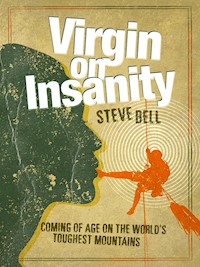
Outwardly, 'Britain's most experienced teenage Alpinist' is a brave young mountaineer. But he's not experienced at all, at least not in the way he really wants to be. Behind his death-defying climbs there lurks a great deal of fear – fear of the opposite sex, fear of failure, fear of not being 'man enough'. He seeks manhood in the mountains, yet he believes he will only truly gain it by losing something. Harrowing escapades in Scotland, the Alps and Alaska are interspersed by excruciating sexual encounters and unsettling hitch-hiking rides. When the mountains fail him, he seeks meaning with a religious cult in Colorado. Eventually he succeeds in his quest, only to find that he's lost more than he bargained for. Virgin on Insanity by Steve Bell is a coming-of-age story of high adventure, youthful insecurity and immature love. The situations might be extreme, but the deeper issues will be familiar to many.
Das E-Book können Sie in Legimi-Apps oder einer beliebigen App lesen, die das folgende Format unterstützen:
Veröffentlichungsjahr: 2016
Ähnliche















Virgin on Insanity
Virgin on Insanity
.
Steve Bell
.
www.v-publishing.co.uk
– Contents –
.
Chapter 1 Turning Point
Chapter 2 Vertigo
Chapter 3 Points of Honour
Chapter 4 School of Rock
Chapter 5 Birth of a Mountaineer
Chapter 6 Alpine Graduation
Chapter 7 A ‘Nice Climb’
Chapter 8 Reflected Glory
Chapter 9 In Dire Straits
Chapter 10 The Great Unwashed
Chapter 11 Performance Anxiety
Chapter 12 Life on the Wall of Death
Chapter 13 Alaska
Chapter 14 The Divine Principle
Chapter 15 Aftermath
Chapter 16 The Girl from Down Under
Chapter 17 Hitting the Wall
Chapter 18 Letting Go
Chapter 19 Crossing the Line
Epilogue
Acknowledgements
Photographs
.
For Rossy
– Chapter 1 –
Turning Point
Steve Monks outside the Leschaux Hut, January 1981.
I didn’t climb mountains because I was brave, I climbed them because I was afraid. The fear of falling, of being buried alive by an avalanche, or being crushed to a pulp by collapsing cliffs, were nothing compared to my fear of not being enough. Frailty is easily hidden behind a mountain’s big reputation. So, duelling with death, that’s where I tucked mine.
I felt like I’d been run over by a truck. When I opened my eyes, I was underneath one. In the first daylight of the year I could see its rusting belly, the drive shaft, its barrel-shaped fuel tank. The stench of old oil was nauseating. Next to my head a fat treadless tyre swelled beneath the weight of the dilapidated truck. If it rolled I would be crushed, perhaps that would make me feel better.
A shard of light pressed through a gap in the garage door and laid down next to me, a frigid reflection of the snow outside. I shifted in my sleeping bag, accidentally nudging Steve who made a noise that sounded like remorse. He rocked his head up to remind himself where he was. His face was a crumpled green as he turned to face me.
‘Your eyes look like piss-holes in the snow,’ he croaked, trying to grin. Steve’s broad Bristol accent was barely discernible.
‘What a night,’ I replied, throat like gravel. ‘Now it’s payback time.’ Each word was separated by a painful pulse in my head.
‘I’ve got a nasty feeling we made a plan last night. God, I hate alcohol.’
‘Happy New Year,’ I said. I really wanted it to be, because I’d made myself a resolution, the same one I made last year.
Fighting wicked hangovers, we grudgingly packed up our sleeping gear and shoved open the garage door. Bright white light charged in from the ground and the sky, illuminating our bedroom. Blimey. I had little recollection of how we got there. The last thing I could remember clearly was partying in the Bar Nationale and dancing in the snow-covered street outside. Oh yes, and a French girl who I’d asked to take me home. Obviously that didn’t work. I sighed inwardly. 1981. Another year had ticked by and I still hadn’t rid myself of my embarrassing secret.
Several hours later Steve Monks and I plodded the last few steps through deep snow up the railway track to Montenvers. It was deserted. Only mad dogs and Englishmen. Most sane people would be languishing in the bars and restaurants back in Chamonix, outwardly frustrated but secretly pleased that the sky was overcast and unappealing. All those hundreds of climbers shaking off their hangovers, while we were up here all alone with only our own hangovers for company.
Soon after Chamonix disappeared behind a bend in the railway track, the Mer de Glace came into view. The glacier was almost all white, a great frozen fiord winding between the spires of the Mont Blanc Massif. Far away at the head of the valley, the glacier climbed up to meet a sheer wall of speckled black and white. That was where we were heading, to the north face of the Grandes Jorasses.
The old hotel had an open room in the basement, so at least we had some shelter for the night. We only had six days’ food and fuel so we tried not to use any. Who knows how long the climb would take, especially with this poor weather?
The next day we clambered down the iron ladders on to the glacier, feeling much better after an alcohol-free night. The snow cover made it hard going, our boots breaking through a meringue-like crust and sinking knee deep into soft mushy stuff underneath. We were thrashing our way across a gargantuan pavlova. Every now and then I’d scoop some up, squeezing the air from it before popping it into my mouth like a lolly. It tasted of the mountains, cold and fresh. It made my teeth ache.
I’d been this way before when I climbed another route on the Grandes Jorasses, the Walker Spur, but that was in the summer when the going was much easier. Then it took a few hours to reach the foot of the climb, now it was taking a few days. We took turns to break the trail, changing over frequently as leading was so much more tiring than stepping into the leader’s footprints. The pavlova was not at all sweet, and by the time darkness descended and snow began to fall, it was positively bitter. There were no old decrepit trucks here so we broke a rule and slept beneath a large rock. We’d both heard the story of the Irish lad who’d done the same on this very glacier; the ice shifted during the night and so did the boulder he was sleeping under. He never woke up. We wondered which rock it was, whether he was still there.
It was still snowing in the morning. The tops of the mountains were obscured by the off-loading clouds, everything we could see was cold and grey and lifeless. The closest shelter was the Leschaux Hut, further still up the glacier. If we could get there we’d be well placed for an attempt on the climb when the weather improved.
The wind turned vicious, hurling snowflakes against our ski masks as we stumbled towards the edge of the glacier. We found a few crevasses, when a foot didn’t stop going down but kept going until stopped by a crotch, or the base of a rucksack. I’d pull my dangling foot out and look into the blackness of a bottomless hole. Somewhere deep inside this glacier was our friend Arnis Strapcans. He and Steve were leading lights of the Bristol climbing scene and they’d been a powerful climbing partnership. The previous summer Arnis had disappeared on a solo mission to climb Mont Blanc. He most likely fell into a crevasse. Looking into the cold dark hole I thought of Arnis’s face, his curly blond hair, intelligent blue eyes and wicked humour. His trademark sign-off was, ‘Have fun, or get hurt real bad!’. The Latvian bombshell was a one-off who’d touched many lives. We’d all wept for him.
We were lucky to find the hut. Only the roof was visible, the little veranda at the front being full of snow. We dug out the door and fell inside, taking a good deal of snow with us. After two days of floundering around on the glacier, it was a relief to have a roof over our heads. The hut was a ramshackle affair, little more than a shed with a line of bunks along the back wall. The water supply was frozen so we had to melt snow. We found a catering-sized tin of potato powder and lived off it for the next four days while we waited in vain for an improvement in the weather. Most of the time we rested, dozed and slept in the warmth of our bulky sleeping bags. Occasionally, we talked; mostly about climbing, sometimes about girls. Steve was considerably more experienced on both counts.
One forlorn evening, while we tucked into a cheerless meal, a sad thought crept in from the cold. ‘I was thinking about Arnis. What do you think happened to him?’
Steve knew Arnis better than I did, and I valued his opinion.
‘We can only surmise can’t we,’ replied Steve, resignation in his tone. ‘I don’t know what route he was trying. Something on the Brenva Face, but he may not have even got there. Lots of big crevasses up there.’
‘That’s the trouble with soloing isn’t it? There’s no one to tie on a rope with. Damn spooky walking across a glacier on your own!’
Steve was quiet for a moment, thoughtful. Then he said, ‘Did you hear about Jon Krakauer when he soloed the Devil’s Thumb in Alaska? He used a pole about five or six metres long tied to his harness and carried it like a tightrope walker. When he fell into a crevasse, which he frequently did, he was stopped by the pole.’
‘Pity Arnis didn’t do that,’ I sighed. ‘I keep thinking about that time we were on the Supercouloir, you with Arnis, and me with Marius the Viking. Sometimes Arnis and I were climbing side by side, front-pointing up the ice wittering on like idiots about how ‘super’ the climb was!’
We laughed briefly without mirth, the sound fading into the dull ache of an old wound. I returned to the present, which was almost as bleak.
‘Wish we had something else to eat other than this cardboard powder stuff. Do you really think it’s potato?’
‘Whose turn is it to make a brew?’
‘Yeah, I know it’s my turn.’ After delivering tea to Steve I wriggled back into my bag.
‘How’s it going with Liz?’ Liz was Steve’s live-in girlfriend, they’d been together for as long as I’d known him.
‘Okay I s’pose.’ Steve never gave much away, but was always ready to give well-meaning advice to others. ‘‘Bout time you got yourself a girlfriend isn’t it?’
It had been ‘about time’ for a few years now, but it didn’t seem like it was up to me. God knows I’d tried. Girls baffled me, they scared me more than mountains. I’d nearly died half a dozen times yet I’d keep going back for more. How could asking a girl out be scarier than that? Yet it was. Performance anxiety and the fear of rejection had locked me in a steel cage of self-doubt. It was my curse. Now I was a twenty-one-year-old virgin and I didn’t want anyone to know.
‘It would be good to have a proper girlfriend,’ I replied. Careful now, I told myself, don’t give anything away. Was that sufficiently vague?
‘Okaay’, drawled Steve, smiling. ‘Anyone in particular in mind?’ He was pointing his trademark grin straight at me, eyes laughing. Steve loved a bit of Bristol gossip.
‘Dunno really. I quite like Ness at the shop.’ Whoa! That was a punt! Hope you’re not setting yourself up for a fall!
‘Oh! She’s nice. Why don’t you ask her out?’
‘Yeah, I might. Assuming we’re still alive when we get back.’ Assuming we weren’t at the bottom of a crevasse, frozen on the Croz Spur, buried in an avalanche or smashed to smithereens at the foot of the climb. All of them were distinct possibilities.
Early each morning one of us would climb out of our warm sleeping bag and go outside to check the weather. The snow and wind persisted, until on the fifth morning it appeared to be clearing. Steve came back into the hut, more animated than he’d been for a week.
‘It’s looking good, Steve. Let’s go for it.’
‘Sounds good to me!’ I said. We packed up, working stiff muscles and joints after days of inactivity. Thankfully leaving the confines of the cold dingy hut, we skidded down the slope of snow-covered scree back on to the glacier. As soon as we’d tied on to the rope, the wind began blowing again. Then came the snow, falling from clouds that appeared from nowhere. The Grandes Jorasses disappeared into the gloom, taking with it all our hopes of climbing it. We didn’t have to discuss it. Steve pointed down the valley and I turned round and started walking.
It was a long walk back. I was bitterly disappointed. No summit elation this time, no reward for the time, effort and hardship of the last week. Nor would there be a glorious return to the valley, back slapping in the pub or write-ups in magazines. Without receiving their gift, I caught a glimpse of what the mountains really were. This was a significant failure. All I could take from the trip was an admission spawned by extreme boredom, and a decision shared with a friend that I hoped I would have the courage to follow through with. Courage. It was time to stop hiding in the mountains, where I’d felt safe. For five long years I’d been searching for myself among them, winning some of their most coveted trophies in my quest for manly fulfilment. Yet my secret remained, hiding and ashamed. The mountains had been my sanctuary; I hadn’t climbed them because I was brave, I’d climbed them because I was afraid. I’d lived on the edge of life’s precipice, pushed beyond my physical limits; journeyed through far-flung regions of my psyche and even been ready to die. But now, I needed courage. It was time to come home from the hills and confront my vertigo, to stop hiding from myself and be a man. When I got home, I was going to ask a girl out.
– Chapter 2 –
Vertigo
The Bell children in 1969. From left: Glynis, Margaret (later changed to Penny), Stephen and Charles.
There shouldn’t have been any room for fear. From the beginning, I was replete with an inborn certainty that whatever happened, everything would be fine. Optimism followed me into the world like an invisible placenta from which the cord of sustenance was never cut. From the beginning, I felt lucky.
Luck certainly seemed to be on my side, even before I was born. My dad was a nurse and had access to all kinds of drugs. He found something to help my mum because I was making her feel sick. ‘Enid,’ he urged when he came home one day, ‘take these tablets. They’ll make you feel better.’
‘What is it?’
‘Thalidomide. It’s for morning sickness, it’s supposed to be very good.’ He held up the bottle, but my mum didn’t look at it.
‘I don’t want any drugs,’ she replied, looking away.
‘Take them, they’ll help you,’ pressed my dad, concerned for her welfare.
‘No thanks, James. I really don’t want them.’
It was the first time my mother sacrificed her own comfort for her children. She continued to do so for nearly half a century.
My mum was only twenty when I was born. Four more children followed, the last one nearly sixteen years after me. The five of us became her chains of bondage, shackling her to a man we called ‘Dad’.
I never thought about my childhood much. As memory fades it’s become less distinct, with only the deepest impressions withstanding the ravages of time. The majority of days, presumably happy, have left no mark; they were lived and too easily forgotten. Those that remain are the dents and the scars. They are stand-alone events that seemed unrelated at the time, but when viewed together reveal a pattern of unwholesome messages that deflected me from the norm. How I responded to those messages shaped the early years of my life.
Strong hands lifted me up on to the stone wall so I could see down the other side. The dam wall fell away in a sickening sweep, sucking the breath from my lungs. I could feel the curving void pulling me down as gravity clawed at me, trying to tug me from my father’s hands. I doubted he would be able to hold me, I was going to fall. I cried out, terrified.
‘No no! Let me down, I don’t like it!’
‘Don’t be silly, I won’t drop you’, he said as he lifted me down. I felt so small and cowardly, I hated being afraid. My dad couldn’t be proud of me so he found someone else, a real hero who had medals. ‘Your Uncle Gilbert blew up a dam like this during the war. He was one of the Dam Busters.’
Walking back to the end of the dam I gave the precipice wall a wide berth because I didn’t like what was on the other side. When you’re six years old life is a bewildering torrent of discovery, and I’d just discovered that I was scared of heights.
My dad wasn’t afraid of heights, he wasn’t afraid of anything. He seemed so big and strong, he was my hero. I loved his stories about when he was a little boy, except he was never weak and scrawny like me. He was the toughest in his school, would beat up bullies, climb church steeples and steal apples from the highest branches of the neighbour’s trees. Through his stories I could pretend I was tough too, and not be afraid of heights. I wanted to be just like him: bold, fearless and manly.
Just before bedtime one evening, my dad told me and my sister Glynis to take off all our clothes and stand before him in the lounge. He wanted to have a look at us. We didn’t question why, as seven and eight-year-olds we just did as we were told. I remember it because it was the first time that he said anything about my back. I already knew my spine was unusually curved, but it didn’t affect me so I never mentioned it. My father gazed at the blunt dorsal fin pushing out the middle of my back.
‘Your back should never be like that’, he said. ‘You’ve got to sit up straight. Don’t slouch.’
I tried not to, but was often scolded for it. Now that my hunchback was ‘outed’, I became very self-conscious about it. It made me want to be someone else, someone with a nice straight back.
My mum didn’t make as much noise as my father. Her imprint on my earliest memories is less discernible, a lower-case script overprinted by the bold capitals of my father’s dominant personality. Sometimes she had a black eye; I never dared to ask how she’d got it.
Mealtimes provided a stage, not for my mum’s cooking, but for my dad to regale us with stories. He grew up in Exeter during the Second World War in a large, deeply religious ‘Exclusive Brethren’ family. The eleventh of twelve children, he would have gone unnoticed if he hadn’t made a lot of noise. The war was the backdrop of his boyhood, its destruction and terror were just a part of nature to him, he knew no different. He knew panic as the wail of the air raid siren seared through the night, triggering a groggy dash to the bomb shelter. He knew fear as he cowered with the rest of his family, while the sky droned with Luftwaffe engines and the ground shook from exploding bombs. The crump of collapsing buildings, the bells of fire trucks, the screams of the injured and dying, and the shouts of their rescuers were as familiar as the school bell. He knew excitement as he and his friends scrambled over the smouldering ruins of the ‘Blitzkrieg’, playing war games and looking for things they could sell. He knew loss when his eldest brother Gilbert, a Lancaster pilot, was shot down over France while bombing German missile sites. It was his seventy-second mission; I wondered how many bombs he’d dropped.
Sometimes my Dad’s stories would leap from boyhood to his young adulthood, and the subject matter would stray into topics inappropriate for young ears. Around the kitchen table we would become privy to his sexual conquests, the story sometimes culminating in him mimicking his partner’s orgasm. His eyes would be closed, head tilted back, ‘Oh, oh, James, oh James!’
We children would smile uncomfortably. We thought it was supposed to be funny, it was just Dad telling a story. My mother would say nothing and stare bleakly down at her plate; when the meal was finished, she would quietly clear away the dishes. It never occurred to me how offensive this must have been to her. I didn’t know any different, as far as I knew my dad’s behaviour was completely normal. My sister Glynis was similarly abused, my dad ridiculing her as a young teenager for her lack of breast development, among other things. Glyn and I were both punished for being late developers.
In some ways he was a good dad. I revered him still, not yet able to discern his positive influences from the unwholesome. As well as mealtime stories, he would ask each of us questions to test our general knowledge and perhaps to show off his own. The subjects were wide-ranging, covering history, geography and often picking up on whatever was making the newspaper headlines. It was how we learned about Hillary and Tenzing’s ascent of Everest, that the sea could be deeper than Everest was high, that Henry the Eighth had six wives and liked chopping off their heads. He told us about the Abominable Snowman, that black people were the missing link, and that babies came through a special hole at the base of their mother’s stomach. Of the questions I remember, one was this: ‘What’s the most difficult and dangerous mountain in the world?’ I didn’t know the answer. It would have been around 1966, when Dougal Haston’s ascent of the Eiger Direct seized the imagination of armchair adventurers like my dad. During the climb by an international team of mountaineers, an American called John Harlin had fallen to his death. ‘The North Face of the Eiger!’ declared my dad. ‘It’s so steep it’s almost impossible to climb. Nearly everyone who tries it gets killed; they call it the Wall of Death. You’d have to be mad to do such a thing.’ He painted a harrowing picture, and I wondered why anyone would want to climb it. Or any other mountain for that matter; they might get eaten by a yeti.
One day my dad told me to get some paper and crayons. ‘Stephen, I want you to draw me a picture.’ I found the items and sat at the kitchen table, waiting expectantly for instructions. I was thinking, perhaps I’ve got to draw a bridge, an animal, or maybe a mountain. It was none of those things. My dad looked up from his newspaper and smiled at me in a peculiar way.
‘I want you to draw me a picture of a naked woman.’
‘Why?’ I was confused. I didn’t think it would make a very nice picture.
‘I want to see what you know,’ he said. His tone was conspiratorial, as though he was allowing me to do something naughty. I began drawing, pressing heavily into the paper. A stick-thin humanoid shape came into being, which I feminised with long hair. Then I drew two circles for breasts, each dotted with a nipple, and scribbled a dark mass of pubic hair over the groin. There dad, this is what I know, I thought, as I gave him the picture. He took it, studying it for a moment. ‘Interesting,’ he said. He smiled at me, signalling the end of my assignment. I had no idea whether I’d passed or failed.
A year or two later my dad took me on a trip to London. We got home very late because he wanted to give me a tour of Soho’s red-light district. I would have been about thirteen when he pointed out the strip bars, the sad yet aloof prostitutes, the pimps leaning on their flash cars, the gay hang-outs. I heard how the whole sordid sex world worked, he seemed to be fascinated by it. I found it intriguing but scary at the same time; it was like watching a movie that was well above my age rating. My dad probably thought of it as educational. He talked about sex like it was a manly thing to do, to be dominant, to impregnate. The physical urge was there, a constant itch that I frequently scratched when alone and ashamed. But doing it with a girl? That was scary, really scary. How would I ask her? What if she said no? How would I know what to do if she didn’t? I was back on the dam wall staring fearfully into the unknown, my dad telling me to jump.
I’d been exposed to the idea of sex too soon. My principal role model, my dad, was telling me to get out there and do it, find a girl and be a man. He made it into a big deal, a rite of passage. I wasn’t ready for it. I wanted to climb trees, ride my bike and play with my Meccano set. Yet the child in me still craved manhood and, like most boys of my age, I wanted to be just like my dad. The ‘big deal’ became a blockage that stifled the natural flow of my emotional development. The river of my growth had backed up behind the dam in my mind, to build a reservoir of fear of what lay beyond. As the rising waters submerged each passing year, the dam rose with it, brick by delusional brick.
I got off lightly compared to my younger brother Charlie. For him, fatherly approval was unforthcoming, so he sought it from anyone who would give him the time of day. He bought friendship and accolades from the most degenerate of his peers by supplying them with drugs taken from my parents’ nursing home. He was only fifteen when he became an addict, and lived a nightmarish existence for twenty-five stupefied years before realising he was going to die unless he ditched the habit. The mountain he climbed to achieve that was a greater challenge than any I have faced.
I hardly knew my two youngest sisters, Penny and Lucy. They were so much younger than me, our worlds were a million miles apart. I was nearly sixteen when Lucy was born; I celebrated her arrival by getting drunk.
I felt the need to act, to strive forward. The strides led me away from my family rather than towards it, as I was drawn to different activities and new places. There seemed to be no inherited precedent for the things that most attracted me, yet they promised a route to manhood. I thought that achieving them would make me the person I wanted to be. Even though it might be painful and dangerous, I had to find a way round the dam; I had to conquer my vertigo.
– Chapter 3 –
Points of Honour
The Grandes Jorasses.
It was the last day of school before Christmas and class was about to finish. Mr Scott held up a bag of chocolates.
‘Before you leave, I’m sure you’d like one of these!’ I liked Mr Scott, so did everyone, especially when he was handing out sweets. Collecting my cellophane-wrapped chocolate I remembered my friend Jack. He was absent that day and was going to miss out on his treat. I offered to take it for him.
Mr Scott handed a second chocolate over with a cynical smile. ‘Go on then’, he said. He was obviously convinced I was going to eat it, especially as Jack lived a long way from me. I was offended and as I walked home I bristled from the injustice of it. I’ll show him, I thought. I wanted to prove that I was trustworthy and that I wasn’t going to eat the chocolate myself. It was a point of honour. Tomorrow morning, first thing. So the next morning, the first of the holidays, I set off to Jack’s house in Woodbury about five miles away.
It was a bitterly cold winter day, much too cold for a bike ride, but my mind was made up. Donning my warmest jumper and some old leather gloves, I decided to take the longer route via Woodbury Common, most of which was uphill but it had less traffic. I pedalled hard to keep warm, yet I had to keep stopping to warm my frozen fingers. The icy wind ignored my woollen jumper, it was as though it wasn’t there. My knees were so cold that I kept looking down at them, pumping up and down on the pedals, half expecting to see my kneecaps bared to the elements. I rode for as long as I could before the pain in my fingers became unbearable, then I would stop, pull off the near-useless gloves and tuck my hands into my armpits. My heaving breath appeared as a white mist while the feeling returned to my fingers. That was when I discovered ‘hot pains’. It was excruciating, as my blood prised its way back into my fingers with red-hot pokers. One day I would learn to welcome it, because the burning meant that I didn’t have frostbite. Right now though it felt pretty grim to a boy of twelve.
As I rode, something happened. From between the layers of cold and discomfort I became aware of a curious warmth. Although I was hurting, I didn’t mind; I was almost enjoying it. Not in a masochistic way, but because it made me feel more alive, more in touch with life and the elements around me. It felt good to be in the cold outdoors, it warmed my soul. Riding hard, breathing deeply, pushing my forming mind and growing body through adversity, I didn’t feel like such a weakling any more. I wondered what the tough boys were doing now, the ones who pushed me around, threw my blazer in the dirt and trampled it, hid my bag making me late for lessons, mocked my hairless crotch in the changing room and pulled my shorts down in front of the girls. They’d still be lying in bed while mummy made them breakfast. They might be bigger and stronger than me, but right now I felt tougher than they were. I still winced with embarrassment about the girls though, and how they’d laughed at my boyish genitals.
As for girls, they were another race altogether. They fascinated and terrified me at the same time. Some of them looked really nice, they’d make my heart miss a beat. The briefest smile from a girl would inflate me with something like helium and I’d hover for a while, my feet just above the ground. If one ever spoke to me I’d blush and start stammering, my words tripping over a vague yet unshakable need to impress. Very occasionally I’d summon the courage to initiate a conversation with an opener like, ‘What’s your favourite dinosaur?’ I couldn’t understand why none of them were interested in dinosaurs. Strange creatures.
Numb fingers could hardly feel the brake levers as I freewheeled, barely in control, down the long curling hill into Woodbury. I found Jack’s house, a tiny terraced cottage squatting right on the edge of the road. When the door opened, a wave of deliciously warm air enveloped me. Jack stood in the doorway, looking at me, his brow furrowed like a ploughed field.
‘Oh, it’s you. What do you want?’
‘I’ve brought you a chocolate from Mr Scott.’
‘Why?’ Jack couldn’t fathom why I’d ridden all the way there just to give him a chocolate that would take him ten seconds to chew and be forgotten.
‘Because I told Mr Scott that I would,’ I said, still enjoying the warmth coming through the door. Jack seemed anxious to close it. I smiled at him, longing to be invited in to warm up a bit, perhaps even have a cup of cocoa.
‘Oh. Thanks.’ Still looking at me rather oddly, he started pushing the door closed. ‘See ya.’
The door clicked shut, leaving me outside with my frozen fingers and numb toes. I didn’t care too much, I’d honoured my commitment. Jumping back on my bike I pressed down on the pedals, swaying the handlebars from side to side to get the blood moving again. The chill winter air flowed right through me for the whole ride home.
A few months after my ride to Woodbury I ran round a corner to find the rotund figure of Mr Perry blocking most of the school corridor. My stomach sank, this isn’t good. I’d seen him walking on Woodbury Common the previous weekend and had harangued him with names, yelling at him from a safe distance. ‘Periwinkle! Periwinkle!’ I’d shouted, before running into the trees. I was safe there, he’d never catch me. Now I was cornered, trapped by the confines of the corridor.
‘Ah!’ he purred, visibly delighted. ‘Come here young Stephen.’ He had a soft yet threatening voice, with all the menace of a sadistic mass murderer.
Head lowered I walked up to him, knowing what was coming because it was his speciality. He reached towards me with his podgy hand and pinched my left sideburn between his finger and thumb. In a vain effort to reduce the pain I stood on my toes as he pulled it upwards.
‘Now young Bell, you’ve been a naughty boy haven’t you?’
‘Ah, ah!’ I winced with pain as he tugged my sideburns, ludicrously balancing as high on my toes as I could. Even then I wasn’t quite up to his shoulder.
‘You’re not going to do that again are you?’ His voice was like milk, soft and flowing. ‘Tell me you won’t be rude to me again Stephen.’
‘No sir,’ I whimpered.
‘Say sorry, Stephen.’
‘Sorry sir.’ I would have said anything to stop him pulling my ‘burns.
‘Good, because it will be much worse for you if you talk to me like that again. Do you understand?’ The milky voice was now congealing, ominously firmer.
‘Ah, ah! Yes sir, sorry sir.’ He slowly let me down. I rubbed the side of my head, smoothing out the crinkles of pain.
‘Alright then, off you go’. His large body turned, smooth as a gun turret, and he glided away down the corridor. He seemed to walk without moving his legs. He looked ridiculous, laughable. How could I take him seriously? How much worse would it be?
A big red button appeared in my mind. Across the top of it were the words, ‘Do Not Press’. It posed the question, What will happen if I do press it? Instantly I was overcome by a moment of madness, with all rationale and fear of consequences swamped beneath a wave of joyful abandon. How much ‘worse’ could it be? I just had to press the button, as a bubble of euphoria burst in my chest.
‘Periwinkle! Periwinkle!’ I yelled at the top of my lungs, elated by the recklessness of not caring; the consequences be damned. Then I ran away, laughing, knowing Mr Perry couldn’t run after me.
Slow-moving animals don’t chase their prey, they wait for them. Mr Perry would have known that I’d have to go to my classroom at the end of lessons, and that’s where he waited. I walked in and there he was, sitting on the desk closest to the door, one foot already placed on a chair, his fat thigh horizontal in anticipation. It was pointless to run away. Better get this over and done with, I thought. His smooth bullet-shaped head rotated in my direction, reminding me of the Daleks from Doctor Who.
‘Come here, Stephen.’ That milky voice again.
He pushed me over his bent leg, exposing the polished seat of my school trousers. Then he smacked me on the bottom with his bare hand, very hard. Smack! My blood-flow must have been confused as it rushed to defend my smarting posterior, because most of it seemed to be pressing into my burning face. Smack! Bending down close to the crease of his trousers I could smell his mustiness; my subjugation was complete. I was utterly humiliated and hardly felt the last … Smack! Mr Perry released me from his knee, stood up and without saying another word slithered out the door. I rubbed my bum, my hot face beetroot red from embarrassment. Consequences eventually catch up with everything, there was no honour in punishment. My classmates started laughing. One of them quipped, ‘He looked like he was enjoying that.’ He obviously didn’t mean me.
Freedom had two wheels. My bike was my vehicle to independence and I rode it everywhere. Especially Woodbury Common where my friends and I explored rough trails through the trees and gorse. It wasn’t called ‘mountain biking’ then, and bicycle helmets didn’t exist. One day, as I careered out of control down a steep incline, the spike of a broken tree branch got in the way. It gouged a chunk out the side of my head, missing my eye by barely an inch. I fell off my bike as generous dollops of blood splashed on to the pine-needle earth. I felt faint and slumped to my knees. Tugging the back of my jumper over my head, I pressed it into the wound. My friend John Thompson skidded to a halt next to me, his normally ruddy cheeks pale. Earlier we’d seen some Royal Marines training nearby. ‘Fetch the marines John! Fetch the marines!’ I cried, as though it was a national emergency. Feet skidding in the pine needles, he remounted his bike and disappeared. Minutes later I was being tenderly gathered up by a battle-hardened sergeant. He unpeeled the blood soaked jumper from my scalp and replaced it with a padded bandage. He didn’t say much, there was just his creased weathered face and the green beret moulded to his head. An elderly couple out for a nice afternoon stroll ended up driving me to hospital where I had thirteen stitches. I wasn’t superstitious, but it was also Friday the 13th, and a few days before my thirteenth birthday. I was very proud of my scar, I thought it made me look tough, like the Royal Marine sergeant.
On the whole, I enjoyed school. I wasn’t the brightest, but I held my own in class better than I could on the sports field. I was one of the nerds, and looked the part with my National Health Service spectacles which had been forced upon me to correct a lazy eye. Although I struggled with maths and science, I enjoyed English. Better still were history and geography, their windows of knowledge exciting my imagination. But my favourite subject was more practical, and involved the use of my hands. I had an affinity with wood; I loved working with it, learning the personality of different timbers and enjoying the process of shaping their destiny. At one time, I believed it would be my destiny too. Taking me aside after class one day my woodwork teacher, Mr James, asked me what I wanted to do after leaving school. I told him I wanted to be a woodwork teacher, just like him. Mr James smiled, took a long draw from his pipe and spoke as he exhaled, cloaking his words with smoke. ‘Well young man, you have flair. I could get you an apprenticeship at an ecclesiastical woodworking company’. Noticing my unspoken question, he went on, ‘They make church furniture; beautiful ornate stuff. It’s right up your street.’ Breathing in air stained with burning tobacco, I pictured a future as a master craftsman. School – apprenticeship – job. Was that all there was to life? Although I enjoyed woodwork, it lacked something I hungered for. Despite the encouragement of my school report, ‘In accuracy and finish, I have rarely seen his equal’, I didn’t want to spend my life hiding in a workshop.
As owners of a nursing home, my parents were on good terms with a local chemist, Martin Gibson. He and his wife Thelma gave me my first job, delivering medicines to all the nursing homes in the area. I had to use their heavy old-fashioned bike. Unlike mine, which had drop handlebars and five gears, it only had a single gear. Its large wicker basket on the front was often so full of tablets and ointments I could barely steer it, the weight pulling the handlebars one way then the other as I wobbled along the road. Three times a week I pedalled the length and breadth of Exmouth, sometimes as far as the village of Lympstone which lay just beyond some memorable hills. It was hard work, but I didn’t mind.
During my mid teens, a subtle transference of interest took place. When I was fourteen I built a wooden kayak designed for surf and white water. Like my bike, it opened another door to wilderness and independence. As time went on, it became clearer to me that my passion was in the great outdoors rather than in a workshop or on a sports ground. To my evolving ego it levelled the playing field with the boys who were good at football and popular with the girls. If only the girls knew what I could do, they might like me too.
Around the same time I joined the school adventure club run by an energetic teacher called Geoff Mason. He threw me head first into the deep end of Dartmoor, where we did a twenty-five-mile ‘bog-trot’ called the North to South. I found it tough as I hadn’t done any real hiking before, and I was poorly equipped. For the second half of the journey I was tortured by the hob-nailed boots I’d found in an army surplus store, but as I was among more experienced walkers I didn’t want to complain. This is the outdoors, you’re supposed to suffer here. There was a wholesomeness about it, a sense that it was good for me, earned by temporary discomfort and perhaps a little pain. Windblown hail stung my face and peaty black water filled my boots; and there was the rain, which was relentless. We tripped over tussocks, slipped on boulders, splashed through streams and wobbled across blanket bog for the whole day. At the end of it my feet were blistered and bloody but it was worth it, especially when I showed them to Geoff Mason. ‘Goodness gracious young man, well done! You’ve got some drive!’ When my parents saw my ravaged heels they immediately agreed to buy me a proper pair of walking boots.
Those boots walked around and over and across Dartmoor many times. I enjoyed the challenge of walking events like Ten Tors, which we treated like a race. We ran most of the forty-five or fifty-five-mile distances. To train for it I’d run the two-mile length of Exmouth beach on the soft sand in bare feet, and back again. The more I trained, the easier it felt. I didn’t mind being uncomfortable, cold, tired and hungry; it made me feel worthy and strong. I also knew that the discomfort was temporary and that when it was over I’d float on a magic carpet of ‘feel-good’ endorphins.
I revelled in the knowledge that my skinny body was getting stronger, that I was developing. I was already doing things that were beyond my dad’s ability, and the need to be as good as him, to be someone other than who I was, was gradually fading away. Adolescence arrived late, but at least it did arrive. The dripping tap of testosterone had turned into a torrent, ravaging the comfortable shore of my boyhood world. It uprooted the trees of expectation that had been planted years earlier by my father, sweeping them into the raging river of teenage turmoil and bewilderment. I flowed with them, jostled and bruised, until the waters slowed then stopped, halted by a dam wall. Damn. It was still there.
The school adventure club was highly sociable and it included some friendly and outgoing girls. They didn’t mind getting their feet wet or their hands dirty, and despite having no interest in dinosaurs they were quite easy to talk to. Hiking over the moors and tors I realised that for the first time in my life I had something in common with girls. Some of them became good friends and with one or two of them I craved more than friendship.
A red Ford Cortina pulled over. A whippet-like man, perhaps in his mid-thirties, picked me up on the A38 between Exeter and Okehampton. He asked me a few questions. I told him I was sixteen and on my way to meet some school friends for a night’s camping on the moor. He asked me which school I went to. Exmouth School was well known for being one of the largest in the country. What started as innocent small talk now took a different path.
‘Ahh! You must know lots of girls there, I bet they’re really hot.’
Immediately feeling uncomfortable, I made a non-committal grunt. The driver then became quite animated, saying,
‘I’ve just been watching a really hot film with all these schoolgirls! Wow, it’s got me all hot and bothered. Look at this!’ He pushed away from his steering wheel to reveal an elongated bulge running down the inside leg of his jeans. ‘What do you think of that?’
By now I just wanted to get out of the car. I answered him truthfully, ‘Not much’, I said.
He took it the wrong way. ‘So you can do better can you?’
While still driving the car he lunged across at me, his left hand pressing into my crotch. ‘I bet I can get you up by the time we get to Okehampton!’
Horrified, I pushed his hand away. Get lost you little creep! He didn’t persist. He put his hand back on the steering wheel and pulled over at the next lay-by. I grabbed my rucksack and got out, and without a word he drove away.
That night I shared a tent with one of my friends. The creep would certainly have described Anne as a ‘hot schoolgirl.’ I lay awake most of the night wondering if I should lean over and give her a kiss. I really liked her, had done for years, ever since she grabbed me for her dance partner at a school disco when I was eleven. For all that time I’d fantasised about going out with her and now was the chance I’d dreamed of. I was stricken with indecision; all possible outcomes made me shrink. My normally healthy appetite for risk didn’t extend to risking rejection or humiliation. I thought about the creep in the car; although he was seedy and disgusting, I wished I had his nerve. Except I wasn’t like him, not at all. His type lurked in the streets and sordid dens of Soho, a place that had scared me when I was a boy. Now I was scared again, of taking a leap into the unknown. I thought I liked adventure, but in some ways I wasn’t adventurous at all.
In the morning Anne seemed sullen, not her usual vivacious self. Our other friends Alison and Mike emerged from their tent, all smiles. Anne noticed.




