


Erhalten Sie Zugang zu diesem und mehr als 300000 Büchern ab EUR 5,99 monatlich.
- Herausgeber: Jonathan Ball
- Kategorie: Geisteswissenschaft
- Sprache: Englisch
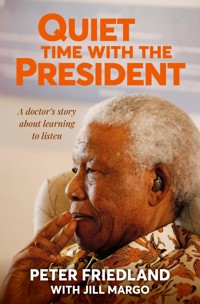
One Sunday in 2001 ear, nose and throat specialist Dr Peter Friedland received an unexpected call from Nelson Mandela's personal physician. The former president was struggling to hear. Could Peter visit him at home? Friedland discovered that Mandela was using antiquated hearing aids and was struggling to maintain them. Soon he became a regular visitor to Mandela's home in Houghton where he experienced the elderly statesman, in the frailty of old age, away from the crowds. He was full of stories and always bearing a lesson. But outside Mandela's quiet house, Friedland's life was ricocheting from treating one victim of violent crime to another. On many days he worked as a head and neck trauma surgeon and found himself drawn into the victims' families. When his own family and friends were exposed to violent crime, he was driven to make a life-changing decision. In Quiet Time with the President, Friedland also examines the powerful forces that push people away from South Africa and those that pull them back. Telling his famous patient that he was planning to leave the country was insurmountably difficult for Friedland, but Mandela surprised him. He'd accept his leaving, but on one condition . . .
Sie lesen das E-Book in den Legimi-Apps auf:
Seitenzahl: 284
Veröffentlichungsjahr: 2024
Das E-Book (TTS) können Sie hören im Abo „Legimi Premium” in Legimi-Apps auf:
Ähnliche




















Table of Contents
Title page
Dedication
Note to the reader
Chapter 1 The first phone call
Chapter 2 Behind the velvet curtain
Chapter 3 Where did the bitterness go?
Chapter 4 A dim awareness
Chapter 5 Intimidation
Chapter 6 Closer to the source
Chapter 7 See one, do one, teach one
Chapter 8 Bullets
Chapter 9 The pink shirt
Chapter 10 What the patient hears (and sees)
Chapter 11 The second phone call
Chapter 12 Where’s the evidence?
Chapter 13 Ear of the nation
Chapter 14 Straddling two worlds
Chapter 15 A common courtesy
Chapter 16 Hello, I’m Nelson
Chapter 17 Your enemy is not necessarily my enemy
Chapter 18 How much to disclose?
Chapter 19 For him they clapped, but for Zuma they ululated
Chapter 20 My brother, my leader
Chapter 21 Staring into the sun
Chapter 22 He listened but did not comment
Chapter 23 Setting an example
Chapter 24 Pilgrimage
Chapter 25 The third phone call
Chapter 26 A toenail in the door
Chapter 27 The silent promise
Chapter 28 The leaving
Chapter 29 Darwin and the Barnacle
Chapter 30 Humble pies
Chapter 31 Overdreaming
Chapter 32 Background noise
Acknowledgements
Sources
About the Book
Imprint page
Landmarks
Table of Contents
Jonathan Ball Publishers
JOHANNESBURG • CAPE TOWN
– For our parents, Selma and Bernie. –
Contents
Note to the reader
In these pages, I explain how I came to treat Nelson Mandela during the latter years of his life. As demands on him had lessened, he had more time on his hands, and after our medical consultations at his home we would sometimes keep chatting or he would offer me tea. Knowing he wasn’t interested in small talk or reminiscing about the past, I made sure I had read the morning newspapers. By the time I got there, he had read them too, so there was always a starting point for a discussion.
Just driving to his house lifted my spirits. I looked forward to seeing that welcoming face and feeling the grace of his presence. It always made me pause and never wore off. To me he was a paradox: a man of steel with a kind of metaphysical power that touched something deep in others, leaving them surprised at feeling so emotional in his presence.
Sometimes I’d be treated to a story or anecdote. He had a particular way of unrolling one and then quietly waiting for me to discern the lesson within it. These parables were often about different aspects of power, and I was hearing them from the master.
I witnessed only fragments of his life, never quite knowing the bigger picture, and never probing too deeply for fear of crossing a line. Just being privy to the thoughts of such an individual seemed gift enough and I didn’t want to endanger that honour. But whenever I asked a question, he took the query seriously, answered me thoughtfully and, I felt, with respect.
I’ve tried to relate these meetings without embellishment. Over the years, there were many stories and I retell some of them here, without the blessing of the authorities who today guard his heritage. I cannot vouch for the veracity of every detail, but I can say that this is what he told me.
As this book was being prepared for publication, so his legacy was being revised in South Africa. The dream he had envisaged when he became president three decades earlier had not been realised and, as the country struggled on, a sense of Mandela fatigue was growing. I believe this is a low point in the cycle of heroism and that in years to come – as the country gets back on its feet – the cycle will turn again. In the larger world, Mandela remains a heroic figure.
I was one of several doctors who treated him in his post-presidential years, and I didn’t earn that distinction because of my medical skill. Fate put me in the appropriate place at the right time. That twist of fortune turned out to be the highlight of my professional career and had a profound impact on my personal life.
My experience is framed by undeserved white privilege that delivered great benefits to me. When I started to think independently, it also delivered dilemmas and personal challenges. In this book, I try to explore the powerful forces that push people away from South Africa and then pull them back, until something snaps.
I snapped. I couldn’t cope with the violence. Giving my family no option, we held a fire sale and left for Australia on a six-month visa. Mandela had listened silently to my reasons for leaving. Then, after a long pause, he told me of a regrettable mistake he had made in Australia, and gave me a hint of a blessing to go, provided I didn’t make the same mistake.
While this text is a piece of ‘living history’, I have taken great care to maintain the confidentiality of our doctor-patient relationship and divulge nothing of his medical history that is not in the public domain. Volumes have been written about Mandela – by himself, by his family, by people who knew him and by those who didn’t. This is a small addition to that legacy.
Peter Friedland
CHAPTER 1
The first phone call
NOTHING MUCH HAPPENS in the South African Army after 3:30 on Friday afternoons. On one such afternoon in February 1991, I had just seen my last patient and was packing up when my desk phone rang. I’d been in the army for almost eight months as a medic and was running an ENT (ear, nose and throat) clinic for military personnel. I picked up. Offering no pleasantries, a male voice barked orders in Afrikaans: ‘Present yourself in officer’s uniform to the lieutenant colonel at the Witwatersrand High Command at the city barracks in Twist Street at 16:30.’
Before I could ask why or what I’d done wrong, the line was dead. I was a second lieutenant – the most junior rank of officer. That command centre was the largest in the army. To make things worse, my step-outs were at home and not in a presentable state. I looked at my watch. I had 45 minutes.
As I got to the car, I counted myself lucky not to have ducked out a few minutes earlier. Imagine missing such a call! I sped down the highway and, from my new brick of a mobile phone, called home. No answer – oh no. At our house I got dressed as best I could. Back on the highway I called again. My wife answered. ‘Linda, I don’t know what I’ve done, but something is terribly wrong and I think I’m going to be court-martialled. Don’t expect me for dinner. Tell the guests anything. I may be shot.’ She told me to stop babbling and said I was overreacting. But then she didn’t understand how the army functioned and what an out-of-the-ordinary command this was.
When I skidded through the gates of the barracks at 4:32 pm, I recognised the officer who was waiting for me. We’d been on a couple of training courses together, but he didn’t acknowledge me. He looked me up and down. ‘Lieutenant, you’re late,’ is all he said as he marched me down a corridor towards the large desk behind which the top brass sat. I saluted, stood to attention and braced to hear my fate.
Without looking up, the lieutenant colonel said, in Afrikaans, ‘I’ve received intelligence that tonight there may be an assassination attempt on Mandela.’
Without looking at me or pausing, he began a rapid briefing: ‘Mandela and President FW de Klerk will receive a joint media award at 19:00 hours at the Johannesburg Country Club. Each will receive the Johannesburg Press Club’s 1990 “Newsmaker of the Year” award; each will make a speech. You will set up medical facilities to manage the assassination attempt.’
The room felt airless. The briefing continued. Two military ambulances and two helicopters would be on site, and I was to set up two resuscitation stations and coordinate the whole operation. I would have all the staff necessary to get this done.
The plan was that Mandela would walk up first and speak from a lectern at the corner of the stage. A heavy velvet curtain would be drawn across the stage and I was to stand immediately behind the curtain, as close as I could get to him. The intelligence was that he would be shot at the lectern. If and when he returned to his seat, President De Klerk would then come up and I was to remain in position. I would be given a civilian suit to wear.
By now I was wiggling my toes – an old parade-ground trick to avoid passing out. When the briefing finished, I nervously raised an issue.
‘Colonel, if I stand behind Mr Mandela and he gets shot, I’ll likely take a bullet too and there won’t be anyone to—’
For the first time he glanced up, and, with a sneer, cut me off. ‘Orders are orders. Dismissed.’
From the army stores, where ‘one size fits no one’, I was handed a dark blue suit, a white shirt and a tie. I found a moment to call Linda to say I had to attend a function but couldn’t disclose the details. I definitely wouldn’t be home for the Sabbath meal. She asked why I had been chosen. I had no idea. Perhaps it was because my clinic at the JG Strijdom Hospital was two kilometres from the country club. But then this hospital, named after a former apartheid prime minister, was not yet admitting people of colour. But helicopters would be there to take the injured to 1 Mil in Pretoria, the biggest military hospital in Africa. Things were happening so fast I couldn’t think beyond the immediate logistics.
We got the equipment to the venue and were fully set up by 6:30 pm, leaving me time to scout the club complex that I’d heard so much about. The old hall could seat a few hundred and was already filling up. I recognised a couple of local white celebrities, captains of industry and some journalists. Someone said this was the first time Mandela and De Klerk would be appearing on a joint public platform, acknowledging each other’s work in the push to end apartheid.
At the time, these two men had different views about how the post-apartheid system might look and there was tension between them. They were working towards a new constitution for the country, and both had to contend with furious opposition within their own ranks. To appease his angry constituents, De Klerk, who had been president of South Africa since 1989, wanted whites to have some form of veto or other special rights in the new constitution. Mandela, who had been out of jail for just a year, rejected this outright. There would be no compromise on a one-person-one-vote system. There would be a majority government.
I was two years old when Mandela went to jail and grew up never hearing his voice or knowing what he looked like. It was the height of apartheid and the South African government had demonised him to such an extent that it was a crime to utter his name. On the rare occasion that I did hear it, it had a mythical ring. All I really knew was that he was a major figure in the fight against apartheid.
Later I learned that on 9 October 1963, the day I turned two, he was in the dock at the Palace of Justice in Pretoria, charged with sabotage, promotion of guerrilla warfare and planning an armed invasion. At the age of 45, he was about to put his stamp on one of the most consequential political trials of the century. He had come to believe that controlled violence was the only way to effect change in South Africa and was commander-in-chief of the African National Congress’s armed wing, Umkhonto we Sizwe (Spear of the Nation). As the oldest liberation movement in Africa, the ANC had spent 50 years peacefully propagating its cause, without significant success. In 1960 it was banned, and the following year it shifted from nonviolent to violent means of opposing apartheid.
The next three years were intense for Mandela. In 1961, together with many other defendants, he was finally acquitted following a treason trial that had dragged on for more than five years. Immediately, he went underground, and in 1962 travelled widely in Africa and visited London organising support for the ANC and undergoing military training. But, later that year, he was arrested and charged with incitement and leaving South Africa illegally. Before he could serve the five-year sentence for these two ‘crimes’ he was back in the dock, in October 1963.
Mandela did not bother disputing the new charges. A lawyer by training, he conducted his own defence and turned the trial on its head. In front of an international audience, he put the government on trial for the injustice of apartheid. He took full responsibility for his actions and, with no fear, said he was prepared to die for his ideals. His courage and dignity touched something universal and people couldn’t look away.
There was no question that the judge would find him guilty as charged. The only question was what his punishment would be. The state wanted the death penalty but bowed to international pressure and sentenced him to life in prison. But it also slapped on a banning order of biblical proportions, making it illegal for anyone to mention Mandela’s name, display his image, write about him, or use any words that had been spoken or written by him.
The intention was to blot him out until he faded from memory. But instead, by suppressing all information about him, the state created a vacuum in which the legend of Mandela grew. This invisible man became a mighty force-in-waiting, a force expected to liberate millions.
And there was more. He and his co-accused were incarcerated on Robben Island, and over the years, as younger black activists were sentenced and arrived on the island, so they were mentored by the older men, led by Mandela. While Robben Island may have been a desolate windswept prison just off Cape Town, it was also an incubator.
The most stunning contradiction is how confinement can set the mind free, and how Mandela possibly became the best modern example of this. After an intensely frenetic life, jail gave him long stretches of contemplative time alone in his tiny cell. All that energy that he once put out was turned inward. He used those long years to think beyond conventional boundaries and to make internal adjustments that would shape him into the statesman he became.
These adjustments would change his approach to politics, which in turn would enable a peaceful transition to majority rule. While this came at immeasurable personal cost to Mandela and his loved ones, it saved the country from a blood-soaked revolution.
In South Africa, a life sentence was usually 21 years, but for him it would be 27. During those years, more than a hundred awards and honours were bestowed upon him outside South Africa. Around the world, streets, squares and parks were named after him. So was a nuclear particle. There were prizes in his name, medals were struck and honorary academic positions conferred. There was no internet then, and as none of this could be reported by the traditional media inside the country, I knew nothing of it.
One of his biographers tells how once, after a medical check-up in Cape Town, Mandela’s jailers allowed him a brief walk on a public beach. As expected, he passed unnoticed. I first glimpsed a photograph of him at Baragwanath Hospital in Soweto in the 1980s, when a young black doctor momentarily opened his locker next to mine. The photo was taped to the inside of the door, and it dated from the time of his trial.
CHAPTER 2
Behind the velvet curtain
FROM NOWHERE, Mandela suddenly materialised in our lives. The negotiations behind the scenes had been kept from the poorly informed public, and he re-entered our lives through two distinct events, nine days apart, in February 1990.
Back then, I was a trainee in ear, nose and throat surgery at the once grand Johannesburg General Hospital (now the Charlotte Maxeke Johannesburg Academic Hospital). This sprawling Victorian estate, with large airy wards that would have pleased Florence Nightingale, had once been for the exclusive use of white people. When a modern, First-World hospital was opened on nearby Parktown Ridge, they moved there. As a student in the mid-1980s, I witnessed this old hospital briefly closing and, despite loud protests, much of its best equipment being relocated to Parktown Ridge. Then, without restocking, this old site was renamed Hillbrow Hospital and reopened for black people.
Although it had fallen into disrepair, the bones of the buildings were beautiful, with their arches, passageways and lightwells. Glass viewing platforms where students could watch operations were also still in place. I watched many, but more interesting to me was how this hospital reflected racial politics. It dated back a century and initially it had treated everyone, regardless of race. In 1924 this changed, and for the next sixty years or so it only served whites. Now, in a poorer condition, it only served blacks.
On Friday morning, 2 February, I was in one of its large wards performing a bedside surgical procedure on a patient who was lying very still. My headlight was on and I was concentrating intensely when a sudden commotion disturbed us both. Staff and patients who could walk were moving down the aisle to the far end of the ward, where a small television set was perched high on the wall. President FW de Klerk was addressing the nation.
At the time, South Africa was in a state of emergency. Large-scale rioting was a daily occurrence, there was blood on the streets and the country was braced for more violence. But rather than announcing a few mild, conciliatory reforms, as was expected, the president was departing from his party line. Patients in starched white gowns holding their drip stands, nurses, doctors, porters and cleaners all stood together, looking up, mouths open.
De Klerk was unbanning every single banned organisation in the country, from the ANC to the Communist Party. He was repealing apartheid laws and all the institutionalised racism they enforced, from forbidden marriages between races to restrictions on where people could live. We were stunned.
Then came the grenade. With immediate effect, he would release all political prisoners, including the biggest antihero of them all, Nelson Mandela. With this, the small crowd burst apart. There was dancing and ululating through the ward as patients clapped and cheered from their antique beds. Over the last years, the ruling party had slowly been loosening the scaffolding of apartheid, but this would be its demolition. For the people in the ward and for most of the nation, that day opened a future of hope and freedom.
For many white people, however, the heavens fell. They expected Mandela would be released the next day and, together with other newly freed political prisoners, would waste no time taking revenge for the brutality of apartheid. But Mandela didn’t want to leave the timing of his freedom in the hands of his oppressors. He wanted to make his own arrangements with his family and the ANC before he walked free.
In 1984, he had declined an offer for a conditional release that would see him confined to a remote ‘homeland’ in South Africa. Again, in 1985, he declined another offer conditional on the renunciation of violence. He would not accept freedom in a country that was not free. But this time, with De Klerk in charge, it would be different. Without the knowledge of the ANC, Mandela had acted alone and in 1989 had conducted secret discussions with De Klerk.
In his memoir, The Last Trek: A New Beginning, De Klerk describes how Mandela was smuggled into the Cape Town presidential office complex, Tuynhuys, via the basement garage. This was their first meeting and, for most of it, each ‘cautiously sized up the other’. To De Klerk, Mandela was dignified, courteous and confident, with an ability ‘to radiate unusual warmth and charm – when he so chose’. Despite this qualifier, Mandela’s standing was so high that De Klerk trusted him enough to put his own future at risk and negotiate with him.
De Klerk insisted that he alone would remain in control of the timing of Mandela’s release. The world would be watching, and while Mandela could not choose the date, he would be permitted to choose the place and time of day. Although he knew apartheid had to end, and end quickly, De Klerk had been profoundly courageous to close the book on apartheid so suddenly. There was no doubt that he would face rebellion from extreme elements in his own party. But world opinion and economic pressure had already forced some changes, and within the Afrikaner community, the quest to establish a religious basis for apartheid had been abandoned.
De Klerk’s speech set off seismic waves of both fear and elation across the country. Was it possible that a transition to majority rule could take place peacefully? No one knew. Over the next days, there were ominous reports of whites stockpiling food and buying guns.
Time magazine rushed to put Mandela on the cover of its 5 February 1990 edition. But, like the rest of the world, it didn’t have a contemporary photograph. In 1964, a reporter from The Daily Telegraph in London had taken some shots of Mandela as a prisoner on Robben Island. In 1977, there was an international press junket to Robben Island and a rather attractive photo of ‘a prisoner in the garden’, well dressed and wearing a hat and sunglasses, was handed out. One journalist looked at the face and realised it was Mandela. It was reported that the warder then scratched out the face. While all these photos were banned in South Africa, they were available to the rest of the world, and it is likely Time built its cover image from them. The result, unsurprisingly, bore no resemblance to the man who emerged from prison nine days after De Klerk’s announcement.
When De Klerk made that announcement, I never imagined I would meet Mandela. Why would I? I was an unknown junior doctor, barely out of medical school. He was one of the most famous incarcerated political leaders of modern times and was about to emerge onto the world stage. There seemed no way our paths would cross.
But exactly a year later, I would be standing centimetres behind him, entrusted with saving his life (and afraid of losing my own). I was only there because I had deferred my compulsory army service. At 17, when most of the boys in my class were conscripted following school, I was able to defer by studying veterinary science. After four years of that, I switched to medicine and was permitted to defer again.
When I finally graduated, no one came for me, and I hoped I had been forgotten. But in January 1990 the military police caught up with me. They knocked on my door with an ultimatum: complete compulsory service for 12 months or go to prison for two years as a conscientious objector.
With my son Gavriel just two years old and Linda pregnant with twins, I agreed to join up that July. I didn’t know that I would be part of the last mandatory conscription for national service. After Mandela was released, the conscription was abandoned. At least, after my basics and officer training, I was stationed at a hospital not too far from home.
Alone on the semi-darkened stage, I looked around, trying to imagine where an assassin might be hiding. There were plenty of places in the wings, but then I looked up. The lighting grids and footholds offered good vantage points too. There seemed to be no security police around, although they might have been out of sight and in plain clothes. It occurred to me that this exclusive country club, which had upheld solid colonial views for almost a century, didn’t admit black, Asian, Indian or Jewish people. Now it was hosting a revered black freedom fighter and a junior Jewish doctor.
It had been a year since Mandela’s release and the country was still deeply unsettled, with open talk of civil war. After more than three centuries of white domination, the extremist right was not going to relinquish its entitlements without a fight. It was smarting from the whiplash of the change and the swift unlocking of a prison gate so Nelson Mandela could walk free on a summer afternoon.
With nothing more to do except wait for gunfire, I started to replay the afternoon of his release in my mind. The world had been waiting for this historic event, and Linda and I had planned to watch it at home, undisturbed. But I was doing an after-hours ‘on call locum’ at the nearby nursing home where my late father had been a patient. Half an hour before the big moment, I was called out. A patient needed my help. I resigned myself to watching a replay on the news that night and drove to the nursing home.
When the consultation was over, both the patient and I were thrilled to hear that Mandela’s release had been delayed. So I pushed his wheelchair to the lounge where other residents were gathered around a television. As I couldn’t risk trying to get home, I settled in with the residents. Anticipation was high. Mandela hadn’t been sighted since 1964 and, given that he had spent much of his sentence on Robben Island, no one knew what to expect.
Eventually a tall, greying man walked slowly into view. Holding his wife’s hand, he looked a little tentative and gave a half-wave. Then, gaining confidence, he raised both arms in a salute, smiled warmly and moved through the enthusiastic crowd that had broken through the police cordon. People wanted to touch him.
The residents in the lounge were surprised. He looked nothing like the devil incarnate who, for their safety, had been forcibly silenced. His face was open and appealing. He greeted people and shook their hands. He wasn’t an evil force, and he wasn’t a broken man. Rather, he cut an elegant, dignified figure, fully in command of himself.
This monumental event unfolded on a country road on an otherwise ordinary Sunday afternoon. Despite its international importance, it appeared totally unchoreographed. Mandela wasn’t walking down a flag-lined boulevard, there was no balcony and there were no fanfare trumpets. Years later, it would be revealed that while he chose the location, the authorities deliberately designed the process to be as undramatic as possible. They said it was for security reasons. Who knows?
Along the way, people kept surrounding his car as it slowly moved towards the heart of Cape Town, where more than a quarter of a million people had been waiting in the sun for hours. I saw an opportunity and dashed home, to continue watching with Linda. Actually, I needn’t have rushed. Mandela’s trip took far longer than expected and by the time he arrived at the City Hall, there was mayhem. Rioting had broken out on the periphery of the crowd before his arrival and the police had opened fire.
Despite this, Mandela insisted on attending the gathering. This time there was a balcony, and from it he spoke to the waiting nation. The crowd hushed, hanging on to every word. He promised there would be freedom and rights for all, a place for everybody and no revenge.
At that moment, I realised the little I’d heard about him from official sources had been distorted. There seemed to be no rage or rancour in him, and I was riveted. Later I would learn that, quite naturally, he had feelings of bitterness and anger but that his greatness lay in his ability to control them. Externally at least, Mandela appeared calm.
But now, behind the curtain, waiting for Mandela to fall backwards into my arms, I could not calm myself. With 20 minutes to kill, I decided to go outside for some air and to check on my medical teams. Everyone else seemed agitated too. There was a big army presence behind the building and these uniformed men were restless. What was going on? I hung around and as I listened to their conversation in Afrikaans, I realised they were furious at De Klerk for throwing away their heritage.
These were right-wing Permanent Force (the term used for South Africa’s standing army at that time) Afrikaners who had defended South Africa against communism and hostile border incursions, and who for decades had fought the ‘Swart Gevaar’, the ‘Black Danger’. Now, they were being asked to protect the man who was putting them in danger. The numbers were against them, and they feared a potential bloodbath, with 30 million blacks putting the country’s 5 million whites to death.
These career soldiers had been brought up, taught in the schoolroom and long encouraged from the pulpit to believe their mission was to bring enlightenment to the indigenous population. Their church held that whites were the fruits of Christian civilisation and gave them the right to rule and to limit the human rights of the colonised population. Now, look what was happening. As I listened, it occurred to me for the first time that perhaps I might also have to resuscitate De Klerk. That would explain the duplication of resuscitation facilities.
My thoughts were interrupted by the arrival of Mandela’s motorcade. As it rolled in, the soldiers were even more put out. He was in a classic, new red Mercedes-Benz 500 SE. This car symbolised so much. Hundreds of workers in the Mercedes factory in East London had banded together to build it for him. A day after his release from prison, they persuaded the factory’s management to supply the components and then they systematically assembled the vehicle in their own time, free of charge.
It was a project of pure passion. As Phillip Groom, who was instrumental in the project, told CarMag, ‘From the moment the car was merely a skeleton, and every time it was passed onto the next station, the workers would gather around the car, like in a ceremony, dancing as it passed them.’ In those days there was a long waiting list for expensive German cars and the standard joke was that Mandela had been on the waiting list for 27 years.
The soldiers, of course, didn’t approve of the car and were further affronted that he had arrived with his own security detail. These black men were armed with guns and semi-automatic rifles. The cheek of it!
Minutes later, De Klerk arrived with his well-armed white security detail, which the soldiers felt was appropriate and which they begrudgingly respected. At that point I returned to my post.
CHAPTER 3
Where did the bitterness go?
I WAS IN TIME to see the two men walk into the hall together, to a standing ovation. Peeping through the curtain, I could feel shivers down my spine. The power of two old adversaries coming down the aisle, side by side, was something to behold. I’d seen De Klerk live before, but this was my first glimpse of Mandela in the flesh. He was almost majestic. De Klerk was a big man, but Mandela towered over him. The symbolism was clear, and when they sat in the front row, the house sat too.
Mandela had the bearing of a member of the royal family of the isiXhosa-speaking Thembu tribe. He was a young boy when his father, a principal counsellor to the acting king of the Thembu people, died. The regent stepped in and took care of the boy. I’d read something of his ancestry and, out of respect, when others addressed Mandela by his clan name of Madiba, I decided I would do the same if ever I got the opportunity to speak to him.




