


13,99 €
Mehr erfahren.
- Herausgeber: The Crowood Press
- Kategorie: Lebensstil
- Sprache: Englisch
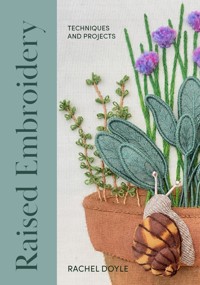
Raised Embroidery is an exciting and practical book packed full of techniques and ideas that explain how to give depth and texture to your embroidery. It carefully explains each stitch, discusses padding options and then shows how to transform a flat design into a three-dimensional artwork. Whatever your level of experience, this book will inspire you to learn traditional skills to try in new designs and to make fabulous raised pieces.
Das E-Book können Sie in Legimi-Apps oder einer beliebigen App lesen, die das folgende Format unterstützen:
Seitenzahl: 122
Veröffentlichungsjahr: 2023
Ähnliche



















CONTENTS
Introduction
1 Designing a Raised Embroidery
2 Materials and Equipment
3 First Steps
4 Padding
5 Applying Fabric
6 Surface Stitches
7 Raised Embroidery Stitches and Wired Elements
8 Project: Ice Cream Brooch
9 Project: Stationery
10 Project: Herb Pot
Templates
Suppliers
Index
INTRODUCTION
As a traditional hand embroiderer, I have always been drawn to raised embroidery. There is something very satisfying about creating depth and texture in an embroidery that cannot be produced by a purely flat surface. Most embroidery has some level of relief to it, created by the nature of stitching a surface and embellishing it, even if it is just with thread.
Detail of a raised embroidery piece worked by the author. The complete design reproduces a pinboard of photos and mementos in raised embroidery. The figure is a modern imagining of a traditional stumpwork figure with needlelace details and an embroidered skirt.
Raised work is a means of creating an embroidery in relief, lifting it from a flat background of fabric or stitches. It has been used in combination with embroidery for almost as long as embroidery has been around. A support or foundation was used under very early metal thread embroideries to give them a three-dimensional quality, and padding is essential to many metal thread techniques still used today.
The most recognisable and prolific era of domestic raised work embroidery in Britain was produced in the seventeenth century. Raised embroidery from this period was called stumpwork, which referred to the padding or ‘stump’ beneath the embroidery itself. Stumpwork was one of the earliest forms of embroidery kit. The designs were from pattern books and the same motifs are often seen repeated on different pieces. They were usually worked on a cream satin background and showed figures, animals and entire scenes, both biblical and mythological. Many of these designs exist as flat silk work, but at some point there was a development that led to these becoming three-dimensional. The padding was often covered with lace-like panels made from buttonhole and lace stitches. Other dimensional elements were applied, such as pearls, mica and cord. These dimensional embroideries were then professionally made up into usable objects such as mirror frames and caskets.
Detail of a raised embroidery piece worked by the author – a pin brooch of Matryoshka dolls made of stuffed fabric with wrapped wire for the pin. The photos are printed onto fabric and the postcard has embroidered lettering.
A collection of raised work bee brooches by the author. The body of each bee is made from raised woolwork and the wings are wired fabric.
Silk ribbons are a beautiful material to work with, creating texture and colour.
After this fashion had ended, there was a later trend for raised woolwork in the nineteenth century. During this period, counted canvas work became a popular technique for domestic embroidery and again these designs were commercially produced and sold. Berlin woolwork, as it was known, was charted and pictorial or patterned in nature, usually with realistic shading. Raised woolwork consists of loops of thread, cut to produce a raised pile, similar to a rug, which would be used to give relief to parts of the design. Again, this is a flat style of embroidery that has changed to incorporate raised elements.
I believe that adding raised elements into an embroidery can complement other flatter techniques, creating more interest and complexity. Even just a small area of padded satin stitch or a wired shape can elevate a good embroidery to a great embroidery.
My hope for this book is that it will inspire you to try out some raised embroidery techniques and begin to include them in your own work. Start by sampling the techniques shown to gain knowledge of what can be achieved and applied to your own projects. By working the projects at the back of the book, you can put this sampling into action and see how different techniques work together. I hope this will give you the confidence to design and embroider your own works of art.
A selection of sewing threads.
CHAPTER 1
DESIGNING A RAISED EMBROIDERY
There is no limit to the subjects you can interpret into this technique, which can make narrowing your design down to one idea very difficult. Inspiration can come from anywhere and at any time. I find ideas either come to me quickly as a fully formed design, or can take a lot of thinking, planning and adjusting. A design can start as one thing and evolve into something else. It can be inspired by a technique, colour, particular thread or fabric, or by another artist’s style or a historical period.
These scrapbook pages show how similar design ideas have been grouped together for inspiration.
INSPIRATION
If I am designing an embroidery for a particular person or as a memento of an event or experience this will provide the starting point which I will then develop into a design. But when you just have a blank piece of paper in front of you, designing your own embroidery can seem like a scary task. If you have an interest in embroidery, this usually goes hand in hand with an interest in design – but perhaps you don’t realise it.
We are constantly surrounded by design, whether it is manmade or natural. When I see something that takes my fancy I take a photo or add it to a Pinterest board, but I also like to have a physical scrapbook of ideas I can flick through. I have always kept a scrapbook and these now run into several volumes. I rip images out of magazines, pick up leaflets and cut up interesting packaging, adding them all to my books. I try to group similar ideas together as I am often drawn to the same themes. When I am stuck for ideas, I will flick through the pages and hope that something catches my eye or sparks another avenue to explore.
A selection of scrapbooks I have kept over the years. My more recent books tend to be A3 in size so that each page can hold several images.
An Embroidery Technique as Inspiration
The three projects in this book all developed in slightly different ways from inspiration I had in front of me. The Ice Cream Brooch started from a technique; I wanted to include a project that used turkey rug stitch, so I looked through my sketchbooks for a starting point. An image of an ice cream cone in one of my sketchbooks looked perfect for the stitch and reminded me of a photo I took on holiday over fifteen years ago. It was a poster of an ice cream with many different colours, advertising an ice cream shop we visited many times on that holiday. I took the snap at the time thinking that it could inspire something one day. I found the photo in my photo album and the idea developed from there. The complete ice cream would have been amazing, but I wanted this design to be a brooch, so the original image was reduced in size but still captured the essence of the original.
Developing a Design from a Theme
The Herb Pot design was a slower-burn idea. I am always taking pictures of leaves and flowers and planning to turn them into embroideries, so some of the thinking had already been done for this piece. I first had the idea to stitch a plant in a pot with three-dimensional leaves – I was thinking of more of a houseplant at the time. Sitting one sunny day in my garden looking at my different pots of herbs, I had the idea to render several herbs into embroidery so that various textures and techniques could be tried, rather than just one repeat leaf. I took pictures of the elements I wanted to include and began to build up a design. All of the shapes and forms are taken directly from photographs I took.
The original ice cream image that inspired the brooch, along with the holiday photo of the ice cream cone poster and the finished brooch.
GET SOMETHING ON PAPER
Once you have your idea, the next step is to start sketching. I always make a few rough sketches first to think about composition – these don’t need to be amazing works of art, they are just a way to get the idea from your head onto a piece of paper. Usually, I start small and only think about the finished size when I have a clearer design drawing. With an idea of where you are heading and what elements you intend to include, it is time to start getting more detailed. I like to gather all of my images and then start tracing or sketching from them to draw together the design. Many of these sketches will be rejected, but it is good to have a selection to pick from rather than sticking to the initial drawing.
I use my printer and scanner a lot at this stage. I can copy images and reduce or enlarge them as you would with a photocopier, then I can cut these up and start to arrange them into my design. When I am happy with what I have, I will then make a single tracing of the entire design. I usually use a fineliner pen for this as it produces a crisp line. The finished tracing can now be enlarged or reduced to the size of the finished embroidery. I usually print out a few options and take a look at them side by side to decide what to use.
A few of the photos taken of herbs and the sketches of them that were combined to make the finished embroidery design.
PLANNING THE EMBROIDERY
Planning is very important for a raised design as there will be many techniques used that need to work together as a complete design. Consider how much of the design will be raised and how much will be flat. What will the finished embroidery be, for example a framed work of art or a practical item such as a brooch? Your embroidery may have minimal raised elements or could be entirely three-dimensional. Break the design down into sections and then decide the height of each of these. Don’t worry too much about techniques initially, but if you have ideas as you are planning, jot them down to consider later.
Think about an order of work. Usually, the background fabrics will be applied first, then anything on top of the background, followed by the foreground and finally any completely separate three-dimensional elements.
When all of your planning on paper is complete, you can start to select fabrics, threads and techniques. When I design, I often simultaneously think about the fabrics I will use and start pulling anything I have that might work from my stash. Each project I work on will have a shoebox or tin into which I start to gather materials.
THE IMPORTANCE OF SAMPLING
Now you can begin to experiment and sample areas of your design. Don’t worry about having the correct colours or exact fabrics at this stage, just have fun and don’t be afraid to fail. The point of sampling is to find out what will work and what won’t, and sometimes the failure of one idea will lead to the success of another. An embroiderer is often planning the next project while they are halfway through the previous one, as one idea can spark the idea for the next.
The samples for the Stationery project, worked at actual size with the fabrics that I used in the final piece.
The Stationery project design came to me when I was sitting down with a pencil and paper, trying to think of an idea. With my drawing materials laid out in front of me it suddenly struck me that a still life would be a great subject. The yellow pencil and green pencil sharpener were the catalyst, then I added further elements to the design.
For this design, the techniques came later – once I had them on paper, the pencil was shouting tapered string padding. I sampled each of the elements for the stationery design and, while the pencil and pencil shavings worked well at this stage, the final sharpener included much more padding in the finished design.
When you are happy with your sampling and where the design is heading, make a start. Use your order of work here to see where to begin and what to apply first. Be flexible with your design too. What is on the paper is not set in stone and may need adjusting to work as an embroidery or you might just change your mind as you begin stitching. The most important part is to enjoy what you are creating.
CHAPTER 2
MATERIALS AND EQUIPMENT
A good pair of scissors and some needles are all you need to begin, but the following equipment is a good starting point for more involved projects. Fabric and threads do not need to be expensive or purchased in great quantity for raised embroidery. A few scraps go a long way.
A selection of embroidery tools including embroidery hoops, roller and slate frames, scissors (fabric, paper and embroidery) and smaller tools such as tweezers, mellor, tape measure and thimbles.
FABRIC AND THREADS
Raised embroidery gives you the opportunity to explore a wide variety of fabric and threads. You can try sheer fabrics, patterned fabrics, metallics, cottons, silks or leather. For thread choice, stranded cotton is widely available and has a huge colour range. But many other threads are available, such as Perle, Coton a Broder, metal threads, silks, rayon and crewel wool. You can also use up all those little scraps of fabric and single skeins of beautiful threads that have been waiting for the right project. There are no rules as to what can or can’t be used. If it has the right texture and colour and you can get a needle in it, or thread a needle with it, then use it.
A selection of fabrics and threads.
Making Your Own Fabrics
With so many different fabrics available it is extraordinary that sometimes you just can’t find quite the right fabric for a project. In this instance, it is a great opportunity to be even more creative and make your own. This can be done in several ways.
Left to right: a printed cotton fabric with a photo of Moroccan tiles, cotton fabric on a paper backing, iron-on transfer paper, freezer paper.




