


6,99 €
Mehr erfahren.
- Herausgeber: Editorial Autores de Argentina
- Kategorie: Ratgeber
- Sprache: Englisch
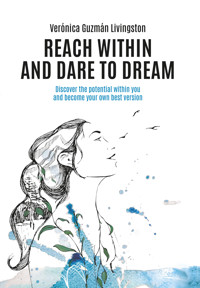
"Reach within and dare to dream" challenges us to get out of our comfort zone, test and improve ourselves. The author shares her extraordinary story that starts in the Patagonian Andes, passes east through ancient Europe, then onto India and Australia before returning west through north America to California. She tells us about her own experiences, the successes and failures, how these experiences, good or bad, can be used to take courage and carry out our dreams. She reflects, shares information from specialists and ideas from other authors. This invites us to enquire about ourselves on topics such as self-awareness, self-esteem, emotional management, and empowerment. Through exercises, she motivates us to venture into a process of introspection to overcome our fears or obstacles, learn from our mistakes, and discover our potential.
Das E-Book können Sie in Legimi-Apps oder einer beliebigen App lesen, die das folgende Format unterstützen:
Seitenzahl: 198
Veröffentlichungsjahr: 2023
Ähnliche

















VERÓNICA GUZMÁN LIVINGSTON
REACH WITHIN AND DARE TO DREAM
Discover the potential within you and become your own best version
Guzmán Livingston, Verónica Reach Within and Dare to Dream / Verónica Guzmán Livingston. - 1a ed. - Ciudad Autónoma de Buenos Aires : Autores de Argentina, 2023.
Libro digital, EPUB
Archivo Digital: descarga y online
ISBN 978-987-87-4111-6
1. Autoayuda. I. Título CDD 158.1
EDITORIAL AUTORES DE [email protected]
Cover art by Julia Vallespín Translation by Catalina Connon The names of the people in the accounts have been changed to protect their identity.
Dedicated to my parents, who gave me freedom and confidence to search for happiness; to my greatest teachers: the people I have loved, who will forever be in my heart.
Tabla de contenido
CHAPTER 1
OUR INNER CHILD WOUND
The importance of knowing our inner child wounds
How our inner child wound affects us
How my inner child wounds conditioned my life
Something to think about
My learning process
Our main obstacle
Enriching belief
Conclusion
EXERCISES to find out whether you have an inner child wound
CHAPTER 2
BELIEF SYSTEM
The importance of knowing our belief system
How our belief system affects us
How my beliefs conditioned my life
Something to think about
My learning process
Our main obstacle
Enriching belief
Conclusion
EXERCISES to find out whether you have an unbalanced belief system
CHAPTER 3
FEAR OF CHANGE
The importance of fear of change
How fear affects us
How the changes in my life conditioned me
Something to think about
My learning process
Our main obstacle
Something else to think about
Enriching belief
Conclusion
EXERCISES to find out whether you’re trapped in your comfort zone
CHAPTER 4
SENSITIVITY AND EMOTIONAL MANAGEMENT
The importance of sensitivity and emotional management
How lack of sensitivity affects us
How lack of sensitivity conditioned my life
Something to think about
My learning process
Our main obstacle
Something else to think about
Enriching belief
Conclusion
EXERCISES to find out whether you’re repressing negative feelings
CHAPTER 5
THE BALANCE OF HEALTHY SELF-ESTEEM
The importance of self-esteem
How imbalance in our self-esteem affects us
How low self-esteem conditioned my life
Something to think about
My learning process
Our main obstacle
Something else to think about
Enriching belief
Conclusion
EXERCISES to find out whether your self-esteem is low
CHAPTER 6
THE DUALITY OF SCARCITY AND ABUNDANCE
The importance of the scarcity or abundance duality
How scarcity and abundance affect us
How scarcity conditioned my life
Something to think about
My learning process
Our main obstacle
Enriching belief
Conclusion
EXERCISES to find out whether you're in a state of scarcity
CHAPTER 7
ENRICHING RELATIONSHIPS
The importance of establishing enriching relationships
How social relationships affect us
How the relationships in my life conditioned me
Something to think about
My learning process
Our main obstacle
Enriching belief
Conclusion
EXERCISES to find out whether you’re in an unhealthy relationship
CHAPTER 8
BEING IN TOUCH WITH YOURSELF
The importance of being in touch with yourself
How not being in touch with ourselves affects us
How not being in touch with myself conditioned my life
Something to think about
My learning process
Our main obstacle
Enriching belief
Conclusion
EXERCISES to find out whether you’re in touch with yourself
CHAPTER 9
LIVING WITH PASSION
The importance of living with passion
How not living with passion affects us
How living with passion conditioned me
Something to think about
My learning process
Our main obstacle
Enriching belief
Conclusion
EXERCISES to find out whether you're living the life of your dreams
CHAPTER 10
BECOMING YOUR OWN BEST VERSION
The importance of becoming your own best version
The effects of not being the person you could be
How not changing my nature conditioned my life
Something to think about
My learning process
Our main obstacle
Enriching belief
Conclusion
EXERCISES to find out whether you need to become your own best version
PHOTOGRAPHS
CONCLUSION
My intention
NOTES
ABOUT THE AUTHOR
SYNOPSIS
Introduction
Thick sea fog obliterated the view that morning as I sat at the foot of the bedroom window, gazing out. Gradually, the gusting wind cleared the air, and the landscape emerged. I glimpsed a family of deer just a few metres from the house before they vanished again through the tall grass. Farther away lay the sea, the village of Mill Valley and Mount Tamalpais in California, USA.
It was then that my brain switched back from autopilot. My senses awoke, and in amazement, I observed my surroundings in detail. I could still hardly believe my situation – everything felt unreal, dreamlike.
The whistling wind brought me back to reality. It was time to clean the house and prepare a meal before my boyfriend came home from work. I set about making the bed, cleaning the three bathrooms, starting a load of laundry and vacuuming the two-story house. The freshly painted white walls intensified my perception of space and neatness.
I cooked some vegetables, set the table, watered the plants, and sat down to wait. The carpet was soft against my feet, while my hands were restless, searching for something to do. My mind again led me to reflect upon the present. There I was, sitting on a modern, six-seater sofa, facing a cherrywood table, a fireplace and a piano.
Niko and I had been together for more than a year, though with many ups and downs. I had come for the second time to Sausalito, determined to do all I could to save our relationship. I’d given up my job as a beach lifeguard in Barcelona, a position I’d held for 10 years, to take a chance – based on his promises – on a supposed better life in California.
Living in the USA had never been in my plans. Niko was the only reason for me to move there. I had tried to be flexible and understanding, adapting as well as possible to his ways so that he would accept me and we could reach a middle ground where our relationship would be sustainable. My life had become so different from what I was used to that I hardly recognised myself.
I couldn’t support myself financially in that country and social class. So I depended entirely on Niko, which made me insecure, a feeling I tried to manage by taking long walks and doing exercise, yoga and reiki.
Suddenly, the door opened, and there he was. I sprang up to hug him, but immediately perceived something was wrong. He seemed tired and somewhat dispirited. He hung his jacket in the closet, washed his hands and sat down at the table. I served the meal, and we began to eat.
I can't recall exactly how the conversation began, but I froze when I heard his words. In a very calm, direct manner, he stated that he was better than I was. Yes: better than me. He said that few people had attained the level of economic freedom that he enjoyed, which placed him in a higher position than me.
My throat closed, my chest tightened, and I no longer felt like eating. I repeated his words in English to make sure I’d understood correctly. And he nodded. He sincerely believed that he was better than me.
Clearly, I hadn’t made any great economic progress. I was 34 years old, but didn’t own a house or a car. My only material belongings were items of sports equipment. I hadn’t earned a university degree or reached a high-powered position at work. My passions were traveling, exploring and discovering the wonders of the world, and that was what I had accumulated. My wealth consisted of the stories of my experiences and adventures. But did that make him better than me?
To hide my distress, I continued to eat. I took deep breaths in an effort to calm down, until a different perspective occurred to me. As a child, I’d always believed that nothing happens by chance, that there’s a reason for everything, and that each person who came into my life had a message for me – a lesson to learn that needed to be decoded. Life was a magical mysterious adventure with a clear mission: to discover my purpose. “What’s the real message in this situation?” I wondered.
Aloud, I simply said, “I don't agree,” without further explanation. Niko tried to argue his point, but I didn’t continue with the conversation. I cleared the table, then went to the living room to draw. As if my back had been whipped, a feeling of weakness washed over me. It wasn’t the first time I’d been discriminated against – but now the discriminator was someone I loved, and this time it was much more painful.
A few hours later, Niko hugged me and apologised. He admitted that what he’d said had been wrong, and I said I forgave him. But would that change what he thought? How had I got myself into a situation where my partner considered me inferior? Why had I become so alienated from myself? How could I accept the lack of esteem and respect?
The situation was painful, yet at the same time it was the experience I needed to realise how little I valued myself. It was a clear message that something within me wasn’t right and needed to change. It was essential that I should take responsibility for my situation, find my equilibrium, and begin to choose what was best for my mental and emotional health.
***
Today, I have a beautiful memory of a relationship that helped me grow. I believe that Niko loved me, and didn’t intend to make me feel miserable. I think that the real reason for what he said, reflecting his own voids, was somehow to motivate me to draw out from myself the potential lying dormant within.
Thanks to Niko’s message, today I’m a more efficient, positive, generous person. He taught me to overcome my limitations regarding possibilities, to see abundance and to increase my self-esteem. But how did I do it?
One deep desire spurred me to make changes in my life, and I accepted to embark upon a journey of learning and evolution. The situation showed me that I wasn’t at the point where I wanted to be, and that I needed to continue working on myself.
Based on experience, I’ve realised how certain beliefs and attitudes limit our potential to love, and I’ve learned how to modify them so they flow freely and enable me to live out my dreams.
The more I dive down within myself, the more I understand the importance of our connection to nature and all living things. The imbalance of one affects all. I hope to help the reader to learn to reduce anxiety, look back at the past without regrets, visualise the future without fear, and live the present in peace and joy, thereby promoting a state of holistic awareness and common wellbeing.
In this book, I share the ten most relevant lessons learned in my life, which I consider to be phases in the transformation process we must undergo towards our authentic identity – our own best version. The book is intended for people who want to make a change in their lives, live out their dreams, confront their fears, and attain the physical, mental, emotional and spiritual balance they seek.
By recounting some of my experiences, I explain my successes, failures and learning processes. There are references to relevant information published by other authors and specialists to help you understand the subject even better. I also suggest exercises to help you become aware of your situation and take action today.
You’ll see that it’s possible to live out your dreams: it depends only on your willpower and determination. There’s a transition path along which we can heal our sorrows and attain the feeling of abundance, balance and love that we all deserve. Don’t give up the search!
Let’s explore this path together and discover all the potential within you!
CHAPTER 1
Our inner child wound
When I picture myself as a child, I see myself with my three sisters way up in the branches of a tree growing in my parents’ back garden in Bariloche, Argentina, pretending to sail across the ocean in a big ship. One sister, perched at the top of the tree, would be on the lookout for pirates. Another would be in charge of hoisting the sails, while I prepared a banquet for the crew. The captain, my eldest sister, would issue orders, calling out “Anyone who fails to obey will be thrown to the sharks!” Below circled the fearsome white shark – Tina, our dog. At the sound of my mother’s loud call, “Children! Lunchtime!” we’d jump down from the tree and run to the kitchen. Time to eat.
My parents worked hard to support us, but mealtimes and Sundays were family time. The kitchen table was always chaotic. My mother, in a rush, would drop food into my sister’s glass; my father would toss wine corks at our heads to get us to pass the salt, and everyone talked at once. All in all, I don’t think communication was our strong point, but there was always laughter.
I was a somewhat untidy child, “plain”, shall we say. I wore comfortable baggy clothes – tracksuits with patched knees and frayed trainers, hair tied up in a ponytail so as not to attract our friends the lice, fingernails black from playing in the dirt, and a grin from ear to ear.
I was never much drawn to Barbie or baby dolls, preferring to play with electric toy cars, cycle around the neighbourhood, or dance. Yes, you heard that, right? I liked classical dancing! Only then would I wash my face, my mother would style my hair into a topknot with hairnet and clips, and I would don cream-coloured tights, a pink leotard, a tutu and ballet slippers, to glide about like a butterfly.
The rest of the time, I loved climbing trees or exploring woods, vacant lots and abandoned houses. I’d spend hours alone, creating my own pastimes. I’d draw, paint, and collect flowers, seeds and leaves to press in a heavy science volume from the bookcase in our bedroom. I also enjoyed recycling containers into creative gifts with papier-mâché made of flour paste and newspaper, decorated with poster paints.
Our house had only two bedrooms: one for my parents and another for their four daughters. In the children’s bedroom were two sets of bunkbeds, which we’d move around according to the day’s activities. One of my favourite games was building a bridge by hanging blankets between the tops of the bunkbeds placed a metre and a half away from each other. All my sisters would hold the blankets tightly while one of us crawled to the middle. Then, we’d all release the blankets at the same time, and whoever was on the “bridge” would fall onto a couple of mattresses and pillows on the ground. If we were lucky, we’d emerge unscathed, having overcome the challenge to our fearlessness.
In winter, we played in the street with a sled and our dog, or built ski runs in the garden. In summer, we travelled to Miramar, a seaside resort on the Atlantic where my grandparents owned an apartment. My parents would pile the children into the car at 3:00 a.m., and the journey would begin. We had to drive 1600 kilometres at 90 km/h. One sister would sleep on the car floor, two on the seats, and I on the rear deck by the back window (behind the headrests). Regulations were laxer in those days! It was a long journey, but we kept ourselves entertained by singing, playing and asking, “Dad! Are we nearly there yet?”
At school, I was never chosen to be flagbearer (good students were given the honour of carrying the flag during assemblies). Perhaps it was due to my grubby school pinafore, always missing a couple of buttons, because in fact I was quite a good student. However, I did have slight dyslexia, so I found reading and writing difficult, and up to the fourth grade, my report card consisted mainly of “SA”s (satisfactory) and “NI”s (needs improvement). But when I was 10, I found a way to get my brain to form synapses. All on my own, I realised that if I wanted to learn, my only choice was to get down to studying, so I simply sat down and did it. Very soon, “O”s (outstanding) began to shine out in my report card.
My parents believed it was important that we should learn to take care of ourselves. They gave us confidence and freedom in our actions, encouraging us to be active and unafraid of the unknown. They didn’t place limits on our dreams, and didn’t impose religion, gender, or life stereotypes on us. They gave us space, time and support to help us find what made us happy without defining a certain path to be followed.
During my childhood, I had the chance to do all sorts of sports, as well as artistic and intellectual activities, in search of my talents. My family always remained united in a relatively healthy setting, with no major issues.
But can someone with a happy childhood have a wound?
“Suffering is a matter of degree to each of us, and most of us do not know where the suffering comes from or what to do to stop it. All we know is that many persons and situations cause us to react and therefore suffer. That is why it is so interesting to discover the source of our suffering.”
LISE BOURBEAU
The importance of knowing our inner child wounds
It’s said that children are highly vulnerable and unprotected in any situation. I'm sure you’ve heard about this before, but do we really know why it is?
From the age of 3 years (or even earlier) to the age of about 7 is the time when our emotional wounds become most strongly established. It’s a vitally important phase because during that time, we don’t have enough tools to understand a situation fully and protect our feelings.
Emotional wounds arise as a result of uncomfortable or unpleasant situations. If we’re unable to process events to prevent them from hurting us, the tension remains stored in the subconscious.
During childhood, emotions are like a roller coaster ride. We may be jumping for joy at one moment, and crying our eyes out seconds later. Children don't know how to manage feelings. Any small incident may represent a catastrophe, and parents’ patience plays a part.
Sometimes – whether or not intentionally – we overstep the limits set by the people in charge of us, and consequently receive – at the very least – a disapproving or scornful remark. “Don't be silly!” or “Making trouble again!” We become more of a nuisance than a loved one, and end up accepting that we’re not good enough or valuable enough, copying behaviour patterns and assimilating any scornful phrase as if it were the absolute truth.
Supposedly, by the time we reach maturity, our life experiences should have enabled us to adopt strategies to control our emotions. It would be interesting to know how many of us have been lucky enough to have had someone teach us anything about managing thoughts and emotions. Well, I wasn’t one of the fortunate few, and came up against a brick wall hundreds of times until I managed to understand human behaviour. Because I suffered so many letdowns, I sought help and information to gain insight into the workings of our brain, emotions and reactions.
I’d like to stress that many of our problems in adult life originate in childhood. No matter how idyllic our memories may be, we store psychological traumas that can ruin a job opportunity, a relationship, or even, in extreme situations, our life.
I could have avoided so many problems if I’d been taught as a child to manage my emotions, have balanced self-esteem, know how to value myself, respect myself and communicate assertively (without belittlement, reproach or confrontation, using respectful, harmonious, productive, efficient dialogue with others), and be empathetic.
To ensure that children develop healthily, it’s key to provide the right amount of attention, plus dedication and ability to guide them regarding how to best manage their feelings.
How our inner child wound affects us
Our inner child wound alters our self-esteem and ability to relate to others. It is reflected in insecurity, being controlling, vulnerability to emotional dependency in relationships, or constant dissatisfaction. In the worst cases, it may manifest as an aggressive or abusive character.
In her book “Heal your Wounds and Find your True Self”, Canadian author Lise Bourbeau says that all of us experience at least four of the five most relevant wounds, which are the following:
An abandonment wound due to lack of affection can cause fear of loneliness, or on the contrary, may sabotage relationships by causing people to abandon others in order to protect themselves, for fear of reliving the pain. People with abandonment wounds are usually dependent, tend to play the part of “victim”, and suffer from intense anguish for no apparent reason. Unconsciously, to attract attention, they are often ill.
A rejection wound due to lack of parental attention may cause a feeling of self-contempt in the inner child, who may feel unworthy of loving or being loved, resulting in low self-esteem. People with rejection wounds may feel constantly self-dissatisfied, distancing themselves from others or acquiring addictions to hide their pain.
An injustice wound occurs when parents are cold and rigid. It promotes a dynamic, active, perfectionist personality, fearful of losing control. People with injustice wounds rarely admit their problems or demonstrate their feelings. They overexert themselves and don’t respect their own limits.
A betrayal wound occurs when a child has been disappointed by a parent and lost trust as a result of unfulfilled promises, lies or signs of weakness. People with betrayal wounds may be controlling, manipulative, mistrustful, and rancorous. They tend to be demanding, try to impose their will, and seek to be special, with a feeling of superiority and a strong need to be admired and loved.
A humiliation wound occurs when, after feeling pleasure through their senses, a child is subjected to a repressive attitude that causes great shame. It may lead to fear of freedom of expression or sexuality. People with humiliation wounds believe that they should put the needs of others before their own.
How my inner child wounds conditioned my life
I come from a large family. My parents’ available time was not enough to provide all the attention their four daughters needed. From the time I was 2 years old, my mother worked Monday to Saturday from 9:00 a.m. to 1:00 p.m. and from 4:00 to 9:00 p.m. My father was self-employed and could adapt his schedules to ferry us to and from our daily activities. When they arrived home at night, they were tired and worried about the continuous economic crises in Argentina.
While I was growing up, I was more or less left to my own devices, as my parents weren’t around much. Usually my eldest sister, who was 7 years older, took care of me. Nobody taught me which was the easiest path, or what I should do to avoid mistakes; everything I learned was by trial and error.




