


36,99 €
Mehr erfahren.
- Herausgeber: John Wiley & Sons
- Kategorie: Geisteswissenschaft
- Serie: Blackwell Reading Poetry
- Sprache: Englisch
Reading Shakespeare’s Poetry
A lively exploration of Shakespeare’s poems and how they speak to readers
Reading Shakespeare’s Poetry presents a fresh interpretation of Shakespeare’s non-dramatic poems, providing insights into the individual poems, their themes and composition, and their relation to the cultural context of Shakespeare’s world. Dympna Callaghan considers what makes Shakespeare’s language poetic and shows how his poetry is comprised not only of lyrical intensity but also of the language of everyday life.
Presented chronologically, lucidly-written chapters examine Venus and Adonis, Lucrece, The Phoenix and the Turtle, the Sonnets, and A Lover’s Complaint. Special attention is paid to the distinctive ways in which lineation, rhyme, verse forms, and meter serve to delineate or erase the boundaries of Shakespeare’s poetry. Throughout the book, the author explains how Shakespeare’s language is influenced by predecessors such as Ovid and Petrarch while highlighting how ideas about the social and cultural function of poetry permeate Shakespeare’s works.
- Offers an eminently readable yet scholarly exploration of the literary importance of Shakespeare’s poems
- Explains the technical features of Shakespeare’s poetic language
- Addresses the significance of the material form in which Shakespeare’s poems appear
- Includes a discussion of songs, poems, and sonnets embedded in Shakespeare’s dramatic verse
Reading Shakespeare’s Poetry is both a fresh and indispensable guide to the poems and a significant critical intervention. This is a must-have book for scholars, students, and general readers alike.
Sie lesen das E-Book in den Legimi-Apps auf:
Seitenzahl: 528
Veröffentlichungsjahr: 2022
Ähnliche



















Reading Poetry
The books in this series include close readings of well known and less familiar poems, many of which can be found in the Blackwell Annotated Anthologies. Each volume provides students and interested faculty with the opportunity to discover and explore the poetry of a given period, through the eyes of an expert scholar in the field.
The series is motivated by an increasing reluctance to study poetry amongst undergraduate students, born out of feelings of alienation from the genre, and even intimidation. By enlisting the pedagogical expertise of the most esteemed critics in the field, the volumes in the ReadingPoetry series aim to make poetry accessible to a diversity of readers.
Published:
Reading Sixteenth-Century Poetry
Patrick Cheney, Penn State University
Reading Paradise Lost
David Hopkins, University of Bristol
Reading Eighteenth-Century Poetry
Patricia Meyer Spacks, University of Virginia
Reading Romantic Poetry
Fiona Stafford, Oxford University
Reading Victorian Poetry
Richard Cronin, Glasgow University
Reading Modernist Poetry
Michael Whitworth, Oxford University
Reading Postwar British and Irish Poetry
Michael Thurston,
Smith College
Nigel Alderman,
Mount Holyoke College
Reading Shakespeare’s Poetry
Dympna Callaghan, Syracuse University
Forthcoming:
Reading Seventeenth-Century Poetry
Michael Schoenfeldt, University of Michigan
Reading Shakespeare’s Poetry
Dympna Callaghan
This edition first published 2023
© 2023 John Wiley & Sons Ltd.
All rights reserved. No part of this publication may be reproduced, stored in a retrieval system, or transmitted, in any form or by any means, electronic, mechanical, photocopying, recording or otherwise, except as permitted by law. Advice on how to obtain permission to reuse material from this title is available at http://www.wiley.com/go/permissions.
The right of Dympna Callaghan to be identified as the author of this work has been asserted in accordance with law.
Registered Office(s)
John Wiley & Sons, Inc., 111 River Street, Hoboken, NJ 07030, USA
John Wiley & Sons Ltd, The Atrium, Southern Gate, Chichester, West Sussex, PO19 8SQ, UK
Editorial Office
The Atrium, Southern Gate, Chichester, West Sussex, PO19 8SQ, UK
For details of our global editorial offices, customer services, and more information about Wiley products visit us at www.wiley.com.
Wiley also publishes its books in a variety of electronic formats and by print-on-demand. Some content that appears in standard print versions of this book may not be available in other formats.
Limit of Liability/Disclaimer of Warranty
While the publisher and authors have used their best efforts in preparing this work, they make no representations or warranties with respect to the accuracy or completeness of the contents of this work and specifically disclaim all warranties, including without limitation any implied warranties of merchantability or fitness for a particular purpose. No warranty may be created or extended by sales representatives, written sales materials or promotional statements for this work. The fact that an organization, website, or product is referred to in this work as a citation and/or potential source of further information does not mean that the publisher and authors endorse the information or services the organization, website, or product may provide or recommendations it may make. This work is sold with the understanding that the publisher is not engaged in rendering professional services. The advice and strategies contained herein may not be suitable for your situation. You should consult with a specialist where appropriate. Further, readers should be aware that websites listed in this work may have changed or disappeared between when this work was written and when it is read. Neither the publisher nor authors shall be liable for any loss of profit or any other commercial damages, including but not limited to special, incidental, consequential, or other damages.
Library of Congress Cataloging-in-Publication Data
Names: Callaghan, Dympna, author.
Title: Reading Shakespeare’s Poetry / Dympna Callaghan.
Description: Hoboken, NJ: Wiley-Blackwell, 2023. | Series: Reading poetry
| Includes bibliographical references and index. | Summary: “Reading Shakespeare’s Poetry presents a fresh interpretation of Shakespeare’s non-dramatic poems, providing insights into the individual poems, their themes and composition, and their relation to the cultural context of Shakespeare’s world. With an engaging narrative style, author Dympna Callaghan illustrates the ways Shakespeare’s poetry often converges with reality yet remains distinct from dramatic verse and the language of everyday life.”– Provided by publisher.
Identifiers: LCCN 2022032880 (print) | LCCN 2022032881 (ebook) | ISBN 9780470659205 (paperback) | ISBN 9781118312322 (pdf) | ISBN 9781118312315 (epub)
Subjects: LCSH: Shakespeare, William, 1564-1616–Poetic works. | Shakespeare, William, 1564-1616–Criticism and interpretation. |Reader-response criticism. | Poetry–Explication. | LCGFT: Literary criticism.
Classification: LCC PR2984 .C34 2023 (print) | LCC PR2984 (ebook) | DDC 821/.3–dc23/eng/20220812
LC record available at https://lccn.loc.gov/2022032880
LC ebook record available at https://lccn.loc.gov/2022032881
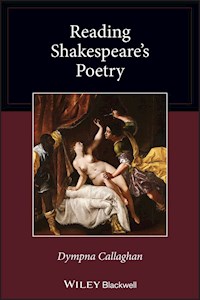
Cover image: © Il ratto di Lucrezia, Artemisia Gentileschi (between circa 1645 and circa 1650), photographic reproduction, public domain, Wikimedia Commons
Cover design by Wiley
Set in 10/13pt GalliardStd by Integra Software Services, Pvt. Ltd, Pondicherry, India
For R.S. White and in memory of Maria Thomas
Contents
Cover
Series page
Title page
Copyright
Dedication
Acknowledgments
Introduction
1 Venus and Adonis
2 Lucrece
3 The Phoenix and the Turtle
4 Shakespeare’s Sonnets
5 A Lover’s Complaint
Conclusion
Bibiography
Index
End User License Agreement
Guide
Cover
Series page
Title page
Copyright
Dedication
Table of Contents
Acknowledgments
Begin Reading
Conclusion
Bibiography
Index
End User License Agreement
Pages
i
ii
iii
iv
v
vi
vii
viii
ix
x
1
2
3
4
5
6
7
8
9
10
11
12
13
14
15
16
17
18
19
20
21
22
23
24
25
26
27
28
29
30
31
32
33
34
35
36
37
38
39
40
41
42
43
44
45
46
47
48
49
50
51
52
53
54
55
56
57
58
59
60
61
62
63
64
65
66
67
68
69
70
71
72
73
74
75
76
77
78
79
80
81
82
83
84
85
86
87
88
89
90
91
92
93
94
95
96
97
98
99
100
101
102
103
104
105
106
107
108
109
110
111
112
113
114
115
116
117
118
119
120
121
122
123
124
125
126
127
128
129
130
131
132
133
134
135
136
137
138
139
140
141
142
143
144
145
146
147
148
149
150
151
152
153
154
155
156
157
158
159
160
161
162
163
164
165
166
167
168
169
170
171
172
173
174
175
176
177
178
179
180
181
182
183
184
185
186
187
188
189
190
191
192
193
194
195
196
197
198
199
200
201
202
203
204
205
206
207
208
209
210
211
212
213
214
215
216
217
218
219
220
221
222
223
224
225
226
227
228
229
230
231
232
233
234
235
236
237
238
239
240
241
242
243
244
245
246
247
248
249
250
251
252
253
254
255
256
257
258
259
260
261
262
263
264
265
266
267
268
269
270
Acknowledgments
I began writing this book at the Huntington Library in the “plague year” of 2019. While my stay was necessarily abbreviated by circumstances, I nonetheless benefited from the intellectual stimulation afforded by the Fellows’ Seminar under the guidance of its Director of Research and redoubtable early modernist, Steve Hindle. It was my great good fortune to be among a remarkable group of fellows that year, several of whom have continued their inspiration and support in our weekly Zoom meetings: Chris Clark, Ben Davidson, Steve Cushman, Jack Hartnell, Dawna Schuld, Sarah Rodriguez, Veronica Castillo-Munoz, and Fuson Wang. I had admired James Walvin’s work long before I met him at the Huntington, and our almost daily communication, which has persisted ever since, has been one of the great delights and benefits of that year.
I am especially grateful also to Catherine Bates, Heidi Brayman, Philippa Berry, Patrick Cheney, Heather Dubrow, Ross Duffin, Paul Edmondson, Lori-Anne Ferrell, Lukas Erne, Heather James, and Carla Mazzio for important exchanges about this project. The influence of their scholarship on my own work, however, is so pervasive that it could never be adequately represented in my footnotes or bibliography. That sentiment also holds true for Michael Schoenfeldt, for whose encouragement at a crucial stage in the writing I am forever grateful.
I have also been extraordinarily fortunate in the sustaining intellectual friendship of Frances E. Dolan, Yang Haiyan, Louise Hindle, Laurie Maguire, Bernadette Powell, and Elizabeth Ridout. One of my greatest joys is that Margaret Newcombe has been there every day and has good-naturedly endured listening to reports of the book’s progress and has provided cake in quantity when needed. Chris R. Kyle is the best and brightest thing in my life. He not only possesses an astonishing range of knowledge about many things, including early modern history, but he also checked my footnotes and compiled the bibliography. Thanks also to my copyeditor, Emma Avery. Finally, no thanks would be complete without acknowledging the patience and fortitude of my wonderful editor at Wiley, Liz Wingett.
For the reader’s convenience, all references to Shakespeare unless otherwise noted are to Barbara Mowat, Paul Werstine, Michael Poston, Rebecca Niles, eds., Shakespeare’s Plays, Sonnets and Poems (Washington, DC: Folger Shakespeare Library, n.d.), accessed January 11, 2022, https://shakespeare.folger.edu. Similarly, unless otherwise noted, quotations from Ovid’s Metamorphoses refer to John Frederick Nims (ed.) Ovid’s Metamorphoses: The Arthur Golding Translation of 1567 (Philadelphia: Paul Dry Books, 2000). I have taken the via media in relation to modernization throughout this book, silently modernizing where necessary in the interests of clarity but retaining early modern spellings and locutions where they did not prove an impediment to comprehension.
*
It was my immense good fortune to have been introduced to early modern poetry in my first year at university by the magnificent Shakespeare and Romantics’ scholar, R.S. White. Had he not been my tutor all those years ago, this book might never have been written. I was fortunate also in my tutorial partner at that time, Maria Thomas, who modelled an intellectual voracity and commitment that inspired my own. She remained a kind, learned, and wonderful friend until her untimely death as I was completing this book, which I dedicate, with immense gratitude, to our tutor, Bob, and to her memory.
Introduction
When Shakespeare published Venus and Adonis in 1593 under the patronage of the Earl of Southampton, he made what was undoubtedly the greatest single leap of his career. No longer just an “upstart crow,” which was the derisive moniker accorded to him only a year before in Greene’s Groats-worth of Wit (1592), ostensibly by Robert Greene, he had now made a claim for himself as a poet worthy of consideration along with the greatest classical authors of the ancient world. Venus and Adonis was a runaway success. It was reprinted no fewer than sixteen times before 1640, and because it was quite literally read to pieces, few copies of those early printings now survive.
The aim of this volume is to attain an understanding of Shakespeare’s poems, namely Venus and Adonis, Lucrece, The Phoenix and the Turtle, and the Sonnets, together with the poem appended to the first printing of Shakespeare’s Sonnets in 1609, albeit one that may not have been written by Shakespeare, namely A Lover’s Complaint. While his plays were for the most part written in blank verse – that is, in unrhymed iambic pentameter with its five strong beats to a line – that use of verse, although it is poetry, does not actually constitute a poem. However, Shakespeare’s dramatic verse also includes lines that are set apart and designated specifically as songs, poems, and sonnets. Berowne’s sonnet in Love’s Labour’s Lost is described in a series of synonyms as a “staff,” (that is, a stave in the musical sense), a “stanza,” a word that had only recently entered the English Language,1 and as a “verse”: “Let me hear a staff, a stanza, a verse,” (4.2.124). Poems which mark their boundaries in such definitive terms and explicitly measure out their distance from the rest of the play in which they appear also work to offer an implicit commentary on the social and cultural function of poetry. Indeed, throughout this book, we will pay particular attention to how Shakespeare’s poetry marks its borders and boundaries, or, conversely strives to erase them. For this reason, we will address some of these embedded poems below because they also serve to illuminate the ways in which verse manifested in the cultural context in which Shakespeare wrote.
A World of Verse
One of the least noticed but most significant differences between Shakespeare’s era and our own is that we inhabit a world dominated by prose while he lived in a world where poetry was far from being the marginal, more specialized form of cultural expression that it has now become. Prose is where we live and how we speak; poetry is another country with another language. We tend to feel that we know where we are with prose because it is typically regarded as particularly suited to rational, logical argument and explanation, and to the straightforward communication of information, whereas we may perceive much more difficulty in orienting ourselves in relation to verse. Despite the ways in which poetry is necessarily distinct from ordinary prose communication, in the early modern period, verse was also often deployed in the service of very ordinary, everyday affairs. Indeed, what was probably the best-selling book of verse in Elizabethan England (one which was not written by Shakespeare) provided instructions about how to run a farm. That book was Thomas Tusser’s A Hundreth Good Pointes of Husbandrie, first printed in 1557,2 which, in its much-expanded printing of 1562, was augmented with “A Hundred Good Poyntes of Huswifery.” In its multiple editions and iterations between 1557 and 1599, Tusser’s rhymes directed his readers as to what labors should be undertaken in different months of the year. The form, or rather formula of the poem, was a series of simple aabb four-line stanzas; a quatrain, with a jog-trot rhythm that made no pretense of rhetorical sophistication:
In March and in April, from morning to night,
in sowing and setting good huswives delight.
To have in their Garden or other like plot,
to trim up their house, and to furnish their pot.
(1570, sig. E.ii)
Tusser’s directions to the housewife to plant her kitchen garden in the spring demonstrates little in the way of literary and aesthetic merit – for that is not its purpose, which is rather to give advice about how to operate a farm resourcefully and how to run a household efficiently. Rhyme also helps to commit the instructions to memory. In fact, Tusser’s rhymes about spring planting share thematic territory with the most elevated literary poetry of the era in that one of the most ancient forms of lyrical expression was the transformation of the seasons. Crucially, the coming of springtime, the vernal equinox, was in particular a long-standing lyrical theme, and is a preoccupation, for example, of many of Shakespeare’s sonnets. For instance, nature’s decorative flowers and greenery are represented in Shakespeare’s Sonnet 98 in the personified figure of “proud-pied April, dressed in all his trim” (98.2), and while in terms of aesthetic finesse Shakespeare’s lyric is a world away from Tusser’s rhyme, there is, nonetheless, a certain continuity between the latter’s stylistically crude, though nonetheless engaging, popular verse and even the most refined lyrical writing of the Elizabethan and Jacobean age, of which Sonnet 98 is an excellent example.
That A Hundreth Good Pointes of Husbandrie out-sold Shakespeare, even and especially his immensely popular pamphlet, Venus and Adonis (1593), is in itself remarkable, but it also provides us with an important sense of the milieu in which Shakespeare’s poetry was written. Verse was ubiquitous, and sometimes, as in the case of Shakespeare and the most illustrious of his contemporaries, it rose to an exalted level of eloquence. Such carefully-wrought, ineluctably literary “poetry,” though it was set farther apart from ordinary language usage than less accomplished verse and common speech (also known by the Latin term, usus loquendi), still maintained clear connections with them. Indeed, English as a language had been given a particular boost by the Protestant Reformation. Hitherto, the classical languages of Latin and Ancient Greek, which were the province of only a tiny elite minority of highly educated men, were the languages of scripture and poetry. Beginning in the 1530s, Protestantism advanced the then novel belief that God’s Word should be available to every English man and woman in his or her own tongue, which led to the translation of the Bible into English.3 A specifically literary development ran alongside this religious shift since the struggle for poetry up until the late sixteenth century had been to make English, the vernacular language, an appropriate vehicle for poetic expression. This was a feat accomplished primarily by metrical innovation, and especially by the adoption of iambic pentameter, which was arguably more suited to the natural rhythms of English speech than the four-stress line of earlier native English verse, and certainly an improvement on the nonetheless worthy though ultimately unsuccessful attempts to imitate the meters deployed in classical poetry. This larger historical environment of linguistic and poetic innovation4 meant that, as Russ McDonald has explained:
Shakespeare was born at the right time. In a fortunate intersection of individual talent and cultural context, his unmatched sensitivity to words combines with the range and plasticity of the English language at this moment in its development.5
This does not mean, however, that Shakespeare wrote only at the high-end of the spectrum of early modern verse. His dramatic poetry, that is, the blank verse of his plays, conveys a wonderfully rich picture of early modern life and language along the entire gamut of the social spectrum. In addition, however, the following verse was attributed to Shakespeare and its purpose was practical rather than purely aesthetic or literary. It is what early moderns would have called a “posy,” a syncopated form of the word “poesie,” which is to say, “posy” records the loss of the “e” sound in the middle of the word. A posy then is a short motto or verse fragment, which in the instance below served as the note to accompany the gift of a pair of gloves.
The gift is small
The will is all
Alexander Aspinall
The historical evidence for Shakespeare’s authorship of this tiny verse appears in the form of an annotation in a manuscript miscellany compiled around 1629 by Sir Francis Fane (1611–80): “Shakxpaire upon a peaire of gloves that master sent to his mistris.” Shakespeare died in 1616 when Fane was only four years old, so since this authorial attribution was not recorded in Shakespeare’s lifetime, we cannot be absolutely certain that the posy was indeed written by Shakespeare. However, Fane’s note merits some serious consideration on the grounds that as an early seventeenth-century attribution it is more likely to be correct than, say, a claim for Shakespearean authorship made in a subsequent century. The annotation suggests that Shakespeare composed this posy on behalf of his friend who was a master at the Stratford grammar school, Alexander Aspinall, to accompany the presentation of a gift of gloves to Anne Shaw, the widow Aspinall was courting.
Gloves were a conventional and rather intimate love token in the rituals of courtship in Shakespeare’s day, and indeed, in Love’s Labour’s Lost, Katherine, one of the ladies of France who is a visitor at the court of Navarre, receives a pair from the courtier, Dumaine. These are also accompanied by a quantity of what she claims is very bad poetry, which conveys only hackneyed expressions of love and fidelity:
PRINCESS …But, Katherine, what was sent to you
From fair Dumaine?
KATHERINE
Madam, this glove. She shows the glove.
PRINCESS Did he not send you twain?
KATHERINE Yes, madam, and moreover,
Some thousand verses of a faithful lover,
A huge translation of hypocrisy,
Vilely compiled, profound simplicity.
Love’s Labors’ Lost (5.2.50–7)
Katherine values neither the material gift she has received nor the verses. Indeed, she is bluntly disparaging about Dumaine’s poem in a fashion that conveys a pithily trenchant critique of love poetry as a genre. Indeed, Shakespeare himself concurs with this assessment at various moments in his Sonnets (1609), for example, in Sonnet 17, “Who will believe my verse in time to come,” where he confronts the resistance of poetry as a medium to original expression or what he calls “fresh numbers” (17.6). Katherine’s withering appraisal of the artifice of poetry implies that it is too-often merely a patchwork of conventional lyrical phrases – perhaps especially, since she uses the word “translation,” a hackneyed imitation of sentiments expressed in other languages – which thus makes verse incapable of conveying genuine emotion or the extraordinary reality of love and beauty. Worse still, she implies, such poetry is untruthful in its deviation from real emotion and genuine, authentic expression.
In A Midsummer Night’s Dream, Egeus, the irate father of Hermia, indignantly accuses Lysander of trying to seduce his daughter with poetry. Like Katherine, his main complaint is that poetry is fake, that it is just a surreptitious means of grooming a woman for dishonorable sexual ends. However, Egeus construes this primarily as an act of theft, claiming that Lysander has stolen Hermia from him by stealing her heart:
Thou, thou, Lysander, thou hast given her rhymes
And interchanged love tokens with my child.
Thou hast by moonlight at her window sung
With feigning voice verses of feigning love
And stol’n the impression of her fantasy
With bracelets of thy hair, rings, gauds, conceits,
Knacks, trifles, nosegays, sweetmeats—messengers
Of strong prevailment in unhardened youth.
With cunning hast thou filched my daughter’s heart.
A Midsummer Night’s Dream (1.1.29–37)
Crucially, here the “rhymes” and songs are accompanied by an array of material gifts, including locks of hair, rings, ornaments and other jewelry, knick-knacks, bouquets of flowers, and candy. Poetry, then, was not delivered on its own; rather, it was but one element in the elaborate social exchanges of the courtship ritual. For Egeus, love poetry is simply an act of deception performed with “feigning [counterfeit] voice verses of feigning love” (1.1.132). This is significant because here Egeus articulates one of the most prevalent objections to literature, and especially to poetry, in the early modern period, namely that it was simply an act of untruth, a cunning deception perpetrated upon unsuspecting readers and listeners, and that, further, any aesthetic accomplishments such verse might demonstrate were merely ways of making its lies more palatable; a spoonful of sugar, so to speak that made the poisonous duplicity go down all the more easily. Indeed, the word “feigning” is frequently used in conjunction with ideas about poetry, in part because as Patrick Cheney argues: “The word ‘feigning’ can mean both imaginative and deceptive.”6 The logic behind this notion is that if something is imagined, it is simply unreal, and therefore, by the lights of many denizens of Elizabethan and Jacobean England, constituted nothing short of a lie. In A Midsummer Night’s Dream, Shakespeare’s clever irony is to offer an exquisitely lyrical account of the nature of poetry in a speech that professes profound skepticism about its morals and its merits:
I never may believe
These antique fables nor these fairy toys.
Lovers and madmen have such seething brains,
Such shaping fantasies, that apprehend
More than cool reason ever comprehends.
The lunatic, the lover, and the poet
Are of imagination all compact.
One sees more devils than vast hell can hold:
That is the madman. The lover, all as frantic,
Sees Helen’s beauty in a brow of Egypt.
The poet’s eye, in a fine frenzy rolling,
Doth glance from heaven to Earth, from Earth to
heaven,
And as imagination bodies forth
The forms of things unknown, the poet’s pen
Turns them to shapes and gives to airy nothing
A local habitation and a name.
A Midsummer Night’s Dream (5.1.2–18)
Of course, the poet both represents and invents, but in this speech, Theseus, himself a figure plucked from mythology, nonetheless refuses to give credence to it even as he so poetically enunciates the poet’s investment in both the terrestrial and celestial aspects of being, and the sheer power of imagination that unites the lover and the lunatic with the poet. As we discover in the Sonnets, the poet does see indeed “Helen’s beauty in a brow of Egypt” when he falls in love with the Black woman, whose beauty is unconventional by early modern English standards. While her precise ethnicity is never specified, she is described as “black” no fewer than nine times – so let us take the poet at his word. And like Thesesus’s “frantic lover” (5.1.10), the poet’s passion for her drives him to frenzied distraction. While the poet can represent earthly reality with various degrees of mimetic exactitude and abstraction, s/he also represents things that do not exist at all and that indeed, have never existed, in observed reality.
This is an idea that the clown, Touchstone, in As You Like It jokes about when he says: “[T]he truest poetry is the most feigning” (3.3.18), in other words, the best and most sound poetry is the most imaginative and therefore the most fraudulent because, to put its merits in pejorative terms, it is fanciful and illusory. Touchstone adds that “lovers” (by which he means male poet-lovers who are wooing women) are particularly prone to such deceptions because they use poetry as an instrument of seduction: “[L]overs are given to poetry, and what they swear in poetry may be said as lovers they do feign” (3.3.18–21).
In A Midsummer Night’s Dream, Egeus too is convinced that his daughter has been the victim of a malicious deception. For him, Hermia is possessed of neither the agency which would allow her to refuse Lysander’s overtures, nor of the capacity to actually desire him as her lover. She is rather positioned by her father as an inert, malleable surface for Lysander’s sexual aims rather than someone fully capable of sexual or even social discernment. There are, of course, no father figures supervising the courtships of Love’s Labour’s Lost. Yet all the ladies rebuff their suitors, not on grounds of, say, a vow of chastity such as the one with which Rosaline rejects Romeo in Romeo and Juliet, but simply because they see through the superficial and hyperbolic claims made by the poems their would-be lovers have written to accompany the gifts conventional to early modern courtship. On these grounds, Katherine has retained only one of the gloves she has been sent by Dumaine, which is why the Princess is compelled to ask whether she received a pair rather than a useless single one: “Did he not send you twain?” (5.2.50).
Since Alexander Aspinall married Ann Shaw in 1594, we must assume that his gift was more favorably received. If the posy intended for Anne Shaw is indeed Shakespeare’s, Aspinall probably purchased the gloves from John Shakespeare, Shakespeare’s father, who was a glover, that is, one who prepared or “tawed” the leathers and utilized them in the manufacture of gloves. Anne’s deceased husband’s family were near neighbors of Shakespeare, so there is a double personal connection between Shakespeare and the soon-to-be-betrothed couple. Essentially the poem says, this is a very small token but the thought, the intention behind it is everything. In other words, “It’s the thought that counts.” That the “thought” here is the “will” or aspiration of the poem, a pun on Shakespeare’s name, indeed, supports the claim that he was its author. If we assume this is the case, we can adduce an additional meaning, namely that in this matter of courtship, betrothal, and impending marriage, Shakespeare, the writer, and indeed the poem itself, is everything, and far surpasses the value and significance of the actual gloves: “The Will is all.” Even though the attribution must remain uncertain, what further bolsters the possibility that Shakespeare is truly the author of this simple but delightful posy is that in the Sonnets, Shakespeare repeatedly puns on his own name, “Will.”
In the Sonnets, Shakespeare’s “Will” is charged with eroticism since “will” connotes sexual desire and is also early modern slang for “penis,” and alternatively, for “vagina.” For example, in Sonnet 135 the word “will” occurs thirteen times in the space of the fourteen lines of the poem:
Who euer hath her wish, thou hast thy Will,
And Will too boote, and Will in ouer-plus.
(Q1, Sonnet 135.1–2)
Whoever hath her wish, thou hast thy will,
And will to boot, and will in overplus.
(Sonnet 135.1–2, edited by Stephen Booth)7
In these very first two lines, “Will” appears three times, and not only is it capitalized in the 1609 Quarto [“Q1”], that is the first printing of Shakespeare’s Sonnets, it is also italicized for added emphasis. Further, Shakespeare’s initial, the letter “W” occurs five times, most conspicuously as the first enlarged character of the sonnet. Most modern editors choose to omit the italicization, and some, for example, Stephen Booth, also eschew the capitalizations on the grounds that they make the poem seem “archly precious.” Booth believes that the speaker of the sonnet goes to “grotesque lengths” to make “a maximum number and concentration of puns on Will,” and that nowadays readers are overly susceptible to typeface variations, that is to orthographical signals such as italics and capitals. Additionally, he worries that “a modern reader may also incline toward the folly of trying to dredge meaning from Q’s selectivity in singling out some will’s typographically and printing others in ordinary roman.”8 In other words, Booth fears readers these days will over-read the significance of “Will” and “dredge” up meanings from the poem that simply do not exist. However, if we read Sonnet 135 in conjunction with the above posy ascribed to Shakespeare, we may arrive at a very different conclusion.
Contra Booth, it is arguably the case that early moderns were even more susceptible than we are to variations in typography. Juliet Fleming has argued that “the Elizabethans understood reading and writing differently” from us, and suggests that the period’s fondness for posies, such as the one above, reveals precisely the nature of that difference. Writing, she shows, was invariably understood to have a physical extension, such as, in the case of Shakespeare’s Aspinall posy, in the form of the gift it accompanied, though such verses were also inscribed on knives, the inside of rings, and painted on platters and other household ornaments. This sense of the physicality of posy also held true for other poetry in the form of the ink in which it was printed, and the paper marked by the ink. Consider, for example, among Shakespeare’s numerous references to paper, pen, and ink, the physical implements of writing, the poet’s hope in Sonnet 65 “That in black ink my love may still shine bright” (65.14). While later historical eras began to recognize the “content” of writing, the ideas it articulated, as somehow unmoored from the material conditions of its expression, in the early modern period writing was not understood to exist in that fashion, in the abstract; untethered from the physical form of its existence. Rather, writing, whether in manuscript or in print, had a solidly substantive material dimension. This historicized understanding of writing and its cultural function suggests that the visually conspicuous aspects of printed verse were, just like the ornamental motto or posy itself, also designed “to catch the eye or memory.”9 If we accept this to be the case, the capitalizations and italicizations of Will in Sonnet 135 in fact should not be downplayed in roman type. Further, since the 1609 edition is the only version of the Sonnets (save for two poems printed earlier), there seems no logical reason to doubt that “will” was given typographical emphasis for a very good, onomastic reason – specifically that it was intended to draw the reader’s attention both to the poem’s verbal, albeit somewhat ribald, ingenuity, and, likewise, to the name of its author.
The sense that knowing how to read and understand a posy can help us to read and understand the Sonnets is instructive. Notably, if those first two lines from Sonnet 135 were to be extracted from the remaining twelve of the sonnet, they would also constitute a posy, albeit a sexually suggestive one. One could, at any rate, imagine these lines engraved on a bracelet:
Who euer hath her wish, thou hast thy Will,
And Will too boote, and Will in ouer-plus.
(Q1, Sonnet 135.1–2)
The more decorous lines that accompanied the gloves delivered to Anne Shaw are also variants on the mottos that were often inscribed on the inside of rings, such as, “The gift is small, the love is all.”10 In Hamlet, for example, the play that Prince Hamlet has contrived to have staged in order to establish Claudius’s guilt in the murder of his father, The Murder of Gonzago, is prefaced by the Player’s prologue, which is but three, rhymed lines long:
For us and for our tragedy,
Here stooping to your clemency,
We beg your hearing patiently.
Hamlet (3.2.73)
“Tragedy,” “clemency,” and “patiently” are all unstressed endings and rhyme somewhat awkwardly, but they are effective in context in so far as these endings assert nothing but rather request something of the audience, namely their kind and uncritical disposition towards the production that is to follow. The brevity of the prologue leads Hamlet to pose the rhetorical question: “Is this the prologue or the posy of a ring” (3.2.173).
In The Merchant of Venice, Nerissa has given her husband, Gratiano, precisely such a ring, “Which I did make him swear to keep forever,” (4.2.18) but he has, as he believes, parted with the keepsake to a young law clerk, who, unbeknownst to him, is none other than his wife in disguise. When Nerissa demands to know what became of the ring, her husband attempts to diminish its significance and thus make light of his own transgression:
GRATIANO
…, a hoop of gold, a paltry ring
That she did give me, whose posy was
For all the world like cutler’s poetry
Upon a knife, “Love me, and leave me not.”
NERISSA
What talk you of the posy or the value?
You swore to me when I did give it you
That you would wear it till your hour of death,
And that it should lie with you in your grave.
(5.1.160–67)
“Cutler’s poetry” is Gratiano’s disparaging assessment of the value of the posy; in other words, something that was composed with all the deficient ingenuity of a knife maker who might inscribe his blades with some inane, clichéd saying; an old motto, or a too well-worn proverb. With increased access to literacy, even such manual laborers as the cutler might indeed take to verse composition. This is perhaps why in the text known as the Bad Quarto of Romeo and Juliet (1597), the dying Mercutio says “some peasantly rogue, some Sexton, some base slave shall write my Epitaph.”11 In this instance, presumably Mercutio’s premature demise would necessitate urgent composition, and anyone with even rudimentary literacy skills might be pressed into the service of engraving a hastily-composed and unoriginal epitaph for his tombstone. This is a society in which crude or simple verse expression – and the manual labor often required to articulate and present it – sits alongside the most refined and sophisticated poetry wrought with a quill on paper or parchment. However, albeit executed without literary accomplishment, even a clumsily-composed posy may be freighted with the gravity of a matrimonial oath as in The Merchant of Venice, or the grief at a burial as in the Bad Quarto of Romeo and Juliet. Alternatively, like Tusser’s printed rhymes, verse may simply be replete with indispensable practical information. Notably, Tusser included in his book a section on “Husbandly [household] Poesies,” which served decorative and ornamental functions and were intended to be copied out onto household objects so that their significance framed and consolidated what they were inscribed upon.12 Gratiano above defensively contends that the value of a posy resides in how well it is executed as purely an act of language, with no consideration of the material form of its expression. However, Tusser’s chapter on how to copy out poesies as household ornaments suggests that, on the contrary, “the value” of a posy or a poem might not be aesthetic in the irreducibly literary sense at all.
Engaging with Petrarch
Shakespeare’s embedded poems, deliberately situated at key moments in the plays in which they appear, were a means of exploring and experimenting with how poems might function in both comic and tragic situations.13 In Love’s Labour’s Lost, Berowne is one of the would-be poets among the lords at the court of Navarre whose sonneteering becomes evidence that the men have contravened the solemn oath they took at the start of the play to commit to become scholarly, celibate recluses and to abjure the company of women. Of course, the jig is up when they are found out to have been composing their lyrics in an endeavor to woo the Princess of France and her ladies. That Berowne’s poem is a sonnet that takes a very circuitous route to its intended recipient in Love’s Labour’s Lost intensifies the comic impact of a poem that in other circumstances would be read very differently, and much more seriously. Indeed, we know this is the case because this sonnet was one of the three poems from this play that appeared, along with versions of Sonnets 138 and 144, in a volume printed in 1599 by William Jaggard called The Passionate Pilgrim, and which bore Shakespeare’s name on its title page even though the book contained only five of his poems. In the play, however, Berowne’s sonnet is read aloud, not by its aristocratic author but by someone decidedly much further down the social scale, the church curate, Nathaniel, and before the uncourtly audience of the pedantic schoolmaster, Holofernes, and the illiterate, rustic wench, Jaquenetta. The latter’s presence in particular marks the veritable chasm between the ideals of femininity expressed in love poetry and the unembellished reality of lower-class womanhood. In fact, Jacquenetta’s presence makes her the impromptu substitute for Rosaline, the poem’s intended addressee, who fulfills the much more conventional role of the aristocratic court lady. Thus, Jaquenetta is the comic stand-in not just for a specific woman, namely Rosaline, but also for the generalized, abstract figure of the “sonnet lady” in the sonnet tradition that derived from the Italian poet, Francesco Petrarch (1304–74). Petrarch’s vernacular sonnets, the Canzoniere (Songs, which in Petrarch’s case, were actually composed with a lyre), related his love for the quasi-fictional, intensely idealized, Laura. This was the most famous sonnet sequence in Europe and, albeit belatedly, in England in the 1590s, it generated a host of imitations, translations, appropriations, and a myriad of verse responses that endeavored to engage with Petrarchan ideas, sometimes by overturning or reversing them. In the 1590s, that is, in the decade of Love’s Labour’s composition, the vogue for Petrarch’s poetry gave rise to the English sonnet craze – a veritable frenzy of sonnet composition of which Shakespeare’s poems, already in manuscript circulation at that time, were but a part.
Petrarch begins the Canzoniere recalling his first encounter with Laura on Good Friday, 6 April 1327. Importantly, though this is the date he saw her, it is far from clear that she is someone he ever actually met or knew. Good Friday was a fateful date, not only because it was the day which commemorates Christ’s crucifixion, but also because meeting Laura led not to happiness for Petrarch but to the perpetual suffering and despair occasioned by unrequited love. This misery, however, was also the impetus for his exquisite lyrics. The underlying mythological narrative of this doomed love affair is described by Petrarch in terms of a kind of cosmic injustice because, given the sacredness of the day, he had gone about unarmed, whereupon Cupid shot and grievously wounded him with an arrow. In contrast, Laura was not only very well armed and thus would have been impervious to Love’s wounds, but Cupid, most unfairly, according to Petrarch, simply never considered her as one of his targets. It is especially this asymmetry of desire that fuels the erotic dynamism of Petrarchan poetry and the masculine melancholy that was so productive of verse expression. Thus, in Romeo and Juliet, Mercutio declares that love-struck Romeo, who pines for the unattainable Rosaline, must, inevitably, be adept in the technical requirements, that is, the metrical counting, “the numbers” of poetry: “Now is he for the numbers that Petrarch flowed in” (Romeo and Juliet, 2.3.36–7; my italics).
Petrarch’s influence on the development of European poetry, and on Shakespeare cannot be overestimated, and crucially the belated heyday of the sonnet in England meant that Petrarchan tropes and themes were not merely available for imitation, but were also subject to satirical treatment as clichés of the sonnet genre. Within the fiction of the Petrarchan tradition, the conventional fair, cruel beloved holds tyrannical power over the poet because she can redeem or damn him at will, depending on her response to his amorous overtures. As Jaquenetta, the boy actress in Love’s Labour’s Lost stands on stage listening to the recitation of the sonnet intended for Rosaline, she serves to represent all those real, historical women who could never even approach the possession of such power. However, even the most aristocratic ladies were devoid of the overwhelming, destructive capacity that belonged to Jove, the chief deity of Roman mythology as well as its most notorious and most habitual rapist. For all that, Berowne attributes precisely Jove’s power to Rosaline in the final quatrain of his sonnet:
Thy eye Jove’s lightning bears, thy voice his dreadful
thunder,
Which, not to anger bent, is music and sweet fire.
Celestial as thou art, O, pardon love this wrong,
That sings heaven’s praise with such an earthly tongue.
(4.2.139–42)
The lady’s voice, according to Berowne, can annihilate him, even though when she is not enraged, her voice sounds like angelic music. This disjunction between the decidedly terrestrial, embodied rustic wench, Jaquenetta, and Berowne’s deification of female authority as well as the association of the beloved with divine beauty, is Shakespeare’s joke on the often-risible, orthodox hyperboles of the sonnet tradition. He interrogated Petrarchan conventions repeatedly and perhaps most famously when in the anti-Petrarchan Sonnet 130, he countered the idea of the lady who is so idealized, venerated, divinized, and “celestial” that she is virtually air-borne, with the line: “My Mistress when she walks treads on the ground” (Sonnet 130.12).
Because Shakespeare is interested in how poetry functions in his society, and about who gets to compose it and to what end, the poems in the plays often do not function as the characters who are their authors hope they will, and that remains the case whether the fictional writer is proficient in the art of poetry or markedly deficient in it. Interestingly, Shakespeare deliberately creates some bad poetry, and indeed, the plays contain their share of ham-fisted versifiers. It is sometimes, paradoxically, their very commitment to poetic convention and their attempts to imitate great poetry that leads Shakespeare’s fictional authors only to the most unoriginal and clichéd forms of expression. One of Shakespeare’s most inept poets is the love-struck Benedick in Much Ado About Nothing. Tricked into acknowledging his love for Beatrice, he seeks a legitimate resolution in marriage both to his conflict with her and his desire for her. Benedick tries to do what was almost a cultural requirement of all literate, aristocratic lovers of the 1590s, namely to compose a song to his lady, or as Proteus puts it in Two Gentlemen of Verona:
You must lay lime to tangle her desires
By wailful sonnets, whose composèd rhymes
Should be full-fraught with serviceable vows.
(3.2.68–70)
Proteus’s rather sinister suggestion, via the image of the lime (a viscous, sticky substance derived from holly bark which was used to trap birds), is that women must be enticed and ensnared by potentially deceptive poetry and insincere oaths. This is what he thinks poetry is for. In contrast, Benedick is genuinely searching for the right words to express a long-suppressed but utterly-sincere love. Alas, he finds himself defeated of lyrical inspiration after only four lines of verse, and his attempt devolves into exasperated prose:
The god of love
That sits above,
And knows me, and knows me
How pitiful I deserve—
The lines of Benedick’s verse convey only that Cupid is a celestial figure, and “love” and “above” are his rudimentary rhymes, while the third line rehearses the clichéd lament that the lover is hard done by his mistress. At that point, Benedick’s powers of lyrical invention peter out, and bereft of further ideas, he enters into an energetic prose declaration on the difficulties of love poetry:
I mean in singing. But in loving… . Marry,
I cannot show it in rhyme. I have tried. I can find out
no rhyme to “lady” but “baby”—an innocent
rhyme; for “scorn,” “horn”—a hard rhyme; for
“school,” “fool”—a babbling rhyme; very ominous
endings. No, I was not born under a rhyming
planet, nor I cannot woo in festival terms.
Much Ado About Nothing (5.2.26–41)14
For all his ineptitude, Benedick is particularly cognizant of the unfortunate suggestions that may arise in linking words with one another through rhyme. “Baby” infantilizes “lady” and may even remind the intended recipient of the poem of the potential consequences of acceding to the lover’s desires, especially before their union is solemnized in marriage. However, as Benedick claims, that rhyme is more “innocent” than “scorn” and “horn,” which suggests not only that the lover has been repulsed by the lady but also cuckoldry because a husband who was cheated on was thought to sprout horns, of which he alone was unaware. The predictive power of such rhymes, the “ominous endings” not only of the lines of verse, but also of the relationship to Shakespeare’s own non-dramatic poems, are decidedly spoken rather than sung and require verbal enunciation, whether in the mind of the reader or out loud. They do not require you to pick up your cittern (an early modern version of the guitar) for a sing-along. Benedick’s reference to “Song,” however, may mean actual singing, that is lyrics to be sung, often with musical accompaniment. As in Petrarch’s title, Canzoniere, which is the Italian world for “song,” song was also a synonym for poetry itself because poetry had its mythic origins in the songs of Orpheus, who played upon his lyre.
Shakespeare was not, in fact, the author of Benedick’s lyric, “The god of love,” but nor, however, was he just trying to pass off the borrowed verse as his own invention. Rather he was incorporating a popular song of the time into his play, and the audience would have easily recognized the lyrics from the widely-known and much imitated ballad: “God of Love.” That song, despite its trite rhymes – or perhaps even because of them – was a commercial success and had been in print since as early as 1562, two years before Shakespeare’s birth. The song’s composer was William Elderton whose reputation was that of “a drunken rhymester” rather than that of an accomplished musician and lyricist.15 In fact, the practice of borrowing verse to suit the occasion was culturally widespread, and Shakespeare again makes comic sport out of it in The Merry Wives of Windsor where Abraham Slender, who clearly cannot rely on his memory in his pursuit of the attractive young Anne Page, wishes:
I had rather than forty shillings I had my
book of Songs and Sonnets here!
The Merry Wives of Windsor (1.1.193–4)
Slender is referring to a volume widely known as Tottel’s Miscellany, which was first published in 1557 during the reign of Mary Tudor, and which was the major literary accomplishment of her reign. The book was an anthology of English poetry compiled by the printer, Richard Tottel. Tottel was responsible for making available the court poetry composed during the reign of Henry VIII to a much wider audience. Most importantly, Tottel’s was the first printing of the Petrarchan lyrics of the great Henrican court poets, Henry Howard, Earl of Surrey, and Sir Thomas Wyatt. These works were the literary fruits of their diplomatic embassies in Italy, and prior to Tottel’s printing, had hitherto existed only in manuscript form and therefore had achieved only a circumscribed readership. That an undistinguished denizen of the town of Windsor now has access to one of the most elite literary productions of the age via the technology of print, suggests the vastly increased reach of poetry in early modern England. Slender belongs to the newly literate class of early modern readers. Members of this group were also among the readers of Shakespeare’s poems. Importantly, Slender does not just enjoy or appreciate poetry, he sees in it something he can use to pursue women. Slender’s desire to thus utilize the poetry written by others achieves a more sympathetic gloss than, say, the malign intentions exhibited, as we saw above, by Proteus in Two Gentlemen of Verona, or indeed those Egeus attributes to Lysander in A Midsummer Night’s Dream, in the light of an episode from the 1994 Italian movie, Il Postino. In that film, the postman of the title has been using the poetry of Pablo Neruda to woo his beloved. Certain that the use to which he has put Neruda’s lines is neither plagiarism nor misuse, he boldly asserts: “Poetry doesn’t belong to those who write it, but those who need it.” Early modern readers were also of this opinion.
Benedick’s failure at verse composition in Much Ado About Nothing, then, may not be that of composition but of memory. This is because he may be merely imperfectly reciting Elderton’s old ballad. If it is indeed the case that he can only recall four lines of an old song and if he hopes to repurpose the fragment taken from his very defective recollection of it in the wooing of Beatrice, then that would seem a failure so profound that it would utterly doom his chances at romantic success. Yet, for all his failure, whether of memory or as a poet in the abortive throes of creative composition, Benedick nonetheless gets his girl, which, as we have seen, was not the case for the much more capable poets of Love’s Labour’s Lost for whom love has instigated fluent composition and the requisite despondency of the unrequited Petrarchan lover, or as Berowne puts it, “By heaven, I do love, and it hath taught me to rhyme, and to be melancholy” (4.3.12–13). Despite the fact that they were despised by their recipients, the poems composed by the lords at the court of Navarre were neither borrowed, incompetent, nor truncated lyrics, and yet, while their sonnets exhibited appropriate courtly accomplishment, they nevertheless failed to achieve their aim of wooing the ladies. Indeed, Love’s Labour’s concludes with the women abruptly suspending the lords’ suit, at least for a year and a day causing the lords to lament:
Our wooing doth not end like an old play.
Jack hath not Jill. These ladies’ courtesy
Might well have made our sport a comedy.
Love’s Labour’s Lost (5.2.947–9)
While this is not a conventionally comic ending, which would require the couples to pair up happily at the conclusion, it is in an important sense a Petrarchan ending because Petrarch never gets his girl, and if he did, he would have nothing to write about. Thus, neither marriage nor even consummation is the real goal of Petrarch’s poetry, but rather the endless expression of his desire.
As a particular genre of eloquence, poetry, such a refined act of language, was one of the accomplishments expected of the exquisitely cultivated style and witty intellectual manner of a Renaissance courtier. This ideal was promulgated by Baldassare Castiglione in Il Cortegiano (1528), translated into English by Sir Thomas Hoby as The Book of the Courtier (1561). A key concept of this book was the ideal of sprezzatura, meaning that the exertions that are inevitably entailed in any courtly activity, including literary and artistic composition, should be hidden behind a façade of apparently effortless expression, and should therefore be executed with a graceful nonchalance.16 Castiglione’s ideals invariably trickled down the social scale in their influence on artistic production. Sometimes, indeed, the decidedly non-aristocratic Shakespeare expressed the smooth and even surface of extraordinary poetic refinement, perhaps most sustainedly in Venus and Adonis. At other times Shakespeare’s aim is not a smooth-as-glass surface, and often, the struggle to express the controlling idea of the poem is incorporated as an intrinsic aspect of the poem itself. For example, in Sonnet 129 the logic of the speaker’s tortured expression breaks down under the weight of emotional chaos: “Savage, extreme, rude, cruel, not to trust” (129.4). Interestingly too, this discordant poem appears directly after a sonnet which celebrates musical harmony when the poet’s mistress plays upon the virginals, whose keys pluck the wires of the instrument to create sound: “The wiry concord that mine ear confounds” (128.4; my emphasis). However, even Sonnet 129 appears, if not exactly effortless because of the sheer emotional energy the poet expends in expressing his distress, then at least spontaneous and unstudied.
When in Love’s Labour’s Lost Holofernes examines the manuscript of Berowne’s poem to Rosaline he declares:
Here are only numbers ratified,
but, for the elegancy, facility, and golden cadence of
poesy—caret. Ovidius Naso was the man. And why
indeed “Naso,” but for smelling out the odoriferous
flowers of fancy, the jerks of invention? Imitari is
nothing: so doth the hound his master, the ape his
keeper, the tired horse his rider.
(4.2.146–52)
Holofernes’s rather stringent critique of Berowne’s composition is that it is not Ovidian, that is to say, it does not achieve the “golden cadence” of the ancient Roman poet, Ovidius Naso (Ovid, the nose – one assumes it was a pronounced one). Ovid, as Holofernes puts it, had “a nose” for the “flowers” or flourishes of poetry, and also for original invention, which he further argues, far exceeds mere imitation of one’s predecessors, despite the fact that this was also a key Renaissance idea. Even animals, Holofernes declares, are capable of imitation. While Berowne may have failed to achieve Ovidian heights of expression, Shakespeare did not, since in 1598 Francis Meres claimed that the soul of Ovid lived on in Shakespeare:
[T]he sweete wittie soule of Ouid liues in mellifluous & hony-tongued Shakespeare, witness his Venus and Adonis, his Lucrece, his sugred Sonnets among his private friends, &tc.
Palladis Tamia: Wit’s Treasury (1598, pp. 281v–282)
While no doubt Shakespeare had encountered Ovid’s poetry in Latin at the King Edward Grammar School in Stratford-upon-Avon, perhaps even at the hands of a Welsh schoolmaster like Holofernes, he also knew Arthur Golding’s translation of Ovid’s Metamorphoses (1567), and later, his fellow playwright Christopher Marlowe translated Ovid’s erotic verse as All of Ovid’s Elegies. Meres was undoubtedly correct that Ovid was Shakespeare’s greatest influence, and that remained the case throughout his career. There are even specific references to Ovid not only in Love’s Labour’s Lost but also in Titus Andronicus, As You Like It, and The Taming of the Shrew, which suggest not only Shakespeare’s admiration for his ancient forebear but also that Ovid was in many ways profoundly connected with poetry as an idea within early modern culture: Ovid was synonymous with poetry itself.
In As You Like It, that the clown, Touchstone’s rustic paramour is the unlettered Audrey, causes him to declare:
I am here with thee and thy goats, as the
most capricious poet, honest Ovid, was among the
Goths.
(3.3.6–8)
The reference here is to Ovid’s forced exile from Rome to Tomis, a remote port on the Black Sea at the command of the Emperor Augustus. Ovid’s scandalously sexual poems, the Ars Amatoria (The Art of Love), were ostensibly the reason, but probably his not very veiled critique of the Emperor in the Metamorphoses did not help his situation. Ovid, according to Touchstone, was “capricious” and “honest,” which proved to be very dangerous things for a poet to be, and furthermore, intimates the dangers of poetry itself. This is especially so since a few lines later, there is a reference to the murder of Shakespeare’s greatest contemporary, Christopher Marlowe:
When a man’s verses cannot be understood,
… it strikes a man more
dead than a great reckoning in a little room.
(3.3. 11–14)
Marlowe was ostensibly killed in a dispute over the check or bill, known as a “reckoning,” at Eleanor Bull’s tavern in Deptford. However, his death bore all the hallmarks of a political assassination.
Such intensive commentaries on poets and poetics are not, however, confined to Shakespeare’s comedies or earlier works. Indeed, the most famous character in Shakespeare who expresses poetic aspirations is undoubtedly Hamlet. Hamlet is self-critical about his poetry, but whatever its perceived deficiencies, his verses have in fact won the heart of Ophelia. When she perceives that he has lost his reason, she recounts something of the history of their courtship, which indeed had proceeded in part by her receipt of his verse compositions:
O, what a noble mind is here o’erthrown!
The courtier’s, soldier’s, scholar’s, eye, tongue, sword,
Th’ expectancy and rose of the fair state,
The glass of fashion and the mold of form,
Th’ observed of all observers, quite, quite down!
And I, of ladies most deject and wretched,
That sucked the honey of his musicked vows,
Now see that noble and most sovereign reason,
Like sweet bells jangled, out of time and harsh;
That unmatched form and stature of blown youth
Blasted with ecstasy. O, woe is me.
Hamlet (3.1.163–73)
Ophelia’s lines are composed in a sedate blank verse that mirrors her sense of loss. Crucially, she describes herself as the intensely receptive audience to Hamlet’s poetry; to his “musicked vows.”17 “Musicked” is the word that reveals that Hamlet’s amorous oaths were neither prosaic nor prose affirmations. Even more importantly, that Ophelia describes herself as the mistress “That sucked the honey of his musicked vows,” resonates with the earliest surviving critical account of Shakespeare’s poetry, namely that of Francis Meres, which, as we noted earlier, described Shakespeare as “mellifluous and honey-tongued,” a point to which we will return at some length in Chapter Four. That is, the sensory, auditory experience, the aesthetic pleasure offered by hearing Shakespeare’s verse is akin to the smooth, viscous, and sweet quality of honey. The highest compliment that could be paid to poetic eloquence was to pronounce that it flowed, not of course like rushing water, but like honey being poured. Shakespeare himself uses this expression when in The Winter’s Tale Paulina reminds Leontes that he used to compose love poetry for his now visibly aging wife: “[Y]our verse/Flowed with her beauty once” (Winter’s Tale, 5.1.102–3, Norton Shakespeare, 3193; my italics). That Ophelia sucks




