


25,99 €
Mehr erfahren.
- Herausgeber: John Wiley & Sons
- Kategorie: Geisteswissenschaft
- Sprache: Englisch
A new study of Shakespeare’s life and times, which illuminates our understanding and appreciation of his works.
- Combines an accessible fully historicised treatment of both the life and the plays, suited to both undergraduate and popular audiences
- Looks at 24 of the most significant plays and the sonnets through the lens of various aspects of Shakespeare’s life and historical environment
- Addresses four of the most significant issues that shaped Shakespeare’s career: education, religion, social status, and theatre
- Examines theatre as an institution and the literary environment of early modern London
- Explains and dispatches conspiracy theories about authorship
Sie lesen das E-Book in den Legimi-Apps auf:
Seitenzahl: 678
Veröffentlichungsjahr: 2012
Ähnliche



















Table of Contents
COVER
TITLE PAGE
COPYRIGHT PAGE
DEDICATION
NOTE ON THE TEXT
ACKNOWLEDGMENTS
PART I: THE LIFE
1 WHO WAS WILLIAM SHAKESPEARE?
2 WRITING
3 RELIGION
4 STATUS
5 THEATRE
PART II: THE PLAYS
6 COMEDIES
The Comedy of Errors
The Taming of the Shrew
Love’s Labour’s Lost
A Midsummer Night’s Dream
The Merchant of Venice
Much Ado About Nothing
As You Like It
Twelfth Night, Or What You Will
Measure for Measure
7 ENGLISH AND ROMAN HISTORIES
Richard II
1 Henry IV
Henry V
Richard III
Julius Caesar
Coriolanus
8 TRAGEDIES
Romeo and Juliet
Hamlet
Othello
King Lear
Macbeth
Antony and Cleopatra
9 ROMANCES
The Winter’s Tale
The Tempest
INDEX
This edition first published 2013
© 2013 John Wiley & Sons Ltd
Wiley-Blackwell is an imprint of John Wiley & Sons, formed by the merger of Wiley’s global Scientific, Technical and Medical business with Blackwell Publishing.
Registered Office
John Wiley & Sons Ltd, The Atrium, Southern Gate, Chichester, West Sussex, PO19 8SQ, UK
Editorial Offices
350 Main Street, Malden, MA 02148-5020, USA
9600 Garsington Road, Oxford, OX4 2DQ, UK
The Atrium, Southern Gate, Chichester, West Sussex, PO19 8SQ, UK
For details of our global editorial offices, for customer services, and for information about how to apply for permission to reuse the copyright material in this book please see our website at www.wiley.com/wiley-blackwell.
The right of Dympna Callaghan to be identified as the author of this work has been asserted in accordance with the UK Copyright, Designs and Patents Act 1988.
All rights reserved. No part of this publication may be reproduced, stored in a retrieval system, or transmitted, in any form or by any means, electronic, mechanical, photocopying, recording or otherwise, except as permitted by the UK Copyright, Designs and Patents Act 1988, without the prior permission of the publisher.
Wiley also publishes its books in a variety of electronic formats. Some content that appears in print may not be available in electronic books.
Designations used by companies to distinguish their products are often claimed as trademarks. All brand names and product names used in this book are trade names, service marks, trademarks or registered trademarks of their respective owners. The publisher is not associated with any product or vendor mentioned in this book. This publication is designed to provide accurate and authoritative information in regard to the subject matter covered. It is sold on the understanding that the publisher is not engaged in rendering professional services. If professional advice or other expert assistance is required, the services of a competent professional should be sought.
Library of Congress Cataloging-in-Publication Data
Callaghan, Dympna.
Who was William Shakespeare? : an introduction to the life and works / Dympna Callaghan.
p. cm.
Includes index.
ISBN 978-0-470-65846-8 (cloth) – ISBN 978-0-470-65847-5 (pbk.) 1. Shakespeare, William, 1564-1616. I. Title.
PR2894.C27 2013
822.3'3–dc23
2012022347
A catalogue record for this book is available from the British Library.
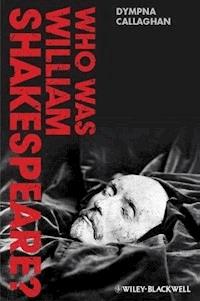
Cover image: A death mask thought to be that of English dramatist William Shakespeare. Photo (c) Hulton Archive/Getty Images
Cover design by www.simonlevyassociates.co.uk
For Chris
NOTE ON THE TEXT
I have adopted the via media in relation to the issue of modernized versus original spelling in using quotations from texts and documents from the period. I have left original spellings except where I felt it would make the language unduly difficult to understand for a non-specialist audience or when a quotation is taken from an already modernized edition. My objective here is to introduce readers to the singular eloquence of sixteenth- and seventeenth-century English with its sometimes alien locutions and resonances and to do so without making early modern spelling an impediment to reading excerpts from the period’s texts and documents. Although I have tried throughout to keep notes to a minimum, there are rather more of them in sections that make extensive reference to primary documents and historical materials.
References to the Oxford Dictionary of National Biography (ODNB) can all be found in its online edition at http://www.oxforddnb.com/.
ACKNOWLEDGMENTS
First and foremost I want to thank the very best of editors, Emma Bennett at Blackwell, for her faith in me and in this project. She made a world of difference. Ben Thatcher also has my heartfelt thanks for seeing it through the press. I am very grateful for the indefatigable labors of my copy editor Felicity Marsh who has been a joy to work with. I have incurred many debts of gratitude along the way, especially to Gail Kern Paster, Georgianna Ziegler and the staff of the reading room at the Folger Shakespeare Library. Denise Walen kindly lent her expertise to the chapter on theatre, and David Kathman was a wonderfully generous resource for matters pertaining to the geography and organization of theatre in early modern London. I am especially grateful to Paul Hunneyball who provided invaluable information on naming practices in early modern England. Jason Peacey also liberally added to my store of duplicate names to put with those of Shakespeare’s sisters. To David Cressy I am almost as grateful for his most recent research on literacy and many other matters early modern as I am for the gift of his friendship. The late Irvin Matus was a generous interlocutor over many a Folger tea, and I am so very sad he is not here to see the finished product.
This book – like everything else I have ever accomplished in academic life – has benefited immeasurably from the guidance and unstinting intellectual generosity of Jean Howard. I am also immensely grateful for the incisive comments and constructive suggestions of an anonymous manuscript reviewer for the press.
Many friends and colleagues listened to my dilemmas about how to frame and organize my materials. Among the most long-suffering are Denise Albanese, Heidi Brayman Hackel, and Deanne Williams. Rory Loughnane proved himself a fabulous and stimulating colleague throughout; Laurie Maguire never tired of talking Shakespeare with me, and I owe a huge debt, as always, to her impeccable scholarship. Despite being a historian of medieval France, Samantha Kahn Herrick provided illuminating insights on our drives to Cazenovia. Frances Dolan always makes me believe that all things are possible, and without her support, intellectual energy, and friendship this book would have been not only much the poorer, but also much less fun to write. Amy Burnette and Rinku Chatterjee provided invaluable research assistance and did so with untiring efficiency and good cheer. I also owe a great debt of gratitude to my students at Syracuse University, past and present, whose encounters with Shakespeare so enhance my own appreciation and understanding of his work. I fervently hope to incur even heavier debts to them in the future.
Last, but by no means least, I must thank my family: my sister, Margaret Newcombe, offered wise counsel upon listening with superhuman patience to weekly installments of where I was with this book. My husband, Chris Kyle, read the script from first to last with unfailingly generous perspicacity and with his extraordinary knowledge of early modern England. I dedicate this book to him.
PART I
THE LIFE
1
WHO WAS WILLIAM SHAKESPEARE?
In 1841 a canon of Cologne Cathedral, Count Francis von Kesselstadt, died. His passing promised to answer definitively the question that is the subject of this book: Who was William Shakespeare? This was because among the count’s dispersed possessions was a death mask bearing the label “Traditionen nach Shakespeare,”1 and marked on the reverse “Ao Dm. 1616,” the year of Shakespeare’s death (see Figure 1.1). Believed to have been purchased in England by one of the count’s ancestors, who had been attached to an embassy at the court of James I, the curiosity was recovered in 1849 from a secondhand shop in Darmstadt and brought from Germany to the British Museum by a man named Dr Ludwig Becker as the death mask of none other than England’s national poet.2 Unfortunately, the unpainted death mask is not an image of Shakespeare, but the belief that it was such epitomizes the persistent desire to capture Shakespeare’s identity.
Figure 1.1 The Kesselstadt Death Mask.
Image reproduced by kind permission of Universitäts- und Landesbibliothek Darmstadt.
The death mask is perhaps what Shakespeare ought to look like, unlike the figure mounted on the north wall of the chancel in Holy Trinity Church at Stratford-Upon-Avon in 1622, pen and paper in hand (see Figure 1.2). Apart from the engraving executed by Martin Droeshout on the First Folio (the collection of Shakespeare’s plays compiled in 1623), this unprepossessing figure is the only reliably authentic image of Shakespeare left to posterity. It is singularly unfortunate, then, that the figure on the funeral monument in Holy Trinity, as the critic Dover Wilson once remarked, looks “like a self-satisfied pork butcher.”3 Dissatisfaction with the bust grew almost directly in proportion to Shakespeare’s posthumous reputation, which gathered increasing momentum through the seventeenth and eighteenth centuries. By the nineteenth century, fascination with the Kesselstadt death mask was excited by what was felt to be the inadequacy of the Holy Trinity monument. When A.H. Wall, who had spent many years as a professional portrait artist, addressed the Melbourne Shakespeare Society in 1890 in a paper called “Shakespeare’s Face: A Monologue on the Various Portraits of Shakespeare in Comparison with the Death Mask …” he described the monument as “a failure,” “clumsy,” “crude, inartistic, and unnatural.”4
Figure 1.2 The Shakespeare memorial bust from Holy Trinity Church, Stratford-Upon-Avon. © John Cheal “Inspired Images 2010.”
Whatever the alleged deficiencies, the Stratford monument (and it is, admittedly, no great work of art) must have offered at least a minimally adequate likeness of Shakespeare because his wife, Anne, and daughters, Judith and Susanna, his sister, Joan, as well as other relatives, friends, and denizens of Stratford who knew the poet well would have seen it every time they went to church. The dissatisfaction Wall articulates, however, extends beyond artistic merit to the ideological reconstruction of Shakespeare’s face by the Romantics as a serene and high-browed poetic countenance that probably bears little or no similarity to Shakespeare’s actual face – which the monument no doubt creditably, if not very artfully, resembles. In contrast, the marble statue at University College Oxford by Edward Onslow Ford of the handsome young poet Percy Bysshe Shelley, who drowned in 1822, looks exactly as a dead poet should (see Figure 1.3). Little wonder, then, that by the time the Kesselstadt death mask was discovered, many prominent artists and experts were eager to proclaim the likeness to be truly Shakespeare’s. After the “discovery” of the death mask, Ronald Gower, opined, “Sentimentally speaking, I am convinced that this is indeed no other but Shakespeare’s face; that none but the great immortal looked thus in death, and bore so grandly stamped on his high brow and serene features the promise of an immortality not of this earth alone.”5 Although, periodically, claims for its authenticity resurface (the most recent advocate being Dr Hildegard Hammerschmidt-Hummel of the University of Mainz in 2006), the death mask’s authenticity has now been wholly discredited, and it does not any longer form part of the British Museum collection, having been consigned to the provincial obscurity of the Grand Ducal Museum in Darmstadt, Germany. David Piper of the National Portrait Gallery in London has queried whether the artifact even genuinely dates from the period. He claims that if it had been an authentic Jacobean artifact, “it must be the only death mask of a subject other than royalty known to have been made let alone survived at this period.”6 What the death mask unequivocally demonstrates, however, is the degree to which ideas about authorship inherited from the nineteenth century still shape ideas and understandings of Shakespeare’s life and work. It is, after all, the disparity between the Shakespeare to be found in the historical record and exalted ideas about dead poets that have led Oxfordians and others to dismiss the real, historical Shakespeare as the mere “man from Stratford.”
Figure 1.3 Memorial Sculpture of Percy Bysshe Shelley by Edward Onslow Ford.
Photograph by Dr Robin Darwall-Smith, FSA, FRHistS. Used by the permission of the Master and Fellows of University College Oxford.
We might expect that Shakespeare would have at the very least merited the services of one of the greatest artists of his time, some English Michelangelo: perhaps Nicholas Stone, who sculpted the magnificent full-length statue of John Donne in his shroud for St. Paul’s cathedral in 1631. Stone was already receiving important commissions by 1614 when he was only fifteen years old, and two years later, in the year of Shakespeare’s death, he was appointed to royal service. Or perhaps Maximilian Colt, who completed the marble sculpture of Elizabeth I for Westminster Abbey, and who in 1608 was appointed master carver to the king, would have been a worthy recipient of the commission. Despite the disparagement heaped on the artistic inadequacies of Shakespeare’s funeral monument, its artist, Gheerart Janssen (sometimes anglicized as Gerard Johnson), the son of a Dutch sculptor of the same name who had settled in London around 1567 and established a notable family business near the Globe theatre in Southwark, was, in fact, a perfectly respectable choice to execute the likeness of the poet. The Janssens had sculpted the handsome monument for Edward Manners, the third Earl of Rutland, who died in 1587. This work is on a vastly larger and grander scale than Shakespeare’s effigy. It includes evidence of the scope of Rutland’s political power in the kneeling alabaster figure of Rutland’s granddaughter, Elizabeth, whose marriage he had arranged to none other than the grandson of Elizabeth’s chief minister, William Cecil, Lord Burghley. A second tomb (which also interned his wife Elizabeth) was made for Edward’s brother, John, the fourth Earl of Rutland, who died only a year later. For this aristocratic charge – two tombs and four paintings erected at St Mary the Virgin in Bottesford, Leicestershire – Janssen the elder was paid two hundred pounds in 1590. When Roger, the fifth earl died, the Janssens were employed again for a recumbent alabaster effigy of the earl and his wife. Shakespeare probably knew about these tombs because the sixth Earl of Rutland, Francis Manners, was a friend of Shakespeare’s patron, the Earl of Southampton. Indeed, Rutland and Southampton had been brought up together as wards of Lord Burghley. Further, Rutland hired Shakespeare along with Richard Burbage for forty-four shillings apiece to design an impresa – a chivalric device of an emblem with a motto – which would be displayed on the combatant’s shield, for the Accession Day Tilt, an annual jousting tournament, of 1613.
A comparison between the full-sized, elaborate, recumbent effigies of the earls of Rutland replete with ancillary figures and Shakespeare’s modest edifice is instructive. Shakespeare was a poet, a playwright, and a player, not an aristocrat, and his funeral monument, commemorating a life begun in Stratford, where he was baptized in 1564 and buried in 1616, is an instance in which art accurately mirrors life, or at least social status. This is exactly how early moderns thought things should be. For, as John Weever observed in Ancient Funerall Monuments (1631), “Sepulchers should be made according to the qualitie and degree of the person deceased, that by the Tombe one might bee discerned of what ranke he was living.”7 The image in Holy Trinity Church, reflects rather accurately, then, the status of a poet and playmaker in early modern England, even one of Shakespeare’s unparalleled talent. By these standards, the bust is appropriate, and thus successfully fulfills the purpose for which it was intended. Indeed, Nicholas Rowe records in his 1709 volume of Shakespeare’s works that in 1634 an early visitor, a Lieutenant Hammond, described it as a “neat Monument.”8 The image in fact tells us a great deal about what it meant to be an author at a time when no one then living could ever have envisaged that the gifted Warwickshire native would vie with Elizabeth I as the most important figure of late sixteenth-century England.
Shakespeare’s immediate family almost certainly commissioned the monument, and they probably employed Gheerart Janssen because he had executed the full-length, recumbent alabaster effigy of fellow-Stratfordian, John Combe, which also lies in Holy Trinity Church. Combe was the friend who left “Mr. William Shackspere five pounds” in his will, and when the poet himself died, he bequeathed his sword to another member of the Combe family, Thomas, John’s nephew. Shakespeare’s image is just the torso and is made of the cheaper, local Cotswold limestone and would have been considerably less expensive than Combe’s more elaborate monument that cost sixty pounds in 1588. However, what most distinguishes the monuments of these friends is that Combe is depicted lying down in peaceful repose whereas Shakespeare is alert, upright, and at work. This posture is not unique to Shakespeare but simply accords with representational convention. The chronicler of London, John Stow, for example, is also thus depicted. Yet, that Shakespeare, almost completely bald, whiskered, and wearing a red doublet and a black sleeveless gown, holds the tools of his trade in his hands – a quill and paper – conveys the sense that even Shakespeare’s afterlife would be in some way about writing rather than resting in peace.
The bizarre phenomenon of the Kesselstadt death mask, however, promised something more than a face better fitted to Shakespeare’s plays than Janssen’s rendering. Had it indeed proved genuine, the mask would constitute the material vestige of Shakespeare’s actual visual identity in a way that a mere sculpted depiction does not. What is more, the Janssen bust is one of only two verifiably authentic portraits of Shakespeare – the other being Martin Droeshout’s engraving on the First Folio.9 The yearning, represented by the death mask, for an image that would take us closer to Shakespeare is understandable in so far as his lineal descendants had died out before the end of the seventeenth century and there are no truly personal traces, such as diaries, letters, or possessions, not even the much-vilified second-best bed that Shakespeare bequeathed to his wife. Probably the closest we get to Shakespeare-the-man is his will, which is simply an inventory of his possessions and their disposal. Little wonder, then, that, even in the late twentieth century, Susan Sontag wished for an impossibly vivid connection with Shakespeare: “Having a photograph of Shakespeare would be like having a nail from the True Cross … , something directly stenciled off the real, like a footprint or a death mask.”10 The German mask had, in fact, promised precisely such a hallowed and evidentiary trace: red facial hair was still attached to the plaster on the inside.11
Thus, the fascination with Shakespeare’s image has persisted despite Ben Jonson’s famous verse directing readers to the works rather than the engraving on the First Folio: “Reader look / Not on his picture, but his book.” Written seven years after Shakespeare’s death and printed under an engraving of the Holy Trinity bust, Leonard Digges’s verse panegyric issues a similar reminder:
when that stone is rent,
And time dissolves thy Stratford monument,
Here we alive shall view thee still. [in] This book12
The monument did indeed begin to fall apart rather early on: the fingers had broken off and the paint peeled away by 1748. But then, in 1793, the Shakespearean editor Edmond Malone persuaded James Davenport, then vicar of Stratford, to whitewash the bust in the mistaken belief that this restrained, classical style must have been its original color. For his pains, Malone – whose editorial labors, though lauded by many contemporaries, also had their vocal detractors – was rewarded with an epigram inserted in the Stratford Visitors’ Book:
Stranger, to whom this monument is shewn,
Invoke the Poet’s curse upon Malone;
Whose meddling zeal his barbarous taste betrays,
And daubs his tombstone, as he mars his plays!13
In 1861, the “daubed” image was repainted, this time in the belief that Shakespeare was represented to borrow his own words in “his very habit as he lived.”14
I begin this volume with the end in mind, the end, that is, both of Shakespeare’s life in his funeral monument and the posthumous reputation that so far outshines it – he was voted Man of the Millennium, for instance, in 2000. Shakespeare’s life does not and cannot explain his works, but it can, I trust, help us to more fully understand them. The central theme of this book is how Shakespeare’s personal circumstances together with historical events and conditions, as well as political, social, and institutional frameworks, helped constitute his identity as a writer. This book takes a counterintuitive approach to Shakespeare’s life, not examining how it was different from the lives of other Elizabethans, but rather the ways in which it occupied common ground with theirs. What made Shakespeare exceptional was not, after all, his life (his extra-literary pursuits) but his identity as a writer, his literary and theatrical career. Above all, this book endeavors to understand what it meant to be a writer in a world long before the rise of the novel. This entails an examination of the intellectual, social, and political forces – educational institutions, systems of patronage, and new institutions such as the printing house and the public theatre – that molded a writer and created the category of the author, the creative literary artist as we have come to know it. Endeavoring to understand Shakespeare’s life and writing also necessitates understanding the complex political and religious forces that upheld and opposed his art. For Shakespeare was part of the Elizabethan Renaissance, that remarkable flowering in English letters that occurred towards the end of the sixteenth century, a period which produced, at an exponential rate, some of the greatest authors in the language: Philip Sidney, Edmund Spenser, John Donne, Ben Jonson, and Christopher Marlowe – along with a host of other writers whose very considerable successes are often dwarfed by the titanic proportions of their contemporaries. However, the post-Reformation Protestant regime in which Shakespeare lived also saw some of the most voluble objections to literature as a discourse that promulgated untruth and ungodliness, and to the theatre as a place that fostered idolatry and immorality.
That the established “facts” of Shakespeare’s life for which there is irrefutable documentary evidence are relatively few is a circumstance neither unusual nor one that tarnishes the veracity of the facts themselves. It is a “fact” that, according to historians of the period, the survival rate for early modern documents is low and that Shakespeare lived in a world prior to the systematic, all-inclusive collection of data that provides the foundation of modern bureaucracy. Shakespeare’s life left two kinds of texts in its wake. The first takes the form of various church and legal documents of which he was not the author but which sometimes refer to him or, in the case of his will, for instance, bear his signature. The parish register duly notes his baptism, marriage, and death, while legal records, especially relating to property transactions and bequests, provide the far from scant evidence for his life. This volume does not aim to detail every legal document, every property transaction, or every record that can be connected with Shakespeare, because this would merely be to traverse rather dry ground that is already amply covered elsewhere. We are fortunate that Shakespeare’s art is left to us in a much more abundant supply than these secondary documents, even though neither the plays nor the poems, any more than the legal records, offer the kind of material that allows anything other than speculation about Shakespeare’s inner world, his emotions, relationships, or political opinions. Even if information about other matters pertaining to a writer’s life, such as his opinions and emotions, his political and religious adherences, and so forth, is sparse, what is remarkable about Shakespeare’s life is that the interstices of all that counts as “evidence” and “fact” are crammed with literary production.
In brief, the substantive details of Shakespeare’s life, chronologically arranged (but excluding the often very problematic dates of performance and publication of his plays) are as follows: He was born the eldest son of John Shakespeare and his wife Mary, née Arden. His father, a glove maker, was a prominent tradesman in Stratford-Upon-Avon and became a bailiff in 1568. An older sister, Joan, had been born in September 1558 and seems to have died in infancy, a fate that also befell John and Mary’s next daughter, Margaret, born in 1562 and buried the following year. Shakespeare, christened on April 26, 1564, was luckier and survived an outbreak of plague in the area during his infancy. His brother Gilbert was born to them in 1566, another child, also named Joan, in 1569, and their daughter Anne, in 1571. Anne, however, died at only eight years of age, and indeed, of Shakespeare’s four sisters only Joan, reached adulthood, dying in 1646. Two more brothers, Richard, born in 1574 and Edmund, born in 1580, completed the family. Of his male siblings, only the much younger Edmund followed Shakespeare’s path to London and became an actor. None of his brothers survived him, though they all lived to adulthood.
Since there was a thriving grammar school in Stratford, that is undoubtedly where Shakespeare received his education. We do not know why in 1582 Shakespeare was issued a marriage license by the bishop of Worcester to marry Anne Whateley of Temple Grafton, but it is most likely simply the result of a clerical error since when he was eighteen, in November 1582, he married Anne Hathaway from Shottery, nearby to Stratford. Shakespeare’s first child, Susanna, although born in wedlock was conceived some months outside it. She was baptized on May 26, 1583, and two years later, on February 2, 1585, William and Anne’s twins, Hamnet and Judith, were christened. By 1587, Shakespeare’s father’s fortunes, which had been on the decline for at least ten years, had fallen so low that he was expelled from the corporation of Stratford. By 1592, when Shakespeare was twenty-eight, he was clearly a force to be reckoned with in the London theatre because he was attacked as an “upstart crow” in Greene’s Groats-worth of Wit, a book purportedly written by Robert Greene. Shakespeare had secured the patronage of the Earl of Southampton by 1593, and the earl was the dedicatee of the narrative poem of that year, Venus and Adonis and, in the following year, of The Rape of Lucrece. By 1595, Shakespeare was a member of the Lord Chamberlain’s Men, who were engaged for royal performance. In 1596, tragedy struck, and his son, Hamnet, was buried on August 11. On his father’s behalf, in the following year, Shakespeare applied to the College of Arms for a patent of gentility, and in 1597 he purchased New Place, the finest house in Stratford. Also in 1597 he was mentioned by Francis Meres in Palladis Tamia as, at that point in time, the author of twelve plays and a number of unpublished “sugar’d sonnets,” which were in restricted manuscript circulation. In Warwickshire in 1599 he was reported by the borough survey as hoarding eighty bushels of malt during a period of dearth. Meanwhile in London that year, the Globe theatre was built in Southwark on the south bank of the Thames. On September 8, 1601 his father was buried. In 1603 Shakespeare was still working as an actor, playing a leading role in Ben Jonson’s Sejanus. In 1602 and 1608 he pursued two of his debtors in Stratford, for a total of less than £10. He purchased tithes in the Stratford area in 1605 for £440, and records of 1614 show his involvement in William Combe’s attempts to enclose common land in the parish of Welcombe near Stratford. In 1607, his daughter Susanna married the physician John Hall, while the following year saw the death of his mother. In 1609, his Sonnets were published, long after the English sonnet craze of the 1590s had passed. He gave evidence in a lawsuit at the Court of Requests in 1612 in relation to a marriage contract which he had facilitated while lodging at the home of Christopher Mountjoy and his family in Silver Street. In 1613, the same year that the Globe was razed to the ground by a fire ignited during a performance of Henry VIII, he purchased the gatehouse at Blackfriars, although he never lived in the property. The Globe reopened the following year. Two months before his death, Shakespeare’s youngest daughter, Judith, married Thomas Quiney, who had already fathered a child upon another woman, Margaret Wheeler, and was sentenced by the consistory court for his offence. Wheeler was buried with her infant on March 15, 1616. A month later, Shakespeare was buried himself, on April 25, 1616. Anne Shakespeare, his wife, survived him and died in 1623. Although he remembered both of his children in his will, the bulk of his property went to his eldest daughter, Susanna.
In a life begun and ended in Stratford, Shakespeare had chosen not to shake the dust from his native place but rather to consolidate his status there. As he put it in the narrative poem The Rape of Lucrece (1594), “The aim of all is but to nurse the life / With honour, wealth and ease in waning age” (ll.141–2). These lines strike a decidedly Elizabethan note with their articulation of the relatively modest aspirations to social respectability and comfort in a poem set just before the dawn of the Roman republic where imperial and dynastic ambitions rather exceeded the desire to amass sufficient wealth to stave off destitution in old age. That said, wealth and ease were hardly negligible considerations in Shakespeare’s world.
The popular fascination with Shakespeare’s life has, if anything, increased in recent years, despite the ostensible paucity of documentary evidence. Similarly, interest in the so-called authorship controversy remains unabated. If it strains the credibility of those skeptical about Shakespeare’s authorship that a man who never went to university and who did not have an illustrious aristocratic background authored his plays, we might do well to consider the case of Shakespeare’s friend and fellow-dramatist, Ben Jonson, about whom there is no authorship controversy. We do not know the Christian names of either of Jonson’s biological parents, and his stepfather’s name, Robert Brett, was only uncovered in the latter part of the twentieth century. The absence of such material is neither unusual nor mysterious given the survival rate for early modern documents. Nor was Shakespeare’s social standing or education unusual for a writer in his day. Christopher Marlowe, Shakespeare’s great contemporary and rival in the late sixteenth century, was the son of a Canterbury cobbler. Unlike Shakespeare, Marlowe had attended Corpus Christi College in Cambridge, but the immensely learned Jonson, who notoriously charged that Shakespeare had “small Latine and lesse Greeke,” did not attend university at all. After receiving his elementary education at the school of St Martin-in-the-Fields in London, Jonson attended Westminster School under the great antiquary William Camden. The stepson of a bricklayer, he followed his adoptive father into the trade, and indeed maintained his right to work as a paid-up member of the Tylers and Bricklayers Company even at the height of his literary career, when his identity as a playwright and poet was thoroughly established. Understandably wishing to avoid arguments that purport to unseat the “man from Stratford” as the author of Shakespeare’s works, instructors are sometimes reluctant to engage with the issue of Shakespeare’s life at all. Unfortunately, this works to cut off one of the main reasons that readers are initially interested in Shakespeare and one of the primary reasons that students sign up for Shakespeare classes. What underlies this fascination with the authorship issue is the perfectly legitimate interest in the contours of Shakespeare’s life. Readers are right to want to know how it came to be that Shakespeare wrote so many of the world’s literary masterpieces and to ask precisely what kind of life he was living while he was writing them.
I begin with three of the most significant issues that shaped Shakespeare’s identity: these are education, religion, and social status. Indeed, the last two of these were inescapably conditions of every Elizabethan life, and, of these, social status, the fundamental hierarchy of Shakespeare’s world, based on wealth, property, and lineage, was by far the most important force in determining the trajectory of all lives in early modern England. For Shakespeare personally, of course, education, the very real and substantial source of his literary achievements, was the most important factor in allowing him as a gifted individual to become a writer. Access to that education, however, was also a direct index of status. A boy in Elizabethan England did not need to be from an exalted or aristocratic background to receive a grammar school education, but he still needed at least modest means, which, small though it might be, was nonetheless far beyond the mass of the laboring population. The remaining category, religion, was, of course, a vexed, highly fraught dimension of life in the post-Reformation era of Shakespeare’s time, as English Christianity, splintered by schism, took new and unprecedented forms. That church attendance, far from being a voluntary expression of devotion, was mandatory, while heresy and atheism were subject to severe legal censure, meant that prescribed belief was compelled by the state, which often ensured compliance by violent means. In these ways, religion infused almost every aspect of early modern life. Far from being, then, the backdrop for Shakespeare’s writing, religion formed the crucible in which his secular drama was generated.
The subject of Chapter 2 is, literally, writing and the humanist institution that most fundamentally shaped Shakespeare’s art, namely the Elizabethan educational system. Shakespeare, Marlowe, Jonson, and many others were all beneficiaries of the Protestant revolution in education and, in particular, of the Elizabethan grammar school system in a way that was unique to their generation. There is no evidence whatsoever that the parents of arguably the greatest writer who ever lived could write. John Shakespeare, though prosperous, was uneducated and never signed his name but always used the conventional, and in his case, the neatly crafted, substitution for it, his “mark.” That even this fact has been a source of contention amongst commentators arises only from the refusal to credit the reality of Elizabethan provincial life where well-to-do people often remained unable to write.
An unreliable anecdotal account of Shakespeare’s early years from the eighteenth century reports that he initially followed his father’s trade, though the story has him slaughtering animals (which was not, in fact, a dimension of John Shakespeare’s employment) and making tragic speeches upon dispatching a calf. Despite paucity of all other evidence, however, one thing we know definitively about Shakespeare is that his move to London represented a definitive decision not to follow his father any further (if indeed he had ever followed him at all) into the trade of whittawer, or whitener of leather (one who “taws,” that is dresses skins with alum and salt), and glover. When Gonzalo in The Tempest ponders a utopia where “letters” (literacy) are unknown (2.1.150), his speech, though indebted to Michel de Montaigne’s account of the indigenous inhabitants of Brazil, would also have reminded those in his audience who were the first generation of literate people in their families, of a world to which they could now never fully return. Stratford produced not only Shakespeare but also the printer Richard Field, who was only three years his senior and the son of a tanner, a trade very much related to that of Shakespeare’s father. Field also went to London to become a stationer’s apprentice. In the immensely successful pursuit of his vocation he published some of the most important works of his era, including Shakespeare’s Venus and Adonis (1593), George Puttenham’s Arte of English Poesie (1589), and Sir John Harington’s translation of Ariosto’s Orlando Furioso (1591). Field, too, was an important part of the burgeoning literary enterprises of the era. Thus, although literacy rates for the overall population were low, even boys of humble background who attended the grammar school, might make something of themselves far beyond the crafts and trades that their forefathers had practiced in the provinces. The chasm opened up by education between the lettered and unlettered that comes up in so many of the plays (Romeo and Juliet and The Tempest, for example) allows us to ask what it means to be a professional writer in this period and precisely where that occupation stood along the spectrum from basic literacy to literary authorship.
Chapter 3, “Religion,” addresses the fundamental conundrum of dealing with the years in which Shakespeare lived in anonymity before the establishment of his London career. Theories about Shakespeare’s religious identity have shaped the lacunae of information pertaining to this period in his life. While critics have argued variously that Shakespeare was a staunch Protestant, a devout crypto-Catholic, a furtive nonbeliever, or the holder of any one of a range of positions in between, this chapter stresses instead the ways in which the impact of the Reformation, religious persecution, and anxiety about religious identity invariably informed Shakespeare’s theatrical practice as well as his identity as a writer.
Chapter 4, “Status,” treats Shakespeare’s application, on his father’s behalf, for a coat of arms, which would allow him the status of a gentleman: Wm. Shakespeare, Gent. But what exactly did that shift in status mean in early modern England? What procedures were involved in attaining official ratification of the fact that Shakespeare had crossed the vast social chasm that separated commoners from the gentry? In addressing these questions, we will see that Shakespeare’s reach for upward mobility did not go uncontested and that the obstacles he encountered at the College of Arms reflect some of the most tumultuous changes in his society, changes which he in turn addresses in his plays. Although the structure and function of the College of Arms remain opaque or obliquely referenced in most extant biographies, it was one of the most important institutions in early modern England. Further, the College provides one of the most illuminating sources of information on the lived experience of class identity in the period. This chapter is especially concerned to explain its operations with utmost clarity.
The final chapter in this section addresses the social and professional conditions that molded Shakespeare’s theatrical career in London. Astonishingly, the first printed account of Shakespeare is very negative indeed, but this may be accounted for by the fact that it was written by one of his rivals (though not necessarily the one whose name is on the title page) in a pamphlet entitled Greene’s Groats-worth of wit (1592). Shakespeare’s success had clearly ruffled some feathers because the pamphlet’s author disparages him as an “upstart crow” and a “johannes factotum” (jack-of-all-trades) who believes he is the only “shakes-scene” in the country. These comments indicate something of the competitive environment of early modern theatre, which, paradoxically, also required collaboration in order to meet the tremendous demand for new plays. This chapter goes on to address the nature of theatre as a new urban institution with a fixed location as well as the pressures of censorship on both performance and print, and, finally, the rather anomalous situation of actors and their companies in comparison with other situations of employment in the capital.
The chapters that comprise Part II treat individual plays from every genre in Shakespeare’s oeuvre. The analyses of the plays also include reference to Shakespeare’s sources and the status of early texts of each play as well as evidence, where available, for first performances. Included here are also reminders (relatively unobtrusive, I hope) of the plot, which will be a little more comprehensive in chapters covering plays that are less often staged and therefore likely to be less familiar to the majority of readers. Reasons of space preclude the treatment of every play and poem, and I extend my apologies in advance to readers who find their favorite work omitted. If it is any comfort, several works very close to my own heart could not be included in the final selection. Nonetheless, while no single volume can do justice to Shakespeare’s achievement, what remains offers a representative sample of the variety of his writing as a poet for both page and stage.
There is little in the way of irrefutable evidence to support the view that The Comedy of Errors was Shakespeare’s first play, but simply because this has been a traditional assumption about the order in which the plays were written, Part II begins there. The genre categories under which the plays are considered are comedies, histories, and tragedies, as well as a category not to be found in the First Folio, namely, romances. Four of Shakespeare plays share the magical and improbable plotlines and the redemptive happy endings that characterize romance, namely Cymbeline, Pericles, The Winter’s Tale, and The Tempest. The latter two, being far more often staged and read, are addressed in this book. Even though The Tempest was placed first in the list of Shakespeare’s comedies in the Folio, these plays have come to be understood to merit a discrete category because they represent the trajectory of Shakespeare’s writing within the genre of comedy towards the end of his career. This development is significant to any biographical account of Shakespeare’s work, or what the title page of Pericles calls “the true relation and whole Historie, adventures, and fortunes” of our poet.
Chapter 6, “Comedies: Shakespeare’s Social Life,” addresses the great range of experience in Shakespeare’s comedies, some of which press the genre to the very edges of its boundaries. What all the plays addressed here have in common is that they demonstrate the way that comedy is an intrinsically social genre about how men and women go about the business of interacting with one another so as to achieve a certain connectedness, either as conjugal pairs or as a cohesive community. Using information about Shakespeare’s day-to-day life in Stratford and London, each reading in this chapter examines the extraordinary power and complexity of the comic perspective. The discussion of The Comedy of Errors, for example, revolves around the fact that Shakespeare had two sisters who were named Joan and uses extensive archival evidence to show how the early modern practice of duplicate naming operated and how it illuminates the treatment of social identity in the play. The Taming of the Shrew section examines the way this play pays homage to Shakespeare’s rural Warwickshire roots. Indeed, the play proves insistently domestic in being a comedy of marriage rather than a comedy of courtship. The analysis of Love’s Labour’s Lost takes Shakespeare’s connections with the translator John Florio, who lived for a time at the French Embassy in London, as a way of beginning to understand what the representation of brilliant and glittering French court culture might mean in England. The section devoted to A Midsummer Night’s Dream considers Shakespeare’s creative and conceptual engagement both with his female sovereign and with the sovereignty of art that he sets so skillfully against the flora and fauna of his native place. In contrast, that on The Merchant of Venice considers all that Shakespeare encountered that was not marked by familiarity and domesticity, particularly those Jews and Italians who were, like himself, entertainers for the court. The next section considers the title of Much Ado About Nothing and specifically its bawdy double entendres, which were regularly recorded in language from the streets of Shakespeare’s London in court depositions relating to women indicted for prostitution. The slander of an aristocratic woman, like the vilification of lower-class women arraigned by authorities, raises the question of who gets to adjudicate a woman’s chastity. The Forest of Arden returns us to Shakespeare’s native county in the next section on As You Like It as Arden has a direct topological connection with Warwickshire as well as being his mother Mary’s maiden name. In this play, the forest is a refuge where Shakespeare uses the license of comedy, exile, and displacement to explore some of the most profound political questions of his day – and indeed of ours – about the nature and extent of political liberty. The proximity of the Paris Garden bearbaiting ring to the Globe is the spur to this analysis of Twelfth Night. Here, Shakespeare examines both cruelty and festivity as the motivations for laughter. Shakespeare turned to the landscape of the city in Measure for Measure, so this section uses the French-speaking population of London, with which Shakespeare was intimately involved, as a means of juxtaposing the threatened decapitation of Claudio with an actual instance of decapitation for sexual misconduct in Calvin’s Geneva.
The plays analyzed in Chapter 7, “English and Roman Histories: Shakespeare’s Politics,” focus on political concepts, structures of law, and government more than on individuals and localities. The objective here is not to discern Shakespeare’s own political opinions, to which we do not have access, but to assess to what degree “Peace, freedom, and liberty!” (Julius Caesar 3.1.110) motivated the popularity of this genre in its own time. The readings here show how Shakespeare navigated the treacherous waters of some of the most volatile political and newsworthy issues and events of his day, from plots against Elizabeth to the circulation of seditious, contraband European writings against tyranny. In particular, Richard II was arguably Shakespeare’s closest encounter with the ire of the Elizabethan state, while Richard III (written before Richard II) exposed, via the compelling histrionics of its eponymous protagonist, the sometimes astonishing contiguities between theatre and power. The First Part of King Henry the Fourth examines the play as unique among Shakespeare’s histories with its dramaturgically remarkable counterpoints between high and low culture, history, and comedy, and its widespread disposition of social groups. The play shifts between registers, from the blank verse sphere of high politics to Welsh lyricism to the prose world of those who haunt taverns and commit highway robbery. This chapter ends with two Roman histories, Julius Caesar and Coriolanus, even though the editors of the First Folio, John Heminges and Henry Condell, placed these plays under the heading of tragedy because these are profoundly and explicitly political tragedies. The section on Julius Caesar begins with the emperor’s historical connection with England, arising from the fact that he had invaded the country in 54 BC, and examines the degree to which autocracy in ancient Rome might be understood as analogous to absolute monarchy in England. The section on Coriolanus examines the play’s action-hero, warrior protagonist as, in an important sense, the antithesis of Shakespeare, construed, for the purposes of this analysis, as a reader – that is, as someone intimately engaged with books. Indeed, this play provides telling evidence of how Shakespeare read history with a view to transposing what he read onto the medium of theatre.
Chapter 8, “Tragedies: Shakespeare in Love and Loss,” addresses Romeo and Juliet, Hamlet, Othello, King Lear, Macbeth, and Antony and Cleopatra. I explore the irreducibly literary dimension of tragedy as well as its intersection with commonplace social incidents of grief and loss, some of them in Shakespeare’s own family. Shakespeare’s sorrows are ordinary: the loss of a child, the loss of a father. What is extraordinary, however, is the way that he turns these nearly ubiquitous forms of loss, these everyday heartbreaks, into the great tragedies of this period.
The section on Hamlet explores the extraordinary onomastic coincidence between the play’s title and his dead son, Hamnet, as well the “muddy death” of a young woman from a village close to Stratford, Katherine Hamlett. In fact, names in Shakespeare often hold biographical clues, and the discussion of King Lear begins by asking why Shakespeare gave one of his greatest villains the same name as his brother. The great paradox considered in the section on Othello is that although the play is in so many ways decidedly un-English, so indebted to the idea of Africa and to its Italian source, it is nonetheless a domestic tragedy. Othello addresses matters very close to home, especially the slander of the virtuous wife, to which any woman, including Shakespeare’s own daughter Susanna might fall victim. The two love tragedies considered here, Romeo and Juliet and Antony and Cleopatra are addressed in the light of less immediately personal issues. The former bespeaks Shakespeare’s intense engagement with Petrarchan poetry, and the latter evidences his interest in the essentially theatrical problem of how to present goddess-like power and femininity.
The final chapter, “Romances: Shakespeare and Theatrical Magic,” addresses The Winter’s Tale and The Tempest, written towards the close of his career, in which families are ultimately reunited by means of extraordinary theatrical magic. The analysis of The Winter’s Tale begins with its court performance in 1611 before the royal couple who were bitterly familiar with the loss of children and whose marital strife about fostering their eldest son and heir in the 1590s had been made public by means of newsletters. News and current events also play a significant part in The Tempest. While these plays are traditionally viewed as Shakespeare’s retrospective on his career in theatre, it is also important that he was, even in his later work, still attuned to matters of immediate interest both to himself and to his audience. The Tempest (now understood to have been followed by collaborative work with John Fletcher), is the focus of the final section, which considers the rather astonishing fact that Shakespeare himself, despite transporting his audience to strange and exotic climes in this play, probably never left England.
What follows, then, is an account of Shakespeare’s writing aimed at readers who have a healthy appetite for information about Shakespeare’s life. This exposition is intended to provide a clear guide to Shakespeare and his works and to deepen readers’ knowledge about Shakespeare’s literary achievement and his historical moment. My aim throughout this book is to make Shakespeare’s personal, social, and literary identity more vividly present. In so doing, I hope also to demonstrate how Shakespeare incorporated the life around him into his plays and how his works show that process as one which in turn might alter, transform, or astonish the reality that had first shaped it.
Notes
1 Samuel Schoenbaum, Shakespeare’s Lives (Oxford: Clarendon Press, 1991), p. 338.
2 Schoenbaum, Shakespeare’s Lives, p. 338; James Walter, Shakespeare’s True Life (London, 1889); David Piper, “O Sweet Mr Shakespeare: I’ll Have His Picture” (London: National Portrait Gallery, 1964), p. 36.
3 Quoted in Samuel Schoenbaum, William Shakespeare: A Documentary Life (New York: Oxford University Press, 1975), p. 254.
4 A.H. Wall, Shakespeare’s Face: A Monologue On the Various Portraits of Shakespeare in Comparison with the Death Mask Now Preserved as Shakespeare’s in the Grand Ducal Museum at Darmstadt (As read before the Melbourne Shakespeare Society, in Australia) (Herald Printing Office: Stratford-Upon-Avon, 1890), p. 4.
5 Quoted in Schoenbaum, Shakespeare’s Lives, p. 338.
6 Piper, “O Sweet Mr Shakespeare” p. 36; Nigel Llewellyn, Art of Death: Visual Culture in the English Death Ritual, c.1500–c.1800 (London: Reaktion), p. 54.
7 Quoted in Roy C. Strong, English Icon: Elizabethan and Jacobean Portraiture (New Haven: Yale University Press, 1970), p. 29.
8 Schoenbaum, Documentary Life, p. 185.
9 See Susan Sontag, On Photography (New York: Picador 1977, 1st edn 1973), p. 154.
10 Sontag, p. 154.
11 See Jonathan Gil Harris, “Shakespeare’s Hair: Staging the Object of Material Culture,” Shakespeare Quarterly 52 (2001): 479–91.
12 Walter, Shakespeare’s True Life, p. 266.
13 Schoenbaum, Documentary Life, p. 256.
14 Schoenbaum, Documentary Life, p. 255.
2
WRITING
In a humorous soliloquy in the first act of Romeo and Juliet, Capulet’s unnamed and illiterate servant is given a list of people he must invite to the Capulet ball: “I am sent to find those persons whose names are here writ, and can never find what names the writing person hath here writ” (1.2.40–2).1 Perplexed, the servant finds himself in the comic predicament of being the intermediary between two entities, both of whom are, in different senses, illegible to him: the author of the list, that shadowy figure, “the writing person,” and the “persons whose names are here writ.” Conscious of his deficiency, the serving-man jokes about his unsuitability for the job at hand with a comic analogy: “It is written that the shoemaker should meddle with his yard and the tailor with his last, the fisher with his pencil [paintbrush], and the painter with his nets” (1.2.38–40). Jokingly, he assigns the tools of the crafts mentioned to the wrong tradesmen: it is a shoemaker who uses a last, not a tailor; a tailor, not a shoemaker, uses a yard; while fishermen, as we know, use nets and painters, brushes. Interestingly, the manual laborers in his itinerary were not always illiterate, and tailors in particular could often read and write. It is also significant that the serving-man’s dirty joke about tradesmen who play (“meddle”) with their own – as well as possibly other men’s – (sexual) equipment (“yard” and “pencil” were slang terms for the male organ) begins with the mildly blasphemous use of the term that typically prefaced readings and quotations from scripture: “It is written.” The authority of scripture was paramount in this society and had been lent greater power by the advent of the printed word, but this was also the period in which authorial identity in a specifically literary sense emerges to greater prominence. At last, the serving-man alights on the only possible solution to his quandary: “I must to the learned” (1.2.40–2; my emphasis). While the gulf between “the learned” and the unlearned, “the writing person” and the illiterate, is bridged here by comedy, it remained one of the starkest divisions in Shakespeare’s society. For Shakespeare, like many others, that division scored through his family as well as his world. This chapter explores what it meant in such a context for Shakespeare to be a “writing person.”
Shakespeare must have covered sheaf upon sheaf of paper with ink during his working life. Of all that labor, not one manuscript of any of the plays printed in the First Folio survives in Shakespeare’s hand. There are only six indisputable autographs, all on legal documents: six relatively inconsiderable traces of Shakespeare’s signature. Notwithstanding Oliver Wendell Holmes’s contention that to spell any word the same way twice is evidence of a lack of imagination, that none of these signatures are spelled the same way would not, from our twenty-first-century point of view, seem to indicate that Shakespeare was a highly literate person. The spelling of inexperienced writers in the period sometimes bespeaks a more phonetic expression than that to be found among those with more highly developed literacies, but such generalizations are difficult to sustain because early modern spelling is notoriously erratic. Standardized spelling was not introduced until the eighteenth century, and spellings such as “aboute,” “younge yeares,” “sonne,” and “paste” (for “past”), are not wrong in our modern sense. Nor are they necessarily the product of a person of mean estate, of someone low on the totem pole of early modern social hierarchies. In fact, these examples are taken from a letter found in the Folger Library’s Bagot collection that was written by the aristocrat Lady Markham to her brother in 1610.2
Shakespeare’s wayward spelling, then, while it may not distinguish him from the minimally or partially literate, does not necessarily make him one of them. That Shakespeare writes in the distinctive cursive script known as secretary hand, on the contrary, indicates a person who writes regularly and with some rapidity. Importantly, in Shakespeare’s day, those who were most fully engaged in the material practices of writing were not authors themselves, who were referred to as “poets,” but scribes who made “fair copies” of both legal and literary documents either for manuscript distribution or for print. Indeed, this kind of writing was sometimes disparaged as mere penmanship, or as Martin Billingsley put it in The Pen’s Excellencie (1618), as “onely a hand-labour,”3 that is, as manual work that did not require the use of the intellectual faculties. That writing was time consuming and physically demanding labor is noted by the scrivener in Richard III, who reports that he has been ordered to copy a legal document: “Eleven hours I have spent to write it over” (3.6.5).4
Only three manuscript pages by “Hand D” from the coauthored play Sir Thomas More exist as presumed autographic evidence of Shakespeare’s creative expression. It is instructive, too, that Shakespeare’s signature does not survive on his poetic scribbles but on the documents early moderns considered most important, namely those pertaining to legal proceedings and the transfer of property: the deed for the gatehouse property at Blackfriars and the mortgage for the Blackfriars’ property; a court deposition in the dowry dispute known as the Belott-Mountjoy case (in which he was called as a witness); and his will. Indeed, three of Shakespeare’s extant signatures were affixed to his will, and all but the final one – the most important one on a legal document – probably represent contractions of his full name rather than misspellings of it as such. The oddity of Shakespeare’s signatures aside, what is not in doubt (except perhaps among Oxfordians and Baconians), though it seems trite to say it, is Shakespeare’s own literacy. Not only was Shakespeare literate, but also, we might say, he was hyper-literate because his facility in reading and writing was above and beyond all norms. Although within the context of early modern education, which prized facility in classical languages, Shakespeare’s literacy had its limitations. Ben Jonson famously derided his literacy skills because, or so Jonson charged, Shakespeare possessed “small Latine and lesse Greeke.”5 These are limitations that even a literate character like Romeo admits to in his exchange with Capulet’s servant:
SERVINGMAN: God gi’ good e’en. I pray, sir, can you read?
ROMEO: Ay, mine own fortune in my misery.
SERVINGMAN: Perhaps you have learned it without book. But, I pray, can you read anything you see?
ROMEO: Ay, if I know the letters and the language.
SERVINGMAN: Ye say honestly. Rest you merry!
ROMEO: Stay, fellow, I can read. (1.2.56–62)
It is clear that the servant takes Romeo’s joke about not being able to read foreign alphabets and languages as an admission of complete illiteracy because “Rest you merry” is a conventional expression of farewell. Similarly, in Christopher Marlowe’s poem Hero and Leander the “illit’rate hinds” (l. 218)6 probably refers to people who cannot read Latin rather than to people who simply cannot read English. Distinctions among degrees of literacy – in the vernacular or in Latin, in European languages or in Greek – were important. Shakespeare himself would have fallen into the category described in ecclesiastical usage as “litteratus,” that is, someone who knew Latin but lacked a university degree.7 The questions, “I pray sir, Can you read?” or “Are you not lettered?” (Love’s Labour’s Lost, 5.1.43)8 were freighted with cultural significance and much more momentous in a world where, despite these impressive humanist advances in education, the majority of the population remained unable to read and write: “the illiterate, that know not how / To cipher what is writ in learned books” (The Rape of Lucrece, ll. 810–11).9 Approximately one man in five in Elizabethan England could sign his own name, but the figures were much lower for women: one in twenty.10 There is, however, considerable debate about the statistics for literacy in the period, and especially about whether women, in particular, but also the lower orders in general, might be able to read but not write – and thus be categorized as literate. Also, since reading and writing were taught independently, the inability to write does not necessarily betoken the inability to read. To complicate matters further, Wyn Ford has demonstrated that “good handwriting was not always linked to competence in other aspects of literacy.”11




