


71,99 €
Mehr erfahren.
- Herausgeber: John Wiley & Sons
- Kategorie: Geisteswissenschaft
- Serie: Reading the Novel
- Sprache: Englisch
This astute guide to the literary achievements of American novelists in the twentieth century places their work in its historical context and offers detailed analyses of landmark novels based on a clearly laid out set of tools for analyzing narrative form.
- Includes a valuable overview of twentieth- and early twenty-first century American literary history
- Provides analyses of numerous core texts including The Great Gatsby, Invisible Man, The Sound and the Fury, The Crying of Lot 49 and Freedom
- Relates these individual novels to the broader artistic movements of modernism and postmodernism
- Explains and applies key principles of rhetorical reading
- Includes numerous cross-novel comparisons and contrasts
Sie lesen das E-Book in den Legimi-Apps auf:
Seitenzahl: 571
Veröffentlichungsjahr: 2013
Ähnliche




















Contents
Cover
Series
Title Page
Copyright
Acknowledgments
Introduction: Reading the American Novel, 1920–2010
Broad Overview, Part One: History ↔ Literary Period ↔ Literary Work
The Role of Genre
Periodization and the Concept of the Dominant
Broad Overview, Part Two: Modernity/Modernism, Postmodernity/Postmodernism, and the Individual Work
History ↔ Period ↔ Work Redux: Toward a Shift in My “Composing Focus”
Choosing Ten Novels
Notes
References
Further Reading
Chapter 1: Principles of Rhetorical Reading
Narrative Progression: An Expanded View
Ethics of the Telling and Ethics of the Told
Off-Kilter, Unreliable, and Deficient Narration: A Rhetorical Model
Respect, Disrespect, and Over-respect
Notes
References
Further Reading
Chapter 2: The Age of Innocence (1920): Bildung and the Ethics of Desire
Material and Treatment
The Beginning: Initiation and Launch
Scenes from the Voyage: Newland and May; Newland and Ellen
The Two-stage Arrival: Configuring Wharton's Fierce Realism
Notes
References
Further Reading
Chapter 3: The Great Gatsby (1925): Character Narration, Temporal Order, and Tragedy
Nick as Narrator: Initiation and Launch
Nick as Narrator: The Interaction
Nick as Character: Fabula, Sjuzhet, and Progression (Especially in the Voyage)
Gatsby: Voyage and Arrival
Talking Back
Notes
References
Further Reading
Chapter 4: A Farewell to Arms (1929): Bildung, Tragedy, and the Rhetoric of Voice
Initiation and Launch I: Or, the Concept of Voice and the Voice of Frederic Henry
Launch II: Frederic and Catherine
Voice in the Voyage
Final Stages of the Voyage, Arrival, and Farewell
Catherine Barkley
Hemingway's View of the World
Notes
References
Further Reading
Chapter 5: The Sound and the Fury (1929): Portrait Narrative as Tragedy
Benjy: Initiation, Launch, Portrait
Quentin: Initiation, Voyage, Portrait
Jason: Initiation, Voyage, Portrait
Dilsey: Initiation, Arrival, Farewell
Notes
References
Further Reading
Chapter 6: Their Eyes Were Watching God (1937): Bildung and the Rhetoric and Politics of Voice
Initiation, Phase One: The Narrator's Voice
Initiation, Phase Two: Dialogue
The Launch
The Voyage
The Trial Scene
Arrival and Farewell
Notes
References
Further Reading
Chapter 7: Invisible Man (1952): Bildung, Politics, and Rhetorical Design
Initiation
Launch
Voyage
Arrival, Part One
Arrival, Part Two, and Farewell
Notes
References
Further Reading
Chapter 8: Lolita (1955): The Ethics of the Telling and the Ethics of the Told
Initial Questions
Initiation
From Initiation to Interaction
Toward a Plot of Narration
Ethics of the Telling and Ethics of the Told
Arrival and Farewell
Limits of the Transformation and Further Ethical Consequences
Notes
References
Further Reading
Chapter 9: The Crying of Lot 49 (1966): Mimetic Protagonist, Thematic–Synthetic Storyworld
The Initiation and Launch
The Voyage
The Open-ended Arrival and Final Configuration
Notes
References
Further Reading
Chapter 10: Beloved (1987): Sethe's Choice and Morrison's Ethical Challenge
The Beginning: Exposition, Initiation, Launch
The Voyage
Connections and Reconfigurations
Arrival and Farewell
Notes
References
Further Reading
Chapter 11: Freedom (2010): Realism after Postmodernism
Initial Reception
Freedom: Initial Questions
The Beginning: Good Neighbors
“Mistakes Were Made”: Reconfigurations and the Ethics of the Telling
“2004”: The Ethics of Interpretation
“2004”: The Personal and the Political
“Mistakes Were Made, Part Two” and “Canterbridge Estates Lake”: Arrival, Farewell, and Final Configuration
Final Judgments
Notes
References
Index
READING THE NOVEL
General Editor: Daniel R. Schwarz
The aim of this series is to provide practical introductions to reading the novel in both the British and Irish, and the American traditions.
PublishedReading the Nineteenth-Century NovelHarry E. Shaw andAlison CaseReading the Modern British and Irish Novel 1890–1930Daniel R. SchwarzReading the Novel in English 1950–2000Brian W. ShafferReading the American Novel 1780–1865Shirley SamuelsReading the American Novel 1865–1914G. R. ThompsonReading the American Novel 1920–2010James PhelanForthcomingReading the Contemporary Irish Novel 1987–2007Liam HarteReading the European NovelDaniel R. SchwarzThis edition first published 2013 © 2013 James Phelan
Blackwell Publishing was acquired by John Wiley & Sons in February 2007. Blackwell's publishing program has been merged with Wiley's global Scientific, Technical, and Medical business to form Wiley-Blackwell.
Registered Office John Wiley & Sons Ltd, The Atrium, Southern Gate, Chichester, West Sussex, PO19 8SQ, UK
Editorial Offices 350 Main Street, Malden, MA 02148-5020, USA 9600 Garsington Road, Oxford, OX4 2DQ, UK The Atrium, Southern Gate, Chichester, West Sussex, PO19 8SQ, UK
For details of our global editorial offices, for customer services, and for information about how to apply for permission to reuse the copyright material in this book please see our website at www.wiley.com/wiley-blackwell.
The right of James Phelan to be identified as the author of this work has been asserted in accordance with the UK Copyright, Designs and Patents Act 1988.
All rights reserved. No part of this publication may be reproduced, stored in a retrieval system, or transmitted, in any form or by any means, electronic, mechanical, photocopying, recording or otherwise, except as permitted by the UK Copyright, Designs and Patents Act 1988, without the prior permission of the publisher.
Wiley also publishes its books in a variety of electronic formats. Some content that appears in print may not be available in electronic books.
Designations used by companies to distinguish their products are often claimed as trademarks. All brand names and product names used in this book are trade names, service marks, trademarks or registered trademarks of their respective owners. The publisher is not associated with any product or vendor mentioned in this book. This publication is designed to provide accurate and authoritative information in regard to the subject matter covered. It is sold on the understanding that the publisher is not engaged in rendering professional services. If professional advice or other expert assistance is required, the services of a competent professional should be sought.
Library of Congress Cataloging-in-Publication Data
Phelan, James, 1951– Reading the American novel 1920–2010 / James Phelan. pages cm Includes index. ISBN 978-0-631-23067-0 (cloth) 1. American fiction–20th century–History and criticism. 2. Books and reading–United States. I. Title. PS379.P49 2013 813′.509–dc23 2012046829
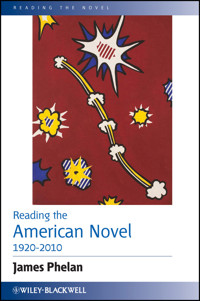
Cover image: Roy Lichtenstein, Illustration for “De Denver au Montana, Départ 27 Mai 1972” (II), from La Nouvelle Chute de l'Amérique, 1992, etching and aquatint. © The Estate of Roy Lichtenstein/DACS 2012.
Cover design: Nicki Averill Design
A catalogue record for this book is available from the British Library.
Acknowledgments
In the beginning, there was Dan Schwarz who, as editor of the Reading the Novel Series, believed I could do this book. Along the way were many people at Wiley-Blackwell who provided advice and support. I am especially grateful to Ben Thatcher who was consistently encouraging, patient, and helpful. I am indebted to Brian McHale and Paul McCormick for incisive readings of the Introduction and Chapter 8, respectively. I am grateful to Brian McAllister for substantial help with citations and to Matthew Poland for valuable help with proof-reading. I also owe a debt to my colleague in the History Department at Ohio State, Stephen Kern, for organizing the modernist reading group. Although this book pursues what I call rhetorical reading rather than historicist reading (of one kind or another), the meetings of the group and Steve's own work have been very beneficial to my thinking about the relations between history and literature. Peter J. Rabinowitz offered valuable comments on the Introduction and on Chapter 6. More than that, I have learned a great deal about rhetorical reading from our many conversations over the years and from his own work. Portions of Chapter 1 are based on the collaboration we did for our contribution to Narrative Theory: Core Concepts and Critical Debates (Columbus: Ohio State University Press, 2012).
As always, my deepest gratitude goes to my wife, Betty Menaghan, who every day gives me a rhetorician's most prized gifts, understanding and love.
Some previously published material has made its way into this book though no chapter is a straightforward reprint of a previously published piece. I am grateful for permission to reprint.
Chapter 3 draws on material from “Reexamining Reliability: The Multiple Functions of Nick Carraway.” Narrative as Rhetoric. Columbus: Ohio State University Press; 1996: 105–118; and “Rhetoric and Ethics in The Great Gatsby; or, Fabula, Progression, and the Functions of Nick Carraway.” In Approaches to Teaching The Great Gatsby (eds J.R. Bryer and N.P. VanArsdale). New York: Modern Language Association; 2009: 99–110.
Chapter 4 draws on material from “Voice, Distance, Temporal Perspective, and the Dynamics of A Farewell to Arms.” In Narrative as Rhetoric; and from “Evaluation and Resistance: The Case of Catherine Barkley.” In Reading People, Reading Plots. Chicago: University of Chicago Press; 1989.
Chapter 6 draws on material from “Voice, Politics, and Judgments in Their Eyes Were Watching God: The Initiation, the Launch, and the Debate about the Narration.” Analyzing World Fiction: New Horizons in Narrative Theory (ed. F.L. Aldama). Austin: University of Texas Press; 2011: pp. 57–73.
Chapter 8 draws on material from “Estranging Unreliability, Bonding Unreliability, and the Ethics of Lolita.” Narrative 2007; 15: 222–238; and “Dual Focalizaton, Discourse as Story, and Ethics.” In Living to Tell about It: A Rhetoric and Ethics of Character Narration by James Phelan. Ithaca: Cornell University Press, 2005.
Chapter 9 draws on “Sethe's Choice and Toni Morrison's Strategies: The Beginning and Middle of Beloved.” Experiencing Fiction. Columbus: Ohio State University Press, 2007.
Introduction: Reading the American Novel, 1920–2010
James Phelan
Whenever I tell someone the title of this book, I feel as if I am revealing my hubris. “Reading the American Novel, 1920–2010” sounds like a boast about all the difficult things its author is promising to do. At least the following are implied. (1) Relate the complex history of the United States to its literary history over this 90-year period. (2) Draw on a vast database of primary works—and of relevant scholarship about them—in order to zero in on the story of the novel across the periods of modernism and postmodernism, a story that will track: the genre's changing subject matters; its dominant thematic, political, and ethical concerns; its evolving conventions, forms, structures, and techniques; its diverse cultural effects; and its shifting status within American culture. (3) Explain and apply a trenchant approach to reading the novel. (4) Offer substantial analyses of a range of individual novels published across those 90 years.
Let me be frank: my hubris is not so great that I will try to fulfill all those promises in the 110,000 words or so I have at my disposal. Besides, as the bibliography indicates, other scholars have collectively done numerous book-length studies on each of these separate tasks—and, indeed, on subsets of them. I do, however, possess the necessary ambition and sufficient confidence to want to fulfill the third and fourth promises, and I believe that I can use this chapter (in conjunction with those readings) to take a few steps toward a more adequate fulfillment of the first two implicit promises. I have, therefore, come to think that a more accurate, albeit far more cumbersome, title for this book would be What a Broad Overview of Twentieth-Century American History, Especially Its Literary History, Some Principles of Rhetorical Reading, and the Detailed Analyses of Ten Diverse and Impressive Works Suggest about the American Novel, 1920–2010. But even this more modest project presents a significant challenge: to provide a solid foundation for studies whose ambitions are to fulfill the first two promises.
Broad Overview, Part One: History ↔ Literary Period ↔ Literary Work
In the most general terms, we can think of the history of the American novel in our 90-year period as part of the larger history of American literature. And American literature is itself a complex body of cultural expression that includes the oral and written literature of American Indians, writings by Europeans who explored the New World, by the English colonists and their imported African slaves, and then by the various inhabitants of the new nation, the United States of America, and their descendants. Since the early days of that nation, writers have been drawn to explore—and in the twentieth and twenty-first centuries critics have been drawn to highlight—the issue of American identity: what does it mean to be an American, how do Americans relate to the Old World of Europe, how do non-European Americans (the slaves and their descendants, the American Indians, the Chinese who came to work on the transcontinental railroad and then stayed, and other people of color) figure into the national narrative? As I discuss the ten novels I have chosen to analyze in some detail, I will be stressing their collective diversity and their individual distinctiveness, but I want to start by acknowledging that this group, too, contributes to this now centuries-long exploration of Americanness.
Lesen Sie weiter in der vollständigen Ausgabe!
Lesen Sie weiter in der vollständigen Ausgabe!
Lesen Sie weiter in der vollständigen Ausgabe!
Lesen Sie weiter in der vollständigen Ausgabe!
Lesen Sie weiter in der vollständigen Ausgabe!
Lesen Sie weiter in der vollständigen Ausgabe!
Lesen Sie weiter in der vollständigen Ausgabe!
Lesen Sie weiter in der vollständigen Ausgabe!
Lesen Sie weiter in der vollständigen Ausgabe!
Lesen Sie weiter in der vollständigen Ausgabe!
Lesen Sie weiter in der vollständigen Ausgabe!
Lesen Sie weiter in der vollständigen Ausgabe!




