


Erhalten Sie Zugang zu diesem und mehr als 300000 Büchern ab EUR 5,99 monatlich.
- Herausgeber: The History Press
- Kategorie: Lebensstil
- Sprache: Englisch
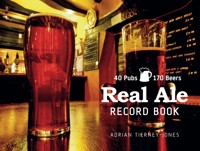
Cask ale, real ale, bitter... whatever you want to call it, it's thriving and this book is the perfect drinking companion. Written by acclaimed beer expert Adrian Tierney-Jones, this is an accessible and interactive guide to Britain's finest beers with reviews of over 150 ales and 40 perfect pubs in which to try them. The unique journal format will help you record and rate every tasting as you work your way through beers of every hue and flavour from the nine regions of the British Isles; from the malty milds of the Midlands to the sweet, fruity golds of the South-West. With guides to beer tasting and styles, plus top ten lists of essential beers for every region, this is a must-have interactive guide to the greatest pints in Britain.
Sie lesen das E-Book in den Legimi-Apps auf:
Seitenzahl: 96
Veröffentlichungsjahr: 2010
Das E-Book (TTS) können Sie hören im Abo „Legimi Premium” in Legimi-Apps auf:
Ähnliche


















40 Pubs 170 Beers
Real Ale
RECORD BOOK
ADRIAN TIERNEY-JONES
First published 2010
The History Press
The Mill, Brimscombe Port
Stroud, Gloucestershire, GL5 2QG
www.thehistorypress.co.uk
This ebook edition first published in 2014
All rights reserved
© Adrian Tierney-Jones, 2010, 2014
The right of Adrian Tierney-Jones to be identified as the Author of this work has been asserted in accordance with the Copyright, Designs and Patents Act 1988.
This ebook is copyright material and must not be copied, reproduced, transferred, distributed, leased, licensed or publicly performed or used in any way except as specifically permitted in writing by the publishers, as allowed under the terms and conditions under which it was purchased or as strictly permitted by applicable copyright law. Any unauthorised distribution or use of this text may be a direct infringement of the author’s and publisher’s rights, and those responsible may be liable in law accordingly.
EPUB ISBN 978 0 7509 5997 1
Original typesetting by The History Press
Cover: © CBW/Alamy
All other images from iStockphoto except p.17, courtesy of Dark Star Brewery; p.21, courtesy of London Pride Brewery; p.25, courtesy of Shepherd Neame Brewery; p.31, courtesy of The Queen’s Arms, Corton Denham; p.35, courtesy of Exmoor Brewery; p.39, courtesy of Skinner’s Brewery; p.45, courtesy of The Walter de Cantelupe, Kempsey; p.49, courtesy of The Grainstore Brewery; p.63, courtesy of Greene King; p.67, courtesy of Wells Brewery; p.72, courtesy of The Creek Inn, Isle of Man; p.76, courtesy of Hawkshead Brewery; p.87, courtesy of The Fleece Inn, Haworth; p.91, courtesy of Sharp’s Brewery; p.95, courtesy of Saltaire Brewery; p.117, courtesy of Brew Dog; p.123, courtesy of Hilden Brewery.
CONTENTS
Introduction
The World of Beer Styles
How to Taste Beer
Pubs and Beers
South-East England
South-West England
Central England
Eastern England
North-West England
North-East England
Wales
Scotland and Northern Ireland
Further Drinking
INTRODUCTION
Back in the 1980s and 1990s admit to liking a drop of cask beer and you would have been typecast as a tubby, Arran sweater-wearing, well-bearded chap with a fondness for hanging pewter tankards on your belt. Lager was the drink that the smart folk drank. The branding was hip and modern, and lager was seen as reassuringly expensive. Cask ale on the other hand was what your grandfather drank.
There was also the small matter of temperature and quality. After the initial success of cask ale, too many pubs thought it necessary to install banks of handpumps, sometimes offering up to a dozen ales. What many of them didn’t realise was that cask beer is a living product and needs to be drunk within three days (sometimes their cellar didn’t have the right temperature for ale either). The unwitting drinker, willing to give cask a chance, was often put off when served a pint of well-vinegared ale that had been sitting around for several days – and back to lager they went. In the mid-1990s, cask beer was also hammered by the emergence of nitro-keg beers such as Caffrey’s.
In the past decade, the situation has changed beyond all recognition. Cask beer, real ale, whatever you want to call it, is growing in popularity. No longer is it saddled with its old image; if anything it’s the premium lagers that look a little fuddy-duddy while ale (possibly helped by Madonna’s endorsement of Timothy Taylor’s Landlord on the Jonathan Ross Show in 2003) has a more go-ahead, aspirational image. The likes of Greene King, SA Brains and Fuller’s are involved in sponsoring major sporting events and teams, while the interest in local food, organic produce and free-range lifestyles has also painted cask beer in a positive light.
The need to present the beer in the very best quality and at the right temperature was boosted by the success of Cask Marque, an organisation that helps pubs serve their beers in the optimum state. The number of breweries has grown over the past few years and in 2010 stands at over 700. Some are small one-man operations, while others are more ambitious and see their beers travel all over the UK. And let us not forget the family regional breweries who have redoubled their efforts to sell beer and also innovate — the usual bitter and golden ale are joined in many instances by an IPA, a mild, porter and beers made with honey or flavoured with various fruits.
Even though up to 40 pubs are said to be closing weekly, those that major in cask beer tend to be thriving and successful as people seek them out, compare notes on the beers they stock and badger the landlord for information on future brews. CAMRA’s regular beer festivals also spread the word. And here is where this book becomes an essential bit of travel kit. Here you will find nearly 200 beers from breweries up and down the country, beers demonstrating that cask ale has a multitude of flavours and aromas, styles and moods. If you want a chocolate stout then look no further, while those with a penchant for a highly hopped IPA will find the very same within. There are also recommended pubs, information on how to taste beer and a reading list. Beer is our national drink and this book will help you celebrate it. Cheers!
THE WORLD OF BEER STYLES
BITTER
Beer was described as ‘bitter’ in the mid-nineteenth century, but this was probably just a reference to the effect produced by a high hopping rate rather than the identification of a new style. It wasn’t until the end of the Victorian age that bitter emerged in its own right, mainly as a result of the big family brewers producing beers that didn’t need to mature for as long as porter or IPA; these ‘running beers’ could then be sold through their pubs. The best English bitters strike a balance between crisp, biscuity maltiness and a citrus and fruity hop character, with the bite of bitterness in the mix. They can be any colour from pale straw to deep russet. In strength they are usually around 3.5–3.8% for an ordinary bitter and 4–4.5% for a best bitter, whilst special or premium is stronger still. Golden ales are not bitters in the old sense of the word but often fall into the same style camp.
INDIA PALE ALE
A nineteenth-century beer sent out to India and enjoyed back in the UK. They were highly hopped and strong in alcohol. In the twentieth century IPA rather lost its way, but the last 20 years has seen it revived, helped in part by American craft brewers’ variation on the style.
PORTER
Strong and dark ale of the eighteenth century, though it declined in the nineteenth century as the fashion for golden IPAs took hold and the emerging middle classes wanted to distance themselves from a drink mainly imbibed by the workers. Brewing porter also became uneconomic as it was stored for months in big vats, while lighter, weaker beers could be sent out to pubs and drunk within a matter of weeks. Porter had virtually vanished by the 1980s until British and American microbrewers started making it again.
STOUT
Strong porters were called ‘stout’ porters (porter and stout are the same many would argue) while Guinness produced the distinctive Irish Dry Stout with its roast bite. English stouts have a less assertive roastiness and a mite more fruitiness (plums, currants). Imperial Russian stouts and porters, milk stout, oatmeal stout and sweet stout are variations on a dark theme.
MILD
Originally received its name became it was young and fresh, compared to vatted porters. Wrongly thought to mean a beer low in hops, even though that is the case now. Most milds are low in alcohol and dark, though there are also light milds and strong ones.
SPECIALITY BEERS
Brewers add all sorts of things to their beer, from fruit and veg to spices, chocolate, coffee beans and vanilla pods. Beers are also aged in wooden barrels, some from the whisky trade, others from rum and even wine. Some brewers are trying their hand at lagered beers, a source of contention. Some would say a cask-conditioned lager is an oxymoron (though some would point to kellerbier or even Zoigl), while others would say as long as it tastes good who cares?
CASK CONDITIONED
Prior to the onset of kegged beers in the years following the end of the Second World War, the majority of beers served by handpump in the pub would have been cask conditioned. In the 1970s the term ‘real ale’ was coined for these beers by the Campaign For Real Ale and its members took up arms against what they saw as a tide of dead and fizzy beers supplanting their traditional heroes (Watney’s Red Barrel was a particular target for their ire).
For a beer to be ‘real’, it needs to undergo a secondary fermentation in the cask as it sits in the pub cellar, thanks to the presence of yeast working away, maturing the beer and producing a fuller flavour as well as natural carbonation. Once the cask is broached the beer within needs to be drunk as quickly as possibly, usually within three days, otherwise it is spoilt – taste a beer when it has just been tapped and try the same cask three days later and there will be a definite difference in the mouthfeel and flavour.
Before beer can be served, casks are tapped and vented, a process of drawing off some of the carbon dioxide that has been produced by the secondary fermentation. Temperature is also important at this stage. Pub cellars should be kept at about 11˚C (52˚F), though some brewers serve their beers slightly cooler, especially in pubs where there is a young clientele used to the mouth-numbingly cold temperatures of some lagers. Beer from which yeast has been filtered is called brewery conditioned – it will not improve or mature.
HOW TO TASTE BEER
Look at it. It should be clear (unless it’s a wheat beer).
Check its condition. A well-conditioned beer should dance, not flop, on the tongue.
Swirl the beer in the glass to release its aromas.
Note the beer’s colour.
One of the great joys of a beer is its aroma. Amongst other things, malty aromas can suggest dried fruit, coffee beans, biscuit, smoke, malt, Ovaltine, plain chocolate, toffee, butterscotch and caramel. Hoppy aromas can be either fruity, resiny, aromatic, citrusy, peppery, herbal, spicy, lemony or floral. It’s possible to pick out Seville orange marmalade (sometimes even lime), tropical fruits such as lychees and passion fruit, resin (think varnish), blackcurrants and even fruit-flavoured candy. With some of the stronger beers the yeast esters add their own complexities such as tropical fruit, banana, apricot skin and a spritzy feel.
Tasting the beer. Some beers come bearing plenty of fruity flavours, while others boast rich, malty savours. What is the essence of the beer in your mouth? Is it smooth, tingling, grainy, thin, acidic or chewy? Some beers are robust on the palate while others slip down like honey.
Do swallow. Unlike wine-tasting, part of beer-tasting involves letting the beer work its effect on your throat. In classic English bitters you will feel the dryness and bitterness.
Consider the beer’s finish. Is it bitter? Is it dry? Does it last? Does a hint of malt return? Does it make you want another? It should.
SOUTH-EAST ENGLAND




