


29,99 €
Mehr erfahren.
- Herausgeber: Hatje Cantz Verlag
- Kategorie: Geisteswissenschaft
- Sprache: Englisch
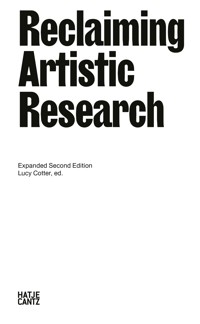
This expanded second edition of Reclaiming Artistic Research explores artistic research in dialogue with 24 artists worldwide, reclaiming it from academic associations of the term. Embracing artists' dynamic engagement with other fields, it foregrounds the material, spatial, embodied, organizational, choreographic, and technological ways of knowing and unknowing specific to contemporary artistic inquiry. The second edition features a new text by the author and four new artist dialogues to reflect on the changing stakes of artistic research in the wake of the global pandemic, a widespread reckoning with social justice, the growing role of artificial intelligence, and the urgent reality of climate change. LUCY COTTER (*1973, Ireland) is a writer, curator, and artist. She was Curator of the Dutch Pavilion, 57th Venice Biennale, 2017, and Curator in Residence at Oregon Center for Contemporary Art 2021–22. The inaugural director of the Master Artistic Research, Royal Academy of Art, The Hague, Cotter has lectured internationally, most recently at Portland State University. She holds a project residency at Stelo Arts and Culture Foundation 2023-24.
Das E-Book können Sie in Legimi-Apps oder einer beliebigen App lesen, die das folgende Format unterstützen:
Seitenzahl: 723
Veröffentlichungsjahr: 2024
Ähnliche



















Contents
ARTISTIC RESEARCH IN A WORLD ON FIRE
Introduction to the Second Edition
MAKING AS FUTURE SURVIVAL
A Dialogue with Cannupa Hanska Luger
SOUNDING OUT THE LAW
A Dialogue with Lawrence Abu Hamdan
HEALING AS BECOMING
A Dialogue with Yo-Yo Lin
HISTORY AS A QUESTION
A Dialogue with Natasha Ginwala
FACT AS FICTION
A Dialogue with Rabih Mroué
EMBODIED KNOWLEDGE
A Dialogue with Grada Kilomba (Katayoun Arian)
LANGUAGE AS FILM
A Dialogue with Sky Hopinka
MAKING AS TRANSLATION
A Dialogue with Christian Nyampeta
ART AS NON-KNOWLEDGE
A Dialogue with Sarat Maharaj
PERFORMANCE AS PHILOSOPHY
A Dialogue with Manuela Infante
SEEING AS UNKNOWING
A Dialogue with Richard Mosse
SOUND AS KNOWLEDGE
A Dialogue with Samson Young
REHEARSAL AS A MODE OF BEING
A Dialogue with Katarina Zdjelar
BEYOND LANGUAGE
A Dialogue with Falke Pisano
BECOMING THE ARCHIVE
A Dialogue with Euridice Zaituna Kala
KNOWLEDGE AS PRODUCTION
A Dialogue with Liam Gillick
THE MALLEABILITY OF SPACE AND TIME
A Dialogue with Mario García Torres
RESEARCH AS PLAY
A Dialogue with Ryan Gander
BETWEEN THE VIRTUAL AND THE REAL
A Dialogue with Yuri Pattison
(Emma Moore)
WORLDING MATTER
A Dialogue with Carolyn Christov-Bakargiev
FUTURE ECOLOGIES
A Dialogue with Em’kal Eyongakpa
WRITING AS EXPERIMENT
A Dialogue with Sher Doruff
THE FUTURE OF INSTITUTIONS
A Dialogue with Sarah Rifky
TECHNOLOGY AS CARE
A Dialogue with Stephanie Dinkins
RECLAIMING ARTISTIC RESEARCH
Introduction to the First Edition
Acknowledgments
Biographies
Artistic Research in a World on FireIntroduction to the Second Edition Lucy Cotter
Writing this, I am looking out on a garden that has hardly seen rain for three months. Its drought is witness to the encroachment of climate change, and the air outside is tainted by smoke from a distant wildfire. Yet today, the patter of my fingers on the keyboard is accompanied by the sound of rainfall, which is causing green grass to sprout out of the barren yellow. Slowly but surely, it takes over: here a few blades, there a flurry, until the overall sense of lack starts to recede into memory. It will not disappear entirely. Large plants that seemed hardy have not survived; small ones are alive but struggling to thrive. It is a landscape that resonates with “post”-pandemic reality, where the human losses are permanent, where many are suffering from long COVID, and where the long evisceration of the lifeblood of the arts is still being felt. Arts programming has returned, yet it is not an easy transition. The arts landscape is still parched and struggling to reckon with its evident unsustainability, its precarious working conditions, the founding violence of many of its institutions, and its long histories and continued practices of exclusion.1 In a world desperate for new ways of thinking, for alternate visions, and seeking radical social, cultural, and political transformation, artists are necessarily becoming more ambitious with their goals for artistic research.
In the United States, where I have been based since this book’s first publication in 2019, artistic research does not have an established discourse related to debates about artists doing a PhD, as it does in Europe, the United Kingdom, Australia, New Zealand, and Canada, as well as in some locations in Asia, Africa, and Latin America.2 “Artistic research” circulates as a free-floating term in the mainstream art world, little-noticed, it seems, except that more and more artists who engage with wider social, cultural, and political questions in their work describe their practices as research-driven.3 There is an urgency to this work that is palpable and exceeds institutional demands or critical intellectual trends. Among other recent experiences, a two-year curatorial conversation with artist Christine Howard Sandoval, who attends to Indigenous-Hispanic legacies as she negotiates what is present and what is invisible in the physical landscape, brought home to me that much work being done by artists in the US – the first-hand archival research, the original thinking, the forming of connections through transdisciplinary inquiry, and the forging of relationships among and between people, and institutions – would not be done otherwise.4 Indeed, artists worldwide are doing important cultural work that is not being done otherwise. In contexts where this inquiry is outside of governmental priorities, or even against national interests, this work exists and is being done with little support. In most countries worldwide, few sources of funding exist for the kind of long-term artistic projects that make especially significant contributions to wider social thinking and action. This is among the reasons why it matters now to look at artistic research and critically reflect on its wider value. What kind of infrastructural shifts need to take place to support artists to undertake significant artistic research on its own terms?
What are an artist’s responsibilities (and possibilities) in a world that is on fire?5 I hope that the publication of this expanded second edition of Reclaiming Artistic Research will further support artists, critics, curators, and art’s many publics to articulate and embrace the singularity of what art does and has the potential to do in the world, at an individual and collective level. In this edition, I engage in four new dialogues with US-based artists Stephanie Dinkins, Cannupa Hanska Luger, Yo-Yo Lin, and Richard Mosse, whose practices navigate and exceed the studio-gallery system feedback loop in thoughtful and provocative ways, while attending to questions of human and nonhuman survival, self-care and collective care, new technologies, and the unlearning of ableist, gendered, sexist, and racist paradigms. Our discussions build on the twenty dialogues with artists (and curators) from the first edition to offer insight into what artistic research is in day-to-day practice. The dialogue form, which is based on oral knowledge, was chosen because it resonates with (embodied, material) artistic thinking in its ability to circle back over thoughts and peel into multilayered processes. Each of the contributing artists’ and curators’ practices in this book are singular, yet these dialogues are also in dialogue with each other, circling around overlapping areas like sound and spatiality, or engaging with questions such as the nature of history, or the reimagining of the body. The polyvocal echoing return of many qualities of artistic research points to some shared ways of knowing and unknowing in and through art practice.
HOW DOES ART KNOW?
The phrase “artistic research” establishes a connection between art and knowledge. It suggests that academics and scientists are not the only ones who can undertake original research and contribute new knowledge to the world. Initiated by artists, artistic research often comes into being through highly intuitive processes, and its unfolding through practice follows the inner logic of artistic processes, rather than academic protocol. It does not depend on an academic context or academic forms of research. This book is titled Reclaiming Artistic Research because there has been a tendency to view artistic research in academic terms, and thus overlook its singularity and potential. As I discuss in the introductory essay to the first edition (republished in this book), this misperception stems partly from the close association of the term with discourses surrounding the establishment of a PhD in Fine Art, in which programs often legitimate artists’ knowledge production with academic criteria.6 Yet, artistic research has many lives beyond the university context.
It is commonplace for artists today to engage with subjects outside of art, from environmental sciences and emerging technologies to disability studies and immigration flows. Yet, it remains underrecognized that these artists are not simply borrowing ideas or illustrating or creating aesthetic versions of existing academic subjects. Rather, many artists (including my interlocutors in this book) seek to create new questions and new forms of knowledge, using the kinds of embodied-material-conceptual thinking that goes hand in hand with art making. In doing so, they are often pointing to what has not yet been thought, what remains unknowable, or what has been overlooked or misperceived because thinking within the related field has been limited by the shapes and forms of standard academic research. (I use the term “non-knowledge” in the dialogues to refer to knowledge that exceeds formal categories of intellectual knowledge, often lying not only in unknown areas but extending into the unknowable.) Artistic making processes involve imagining, creating, and sometimes prototyping new forms, which can as easily take the shape of a social arrangement or a model for repurposing artificial intelligence as a traditional artwork. Similar types of thinking involving gathering, finding new constellations, imagining forward, and experimenting with possibilities exist as a continuum across these art practices. Even the most abstract work can involve artistic research processes.
Artistic mediums of all types lend themselves to ways of thinking beyond language, and even beyond consciousness. (I address these qualities more fully in my introduction to the first edition.) In its material fluidity and medium-specific processes of making visible, audible, spatially or materially palpable, contemporary art can bring about different multisensory modes of witnessing. The artists in this book were invited one by one, so that the medium-specific ways of knowing and unknowing unfolding through their practices could be built upon through each subsequent dialogue and considered from other facets. I have titled the dialogues to help orient the reader toward these underlying areas, and to make visible overlapping concerns among artistic bodies of work that may not immediately appear to be in dialogue with one another.
Instead of building on what is tangible, artistic research can pivot toward paying attention to human absences. It is attuned to gaps and strains in knowledge, rather than only what is evidently there. Through radical archival interventions and oral-material creations, artists can find ways to manifest and engage with the fragmentation and dispersal of human histories in ways that the formal discipline of history struggles (and often fails) to do. This matters in a world in which the traces of marginalized peoples, enslaved peoples, disappeared peoples, peoples who have been forced to migrate, and / or who have faced genocide and extinction seek to claim their own histories and trajectories. In our dialogue, artist Euridice Zaituna Kala described how, when she did archival research into the history of the eighteenth-century Portuguese slave ship São José Paquete d’África, she was faced not with ample material, but near silence on the 400 enslaved Mozambican people’s experiences. Being an artist, she had other means of moving forward. “I am the archive,” she realized, and continued this research by retracing the ship’s journey with her own body and leaning into transgenerational embodied knowledge.
It is often through gathering fragmented, dispersed, invisible, unarchived cultural memory, and seeing the resemblances between forcibly separated materials and areas of thinking that a community or a culture can imagine forward. In grasping continuities across locations and temporalities, they can “move forward – both internally and externally.”7 The capacity for artistic research to bring together material, textual, and embodied sources of knowledge lends itself to these processes in ways that other (academic) forms of research seldom can. Artists bring the imaginative force and the associative, combinatory thinking of art making to bear on these materials, leading to potentially unforeseen outcomes.
In a new dialogue for this edition, Yo-Yo Lin points to art as a space for unlearning interlocking paradigms of ableist, racist, and anti-queer thinking. She leans into nuanced transcultural imaginaries around the body and incorporates experiences of chronic pain, chronic illness, and disability to create platforms for connectivity where new bodies of knowledge can be formed collectively. Like many artists in this book, Lin’s work is multidisciplinary, cross-cultural, and intersectional. Art’s long-held freedom to work in post-disciplinary ways enables artists to expand their research into the many facets of the subjects they address.
Several artists in this book self-position their practice in terms of the complex relationship between art and activism. Living in the United States, I have been strongly reminded of the ongoing need for artistic research into subject areas that are not wanted or are dangerous or undermining to governing bodies. Having witnessed first-hand the brutality of police violence, while living in Portland, Oregon through the 100-plus days of protest following George Floyd’s murder in 2020, I deeply appreciate Forensic Architecture and Bellingcat’s project, Police Brutality at the Black Lives Matter Protests (2020 – present). By geolocating and verifying over a thousand incidents of police violence, analyzing them according to multiple categories, and presenting the resulting data in an interactive cartographic platform, this artistic research is of widespread legal and sociopolitical importance. (Artist and audio investigator Lawrence Abu Hamdan discusses his work with Forensic Architecture in our dialogue.)
Artists can be keen researchers of scopic regimes, surveillance, and visibility because of their expanded visual registers and expert visual cognition.8 Fluid thinking around media enables artists to use existing technology for different purposes than its inventors intended. In a new dialogue for this edition, Richard Mosse discusses multiyear projects like INCOMING, for which he repurposed military surveillance equipment to foreground the catastrophic conditions of migration into Europe. His latest film work, Broken Spectre, repurposes multispectral technologies used by multinational mining companies and redeploys scientific UV microscopy photography to create one of the most extensive and nuanced documents of the destruction of the Amazon rainforest in existence today. These artists’ work is not made without risk, and in a world where the political climate is increasingly polarized and tightened, artists’ relative freedom of speech and social visibility are crucially important assets.
The ethical and social repercussions of emerging technologies are constantly unfolding, and artists continue to address these questions in provocative and publicly accessible ways. The world is currently on the precipice of an artificial intelligence-led knowledge revolution that is mostly market oriented. It is no longer possible to talk about knowledge production without reflecting on these tech-led epistemic paradigm shifts, in which artificial intelligence’s algorithms favor predictability and therefore the dominant and the known. In doing so, they herald in forms of “digital colonialism,” “technological redlining,” and the “default discrimination” brought about by artificial intelligence’s logic of inclusion / exclusion.9 Artistic research lends itself to counteracting the resulting absences and gaps in knowledge thanks to its tendency to move toward the invisible, the neglected, the unknown, and the unrecoverable. In another new dialogue in this edition, Stephanie Dinkins, one of the leading artists in the US, engaged with AI and emerging technologies, discusses what can be done and why it needs to be done by people from all walks of life, artists included. Moving beyond reactionary critique, Dinkins’s interactive and immersive work offers models for reorienting emerging technologies toward social benefit, equity, and collective care.
As artist Cannupa Hanska Luger proposes in another new dialogue, technology is ultimately not mechanisms but ideas, and “[a] lot of Indigenous technology exists in our cosmology, in our homes, in symbols we create, in forms we express through dance and music” that “has not been allowed to navigate through material science and mechanisms.”10 In his ongoing Future Technologies project, Luger imagines past the exodus of the wealthy to other planets to consider adaptations necessary for the future survival of Earth. In resonance with Dinkins, who identifies the underrecognized knowledge and survival strategies handed down by enslaved peoples, Luger reminds us that this moment of impending environmental collapse is not the first time his people have faced extinction.
SELF-REFLEXIVE KNOWLEDGE
Artistic research may offer competing paradigms for knowledge in today’s world, but it cannot neglect its own foundations. As Tom Holert summarizes: “The more contemporary art is accounted for and addressed as a platform, system, or institutional space of research, investigation, epistemological speculation, and decolonial struggles for the recognition of subaltern, Black, feminist, queer, Indigenous and other marginalized yet powerful modes of knowing and thinking, the more it is confronted with the task of understanding its own roles in the general intellect’s current manifestations.”11 While many artists and arts workers have worked toward equity for decades, this moment of mainstream awareness of social justice issues offers ripe conditions for the art field at large to confront the problematic foundations and exclusionary norms of contemporary art’s modes of existence and operation. The scope of artistic research, which exceeds the production of artworks, offers space to redefine artistic practice. It can be a means of challenging dominant definitions of contemporary art and, by extension, exploring alternatives to white cultural supremacy in arts institutions. In our dialogue, Cannupa Hanska Luger observes: “I work in an industry where art is considered an object, the thing that somebody makes. That couldn’t be further from my personal definition of what art is. Art for me is the making. It is these processes that have been passed down from teacher to student, from ancestor to elder. It’s a continuum. It’s intergenerational.”12
Contemporary art discourse’s self-proclaimed autonomy and porous yet often inward-looking relationship to art has occluded the crucial question of how art relates to culture. Ariella Aïsha Azoulay points to the historic establishment of the art museum as a repository for colonially looted objects, leading to a necessity to present (art) objects as outside of living culture.13 Some of the other legacies of colonial regimes of visibility and categorization of subjects and objects include the individual authorship inherent in the modern artist-function, which naturalizes the apparent cultural neutrality (and default whiteness) of artists in the West. Art has been rarified into something inactive and in need of preservation, and its decontextualization is reflected in the “professional” (distancing, socially detached) protocol for curators, art writers, and institutional workers.14 What is the relationship between the self-perceptions of the art world as a field and how art operates (and co-determines perceived cultural value) in the world? These are questions artistic research discourse cannot skip over. The title of this essay is inspired by a Zoom-based performance by artist Pope.L, which exposed the performativity of the artist’s position in society and the structuring force of the art world, which cannot assume to separate itself from a world at large that, in fact, “has always been on fire.”15
Wider inclusivity in the art world matters as a means of reconnecting institutions with a more expansive sociocultural and political reality and as a way to counteract historically inbuilt measures of exclusion. This is not a simple matter of adding onto existing ways of thinking and working, but rather the bringing in of conflicting paradigms that should reorient institutions to question and relativize the narrowness of previous working paradigms. I felt this sense of reorientation when an artist in a workshop I attended asked, “Why does the art world always seek to ‘include’ the disabled in its activities, rather than asking what we are working on and thinking about and asking if they can join us?”16 Julie Philips thinks far beyond the token acknowledgment of artists who are mothers when she observes that the life-altering and lifelong experience of maternity forges bodies of knowledge that are not otherwise available.17 In her dialogue with Katayoun Arian in this book, Grada Kilomba offers a powerful reflection on the knowledge that is otherwise lost when people of color are not present as leaders and co-shapers of art institutions.18
It matters not only which artists or artworks are included in art discourse and institutions, but how they are included. Attending to artistic research as an entry point into all artists’ practices offers an important counterweight to the identity-led framing of so-called diverse artists because it draws attention to competing cultural paradigms and alternate bodies of knowledge. Curator Karen Archey notes that institutional hyperfocus on an artist’s biography is a way of cutting corners in the contextualization of these artists’ work.19 This covers up the inevitable lack of institutional knowledge and the paltry research undertaken within the tightly budgeted timeframes of the contemporary art institution. (The authors of Post-Critical Museology suggest that the contemporary museum can better let go of its claims to representativeness and return to serious research on art.)20 Too often, “diverse” artists’ work is represented in issue-led terms so that the institution can profit from the currency of hot topics, with discursive simplifications overshadowing the full complexity of an artist’s inquiries. The artistic (material-spatial-embodied) sensibilities in their practice go under- or unaddressed, creating a false separation from other (“neutral”) artists whose work is perceived as medium-led, abstract, philosophical, poetic, etc. (I have addressed this issue elsewhere in more detail.)21 By undertaking in-depth dialogues that are three to four times longer than the standard artist interview, this book seeks to make space to articulate artistic practice in ways that keep these complex form-content-context relationships intact.
Many artists’ work deliberately resists easy legibility as a counterweight to the tendency for the identity-driven neoliberal knowledge economy and click-bait-led public discourse to flow toward transparency and simplification. In response to the hypervisibility that accompanies identity-oriented framing of Black, feminist, queer, crip, and Indigenous practices, many artists embrace opacity, in Édouard Glissant’s sense of a refusal of individuals or communities to be cornered into declaring an essential identity or essence in the face of the “transparency” demanded by dominant culture.22 This doesn’t make these artists’ practices immune to opportunistic misframing, however. Artists today face difficult ethical decisions in this respect, as the sustainability of their practice or their livelihood is often dependent on contradictory opportunities. There is much to learn from artists who push back against this institutional and critical capture. One artist with whom I worked curatorially toward a site-specific performance requested to title the work with an untypable word-image, and to replace the usual press release with a crossword.23 These gestures extended the critical ethos of the performance into all of the conditions of its production, exposing that standard formats are not neutral, and that curators and institutions have the agency to rethink and change them, should they so wish, or, as is often the case, “if they are willing to give something up.”24
There is no such thing as a neutral container for art.25 In considering how artistic research enters the world, art writing is an important interface to the public, as language is a source of security in the face of relatively opaque artwork. However, I increasingly think about the perfunctory role writing plays in the art world, which can limit the possibilities of creating a more nourishing and generative relationship between art and language (and the public). Several dialogues in this book manifest a move away from academic writing toward questions of how language itself can unfold new ways of thinking. (Sher Doruff writes from the position of inter-species; Manuela Infante writes in structures that follow plant thinking.) Several artists play with how text relates to objects, space, and territory (Falke Pisano sees where language ends and the object begins; Sky Hopinka uses song and calligrams to meld imaginaries and places). More and more artists, art writers, and curators are forging experimental writing practices that help to shift the status quo, and it seems that the publishing landscape is starting to make more space for the gray areas between the artistic and the literary, where artists’ experimental material-spatial-embodied-led writing can thrive.26 Having experimented widely with the “affordances” of different genres and writing styles that resonate with artistic practice in conversation with artists working at every level, I am excited to be working on a new book that will address writing as an artistic process and medium.27
EMBODIED MATERIAL KNOWLEDGE
Beyond the immediate concerns of the specific artistic practice at hand, what is at stake in the questions surrounding artistic research is a radical questioning of what defines and constitutes knowledge in the world – in university contexts, in the public discourse and the policies they inform, in our own minds and those of everyone we love, who has inherited and internalized these habitual ways of thinking through normal everyday life. This legacy includes the artist’s sense of inferiority in the academic context, which relates to the inferior positioning of embodied, material, spatial, and lived knowledge relative to linguistic and numerical knowledge (with resulting narrow definitions of intelligence). The dominant consensus around what constitutes thought, or knowledge, art or culture is, of course, historically constructed. Its epistemological foundations lie in Enlightenment thinking from the seventeenth and eighteenth centuries (René Descartes, Francis Bacon, Immanuel Kant et al.). Europe’s territorial imposition and power over peoples worldwide was partly justified by and made successful by the global indoctrination of defining and enforcing this white supremacist, Western form of thinking as the only real form of knowledge. This left on the scrap heap the forms of knowledge, worldviews, and ways of thinking intrinsic to over 80 percent of the world’s population. The extent to which one feels included or seen within dominant definitions of knowledge, art, or culture complexly relates to this historical and continuous dynamic of internalized oppression and the embeddedness of this exclusionary logic in the norms of discourse and institutional logic. (As an extension of direct exclusion, imposter syndrome is a daily reality for many artists and art workers.) Among many other losses, the Enlightenment epistemic shift toward empiricism, rationalism, and scientific methodology meant that all human knowledge that lay beyond linguistic consciousness (over 90 percent of thinking) was (and still is) sidelined.28
With its fluidity of frameworks, and foregrounding of embodied, material, spatial, transgenerational, and temporally multidirectional knowledge, contemporary art offers possibilities to push against, question, and destabilize Western academia’s epistemological monopoly, bringing in openness to other ways of thinking. Art “can provide in rare but important cases the very organizational structures, theoretical devices, and material contexts to sustain multilayered work on the dislocation and repurposing of knowledge itself.”29 This is why art’s affront to (Western) academic knowledge is an important partner in efforts to decolonize knowledge in the university, and in our own minds. With its foregrounding of oral, material, and performative registers of knowledge, artistic research is starting to be recognized as a unique point of entry for Indigenous knowledge within academic contexts globally.30 Art inherently aligns with and can support the work of activists and academics seeking to decolonize and to center Indigenous ways of knowing. The potential for artistic research to co-shape this wider negotiation of epistemological parameters is one reason why it matters now, more than ever, “to draw a line between conformist, depoliticizing ways of associating knowledge with art” and “the quest for different, oppositional modes of knowing” that many artists today choose to prioritize.31
I once attended a conference in which a young academic was struggling to articulate yoga as a form of embodied philosophy. It struck me that her argument would have been more successful had she invited her audience to do yoga together, precisely because most of yoga’s knowledge is available in and through the body, bypassing conscious thinking and language. Because art’s ways of working encompass inseparable body-mind and subject-object experiences, a comparable falling-out of knowledge happens when academics expect to be able to understand art’s forms of knowledge through academic paradigms. In my “Reclaiming Artistic Research” essay (republished here), I reflect on what happens in the university context when artists undertake PhDs with expectations of having art’s forms of knowledge recognized and embraced, only to find themselves in situations where academic requirements force them to prioritize already existing and nameable ideas and areas of interest over the opaque unfoldings of art practice.
The dominance of academic thought over artistic thinking is not only relevant in the university context, however. It is present whenever critics and curators attend to artistic research with the expectation that it will resemble or can be addressed using the paradigms of academic research. There will, in many instances, be overlaps with academic fields, and the long-standing theorization of those findings can contribute to deepening artistic inquiry, if this is done meaningfully. Too often art is framed using the most well-worn cultural theory, instead of looking further to find deeper resonances in the work of thousands of academics globally, thinking about overlapping questions. (This could be the entry point into collaborative co-thinking, instead of reinforcing knowledge hierarchies through critical juxtaposition of world-renowned thinkers with emerging or less established artists.) This is among many reasons why the PhD in Fine Art needs to be reoriented toward its stated ambitions of articulating practice-based knowledge.
While it is beyond the scope of this essay, I have elsewhere tried to articulate why practice-led thinking needs to be identified and nourished in curatorial discourse.32 Practice-led curating unfolds in similar ways to artistic research processes and this kinship sets up the conditions to do more justice to artistic thinking. For those of us who started to curate as a way of attending to fellow artists’ practices, curating is often led by material-conceptual and spatial-embodied thinking. This allows for a collage-like creation of thought-constellations and a material-spatial unfolding that cannot be expressed in critical jargon or academic terms. To curate in this way is in fact to say something that writing cannot capture. Today, when it is more and more difficult to fund exhibitions that are not designed to engage click-bait attention spans, I wish to emphasize that exhibitions have the potential to be experimental working sites. Their physical, spatial, and material presence can make space for ways of knowing that are embedded in the body, that make us see the performativity of knowledge; that make us witness the connection between voice and word, movement and body, space and subjectivity.
The exhibition’s variety of modes of experiencing opens possibilities for anti-ableist forms of accessibility and its ability to draw attention to the performativity of knowledge opens possibilities for the decolonization of thought.33 Exhibitions offer an unparalleled opportunity to attend to and foreground the value of the “extra-discursive significations of Indigenous art and culture-making.”34 Prem Krishnamurthy once wrote that exhibitions should be permanent, which is a powerful reminder that the knowledge (and potential paradigm shifts) exhibitions can produce should be taken more seriously.35 Moving beyond simple notions of inclusion, and respecting the right for Indigenous “unbelonging” within given institutional structures, what might it look like for Indigenous values and principles to more fully inform and challenge the dominant frameworks of curatorial discourse? How can the rich multiplicity of Indigenous forms of knowledge “reformulate in unique and complex ways” the very concept and practice of curating?36 How might the paradigms of artistic research support this process?
TEMPORAL SHIFTS, A MORE HOLISTIC APPROACH TO ART PRACTICE
When the first edition of this book was published, I was concerned that the absence of images might block artists from engaging with each other’s practices, but something unexpected happened. Not being able to make quick aesthetic judgments, there was more space for artists to focus on what they have in common. This reminded me how often artists are set up to compete with one another, and how by being constantly asked what makes our individual practices singular, a sense of collectivity is undermined. As the pandemic brought to the fore, art is one of our survival mechanisms on an individual and collective level; it does not belong to a market or even to its makers, its temporalities are much longer. In our dialogue, Cannupa Hanska Luger suggests that art predates Homo sapiens, an expanded temporal framing that is reflected in some curatorial practices that work from Indigenous principles.37 I want to close this essay with a reflection on why the notion of artistic research might alter temporalities within the process of day-to-day art making and help to shift public awareness and infrastructures toward a more sustainable art field in which artists can make their best contributions to the world.
The term “artistic research” implicitly encompasses more than the direct production of artworks and by doing so it crucially makes space for otherwise-unnamable activities that are intrinsic to the artistic process.38 The precise nature of the activities included in artistic research is different for each artist, depending on their ways of working and interests. (These differences unfold across the twenty-four dialogues.) Importantly, however, the term “artistic research” grants permission to artists to take the necessary time and actions (or inactions) to nourish and inform their practice, to experiment and develop their work, and not only produce more work. This paradigm shift starts with artists’ self-acknowledgment that this in-depth material-intellectual process (including times of sitting still and critically reflecting) is a necessity and not a luxury for their artistic practices. This acknowledgment needs to extend more fully into institutional recognition of artists’ need to take time to invest in the unfolding of their process. If this clashes with the needs for quick institutional turnover, then those needs can in turn be questioned, which can only help to offset the stress levels of overstretched art workers everywhere.
The premise of artistic research, which foregrounds the material-intellectual processes involved in the making of art, challenges a tendency I observe in the US and other market-driven art locations, for even the very limited funding sources available to only be allocated for direct artistic output, and for awards and residencies to come with a priori demands of culminating exhibitions.39 Not surprisingly, many artists hold back from long-term experimentation and in-depth research, being obliged to focus on continuous output to have any kind of sustainable practice.40 In order to remain prolific in the face of inevitable time constraints, too many artists frequently skip over the necessary “restocking of the pond” of their creative process.41 While inertia is part of any creative process, these conditions lead to long-term production of under-par work, and ultimately block the artist from reaching their full potential, creatively and professionally. Experimentation and open-ended research are, of course, the most difficult thing to finance anywhere and most contemporary art projects, even those privately funded, are being carried out by artists working at low pay.42 However the agency of artists to determine the shape and form of their practices increases when these needs are widely understood.
The notion of artistic research as an ongoing process within practice shifts emphasis away from the production of “new” (art)work. It insists rather on multiyear time spans for artistic projects (that include but are not limited to artworks). In the dialogues, we witness how many years these processes take. This mental shift also redirects curatorial and critical attention from the latest work toward how an artist’s practice unfolds from one project to the next, with an eye for continuity and growth, and the inevitable circling back and deepening of the process. (The practice moves at different speeds on different levels of its existence.) This perspective exposes what artists need to nourish within their practice to continue to grow and to thrive, and to not plateau mid-career. It shows what artists need to receive in terms of curatorial, institutional, academic, and public support in order to reach their full potential. Greater support of artistic research could enable artists to bring their work into every kind of social and public context that they could meaningfully contribute to.43 Through this expanded view of artistic practice as a multi-sited entity that unfolds over many years, the world at large might better apprehend and appreciate the life-long contribution of artists, culturally, socially, and politically.
As an embodiment of this longevity of artistic research, I am picturing Simone Forti at the age of eighty, pushing her prone body across an ice-laden Illinois shoreline as part of a late performance work.44 The incessant stream of news on the transistor radio she carries is drowned out by the sheer physicality of her actions, and how they make palpable the connectedness of environmental and individual well-being – a quietly insistent message in a world on fire.
Endnotes
1 Data from 2022 gleaned from a survey of staff members from fifty-four art museums in the United States suggests that 60 percent of workers are thinking about leaving their jobs, and 68 percent are thinking of leaving the field altogether. Low pay and burnout are cited as the top reasons for this. This rate is higher among those who experience discrimination or harassment. Museums Moving Forward (2023), https://museumsmovingforward.com/data-studies/2023. The continuity between museums’ colonial foundations and US museums’ values in the present is examined by Laura Raikovich in Culture Strike: Art Museums in an Age of Protest (London: Verso, 2021).
2 James Elkins has mapped the existence of PhD in Fine Art programs globally. See https://www.jameselkins.com/yy/2-list-of-phd-programs-around-the-world, including some in the US (see note iii). See also J. Elkins, Artists with PhDs: On the New Doctoral Degree in Studio Art (Washington, DC: New Academia Publishing, 2009, expanded ed., 2014). See Danny Butt, Artistic Research in the Future Academy (Chicago: University of Chicago Press, 2017) for reflections and debates on the PhD in Fine Art’s relationship to the university.
3 Sporadic independent institutions throughout the US center artistic research in their mission, including Rivers Institute for Contemporary Art and Thought, New Orleans, and the recently established Center for Art, Research and Alliances in New York City. James Elkins identifies seven arts practice-based PhDs in Fine Art in the US. Alongside electronic, digital, film, and performance arts PhDs, two of these are studio-based visual arts PhDs and one is a non-studio-based PhD in Fine Art. The wider contextual reasons for the PhD in Fine Art not proliferating throughout the US are considered by Elkins, Artists with PhDs.
4 Our dialogue led to an extensive solo exhibition Christine Howard Sandoval: Timelines for the Future. Documentation can be viewed at: https://www.oregoncontemporary.org/timelines-for-the-future.
5 I draw on Anna Jensen’s formulation that art has responsibilities and possibilities. Encyclopedia of In-Betweenness: An Exploration of a Collective Artistic Research Practice, PhD diss. (Aalto University, 2023), p. 47
6 Silvia Henke, Dieter Mersch, Nicolaj van der Meulen, Thomas Strässle, and Jörg Wiesel’s Manifesto of Artistic Research (Zurich: Diaphanes, 2020) pleas for art to stop being in competition with the academic, and to strike out and articulate its own research epistemologies, in relation to and drawing on a long history of aesthetics as a mode of thinking. This subtly argued philosophical reflection speaks back to the university in the dominant terms of Western philosophy. Centering Kant’s philosophies on aesthetics, it overlooks the potential to challenge these frameworks for decolonial purposes.
7 Sky Hopinka, Around the Edge of Encircling Lake (Milwaukee, WI: Green Gallery, 2018), p. 75.
8 This heightened visual perception is discussed in, e.g., Stine Vogt and Svein Magnussen, “Expertise in Pictorial Perception: Eye-movement Patterns and Visual Memory in Artists and Laymen,” Perception 36, no. 1 (2007): 91–100.
9 Artist Morehshin Allahyari uses the term “digital colonialism” in an eponymous lecture performance from 2013 to refer to how the 3D-rendered digital archiving of cultural artefacts by museums often reinscribes property rights for perpetuity. Ruha Benjamin attributes the term “technological redlining” to Safiya Noble in Race After Technology (Cambridge, UK: Polity, 2019), p. 147. Benjamin addresses “default discrimination” in chapter 7, pp. 77–96.
10 Lucy Cotter, “Making as Future Survival: A Dialogue with Cannupa Hanska Luger,” in Reclaiming Artistic Research, expanded 2nd ed. (Berlin: Hatje Cantz, 2024), pp. 42–63, p. 47.
11 Tom Holert, Knowledge Beside Itself (Berlin: Sternberg Press, 2020), p. 55
12 Cotter, “Making as Future Survival: A Dialogue with Cannupa Hanska Luger,” p. 49.
13 Ariella Aïsha Azoulay’s Potential History: Unlearning Imperialism (London: Verso, 2019) is a landmark critique of the relationship between looting and the curatorial gaze, and the artist-function, among other subjects, and seeks to radically rethink archives, museums, and photography. I had the pleasure of discussing Azoulay’s writing, filmmaking, and curatorial work in A Dialogue with Curator Lucy Cotter and Filmmaker Ariella Aïsha Azoulay, YouTube video, 1:24:10 min., uploaded by Disjecta Contemporary Art Center, April 24, 2021, https://www.youtube.com/watch?v=p1u5qoxrMuA.
14 See Azoulay, Potential History: Unlearning Imperialism. Andre Lepecki reflects on how some artworks intrinsically refuse these protocols in “Decolonizing the Curatorial,” Theatre 47 (I) (2017), pp. 101–15, here p. 102.
15 Pope.L, Notes on the Roll of the Artist When the World has Always Been on Fire??, Vimeo video, 15 min. excerpt, uploaded by Berkeley Arts + Design, September 21, 2020, https://vimeo.com/462019660.
16 Dis/Rep: Liberating Words, six-week workshop by Curiosity Paradox engaging with art and access, 2022, https://thecuriosityparadox.com/disrep2022.
17 Julie Philips, The Baby on the Fire Escape: Creativity, Motherhood and the Mind-Baby Problem (New York: W. W. Norton, 2022).
18 Katayoun Arian, “Embodied Knowledge: A Dialogue with Grada Kilomba,” in Reclaiming Artistic Research, expanded 2nd ed. (Berlin: Hatje Cantz, 2024), pp. 140–153.
19 Karen Archey, After Institutions (Berlin: Floating Opera Press, 2022).
20 Andrew Dewdney, David Dibosa, and Victoria Walsh, eds., Post-Critical Museology: Theory and Practice in the Art Museum (London: Routledge, 2013).
21 Lucy Cotter, “Mercurial States,” Art and Education, 2019. This guest edition featuring five curated videos and related texts is now offline, but the essay can be accessed via my website: www.lucycotter.org.
22 See Édouard Glissant, Poetics of Relation (Ann Arbor: University of Michigan Press, 2010), pp. 189–94.
23 This “performance of keyon gaskin” and the related crossword is documented in Turnstones: Season 10, 2020–21, Curator in Residence Lucy Cotter (Portland, OR: Oregon Center for Contemporary Art, 2022).
24 I attribute this understanding to conversations with David Dibosa.
25 I discuss this in more depth in an interview with Marjoca de Greef, “Reorienting (Online) Spaces: An Interview with Lucy Cotter,” In the Pause of a Gesture There May Be an Echo, 2020, https://inthepauseofagesturetheremightbeanecho.eu/index.php/en/?view=article&id=74&catid=22.
26 Some recent examples of artists’ book publications include Steffani Jemison’s A Rock, A River, A Street (New York: Primary Information, 2022); Na Mira, The Book of Na (New York: Wendy’s Subway, 2022); Katie Holten, The Language of Trees (Portland: Tin House, 2023). Experimental texts are increasingly published in exhibition catalogs and academic books. For one recent commission, I had the bandwidth to create a series of text portraits of individual artistic practices in forms ranging from flash fiction and prose poetry to philosophical reflections; see Fieldings: Propositions for 3rd Cycle Education in the Performing Arts (Amsterdam: DAS Publishing, Amsterdam University of the Arts, 2021).
27 “Affordances” is a term used in design thinking. I borrow it from Caroline Levine who uses it to describe the possibilities of different literary genres in Forms: Whole, Rhythm, Hierarchy, Network (Princeton: Princeton University Press, 2017). In my book in progress, which has the working title Writing as an Artistic Medium, I trace how writing appears in and through everyday artistic practice (beyond text-based artworks) and look at the fluidity of writing and orality in contemporary artworks and performance, and related experimental artists’ writings.
28 Doing justice to this epistemological legacy requires in-depth critical analysis of how the power dynamics and ideologies of Enlightenment and colonial thinking became embedded in the continuing dynamics of contemporary infrastructures. Those seeking accessible entry points into this vast area for art education purposes will find some in Louis Yako’s “Decolonizing Knowledge: A Practical Guide,” Counterpunch, April 9, 2021, https://www.counterpunch.org/2021/04/09/decolonizing-knowledge-production-a-practical-guide/, and Ijeoma Nnodim Opara’s, “It’s Time to Decolonize the Decolonization Movement,” Speaking Medicine and Health blog, July 29, 2021, https://speakingofmedicine.plos.org/2021/07/29/its-time-to-decolonize-the-decolonization-movement/. The latter offers a sharp analysis of how to exceed the limits of acritical DEI-led thinking.
29 Tom Holert, Knowledge Beside Itself, p. 18.
30 See, for example, Estelle Barrett, Chapter 9, “New Frontiers of Research: Indigenous Knowledge Systems and Artistic Practice,” in Margaret Kumar and Supriya Pattanayak, eds., Positioning Research, Shifting Paradigms, Interdisciplinarity and Indigeneity (London: SAGE, 2018), pp. 181–95; Danny Butt, “The Promise of Artistic Research in the Asia Pacific,” Manusya Journal of Humanities 23, issue 3 (2020): 328–34; Mareli Stolp, “Artistic Research as African Epistemology,” Arts Research Africa Conference Proceedings (2020), https://wiredspace.wits.ac.za/items/1256bcbe-8431-4871-b0aa-eb03f07d97c4.
31 Holert, ibid. Knowledge Beside Itself, p. 19.
32 See Lucy Cotter, “Unravelling: After Practice-based Curating,” Bassam El Baroni, Bridget Crone, and Matthew Poole, eds., Edinburgh Companion to Curatorial Futures (Edinburgh: Edinburgh University Press, forthcoming 2024).
33 Amanda Cachia examines possibilities for curators to fold access into curatorial practice in Curating Access: Disability Art Activism and Creative Accommodation (London: Routledge, 2022). I have sought to use the exhibition self-reflexively as a decolonial epistemological space in two recent group exhibitions engaging with the exclusionary contours of art and curatorial value systems: Unquiet Objects, Oregon Center for Contemporary Art, 2021, https://www.oregoncontemporary.org/unquiet-objects, and The Unknown Artist, Center for Contemporary Art and Culture, Portland, 2020. Amelia Rina’s review of the latter for Art in America can be found here: https://www.artnews.com/art-in-america/aia-reviews/unknown-artist-lucy-cotter-center-contemporary-art-culture-pacific-northwest-college-art-1202686594.
34 Stephen Gilchrist, Belonging and Unbelonging: Indigenous Forms of Curation as Expressions of Sovereignty, PhD diss. (University of Sydney, 2018), https://ses.library.usyd.edu.au/handle/2123/22301.
35 Prem Krishnamurthy offered this observation as part of Endless Exhibition, a curatorial-manifesto-as-artwork (2018–forever) at Kunsthal Ghent, Belgium.
36 In my formulation, I draw on Gilchrist, Belonging and Unbelonging: Indigenous Forms of Curation as Expressions of Sovereignty. See also Katya García Antón, ed., Sovereign Words: Indigenous Art, Curation and Criticism (Amsterdam: Valiz, 2019), and Bruno Brulon Soares, The Anticolonial Museum: Reclaiming our Colonial Heritage (London: Routledge, 2023).
37 Stephen Gilchrist reflects on how curating from Indigenous principles may include a shift in mental timelines toward tens of thousands of years in “Awakening Objects and Indigenizing the Museum: Stephen Gilchrist in Conversation with Henry F. Skerritt,” Contemporaneity: Historical Practice in Visual Culture 5. no. 1, “Agency in Motion” (2016), pp. 108–21, p. 114.
38 For an extended reflection on the artistic process, see Kim Grant, All About Process: The Theory and Discourse of Modern Artistic Labor (University Park, PA: Penn State University Press, 2017).
39 In the United States, artists’ public funding structures are typically state-based (and thus very limited almost everywhere outside of California and New York), and private patron-based or corporate funding is often based on the most conservatively drawn criteria.
40 Painting dominates the US art field, a medium that offers a more direct financial return than experimental, ephemeral formats that outnumber traditional artworks in other (publicly well-funded) art locations. In the US even the most established artists often work a full-time job, or several “side jobs.”
41 I borrow this phrase from Julia Cameron’s wise book The Artist’s Way (New York: TarcherPerigee, 1992), a book of self-care and nourishment of creative practice.
42 I draw on Tom Holert’s discussion of these conditions in Knowledge Beside Itself, p. 32.
43 Sher Doruff points out the need for more support for artists to engage in artistic research in contexts outside of the art world. “A New Format for an Artists’ PhD: Conversation between Sher Doruff and Jeroen Boomgaard,” in Yael Davids, I’m Going to be Your Last Teacher-A Workbook (Amsterdam: Roma, with Van Abbemuseum, Migros Museum für Gekenwartskunst, Gerrit Rietveld Academie, 2023), pp. 189–91.
44 Simone Forti, A Free Consultation, Vimeo video, 17:35 min., uploaded by The Box, LA, January 30, 2016, https://vimeo.com/154902507.
Making as Future Survival A Dialogue with Cannupa Hanska Luger
Lucy CotterThe core focus of your current work is future survival and twenty-first-century Indigeneity. You work in so many ways – sculpturally, through performance and video, and with socially engaged and curatorial projects – but it seems to me to all revolve around making. Is that what drives you as an artist?
Cannupa Hanska LugerYes, I’m more about materials and process than I am about concepts. My approach is, “The concept will show up. What am I working with here?”
LCSometimes you’ve described yourself as a craftsperson and there’s a sense that we can take things into our own hands and make a future – we can make in ways that bring the past into the present and the future. There is so much political agency in what making can or could make happen in your practice.
CHL Yes, totally. I think it’s funny that to be able to make something with your hands and create a thing somehow puts you in the position of being political. That makes sense because we’ve submitted our wealth, our collective knowledge of creation and making to the economic wheels that spin. We’ve removed all notions of manufacturing within society. Our economy is built on trading stuff, but we’re not making any of the things for trade. You’re just connecting one person to another to get a thing, sell a thing, and in that process you lose a lot of agency.
I like making stuff, whatever it is – making dinner, making dishes I would eat off. I like learning new skill sets. I’m a jack-of-all-trades, master of none, although I’m getting pretty close in clay. I’ve definitely put in my 10,000 hours in some random things, but there’s constant knowledge to be gained. What I know is finite, what I don’t know is infinite. I should look at the infinite, start from that place, and I think making, for me, is a way to take in information. It’s a way to take in knowledge, take in recipes, and give meaning to definitions, materials, and other things.
Interacting with material, pushing it to its edge, allowing it to push me to my edge, there’s a whole reciprocal experience that happens between me and things that are deemed inanimate, and I think their influence is proof of their animism. They’re literally pushing and bending the way that I’m living my life. They’re a participant in life being lived: How is that not the same? I think when you interact with materials, you begin to better understand that connectedness versus calling up Jeff Bezos and saying, “Send me a thing.”
LCOne of your current major projects, Future Ancestral Technologies, delves into the relationship between making and knowledge in the past and the future. It is based around Indigenous futurism, and you also draw on speculative fiction and science fiction. Can we talk about the video work We Live, in which two figures can be seen walking across a landscape? We hear in the narrative voiceover that the colonizers have left, and those who have been left behind are the Indigenous people and those who have worked the land, and together they’re going to create some kind of new cultures.
These people are wearing full regalia, with aesthetic aspects that invoke traditional Indigenous regalia, but they also incorporate futuristic, sports equipment-based elements. It seems like this storyline of imagining forward is a departure point for each of the various aspects of the Future Ancestral Technologies project. I’m interested to hear you speak about this coming together of past, present, and future, as well as the role of fiction.
CHL Yes, that’s me just reading the room. “Okay, what’s going on presently? If I’m going to imagine a future place, what’s happening now?” Some of the wealthiest folks in the world are looking at space exploration. They’re saying, “All right, we can go where there isn’t going to be an Indigenous problem.” There’s a notion of colonies, this notion of space exploration. I’m thinking, “I’ve seen it before. I promise you; you’re going to call it the New World. You’re not that creative. I’ve seen this happen.”
I’m also thinking, “How many things do I have to purchase to give you the capital to go? You should totally go. I’m for it. It’s going to be amazing. You should go and check out space. That’d be great.”
LCAnd the rest of us should stay here. (Laughs)
CHL I’m totally staying, and they’re not going to make enough seats for all of us anyway. I know how this operates, and they’re going to take every resource they can from the perfect ship we live on right now to fulfill this dream of exodus. I’m saying, “You should go, take it, take what you need. I promise you we’ll survive it.” We’ll survive after this toxic perpetuation of dominion and control has left the planet. I’m thinking, “You should totally go, we’ll come up with something better.”
I don’t want to focus on it being an antithesis to those systems either, because I feel like the inevitable failure of those systems is nigh. We’re seeing it crumbling right now, and there are some last-ditch efforts, like space exploration. It looks like, as Tesla and [Elon Musk’s] thinkers are saying, a multi-planet species. I’m like, “Dude, the moment you spend six months out there, a year, four years, you’re going to begin to resent the neglect of planet Earth.” I’m like, “It’s hard, space is hard, but you should totally do it.” This pioneer intrepid spirit.
I’m thinking, “You know what you can actually do in space? You can lift yourself up by your own bootstraps.” In outer space, in zero G, is the only place in the universe where you can lift yourself up by your own bootstraps. That’s the myth of America. I’m like, “Nobody’s ever done that, we’re all super-reliant on one another. We’re interconnected, we’re interdependent, but you should go to space.”
Where I’m interested in starting that conversation is beyond the exodus. What happens to those who remain and how do we develop and reinforce technology? Presently, we focus on technology being mechanisms, and it’s not. Technology is ideas. A lot of Indigenous technology exists in our cosmology, in our homes, in symbols we create, in forms we express through dance and music. But that technology has not been allowed to navigate through material science and mechanisms.
LCCan we talk about how you enable these ideas to be recognizable as technologies? The word “technology” comes from techne, which has to do with making, a link that is foregrounded in many areas of your practice. In your We Survive You and Tipi projects you repurpose the detritus of industrial culture and future-proof and reintegrate Indigenous elements. While imagining a nomadic post-industrial way of life, we see the tipi becoming something that echoes high-tech mountaineering trek equipment.
One of your recent film projects, Continuum, shows your family kitted out in gear that is made by you, partly from repurposed packing blankets. I love the fact that rather than being dystopic or utopian, there is this very practical sense that we’re going to work with everything we have, which is a mixture of this detritus and the constancy of the natural world, and the knowledge that lies in both.
CHL Totally, but I’m more inclined to talk about our customary practices than our traditions. Tradition feels like an imposition of ideas that makes it stagnate, makes it stick to a certain moment in time. Customarily, we would adapt to new material immediately. That adaptation is how we survive to this present moment. As a human species, we’re one of the most adaptable creatures on the planet. We’re everywhere. Even in places that would be hostile to us, we find a way to explore those regions. The exploration is in the question, can we live here? What would we have to do to live here?
The thing that I like about the tipi as a methodology, or a technology is that it is embedded in the nomadic existence, and it doesn’t have to be much more high-tech than it is already. The high-tech aspect of it is a shift in mental perspective. The home I live in, the studio that I’m working in, the plot of land that I own is a technology that I was forced to assimilate into; this notion that these are mine now. This isn’t my stuff. I’m borrowing this. I’m only here for so long. I think the tipi reinforces this notion of transience and movement, and, really, freedom in the core sense of the word, where I have more choices.
The more stuff I have, the fewer choices, so a tipi opens that up. Look at this entire generation of people interested in blowing off their parental modalities and saying, “I’m going to live in a van for a while and travel around. I’m going to see things and enjoy my life.” That’s not new, that’s really old. It’s probably truer to our nature than the systems that we’re forced to navigate, which are ultimately traps to make us still, to settle us.
LCSome of your other works foreground these long-term migratory routes among peoples. I’m thinking especially of socially engaged projects like Something to Hold Onto, which sets out to make the statistics of the loss of life on the US-Mexican border tangible. There is an implicit insistence on the naturalness of that migratory route. I see it as a repair line across what has been forcibly separated.
CHL Yes, it’s because this fluid migration, this movement of people and ideas and technologies and culture is absolutely natural and inevitable. When you throw something in the path of that movement, there will be a collision. The lives lost represented in Something to Hold Onto are the collateral damage of that barrier. To me, it’s heartbreaking because we have no idea where we could be because of what we lost. It’s called Something to Hold Onto because the impact of their lives on our lives has been stifled immediately. The last thing that we get to hold onto is their loss of life.
That project was a collective effort. I asked people to squeeze clay beads and embed their handprints into pieces of clay to represent data. I work in an industry where art is considered an object, the thing that somebody makes. That couldn’t be further from my personal definition of what art is. Art for me is the making. It is these processes that have been passed down from teacher to student, from ancestor to elder. It’s a continuum. It’s intergenerational. These socially engineered projects are a way for me to share art by my own definition. Where I’m saying, “Help me make it.” I simplify it so that it’s completely accessible.
There’s a lot of backend engineering that goes into how to simplify an overall thing. Working with data is a really great way to do that because data oftentimes is something very hard for us to wrap our heads around. Even when we get numbers, a large number is still only one number. Whether it’s a trillion or seven, it’s still one number, but seeing it at scale, you have a different relationship to it mentally. That’s the driving force to these collective things, to look at numbers at scale.
LCThe first collective project of yours that I saw was the Mirror Shield project where you invited people to make a wooden shield that could be used in protests against the Dakota Access Pipeline at Standing Rock. You made instructional videos of how to make these shields and put them on social media. In a related talk that I watched, you said this might be the first time that some people make something, certainly as an adult. For me, that project also seemed to include prototyping what an artist could be or what an artist could do.
That sharing of knowledge was one aspect of it. The other aspect embraced what physical material presence can do in the world. At the Standing Rock Reservation protest, having a visual material element in common created a more united front. This included a choreographed component where you had people collectively perform with the shields in space. There was a political weight and presence to that performance which manifested the agency of art as a cultural mover and shaper.
CHL Yes. It’s interesting; that whole piece was built out of necessity. I didn’t ever think of it as art. I just thought, “We need shields.” That’s the base, and I was trying to solve a problem, “I’m one person, what can I do?” The shield was built out of that question, what can one person do? There were GoFundMe things and on social media, there was a lot of interaction and participation through liking and sharing. I thought, “All right, that’s a river that is wide and shallow. How do you make it a little bit deeper?” So, I created a prompt for people to make something, “You don’t need to send money or supplies. For less than sixty dollars, you can make six of these shields. I’ll show you exactly how.”




