


71,99 €
Mehr erfahren.
- Herausgeber: John Wiley & Sons
- Kategorie: Fachliteratur
- Sprache: Englisch
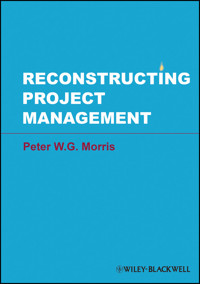
This hugely informative and wide-ranging analysis on the management of projects, past, present and future, is written both for practitioners and scholars. Beginning with a history of the discipline’s development, Reconstructing Project Management provides an extensive commentary on its practices and theoretical underpinnings, and concludes with proposals to improve its relevancy and value. Written not without a hint of attitude, this is by no means simply another project management textbook.
The thesis of the book is that ‘it all depends on how you define the subject’; that much of our present thinking about project management as traditionally defined is sometimes boring, conceptually weak, and of limited application, whereas in reality it can be exciting, challenging and enormously important. The book draws on leading scholarship and case studies to explore this thesis.
The book is divided into three major parts. Following an Introduction setting the scene, Part 1 covers the origins of modern project management – how the discipline has come to be what it is typically said to be; how it has been constructed – and the limitations of this traditional model. Part 2 presents an enlarged view of the discipline and then deconstructs this into its principal elements. Part 3 then reconstructs these elements to address the challenges facing society, and the implications for the discipline, in the years ahead. A final section reprises the sweep of the discipline’s development and summarises the principal insights from the book.
This thoughtful commentary on project (and program, and portfolio) management as it has developed and has been practiced over the last 60-plus years, and as it may be over the next 20 to 40, draws on examples from many industry sectors around the world. It is a seminal work, required reading for everyone interested in projects and their management.
Sie lesen das E-Book in den Legimi-Apps auf:
Seitenzahl: 605
Veröffentlichungsjahr: 2013
Ähnliche
















Table of Contents
Endorsements
Title page
Copyright page
Figures
Tables
About the Author
Preface
Introduction
Structure and Thesis of the Book
Take-Aways
References and Endnotes
Part 1: Constructing Project Management
1 Introduction to Part 1
Historical Method
Bespeaking Relevant Knowledge
References and Endnotes
2 Project Management before it was Invented
Pre-History: Projects and Society
Early Attempts at Formal Project Integration
World War II and the Manhattan Project
References and Endnotes
3 Systems Project Management
USAF Integration: The Formal Recognition of Project Management
Schriever and the Atlas Program
Polaris
PERT and CPM
Construction
The Harvard Business Review Introduces the Project Manager!
McNamara and the Bureaucracy of Systems
Apollo: Configuration Management and Project Leadership
DoD Bureaucratisation
Externalities
Energy and Commodities Projects
Nuclear Power
The Extractive Industries
References and Endnotes
4 The Project Management Knowledge Base
The PMBOK® Guide
Theoretical Underpinnings
‘The Management of Projects’
‘The Management of Projects’ Paradigm versus ‘Execution Delivery’
The APM, IPMA, and Japanese BOKs
Quality Management
New Product Development: Lessons from Toyota
Academic Engagement
References and Endnotes
5 Developing Project Management
IMEC: ‘Large Engineering Projects’
Contracting and Procurement
Partnering and the new Procurement Environment
Risks and Opportunities
Flyvbjerg et al.: Transportation Projects and Optimism Bias
BOT/PFI
Value and Benefits
Health, Safety, and Environment
Defence Projects
Software Projects and Standish
Technology and Requirements Management
Agile Project Management
Information and Communications Technology (ICT)
Critical Chain
Program Management
Developing Enterprise-Wide p.m. Capability: The US Department of Energy (DoE)/NRC Study
References and Endnotes
6 Enterprise-Wide Project Management (EWPM)
Strategy and Governance
PMOs
Best Practice Guidelines and Maturity
Critical Management
Learning and Development
Project Management as a Career Track
References and Endnotes
7 The Development of Project Management: Summary
Part 2: Deconstructing Project Management
8 Introduction to Part 2
The Domain
Deconstructing Deconstruction
Approaching the Management of Projects
Developing Projects
References and Endnotes
9 Control
Scope Management
Scheduling
Estimating
Budgeting
Cost Management
Performance Management (Earned Value)
References and Endnotes
10 Organisation
Roles and Responsibilities
Structure
Structural Forms
Contingency Theory and Organisation Design
Project Management Contingency: Getting the Fit
References and Endnotes
11 Governance and Strategy
Governance
Strategy
References and Endnotes
12 Managing the Emerging Project Definition
Requirements Management
Solutions Development
References and Endnotes
13 Procurement and the Project’s Commercial Management
Acquisition and Contracting Strategy
Partnering and Alliancing
Procurement
Contract Administration
References and Endnotes
14 Adding Value, Controlling Risk, Delivering Quality, Safely and Securely
Building Value, Achieving Benefits
Risk and Opportunity Management
Quality Management
Health, Safety, Security, and Environment (HSSE)
References and Endnotes
15 People
Leadership
Teams
Stakeholder Management
Culture
Individuals’ Skills and Behaviours
References and Endnotes
16 Level 3: The Institutional Context
PMOs
Functions of the PMO
Clearing the Decks for Reconstruction
References and Endnotes
Part 3: Reconstructing Project Management
17 Introduction to Part 3
A Discipline
A Knowledge Domain
Foundations for the Future
References and Endnotes
18 The Character of our PM Knowledge
Terminology
Ontology
Epistemology and Theories of Project Management
Methodology
The Character of the Field’s Substantive Knowledge
References and Endnotes
19 Managing Context
Independent (or Semi-Independent) Variables
Dependent Variables
References and Endnotes
20 Ethos: Building Sponsor Value
Questions of Purpose
Effectiveness
Enhancing Sponsor Value
The Japanese Approach: Pursuing Innovation and Value
References and Endnotes
21 ‘only connect’ – the Age of Relevance
Connecting p.m. to Organisational Performance
The New Dystopia?
The Role of MoP/P3M
References and Endnotes
Part 4: Summa
22 Summary and Conclusions
The Sweep of Project Management
Conclusions for the Discipline
Appendices
Appendix 1: Critical Success Factor Studies
Appendix 2: ‘Characteristics of Successful Megaprojects or Systems Acquisitions’
Index
There is a need to reconstruct project management, both as a scientific cross-disciplinary research domain and as a practical area of application. Peter Morris’s book helps our thinking enormously regarding both these needs. The structure and content of Part 1 skilfully introduces the theoretical and practical components that constitute the field. In outlining its history, Peter builds a solid foundation for exploring its elements: systems, integration, efficiency, effectiveness, performance, requirements, ‘solutioneering’, contracting, procurement, risk and opportunities, value and benefits, people. New perspectives are meanwhile introduced: agility, competences and capabilities, governance and the sponsor, the front-end, technology, sustainability, innovation, partnering, context, philosophy. The final part is ground-breaking in its future projection of project management (mop/p3m). Mankind faces many challenges, be they ecological, demographic, violence or other. Peter’s book explores possible interactions between project management and these futures. No other book is the same.
Karlos Artto
Professor of Project Business
Aalto University, Helsinki, Finland
***
Bravo! Reconstructing Project Management is a tour de force on the philosophy, methods and practices of project and program management; a feast of PM lore, knowledge and insight.
Peter Morris’ long and incredibly productive career has uniquely straddled project management research, teaching, practice, and consulting on some of the most important projects and biggest companies of the last few decades. Reconstructing Project Management provides the most complete and well-integrated coverage of the evolution of project management written to date. But, more importantly, Morris has extracted a wealth of insights from his broad and deep knowledge and experience regarding the shortcomings of conventional project management in addressing the daunting challenges that currently face managers of projects worldwide, and the even greater ones that the next generation of project managers must face.
This book is a must-read for teachers, students and reflective practitioners of the art and craft of project management.
Raymond E. Levitt
Kumagai Professor of Engineering
Director, Stanford Global Projects Center
University of Stanford, California, USA
***
Peter Morris’ writings have influenced and informed the world of project management for over 40 years, not least his powerful idea of ‘The Management of Projects’: the thesis that management should be responsible for the development and delivery of the whole project and that managing the front-end of projects is key to projects’ success.
Reconstructing Project Management continues his thought leadership. It starts with an absorbing history of project management. It then addresses the discipline’s constituent parts, whether related to processes, tools, people or context. Finally, it re-assembles these parts in ways that can add value given tomorrow’s business and social needs.
This book has something for everyone – facts, ideas, concepts and theories that will be of interest to students, practitioners and managers alike. Through whatever lens you are looking at project management, whether past, present or future, you will almost certainly find the answer in this book.
Mike Brown
Director of Project and Programme Management,
Rolls-Royce plc, Derby, UK
***
In Reconstructing Project Management Peter Morris demonstrates a profound understanding of the nature of the discipline, its complexity and its component parts. The analysis is both broad and deep. After chronicling the growth of modern project management, he deconstructs it into its component parts. He then recombines those elements to address today’s needs and tomorrow’s challenges.
As a practitioner, I often witness project managers becoming so consumed in delivery that we forget the need to generate value. Peter reminds us of this need, within a contemporary context. His book challenges us to consider the rapidly changing environment we face in the 21st century. Fewer resources, less water, more carbon, a rapidly changing climate – the management of projects can only get tougher, and more important.
For anyone involved in thinking about projects, whether as deliverers, teachers or researchers, this book will fascinate and challenge in equal measure.
Robbie Burns
Regional Director for Network Rail's Western and Wales Region, Infrastructure Projects Directorate
***
This book begins by showing how our conception of project management evolved to what we today recognise as the project management body of knowledge. Professor Morris then deconstructs that body of knowledge and challenges the reader to think. Is project management merely a tactical approachto delivery or is it an organising principle with a distinctive philosophy? Should it have a role in corporate management or is it only about meeting project targets given to the p.m.team? Peter Morris demonstrates that seeing the discipline as the ‘management of projects’ provides a completely new approach.
Reconstructing Project Management is designed for the purist, the academic, the project practitioner and the project organisation in equal measure. It is at times a challenging read – a some of what it says may clash with traditional thinking – but as an aid to developing the profession and as food for the mind, it is a must-read.
Paul Hodgkins
PM@Siemens, Programme Executive – UK and North West Europe
***
This book is a must for all those who would like to ‘awaken their dreams’ or ‘realise their vision’ or ‘concretise their abstract ideas’. It covers the entire gamut of project management in a lucid manner.
Part 1, ‘Constructing Project Management’, covers the discipline’s history from ancient times to today showing that projects and their management have always been at mankind’s centre. In Part 2, ‘Deconstructing Project Management’, Peter covers exceedingly well the complexity of the subject, simplifying and integrating the various conceptual elements relevant to the broad discipline of managing projects. Peter then does a marvellous job in Part 3, ‘Reconstructing Project Management’, unravelling the challenges in the 21st century as well as the opportunities opening up for us.
The art and science of project management is enunciated here in a way that can be grasped by all those wishing to manage change in our society.
Adesh Jain, New Delhi, India
President, Project Management Associates (PMA-India) and President, International Project Management Association, 2005
***
Reconstructing Project Management starts with a fascinating and highly readable history of the study and practice of managing projects. Starting with early efforts by the Pentagon to codify and structure its approach to projects in the 1960s, Professor Morris puts many of the landmark studies of project delivery approaches in perspective. He then proceeds to rebuild the readers’ understanding of project management in a new way.
If you are a serious student of project management, you will find Morris’s ‘reconstruction’ provocative and thought-provoking, whether you agree with every aspect or not. His critique of the literature and our efforts to date is devastating and his plea for more disciplined critical thinking is spot-on. Reading this book will be enjoyable to anyone interested in the broad field of managing work through projects and is required reading for those interested in contributing to the discipline.
Ed Merrow
Founder and CEO, Independent Project Analysis, Inc.
Ashburn, Virginia, USA
***
Reconstructing Project Management is a tour de force! Peter Morris describes the past, present and future of project management! The big picture! The world of project management, not only as it is but as it ought to be! This is one of the best books on project management that I have ever read. I believe Reconstructing Project Management will be recognized as one of the seminal books of the 21st Century on modern project management. Every thinking professional in the field should read it; every serious library must contain a copy. This book confirms Peter’s place as THE world’s leading critical thinker on the increasingly important topic of managing projects.
David L. Pells
Managing Editor, PM World Journal, Houston, Texas, USA
***
Scholarship is the word that comes to mind reading this truly comprehensive and impressively thorough volume. This is a book about and for the project management profession. It is rigorously researched and extremely readable. It challenges you to think, the need for which in project management has probably never been greater. Despite its scholarly nature, it is completely practical and covers an intriguing past, a diverse present, and a pragmatic future.
The role of universities in providing the profession with such thinking should be fully acknowledged. Knowledge of this kind is extraordinarily valuable.
Two lifetimes are reflected in the book. One is the long gestation of the discipline which, with its new ‘construction’, is now helping mankind address major challenges. The other is the professional lifetime of Peter Morris, who has dedicated much effort in practice and in education to establishing the principles of the effective management of projects.
Tom Taylor
President, Association for Project Management, UK
***
Peter Morris has been a critical commentator on, and an important contributor to, project management for over 40 years. In this important, summative book he draws upon his in-depth knowledge of the field to describe and reflect upon its emergence, both as a practical discipline and as a domain of academic study. His analysis is rich, compelling and robust. It highlights project management’s inherent strengths and its current weaknesses, proposing ways in which it could be restructured to better fill its roles in society, today and in the future. The book makes observations and provides recommendations that will be provocative to many practitioners and academics, yet its proposals are profound and needed, and should be actionable by everyone who is concerned, whether directly or indirectly, with the effective management of projects.
Dr. Brian Hobbs, Project Management Chair at the University of Quebec at Montreal, and recipient of PMI’s Research Achievement Award for 2012
This edition first published 2013 John Wiley & Sons, Ltd
© 2013 by John Wiley & Sons, Ltd
Registered office:
John Wiley & Sons, Ltd, The Atrium, Southern Gate, Chichester, West Sussex, PO19 8SQ, UK
Editorial offices:
9600 Garsington Road, Oxford, OX4 2DQ, UK
The Atrium, Southern Gate, Chichester, West Sussex, PO19 8SQ, UK
2121 State Avenue, Ames, Iowa 50014-8300, USA
For details of our global editorial offices, for customer services and for information about how to apply for permission to reuse the copyright material in this book please see our website at www.wiley.com/wiley-blackwell.
The right of the author to be identified as the author of this work has been asserted in accordance with the UK Copyright, Designs and Patents Act 1988.
All rights reserved. No part of this publication may be reproduced, stored in a retrieval system, or transmitted, in any form or by any means, electronic, mechanical, photocopying, recording or otherwise, except as permitted by the UK Copyright, Designs and Patents Act 1988, without the prior permission of the publisher.
Designations used by companies to distinguish their products are often claimed as trademarks. All brand names and product names used in this book are trade names, service marks, trademarks or registered trademarks of their respective owners. The publisher is not associated with any product or vendor mentioned in this book.
Limit of Liability/Disclaimer of Warranty: While the publisher and author(s) have used their best efforts in preparing this book, they make no representations or warranties with respect to the accuracy or completeness of the contents of this book and specifically disclaim any implied warranties of merchantability or fitness for a particular purpose. It is sold on the understanding that the publisher is not engaged in rendering professional services and neither the publisher nor the author shall be liable for damages arising herefrom. If professional advice or other expert assistance is required, the services of a competent professional should be sought.
Library of Congress Cataloging-in-Publication Data
Morris, Peter W. G.
Reconstructing project management / Peter W.G. Morris, professor of construction and project management, The Barlett, University College London.
pages cm
Includes bibliographical references and index.
ISBN 978-0-470-65907-6 (hardback : alk. paper) 1. Project management. I. Title.
T56.8.M725 2014
658.4'04–dc23
2012037674
A catalogue record for this book is available from the British Library.
Wiley also publishes its books in a variety of electronic formats. Some content that appears in print may not be available in electronic books.
Cover design by Steve Thompson
Figures
Figure 2.1 The Gantt chart
Figure 2.2 Adamiecki’s Harmonygraph
Figure 2.3 Crystal Palace
Figure 2.4 Work Breakdown Structure of the Manhattan Project
Figure 3.1 Atlas
Figure 3.2 Bernard Schriever
Figure 3.3 William Raborn
Figure 3.4 PERT
Figure 3.5 Robert McNamara
Figure 3.6 George E. Mueller
Figure 3.7 Sam Phillips and Houston Control
Figure 3.8 Apollo matrix organisation
Figure 3.9 Earth rise and Lunar Excursion Module (LEM)
Figure 3.10 Concorde
Figure 3.11 Dungeness B nuclear power station
Figure 3.12 The TransAlaskan Pipeline
Figure 4.1 Knowledge areas and processes of the PMBOK® Guide
Figure 4.2 Thompson’s classification of types of interdependence and concomitant integration types
Figure 4.3 Galbraith’s range of integrating mechanisms
Figure 4.4 Five CSF studies
Figure 4.5 ‘MOP’ – ‘the management of projects’ – compared with PMBOK® Guide
Figure 4.6 The APM Body of Knowledge
Figure 4.7 P2M: The Japanese Body of Knowledge
Figure 4.8 Concurrent Engineering
Figure 5.1 The Andrew project
Figure 5.2 Apollo 11 view of Earth
Figure 5.3 The Waterfall model
Figure 5.4 The Spiral model
Figure 5.5 The Vee model
Figure 6.1 SEI Capability Maturity Model
Figure 8.1 Levels 1 to 3 in the management of projects
Figure 8.2 Sequence of project development
Figure 9.1 Product Breakdown Structure (PBS)
Figure 9.2 Work Breakdown Structure (WBS)
Figure 9.3 The Rolling Wave concept
Figure 9.4 Activity-on-Arrow and Activity-on-Node networks
Figure 9.5 Evolution of CPM compared with PERT
Figure 9.6 Critical Chain
Figure 9.7 The estimating funnel
Figure 9.8 Earned value performance measures
Figure 10.1 Owner/supplier p.m. roles
Figure 10.2 The matrix swing
Figure 11.1 Roles in the management of projects
Figure 12.1 The Technology Readiness tool
Figure 16.1 The elements of project management capability
Figure 20.1 The ‘traditional’ versus a ‘value-driven’ approach to the management of projects
Figure 21.1 Geels’ transition theory model
Tables
Table 5.1 Standish findings, 1994–2009
Table 7.1 The 10 stages of project management, or how the discipline developed: 1953–2013
Table 18.1 Generic principles in the management of projects
About the Author
Peter Morris is Professor of Construction and Project Management at University College London (UCL). He is the author of The Management of Projects (Thomas Telford, 1994); with George Hough, of The Anatomy of Major Projects (John Wiley & Sons, 1987); and, with Ashley Jamieson, of Translating Corporate Strategy into Project Strategy (PMI, 2004). He is co-editor with Jeffrey Pinto of The Wiley Guide to Managing Projects (Wiley, 2005); and, with Jeffrey Pinto and Jonas Söderlund, of The Oxford Handbook of Project Management (OUP, 2011).
He was Chairman of the Association for Project Management (APM) from 1993 to 1996 and Deputy Chairman of the International Project Management Association (IPMA) from 1995 to 1997. He received the Project Management Institute’s 2005 Research Achievement Award, IPMA’s 2009 Research Award and APM’s 2008 Sir Monty Finniston Lifetime Achievement Award.
Preface
A variety of titles suggested themselves for this book: Project Management Past, Present and Future was an obvious one. The Book behind the BOK was another, though a bit obscure. Something to do with construction seemed more appropriate for a professor of construction and project management.
I have been trying to formalise what one needs to know, and can say about, the management of projects since the late 1960s. Here is what will perhaps be my last such effort: Reconstructing Project Management. What is it; how did it get to where it is; where is it going?
My perspective has shifted on a number of occasions as I have climbed this mountain over the years.
In 1967, when newly beginning work as a site engineer at Dungeness nuclear power station, I was amazed at the sudden, very late arrival of design changes. Why was nobody scheduling the release of information? From this came recognition of the horizontal (cross-function) project dimension and my PhD on how the amount and type of integration required varies for projects of differing size, speed and complexity (the matrix and contingency theory – Chapter 10).
In 1976, in Brazil advising on the management of a $4 bn. steel mill, my colleague Joe Graubard, recently of US Steel project management, explained it was all about delivering ‘on time, in budget, to scope’ and showed me how to set out to do this and to control ‘earned value’ (Chapter 9).
In 1980, advising the owners of the TransAlaskan Pipeline, I discovered that the overrun record of projects was truly appalling, and that the reasons for this had little to do with planning and monitoring but were rather contextual things like stakeholders, geophysical conditions, weather and other exogenous factors, as well as poor technology management, commercial issues, and people (Appendix 1). This lead me to suggest that the discipline should really be about ‘the management of projects’ where the project is the unit of analysis and the challenge is to develop and deliver it successfully. That the real place to focus is the front-end, where the project targets are set and value is built. And that we need to be quite sophisticated in choosing measures of success (Chapter 4).
In the early 1990s, I was asked to produce the first draft of the Association for Project Management’s ‘Body of Knowledge’. Using the ‘management of projects’ perspective, we developed a structure for the discipline which, I believe, more properly reflects the knowledge that one needs to have in order to manage projects effectively than was to be found in other BOKs at the time.
Through my research and consulting with major companies in the 1990s, I began to realise just how difficult it is to build enterprise-wide project management competencies. How difficult it is to get people to seek out knowledge and learn. How difficult it is to acquire, build and deploy competent people who will be supported by an organisation having a mature project management infrastructure, in a manner that is appropriate both to the characteristics of the project or program, and to the context in which it operates (Chapters 10 and 19) – quite a mouthful; and in reality, it is!
In the late 1990s/early 2000s, I was persistently reminded of two variants of project management and the challenges they pose to our understanding of the discipline: namely, program management and agile project management. Program management had a vociferous following that promoted it as a form of strategic change management, yet it has several other interpretations. Agile sounds attractive but defies the traditional definitions of the discipline. Our knowledge of both seems as yet not wholly worked out (Chapters 5 and 21).
In the first decade of the 21st century, as part of project assurance activities, I did a number of Root Cause analyses for an oil and gas major on projects that had been significantly late and over budget. In all cases, we traced the root cause to People: human beings making the wrong decisions, either because they didn’t have the requisite experience, missed things, or were overly influenced by inappropriate drivers. ‘Projects are built by people, for people, through people’ yet too often we give too little attention to getting our people right. As we’ll see (Chapter 15): ‘one should never compromise on people – but one always does’.
Working with a number of companies at about the same time made me acutely aware of the huge impact that the sponsor can have on the conduct of the project, yet how little professional knowledge of the subject they may have.
Finally, research at UCL around 2010 highlighted how serious many of the trends in our society are: the world in 2050 (one professional generation away) offers much to worry about. But what is the academic community in project management doing about it? Almost nothing: nearly all project management writing and research seems to be about means rather than ends. Very little connects with performance (Chapter 21). This seems to be a major shortcoming, challenge and opportunity.
The book explores the events on this journey from simple, classical project management to ‘the management of projects’ (mop) and to p3m – portfolio, program and project management. It does so from two perspectives, reaching out to two or three sets of readers: practitioners who practise the discipline of project management (p3m or whatever we call it); academics who research and teach in the domain; and of course, students. Maybe neither the practitioners nor the academics will feel the material is always quite in their comfort zone. That’s too bad, for I believe that the language and thinking about the practice and theory of managing projects needs to be better integrated, and that it’s worth struggling to help achieve this.
With Thanks, and More
This book is the product of two partnerships which have dominated my life: my work and my family. Without the former the latter would not be what it is, and vice versa. But without Carolyn, my wife, neither would have been what they are. I dedicate the book to her, therefore, with all my love.
Many people have helped me develop the ideas put forward in the book. From UMIST (the University of Manchester Institute of Science and Technology), Professors Dennis Harper, Roger Burgess and Stephen Wearne; from Sir Robert McAlpine, David Rolt; from Booz Allen & Hamilton, Joe Graubard, John Smith and George Steel; from Arthur D. Little, Dr. Albert J. Kelley and Ivars Avots; from the Major Projects Association and Templeton College, Oxford, Allan Sykes, Derek Fraser, Uwe Kitzinger and Dr. George Hough; from Bovis, Sir Frank Lampl; from INDECO, George Steel (again) and James Young; and from my time at UCL, Dr. Andrew Edkins, Dr. Joana Geraldi, Dr. Stephen Pryke and Dr. Hedley Smyth, and Professor Jeff Pinto of Penn State University and Professor Jonas Söderlund of BI Norway, Thanks especially to Dr. Sulafa Badi, who helped me enormously in marshalling the figures and tracking down several of the references. Thanks, too, to those who read early drafts of the book and who made many invaluable comments, not least Dr. Joana Geraldi, Dr. Peter Harpum, Dr. Efrosyni Konstantinou, Paul Mansel, Dr. Tyrone Pitsis, Miles Shepherd and Dr. Yannis Zoiopoulos. They invariably caused me to reflect and often to amend.
Mrs. Beeton opens the preface to her famous and eponymous guide to household management with the memorable sentence “I must frankly own, that if I had known, beforehand, that this book would have cost me the labour which it has, I should never have been courageous enough to start it”. In the case of this book, I have to admit that I had a pretty good idea of the labour that was to be required, but I neither recoiled from the prospect nor regretted its expenditure in execution. I only hope that the pleasure, if such there is, and reward that you may derive in reading it is proportional to that which I found in writing it.
Peter W.G. MorrisUniversity College London2 June 2012
Introduction
There once was a little girl who was found staring at a can of orange juice. When asked what she was doing, she said, it says ‘Concentrate’. Seems a funny way to begin a book on project management? Well, this little literary cartoon has several lessons directly relevant to this book. Don’t take words necessarily at their face value. Don’t act on them without thinking critically about their meaning. Beware of following normative or prescriptive advice too literally. Don’t underestimate the young, neither their determination nor, like the rest of us, their ability to misread. Sometimes, a sense of humour may not be amiss! And lastly, concentrate!
This book is an essay on the knowledge needed to manage projects (and programs) effectively*. We’ll see the little girl’s lessons apply richly in tackling the subject. Management is an eminently practical business. Managers are essentially concerned with achieving results effectively. By and large, managers respect ‘academic’ rules and practices but may not feel too constrained by them unless there are clear reasons for doing so. Project management has chosen to put considerable weight on normative rules, adopting a persona of professionalism; a persona where knowledge is codified to the point where it has its own unique ‘body of knowledge’, or bodies, which can be taught and examined.
But management knowledge needs to be tailored in its application. Doing this requires judgement. It would be naïve and could be dangerous to imagine that project and program management could be applied straight ‘out of the box’. This book aims to help form the judgement needed for such tailoring by addressing the principles of managing projects and programs: looking at how they may be applied in practice in different ways, according to need and context. It thus approaches the subject in the spirit of education rather than as a ‘how-to’ handbook or a form of training; it is concerned with thinking about the management of projects rather than simply with applying its practices mechanistically. It is about both the theory and the practice of managing projects and programs.
The book is therefore written for those who wish to develop both their knowledge of, and their ability to think about, the management of projects, and programs. Specifically, it is written for:
tomorrow’s leaders in project and program management (as an area of management practice and as a domain of management study);
project management professionals and practitioners who ought to be, as professionals, or might be, as practitioners, interested in a slightly more ambitiously theoretically-grounded treatment of the area they are working in;
post-graduate students who are looking for a significant resource book, addressing, hopefully, just about all the principle areas of knowledge relevant to the subject;
my colleagues in the academic project management community, as a contribution to the ongoing discussions and debates about the knowledge area; and
anybody else who is interested in projects or programs and their management and who wants a good read!
Structure and Thesis of the Book
The book is in three parts. Part 1 traces how our knowledge of the field developed, how the subject has come to be constructed in the way we think of it today. It chronicles the growth of a discipline for managing projects; a discipline that, as many envision it today, needs to be enlarged. In parallel it chronicles the development of what many scholars see more as a field of enquiry – a knowledge domain – than as a discipline.
Part 2 takes this construct apart – deconstructs it – describing and presenting back to the reader the range of practices that are available for managing projects.
Part 3 then looks at how these elements of project management may be recombined – reconstructed – when deployed under different circumstances to meet today’s needs and tomorrow’s challenges. As a discipline, how and to what ends should it be deployed? Looking forward, it is argued, it needs refocusing around value and context. It could, and should, engage more with the major issues facing society today – issues such as climate change, profound demographic changes, hugely expanded data and information pools, and the need for massive infrastructure replenishment, all of which will require a project or program approach if they are to be tackled effectively.
More specifically:
Part 1: the Development of the Domain
Some of the early chapters of Part 1 have been covered in my earlier book, The Management of Projects (1994) and in chapter 1 of The Oxford Handbook of Project Management (2011). I have kept largely to the events used in these previous accounts, albeit with significant additions and some omissions, because I believe that they do truly illustrate the story of how project management developed from something instinctive and ad hoc to something formal and well structured. No part of Part 1 (or any other part) is merely a copy of these previous publications. It is freshly written and draws on much writing and research that has been done since The Management of Projects was originally published in 1994 and is almost four times the length of the Handbook chapter, having new information, new case studies, and more to say on several matters – the 19th century; the development of project management in the US aircraft and missile programs between 1920 and 1960; and the origins of PMBOK, Agile, and the Scandinavian School, amongst other topics.
It is important to acknowledge that the events reviewed here are not the only events that could be chosen to illustrate the emergence of the discipline. There is potentially an infinitude of possible candidates and there are clearly some obvious omissions. I dwell on the rise of coordination in the nascent aircraft industry of the 1920s but suspect similar evidence could be found in, for example, shipbuilding, and of course the military. I have chosen aircraft manufacturing because there is evidence readily to hand (Benjamin Pinney’s PhD). I simply don’t have the time now to do the primary research that would lead to data for other examples. Similarly, a comprehensive history of the development of the discipline would search out examples from other countries and regions, but this is beyond the scope of this book. These omissions, however, represent opportunities for other researchers.
This said, even as it stands, I believe Part 1 is very important in setting the context in which Parts 2 and 3 need to be seen: the ‘state of play’ today and thoughts for the future. Reading a history of the development of the subject – of the issues faced and responses taken – as given in Part 1 provides a means of seeing the scope of knowledge that has been deployed, as time and events have gone by, in managing projects and programs effectively, and to reflect on the coherence and robustness of this knowledge and the challenges in deploying it.
This re-acquainting with the true scope of the subject is especially important in project and program management as a result of the many guidance manuals and ‘standards’ that have been published by the professional associations, government agencies, and national and international standards bodies over the last 30–40 or more years and the impact these have had on the discipline. For this codification can become troublesome if, as is currently the case, it is in some way not an adequate representation of the knowledge that is really needed. (And matters are made worse if educational programs are then accredited against the very standards which their researchers and teachers should be critiquing.)
This may seem a little over the top, but there are places where the official view is at odds with what this book will present. Take two examples. First, the most popular conception of project management is that it is essentially about delivery execution, and about outputs rather than outcomes1. This conception is inadequate, as Part 1 demonstrates. History, and research, shows that the effective management of projects involves the management of the project’s development and definitional ‘front-end’ stages as much as its downstream execution. Second, much of project and program management is portrayed as centring on monitoring and controlling. Yet a perfectly valid alternative, and a logically preferable one, would be to centre it on improving value, for example, to the sponsor, which is an approach argued for in Part 3*. These are not the conceptions promoted by some of the more influential standards-setting bodies. They come from university-led research2. They are cogent and they make a substantial difference to the way the discipline can be viewed. Their omission dramatically diminishes what I believe is a proper and richer perception of the subject. It profoundly and adversely misshapes its essence and reduces its potential effectiveness.
This said, Part 1 tells an outstanding story of intellectual and professional development. It paints a picture of a robust, valuable, healthy, popular, coherent subject which has become a major force in society and business, even if it still has some issues, such as the ones discussed above, unresolved.
Part 2: Analysing the Elements
The middle portion of the book, Part 2 – the deconstruction of project management – is the largest section. It is essentially a comprehensive reference work on the functions of project and program management: on the competencies required and on the tools and techniques, and processes and practices available.
Some thinkers are sceptical about the possibility of identifying generic ‘good practices’ (or more precisely, of identifying context-free prescriptive practice) for the reasons discussed at the beginning of this introduction. I maintain that, to an extent, however, one can; that indeed our research and teaching should have a ‘should’ about it – because we do want to learn about practices which are likely to lead to improved performance rather than just describe in a non-teleological, value-free way who did what to whom and how (as with ‘practice-based’ research3) – but that when doing so one needs to make clear the epistemological base that one is using and the methodology that one is adopting. Merely asserting something as ‘the way to do project or program management’ is often not convincing. Indeed, its very superficial plausibility may obscure issues and be positively dangerous. (Epistemology and methodology are addressed in Part 3.)
Part 3: Putting it Together Again
The final part of the book looks at how the elements of project management may be reconstructed to meet society’s future needs. It does so from four perspectives: its conceptual and philosophical roots; shaping context; the ethos of the discipline (enhancing sponsor value rather than just planning and monitoring); and responding to organizational, technological and societal developments and to the changing challenges facing our world. Part 3 suggests that the discipline needn’t be limited just to responding reactively. In doing so, it notes that much of project and program management scholarship has tended to ignore application and impact – to be more concerned with means than with ends, with theory than with practice. Part 3 argues that the academic value of project, program and portfolio management would be greater if we could relate theory more directly to practical benefits, that it should concern itself more with how project practices can make a difference to society’s issues.
Take-Aways
So much the structure. What do I expect you, the reader, to get out of reading the book? I would hope:
It’s important to recognise that the book is not a summary of all the research available in the field. To attempt this would be invidious and the result would be overwhelmingly unusable. The literature is instead called on to support these eight aims.
In pursuing these aims, but particularly with respect to the last two, I ask you, the reader, to engage and read critically: with an alertness, commitment and awareness that the little girl would be proud of; with a concern for purpose and evidence that is appropriate to a discipline that, in its contribution to society, past, present and to come, is truly important.
Notes
*I explain why I spell program only with one ‘m’ on page 93 – briefly, it is the spelling recommended by the Oxford English Dictionary.
*The role of the sponsor, by the way, is another example of a key actor – a key piece of knowledge – being poorly, if at all, treated in these standards. See pages 145–7.
References and Endnotes
1 As in the Project Management Institute (2013), A guide to the project management body of knowledge, fifth edition, Project Management Institute: Newton Square: PA and Office of Government Commerce (2007) Managing successful programmes, The Stationery Office: Norwich.
2 For example, Flyvbjerg, B., Bruzelius, N. and Rothengatter, W. (2003), Megaprojects and risk: An anatomy of ambition, Cambridge University Press: Cambridge; Miller, R. and Lessard, D. R. (2000), The strategic management of large engineering projects, MIT Press: Cambridge; Morris, P. W. G. and Hough, G. H. (1987), The anatomy of major projects, John Wiley and Sons: Chichester.
3 This is a mild dig at the ‘projects-as-practice’ approach: Hällgren, M. and Söderholm, A. (2011), Projects-as-practice: New approach, new insights, in: Morris, P. W. G., Pinto, J. K. and Söderlund, J. (eds.) The Oxford handbook of project management, Oxford University Press: Oxford, pp. 500–518.
Part 1 Constructing Project Management
Its History Constructed
1
Introduction to Part 1
Part 1 is a description of how the elements of what we call project management evolved over many years, but particularly since the early 1950s, and were slowly constructed into the thing that most project managers would recognise by the term today.
It is not an account of the management of projects through history; such a thing would be huge and probably meaningless. It does not claim – indeed it positively challenges the notion – that project and program management is now all defined and textbook clear. It shows rather that there are points of divergence and contradiction in the way we describe it and present our knowledge of it.
Some argue that such pluralism of knowledge is no bad thing since it shows vigour and reflects widespread adoption under differing conditions1. Maybe. Such a thought is at least comforting. But it doesn’t diminish the concern where one believes misperceptions or mistakes are being propagated.
It is not the intent of this first section of the book to enter into any real or detailed critical discussion of the theory of the subject. This will be more the aim of Parts 2 and 3. It is instead intended as a description of the major actions that have contributed to the development of what passes for the discipline: an account of the major insights which slowly have built up our knowledge of the domain.
Historical Method
In presenting this chronology, I have endeavoured to be scholarly, respecting original texts (though admittedly much of the source material is secondary) and reflecting the thinking of the actors of the time and the contexts in which they were operating.
All historians face the twin challenges of how to choose – how to frame – the object to be investigated, and then how to evaluate the data that are available and relevant. Scholarship requires absolute respect for the data, rigour and lucidity of analysis, and clarity of exposition. But judging relevance is not a value-independent exercise: it reflects a perspective. History today is rarely seen as an objective, disinterested enquiry but rather as socially constructed. My personal concern is how best to manage projects but critically my unit of analysis is the project, not management processes and practices. So I look for examples of how projects were, or were not, successfully managed. My history is thus different in scope and purpose from much of the more traditional project management preoccupation with planning and control.
The trouble is, the field is vast. Selecting events to illustrate the evolution of the discipline and, to a degree, in describing them, will inevitably reflect my own views, despite the desire for objectivity. But contemporary history acknowledges this: we are long past the time when we claimed that history was based on hard facts from which ‘objective’ truth was inductively drawn. Historians create historical facts, as the eminent historian E.H. Carr put it, according to their interests – feminism, gender, poverty, Marxism, colonialism, etc.2 Study the historian to understand the history.
Bespeaking Relevant Knowledge
The examples I have chosen reflect major learning cases: one extraterrestrial (the Apollo Moon program); some international (Concorde); some national but private sector (the Andrew North Sea oil project); and others public (the US Department of Defense programs or the UK ‘New Accommodation Program’ (NAP) – the relocation of the UK’s intelligence services). Were I say German, Japanese, Brazilian or Ghanaian, to pick a few nationalities at random, my examples would doubtless be different. Apollo would figure, though I am not so sure about the others. But I am not. I am an English academic with a strong practitioner bias who has spent a lot of time working in the Americas, Europe and the Middle East, and who believes passionately that there are things one can say about good practice in managing projects and programs.
And I also recognise the importance of context. Management, as we noted in the Introduction and as we shall see reiterated often, as a subject is inherently contextual3. One of the very strong aims of Part 1 is to illustrate this, showing how different contexts create the need for different management responses.
Aristotle said the mark of an educated man is to recognize in every field as much certainty as the nature of the matter allows. Context and personal perspectives shield us from ever attaining pure truth, be this historical or operational. Pure, whole truth is, in the social sciences, epistemologically impossible given the types of knowledge potentially in play and the effect of context, topics we shall discuss in Part 3.
Practising project and program managers must therefore shape their own version of ‘what we need to know to manage projects effectively’. Part 1 is presented in the belief that reading a chronological account of how the project and program body of knowledge came into being will provide a foundation to help do this.
So, read and reflect; evaluate and adjust; modify and apply! Conjure your own account of what has made project management what it is. Most importantly, ask yourself, what in fact it – this knowledge – is.
References and Endnotes
1 Söderlund, J. (2011), Theoretical foundations of project management, in: Morris, P. W. G., Pinto, J. K. and Söderlund, J. (eds.) The Oxford handbook of project management, Oxford University Press: Oxford, pp. 37–42.
2 Carr, E. H. (1961), What is history? Cambridge University Press: Cambridge.
3 Griseri, P. (2002), Management knowledge: A critical view, Palgrave Macmillan: Basingstoke.
2
Project Management before it was Invented
Projects have been around since man first walked on Earth, ranging from the informal, such as cooking or hunting, to the large formal construction or military ones. Often – maybe generally – they were accomplished very well. But there was no formal discipline of ‘project management’. Indeed, there was no formal discipline of management at all until the 20th century – there was no ‘village Project Manager’ in the way there was a village butcher or baker, parish priest or possibly doctor. Not until the early 1950s did anyone even suggest that there might be a formal discipline called ‘project management’.
This chapter, after acknowledging the enormous organisational abilities of man even at the dawn of civilisation, identifies some of the early formal techniques for managing projects – Plutarch, Vauban and Perronet on contracting; Wren and Hooke on construction organisation; the tools of Scientific Management (Gantt, Adamiecki, DuPont); and the rise of formal integration (the Bureau of Land Reclamation, aircraft manufacturing in the 1920s). The Manhattan Project – the program to build the USA’s atomic bomb – often quoted as the originator of the discipline – is, however, no more an early example of project management than the pyramids four and a half thousand years earlier.
Pre-History: Projects and Society
Projects are undertakings to realise an idea. ‘Project’ (noun) means something thrown forth or out; an idea or conception1. People have, of course, been doing this since time began. The cave paintings of the Upper Palaeolithic era (35,000 BC) both reflect projects (hunting) and are themselves the result of complicated shamanistic belief systems and practices2.
Projects are organisational entities. They differ from non-project organisations in that they all follow the same generic development sequence. Something like: (1) idea; (2) outline concept and strategy; (3) detailed planning; (4) execution; and (5) completion/close-out. All projects, no matter how complex or trivial, large or small, follow this development sequence. Non-projects (for example, running a production line in a bottling plant or a business) do not. Cooking my dinner is a project: it follows the same sequence: idea (menu), preparation, execution (eat), and wash-up*. Hunting is a project in that it follows this sequence, though its conception and execution may, in large part, be instinctive. Animals hunt. Homo erectus, 1.8 million years ago, hunted. Managing projects is partly instinctive.
As groups grew and society formed, projects became more complex. Many were unremarkable, as many are today. Others were spectacularly large and complex, designed to reflect temporal power, acknowledge deity, and witness life through death. The Giza pyramids of 2600–2700 BC probably involved the labour of some 70,000 people3 – essentially the whole community – quarrying, hauling, dressing and laying the 25 million tons of giant limestone pieces that make up the three major pyramids; in effect, nation building. Clearly this huge effort required managing. Imhotep, Giza’s architect, the builder before Giza of the pyramid at Saqqara, the first two-storey pyramid ever, was the organising genius. (He later died of cancer and was deified.)
Stonehenge, approximately 3000–1600 BC, was no less spectacular a feat of organisation, more so perhaps in both its size, relative to the population, duration, and given the less benign weather (frequently foul and quite un-Egyptian in its variability) and the long haulage over rough ground – 200 miles for each of the 82 four-ton bluestones that were probably dragged from south Wales to Wiltshire used for Stonehenge II/3.1 (2400 BC), and later, in Stonehenge III/3.2 (2400–2200 BC), and some 20 miles for the 77 huge twenty-ton sarsens brought from their quarry on the Marlborough Downs4. (Not only were the stones placed incredibly accurately in plan with regard to the Solstice, in elevation they were level despite being placed on an inclining site.) This enormous project – actually many projects, reflecting at least two belief systems5 – must have involved the entire population of Wessex, some 50,000 people, working and supporting a thousand labourers, for many generations6. It’s been estimated that hauling the stones and building Stonehenge required about 30 million man-hours of labour7.
Projects (and programs of projects†) clearly existed then from the times of pre-history – since man has been on Earth – and were managed as such, often very effectively. But no-one thought of their management as a formal activity called project management. Indeed, no-one thought abstractly of management as a subject at all. For although the management terms ‘supervisor’ and ‘vizier’ were in use, for example in Egypt, and we find discussion of organisation and leadership by, inter alia, Socrates, Aristotle and Xenophon, and of course Sun Tzu also on strategy8, the topic as such would have to wait until the early 20th century to appear as a subject of credibility and substance.
Nor was management alone in not yet being a subject of intellectual enquiry: the engineering of projects was also quite rule of thumb. Until the Enlightenment and really well into the 17th century, engineering was pre-eminently based on intuition and experience rather than science. Despite the contributions of a few notable theoreticians such as Archimedes, Hero, Vitruvius and Frontinus, “the master builder remained a craftsman who, even in the design of important structures, was mainly guided by intuition”9. This is as true for the large irrigation projects and programs, for example of Iraq or Spain, as of the magnificent Roman aqueducts, roads and bridges, the vaulted buildings in Roman and Arabic architecture, or of the use of buttresses in Romanesque and Gothic architecture. (With often calamitous results: collapsing towers, domes and arches were frequent mishaps.)
The organisation of project work followed a similar practical bent. We see much that resonates with contemporary ‘good management practice’ – for example there is evidence as far back as Greek times of projects being divided into work packages, as in the Long Walls of Athens, divided amongst 10 contractors, or the building of the Coliseum in Rome, divided amongst four. Contracting strategies seem to have changed but little since then, at least until recently. Plutarch could be describing some of today’s procurement practices when he writes: “when the local authorities intend to contract the construction of a temple or the erection of a statue, they interview the artists who apply for the job and submit their estimates and drawings; whereupon they select the one who, at the lowest price, promises the best and quickest execution”10.
Managing Engineering Projects: the Master Mason
So, for many hundreds of years specialisation was by craft (hence the guilds) rather than by function (e.g. engineer). It was not until the 18th century that scientific theory began to be developed, enabling explanation and prediction, first, of the technical basis of project work, and later, more slowly and infinitely more tentatively, of some of their management needs and consequences.
Sir Christopher Wren exemplified the changing role of knowledge, both in engineering and architecture and in management. A mathematician turned astronomer and architect/engineer, Wren was a founding Fellow of the British Royal Society (‘for Improving Natural Knowledge’, i.e. for Science) which was granted its Royal Charter in 1663. An outstanding example of Wren’s project management skills was his role in responding to the catastrophic Great Fire of London of 1666, which reduced 13,000 houses, 90 churches and many other buildings, some quite magnificent, to ash and ruin. Wren and Robert Hooke, the Oxford physicist, another Royal Society member, were commissioned to survey the blasted site, plan the new city, design the churches, houses and other buildings, and oversee the rebuilding works, Wren being appointed chief architect to the Crown in 1669. So great were the organisational challenges that Wren and Hooke abandoned the traditional approach to building – of craftsmen constructing the architect’s design11. “The huge amount of materials and personnel necessary called for careful management of the work and control of costs. The beginnings of modern construction management can be seen in the way Wren’s office was organized. The complimentary roles of architect, engineer, surveyor and contractor emerged”12.
Military Projects
Not that project management skills were limited to construction. Moving thousands of soldiers over large expanses of territory inevitably poses considerable challenges of project planning and control. William of Normandy’s invasion of England in 1066 involved the shipment of 8,000 to 10,000 men, as well as their horses, across the English Channel in 400 boats over several days:, an immense undertaking13. We have little idea of how detailed William’s inventorying and scheduling were but there was certainly considerable overall planning for this huge project. Loose planning under an overall schema was typical of armies on the move well up to the American Civil War and beyond. Often it was done badly.
Napoleon, while recognising the need for substantial logistical support in his invasion of Russia in 1812, established immense supply depots at Könisberg and other towns and provided additional transport battalions, yet failed to appreciate how wholly his grande armée would need to forage off the land, which the Russians destroyed as they retreated in front of his famished troops.
But if Bonaparte was rather careless of life (380,000 of his men died in the invasion), John Churchill, Duke of Marlborough, the greater soldier, who never lost an engagement let alone a battle, wasn’t*. His famous march down the Rhine and Danube in 1704, ending in the Battle of Blenheim, is a fine example of project planning and leadership. “Vital stores and lighter canon were conveyed by river barges as far as possible. … Initially Marlborough’s 21,000 men were accompanied by 1,700 supply carts carrying 1,200 lbs. of stores apiece, drawn by 5,000 draught-horses. The artillery needed as many more. At Heidelberg a new pair of shoes awaited every man. … These measures were supplemented by a carefully-planned march time-table designed to confuse the enemy scouting parties and save the men from undue wear and tear”14.
These examples of military, and civil, projects, managed at times superbly, at others not, are offered not gratuitously but simply to make the point that people have been managing projects, of all kinds, many very challenging, well before the advent of the tools, the language, the concepts that we today associate with the contemporary discipline of project management. And this was to remain the case, as we shall see, at least until the early 21st century, but really up until the 1950s.
The Rise of the Professional Engineer: Integration Is Threatened
It was Marlborough’s opponent in the War of Spanish Succession, the French, under Sébastien Le Prestre de Vauban, who now advanced engineering onto a new, more scientific and professional basis. Vauban was a soldier first, a master builder of redoubtable fortresses, but later also of civil public works. Vauban promoted the role of ‘Ingénieur’ as a professional title for a scientifically trained technician in, effectively, civil engineering, with the “Corps des ingénieurs du Génie Civil” being founded in 1675 and the “Corps des ingénieurs des ponts et chausées” following in 1720. Vauban’s approach to projects was a masterpiece of clarity, comprising a covering letter, a ‘Mémoire’ and drawings, the Mémoire giving information on the background to the project, a detailed description of the works, cost estimates, and a description of any special features. Standard rules were laid down for tendering and contracting including the preparation of an ‘execution plan’, definition of the duties and responsibilities of the contractor, stipulation of required records, etc.15. Jean-Rodolphe Perronet, appointed Chief Engineer of the Corps in 1763, equally put great emphasis on the organisation of the project: specifications were supremely important and a construction program(me) and site organisation plan had to be submitted.
The rise of the professional civil engineer in Great Britain in the late 18th/early 19th centuries in the new era of the canals and railways however now introduced a new obstacle to the effective management of projects by breaking the integration between design and construction that had, up until this time, been provided by the master masons, and which Wren and Hooke had begun to develop further* – integration that we shall see is so much at the heart of effective project management.
The advance of steam power and new materials such as cast iron in Britain in the 18th century revolutionised methods of working, shifting society from its dominant rural base to an industrial one. Engineers, beginning with Brindley’s design of the Bridgewater Canal in 1759, were engaged to produce designs and to present (or oppose other competing) plans in Parliament for planning approval. So busy did engineers like John Smeaton, Thomas Telford and John Rennie become in doing the front-end planning that they effectively disengaged from the day-to-day building of the project, leaving this to the contractor. This trend was magnified with the building of the railways, not just in Great Britain but all over the world16. Contractors like Thomas Brassey assembled and ran huge organisations with, in his case, a labour force of up to 100,000 men scattered around the globe*. Brassey’s organisation was pyramidal in nature, with his agents managing subcontractors17. The quality of these agents – project managers in deed if not in name – was absolutely central to the effective functioning of the organisation.
The divorce of design from construction, in the United Kingdom at least, was made worse when the Royal Institute of British Architects (RIBA) in 1887 prohibited its members from being in a profit-making position with respect to the organisation of building work18




